Quotulatiousness

June 20, 2020

Opposition to home schooling is merely a side-issue for those who want government to control everything

Filed under: Education, Government, Liberty, Politics, USA — Tags: , , , , , — Nicholas @ 03:00

Kerry McDonald recently took part in a debate with a Harvard academic who has called upon governments to ban homeschooling. She’s written up some of the things she took away from the discussion and from the many questions submitted before the event:

While this event was framed as a discussion about homeschooling, including whether and how to regulate the practice, it is clear that homeschooling is just a strawman. The real issue focuses on the role of government in people’s lives, and in particular in the lives of families and children. In her 80-page Arizona Law Review article that sparked this controversy, Professor Bartholet makes it clear that she is seeking a reinterpretation of the US Constitution, which she calls “outdated and inadequate,” to move from its existing focus on negative rights, or individuals being free from state intervention, to positive rights where the state takes a much more active role in citizens’ lives.

During Monday’s discussion, Professor Bartholet explained that “some parents can’t be trusted to not abuse and neglect their children,” and that is why “kids are going to be way better off if both parent and state are involved.” She said her argument focuses on “the state having the right to assert the rights of the child to both education and protection.” Finally, Professor Bartholet said that it’s important to “have the state have some say in protecting children and in trying to raise them so that the children have a decent chance at a future and also are likely to participate in some positive, meaningful ways in the larger society.”

It’s true that the state has a role in protecting children from harm, but does it really have a role in “trying to raise them”? And if the state does have a role in raising children to be competent adults, then the fact that two-thirds of US schoolchildren are not reading proficiently, and more than three-quarters are not proficient in civics, should cause us to be skeptical about the state’s ability to ensure competence.

I made the point on Monday that we already have an established government system to protect children from abuse and neglect. The mission of Child Protective Services (CPS) is to investigate suspected child abuse and punish perpetrators. CPS is plagued with problems and must be dramatically reformed, but the key is to improve the current government system meant to protect children rather than singling out homeschoolers for additional regulation and government oversight. This is particularly true when there is no compelling evidence that homeschooling parents are more likely to abuse their children than non-homeschooling parents, and some research to suggest that homeschooling parents are actually less likely to abuse their children.

Additionally, and perhaps most disturbingly, this argument for more state involvement in the lives of homeschoolers ignores the fact that children are routinely abused in government schools by government educators, as well as by school peers. If the government can’t even protect children enrolled in its own heavily regulated and surveilled schools, then how can it possibly argue for the right to regulate and monitor those families who opt out?

QotD: Morality and the government

Filed under: Government, Law, Quotations, USA — Tags: — Nicholas @ 01:00

If an action is immoral for me and you, it is also immoral for others, including those who constitute the government. Election to public office is not a licence to lie, defraud, extort, rob, kidnap, or murder. Those who believe that government officials, employees, and contractors may morally do what other individuals may not do are morally bankrupt. The government has the power to act immorally — and does so as its standard operating procedure — but power and just right are completely different things. To affirm that might makes right in a moral sense is to affirm that one has simply chosen to abandon all pretense of taking morality seriously.

Gaze upon the members of Congress, the president and his lieutenants, the justices of the Supreme Court, and the leading figures of the government bureaucracies. As I do so, I cannot help but wonder: Who are these people? I am not personally acquainted with a single one of them; they are complete strangers to me. I have not contracted with them for the provision of any services, nor have I agreed to support them financially. Why then do these strangers presume to dictate to me what I must do and not do, and to threaten me with violence if I do not obey? They might as well be alien invaders from outer space.

Robert Higgs, “A Straightforward View of Morality and the Government”, The Beacon, 2018-03-06.

June 18, 2020

The origins of Antifa

Filed under: Germany, History, Politics, USA — Tags: , , , , , — Nicholas @ 05:00

Kyle Shideler outlines the history of Antifa from the Weimar Republic to the streets of cities all over the western world:

“antifa 8973ag” by cantfightthetendies is licensed under CC BY 2.0

With riots and civil unrest metastasizing across the United States, the president declared he intends to designate Antifa as a terrorist group. Predictably, the talking heads rushed out to declare that Antifa doesn’t really exist, and even if it did the president couldn’t possibly target it using that legal designation. They argue Antifa is an amorphous blob of discontents, not a functioning organization, and certainly not one which could be designated and targeted for concentrated counterterrorism enforcement.

As usual, the Twitterati don’t know what they are talking about. Reality is both simpler and more complex.

To begin at the beginning: Antifa — real name: Antifaschisitsche Aktion — was born during the street-fights of the 1932 Weimar Republic. It was founded by the Stalinist Communist Party of Germany (KPD), although various Communist “anti-fascist defense” units were associated with the KPD much earlier.

Anti-fascist Action’s sole purpose was to help the KPD combat other political parties for control of the streets in the revolutionary politics of the rapidly failing Weimar Republic.

And yes, they fought the Nazis.

But they also fought liberal parties, conservative parties, and anyone and everyone who got in their way. While these early antecedents were short-lived, it is useful to view Antifa in this context. More than anything, Antifa exists to serve as a tool of revolutionary politics in a failed (or failing) state.

Antifa would reestablish itself in the early 1980s, also in Germany, out of Autonomism. Autonomism is an anti-authoritarian anarcho-Marxist ideology associated with the Communist urban guerilla organizations of 1970s and ’80s Europe like Red Army Faction and the Red Brigade. Autonomism would find a home among the young punks of Germany’s squatters’ rights movement. Around this time, Antifa tactics like the “black block,” where large numbers of rioters dress in black and move together in formation as part of a larger protest, were developed.

H/T to Rafe Champion for the link.

The fall of olde timey “liberalism”

Filed under: Books, Britain, Education, History, Liberty, Politics, USA — Tags: , , , , — Nicholas @ 03:00

David Warren on the way “liberalism” was dissected, consumed, digested, and excreted by progressivism:

From different angles, from Tocqueville to Schumpeter to a thousand reporters on the ground, it has been observed that liberalism defeats itself. I mean by this real liberalism, not the poison candy version that is offered to children by our academic Left. The real thing celebrates liberty as the central political good, and equality of opportunity versus equality of result. It frees up economies and societies, by cancelling hidebound rules and regulations. When much younger and under the influence of my father and his war-veteran generation (his was World War II), I considered myself a “liberal,” for views that activist mobs would now consider to be deeply “conservative,” or as they say, “fascist.”

Opposition to totalitarianism was a key to that generation. They weren’t shy about using arms. A true liberal was an enthusiast for the War in Vietnam, and other global initiatives. Liberals were “open society” in an explicitly anti-communist, 1950s way. They loved “civil rights,” and opposed the Nanny State, although incoherently. They wished to accommodate the women’s movement. Their instinctive suspicion of social programmes, and revulsion for “ideology,” were slipping away; or had already slipped, to a longer historical view.

To be tediously economic, they were intoxicated by the view that, “now we are rich we can afford to have some fun.” They had long been bored with the absolute moral judgements that their ancestors (to whom neither divorce nor contraception were thinkable) took for granted — based on a Protestant Christianity that had been abandoned by sophisticated intellectuals a century before. “Church versus State” was no longer an issue, and because it wasn’t, morality became a statist “construct,” even without action from the Marxists.

When Ross Douthat writes a book on “decadence,” he is treating it as a temporal trend: something that comes and goes through the decades. His arguments are themselves decadent: something for the chattering classes to play, in the spirit of badminton. It is a topic for upmarket wit; no horror lurks beneath it. The old Gibbonesque “decline and fall” narrative has evaporated with classical culture, and been replaced by a dry happyface from which the wrinkles of serious history are botoxed. The “whig view of history” survives, but only by cliché.

What isn’t defended, is soon killed off, in nature but also in metaphysics. Leftism flourishes today, not because it has won any argument, but by eating everything on the liberal side. Even the word, “liberal,” went down with a soft burp. It now represents the denial, or reversal, of everything that liberals once stood for. Gentle reader may prove this to himself, by reading old magazines.

Shooting the Thompsons: Comparing the 1921, 21/28, and M1A1

Filed under: History, Military, USA, Weapons, WW2 — Tags: , , — Nicholas @ 02:00

Forgotten Weapons
Published 17 Oct 2018

http://www.forgottenweapons.com/shoot…

http://www.patreon.com/ForgottenWeapons

Cool Forgotten Weapons merch! http://shop.bbtv.com/collections/forg…

Having gone through the whole series of Thompson submachine guns, now it’s time to take them out to the range! I was quite curious to see how the different variations would handle side by side, since they have several significant differences. The Cutt’s Compensator and the changing rate of fire can both be expected to have a noticeable impact on the shootability of the guns.

I went in expecting to prefer the World War Two M1A1 pattern, and was rather surprised to find myself actually liking the 1921 model best. Its very high rate of fire actually worked very well, with less noticeable vibration and sight disruption than either of the other types. Its sights are close to useless, and it is both heavy and awkward to handle — but I can see why it developed the following it has!

Contact:
Forgotten Weapons
PO Box 87647
Tucson, AZ 85754

If you enjoy Forgotten Weapons, check out its sister channel, InRangeTV! http://www.youtube.com/InRangeTVShow

QotD: The feminization of culture

Filed under: Health, Liberty, Quotations, USA — Tags: , , , — Nicholas @ 01:00

What’s happening to pop culture is a reflection of our age. We’ve been turned into Pandas by a smothering, soft totalitarianism. The feminization of the culture means we’re ruled by mothers, who refuse to ever let us wander from the nest, physically, spiritually, creatively or intellectually. That has had all sorts of effects, like the drop in sperm counts and the collapse of popular culture. A deracinated people, kept in adult daycare centers and tended to by belligerent spinsters is not going to have a lot to celebrate or live for.

“The Z Man”, “The Soundtrack Of This Age”, The Z Blog, 2018-03-15.

June 17, 2020

Alcibiades, the first recorded iconoclast, but far from the last

James Heartfield on the modern day resurgence of iconoclasm:

“Drunken Alcibiades interrupting the Symposium”, an engraving from 1648 by Pietro Testa (1611-1650)
Via Wikimedia Commons.

… far more often, the attacks on public symbols are indicative of a breakdown in social solidarity — often with alarming consequences. For activists seeking to win popular support, knocking down statues is a high-risk strategy that can provoke the opposite sentiments to those hoped for. The futurist Marinetti’s proposal to fill in the canals of Venice with concrete to make modern roads is a witty way to make a point, but not a sound policy.

Alcibiades was perhaps the first recorded statue vandal. One night in 415 BC he knocked all the stone cocks off the statues of Hermes in Athens. In 1497, the friar Girolamo Savonarola launched a Bonfire of the Vanities in which artworks, books and statues were destroyed out of a fear they would tempt people away from God. As any lover of old English churches knows, the furies of the Puritan revolution led to the destruction and defacing of Catholic saints’ statues and paintings.

In the modern era, the temptation to destroy monuments has been strong. In the First World War, Britain’s local authorities changed German-sounding names of streets like Bismarck Road — now Waterlow Road — while bully boys attacked German-owned shops. In 1933, Nazi students in Germany organised bonfires of subversive books, while the Reich organised an exhibition of “degenerate” modernist art. The burning of books only served as a trial run for the extermination of people, as the symbolic slaughter failed to yield the results of a “cleansed” Germany.

People often make the point that there are no statues of Hitler in Germany — though those were not taken down by Germans, but by the Allied occupiers. You can still see Albert Speer’s Zeppelinfeld and grandstand in Nuremberg, where many of Hitler’s rallies took place, though not much else of his Nazi architecture survives. Mussolini’s architects, Giuseppe Terragni and Marcello Piacentini, did better — much of their absurdly grandiose work survives. The model of an Allied-led “denazification” was in the minds of the US-led forces that overthrew Saddam Hussein in 2003. The destruction of his statue in Baghdad was largely staged by the allies.

Under the Maoist regimes in China and the Khmer Rouge in Cambodia, some of the worst atrocities after the Nazis were carried out. Mao’s “Cultural Revolution” against the “four olds” led to the destruction of books and artworks. Later, there were showtrials and the politically incorrect were battered by the mob. In the wreckage of Cambodia, Pol Pot led a terrifying war on alleged capitalist-roaders and even intellectuals — who could be handily identified by the fact they wore glasses — that led to millions being killed. Pol Pot declared a “year zero” — that all civilisation before the Khmer Rouge took power would be cancelled. Tragically, the wholesale wiping out of Cambodian culture was only a prelude to the extermination of much of its population. The sentiment of wiping out the wrong history was repeated in the war that al-Qaeda-inspired regimes in Afghanistan and Mali conducted against books and statues that did not match their own Islamist views.

In Soviet Russia, when the communist-allied artists of the Proletkult organisation argued that all Tsarist culture should be expunged, the Bolshevik leader Lenin took them to task for “rejecting the most valuable achievements of the bourgeois epoch”. Instead, he said, they should assimilate and re-work “everything of value in the more than 2,000 years of the development of human thought and culture”. Sadly, Lenin’s wise advice was lost on the Stalinist regimes that followed, during which the policy oscillated between futurist iconoclasm and maudlin Russian sentimentality. History got its revenge in eastern Europe when most of the ubiquitous Lenin and Marx statues came down in the 1990s.

June 16, 2020

Andrew Sullivan on Puritanism in the Current Year

Filed under: History, Liberty, Politics, USA — Tags: , , , — Nicholas @ 03:00

Andrew Sullivan wonders if there’s any room for debate any more:

Portrayal of the burning of copies of William Pynchon’s book The Meritous Price of Our Redemption by early colonists of the Massachusetts Bay Colony, who saw his book as heresy; it was the first-ever banned book in the New World and only 4 original copies are known to survive today.
Engraving by F.T. Merrill in The History of Springfield for the Young by Charles Barrows, 1921.

In the last couple of weeks, as the purges of alleged racists have intensified in every sphere, and as so many corporations, associations, and all manner of civic institutions have openly pledged allegiance to anti-racism, with all the workshops, books, and lectures that come with it, I’m reminded of a Václav Havel essay, “The Power of the Powerless.”

It’s about the dilemma of living in a world where adherence to a particular ideology becomes mandatory. In Communist Czechoslovakia, this orthodoxy, with its tired slogans, and abuse of language, had to be enforced brutally by the state, its spies, and its informers. In America, of course, with the First Amendment, this is impossible. But perhaps for that very reason, Americans have always been good at policing uniformity by and among themselves. The puritanical streak of shaming and stigmatizing and threatening runs deep. This is the country of extraordinary political and cultural freedom, but it is also the country of religious fanaticism, moral panics, and crusades against vice. It’s the country of The Scarlet Letter and Prohibition and the Hollywood blacklist and the Lavender Scare. The kind of stifling, suffocating, and nerve-racking atmosphere that Havel evokes is chillingly recognizable in American history and increasingly in the American present.

The new orthodoxy — what the writer Wesley Yang has described as the “successor ideology” to liberalism — seems to be rooted in what journalist Wesley Lowery calls “moral clarity.” He told Times media columnist Ben Smith this week that journalism needs to be rebuilt around that moral clarity, which means ending its attempt to see all sides of a story, when there is only one, and dropping even an attempt at objectivity (however unattainable that ideal might be). And what is the foundational belief of such moral clarity? That America is systemically racist, and a white-supremacist project from the start, that, as Lowery put it in The Atlantic, “the justice system — in fact, the entire American experiment — was from its inception designed to perpetuate racial inequality.” (Wesley Lowery objected to this characterization of his beliefs — read his Twitter thread about it here.)

This is an argument that deserves to be aired openly in a liberal society, especially one with such racial terror and darkness in its past and inequality in the present. But it is an argument that equally deserves to be engaged, challenged, questioned, interrogated. There is truth in it, truth that it’s incumbent on us to understand more deeply and empathize with more thoroughly. But there is also an awful amount of truth it ignores or elides or simply denies.

It sees America as in its essence not about freedom but oppression. It argues, in fact, that all the ideals about individual liberty, religious freedom, limited government, and the equality of all human beings were always a falsehood to cover for and justify and entrench the enslavement of human beings under the fiction of race. It wasn’t that these values competed with the poison of slavery, and eventually overcame it, in an epic, bloody civil war whose casualties were overwhelmingly white. It’s that the liberal system is itself a form of white supremacy — which is why racial inequality endures and why liberalism’s core values and institutions cannot be reformed and can only be dismantled.

This view of the world certainly has “moral clarity.” What it lacks is moral complexity. No country can be so reduced to one single prism and damned because of it. American society has far more complexity and history has far more contingency than can be jammed into this rubric. No racial group is homogeneous, and every individual has agency. No one is entirely a victim or entirely privileged. And we are not defined by black and white any longer; we are home to every race and ethnicity, from Asia through Africa to Europe and South America.

June 15, 2020

How Shaker Furniture is constructed – What makes a quality piece?

Filed under: History, USA, Woodworking — Tags: , , — Nicholas @ 02:00

Stumpy Nubs
Published 3 Dec 2015

SUBSCRIBE TO STUMPY NUBS WOODWORKING JOURNAL► http://www.stumpynubs.com

PART ONE OF TWO: We investigate a very old piece of Shaker furniture to determine if it was made by the Shakers themselves.

June 14, 2020

The cat’s in the bag … once. Twice is a different matter altogether

Filed under: Economics, Government, History, Politics, USA — Tags: , , , , — Nicholas @ 05:00

David Warren discusses some specific cats and bags:

A building burning in Minneapolis following the death of George Floyd.
Photo by Hungryogrephotos via Wikipedia.

You can get a cat into a bag twice, as someone said (I think it was me); but the second time it has to be dead. This would be the reasoning behind my prediction that a second general lockdown will not even be attempted; but it must be qualified. For many of the people who imposed the first one were demonstrably insane, and they haven’t yet been removed from public office.

The same could be said about our impending “summer of love,” or hot season of race riots, already endured a half-century ago. That cat has been put into that bag before. This time is bound to be a different story.

It is fairly strictly a party question, now. The “theory” behind the lockdowns — to avoid overloading the hospitals in Manhattan — proved a crock, but there is a more cogent alternative theory. The Democrats in Natted States Merica guessed that destroying the “Trump economy,” and encouraging “peaceful” riots in the cities, was the only way they could defeat Trump, having tried other methods to remove him. And for a party of convinced abortionists, defeating Trump takes priority over mere human lives. We’ll see in November whether their Caracas strategy is the final winner.

To be fair, as they say at Instapundit, the Repubs have historically played along with this, and agreed to take responsibility and blame for almost purely Democrat measures. A good example is race, where the party of slavery, the Ku Klux Klan, eugenic birth control to reduce the black population, and Jim Crow laws, presents itself to captive media as the champion of the black man against “systemic racism”; while the party of Lincoln apologizes for itself. That the devil is at large in American politics is, to my mind, an irresistible hypothesis.

The refusal of this Trump fellow to play this game, as his predecessors did, drives Democrats berserk. He actually fights back, to their consternation. It didn’t help that they were so proximate to berserk already.

The Iconic American WW2 Thompson: the M1A1

Filed under: History, Military, USA, Weapons, WW2 — Tags: , , , — Nicholas @ 02:00

Forgotten Weapons
Published 15 Oct 2018

https://www.forgottenweapons.com/the-…

http://www.patreon.com/ForgottenWeapons

Cool Forgotten Weapons merch! http://shop.bbtv.com/collections/forg…

While the US Army was satisfied with the Thompson as a fighting weapon in World War Two, it was most certainly not happy with the gun’s exorbitant price tag. The Thompson was a very expensive gun, and the Army wanted to see that change. In March of 1942, engineers at the Savage factory submitted a simplified version for Army consideration, and it was accepted and adopted the very next month. Savage would transition from M1928A1 production to the new M1 pattern in June and July of 1942.

This new M1 Thompson had eliminated at last the unique and unnecessary Blish lock system in favor of a simple blowback action delayed only by bolt mass. In addition to greatly simplifying the production of bolt components, this also allowed the receiver internal shape to be much simplified. A further simplification would follow shortly, as the hammer and floating firing pin were replaced by a fixed firing pin milled into the bolt face in October of 1942 – this new type being designated the M1A1. Another 715,000 M1 and M1A1 Thompsons would be produced by Savage and Auto-Ordnance by February of 1944, when the Thompson was finally replaced by the yet cheaper M3 “Grease Gun”.

This is the fourth in a 5-part series on the development of the Thompson…

Note: I refer to the M1A1 in this video as a transferrable gun; it is actually a pre-May dealer sample. Sorry!

Contact:
Forgotten Weapons
PO Box 87647
Tucson, AZ 85754

If you enjoy Forgotten Weapons, check out its sister channel, InRangeTV! http://www.youtube.com/InRangeTVShow

QotD: The seen gains and unseen losses of high tariffs

Filed under: Economics, Politics, Quotations, USA — Tags: , , , — Nicholas @ 01:00

Sure, there are gains to the workers and firms protected by tariff walls from their fellow Americans’ ability to trade freely with foreigners. But these protected firms’ resulting higher outputs are produced with resources from elsewhere in the economy. Output and opportunity in other parts of the economy shrink. American firms diverted by tariff walls into producing, say, more steel, rejoice. But this rejoicing ignores the jobs that these tariff walls destroy elsewhere in America and the loss of output from other domestic industries.

It’s easy to rejoice when a wall, literal or figurative, enriches you. And it’s even easier when the destruction wrought elsewhere by that wall is invisible. When a tariff wall causes people in Louisiana and Oregon to pay higher prices for steel made in Pittsburgh, no one can know how they would otherwise have used the extra funds they now pay to Pennsylvania steel producers. But those funds must be diverted from somewhere.

Yet because those somewheres are many, no one domestic industry suffers any great loss from higher steel tariffs. The destruction wrought by tariff walls is dispersed and, hence, invisible. But the sum of the losses is greater than the gain to domestic steel producers.

Americans on the whole are made poorer.

Don Boudreaux, “Mr. Trump, don’t build those walls!”, Pittsburgh Tribune-Review, 2016-11-22.

June 12, 2020

An unwelcome return to the 1960s

Filed under: History, Media, Politics, USA — Tags: , , , — Nicholas @ 05:00

David Warren reflects on how many parallels we’re seeing in the current year to the worst aspects of the 1960s:

Young “hippie” standing in front of a row of National Guard soldiers, across the street from the Hilton Hotel at Grant Park, at the Democratic National Convention in Chicago, August 26, 1968. Photo by Warren K. Leffler for US News & World Report via Wikimedia Commons.

As an old Cold Warrior, and once “science kid,” whose childhood developed through the 1960s, there is nothing that ought to surprise me. We have Antifa today; we had the Weather Underground then. We have parallels to every event I witnessed through the idiot box of adolescence, and vice versa. Even the destruction of American cities by riots and crime isn’t new; nor the supine response of our liberal leaders. The obvious left bias of news and entertainment was the same then as now, only less shrieking. The replacement of flatfoot journalists, with malicious ideological clowns from the universities, then a work in progress, was by the end of the last century, complete. The poison spread, through all media of information. We’ve reached an Age of Unreason to match Robespierre’s, and seem now to be waiting for a Napoleon.

Charlatans are the handmaids of paganry. That the charlatans slide into violent insurrection, even against the better pagan customs, is not something historically new.

The alternative is improbable: another Age of Faith. This would necessarily include a subsidiary restoration of faith in science — in the modest belief that if we follow the facts where they lead, as opposed to where we want them to go, a lost perception of cosmological order will also be, willy-nilly, restored. “Modern science” — an unambiguously Christian construct — depends entirely on one assumption. It is, that a universe God created will make sense. Logic, or the principle of non-contradiction, will hold up, and where it doesn’t seem to be doing so, it is not God, but we, who have got it wrong.

By the inversion of “values,” at the present day, the sane views are labelled as “psycho.” The truth is not the true, but what we (or our masters) want to call true. This “truth” is “settled,” from one moment to another; and is not to be discovered, but imposed.

QotD: Homelessness in America

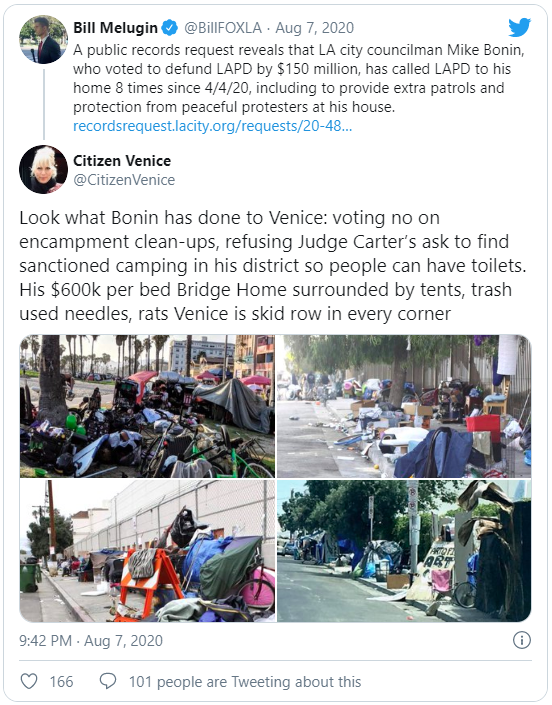
First let’s start with the fact that homelessness as it exists in America isn’t poverty. In fact part of the problem with it is that it ISN’T poverty. Look, regardless of what you’ve seen on the movies or TV, most homeless are not families fallen on hard times. Yes, there are some of those now, but most of those while technically “homeless” aren’t living in your local park. They’ve just taken over mom and dad’s basement, moved onto a friend’s living room or whatever. Terrible – I’ve been JUST short of that at least three times in my married life – and humiliating, but NOT “stand in the park and wheedle on yourself.”

90% of the homeless in America and the hard core ones are people with mental health issues, people with drug abuse issues and people who have found they can live without having to do anything for it, and can be “free” and outside society. I’ve overheard conversations in the park, and I suppose that most of the people who “dropped out” in the sixties are dead, but a lot of them are alive and going from soup kitchen to free clinic, with a bit of begging in between.

Yes, there are entire families in this system, including homeless children – but for them to stay in it, the parents need to have some sort of serious issue. Otherwise, even if they can’t find work, there is assistance available to get them at least into public housing, which, nightmarish though it is, is not living in the park.

I’m not going to pretend this doesn’t happen to normal families too – see where I came very close to that level and more than once too – but normal families usually tend to bounce back. They go through a few months of mess and horror, and then they claw back to some semblance of normalcy. (This might change as our economy dives and programs of necessity get cut. The ones for the DESERVING poor will be cut first, of course, since they rarely riot.)

The problem with this is that when people get appalled at the conditions the homeless live in and start offering “homeless services” there is an entire network, not just of homeless but of social workers who direct the homeless to the cities with better services.

I swear to you and I’m not even joking that right now there are plenty more homeless on Colorado Springs streets than in Denver, despite the Springs being much smaller.

The Springs also has its soup kitchens and other services downtown and within easy walking distance of each other.

This means downtown businesses are closing, except for bars and restaurants which can control access. And that the library is of course a place to camp in the cool/warm during the day.

It means more than that. We moved within easy driving distance of downtown, because when we lived downtown when we first came to Colorado Springs, I used to take walks every day. When we moved to our little mountain village, without these, I gained ten pounds a year. I used to love walking downtown, dropping by the deli and the three bookstores (only one left, and it’s MOSTLY a restaurant now) checking out the other little shops which ranged from yarn to weird import crafts.

Now those are gone. Worse – the last two times I walked downtown alone (i.e. without commanding the muscle, aka older son to go with me) someone FOLLOWED me and I had to employ stuff from my childhood to lose them. Once it was a large and addled looking male, and yes, he was following me. And once it was TWO large and addled looking males. For the icing on the cake – not related to this, but from a blog entry – I clicked on the sex offenders registry. Yes, I know, a lot of people there are there because someone accused them and was never proven. Our local one at least has notes on whether it’s accusation, trial or conviction and also whether the crime was against children or adults.

The downtown zipcode is FULL of registered sex offenders who’ve done hard time and who have committed their crimes against adults. The faces are very familiar from my walks, and yep, one was the guy who tried to follow me.

Sarah Hoyt, “Of Books, Compassion And Cruelty A Blast From The Past From June 2013”, According to Hoyt, 2020-03-10.

June 11, 2020

Current year Iconoclasm

Filed under: History, Politics, USA — Tags: , , , , — Nicholas @ 03:00

In an Areo article from last year, Alexander Adams discusses the phenomenon of iconoclasm:

The 1931 demolition of the Cathedral of Christ the Saviour in Moscow.
Public domain image via Wikimedia Commons.

Behind any campaign is the campaigner: the activist convinced of his own righteousness.

The political activist reserves to himself the right to retrospectively edit our history for his satisfaction by removing monuments, those fixtures of civic life, embedded in the memories of generations. The activist often knows almost nothing about the object of his hatred — merely a garbled caricature of a person caught up in the conditions of her age — but the activist acts as if he were not also caught up in the conditions of his own age.

Iconoclasm is an expression of domination and a demonstration of willingness to act — illegally and unethically — to impose the will of one group over an entire population. It asserts control over all aspects of society. It sets a challenge that will elicit a strong reaction. Iconoclasm is a warning that the protection of law and social conventions no longer applies and that the cause will be promoted through physical force if necessary.

The campaigner argues that public art, accumulated piecemeal over 1,000 years of history, must reflect our society and values today — even if that means altering or erasing stories of the values our past society expressed via its monuments, or suppressing evidence of how we arrived at our current situation. The left-wing activist wants to celebrate current-day multiculturalism, but mostly he wants to erase evidence of the historic monoculturalism that preceded it.

Our willingness to live with historical relics we feel ambivalence towards is a demonstration of our toleration of dissent. Likewise, an openness to imagining ourselves in past times — constrained by the conventions and laws of a different era — forces us to question common assumptions about the completeness of our knowledge and our moral certainty. If we can make this leap of empathy, we can free ourselves of ideological possession. We have the ability to empathize with both slave and slave owner. Empathy makes it harder to justify destruction of the cultural relics of an older age or silence the voices of individuals, who might share insights into life.

The toleration we extend towards symbols of former regimes and proponents of ideas with which we disagree shows our willingness to be honest about our nations’ pasts. To accept our flaws as a necessary part of our development is to display the maturity, restraint and empathy that define the confident yet self-critical nation. For if we cannot stand the sight of a dead political opponent carved in stone, how can we restrain ourselves in the face of a living political opponent who speaks against us?

« Newer PostsOlder Posts »

Powered by WordPress