
I’ve written a lot here about how the most dangerous types in peacetime are the ones who juuuuust missed participating in some vast social upheaval. The Nazis are an obvious example. The Nazi-est Nazis of them all — Himmler, Heydrich, Eichmann, etc. — were old enough to have seen and understood the great national cataclysm that was World War I, but weren’t quite old enough to participate in it directly. Thus, when their turn came, they had to go double-or-nothing to prove to their older kin and classmates that they had what it takes. In America, guys like Teddy Roosevelt don’t make much sense until you realize that they grew up hearing their fathers and older brothers reminisce about the Civil War. And so on.
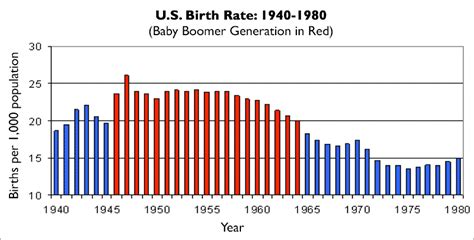
Now, I’m all for bashing the goddamn Boomers, but let’s be fair (since it matters for historical analysis). There’s a common misconception about the Baby Boom. Here, see if you can spot it:
Did you see it? Look closer, and you’ll see that while 1947(-ish) appears to be the peak year in terms of total births, the vast majority of what we call “Boomers” were born after 1950. Let’s do some simple math. The very oldest Boomers were born in 1946. The Summer of Love was 1967. Even if we assume the Summer of Love came out of nowhere — which is impossible, of course, any movement that large had antecedents going back years, probably decades, but let’s assume — that means that any “Boomers” participating were, at most, barely 22 years old. They were just barely 24 when Woodstock came around. Granted that the youngest are the dumbest, and thus can have outsize influence, they still can’t have been largely, let alone solely, responsible for the idiocy of the hippies.
That’s all on the older crowd, the so-called “Silent Generation” — the ones who were old enough to be aware of World War II, but unable to participate directly.
It’s easy to verify. The Port Huron Statement, the founding document of the New Left, was penned by coddled college kids in 1962 — meaning, by kids born, at latest, in about 1942 (its principal author, Tom Hayden, was born in 1939). Here are the Chicago Seven and their dates of birth: Abbie Hoffman (1936), Jerry Rubin (1938), David Dellinger (1915!), Hayden, Rennie Davis (1941),John Froines (1939), and Lee Weiner (1939).
Hoffman, especially, bears scrutiny. Though he’s best remembered as a Yippie — that is, the founder of an ostentatiously youth-oriented movement — he was 31 at its founding. Don’t trust anyone over thirty, right?
1936 to 1946 is only a decade, but it’s crucial. A kid born in 1936 would have vivid memories of World War II and its immediate aftermath — fathers, uncles, and older brothers (and, in more than a few cases, aunts and older sisters) coming home from the service. A kid born in 1946 would have a completely different experience — ask any combat veteran about the first year or two back in the world, versus being home for a decade. Those guys — the kids who saw firsthand the angry young strangers they were supposed to call “Dad” — were the ones who did the real damage in The Sixties(TM), just as it was the almost-but-not-quite frontsoldaten who did the real damage in the Third Reich.
With me? Now hang on to your hats, because here’s where it gets pretty meta: It was the “Silent Generation,” not the Boomers, who did the real damage in The Sixties(TM). That is, the guys who juuuust missed the giant social upheaval that was World War II. The Boomers have done all the damage since The Sixties(TM).
That — The Sixties(TM), which is why I’m using that obnoxious (TM) — is the great social upheaval they juuuust missed. [These people] aren’t old fossils from the flower power years, though many of those fossils are still alive and kicking (including four of the Chicago Seven: Hayden, Davis, Froines, and Weiner). Has anyone heard from Billy Ayers lately? How about Noam Chomsky (born 1928)? I’m sure they have plenty to say … but nobody cares.
It’s not retreads from The Sixties(TM) out there doing this stuff. It’s the people who wish they’d been around for the Summer of Love that are doing it. It’s the people who just know they would’ve ended the Vietnam War, if only they hadn’t been in junior high at the time. This is their Woodstock, not least because they only heard about the original when they arrived for freshman orientation in 1976.
Severian, “Talkin’ ’bout My Generation!”, Rotten Chestnuts, 2020-06-11.
September 23, 2020
QotD: Don’t blame the Boomers for the “Summer of Love” … most of ’em were too young to participate
September 22, 2020
QotD: City dwellers and the state
The Z Man, “Never Newark Nights”, The Z Blog, 2018-06-06.
September 21, 2020
Ruth Bader Ginsburg, RIP
David Warren notes the passing of US Supreme Court Justice Ruth Bader Ginsburg at a particularly fraught moment in US political history:
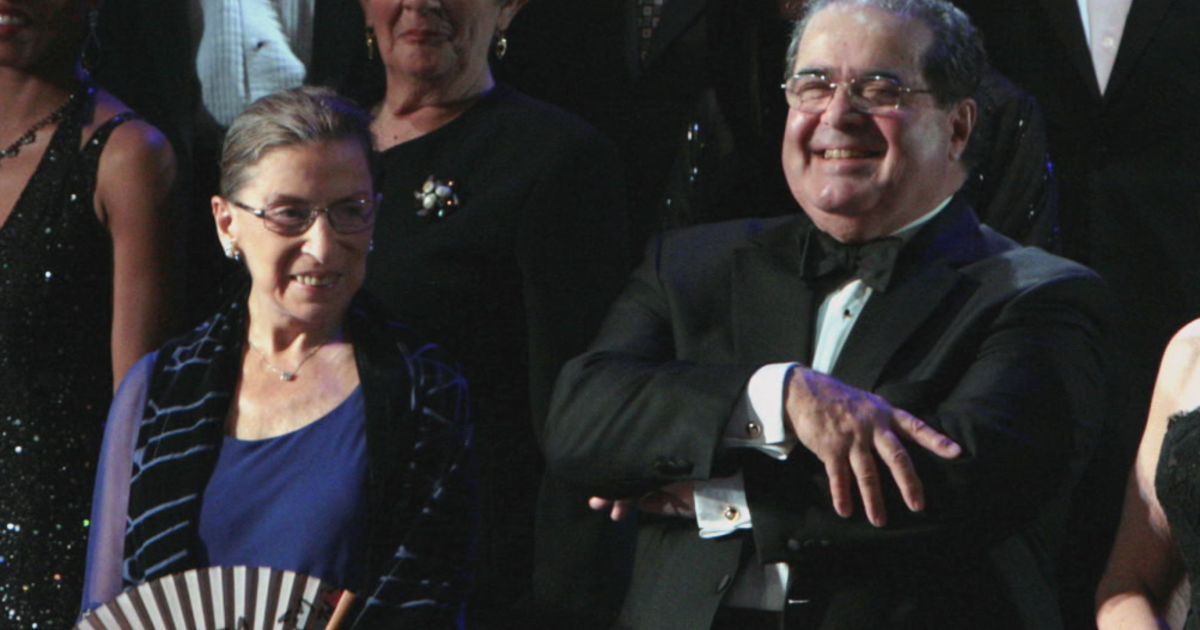
US Supreme Court Justices Ruth Bader Ginsburg and Antonin Scalia.
Screencap from a report by CBS News.
The death of the prominent American jurisprude, Ruth Bader Ginsburg, will be this morning’s example. I noticed that a favoured rightwing blog said, “Breaking news. Try to show some respect for the dead.” This comes more easily to a human being, if he is at least superficially decent. Self-discipline may make it possible for others.
Mrs Ginsburg was toward the left side of the Supreme Court in Washington, in her rulings and often articulate dissents, but I loved her anyway. So did the late Antonin Scalia, who when he died inspired real grief to exponents of the other side. They were notorious buddies, Ginsburg and Scalia. They were more than willing to hear each other out; neither was a hothead. Both were deeply informed about Yankee law, and human law generally, unlike most judges. They could discuss its principles at a high level; and at a low, with a sense of humour. Their mutual respect set an example in their vicinity, claquers who included other Court members. They were both utterly worth having at their stations.
One wonders if those days are gone, for the foreseeable future, when some degree of civilization was possible in legal and political debate. When I look instead at electoral campaigns, in which knowing, malicious lies are repeated by both sides, and both are trying to raise the temperature (I won’t say “equally”), I see something larger than the current political issues. We cannot have public order if this continues; only tyranny can be imposed by one side. Mistakes are being made by “my side,” when we forget that daily life requires negotiation. Or rather it doesn’t, if one prefers civil war.
QotD: Prohibition and the Temperance movement
… [T]he original Temperance movement started out with the very best of intentions, and was trying to deal with a real problem. In colonial and early-19th-century America, people (men, women and OH HORRORS even children!) drank enough that by modern standards we’d call them alcoholics. Modern Russians drink more, but if they were transported back to that time and place, they’d fit right on in. Part of it was because water was often not safe to drink (tea and coffee were often expensive and hard to get, while beer and other alcoholic drinks were made just about everywhere), part of it was snobbery (only really poor people drank water!) and part of it was because people back then believed that alcohol strengthened and warmed the body.
Two of the good side effects of the Temperance/Prohibition movement were the provision of safe, clean drinking water in American cities and towns, and the modern fruit-juice industry (as a lot of churches went hot-Prohibition, they got uneasy about serving wine at Communion, so they went to work and came up with non-alcoholic substitutes.) Welch’s Grape Juice was started by a pastor who wanted non-alcoholic “wine” for Communion, and caught on, real big.
Eric Oppen, posting to the Lois McMaster Bujold mailing list, 2020-06-18.
September 20, 2020
Our World 100 Years Ago – September 1920 I THE GREAT WAR
The Great War
Published 19 Sep 2020Let’s take a look at our world 100 years ago, in September 1920.
» SUPPORT THE CHANNEL
Patreon: https://www.patreon.com/thegreatwar» OUR PODCAST
https://realtimehistory.net/podcast – interviews with World War 1 historians and background info for the show.» BUY OUR SOURCES IN OUR AMAZON STORES
https://realtimehistory.net/amazon *
*Buying via this link supports The Great War (Affiliate-Link)» SOURCES
» MORE THE GREAT WAR
Website: https://realtimehistory.net
Instagram: https://instagram.com/the_great_war
Twitter: https://twitter.com/WW1_Series
Reddit: https://reddit.com/r/TheGreatWarChannel»CREDITS
Presented by: Jesse Alexander
Written by: Jesse Alexander
Director: Toni Steller & Florian Wittig
Director of Photography: Toni Steller
Sound: Toni Steller
Editing: Toni Steller
Motion Design: Philipp Appelt
Mixing, Mastering & Sound Design: http://above-zero.com
Maps: Daniel Kogosov (https://www.patreon.com/Zalezsky)
Research by: Jesse Alexander
Fact checking: Florian WittigChannel Design: Alexander Clark
Original Logo: David van StepholdContains licensed material by getty images
All rights reserved – Real Time History GmbH 2020

Andrew Sullivan on the politically deranging effects of social media addiction
In his latest Weekly Dish installment, Andrew Sullivan decries the extreme polarization of the US electorate and points an accusing finger at social media for making things much worse:
An Electoral College victory for Trump, if he loses the popular vote again, would, in this new elite consensus, prove beyond doubt the centuries’ long grip of “white supremacy”. Some are already calling such a victory illegitimate, even though it would be completely constitutional, under the rules everyone has agreed to. The sickening street violence that the far left has downplayed, and permitted to run riot in major cities could be a mere taste of what is to come — along with ever-stronger white nationalist gangs instigating or responding in kind. (Trump’s toleration of this dangerous right-extremism in the past four years is as unforgivable as the left’s excuses for murderous violence.) But the upshot is the same: we will be lucky if the country doesn’t erupt in large-scale civil violence by the end of all this.
And the reason this dystopian scenario is so credible is not just the fault of these political actors. It’s ours too — thanks to the impact of social media. I think we’ve under-estimated just how deep the psychological damage has been in the Trump era — rewiring the minds of everyone, including your faithful correspondent, in ways that make democratic discourse harder and harder and harder to model. The new Netflix documentary, The Social Dilemma, is, for that reason, a true must-watch. It doesn’t say anything shockingly new, but it persuasively weaves together a whole bunch of points to reveal just how deeply and thoroughly fucked we are. Seriously, take a look.
The doc effectively shows how the information system necessary for democratic deliberation has, in effect, been jerry-rigged in the last decade to prevent any reasoning at all. It’s all about the feels, and the irrationality, and the moment, which is why Trump is so perfectly attuned to his time. And what’s smart about the documentary is that it shows no evil genius behind this unspooling, no sinister plot deliberately to destroy our system of government. One of the more basic motives in American life — making money — is all you now need, the documentary shows, to detonate American democracy at its foundation.
For Facebook and Google and Instagram and Twitter, the business goal quickly became maximizing and monetizing human attention via addictive dopamine hits. Attention, they meticulously found, is correlated with emotional intensity, outrage, shock and provocation. Give artificial intelligence this simple knowledge about what distracts and compels humans, let the algorithms do their work, and the profits snowball. The cumulative effect — and it’s always in the same incendiary direction — is mass detachment from reality, and immersion in tribal fever.
With each passing second online, news stories, graphic videos, incendiary quotes, and outrages demonstrate their stunning utility to advertisers as attention seizers, are endlessly tweaked and finessed by AI to be even more effective, and thereby prime our brains for more of the same. They literally restructure our minds. They pickle us in propaganda. They use sophisticated psychological models to trap, beguile, outrage, and prompt us to seek more of the same.
[…]
And online is increasingly where people live. My average screen time this past week was close to ten hours a day. Yes, a lot of that is work-related. But the idea that I have any real conscious life outside this virtual portal is delusional. And if you live in such a madhouse all the time, you will become mad. You don’t go down a rabbit-hole; your mind increasingly is the rabbit hole — rewired that way by algorithmic practice. And you cannot get out, unless you fight the algorithms to a draw, or manage to exert superhuman discipline and end social media use altogether.
But the thing about algorithms and artificial intelligence is that they don’t rest, they have no human flaws, they exploit every weakness we have, and have already taken over. This is not a future dystopia in which some kind of AI robot takes power and kills us all. It is a dystopia already here — burrowed into our minds, literally disabling the basic mental tools required for democracy to work at all.
If you watch video after video of excessive police force against suspects, for example, and your viewing habits are then reinforced by algorithms so you see no countervailing examples, your view about the prevalence of such excessive force will change, regardless of objective reality. A new study shows how this happens. Watching the videos, even more than reading text about them, raises the percentage of white liberals who believe the cops frequently or always use excessive force by around 20 percentage points. The actual data are irrelevant. The BLM movement this summer was less a racial reckoning, as we’re constantly lectured, than a moment of web-induced mass hysteria.
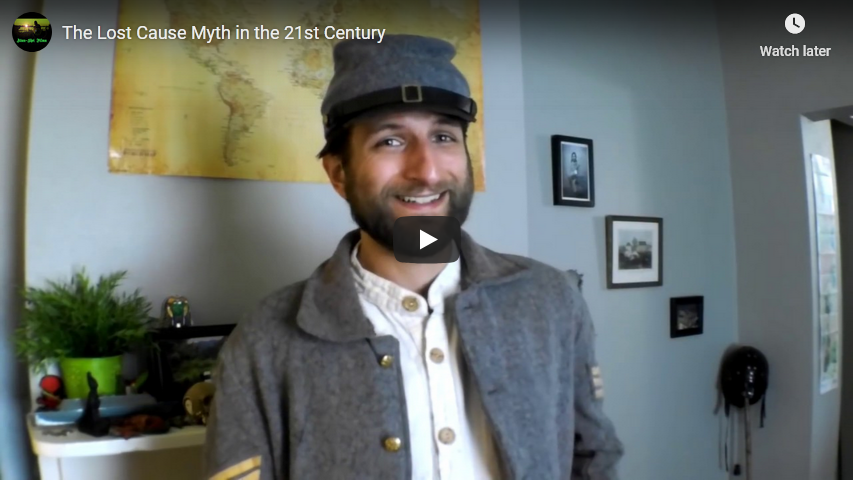
The Lost Cause Myth in the 21st Century
Atun-Shei Films
Published 23 Feb 2019A former Gettysburg tour guide talks about how the American Civil War is remembered today.
Support Atun-Shei Films on Patreon ► https://www.patreon.com/atunsheifilms
#CivilWar #Confederacy #AmericanHistory
Watch our film ALIEN, BABY! free with Prime ► http://a.co/d/3QjqOWv
Reddit ► https://www.reddit.com/r/atunsheifilms
Twitter ► https://twitter.com/alienbabymovie
Instagram ► https://www.instagram.com/atunsheifilms
Merch ► https://atun-sheifilms.bandcamp.com
September 19, 2020
QotD: Dictatorship of the Cancel Culture proletariat
While not the most important, the first of these points is the most relevant on a day-to-day basis. Without endorsing these behaviours, the plain fact is that the huge majority of people have probably at some point told an ethnic or regional joke, sent a pornographic or un-PC snap, had sex while intoxicated, used a slur tied to sexual orientation / race / gender online or in the lockerroom, worn a St Paddy’s Day or Cinco de Mayo outfit they would really prefer a mulligan on, or committed other Cardinal Sins against Wokeness. As a result of this, many young people are intently aware that Twitter and Facebook wars involving the unearthing of old content generally end with egg on the face of everyone involved. Caucasian NBA point guard Donte DeVincenzo was humiliated in late 2018 by the revelation that – at age 14 – he had described his hoops handle as “ballin’ on these nig*as like I’m Derrick Rose”. He ended up deleting his entire social-media presence. The point of monitoring this sort of thing, for the many people and organisations that do so, is not punishing the tiny minority of real racists and abusers out there so much as keeping normal citizens too terrified by the potential unearthing of past indiscretions to comment lustily on the issues of the day.
The fact that virtually anyone could in fact “legitimately” be cancelled leads into extreme partisan hypocrisy. While anyone who attended church as a lad might correctly suspect that the hard right is capable of similar behaviour, cancellers today are overwhelmingly concentrated on the “social justice” left – and they are, at least occasionally, reluctant to eat their own. This often results in remarkable and hilarious double standards. In February 2018, for example, liberal Virginia governor Ralph Northam – nicknamed “Coonman” – escaped any serious censure after he was revealed to have apparently appeared in a mid-1980s high-school yearbook photo wearing shoe-polish blackface.
To be fully fair to Northam, the same photo included a student dressed in full white robes as a Ku Klux Klansman, and CNN has noted that Northam has never actually said “whether he was wearing the Ku Klux Klan outfit or [the] blackface”. Oh, fair enough. At any rate, he serves as governor of Virginia today. Not to be outdone by any of his neighbors to the south, Canadian prime minister Justin Trudeau was revealed that same year to have worn black- and brown-face several times, and as late as 2001, once apparently painting his entire body to appear in costume as Aladdin at an Arabian Nights revue! He, too, remains solidly entrenched in office today.
Wilfred Reilly, “They can’t cancel all of us”, Spiked, 2020-06-17.
September 18, 2020
“The Last Battle” – The Strangest Fight of WWII – Sabaton History 085 [Official]
Sabaton History
Published 17 Sep 2020On the 5th of May 1945, the Second World War in Europe is literally in its final days. As the German lines and Nazi state collapse into free fall, some Nazi hardliners remain fighting until the very moment surrender is announced. At Castle Itter, the lines are blurred as US and German soldiers fight side by side in a medieval castle, home to some of the highest profile prisoners of the war.
Support Sabaton History on Patreon: https://www.patreon.com/sabatonhistory
Listen to “The Last Battle” on the album The Last Stand:
https://music.sabaton.net/TheLastStandWatch the Official Lyric Video of “The Last Battle” here:
https://www.youtube.com/watch?v=BwfJs…Listen to Sabaton on Spotify: http://smarturl.it/SabatonSpotify
Official Sabaton Merchandise Shop: http://bit.ly/SabatonOfficialShopHosted by: Indy Neidell
Written by: Markus Linke and Indy Neidell
Directed by: Astrid Deinhard and Wieke Kapteijns
Produced by: Pär Sundström, Astrid Deinhard and Spartacus Olsson
Creative Producer: Maria Kyhle
Executive Producers: Pär Sundström, Joakim Brodén, Tomas Sunmo, Indy Neidell, Astrid Deinhard, and Spartacus Olsson
Community Manager: Maria Kyhle
Post-Production Director: Wieke Kapteijns
Editor: Iryna Dulka
Sound Editor: Marek Kaminski
Maps by: Eastory – https://www.youtube.com/c/eastory
Archive: Reuters/Screenocean – https://www.screenocean.com
Sources:
– Photos of the Itter Castle: Sammlung Risch-Lau, Vorarlberger Landesbibliothek
All music by: SabatonAn OnLion Entertainment GmbH and Raging Beaver Publishing AB co-Production.
© Raging Beaver Publishing AB, 2019 – all rights reserved.
QotD: Heinlein’s “Crazy Years”
Things like the girl who had to remove a decoration from her purse before boarding a plane because the decoration was in the shape of a revolver, though about finger sized and evidently cut in half lengthwise. The TSA thought the ban on guns applied to this too. (Of course, she’d flown with it before, so it was just this TSA station, but nonetheless its rulings were absolute.)
Things like the little deaf boy who can’t sign his name because one of the letters looks like a gun.
Things like kids getting in trouble because of a fictional story they wrote. Things like my younger son – it’s a theme, yes. The boy is lightning rod on his mother’s side. More on that later – getting sent to the school psychiatrist because he used the following sentence in an essay “Some people think I’m crazy.”
[…]
There’s half (half?) of our literature and movies, which glorify behaviors that in real life get you killed or make you a bum. There’s the fact that being thrifty, hard working and honoring your contracts makes you “uncool.” There the fact our women are taught to hate all men and men are finally learning to avoid women. There’s …
You say it in groups of Heinlein fans, and people go “Well, these ARE the crazy years.” And you move on.
Sarah Hoyt, “These Are The Crazy Years”, According to Hoyt, 2013-07-17.
September 16, 2020
The Canadian echo chamber on American political issues
Ben Woodfinden’s latest for The Dominion looks at the weird effects political passions in the United States have on political stances in Canada:

Restricted and prohibited weapons seized by Toronto police in a 2012 operation. None of the people from whom these weapons were taken was legally allowed to possess them.
Screen capture from a CTV News report.
Participatory media increasingly defines and shapes our discourse. It submerges us in a broader reality but only does so by filtering it into a digital reality that offers a distorted reflection rather than picture of the real world. This has been going on for at least a decade now, but the pandemic has accelerated this transformation of our discourse and politics. By locking us in our homes the pandemic forces us to view the world through a digital lens even more than we already did, and in a world where we’re all viewing everything through our screens that digital reality becomes closer and closer to our primary reality.
One of the specific, and most pernicious effects of this, as I lamented in The Critic is that it turns us all into online Americans participating in their politics through the digital medium, rendering us virtual participants and not just foreign observers. I won’t repeat myself too much, I’d recommend just reading the piece [link], but the online realm is American, and what digital politics does is make politics everywhere more American. We participate in it as a game and a form of entertainment. This bleeds back into our own politics.
Americanized Discourse
Gun politics is one particular political issue where Americanized discourse is most pronounced. It captures perfectly how Americanization plays out. Every time there is some sort of tragic shooting or discussion of gun violence in Canada the debates play out in depressingly predictable ways. Progressives and Liberals paint a picture in which Canada suffers from the kind of rampant gun violence and mass proliferation of firearms as in America. This is the framing used to justify often highly symbolic or ineffective new gun laws and restrictions that, while often not all that effective, make the Liberals and progressives seem like the party for gun control in the face of this rampant violence. But only if you pretend we live in America.
And it’s not just the Liberals and progressives who play this game. Listen to some of the more vocal advocates of “gun rights” in Canada and you’d think we have a second amendment in the Charter. One side wants to make it seem like Canadians are walking around with and easily able to acquire assault weapons, the other side wishes it were so! The reality of course lies somewhere in between. Gun possession is heavily regulated, but lawful citizens can still buy firearms if they want to, and there is no explicit right in the Charter that prevents the government from regulating and restricting firearms. Talking about gun “rights” in Canada is itself quite a foreign and imported concept. At the same time we don’t have an epidemic of gun violence, and while we have experienced some horrific mass shootings, like the recent Nova Scotia tragedy, gun violence in Canada pales in comparison to the United States.
But because both sides are essentially happy to help paint a phantasmic picture of gun violence and/or gun regulations in Canada, we end up with a surreal politics around guns. Sensible debates around guns are made harder by this because debates take place on top of a framing and narrative that draws explicitly on American political culture more than it does Canada’s. Both sides want to take on American roles and are happy to contribute to this framing.
Gun politics is just one example, and there are so many others. Our discourse is so often built around framings that make it seem as if the issues and political cleavages here are indistinguishable from American ones, but it only happens because we import American framing and narratives into our own discourse and then build are arguments around these phantasms. We, like many other countries around the world, are in the middle of a moment of racial reckoning, or whatever you want to call it, because of something that happened in Minneapolis, not in Canada.
Racism is a real thing in Canada, no honest person should deny this, because there is racism in absolutely every country and society. But in the wake of George Floyd’s killing we ended up having a conversation about racism that reflected the particular ways racism works in America.
QotD: Firearms apocrypha
People like to repeat the myth that the tiny M-frame .22 “Ladysmith” was discontinued because a puritanical D.B. Wesson heard that it was popular with “ladies of the night”, because that’s sexier than the fact that it was selling poorly, expensive to make, and constantly broke when people ran the then-new .22 Long Rifle cartridges through the fragile little guns.
Similarly, there’s a legend involving Mr. Wesson that’s attached to the final iteration of the .38 Double Action […] In this case, the story goes, D.B. heard the tale of a police officer who, while arresting a miscreant, had the offender reach over and pop the latch on his top-break Smith, dumping the rounds on the ground, like Jet Li with the slide of a movie prop Beretta. The officer, goes the legend as it was told to yours truly, was killed in the ensuing struggle.
Moved by the fate of the dead officer, the apocryphal tale has Mr. Wesson designing the Perfected Model top-break. This model features a Hand-Ejector style cylinder latch that must be operated in conjunction with the more normal “T”-shaped barrel toggle in order to break the revolver open.
This origin myth is almost certainly, to use the technical term, a load of hooey.
Tamara Keel, “Sunday Smith #60: .38 Double Action Perfected Model”, The Arms Room, 2020-06-14.
September 15, 2020
Critical Race Theory
Dan Sanchez, Tyler Brandt, and Brad Polumbo discuss President Trump’s recent Executive Memo banning the use of federal government funds for Critical Race Theory training:
Critical Race Theory is a branch of Critical Theory, which began as an academic movement in the 1930s. Critical Theory emphasizes the “critique of society and culture in order to reveal and challenge power structures,” as Wikipedia states. Critical Race Theory does the same, with a focus on racial power structures, especially white supremacy and the oppression of people of color.
The “power structure” prism stems largely from Critical Theory’s own roots in Marxism — Critical Theory was developed by members of the Marxist “Frankfurt School.” Traditional Marxism emphasized economic power structures, especially the supremacy of capital over labor under capitalism. Marxism interpreted most of human history as a zero-sum class war for economic power.
“According to the Marxian view,” wrote the economist Ludwig von Mises, “human society is organized into classes whose interests stand in irreconcilable opposition.”
Mises called this view a “conflict doctrine,” which opposed the “harmony doctrine” of classical liberalism. According to the classical liberals, in a free market economy, capitalists and workers were natural allies, not enemies. Indeed, in a free society all rights-respecting individuals were natural allies.
Classical Race Theory arose as a distinct movement in law schools in the late 1980s. CRT inherited many of its premises and perspectives from its Marxist ancestry.
The pre-CRT Civil Rights Movement had emphasized equal rights and treating people as individuals, as opposed to as members of a racial collective. “I look to a day when people will not be judged by the color of their skin, but by the content of their character,” Martin Luther King famously said.
In contrast, CRT dwells on inequalities of outcome, which it generally attributes to racial power structures. And, as we’ve seen from the government training curricula, modern CRT forthrightly judges white people by the color of their skin, prejudging them as racist by virtue of their race. This race-based “pre-trial guilty verdict” of racism is itself, by definition, racist.
The classical liberal “harmony doctrine” was deeply influential in the movements to abolish all forms of inequality under the law: from feudal serfdom, to race-based slavery, to Jim Crow.
But, with the rise of Critical Race Theory, the cause of racial justice became more influenced by the fixations on conflict, discord, and domination that CRT inherited from Marxism.
Social life was predominantly cast as a zero-sum struggle between collectives: capital vs. labor for Marxism, whites vs. people of color for CRT.
When you mix up cause and effect
In the Continental Telegraph, Esteban remembers a Reagan bon mot that is still observably true today:
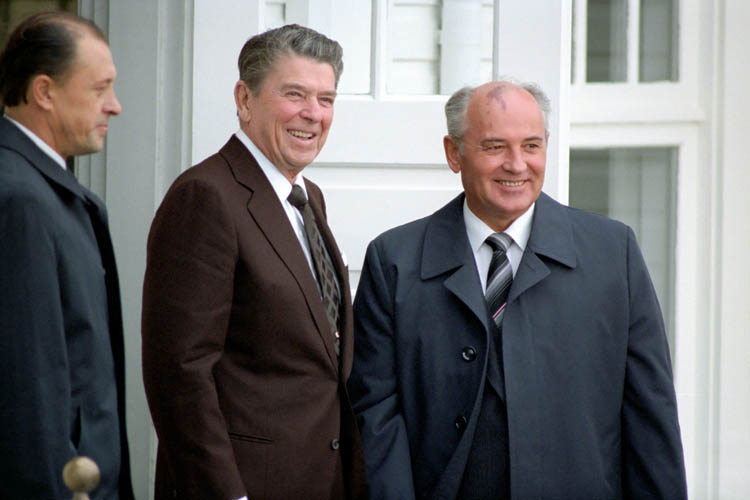
US President Ronald Reagan and Soviet General Secretary Mikhail Gorbachev at the Hofdi House in Reykjavik, Iceland during the Reyjavik Summit in 1986.
Official US government photograph via Wikimedia Commons.
Ronald Reagan once observed that “the trouble with our liberal friends isn’t that they are ignorant, it’s that so much they know isn’t so”. I am repeatedly surprised by Leftists’ ability not to just get something wrong, but to get it spectacularly, 180 degrees wrong.
First, a couple of examples from the archives – some years ago there was an article in the NY Times (or WaPo perhaps) quite distressed that even though crime rates in the U.S. were at historically low levels the percentage of the population in prison was quite high. “Why are we putting so many people in prison when the crime rate is low?” they wondered, seriously. Hmm, how about this – when we put more bad people in prison the crime rate goes down? Keep in mind that the crime rate is what’s happening now, the prison population is who we caught and locked up over the past several years.
Then we had an article in a West Coast newspaper wondering why the homeless population in San Francisco had grown dramatically in recent years despite all the wonderful things the city had done to help them – weekly stipends, free shopping carts, etc. Note that none of this assistance to the homeless enabled them to become independent or required them to better themselves, they were all handouts. How is it that offering lots of goodies to homeless people attracts more of them here?
My point in bringing up these old stories is that it seems impossible that someone could fail to see they had cause and effect reversed. How could someone intelligent enough to write a column get these stories so backwards. The only answer I can see is that their worldview, at least in these areas, flows in only one direction and the underlying premise can never be questioned – putting people in prison is bad, there can be no possible upside, giving homeless people stuff is good, there can be no downside. So, when things get worse it’s a mystery, we can’t reconsider our starting point.


