
But what this whole developing scandal really reminded us of was, ironically, another scientific paper that was published in the midst of the pandemic. This one in the Journal of Experimental Social Psychology was released in September 2021 and titled: “Misplaced trust: When trust in science fosters belief in pseudoscience and the benefits of critical evaluation”.
The paper consisted of the results of four pre-registered experiments of decent sample size, albeit administered online. They introduced false claims about a fictional virus created as a bioweapon, and about the carcinogenic nature of GMO foods.
The results were so, so very telling.
“Participants who trust science are more likely to believe and disseminate false claims that contain scientific references than false claims that do not,” and “We conclude that trust in science, although desirable in many ways, makes people vulnerable to pseudoscience.”
Let that sink in. The people who #BelieveScience are more vulnerable to falling for pseudoscientific claims, especially when those claims are presented with the comforting ephemera of science — the lab coats, the credentials, the technical studies filled with jargon. That’s because “Believing Science” isn’t the same thing as actually doing science. “Believing Science” is a statement of tribal affiliation. All this claim demonstrates is that a person wants to be seen as the sort of individual who believes experts and takes advice from trusted and credentialed officials. For the most part, this is a good instinct! But if those experts and trusted officials are wrong, malicious, or simply full of shit, the “Believe Science” crowd will reliably fall in line. Because of its ideological affiliation, this crowd is, ironically, far less capable of spotting bad science.
Actually doing science as opposed to merely believing in it requires that we all evaluate claims critically regardless of their origins; we look for inconsistencies, we examine the quality of the evidence presented, and we question the credibility of the people making the claims.
“Dispatch from the Front Line: Comms aren’t the government’s problem”, The Line, 2023-07-23.
October 27, 2023
October 26, 2023
QotD: Making steel
So we are going to limit ourselves here to just carbon and iron. Now in video-game logic, that means you take one “unit” of carbon and one “unit” of iron and bash them together in a fire to make steel. As we’ll see, the process is at least moderately more complicated than that. But more to the point: those proportions are totally wrong. Steel is a combination of iron and carbon, but not equal parts or anything close to it. Instead, the general division goes this way (there are several classification systems but they all have the same general grades):
Below 0.05% carbon or so, we just refer to that as iron. There is going to be some small amount of carbon in most iron objects, picked up in the smelting or forging process.
From 0.05% carbon to 0.25% carbon is mild or low carbon steel.
From about 0.3% to about 0.6%, we might call medium carbon steel, although I see this classification only infrequently.
From 0.6% to around 1.25% carbon is high-carbon steel, also known as spring steel. For most armor, weapons and tools, this is the “good stuff” (but see below on pattern welding).
From 1.25% to 2% are “ultra-high-carbon steels” which, as far as I can tell didn’t see much use in the ancient or medieval world.
Above 2%, you have cast iron or pig iron; excessive carbon makes the steel much too hard and brittle, making it unsuitable for most purposes.Bret Devereaux, “Collections: Iron, How Did They Make It, Part IVa: Steel Yourself”, A Collection of Unmitigated Pedantry, 2020-10-09.
October 25, 2023
QotD: Constant change
Instead of empty analogies, the only way to survive change is to have a vigorous debate about the merits of our new ideas — precisely the kind of debate that techno-optimists want to foreclose by appealing to history. We might ask instead: what does this new thing do to us? Do we understand enough to answer that question? If not, on what basis does our confidence rest? Debate on the merits is essential to distinguishing good ideas from bad ones. And for that, you need the people that techno-optimists most loathe: conservatives.
Nicholas Phillips, “The Fallacy of Techno-Optimism”, Quillette, 2019-06-06.
October 18, 2023
The greatest sin of Twit-, er, I mean “X” is that it allowed us hoi polloi to peek behind the curtains of governments, universities, and major corporations
The latest book review at Mr. and Mrs. Psmith’s Bookshelf begins with a brilliant explanation for the coming fall of western civilization at the hands of Twit-, er, I mean “X”:

The greatest gift bestowed by admittance to elite institutions is that you stop being overawed by them. For instance, there was a time when upon hearing “so-and-so is a Rhodes Scholar”, I would have assumed that so-and-so was a very impressive person indeed. Nowadays I know quite a lot of former Rhodes Scholars, and have seen firsthand that some of them are extremely mediocre individuals, so meeting a new one doesn’t phase me much. My own cursus honorum through America’s centers of prestige has been slow and circuitous, which means I’ve gotten to enjoy progressive disenchantment with the centers of power. Trust me, you folks aren’t missing much.
I have a theory that this is why Twitter has been so destabilizing to so many societies, and why it may yet be the end of ours. Twitter offers a peek behind the curtain — not just to a lucky few,1 but to everybody. We’re used to elected officials acting like buffoons, but on Twitter you can see our real rulers humiliating themselves. Tech moguls, four-star generals, cultural tastemakers, foundation trustees, former heads of spy agencies, all of them behaving like insane idiots, posting their most vapid thoughts, and getting in petty fights with “VapeGroyper420.” There’s a reason most monarchies have made lèse-majesté a crime, there’s a level at which no regime can survive unless everybody pretends that the rulers are demigods. To have the kings be revealed as mere men who bleed, panic, and have tawdry love affairs is to rock the monarchic regime at its foundations. But Twitter is worse than that, it’s like a hidden camera in the king’s bedroom, but they do it to themselves. Moreover it seems likely that regimes like ours which legitimate themselves with a meritocratic justification are especially fragile to this form of disenchantment.
This is also why the COVID pandemic was so damaging to our government’s legitimacy. I’ve been inside elite institutions of many different sorts, and discovered the horrible truth that most of the people in them are just ordinary people making it up as they go along, but one place I hadn’t quite made it yet was the top of our disease control agencies.2 So in a bit of naïveté analogous to Gell-Mann amnesia, I just assumed that there was some secret wing of the Centers for Disease Control which housed men-in-black who would rappel out of helicopters and summarily execute everybody in Wuhan who had ever touched a bat. And I was genuinely a little bit surprised and disappointed when instead they were caught with their pants down, and a bunch of weirdos on the internet turned out to be the real experts (the silver lining to this is that now we all get to be amateur scientists).
So much for public health. But if there’s one institution which still manages to shroud itself in mystery while secretly pulling all the strings, surely it’s the Federal Reserve. You can tell people take it seriously because of all the conspiracy theories that surround it (conspiracy theories are the highest form of flattery). And there’s a lot to get conspiratorial about — the Fed manages to combine two things that rarely go together but which both impress people: technocratic mastery and arcane ritual. The Fed employs a research staff of thousands which meticulously gather and analyze data about every aspect of the economy, and they have an Open Market Committee whose meeting minutes are laden with nuanced double-meanings that would make a Ming dynasty courtier blush, and which are accordingly parsed with an attention to detail once reserved for Politburo speeches.
And they also control all of our money! Is it any wonder that people go a little bit crazy whenever they think about the Fed? I can’t think of a more natural target for the recurring cycles of ineffectual populist ire that characterize American politics. So it is with great regret that I’m here to report that they, too, are making it all up as they go along.
1. And that lucky few have much to gain by maintaining the charade. A stable ruling class is one that has much to offer potential class traitors, so they don’t get any ideas. It’s when the goodies dry up, whether due to elite overproduction or to a real reduction in the spoils available, that things fall apart.
2. That’s not quite true: I did once attend an invite-only conference at the United States Army Medical Research Institute of Infectious Diseases. The food was awful, and I wasn’t even able to find the lab where they created crack cocaine, HIV, and Lyme disease.
October 17, 2023
Those problematic “AI girlfriends” – men suck and women suffer because of it
Janice Fiamengo discusses a recent CNN program that woman-splained why young men paying for “AI girlfriends” are yet another way that misogynistic men are harming women:
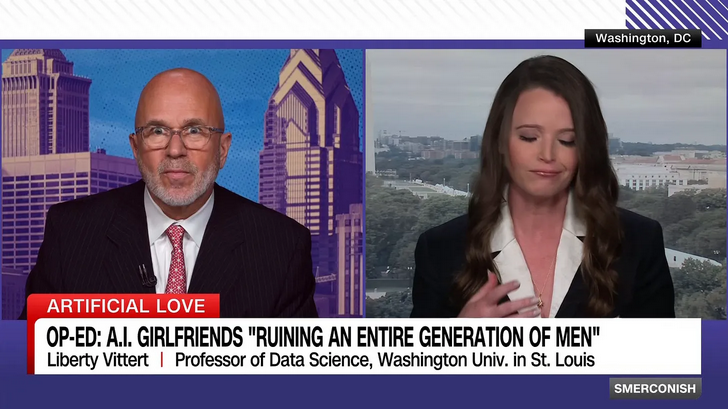
Last week, CNN aired a must-watch episode with the somber headline, “AI girlfriends are here and they’re posing a threat to a generation of men”. If that sounds as if the show might possibly express some compassion for young men and for the “epidemic of loneliness” referred to in the show, it was not to be. Even an expert, Scott Galloway, profiled briefly on how society is “failing men”, felt the need to express contempt for their alleged conspiracy theories, online misogyny, and even (gasp!) climate change denial. With friends like these …
The segment is fascinating, however, for its revelation of some pundits’ uneasy awareness of male discontent.
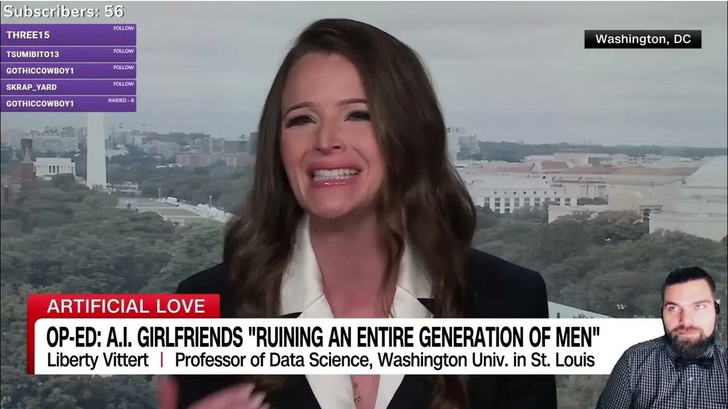
[…] The expert is Liberty Vittert, a statistician and professor of data science at Washington University’s Olin Business School. But she might as well be an AI feminist, so predictable was her analysis of the male entitlement allegedly driving the turn to AI girlfriends. Though a statistician, Vittert gave no data about the numbers of men who are paying to access AI content. While the CNN host, Michael Smerconish, seemed open to the possibility of exploring men’s points of view, the expert could only emphasize male failure.
She condemned young men for “choosing AI girlfriends over real women”. The choice means, according to Vittert, that “they don’t have relationships with real women, don’t marry them and then don’t have and raise babies with them”.
But wait, aren’t marrying and raising babies a patriarchal imposition on women — part of the “comfortable concentration camp” that Betty Friedan so memorably indicted?
Professor Vittert says nothing about the decreasing number of young women willing to marry and procreate. Her (botoxed) mouth turns down in disapproval as she explains that the increasing realism of AI is “enabling this entire generation of young men to continue in this loneliness epidemic”. It seems that men prefer sterile self-pleasuring and facile scopophilia to the “hard work” of relationships with real women. Like Joaquin Phoenix’s hapless character, these men, she says, are so fixated on perfection that they “are not able to deal with ups and downs, not only in a relationship, but in life in general”. The glibness of the condemnation is remarkable, though far from unusual.
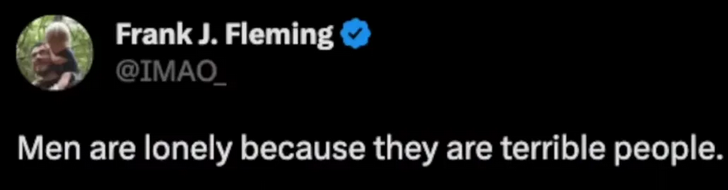
It’s not clear if Professor Vittert has ever talked to actual men about why some of them (not “an entire generation”) might choose an AI relationship. Does she know any young men who have tried for years without success to find a marriageable girlfriend? Many discover that such prizes are remarkably thin on the ground, many of them unsuitable to be considered as future mothers. Even worse, perhaps, does Vittert know anything about what can happen to an inexperienced young man who pursues the wrong woman or women (there are a couple of heartbreaking examples in Sons of Feminism)? How many times does a young man who has failed repeatedly need to hear that no woman owes him love or sex before he starts thinking that giving up on them might not be a bad idea? Meanwhile, women laugh at his loneliness and drink “I bathe in male tears” mugs.
To give him credit, CNN’s Smerconish asks a few questions about the male point of view: “What’s going on with the women?” Has the power dynamic shifted in their favor? Are they less approachable than formerly? These only scratch the surface, but he’s chosen the wrong expert for such a conversation.
Vittert freely admits that there are now many more women than men at university (thanks, affirmative action!) and that far more women than formerly are choosing career over homemaking (thanks, feminist propaganda!). But those are good things, and young men simply need to adapt. Calling any of this debacle women’s fault, she declares, would not be “the right way to go”.
An appropriate task for AI – reading the Herculaneum scrolls
Colby Cosh discusses the possibility of finally being able to read the carbonized scolls found in the buried remains of a wealthy Roman’s country villa in 1750:

Unrolled papyrus scroll recovered from the Villa of the Papyri.
Picture published in a pamphlet called “Herculaneum and the Villa of the Papyri” by Amedeo Maiuri in 1974. (Wikimedia Commons)
From the standpoint of fragile human life, a volcanic eruption is the worst possible thing that can happen anywhere in your general vicinity, up to and probably including the detonation of a nuclear weapon.
It goes without saying that pyroclastic flows are also bad for animals or buildings or vegetation … or documents. And yet: as a consequence of the eruption of Vesuvius, there exists a near-complete library of papyrus scrolls retrieved from the buried ruins of a splendid Roman villa.
The “Villa of the Papyri” in Herculaneum was found in 1750 by farmers and was quickly subjected to archeological excavation, an art then in its infancy.
These scrolls, which today number about 1,800 in all, are often described as the only known library to have physically survived from antiquity. The problem, of course, is that they have all been burned literally to a crisp, with only a few easily readable fragments here and there.
The incinerated scrolls are so sensitive that they tend to explode into a cloud of ash at the slightest touch. Occasional attempts to unravel the scrolls — which were rolled very tightly for storage in the first place — have been made over the past 300 years; the chemist Sir Humphry Davy (1778-1829), for example, gave it a shot using newfangled stuff called chlorine. But none of these projects ever came especially close to success, and they typically involved destruction of some of the “books” in the library.
In recent years 3D imaging techniques for “reading” documents like this in a non-invasive way have been making great headway. The leader in the field is a University of Kentucky computer scientist named Brent Seales, who in 2015 led efforts to read a fragile, desiccated Hebrew Bible parchment scroll dating to the third or fourth century AD.
The text was from the book of Leviticus, and proved to be a letter-for-letter match with the Torah of today — which is a disappointment to scholars from one point of view, and a finding of awesome significance from another. (It goes without saying that this scroll came from the territory of Israel, near a kibbutz: this is a fact that would, in any other political context, be regarded as a supreme affirmation of indigeneity.)
Seales has been able to “unroll” some Herculaneum scrolls and detect the presence of inks using CT scanning, but reading the pages is a profound challenge. Roman ink was carbon-based, meaning researchers are trying to “read” traces of carbon on carbonized pages rolled up into three dimensions.
October 10, 2023
QotD: The production of charcoal in pre-industrial societies
Charcoaling solves this problem. By heating the wood in conditions where there isn’t enough air for it to actually ignite and burn, the water is all boiled off and the remaining solid material reduced to lumps of pure carbon, which will burn much hotter (in excess of 1,150°C, which is the target for a bloomery). Moreover, as more or less pure carbon lumps, the charcoal doesn’t have bunches of impurities which might foul our iron (like the sulfur common in mineral coal).
That said, this is a tricky process. The wood needs to be heated around 300-350°C, well above its ignition temperature, but mostly kept from actually burning by lack of oxygen (if you let oxygen in, the wood is going to burn away all of its carbon to CO2, which will, among other things, cause you to miss your emissions target and also remove all of the carbon you need to actually have charcoal), which in practice means the pile needs some oxygen to maintain enough combustion to keep the heat correct, but not so much that it bursts into flame, nor so little that it is totally extinguished. The method for doing this changed little from the ancient world to the medieval period; the systems described by Pliny (NH 16.8.23) and Theophrastus (HP 5.9.4) is the same method we see used in the early modern period.
First, the wood is cut and sawn into logs of fairly moderate size. Branches are removed; the logs need to be straight and smooth because they need to be packed very densely. They are then assembled into a conical pile, with a hollow center shaft; the pile is sometimes dug down into the ground, sometimes assembled at ground-level (as a fun quirk of the ancient evidence, the Latin-language sources generally think of above-ground charcoaling, whereas the Greek-language sources tend to assume a shallow pit is used). The wood pile is then covered in a clay structure referred to a charcoal kiln; this is not a permanent structure, but is instead reconstructed for each charcoal burning. Finally, the hollow center is filled with brushwood or wood-chips to provide the fuel for the actual combustion; this fuel is lit and the shaft almost entirely sealed by an air-tight layer of earth.
The fuel ignites and begins consuming the oxygen from the interior of the kiln, both heating the wood but also stealing the oxygen the wood needs to combust itself. The charcoal burner (often called collier, before that term meant “coal miner” it meant “charcoal burner”) manages the charcoal pile through the process by watching the smoke it emits and using its color to gauge the level of combustion (dark, sooty smoke would indicate that the process wasn’t yet done, while white smoke meant that the combustion was now happening “clean” indicating that the carbonization was finished). The burner can then influence the process by either puncturing or sealing holes in the kiln to increase or decrease airflow, working to achieve a balance where there is just enough oxygen to keep the fuel burning, but not enough that the wood catches fire in earnest. A decent sized kiln typically took about six to eight days to complete the carbonization process. Once it cooled, the kiln could be broken open and the pile of effectively pure carbon extracted.
Raw charcoal generally has to be made fairly close to the point of use, because the mass of carbon is so friable that it is difficult to transport it very far. Modern charcoal (like the cooking charcoal one may get for a grill) is pressed into briquettes using binders, originally using wet clay and later tar or pitch, to make compact, non-friable bricks. This kind of packing seems to have originated with coal-mining; I can find no evidence of its use in the ancient or medieval period with charcoal. As a result, smelting operations, which require truly prodigious amounts of charcoal, had to take place near supplies of wood; Sim and Ridge (op cit.) note that transport beyond 5-6km would degrade the charcoal so badly as to make it worthless; distances below 4km seem to have been more typical. Moving the pre-burned wood was also undesirable because so much material was lost in the charcoaling process, making moving green wood grossly inefficient. Consequently, for instance, we know that when Roman iron-working operations on Elba exhausted the wood supplies there, the iron ore was moved by ship to Populonia, on the coast of Italy to be smelted closer to the wood supply.
It is worth getting a sense of the overall efficiency of this process. Modern charcoaling is more efficient and can often get yields (that is, the mass of the charcoal when compared to the mass of the wood) as high as 40%, but ancient and medieval charcoaling was far less efficient. Sim and Ridge (op cit.) note ratios of initial-mass to the final charcoal ranging from 4:1 to 12:1 (or 25% to 8.3% efficiency), with 7:1 being a typical average (14%).
We can actually get a sense of the labor intensity of this job. Sim and Ridge (op cit.) note that a skilled wood-cutter can cut about a cord of wood in a day, in optimal conditions; a cord is a volume measure, but most woods mass around 4,000lbs (1,814kg) per cord. Constructing the kiln and moving the wood is also likely to take time and while more than one charcoal kiln can be running at once, the operator has to stay with them (and thus cannot be cutting any wood, though a larger operation with multiple assistants might). A single-man operation thus might need 8-10 days to charcoal a cord of wood, which would in turn produce something like 560lbs (253.96kg) of charcoal. A larger operation which has both dedicated wood-cutters and colliers running multiple kilns might be able to cut the man-days-per-cord down to something like 3 or 4, potentially doubling or tripling output (but requiring a number more workers). In short, by and large our sources suggest this was a fairly labor intensive job in order to produce sufficient amounts of charcoal for iron production of any scale.
Bret Devereaux, “Iron, How Did They Make It? Part II, Trees for Blooms”, A Collection of Unmitigated Pedantry, 2020-09-25.
October 8, 2023
QotD: Internet – pro and con
Those of us who came of age before Endless September still regard the Internet as a tool. I can do online in two minutes what used to take me two hours in meatspace. For instance, when I first started working full time, I’d have to waste my entire lunch break on the first Monday of every month taking my physical paycheck down to the brick-and-mortar bank, where I’d fill out a bunch of paper to move money around, which I’d hand to a real person who took her sweet goddamn time filing it, and so on. Fight traffic all the way there, fight traffic all the way back, and yeah, that’s a full hour, even when the bank is relatively close. If that bank is closed, or there’s road construction or something, I’d have to spend all Saturday morning doing it, because banks kept bankers’ hours and so I’d better get there and get it done during the three-hour window the brick-and-mortar place was open. And since everyone else on earth was in the same situation …
These days, I’m hard pressed to remember the last time I stepped a real foot inside a physical bank. There’s simply no need. Everything is automatic. Which is convenient, no doubt, but that’s ALL it is: I’ve saved X minutes / hours in my day, which I can use to do other stuff. Other stuff like “see my friends” or “take a walk” or “read a book”. You know, real person stuff. I might read the book online; I might check my email if there’s nothing else to do; but there too the Internet is just a boredom-alleviation tool; something conveniently to hand that passes the time when there’s no other easily accessible way to pass the time.
I would find it inconvenient, sometimes extremely so, to throw the Pocket Moloch in the nearest lake, but the thought doesn’t fill me with dread. Oh, the Net’s down? Shrug.
Not so with the younger generations. I have friends I haven’t seen in weeks, months, years, but when we get together again, it’s like we were never apart, because we met in meatspace and have so much real, personal interaction to fall back on. Younger generations have “friends” they’ve never met in the flesh. Not once. Tell me “Hey, you’re not going to be able to see Tim for a few months” and it’s no big thing. I can still call Tim, or write Tim a letter, or just catch up with him when he gets back, to hear all the cool stories he has. Tell the younger folks “Tim is offline” and they freak the fuck out. Tim is inseparable from the Pocket Moloch in a way we oldsters can only dimly grasp.
They would, I’m sadly sure, prefer to interact with Tim entirely digitally. If you haven’t done it yet, try to find some young people hanging out in a group. It’s actually not the easiest thing to do – which should tell you something right there – but if you manage it, you’ll notice that they spend more time texting than they do talking to each other. And here’s the real kicker: Half the time, they’re texting each other. The same people who are physically right there.
That’s a mentality I can’t begin to grasp. I wonder if it can be broken. I’m not optimistic.
Severian, “Friday Mailbag”, Founding Questions, 2023-07-07.
October 6, 2023
Farnborough Airshow – 1959 (in colour)
spottydog4477
Published 28 Dec 2009Farnborough Airshow – 1959 (in colour)
October 5, 2023
The Soviet Spies who Kickstarted the Nuclear Arms Race
World War Two
Published 4 Oct 2023Last episode we saw Klaus Fuchs steal details of the American atomic bomb for the Soviet Union. But he’s only one component of a much bigger conspiracy. Today, Astrid introduces you to the mysterious web of Soviet atomic spies. Their work changed our world forever.
(more…)
October 2, 2023
Why Web Filters Don’t Work: Penistone and the Scunthorpe Problem
Tom Scott
Published 6 Jun 2016In a small town with an unfortunate name, let’s talk about filtering and innuendo. And use it as an excuse for as many visual jokes as possible.
(more…)
September 29, 2023
WW2 Jet Engine Development
World War Two
Published 28 Sep 2023Jet planes and jet engine technology revolutionized air travel, as we are all well aware. However, the development of jet planes during WW2 was fraught with all sorts of obstacles and hurdles. Let’s take a look at it.
(more…)
Bored? Lonely? No girlfriend? Mister, you want an AI Girlfriend!
As discussed earlier, GenZ men live in a sexual hellscape unless they meet statistically unlikely criteria. Many of them turn to alternatives like online gaming and porn … but some are apparently paying for AI Girlfriends:

Apparently ads for AI girlfriends have been all over TikTok, Instagram and Facebook lately. Replika, an AI chatbot originally offering mental health help and emotional support, now runs ads for spicy selfies and hot role play. Eva AI invites users to create their dream companion, while Dream Girlfriend promises a girl that exceeds your wildest desires. The app Intimate even offers hyper-realistic voice calls with your virtual partner.
This might seem niche and weird but it’s a fast growing market. All kinds of startups are releasing romantic chatbots capable of having explicit conversations and sending sexual photos. Meanwhile, Replika alone has already been downloaded more than 20 million times. And even just one Snapchat influencer, Caryn Marjorie, makes $100,000 a week by charging users $1 a minute to chat with the AI version of herself.
Of course most people are talking about what this means for men, given they make up the vast majority of users. Many worry about a worsening loneliness crisis, a further decline in sex rates, and ultimately the emergence of “a new generation of incels” who depend on and even verbally abuse their virtual girlfriends. Which is all very concerning. But I wonder, if AI girlfriends really do become as pervasive as online porn, what this will mean for girls and young women? Who feel they need to compete with this?
Most obvious to me is the ramping up of already unrealistic beauty standards. I know conservatives often get frustrated with feminists calling everything unattainable, and I agree they can go too far — but still, it’s hard to deny that the pressure to look perfect today is unlike anything we’ve ever seen before. And I don’t think that’s necessarily pressure from men but I do very much think it’s pressure from a network of profit-driven industries that take what men like and mangle it into an impossible ideal. Until the pressure isn’t just to be pretty but filtered, edited and surgically enhanced to perfection. Until the most lusted after women in our culture look like virtual avatars. And until even the most beautiful among us start to be seen as average.
September 27, 2023
QotD: Geeks and hackers
Thus, one doesn’t expect a “gaming geek” or a “computer geek” or a “physics geek” to actually produce games or software or original physics – but a “computer hacker” is expected to produce software, or (less commonly) hardware customizations or homebrewing. I cannot attest to the use of the terms “gaming hacker” or “physics hacker”, but I am as certain as of what I had for breakfast that computer hackers would expect a person so labeled to originate games or physics rather than merely being a connoisseur of such things.
One thing that makes this distinction interesting is that it’s a recently-evolved one. When I first edited the Jargon File in 1990, “geek” was just beginning a long march towards respectability. It’s from a Germanic root meaning “fool” or “idiot” and for a long time was associated with the sort of carnival freak-show performer who bit the heads off chickens. Over the next ten years it became steadily more widely and positively self-applied by people with “non-mainstream” interests, especially those centered around computers or gaming or science fiction. From the self-application of “geek” by those people it spread to elsewhere in science and engineering, and now even more widely; my wife the attorney and costume historian now uses the terms “law geek” and “costume geek” and is understood by her peers, but it would have been quite unlikely and a faux pas for her to have done that before the last few years.
Because I remembered the pre-1990 history, I resisted calling myself a “geek” for a long time, but I stopped around 2005-2006 – after most other techies, but before it became a term my wife’s non-techie peers used politely. The sting has been drawn from the word. And it’s useful when I want to emphasize what I have in common with have in common with other geeks, rather than pointing at the more restricted category of “hacker”. All hackers are, almost by definition, geeks – but the reverse is not true.
The word “hacker”, of course, has long been something of a cultural football. Part of the rise of “geek” in the 1990s was probably due to hackers deciding they couldn’t fight journalistic corruption of the term to refer to computer criminals – crackers. But the tremendous growth and increase in prestige of the hacker culture since 1997, consequent on the success of the open-source movement, has given the hackers a stronger position from which to assert and reclaim that label from abuse than they had before. I track this from the reactions I get when I explain it to journalists – rather more positive, and much more willing to accept a hacker-lexicographer’s authority to pronounce on the matter, than in the early to mid-1990s when I was first doing that gig.
Eric S. Raymond, “Geeks, hackers, nerds, and crackers: on language boundaries”, Armed and Dangerous, 2011-01-09.
September 25, 2023
Ted Gioia explains why he loves writing for Substack
It’s much easier to reach the audience he wants to share with using his Substack than either Twit-er, er, I mean “X”, or Facebook:

Below I look at some surprising ways Substack has changed the media (and social media) landscape.
This gives me a good excuse to recommend the new Substack app. It’s now my go-to source for informed writing — providing access to a smarter and more diverse group of authors, thinkers, and creators than I’ve found anywhere else.
I’ve now been on Substack for 30 months, and the improvements in the platform during that time have far exceeded my expectations. I didn’t know any music writers on Substack back when I launched, but it now boasts a better roster of critics than any newspaper or magazine. By the way, I’m also subscribing to writers in a dozen or so other fields (culinary arts, economics, literature, finance, technology, psychology, etc.).
I’m a heavy user. I must have signed up for almost a hundred Substacks.
Substack has also added a lot of new features during those 30 months. I especially like Notes, which is similar to Twitter but with extra IQ points. And I’ve also benefited from cross-posting, recommendations, and many other new features. I also applaud options I don’t currently use (like chat and podcasts), because they empower writers and readers.
The reality is that Substack is innovating faster than I can keep up with. But I like it that way. It’s creating an interconnected and independent media ecosystem here.
Best of all are the core values behind all this:
- Substack supports writers — who receive almost 90% of subscription revenues. This is the exact opposite of the traditional publishing model, where royalty rates of around 10% are typical.
- I don’t need to attract advertisers, and this frees me from the conflicts-of-interest advertising brings to other platforms.
- There’s no surveillance or selling of users’ private information here.
- I share my articles directly with readers, and no algorithm or gatekeeper intervenes to prevent our direct connection.
For these and other reasons, I’ve been an advocate for the platform. And that’s a good introduction to my subject today.


