
One of the interesting things about being a participant-observer anthropologist, as I am, is that you often develop implicit knowledge that doesn’t become explicit until someone challenges you on it. The seed of this post was on a recent comment thread where I was challenged to specify the difference between a geek and a hacker. And I found that I knew the answer. Geeks are consumers of culture; hackers are producers.
Thus, one doesn’t expect a “gaming geek” or a “computer geek” or a “physics geek” to actually produce games or software or original physics — but a “computer hacker” is expected to produce software, or (less commonly) hardware customizations or homebrewing. I cannot attest to the use of the terms “gaming hacker” or “physics hacker”, but I am as certain as of what I had for breakfast that computer hackers would expect a person so labeled to originate games or physics rather than merely being a connoisseur of such things.
[. . .]
All hackers are, almost by definition, geeks — but the reverse is not true.
Eric S. Raymond, “Geeks, hackers, nerds, and crackers: on language boundaries”, Armed and Dangerous, 2011-01-09
January 10, 2011
QotD: Geeks and Hackers defined
Facebook has a repeat of their earlier boob
Facebook apparently has something against breasts — specifically those used to feed babies:
Facebook had one of its nipple-related related brainstorms last week, banning, unbanning, then re-banning breastfeeding support group, The Leaky Boob.
The Leaky Boob group allows almost 11,000 mothers to share their experiences on breastfeeding — as well as providing casual visitors with a treasure trove of advice and tips. Well, it would do, if Facebook didn’t keep deleting it — as they did the previous weekend.
This provoked an angry reaction from the tens of thousands of women who use the page for information and support.
Breastfeeding supporters responded swiftly, creating two pages on Facebook, Bring Back the Leaky Boob and TLB Support, which gained the best part of 10,000 fans in just two days.
On Tuesday, according to group founder Jessica Martin-Weber, the page was back up.
On Wednesday it was gone again.
Then, later in the day, it returned and is still up today.
It’s easy to see how the content of TLB might be offensive to closed-minded people, and if the banning mechanism Facebook uses is mostly automated, it’d explain the way in which the group was originally banned. If all it takes is a complaint, and the (I assume automated) follow-up to the complaint only checks for certain things, the first shutdown is explained. The fact that the group has been through this process before shows a weakness in Facebook’s administrative tracking policies.
December 30, 2010
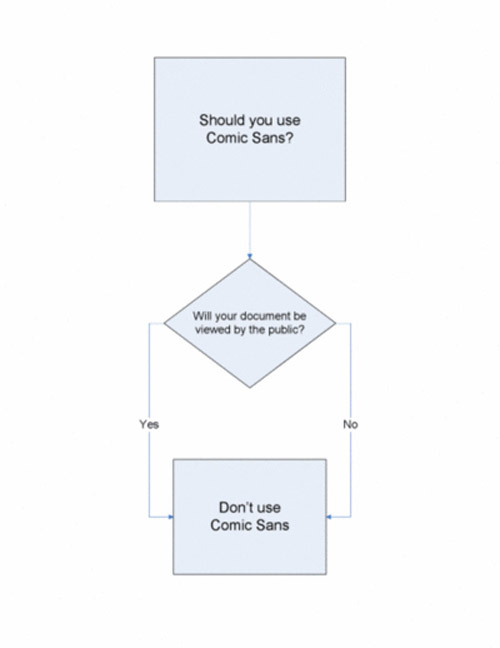
Font geek humour
How geeky do you have to be to find this sort of thing funny as hell?
H/T to Eric S. Raymond for the link.
December 21, 2010
EMALs successfully launches aircraft
In what must be welcome news for naval aviators, the next-generation catapult for launching aircraft from carriers was successful in a land-based test:
The US Navy says it has successfully launched a jet fighter into flight using a radical new electromagnetically powered catapult. The feat is important for the Americans, whose next supercarrier will be a disastrous botch without the new tech: it is even more critical for the future of the Royal Navy.
The US Naval Air Systems Command (NAVAIR) announced the test success of its Electromagnetic Aircraft Launch System (EMALS) last night, saying that the shore-based trials catapult at Lakehurst, New Jersey, successfully launched a Navy F/A-18E Super Hornet on Saturday.
“I thought the launch went great,” said Lieutenant Daniel Radocaj, the test pilot who flew the Hornet off the electric mass-driver. “I got excited once I was on the catapult but I went through the same procedures as on a steam catapult. The catapult stroke felt similar to a steam catapult and EMALS met all of the expectations I had.”
The timing of the test is crucial for the US Navy’s next big warship:
The next US fleet carrier — CVN 78, aka USS Gerald R Ford — is now at an advanced stage of build, and was designed around the EMALS. If EMALS couldn’t be made to work, the US Navy would have found itself in possession of the world’s biggest helicopter carrier. There will be much celebration at NAVAIR following Saturday’s success.
The next step in robotics: combat casualty recovery bots
It’s not ready to be used in the field yet, but the next military robot may be a stretcher bearer:
Killing a soldier removes one enemy from the fray. Wounding him removes three: the victim and the two who have to carry him from the field of battle. That cynical calculation lies behind the design of many weapons that are intended to incapacitate rather than annihilate. But robotics may change the equation.
The Battlefield Extraction-Assist Robot, BEAR for short, is, in the words of Gary Gilbert of the American Army’s Telemedicine and Advanced Technology Research Centre (TATRC), “a highly agile and powerful mobile robot capable of lifting and carrying a combat casualty from a hazardous area across uneven terrain.” On top of that, when it is not saving lives, it can perform difficult, heavy and repetitive tasks, such as the loading and unloading of ammunition.
The current prototype BEAR is a small, tracked vehicle with two hydraulic arms and a set of video cameras that provide a view of its surroundings to its operator across a wireless link. It has been developed by TATRC in collaboration with Vecna Technologies, a company based in Maryland that invented the robot.
December 18, 2010
Man bites dog story, military style
In Afghanistan and Iraq, they are finding uses for manned aircraft to supplement Predator UAV patrols:
The U.S. Air Force MC-12 “manned UAV replacement” has been in Afghanistan for a year, and has proved successful. This despite the fact that it can only stay in action for seven hours per sortie, versus more than twice the hours for a UAV. But the military needs more UAV capabilities (vidcams overhead for hours at a time), and doesn’t care if the pilots are in the air or on the ground.
[. . .]
The MC-12 is basically a militarized version of the Beech King Air. The army began using the Beech aircraft as the RC-12 in the 1970s, and has been seeking a replacement for the last few years. But then it was realized that the RC-12 was suitable for use as a Predator substitute.
The King Air 350 is a 5.6 ton, twin engine aircraft. The MC-12 can stay in the air for up to eight hours per sortie. Not quite what the Predator can do (over 20 hours per sortie), but good enough to help meet the demand. The MC-12 has advantages over UAVs. It can carry over a ton of sensors, several times what a Predator can haul. The MC-12 can fly higher (11 kilometers/35,000 feet) and is faster (over 500 kilometers an hour, versus 215 for the Predator.) The MC-12s cost about $20 million each, more than twice what a Predator goes for. The MC-12’s crew consists of two pilots and two equipment operators. Some of the sensors are operated from the ground.
Interesting hand-powered table saw
I thought this was a joke . . . but those are some pretty impressive results shown in the video.
H/T to BoingBoing for the link.
December 16, 2010
Bruce Schneier on Security in 2020
Aside from all the ugly new terms coined to describe the phenomena, the evolution of security is one of the most under-appreciated stories of the decade. The next decade is going to be even more important to how we live our lives:
There’s really no such thing as security in the abstract. Security can only be defined in relation to something else. You’re secure from something or against something. In the next 10 years, the traditional definition of IT security — that it protects you from hackers, criminals, and other bad guys — will undergo a radical shift. Instead of protecting you from the bad guys, it will increasingly protect businesses and their business models from you.
Ten years ago, the big conceptual change in IT security was deperimeterization. A wordlike grouping of 18 letters with both a prefix and a suffix, it has to be the ugliest word our industry invented. The concept, though — the dissolution of the strict boundaries between the internal and external network — was both real and important.
So, that was then. This is now:
Today, two other conceptual changes matter. The first is consumerization. Another ponderous invented word, it’s the idea that consumers get the cool new gadgets first, and demand to do their work on them. Employees already have their laptops configured just the way they like them, and they don’t want another one just for getting through the corporate VPN. They’re already reading their mail on their BlackBerrys or iPads. They already have a home computer, and it’s cooler than the standard issue IT department machine. Network administrators are increasingly losing control over clients.
This trend will only increase. Consumer devices will become trendier, cheaper, and more integrated; and younger people are already used to using their own stuff on their school networks. It’s a recapitulation of the PC revolution. The centralized computer center concept was shaken by people buying PCs to run VisiCalc; now it’s iPads and Android smart phones.
I’ve certainly noticed this myself: it was forced to my attention a couple of years ago, when a change of employment required me to buy and maintain my own “business” computer and software. Without seriously stressing my wallet, I was able to buy far more capable equipment than my previous employer had provided. Being able to check my email on multiple devices was very important, and once I’d started doing that, I realized the need to do many other things regardless of the machine I happened to be using. There are, of course, trade-offs involved:
The second conceptual change comes from cloud computing: our increasing tendency to store our data elsewhere. Call it decentralization: our email, photos, books, music, and documents are stored somewhere, and accessible to us through our consumer devices. The younger you are, the more you expect to get your digital stuff on the closest screen available. This is an important trend, because it signals the end of the hardware and operating system battles we’ve all lived with. Windows vs. Mac doesn’t matter when all you need is a web browser. Computers become temporary; user backup becomes irrelevant. It’s all out there somewhere — and users are increasingly losing control over their data.
Anyway, there’s lots more interesting stuff. Go read the whole thing.
December 15, 2010
That’s not an elaborate Christmas display. This is an elaborate Christmas display
PC World says:
Turner calls the game “Snowball Blaster.” If you help Santa dodge all the snowballs, you get a special lights display. Passers-by can hop into the “blaster” unit and use a controller to play via a PC that operates 128-channels of lights to form the display.
Yet another railgun trial
You’ve probably heard about the US Navy’s recent successful railgun test, but it’s not the only game in town:
It’s all go in the world of hypervelocity railguns this week. Following Friday’s 33-megajoule test shot carried out at a US Navy laboratory, it has also been announced that a different railgun known as “Blitzer” has recently carried out firings which suggest that it is almost combat ready.
The Blitzer comes to us courtesy of famous radical-tech company General Atomics, well known to Reg readers for its development of robot warplanes and electromagnetic mass-driver catapults for aircraft carriers among other things.
Now, in a statement which is dated 7 December (but which didn’t appear on the firm’s website until yesterday*) General Atomics would like to inform the world that the Blitzer was carrying out highly interesting and “tactically relevant” shoots back in September, actually, while the johnny-come-lately test job at Naval Surface Warfare Centre Dahlgren hadn’t even got its boots on.
Railguns have been one of the preferred technologies of near-future SF writers for years, but the necessary real-world technology has not been easy to develop. SF versions are often postulated as replacements for rifles and machine guns, but the current technology will only be suitable for fixed installations or shipboard use (and not just any ship: the electrical requirements are huge).
This may be the most attractive facet for the remaining “big gun” advocates in the Navy:
In the nearish future, depending how accurate GA’s “tactically relevant” puffery turns out to be, warships equipped with Blitzer-type railgun turrets might offer far better air defences than Type 45 or Aegis vessels can today. Such defences might only be penetrable by bigger, heavier railguns firing from beyond the horizon — along the lines of the Dahlgren boffins’ desired 64-megajoule weapon. It would, of course, require a massive capital ship to carry such guns and power them for any serious rate of fire — such a future might see the big-gun (railgun) dreadnought battleship return to its lost dominion over the seas, ousting the parvenu aircraft carrier, missile cruiser etc.
December 14, 2010
No surprises at all in Gawker’s 50 most-popular passwords
An article in the Wall Street Journal has the 50 most popular passwords from the Gawker data heist:
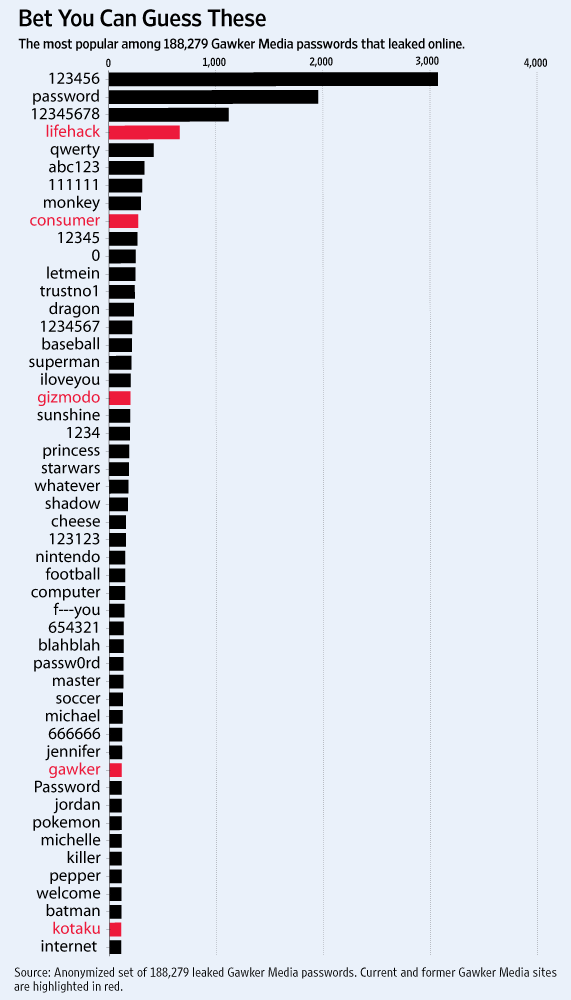
Recognize the pattern? Here’s a word cloud from my last post on passwords:
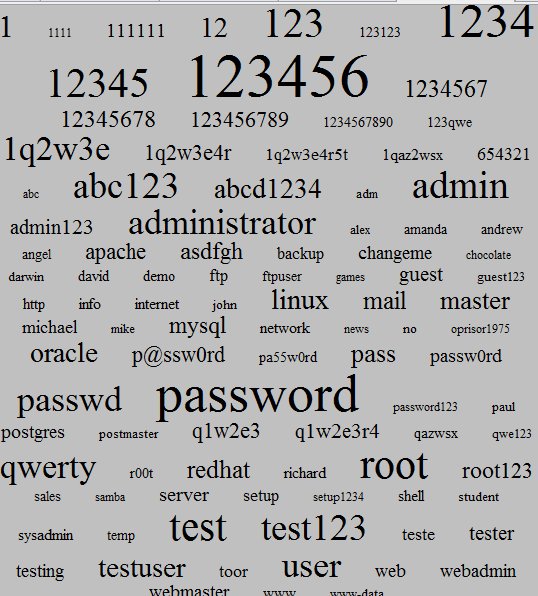
Other posts on this topic: Passwords and the average user, More on passwords, And yet more on passwords, and Practically speaking, the end is in sight for passwords.
Conservatives now still pushing corporate welfare
Okay, they’re not even pretending to be fiscally conservative any more:
The Conservative government has announced it is loaning aerospace giant Pratt & Whitney Canada $300 million for a $1 billion research project to develop the next generation of aircraft engines.
Industry Minister Tony Clement made the announcement on Monday saying it will create 700 high-skilled jobs in the GTA and more than 2,000 over the 15-year lifespan of the project. He also claimed the firm is in the process of hiring 200 engineers.
[. . .]
‘Create and maintain Canadian jobs’ has been the Conservative mantra during their recent shift to Keynesian economics and massive long-term deficits for the next half decade. The same political party that once decried government largesse and inexplicable corporate subsidies (also known affectionately as corporate welfare) is now a major player in the ‘too big to fail’ macroeconomics game.
This is nothing new: under former minister Maxime Bernier, the current darling of the small-government wing of the Conservative party, Pratt & Whitney got $350 million in corporate welfare just four years ago. That debt hasn’t been repaid.
December 13, 2010
The impossible balance of security and utility
Strategy Page looks at the mechanic that PFC Bradley Manning is reported to have used to grab copies of all the information now being released by WikiLeaks:
A bit late, the U.S. military has finally forbidden the use of all removable media (thumb drives, read/write DVD and CD drives, diskettes, memory cards and portable hard drives) from SIPRNet. Thumb drives had earlier been banned. The motivation for this latest action was Wikileaks, which obtained hundreds of thousands of secret American military and diplomatic documents from a U.S. soldier (PFC Bradley Manning). As an intel specialist, Manning had a security clearance and access to SIPRNet (Secret Internet Protocol Router Network). This was a private Department of Defense network established in 1991, using Internet technology and able to handle classified (secret) documents. But Manning got access to a computer with a writable CD drive, and was able to copy all those classified documents to a CD (marked as containing Lady Gaga tracks) and walk out of his workplace with it. The big error here was having PCs available with writable media. You need some PCs with these devices, but they should be few, and carefully monitored. Normally, you would not need to copy anything off SIPRNet. Most of the time, if you want to share something, it’s with someone else on SIPRNet, so you can just email it to them, or tell them what it is so they can call it up themselves. A network like SIPRNet usually (in many corporations, and some government agencies) has software that monitors who accesses, and copies, documents, and reports any action that meets certain standards (of possibly being harmful). SIPRNet did not have these controls in place, and still does not on over a third of the PCs connected.
Just like their civilian counterparts, soldiers have been very eager to get and keep connected, both for personal and professional reasons. Data not shared can’t be useful.
For the last decade, the Pentagon has had increasing security problems with its internal Internet networks. The Department of Defense has two private Internets (using Internet technology, but not connected to the public Internet). NIPRNet is unclassified, but not accessible to the public Internet. SIPRNet is classified, and all traffic is encrypted. You can send secret stuff via SIPRNet. However, some computers connected to SIPRNet have been infected with computer viruses. The Pentagon was alarmed at first, because the computers only used SIPRNet. As a result, they did not have any anti-virus software installed. It turned out that worm type hackware was the cause of infection, and was installed when someone used a memory stick or CD, containing the worm, to work and, well, you know the rest.
[. . .]
It’s easy for troops to be doing something on SIPRNET, then switch to the Internet, and forget that they are now on an unsecure network. Warnings about that sort of thing have not cured the problem. The Internet is too useful for the troops, especially for discussing technical and tactical matters with other soldiers. The army has tried to control the problem by monitoring military accounts (those ending in .mil), but the troops quickly got hip to that, and opened another account from Yahoo or Google, for their more casual web surfing, and for discussions with other troops. The Internet has been a major benefit for combat soldiers, enabling them to share first hand information quickly, and accurately. That’s why the troops were warned that the enemy is actively searching for anything G.I.s post, and this stuff has been found at terrorist web sites, and on captured enemy laptops. In reality, information spreads among terrorists much more slowly than among American troops. But if soldiers discuss tactics and techniques in an open venue, including posting pictures and videos, the enemy will eventually find and download it. The terrorists could speed up this process if they could get the right hackware inside American military computers.
December 10, 2010
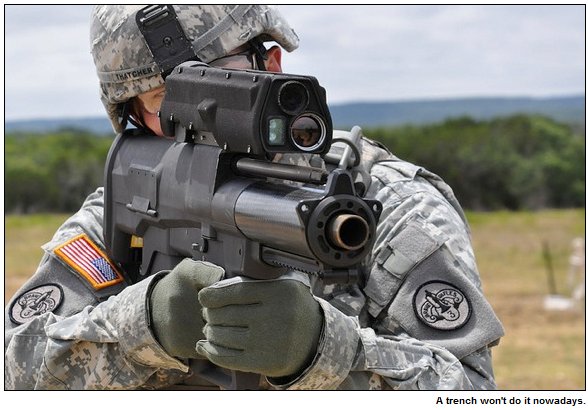
US Army to equip troops with XM-25 manpack artillery by 2014
The XM-25, which The Register refers to as a Judge Dredd smartgun will be provided to front-line troops by 2014:
The US Army has confirmed plans to equip every infantry squad and special-forces team by 2014 with an XM-25 Judge Dredd style computer smartgun able to hit enemies hiding around corners or behind rocks etc.
The XM-25 has been widely covered in the media recently, despite the fact that the last piece of actual news regarding the futuristic weapon — that it would at long last be put in the hands of US combat troops, in Afghanistan — came back in October, as we here on the Reg crazy-guns desk reported at the time (getting the tip from the Soldier Systems blog). However we also mentioned it about six weeks later in our widely-read Thanksgiving crazy-guns-o-the-future feature — and shortly thereafter the XM-25’s Afghan deployment decision was in all the mainstream outlets as “news”.
December 9, 2010
A step closer to private space travel
SpaceX’s Dragon capsule was successfully launched into orbit:
Judging by the excited faces of SpaceX employees after the live webcast, everything went perfectly. Dragon, the world’s first orbital space capsule built by the private sector, will now orbit the planet a few times over the next couple of hours before splashing down in the Pacific.
It is a small but significant milestone. The unmanned demonstration mission wants to prove that Dragon is able to deliver crew and cargo to the International Space Station (ISS). The reason for all the excitement is that the working capsule really points the world firmly in the direction of greater involvement by the private sector in providing trips to space. More competition means lower prices. Lower prices mean better access. After the retirement of the shuttle, Dragon would be able to deliver crew and cargo to the ISS on top of a Falcon 9 rocket.
Here’s hoping that NASA won’t succeed in choking off/crowding out other private launch efforts.
More information (including some graphics) at the BBC website.


