
My grandfather used to say this all the time, and it’s true. Salt brings out the flavor of the food, full stop. There are a great variety of salts, but the reality is they’re all the same mineral. Coloration in salt comes from the minerals near the salt as it forms. There’s nothing inherently better about colored salts, but the marketers selling you that stuff will try to convince you otherwise. I’ve seen pink salt promoted as an “alternative” salt that doesn’t cause blood pressure issues. That’s a lie. My advice is to buy kosher salt or the chunkier white salt if you like the crunchiness. If you really like the mild flavoring of gray salt, that’s fine, just know that it’s sold at a higher cost for what comes down to the same thing as my box of salt I can get for a couple bucks. And one more thing: All salt is sea salt.
Salt grinders are bullshit
I’m not done with salt yet: Don’t put your salt in a grinder. All you’re doing is making your salt smaller than it was before. Unlike pepper, which is actually processed in the grinder, salt does not need to be ground and is not fresher after coming out of a grinder. It’s just smaller. Use a shaker.
Caitlin PenzeyMoog, “Salt grinders are bullshit, and other lessons from growing up in the spice trade”, The A.V. Club, 2017-04-06.
March 26, 2019
QotD: Salt
March 24, 2019
Trust in scientific findings decreasing among the general public
In Scientific American, Louise Lief discusses the problem of rising public distrust of science:
We live in a moment when preventable infectious diseases like measles are spreading because parents distrust vaccines, and scientists at government agencies are being told not to use terms like “evidence-based.” The president dismisses the findings of a National Climate Assessment by more than 300 scientists and 13 federal agencies that warns of massive economic and environmental damage totaling hundreds of billions of dollars, crop failures, disrupted supply chains and multiple threats to human health, saying, “I don’t believe it.”
But when I argued in favor of the proposition (Resolved: “Science writers are responsible for building public trust in science”) during a debate at the National Association of Science Writers’ 2018 annual conference last fall, the majority of science writers and science journalists present voted that building public trust in science was not the responsibility of science writers.
[…]
Kathleen Hall Jamieson, director of the Annenberg Public Policy Center at the University of Pennsylvania’s Annenberg School for Communication also tackled the science trust question at the NASW conference, and researchers at Cardiff University have traced credibility and accuracy problems to press releases from scientists’ own academic institutions.
If a problem is discovered or a study is retracted, said Jamieson, the scientist or scientific journal needs to explain to journalists and the public how the error was discovered, what the problem is, and what steps are being taken to ensure it doesn’t happen again.
Scientists often make it hard for journalists to cover these three interrelated issues, she says. Scholarly journal publication protocols may cause scientists to write one article on the problem they’re investigating, and a second or third article on processes and solutions, resulting in coverage that emphasizes problems and shortchanges corrective action.
For their part, researchers at Cardiff University found that press releases from scientists’ own academic institutions about their work were a significant source of exaggerated claims and spin, even though most scientists can approve their wording.
Their study of press releases from 20 leading British universities on health-related science news found that when the press releases exaggerated, it was likely the news stories would too.
An analysis of 41 news articles on randomized controlled trials based on 70 press releases showed only four articles that contained exaggerated claims not included in the press release or journal abstract. Interestingly, they also found the hype and spin intended to tempt the media did not result in more news coverage.
H/T to Blazing Cat Fur for the link.
March 23, 2019
The NHS, Britain’s “national treasure”, gets panned by other EU patients who’ve experienced non-NHS care
In The Conversation, Chris Moreh, Athina Vlachantoni, and Derek McGhee report that — contrary to British myth-making — the National Health Service isn’t the envy of the civilized world:
Britain’s National Health Service is often described as a “national treasure”. And it is a sentiment those on the left and the right of the political divide agree on. The British public are so proud of the NHS, they made it the central theme of the opening ceremony of the 2012 London Olympic Games.
But this pride has also been coupled with fears that the universal healthcare provided by the NHS might be taken advantage of by patients from outside the UK. A few months after the Olympics, the then health secretary, Jeremy Hunt, felt the need to clarify that “we are a national health service, not an international health service”. The 2015 election-winning manifesto of the Conservative party made this point even clearer when it pledged to “tackle health tourism” and “recover up to £500m from migrants who use the NHS”.
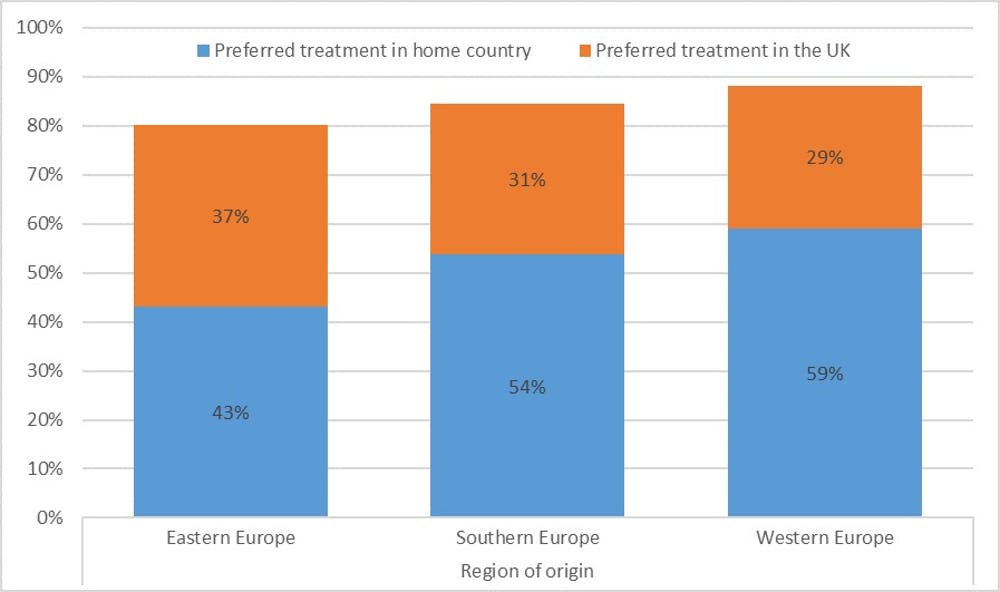
But our research shows that while the NHS may be a national treasure to British people, EU migrants would rather be treated in their countries of origin. As a 38-year-old woman from Germany put it: “Sorry, NHS? No thanks.” And the reasons for rejecting the NHS? A 25-year-old man from the Netherlands says it’s because the “NHS is slow and the medical care mediocre”. Or, at least, it “is rather poor compared to healthcare in my country,” says a 45-year-old woman from Germany.
But why should British people worry about what EU migrants think of their health service? What EU migrants think and choose is important because they are familiar with at least two European healthcare systems. They have the information and personal experience that most British citizens do not. There is a lot to be learnt from them.
March 11, 2019
Misery was
exurb1a
Published on 10 Mar 2019Goodbye to closed-source human history. Maybe.
The Fifth Science Paperback ► https://tinyurl.com/y5zj33s5 (you may need to change your region accordingly: .co.uk, etc)Sample story from the book (The Lantern) ► https://youtu.be/um6cGuJ4mNE
The Fifth Science Treasure Hunt:
Minimal clues will be provided in the videos below. If you happen to live in one of these countries, then all the very best of luck finding the books. They’re not hidden elaborately, just out of sight of passers-by. If you need to do any heavy lifting, trespassing, or scale walls, you’re definitely in the wrong place. Hint: strange fonts and geography.
England ► https://youtu.be/HQDeKPNUF4U
Germany ► https://youtu.be/qfKd134AETo
Bulgaria ► https://youtu.be/XLLaa7G97B8
I also make horrendous music ► https://soundcloud.com/exurbia-1
Help me to do this full-time, if you’re deranged enough ► https://www.patreon.com/exurb1r?ty=h
The rest of my books ► https://tinyurl.com/ycnl5bo3Incidentally:
So, one of the many issues I didn’t get around to yelling at you about was the line between ‘genetic disorder’ and an individual’s unique features. I’ve mentioned before I’m more or less blind in one eye and this is almost definitely a result of a mutation in my family line. And you know, given the option, I’m not sure if I’d have it removed. Or, I’d need to give it a very, very long think.
There are plenty of lovely and bizarre anomalies specific to individuals, and it’s not for me to say – or even speculate really – where the line should be drawn when it comes to one day potentially making alterations to our descendants. I’m not a public educator, philosopher, scientist, or policy maker. Just an idiot with a USB microphone. I’m not the person to talk about this stuff. So I hope you’ll forgive my glossing over of it.
March 6, 2019
The “grandmother hypothesis”
Jonathan Lambert on the theory for why, almost alone among species, human females live on well past their reproductive years:
Killer whales, Japanese aphids and Homo sapiens — they’re among the few organisms whose females live on long past the age of reproduction.
Since the name of the evolutionary game is survival and reproduction, the phenomenon begs explanation — why live longer than you can reproduce? In the 1960s, researchers came up with the “grandmother hypothesis” to explain the human side of things. The hypothesis is that the help of grandmothers enables mothers to have more children. So women who had the genetic makeup for longer living would ultimately have more grandchildren carrying their longevity genes. (Sorry, grandfathers, you’re not included in this picture.)
Two studies published Thursday in Current Biology take another look at this hypothesis and add new insights into the role grandmothers play.
The first hard evidence for the grandmother hypothesis was gathered by Kristen Hawkes, an anthropologist at the University of Utah who was studying the Hadza people, a group of hunter-gatherers in northern Tanzania. Hawkes was struck by “how productive these old ladies were” at foraging for food, and she later documented how their help allowed mothers to have more children.
If our long post-reproductive lives evolved because of grandmothers, we should be able to find fingerprints of the benefits of grandmothering in many cultures. But the circumstances of modern life differ drastically from those we faced at the beginning of our evolutionary story.
The studies in Current Biology turned to the detailed records of two preindustrial populations, one in what is now Quebec and the other in Finland. The researchers mined these rich databases to quantify the reproductive boost that grandmothers provide and to help us better understand the limits of their help.
H/T to Claire Lehmann for the link.
March 1, 2019
QotD: Toxic masculinity
Thanks to the new guidelines from the American Psychological Association (APA) for practice with men and boys, male psychology is no longer a mystery and mental health professionals are now equipped with the tools they need to combat the worst forms of it. According to the APA, boys and men are at risk of suffering from traditional masculinity which is on the whole unhealthy. Turns out, the traditional masculinity that drives many of us men to be confident, assertive, adventurous, stoic, and willing to take risks for our goals, the people we love, and sometimes even complete strangers are bad for us and society.
Who knew?
Biologists, philosophers, theologians, physicians, parents, and really almost all regular folk have long believed that there are meaningful and biologically-based psychological differences between males and females. Fortunately for us mere mortals, the APA is setting the record straight. It is an oppressive patriarchy, not biology, that has shaped our psychology. Gender and the masculine traits associated with being male are social constructs. The APA obviously isn’t denying that evolution is true. They aren’t some kind of silly group of religious fundamentalists. But like most educated progressives, they understand that evolution stopped at the neck.
There is this odd group of evolutionary psychologists who seem hell-bent on holding onto antiquated views about human mental and social life. It seems pretty clear that these individuals are the academic wing of the alt-right. Don’t be fooled by surveys suggesting the majority of evolutionary psychologists self-identify as liberal. We can’t trust people to self-report their own politics. Only the most enlightened are in a position to tell everyone else what they really think. I would laugh at how ridiculous the academics are who continue to insist that males and females are distinct in any meaningful way, but I now know that comedy is a form of oppression.
Perhaps the saddest part of reading the new APA guidelines is realizing just how many American boys and men suffer from traditional masculinity and don’t even realize it, and how many mothers and wives tolerate and even promote this sickness. There are millions of couples and families across the United States who are living lives imprisoned by traditional gender roles and on the surface appear to be happy and flourishing. I especially feel for all the conservatives and devout Christians who are most vulnerable to this illness. It doesn’t help when alt-right institutions such as Harvard publish research suggesting that children may benefit from being raised in such traditionally religious homes.
Clay Routledge, “Thank you, APA”, Quillette, 2019-01-22.
February 25, 2019
Modern parenting – too many helicopters yield lots of snowflakes
It’s a commonplace assertion that children today have less unscheduled, unsupervised opportunities for play and exploration, and parents have been indoctrinated into the belief that the world has become a much more dangerous place and their kids need 24/7 protection from those myriad dangers. “Helicopter” parenting is a rational response to this indoctrination, but it comes with costs to the growth and maturity of the next generation. More than a decade ago, I posted this graphic showing how each generation has been more protective of their own children than their parents had been for them:

The problem has been getting worse over time, as Rob Creasy and Fiona Corby describe:
Children growing up in the UK are said to be some of the unhappiest in the industrialised world. The UK now has the highest rates of self harm in Europe. And the NSPCC’s ChildLine Annual Review lists it as one of the top reasons why children contact the charity.
Children’s mental health has becomes one of British society’s most pressing issues. A recent report from the Prince’s Trust highlights how increasing numbers of children and young people are unhappy with their lives, sometimes with tragic consequences.
This is a generation of young people that has been labelled as “snowflakes” – unable to handle stress and more prone to taking offence. They are also said to have less psychological resilience than previous generations. And are thought to be too emotionally vulnerable to cope with views that challenge their own.
[…]
Children’s lives are being stifled. No longer are children able to spend time with friends unsupervised, explore their community or hang around in groups without being viewed with suspicion. Very little unsupervised play and activity occurs for children in public spaces or even in homes – and a children’s spare time is often eaten up by homework or organised activity.
This is further impacted by the way children are taught in schools and how pressure to succeed has led to a taming of education. But if children are never challenged, if they don’t ever experience adversity, or face risks then it is not surprising they will lack resilience.
February 23, 2019
How a statistical error became the key argument in the “everyone must turn vegan” movement
At The Conversation, Frank M. Mitloehner explains how a flawed statistic — comparing numbers derived from non-parallel bases — evolved into one of the most widely quoted arguments for governments forcing people to give up meat in their diet:
As the scale and impacts of climate change become increasingly alarming, meat is a popular target for action. Advocates urge the public to eat less meat to save the environment. Some activists have called for taxing meat to reduce consumption of it.
A key claim underlying these arguments holds that globally, meat production generates more greenhouse gases than the entire transportation sector. However, this claim is demonstrably wrong, as I will show. And its persistence has led to false assumptions about the linkage between meat and climate change.
[…]
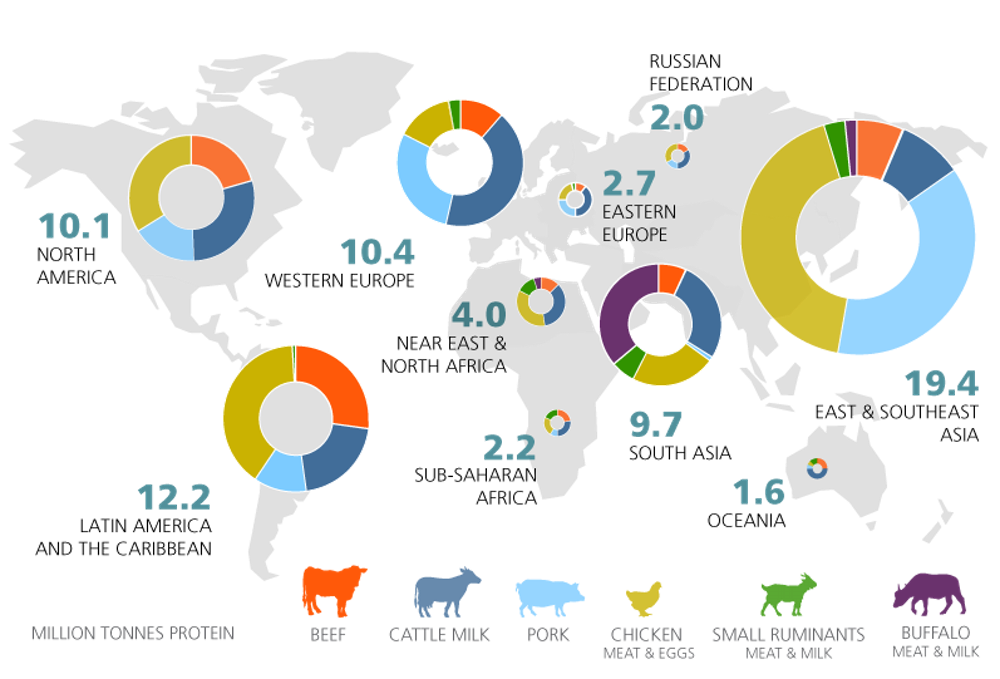
Global livestock production by region (milk and eggs expressed in protein terms).
Source: United Nations Food and Agriculture Organization.Setting the record straight on meat and greenhouse gases
A healthy portion of meat’s bad rap centers on the assertion that livestock is the largest source of greenhouse gases worldwide. For example, a 2009 analysis published by the Washington, D.C.-based Worldwatch Institute asserted that 51 percent of global GHG emissions come from rearing and processing livestock.According to the U.S. Environmental Protection Agency, the largest sources of U.S. GHG emissions in 2016 were electricity production (28 percent of total emissions), transportation (28 percent) and industry (22 percent). All of agriculture accounted for a total of 9 percent. All of animal agriculture contributes less than half of this amount, representing 3.9 percent of total U.S. greenhouse gas emissions. That’s very different from claiming livestock represents as much or more than transportation.
Why the misconception? In 2006 the United Nations Food and Agriculture Organization published a study titled “Livestock’s Long Shadow,” which received widespread international attention. It stated that livestock produced a staggering 18 percent of the world’s greenhouse gas emissions. The agency drew a startling conclusion: Livestock was doing more to harm the climate than all modes of transportation combined.
This latter claim was wrong, and has since been corrected by Henning Steinfeld, the report’s senior author. The problem was that FAO analysts used a comprehensive life-cycle assessment to study the climate impact of livestock, but a different method when they analyzed transportation.
For livestock, they considered every factor associated with producing meat. This included emissions from fertilizer production, converting land from forests to pastures, growing feed, and direct emissions from animals (belching and manure) from birth to death.
However, when they looked at transportation’s carbon footprint, they ignored impacts on the climate from manufacturing vehicle materials and parts, assembling vehicles and maintaining roads, bridges and airports. Instead, they only considered the exhaust emitted by finished cars, trucks, trains and planes. As a result, the FAO’s comparison of greenhouse gas emissions from livestock to those from transportation was greatly distorted.
February 21, 2019
Food rituals and observances among the very woke
Americans in the 21st century are far less religious than their parents’ or grandparents’ generations, at least as far as formal, organized, traditional religion is concerned. In the place of old-fashioned religion, many have adopted a replacement that functions very much as religion used to:
Muslims eat halal. Jews eat kosher. Devout Catholics and Orthodox Christians abstain from meat on Friday and certain holy days. Hindus are vegetarian. But you will never see food practices take on religious intensity like they do in the more politically blue/left-wing bastions of the United States. This food intensity has been a gold mine of joke material for comedians like JP Sears.
Spend some time with vegan, gluten-free, and paleo devotees and you will realize that a fish filet on Friday can never match the cultlike seriousness these food fads take on. (And if you should ever be trapped at a restaurant table with somebody who is both vegan and gluten-free, run like the wind.)
Studies show left-leaning individuals are less likely to identify themselves as religious. But the truth is they have merely replaced well-known western religious traditions with more rigid ones. If you move to a politically blue part of the country, you will experience the cultural shift the minute your kids enter preschool. School picnics, snack time and birthday parties can become an anxiety-inducing strain as you try to determine what you can bring that all the children can eat. The parents are generally nice people who would never expect you to consider their dietary rules, but you will nonetheless feel a twinge of guilt if you bring that batch of traditionally-made cupcakes and accidentally feed it to a kid who is not allowed to experience it.
[…]
The popular food fetishes of these cultural enclaves often go hand-in-glove with a neo-pagan mishmash of Gaia-worship, 4th century Gnosticism, and rejuvenated new age/occult practices. Every religion has its food rituals. The left is no exception.
Now I know there are valid reasons to be concerned with the mistreatment of animals on factory farms and there are legitimate medical reasons that some must reduce gluten. Paleo eaters can have points about unnecessary additives in contemporary foods. But the reality remains that the food habits of contemporary leftists have the ritualistic feel of dogma, with many of its followers being far more rigid than the most fundamentalist religious believer.
We tend to have a lot of gluten-free meals here, but it’s a medical necessity, not a food-religion observance, as two of the three of us suffer from gluten-intolerance. One outcome of the “fashionability” of gluten-free dining, there has been a substantial increase in the availability of gluten-free foods which has been welcome. Unfortunately, as a lot of the demand has been due to fashion rather than necessity, some restaurants have been remarkably casual when gluten-free dishes are ordered, where the main dish may be safe, but it’s been covered with a sauce or glaze that isn’t gluten-free.
February 11, 2019
Tuberculosis – A Ten-Thousand Year Battle – Extra History – #2
Extra Credits
Published on 7 Feb 2019Tuberculosis couldn’t be cured and eliminated by just one person like Dr. Robert Koch, but thanks to the collective efforts of the medical community since Koch’s time — including public health initiatives and the introduction of randomized clinical trials — TB is steadily being wiped out.
Join us on Patreon! http://bit.ly/EHPatreon
February 8, 2019
QotD: Sex toys and sexbots
The global market in these abominations is currently valued at more than £12 billion, and that’s not counting the monstrous regiment of aforementioned sex dolls, the ‘high end’ of which began in Japan in the 1980s. Also coming soon will be sex robots, beginning with a robot ‘Fellatio Café’ in Paddington, due to open later this year. Even though I describe myself as a feminist, I can’t wait to mock the self-appointed spokeswomen for my gender slamming this set-up after years of bigging up broads bringing themselves off using battery-operated devices. As the rather rabid David Mills, an atheist activist and admirer of sex dolls, ranted to Vanity Fair: ‘Women have enjoyed sex toys for 50 years, probably 5,000 years, if the truth be known, but men are still stigmatised! We have to correct that! I want to be the Rosa Parks of sex dolls! Men are not going to sit in the back of the bus any more!’
Indeed, you could argue that a blowjob from a humanoid sexbot is far more indicative of a healthy desire to be connected to humanity than a quick once-over with a gilded pebble or a faceless phallus. But that won’t stop the lady columnists from penning predictable screeds about the woeful immaturity of men, and their willingness to risk having their tackle snagged in a faulty man-trap rather than ‘commit’ to a living, breathing female.
So can I (for once) put my head above the parapet and say that I totally get the appeal of sexbots in the current climate? Sex is, generally, a rather basic thing. Yet somewhere along the line some women have adopted the notion that it should be akin to a trip to Disneyland on gossamer wings for a playdate with Barbie and her pet unicorn. Some women seem to think sex should be about communicating, sharing, scented candles, two-hour massages, three-hour role play, kissing, cuddling and then… that other thing, if you must… whereas men generally tend to believe that sex is about having sex, the rotters. So can you blame them for wanting to keep it short and simple with a sexbot? And if it’s OK for women to pleasure themselves with friends electric, why not men?
Julie Burchill, “The other sexual double-standard: Why is self-love for women so cool and feminist? For men it’s seen as sad and sleazy”, The Spectator, 2017-03-23.
February 2, 2019
Curing Tuberculosis – The Hero Koch – Extra History – #1
Extra Credits
Published on 31 Jan 2019Fascinatingly enough, tuberculosis was actually considered “trendy” in the Victorian era of Europe — but Dr. Robert Koch, hero of the German Empire, was convinced that he could cure it. A British writer named Arthur Conan Doyle, however, was a little skeptical, and for good reason…
Enjoy today’s extra-Extra History! Dr. Robert Koch was going to save Germany, and the rest of Europe, from tuberculosis. Maybe he would even get his own institute, like his medical rival Louis Pasteur. He knew for sure he was on to something…
Join us on Patreon! http://bit.ly/EHPatreon
Did People in Medieval Times Really Wear Lockable Chastity Belts?
Today I Found Out
Published on 28 Mar 2016Never run out of things to say at the water cooler with TodayIFoundOut! Brand new videos 7 days a week!
In this video:
The lasting images of what most of us perceive to be the “medieval times” includes heroic knights, stampeding horses, court jesters, giant turkey legs, ruling kings, and pure maidens wearing chastity belts. But the fact is that, besides the more obvious of those that aren’t accurate, most scholars believe that the chastity belt didn’t actually exist during medieval times, but rather is a product of 18th and 19th century obsession with masturbation as a societal ill and safeguarding women in the workplace.
Want the text version?: http://www.todayifoundout.com/index.p…
January 28, 2019
Is there a championship for solipsistic self-absorption?
If so, then “Alex” here is an Olympic-class competitor:
The routine of a man called Alex starts as follows (he wakes between 5:55 and 6:45):
I wake up and immediately rehydrate. Your body is most absorbent after you sleep, so the first thing you put in it is the most important. I have a glass of Rebel Kitchen raw coconut water (you should be drinking slightly pink coconut water not white, as that’s more concentrated) and dilute it with water at a ratio of 2:1. I take multi-vitamins and vitamin C boosters.
Where, one might ask, does he sleep? The Sahara desert? More likely Chiswick or Clapham (prosperous districts of the inner part of outer London, where the worried-well who think of illness as an infringement of human rights congregate in droves). I was reminded of the medical students whom I used to examine, who brought bottles of water with them to the exam as if it were being held at an open-air bus station in Nouakchott, the capital of Mauritania.
Having resuscitated himself physically, Alex attends to his soul:
I do some meditation, where I might recite some mantras. One of them is, “All my relationships are harmonious and full of love,” which is good if you are working with difficult clients.”
Compared with this, Uriah Heep was straight-talking and plain-dealing; but what is most evident in this “mantra” (a word with spiritual connotations) is its complete solipsism. Alex’s relationships, if they can be called that, are either entirely with himself or delusional, because a relationship with another that is full of love requires that the other person should love as well as be loved, for otherwise it is not a relationship.
Having sung some “really relatable mantras,” he “focuses on each inhale and exhale for five minutes” before taking himself off to the gym for a little “yoga, cardio and weight-training,” after which he returns home — it is now 7:45 — to “have a shot of coconut water and glutamine.” By now, he says, his serotonin levels are through the roof, and he showers with organic products and moisturizes with vitamin E oil.
During the rest of the day, he eats nuts, drinks green juice, and swallows activated charcoal and two apple cider vinegar tables “to help with digestion,” as well as digestive enzymes “to help distribute the nutrients all over my body.” And if, when turning in for the night after all this care for himself (and a second spell in the gym), he feels under the weather, he swallows some almond milk with turmeric. Naturally, he believes in the healing, or at least the prophylactic, powers of crystals, and keeps one on his desk, and works by the light of a Himalayan salt lamp, which “helps to absorb the magnetic and radioactive waves that are all around you from wifi and your computer.” All that is missing from his regime to render himself immortal is Hopi ear candles, coffee enemas, and red flannel underwear.
January 23, 2019
The value of boredom
I must have missed this Quillette essay by Caroline ffiske when it was published earlier this month:
In their book The Coddling of the American Mind Jonathan Haidt and Greg Lukianoff wonder where it all went wrong. How did we get to a situation where so many of our kids see themselves as fragile victims, but at the same time throw their weight around, telling the rest of us what we are allowed to think and say and do? Haidt and Lukianoff have set up a website devoted to exploring the issue and finding solutions.
I have a suggestion. It hit me like a hammer blow when I read Joseph Brodsky’s essay “In Praise of Boredom.” This was delivered as a commencement address at Dartmouth College in July 1989. Here is the opening sentence: “A substantial part of what lies ahead of you is going to be claimed by boredom.” That’s right. Joseph Brodsky, winner of the Nobel Prize for literature in 1987, assumed that these Ivy League graduates, in common with the rest of humanity since the dawn of time would face hours of the psychological Sahara of boredom that “starts right in your bedroom and spurns the horizon.”
How could Brodsky have guessed that the young people he addressed in July 1989 would be the last Western generation to live alongside boredom: in their bedrooms, on the bus, at the end of the day, and in the morning? That now, when the tiniest tips of our little fingers feel the first twinges of tedium, while the elevator travels between ground and first, we reach for our screens to become masters of fate, captains of souls, kings of new continents.
Even the vocabulary of boredom is disappearing. Brodsky lists these: “anguish, ennui, tedium, doldrums, humdrum, the blahs, apathy, listlessness, stolidity, lethargy, languor, accidie, etc.” Most of those can be excised from the Dictionary. Tell me honestly when you last used any of them?
[…]
Why? Because boredom represents your window onto infinity. And that is to say, onto your own insignificance. “For boredom speaks the language of time, and it is to teach you the most valuable lesson in your life … the lesson of your utter insignificance.” Boredom puts your existence into perspective “the net result of which is precision and humility.” The more you learn about your own size “the more humble and compassionate you become to your likes.”
Is boredom the ingredient our “snowflake” generation is missing?


