
Practical Engineering
Published Dec 5, 2023A friendly overview of thermal effects on railways.
Errata: At 9:00, the left column of calculations is incorrectly labeled “SI.” It should be imperial. Whoops!
Just as all materials have a mostly linear relationship between temperature change and length change, all materials also have a similar relationship between stress and change in length (often called strain). And this is part of the secret to continuous welded rail: restrained thermal expansion. You can overcome one with the other.
(more…)
March 11, 2024
Why Railroads Don’t Need Expansion Joints
Comments Off on Why Railroads Don’t Need Expansion Joints
February 16, 2024
What remains of the “first” steam powered passenger railway line?
Bee Here Now
Published 23 Oct 2023The Stockton-Darlington Railway wasn’t the first time steam locomotives had been used to pull people, but it was the first time they had been used to pull passengers over any distance worth talking about. In 1825 that day came when a line running all the way from the coal pits in the hills around County Durham to the River Tees at Stockton was opened officially. This was an experiment, a practice, a great endeavour by local businessmen and engineers, such as the famous George Stephenson, who astounded crowds of onlookers with the introduction of Locomotion 1 halfway along the line, which began pulling people towards Darlington and then the docks at Stockton.
This was a day that would not only transform human transportation forever, but accelerate the industrial revolution to a blistering pace.
In this video I want to look at what remains of that line — not the bit still in use between the two towns, but the bit out in the coalfields. And I want to see how those early trailblazers tackled the rolling hills, with horses and stationary steam engines to create a true amalgamation of old-world and new-world technologies.
(more…)
Comments Off on What remains of the “first” steam powered passenger railway line?
February 13, 2024
GO Transit – North America’s BEST Commuter Rail Network
Lonestar Trip Reports
Published Nov 11, 2023Hello and Welcome to Oshawa, Ontario! Today we’re riding with GO Transit, Toronto’s commuter rail provider, from here down to Toronto Union Station.
Trip Information
Train Number: GO Lakeshore East 9015
Locomotive: MPI MP36PH-3C 609
Departure Time: 10:10am
Arrival Time: 11:11am
Journey Time: 1hr 1min
Price: $10.00Thanks for watching and I hope you enjoyed!
Comments Off on GO Transit – North America’s BEST Commuter Rail Network
February 10, 2024
QotD: When Manchuria became Manchukuo
Back around the turn of the 20th century, the Russians decided to build a railroad across Siberia, the better to (among other things) supply their spiffy new naval base at Port Arthur, on the strategic Liaodong Peninsula (linking up with their Chinese Eastern Railway). This pissed off the Japanese, who claimed the Peninsula by right of conquest in the First Sino-Japanese War. Unpleasantness ensued.
Further unpleasantness ensued in the wake of World War I, when both Imperial Russia and Republican China collapsed. The Japanese had a big railroad project of their own going in the Kwantung Leased Territory, which was threatened by the chaos. Moreover, the big Japanese railroad project had grown — as Japanese industrial concerns tend to do — into a ginormous, all-encompassing combine known as Mantetsu.
So far, so recondite, I suppose, but stop me if this part sounds familiar: Mantetsu was so big, and so shady, that it was all but impossible to tell where “the guys running Mantetsu” ended and “the Japanese government” began. And it gets better: Thanks to the Japanese Empire’s distinctive (to put it mildly, and kindly) administrative structure, it was equally hard to tell where “the Japanese government” ended and “the Japanese military” began. Even better — by which I mean much, much worse, but again feel free to stop me when this sounds familiar — “the Japanese military” was itself composed of several wildly different, mutually hostile chains of command, all competing with each other for political power, economic access, and glory. Best of all — by which, again, I mean worst — since Mantetsu was so big, and so wired-in to every level of the Japanese government, it basically got its own army, which was effectively separate even from the Army High Command back in Tokyo.
Here again, the granular details are insanely complex, and I’m not qualified to walk you through them, but the upshot is: Thanks to all of the above, plus the active enmity of the rapidly-rearming Soviet Union and the rapidly-accelerating chaos of the Warlord Period in China, Japan’s foreign policy ended up being dictated by the Kwantung Army, with almost no reference to even the High Command, let alone the civilian politicians, back in Tokyo. A particular warlord giving the Mantetsu Board of Directors — or, you know, whoever — grief? No problem — boom! Oh, that didn’t solve the problem, and now the politicians are dragging their feet? Might as well blow up a different part of your own railway, seize a whole bunch of territory on that flimsy pretext, and set up a puppet government to give you cover …
I don’t expect y’all to follow all the links right away, so trust me on this: Nobody involved in any of that stuff ranked higher than colonel. Indeed, the guy most “responsible” — if that’s really the word — for all of this stuff was a staff pogue, also a colonel, named Kanji Ishiwara. He and another staff pogue, Seishiro Itagaki, who was head of the Kwantung Army’s intelligence section, orchestrated the Japanese invasion of China, and while it’s oversimplifying things a bit too much to say those two clowns started World War II in the Pacific, I’m not stopping you from saying it.
From there, events took on a logic of their own. The rest of the Army was soon committed to the war in North China, which rapidly became the war in all the rest of China. The Navy, not wanting to let the Army hog all the glory, had gotten in on the war a few years prior to the Marco Polo Bridge, and soon enough they were causing all kinds of international grief on their own account. Put simply, but not unfairly, you had the Navy chasing the Army, and the Army chasing itself, all across China, with the civilian politicians lagging way behind in the rear, desperately trying to catch up, or even just figure out what the hell was going on …
Severian, “Lessons from Manchuria”, Rotten Chestnuts, 2021-04-21.
Comments Off on QotD: When Manchuria became Manchukuo
February 8, 2024
North American newspaper economics
Tim Worstall discusses some of the issues ailing Canadian and American newspapers which are not easily solvable (government subsidies, as attempted in Canada, just turn the recipients into an underpaid PR branch of the governing party … not a good look in a democratic nation):

So, as a little corrective, a quick jaunt through what actually ails American journalism. The concentration is upon the big newspapers because that’s where the problem is worst. The conclusion is that it’s gonna get a lot, lot, lot, worse too. Because the industry is facing a base economic problem that it’s not willing to actually face up to. Or, at least, all the journalists writing about it aren’t — there’s the occasional sign that some of the business side of the equation grasp it.
[…]
Before Y2K American newspapers were segmented along geographic lines. The size of the country, the lack of a long distance passenger railroad network, meant that this was just so. If you’re printing a daily paper then you’ve got to deliver it daily. On the day it’s meant to refer to as well. If Chicago is 1,100 miles (no, I’ve not looked it up but that’s within an order of magnitude of being right, which is better than many newspapers manage with numbers) from New Orleans then the same newspaper is going to find it difficult to print and deliver to both markets. Add in the fact that trains take a week to traverse that distance, passenger trains – anyone who has ever travelled Amtrak will say it feels that long at least — included.
You could not and therefore did not have national newspaper (USA Today, with satellite printing plants, was an attempt to deal with this and slightly earlier than our cut off date but doesn’t change the basic story) distributions. What you had was a series of local and regional monopolies. Each one centred on a large population centre and serving the area around it that could be reasonably reached by truck overnight. Chicago and Cincinnati, not 1,100 miles away from each other, did have entirely different newspapers.
By contrast, and just as an example, the British newspaper market was national from pre-WWI. We simply did have overnight at worst passenger rail that covered the country. Partly it’s a much, much, smaller place, partly the passenger rail system was just different. So, printing overnight (and some maintained separate Scottish editions and plants) meant that those papers that came off the press in London at 8pm were on sale in Glasgow at 8 am, those that came off the press in London at 4 am were on sale in London at 8am. That’s not exact but it’s a good enough pencil sketch.
Cincinnati newspaper(s) served Cincinnati. Chicago, Chicago and New Orleans the area of New Orleans. There simply wasn’t a “national press” in the US in that British sense.
OK. But this also meant that American newspapers were much more like a monopoly in their local area than anything else. Network effects still exist even before computer networks after all. The most important of which was the classifieds.
As with Facebook, we’re all on Facebook because everyone else is on Facebook. So, if we’re to join a social network we’re going to be on Facebook where everyone else is — except those three hipsters who are where it isn’t cool yet. This applies to classifieds sections. Folk advertise in the one with the most readers, the widest market. Readers buy the one with the most ads in it, the widest market. You advertise the bronzed baby shoes, unused, where there are the most people looking for bronzed baby shoes, unused.
So, the dominant paper will suck up the classifieds in any particular market. Classifieds, fairly obviously back in the days of prams, cheap used cars, waiters’ jobs and so on being geographically based.
No, this is important. A useful pencil sketch of American newspaper revenues pre-Y2K was that subscriptions produced some one third of revenues. They also, around and about, covered print costs and distribution. They were, roughly you understand, about a face wash in fact.
Display ads produced another one third and classifieds the final one third. Classifieds were also wildly profitable — no expensive journalists to pay, no bureaux, just a few women waiting to get married on the end of the phone line.
February 4, 2024
QotD: American railroads and the Interstate Commerce Commission
Randy Holcombe, Liberty in Peril: Democracy and Power in American History, (2019).
Comments Off on QotD: American railroads and the Interstate Commerce Commission
January 31, 2024
The ghost of Beeching haunts model railways?
In The Critic, Richard Bratby notes the solemn departure of the very last model railway train in Britain, at least based on recent reporting on the hobby:
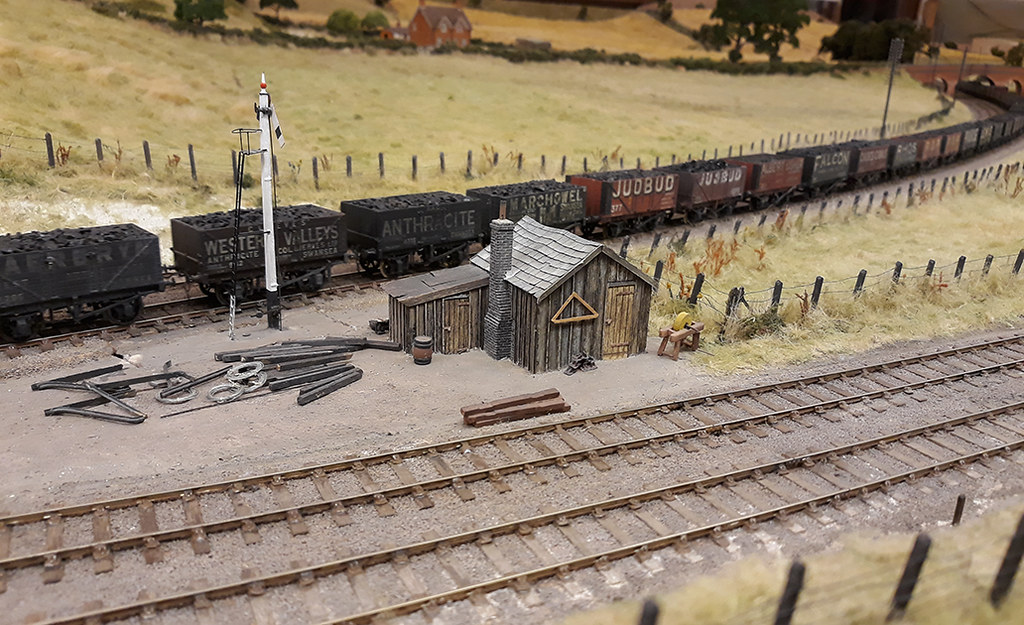
“Platelayers hut and coal train” by Phil_Parker is licensed under CC BY 2.0 
 .
.
The last model train has departed, and in the attics and spare bedrooms of Britain, closure notices the size of thumbnails are being glued to cardboard stations. OO gauge track is being torn up; weeds made from lichen and flock shoot up where once there were busy miniature main lines. It’s Beeching all over again, just tiny. And in a desolate parade, once-cherished model locos trundle off to 4mm scale scrapyards, to stand lifeless and forgotten until, like their real-life forebears, they are broken up to be recycled as … oh, I don’t know. iPhones. Xboxes. Something modern, anyway. Something cool.
Well, I read it in the Telegraph, so it must be true. “Death of the Model Railway” proclaimed the headline last weekend, and the same story duly popped up all over the media, usually with some variant of “running out of steam”, or “going off the rails”. I was a bit late coming to the news because it was Saturday and I’d spent the afternoon building a model goods wagon from a plywood kit. I’d just added the lettering, and it came as a jolt to learn that the hobby no longer existed. Gingerly, I poked at the varnish I’d just applied — damn, still sticky, and now there was a socking great out-of-scale thumbprint spoiling the look of the thing. That seemed real enough.
But why did those headlines seem so familiar — and ring so false? True, 2024 has begun badly in the railway modelling world. Last week the organisers of the annual Warley National Model Railway Exhibition — a giant show held at the NEC in Birmingham, and a highlight of the hobby’s annual calendar — called it quits. A few days previously, the venerable model railway shop Hattons had announced that it was closing down after 78 years. Taken together, you can see why a journo from outside this particular subculture might link unrelated events into a bigger, juicier story. And let’s face it, a dig at railway enthusiasts is always good for a laugh, isn’t it?
I won’t deny that both events stung me. As a kid in the 80s I used to visit Hattons at its original Liverpool location. Even then, it felt old-school: a gloomy, musty terraced shop, piled to the ceiling with boxes and display cases. But a Saturday visit was like entering Aladdin’s cave and we’d always leave with some new treasure, wrapped in brown paper. Hattons has long since moved to newer, brighter premises and refocused on its mail-order business. I realise with a pang of shame that I’ve never used either.
As for the Warley Exhibition; well, I was there with my dad in November. It’s a regular father and son fixture a few weeks before Christmas, and if we’re honest we probably look forward to it rather more. It was rammed — 80-odd layouts (please, never “train sets”) from the UK, Europe and America, with crowds jostling four deep, and trade stands offering everything from antique clockwork models to the latest digital tech. My 12-year old eyes would have popped out of my head at the quantity and quality of products available. One stall was using airport-stye scanners to produce miniaturised replicas of its customers, so they could ride their model trains in person. If this is a hobby in decline, I’m not seeing it.
I’m going to stick my neck out here: correlation does not imply causation, and railway modelling is actually thriving. What the headlines describe is a collision of two familiar, but separate, 21st century trends the death of the high street, and the decline of old-style social clubs. Hattons never went bust: it read the runes and decided to get out in good order. As for Warley; well, if anything, the Exhibition seems to have been a victim of its own success. Like many leisure pursuits, railway modelling in the 20th century revolved around clubs, with all the paraphernalia of committees and tea rotas. People don’t do that quite so much nowadays.
Comments Off on The ghost of Beeching haunts model railways?
January 29, 2024
QotD: Amtrak’s improvements
No, Amtrak is in good shape. The cars have been rebuilt, the blankets no longer draw blood when they come in contact with human skin, the tracks are smoother, and the Pit of Hazy Death — the snack car — is now smoke-free.
That means it’s not packed with throaty-voiced semi-toothed drifters who emit a Pompeii-sized cloud of ash every time they start in on one of those up-from-the-ankles 20-minute hacking fits. And somehow — don’t ask me how — the general aromatic profile of the train is no longer “feet, with a top note of septic tank.” The train actually smelled good. Bravo, Amtrak.
James Lileks, “A windy narrative of a trip to Chicago”, Minneapolis Star-Tribune, 2004-12-19.
Comments Off on QotD: Amtrak’s improvements
January 26, 2024
Which Is Easier To Pull? (Railcars vs. Road Cars)
Practical Engineering
Published Nov 7, 2023A lot of the engineering decisions that get made in railroading have to do with energy. How does the rolling resistance of a 20-ton freight railcar compare to my little grocery hauler?
(more…)
Comments Off on Which Is Easier To Pull? (Railcars vs. Road Cars)
January 22, 2024
Nationalization of British Railways: What Went Wrong?
Railways Explained
Published 22 Oct 2023In today’s video we continue uncovering the story of railway development in Great Britain, as part of a special trilogy marking the Railways Explained’s achievement of 100,000 subscribers!
This is actually the second video in series, and it covers a period from the aftermath of World War II to the momentous era of rail privatization, which was quite challenging period for British railways, full of ups and downs, but it is mostly marked by the formidable challenges.
We talked about the pivotal moments, such as the birth of British Railways, the ambitious Modernisation Plan, the influential Beeching Report, structural reforms, and the eventual transition to rail privatization, which all defined the British railways during this transformative period.
This insightful journey through time illuminates the intricacies and milestones of a railway system that has left an indelible mark on the United Kingdom’s transportation history.
(more…)
Comments Off on Nationalization of British Railways: What Went Wrong?
January 7, 2024
Every Type of Railcar Explained in 15 Minutes
Practical Engineering
Published 19 Sept 2023How many of these cars have you spotted before?
Trains are one of the most fascinating engineered systems in the world, and they’re out there, right in the open for anyone to have a look! Once you start paying attention, it’s pretty satisfying to look for all the different types of railcars that show up on the tracks.
(more…)
Comments Off on Every Type of Railcar Explained in 15 Minutes
December 19, 2023
Overthinking Thomas the Tank Engine: What Actually Is Thomas?
Jago Hazzard
Published 13 Aug 2023Peep peep!
(more…)
Comments Off on Overthinking Thomas the Tank Engine: What Actually Is Thomas?
December 10, 2023
Engines of War: How Wars Were Won and Lost on the Railways
WW2TV
Published 15 Jun 2023Engines of War: How Wars Were Won and Lost on the Railways With Christian Wolmar
Before the nineteenth century, armies had to rely on slow and unreliable methods of transportation to move soldiers and equipment during times of conflict. But with the birth of the railroad in the early 1830s, the way wars were fought would change forever. In this show renowned expert Christian Wolmar tells the story of that transformation with a focus on railways in WWII and especially the Normandy campaign.
Christian Wolmar is a British journalist, author, railway historian and Labour Party politician. He is known for his commentary on transport, especially as a pundit on Britain’s railway industry, and was named Transport Journalist of the Year in the National Transport Awards in 2007.
(more…)
Comments Off on Engines of War: How Wars Were Won and Lost on the Railways
December 8, 2023
The development of the American suburb
In the latest book review from Mr. and Mrs. Psmith’s Bookshelf, Jane Psmith discusses A Field Guide to American Houses (Revised): The Definitive Guide to Identifying and Understanding America’s Domestic Architecture, by Virginia Savage McAlester. In particular, she looks at McAlester’s coverage of how suburbs developed:
After some brief but interesting discussion of cities,1 most of the page count is devoted to the suburbs. It’s a sensible choice: suburbs have by far the most varied types of house groupings, and more than half of Americans live in one. But what exactly is a “suburb”? It’s a wildly imprecise word, referring to anything that is neither truly rural nor the central urban core, and suburbs vary tremendously in character. As a working definition, though, a suburb is marked by free-standing houses on relatively larger lots. (If you can think of a counter-example that qualifies but is “urban”, I’ll bet you $5 it started out as a suburb before the city ate it.)
This means that building a suburb has a few obvious technological prerequisites, which McAlester lists as follows: First, balloon-frame construction, which enabled not just corners but quick and inexpensive construction generally and removed much of the incentive for the shared walls that were so common in the early cityscape. Second, the proliferation of gas and electric utilities in the late nineteenth century meant that the less energy-efficient free-standing homes could still be heated relatively inexpensively. Third, the spread of telephone service after 1880 meant that it was much easier to stay in touch with friends whose front doors weren’t literally ten feet away from yours.2 But by far the most important technological advances came in the field of transportation, which is obviously necessary if you’re going to live in the country (or a reasonable facsimile thereof) and work in the city.
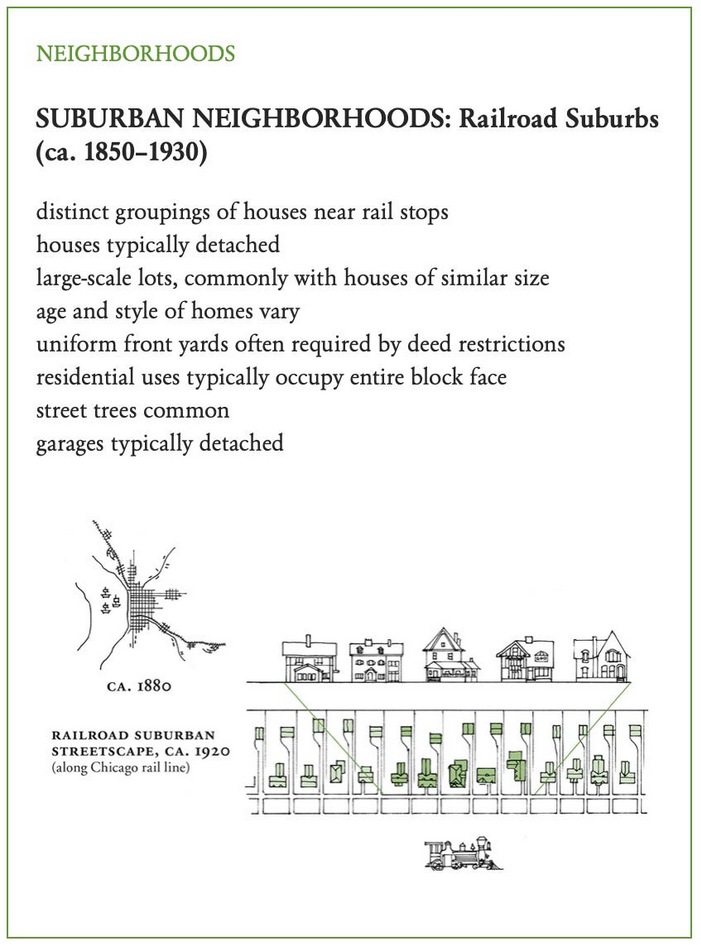
The first of these transportation advances was the railroad. In fact “railroad suburb” is a bit of a misnomer, because most of the collections of houses that grew up around the new rail stops were fully functional towns that had their own agricultural or manufacturing industries. The most famous railroad suburbs, however, were indeed planned as residential communities serving those wealthy enough to pay the steep daily rail fare into the city. Llewellyn Park near New York City, Riverside near Chicago, and the Main Line near Philadelphia are all examples of railroad suburbs that have maintained their tony atmosphere and high property values.
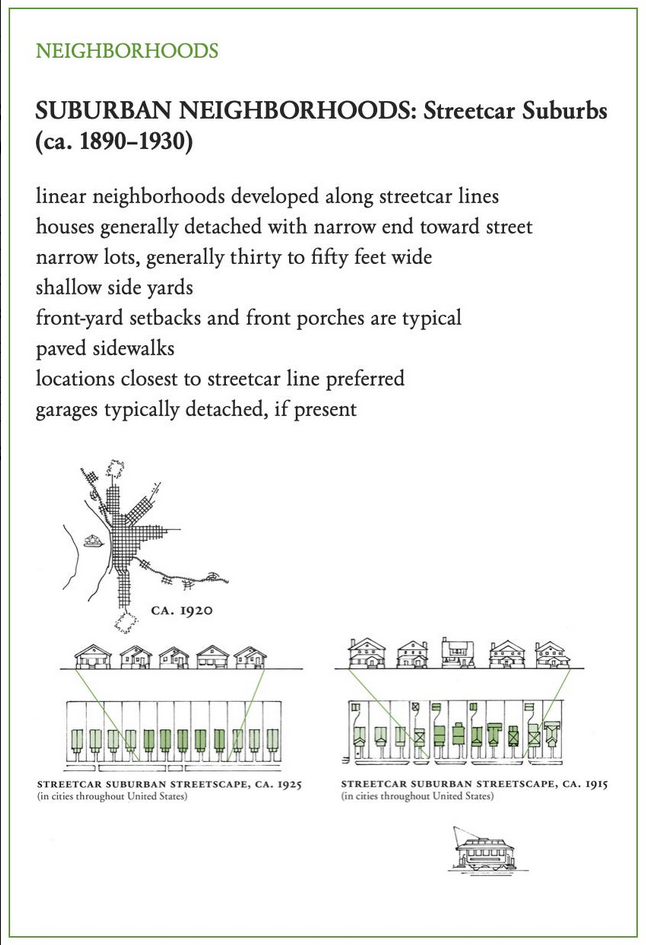
The next and more dramatic change was the advent of the electric trolley or streetcar, first introduced in 1887 but popular until about 1930. (That’s what all the books say, but come on, it’s probably October 1929, right?) Unlike steam locomotives, which take quite a long time to build up speed or to slow down again, and so usually had their stations placed at least a mile apart, streetcars could start and stop far more easily and feature many more, and more densely-placed, stops. Developers typically built a streetcar line from the city veering off into the thinly-inhabited countryside, ending at an attraction like a park or fairground if possible. If they were smart, they’d bought up the land along the streetcar beforehand and could sell it off for houses,3 but either way the new streetcar line added value to the land and the development of the land made the streetcar more valuable.
You can easily spot railroad towns and streetcar suburbs in any real estate app if you filter by the date of construction (for railroad suburbs try before 1910, for streetcar before 1930) and know what shapes to look for. Railroad towns are typically farther out from the urban center and are built in clusters around their stations, which are a few miles from one another. Streetcar suburbs, by contrast, tend to be continuous but narrow, because the appeal of the location dropped off rapidly with distance from the streetcar line. (Lots are narrow for the same reason — to shorten the pedestrian commute.) They expand from the urban center like the spokes of a wheel.
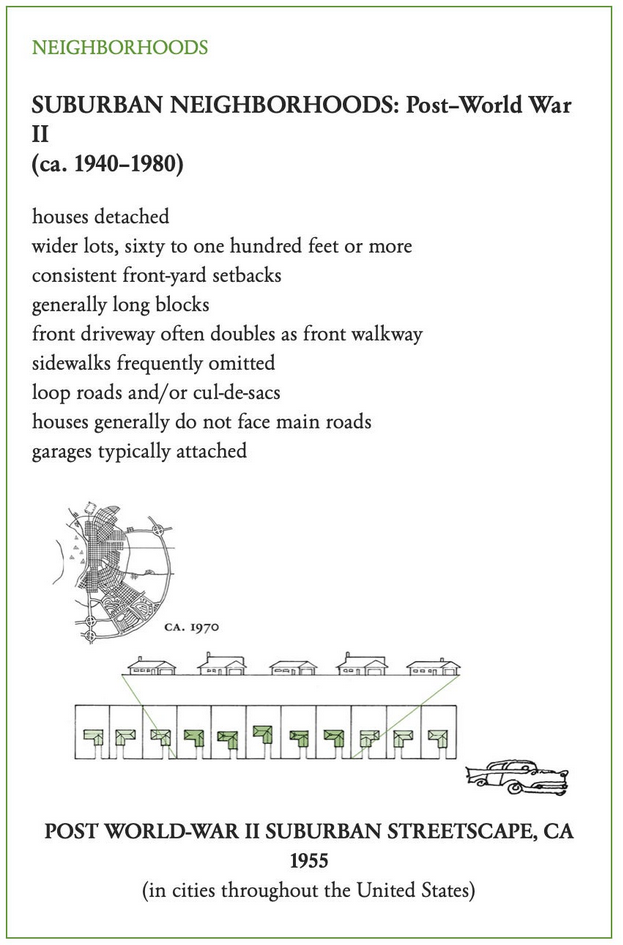
And then came the automobile and, later, the federal government. The car brought a number of changes — paved streets, longer blocks, wider lots (you weren’t walking home, after all, so it was all right if you had to go a little farther) — but nothing like the way the Federal Housing Authority restructured neighborhoods.
The FHA was created by the National Housing Act of 1934 with the broad mandate to “improve nationwide housing standard, provide employment and stimulate industry, improve conditions with respect to mortgage financing, and realize a greater degree of stability in residential construction”. It was a big job, and the FHA set out to accomplish it in a typical New Deal fashion: providing federal insurance for private construction and mortgage loans, but only for houses and neighborhoods that met its approval. This has entered general consciousness as “redlining”, after the color of the lines drawn around uninsurable areas (typically old, urban housing stock),4 but the green, blue, and yellow lines — in order of declining insurability — were just as influential on the fabric of contemporary America.
A slow economy through the 1930s and a prohibition on nonessential construction during the war meant that FHA didn’t have much to do until 1945, but as soon as the GIs began to come home and take advantage of their new mortgage subsidies, there was a massive construction boom. With the FHA insuring both the builders’ construction loans and the homeowners’ mortgages, nearly all the new neighborhoods were built to the FHA’s exacting specifications.
One of the FHA’s major concern was avoiding direct through-traffic in neighborhoods. Many post-World War II developments were built out near the new federally-subsidized highways on the outskirts of the cities, so the FHA was eager to protect new subdivisions from heavy traffic on the interstates and the major arterial roads. Neighborhoods were meant to be near the arterials, but with only a few entrances to the neighborhood and many curved roads and culs-de-sac within it. Unlike the streetcar suburbs or the early automobile suburbs that filled in between the “spokes” of the streetcar lines, where retail had clustered near the streetcar stops, the residents of the post-World War II suburbs found their closest retail establishments outside the neighborhood on the major arterial roads. Lots became wider, blocks longer, and sidewalks less frequent; houses were encouraged to stay small by FHA caps on the size of loans. And although we tend to assume they were purely residential areas, the FHA encouraged the inclusion of schools, churches, parks, libraries, and community centers within the neighborhood.
1. America doesn’t have many urban neighborhoods that predate 1750, and even fewer that persist in their original layout, but if you’ve ever visited one it’s amazing how compact everything feels even in comparison to the rowhouses of the following century.
2. McAlester’s footnote for the paragraph that contains all this reads: “These three essentials were highlighted in an essay the author has read but has not been successful in locating for this footnote.”
3. This is still, I am told, how some of the more sensibly-governed parts of the world run their transit systems: whatever company has the right to build subways buys up the land around a planned (but not announced) subway line through shell corporations, builds the subway, then sells or develops the newly-valuable property. Far more efficient as a funding mechanism than fares!
4. This 2020 NBER working paper points out that redlined areas were 85% white (though they did include many of the black people living in Northern cities) and suggests that race played very little role in where the red lines were drawn; rather, black people were already living in the worst neighborhoods.
Comments Off on The development of the American suburb
November 25, 2023
Crystal Palace Station is Needlessly Magnificent
Jago Hazzard
Published 9 Aug 2023Crystal Palace and the station built for it. Well, one of them.
(more…)
Comments Off on Crystal Palace Station is Needlessly Magnificent


