
“I’m very concerned about a phenomenon called ‘concept creep’ – which has been happening to a lot of psychological terms since the 1990s”, he says. “When a word like ‘violence’ is allowed to creep so that it includes a lot of things that are not violence, then this causes a cascade of bad effects. It’s bad for the students themselves because they now perceive an idea that they dislike, or a speaker that they dislike, as having committed a much graver offence against themselves – which means that they will perceive more victimisation of themselves. And it’s also really bad for society because, as we are seeing in a spectacular way in the United States this year, when each side can point to rampant occurrences of what they see as violence by the other side, this then justifies acts of actual physical violence on their side. And there’s no obvious end to this mutual escalation process.”
He adds: “Everybody involved in education needs to be dampening down violence and the acceptance of violence. Telling students that words are violence is counterproductive to that effort.”
Jonathan Haidt, quoted by Naomi Firsht, “The Fragile Generation”, Spiked, 2017-08-31.
September 10, 2019
QotD: Mere words are not “violence”
September 9, 2019
QotD: War
Pushbotton war has its place. There is another kind of conflict — crusade, jihad, holy war, call it what you choose. It has been loosed before, with attendant horror but indecisive results. In the past, there were never means enough to exterminate all the unholy, whether Christian, Moslem, Protestant, Papist, or Communist. If jihad is preached again, undoubtedly the modern age will do much better.
Americans, denying from moral grounds that war can ever be a part of politics, inevitably tend to think in terms of holy war — against militarism, against fascism, against bolshevism. In the postwar age, uneasy, disliking and fearing the unholiness of Communism, they have prepared for jihad. If their leaders blow the trumpet, or if their homeland is attacked, their millions are agreed to be better dead than Red.
Any kind of war short of jihad was, is, and will be unpopular with the people. Because such wars are fought with legions, and Americans, even when they are proud of them, do not like their legions. They do not like to serve in them, nor even to allow them to be what they must.
For legions have no ideological or spiritual home in the liberal society. The liberal society has no use or need for legions — as its prophets have long proclaimed.
Except that in this world are tigers.
T.R. Fehrenbach, This Kind of War: A Study in Unpreparedness, 1963.
September 8, 2019
QotD: The Amritsar massacre and the partition of India
A comparison is in order. At the famous Amritsar massacre of 1919, shot in elaborate and loving detail in the present movie and treated by post-independence Indian historians as if it were Auschwitz, Gurkha troops under the command of a British officer, General Dyer, fired into an unarmed crowd of Indians defying a ban and demonstrating for Indian independence. The crowd contained women and children; 379 persons died; it was all quite horrible. Dyer was court-martialed and cashiered, but the incident lay heavily on British consciences for the next three decades, producing a severe inhibiting effect. Never again would the British empire commit another Amritsar, anywhere.
As soon as the oppressive British were gone, however, the Indians — gentle, tolerant people that they are — gave themselves over to an orgy of bloodletting. Trained troops did not pick off targets at a distance with Enfield rifles. Blood-crazed Hindus, or Muslims, ran through the streets with knives, beheading babies, stabbing women, old people. Interestingly, our movie shows none of this on camera (the oldest way of stacking the deck in Hollywood). All we see is the aged Gandhi, grieving, and of course fasting, at these terrible reports of riots. And, naturally, the film doesn’t whisper a clue as to the total number of dead, which might spoil the mood somehow. The fact is that we will never know how many Indians were murdered by other Indians during the country’s Independence Massacres, but almost all serious studies place the figure over a million, and some, such as Payne’s sources, go to 4 million. So, for those who like round numbers, the British killed some 400 seditious colonials at Amritsar and the name Amritsar lives in infamy, while Indians may have killed some 4 million of their own countrymen for no other reason than that they were of a different religious faith and people think their great leader would make an inspirational subject for a movie. Ahimsa, as can be seen, then, had an absolutely tremendous moral effect when used against Britain, but not only would it not have worked against Nazi Germany (the most obvious reproach, and of course quite true), but, the crowning irony, it had virtually no effect whatever when Gandhi tried to bring it into play against violent Indians.
Despite this at best patchy record, the film-makers have gone to great lengths to imply that this same principle of ahimsa — presented in the movie as the purest form of pacifism — is universally effective, yesterday, today, here, there, everywhere. We hear no talk from Gandhi of war sometimes being a “necessary evil,” but only him announcing — and more than once — “An eye for an eye makes the whole world blind.” In a scene very near the end of the movie, we hear Gandhi say, as if after deep reflection: “Tyrants and murderers can seem invincible at the time, but in the end they always fall. Think of it. Always.” During the last scene of the movie, following the assassination, Margaret Bourke-White is keening over the death of the Great Soul with an English admiral’s daughter named Madeleine Slade, in whose bowel movements Gandhi took the deepest interest (see their correspondence), and Miss Slade remarks incredulously that Gandhi felt that he had failed. They are then both incredulous for a moment, after which Miss Slade observes mournfully, “When we most needed it [presumably meaning during World War II], he offered the world a way out of madness. But the world didn’t see it.” Then we hear once again the assassin’s shots, Gandhi’s “Oh, God,” and last, in case we missed them the first time, Gandhi’s words (over the shimmering waters of the Ganges?): “Tyrants and murderers can seem invincible at the time, but in the end they always fall. Think of it. Always.” This is the end of the picture.
Richard Grenier, “The Gandhi Nobody Knows”, Commentary, 1983-03-01.
September 7, 2019
QotD: The affections of the voters
Orson Scott Card, quoted at Samizdata. (Reposted from the old blog, 2004-08-31).
September 6, 2019
QotD: The horrors of war
An aside: I’ve long thought that prettifying World War II for domestic consumption contributed to both the media shock of Vietnam and the generation gap. WWII and Korea vets, who knew war first-hand, didn’t understand just how shocked their doted-on boomer kids were. “The Good War” wasn’t any more pleasant when you were experiencing it.
Virginia Postrel, “Horrors of War”, Dynamist.com, 2004-04-27.
September 5, 2019
QotD: Fashion
[… image from Marshall Fields catalogue …]
Ponchos. Good God. Ponchos. And what’s with this blonde’s hair? How many My Little Ponys did they kill to make this wig?
[…]
God forbid our children should ever be happy. Not when they can have ATTITUDE, which is what we all really want from our kids.
[… image of sneering, posturing child models …]
Charming. Remember: Fashion means never having to say you’re happy. From Dutch supermodels to haughty tykes, the watchword from Dame Fashion is “pissed.” Now put on your poncho and radiate sullen blankness.
James Lileks, “The Bleat”, 2004-08-17 (Reposted from the old blog).
Note: Jon mentioned that he looked at the images in Lileks’ article and at first thought they were actual 1970s catalogue photos, but in that dreckful decade, the models would have been smiling. A valid point, I think, and one of the issues Lileks has with the current fashion industry. Nowadays, you can’t be a fashion model without the kind of surly attitude best expressed by thugs and angry bar patrons after last call.
September 4, 2019
QotD: Goth problems
Dan Savage, The Onion A/V Club, 2004-08-04.
September 3, 2019
QotD: Fencing out the London poor
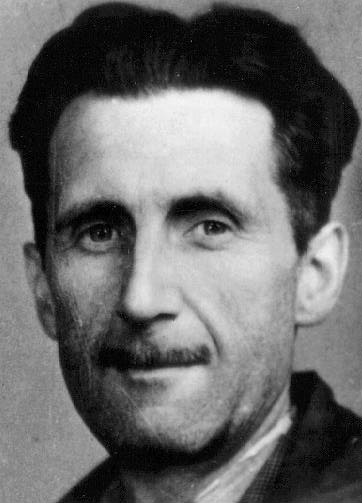
Orwell’s press card portrait, 1943
I see that the railings are returning — only wooden ones, it is true, but still railings — in one London square after another. So the lawful denizens of the squares can make use of their treasured keys again, and the children of the poor can be kept out.When the railings round the parks and squares were removed, the object was partly to accumulate scrap-iron, but the removal was also felt to be a democratic gesture. Many more green spaces were now open to the public, and you could stay in the parks till all hours instead of being hounded out at closing times by grim-faced keepers. It was also discovered that these railings were not only unnecessary but hideously ugly. The parks were improved out of recognition by being laid open, acquiring a friendly, almost rural look that they had never had before. And had the railings vanished permanently, another improvement would probably have followed. The dreary shrubberies of laurel and privet — plants not suited to England and always dusty, at any rate in London — would probably have been grubbed up and replaced by flower beds. Like the railings, they were merely put there to keep the populace out. However, the higher-ups managed to avert this reform, like so many others, and everywhere the wooden palisades are going up, regardless of the wastage of labour and timber.
George Orwell, “As I Please” Tribune, 1944-08-04.
September 2, 2019
QotD: The abolition conspiracy of the 1850s
But there was another conspiracy afoot in the 1850s: The abolition conspiracy. You don’t hear about this one in high school history because the victors write the textbooks, but it was quite real. And this one really was a conspiracy, in that they had a clear goal: The end of chattel slavery. And it was a conspiracy in a more fundamental sense, in that it was illegal. The so-called “slave power conspiracy” was obstructionist to the bone, but it’s perfectly legal for legislators to vote against proposed legislation. It’s not legal to advocate armed insurrection but that’s what the abolitionists did.
On October 16, 1859, a lunatic abolitionist named John Brown led a partisan band in an attack on the Federal arsenal at Harper’s Ferry, Virginia. He wanted to distribute the stolen guns to local slaves, thus sparking a race war. We know this because Brown was captured alive, and the great state of Virginia put him on trial, as they were legally required to do. Being a fanatic, and knowing that he was a dead man already, Brown took the opportunity to advertise his cause to the world …
At which point it became obvious that not only did Brown have the financial backing of several prominent Northerners, but he had the moral backing of a large segment of the Northern population. Brown became a martyr, literally — he was frequently compared to Jesus Christ in Northern periodicals. The important thing to note is this: Brown was captured in armed insurrection against the United States, and lots of the country was ok with it. This man simply decided that the legal processes could never result in the outcome he deemed morally necessary, so he took the law into his own hands — with the active connivance of prominent Northern financiers and intellectuals, and the avid approval of many Northern citizens.
Remember that, and Southern belligerency makes a whole lot more sense. The North was obviously ready to go to the gun in 1861, because they’d already gone to the gun in 1859. The “John Brown Moment,” then, is the point at which violence becomes inevitable, because one significant, influential segment of the country not only passively tolerates it, but actively cheers it.
Severian, “The John Brown Moment”, Rotten Chestnuts, 2019-07-16.
September 1, 2019
QotD: Wonks inside the Beltway
There are few words that stir the blood of a Beltway wonk like “the Commission has issued its report.” That means that those in the government must now react, importantly, and those in the media must now react as well — dissect, digest, explain to the benighted groundlings what it means, and issue Important Recommendations by way of reasoned editorials aimed at the corridors of power, but more likely received by a schoolteacher in Iowa who photocopies it off and puts it on the bulletin board in the staff lounge with yellow highlight-lines through the better parts.
The commission has issued its report! Mo better, the commission has issued recommendations! And the Washington press corps open their beaks, spindly necks trembling, waiting for the savory worm to be dropped from the blue-ribbon mother bird.
Unless you’ve spent some time in DC you can’t imagine the tremendous self-importance that possesses the people who feed off the government. They’re like people who live in the same town where NASA has a tracking station, and think that it makes them all astronauts.
James Lileks, Bleat, 2004-07-23.
August 31, 2019
QotD: Thinning out the book collection
James Lileks, Bleat, 2004-07-06.
August 30, 2019
QotD: Racism in London during WW2
Orwell’s press card portrait, 1943
A few days ago a West African wrote to inform us that a certain London dance hall had recently erected a “colour bar”, presumably in order to please the American soldiers who formed an important part of its clientele. Telephone conversations with the management of the dance hall brought us the answers: (a) that the “colour bar” had been cancelled, and (b) that it had never been imposed in the first place; but I think one can take it that our informant’s charge had some kind of basis. There have been other similar incidents recently. For instance, I during last week a case in a magistrate’s court brought out the fact that a West Indian Negro working in this country had been refused admission to a place of entertainment when he was wearing Home Guard uniform. And there have been many instances of Indians, Negroes and others being turned away from hotels on the ground that “we don’t take coloured people”.It is immensely important to be vigilant against this kind of thing, and to make as much public fuss as possible whenever it happens. For this is one of those matters in which making a fuss can achieve something. There is no kind of legal disability against coloured people in this country, and, what is more, there is very little popular colour feeling. (This is not due to any inherent virtue in the British people, as our behaviour in India shows. It is due to the fact that in Britain itself there is no colour problem.)
The trouble always arises in the same way. A hotel, restaurant or what-not is frequented by people who have money to spend who object to mixing with Indians or Negroes. They tell the proprietor that unless he imposes a colour bar they will go elsewhere. They may be a very small minority, and the proprietor may not be in agreement with them, but it is difficult for him to lose good customers; so he imposes the colour bar. This kind of thing cannot happen when public opinion is on the alert and disagreeable publicity is given to any establishment where coloured people are insulted. Anyone who knows of a provable instance of colour discrimination ought always to expose it. Otherwise the tiny percentage of colour-snobs who exist among us can make endless mischief, and the British people are given a bad name which, as a whole, they do not deserve.
In the nineteen-twenties, when American tourists were as much a part of the scenery of Paris as tobacco kiosks and tin urinals, the beginnings of a colour bar began to appear even in France. The Americans spend money like water, and restaurant proprietors and the like could not afford to disregard them. One evening, at a dance in a very well-known cafe some Americans objected to the presence of a Negro who was there with an Egyptian woman. After making some feeble protests, the proprietor gave in, and the Negro was turned out.
Next morning there was a terrible hullabaloo and the cafe proprietor was hauled up before a Minister of the Government and threatened with prosecution. It had turned out that the offended Negro was the Ambassador of Haiti. People of that kind can usually get satisfaction, but most of us do not have the good fortune to be ambassadors, and the ordinary Indian, Negro or Chinese can only be protected against petty insult if other ordinary people are willing to exert themselves on his behalf.
George Orwell, “As I Please” Tribune, 1944-08-11.
August 29, 2019
QotD: Imagining a world made up only of women
So what would a world made up totally of women really be like? It would be tyrannical beyond belief. No one would be willing to speak against the accepted narrative unless they were willing to be unpersoned or killed. Think of a mix between 1984, the very worst social aspects of socialist regimes, and the Borg. There would be constant pushing for position, usually by starting whisper campaigns or setting someone above oneself up to be badly embarrassed. Look at the SJWs of today’s world and see how they operate. That’s what it would look like, writ large across the entire planet. They attack anyone outside the group who doesn’t comply with their demands, and if someone inside the group says a single word out of line according to the ever-shifting standards the entire group turns on them without mercy. The only way to get back in their good graces is to loudly proclaim your “sin” and accept their abuse until they get bored of you. Even afterward, you’ll forever be “tainted” with the sin of noncompliance.
When you write your books and send them out into the world, please stop writing women as soft, cuddly pacifists. We aren’t. Kipling was completely right about the female of the species being the more dangerous sex. He was also right about the price of letting women control society. If any thinking individualist finds themselves in a society run by women, may God have mercy on their souls because those women will have none at all.
“outofthedarkness”, guest posting at According to Hoyt, 2017-08-09.
August 28, 2019
QotD: The secret power of Quebec separatists that Western separatists lack
Colby Cosh, “Advice on Western separatism: don’t take it any more seriously than it takes itself”, National Post, 2019-07-26.
August 27, 2019
QotD: Salvador Dali and the “benefit of clergy”
Orwell’s press card portrait, 1943
Now, if you showed this book, with its illustrations, to Lord Elton, to Mr. Alfred Noyes, to The Times leader writers who exult over the “eclipse of the highbrow” — in fact, to any “sensible” art-hating English person — it is easy to imagine what kind of response you would get. They would flatly refuse to see any merit in Dali whatever. Such people are not only unable to admit that what is morally degraded can be aesthetically right, but their real demand of every artist is that he shall pat them on the back and tell them that thought is unnecessary. And they can be especially dangerous at a time like the present, when the Ministry of Information and the British Council put power into their hands. For their impulse is not only to crush every new talent as it appears, but to castrate the past as well. Witness the renewed highbrow-baiting that is now going on in this country and America, with its outcry not only against Joyce, Proust and Lawrence, but even against T. S. Eliot.
But if you talk to the kind of person who can see Dali’s merits, the response that you get is not as a rule very much better. If you say that Dali, though a brilliant draughtsman, is a dirty little scoundrel, you are looked upon as a savage. If you say that you don’t like rotting corpses, and that people who do like rotting corpses are mentally diseased, it is assumed that you lack the aesthetic sense. Since Mannequin rotting in a taxicab is a good composition. And between these two fallacies there is no middle position, but we seldom hear much about it. On the one side Kulturbolschevismus: on the other (though the phrase itself is out of fashion) “Art for Art’s sake.” Obscenity is a very difficult question to discuss honestly. People are too frightened either of seeming to be shocked or of seeming not to be shocked, to be able to define the relationship between art and morals.
It will be seen that what the defenders of Dali are claiming is a kind of benefit of clergy. The artist is to be exempt from the moral laws that are binding on ordinary people. Just pronounce the magic word “Art”, and everything is O.K.: kicking little girls in the head is O.K.; even a film like L’Age d’Or* is O.K. It is also O.K. that Dali should batten on France for years and then scuttle off like rat as soon as France is in danger. So long as you can paint well enough to pass the test, all shall be forgiven you.
One can see how false this is if one extends it to cover ordinary crime. In an age like our own, when the artist is an altogether exceptional person, he must be allowed a certain amount of irresponsibility, just as a pregnant woman is. Still, no one would say that a pregnant woman should be allowed to commit murder, nor would anyone make such a claim for the artist, however gifted. If Shakespeare returned to the earth to-morrow, and if it were found that his favourite recreation was raping little girls in railway carriages, we should not tell him to go ahead with it on the ground that he might write another King Lear. And, after all, the worst crimes are not always the punishable ones. By encouraging necrophilic reveries one probably does quite as much harm as by, say, picking pockets at the races. One ought to be able to hold in one’s head simultaneously the two facts that Dali is a good draughtsman and a disgusting human being. The one does not invalidate or, in a sense, affect the other. The first thing that we demand of a wall is that it shall stand up. If it stands up, it is a good wall, and the question of what purpose it serves is separable from that. And yet even the best wall in the world deserves to be pulled down if it surrounds a concentration camp. In the same way it should be possible to say, “This is a good book or a good picture, and it ought to be burned by the public hangman.” Unless one can say that, at least in imagination, one is shirking the implications of the fact that an artist is also a citizen and a human being.
* Dali mentions L’Age d’Or and adds that its first public showing was broken up by hooligans, but he does not say in detail what it was about. According to Henry Miller’s account of it, it showed among other things some fairly detailed shots of a woman defecating.
George Orwell, “Benefit of Clergy: Some Notes on Salvador Dali”, Saturday Book for 1944, 1944.


