
[Princesses] think of themselves as Strong, Independent Women, even while saying “I like a man to open doors and pay for everything — and treat me like a princess!” No, dear, if a man opens doors for you he’s treating you like a simpleton and if he pays for everything, he’s treating you like a hooker. (The crossover between the princess look and the hooker look, as the late Barbara Cartland grotesquely illustrated, is considerable.) And it’s a man knowing that you can be bought with a dinner and a pair of shoes which leads to him so frequently mugging you off — royally — in favour of a better bargain. Back on the pink plastic shelf you go!
How do you spot a Princess? She’ll be keen on pampering to an extent which indicates to the casual onlooker that her natural self must be extraordinarily rank if it takes such effort and expense to keep in check. (Princesses shouldn’t be confused with Professional Beauties, most of whom retain a healthy contempt for the business of exchanging physical gifts for fiscal rewards, from Hedy Lamarr saying “Any girl can be glamorous — all you have to do is stand still and look stupid” to the catwalk models who invariably live in jeans and sneakers after shrugging off the stupid clothes which Princesses pine for.)
The Princess believes that retail therapy is the answer to everything, even though the rest of us avert our eyes from this most obvious manifestation of the essential hollowness of a life that an over-enthusiasm for clothes-shopping invariably indicates in anyone out of their teens. They’ll have long nails, ostensibly to show that they’re ladies of leisure, but signalling to the rest of us that they’re very likely parasites with low sex-drives. They like big weddings — and as a liking for big weddings often goes hand in hand with humourlessness, they often have very short marriages. They are in short practitioners of the Violet Elizabeth Bott school of feminism – less about equal rights and fulfilling one’s potential than about stamping your foot till you get what you want.
They dislike men, seeing them not as flesh-and-blood people so much as platinum-and-titanium meal-tickets, and they mistrust women, seeing them as competition. An ageing Princess is more than likely to end up lonely — and with no life of the mind to comfort her, this loneliness may make her mentally addled at a comparatively young age. Once the sheen is off her skin, the Princess has nothing that would make one seek her out; like a lot of people over-keen on spangles and glitter, they are at heart rather drab people — drains not radiators, personality-wise — who never make things happen or drive things forward but rather wait to be rescued. They tend to find themselves eternally in the passenger seat of their life’s journey, stranded on the hard shoulder with their souvenirs, waiting in vain for hunky help to arrive.
Julie Burchill, “The Princess generation needs to grow up”, The Spectator, 2017-07-18.
August 26, 2019
QotD: Princesses
August 25, 2019
QotD: Bipartisan authoritarianism
Some Democrats want to double down on their party’s shameful Drug War history. Massachusetts Rep. Stephan Hay [D-Fitchfield] has introduced House Bill 1266, which treats the existence of “a hidden compartment” in a vehicle as “prima facie evidence that the conveyance was used intended for use in and for the business of unlawfully manufacturing, dispensing, or distributing controlled substances.”
This means that if a cop stops you and finds no drugs or other contraband, but decides that part of your car is a “hidden compartment,” that cop can subject your car to civil asset forfeiture — that is, they can steal it, and force you to sue them to get it back.
The role of the Democratic Party is often to take the Republicans’ stupidest, red-meat-for-the-base policies, sloppily designed and doomed to collapse under their own weight, and operationalize them, putting them on the kind of sound bureaucratic footing that they need to have real staying power. Exhibit A is the drug war, but see also Obama’s perfection of GWB’s mess of a mass-surveillance apparatus, turning it into an immortal and pluripotent weapon that Donald Trump now gets to wield.
Cory Doctorow, “Proposed Massachusetts law would let cops steal your car if it had a ‘hidden compartment'”, Boing Boing, 2017-07-16.
August 24, 2019
QotD: Strikes at non-profit organizations
[…]
Which is where we get to see the pay deal matter in the raw. At the auto companies (well, absent those in and near bankruptcy problems) it was indeed possible to start shouting “But what about the workers?” Why should they get less generous pay or terms just so that the capitalists can make out like bandits? But here we’ve got exactly the same problem. And there are no capitalists, there are no profits. The income into NPR is pretty much exclusively used to pay the employees of NPR. There are no leakages to the capitalists so, in the absence of more money, what can be done?
[…]
You can see NPR’s finances here and it becomes obvious that they have available only two of the traditional three ways of dealing with a higher wage bill. In for profit companies there is that possibility of reducing the profit to pay the workers more. In the absence of profiteering this cannot of course happen. Thus, in order to accommodate higher wages they can either raise prices to stations which carry the programs or NPR can employ fewer people at those higher wages. They’re restricted to only two of those ways normally put forward. Something which does rather aid in highlighting why and how companies, for profit ones, react the way they do to forced pay rises.
That NPR is a non-profit aids in highlighting exactly the problems that all organisations have with demands for higher wages. With no profits to cut they can either charge more or employ fewer people, nothing else.
Tim Worstall, “NPR’s Problems – Isn’t It Fun When Workers At A Non-Profit Seek To Strike?”, Forbes, 2017-07-15.
August 23, 2019
QotD: The ego of Salvador Dali
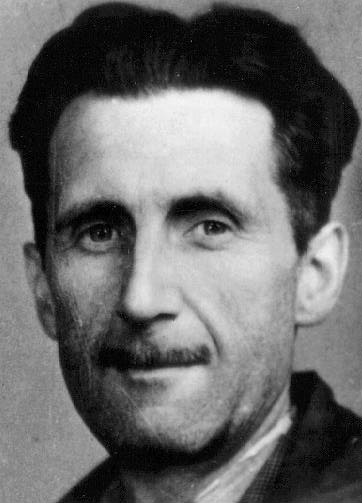
Orwell’s press card portrait, 1943
[Dali’s] aberrations are partly explicable. Perhaps they are a way of assuring himself that he is not commonplace. The two qualities that Dali unquestionably possesses are a gift for drawing and an atrocious egoism. “At seven”, he says in the first paragraph of his book, “I wanted to be Napoleon. And my ambition has been growing steadily ever since.” This is worded in a deliberately startling way, but no doubt it is substantially true. Such feelings are common enough. “I knew I was a genius”, somebody once said to me, “long before I knew what I was going to be a genius about.” And suppose that you have nothing in you except your egoism and a dexterity that goes no higher than the elbow; suppose that your real gift is for a detailed, academic, representational style of drawing, your real métier to be an illustrator of scientific textbooks. How then do you become Napoleon?
There is always one escape: into wickedness. Always do the thing that will shock and wound people. At five, throw a little boy off a bridge, strike an old doctor across the face with a whip and break his spectacles — or, at any rate, dream about doing such things. Twenty years later, gouge the eyes out of dead donkeys with a pair of scissors. Along those lines you can always feel yourself original. And after all, it pays! It is much less dangerous than crime. Making all allowance for the probable suppressions in Dali’s autobiography, it is clear that he had not had to suffer for his eccentricities as he would have done in an earlier age. He grew up into the corrupt world of the nineteen-twenties, when sophistication was immensely widespread and every European capital swarmed with aristocrats and rentiers who had given up sport and politics and taken to patronising the arts. If you threw dead donkeys at people, they threw money back. A phobia for grasshoppers — which a few decades back would merely have provoked a snigger — was now an interesting “complex” which could be profitably exploited. And when that particular world collapsed before the German Army, America was waiting. You could even top it all up with religious conversion, moving at one hop and without a shadow of repentance from the fashionable salons of Paris to Abraham’s bosom.
That, perhaps is the essential outline of Dali’s history. But why his aberrations should be the particular ones they were, and why it should be so easy to “sell” such horrors as rotting corpses to a sophisticated public — those are questions for the psychologist and the sociological critic. Marxist criticism has a short way with such phenomena as Surrealism. They are “bourgeois decadence” (much play is made with the phrases “corpse poisons” and “decaying rentiers class”), and that is that. But though this probably states a fact, it does not establish a connection. One would still like to know why Dali’s leaning was towards necrophilia (and not, say, homosexuality), and why the rentiers and the aristocrats would buy his pictures instead of hunting and making love like their grandfathers. Mere moral disapproval does not get one any further. But neither ought one to pretend, in the name of “detachment”, that such pictures as Mannequin rotting in a taxicab are morally neutral. They are diseased and disgusting, and any investigation ought to start out from that fact.
George Orwell, “Benefit of Clergy: Some Notes on Salvador Dali”, Saturday Book for 1944, 1944.
August 22, 2019
QotD: Stars of the silver screen
Julie Burchill, “The Princess generation needs to grow up”, The Spectator, 2017-07-18.
August 20, 2019
QotD: Autobiography
Orwell’s press card portrait, 1943
Autobiography is only to be trusted when it reveals something disgraceful. A man who gives a good account of himself is probably lying, since any life when viewed from the inside is simply a series of defeats. However, even the most flagrantly dishonest book (Frank Harris‘s autobiographical writings are an example) can without intending it give a true picture of its author. Dali’s recently published [The Secret Life of Salvador Dali] comes under this heading. Some of the incidents in it are flatly incredible, others have been rearranged and romanticised, and not merely the humiliation but the persistent ordinariness of everyday life has been cut out. Dali is even by his own diagnosis narcissistic, and his autobiography is simply a strip-tease act conducted in pink limelight. But as a record of fantasy, of the perversion of instinct that has been made possible by the machine age, it has great value.
George Orwell, “Benefit of Clergy: Some Notes on Salvador Dali”, Saturday Book for 1944, 1944.
August 19, 2019
QotD: Hitler’s “wonder weapons”
Marcus Jones, “Innovation For Its Own Sake: The Type XXI U-boat”, Naval War College Review, 2014-04.
August 18, 2019
QotD: “Hitting back” at protectionist policies
But soon a trade dispute erupts. Stump discovers – correctly, we can assume – that XYZ is charging you less for its lawn-care services than Stump agreed is acceptable for you to be charged and that XYZ agreed in the trade deal to charge. Stump, being a master negotiator, threatens to reimpose the $25 tariff on you unless and until XYZ raises the price it charges you to at least the level that Stump has divined is acceptable and that is enshrined in the terms of the trade agreement between him and XYZ. Alas, XYZ gives in and agrees to raise the price it charges you. Stump then boasts that, by not letting XYZ get away with breaking its word in the trade deal, he is not only protecting the neighborhood from dangerously low prices but is also upholding the sacred rule of law and the sanctity of contractual agreements.
Of course, in reality, Stump’s presumptuous exercise of the power to
rob youimpose a tariff on you whenever you engage in commerce that he finds objectionable is a wrong inflicted on you and on your trading partner, XYZ. The fact that the practicalities of the situation result in your and XYZ going along with the “deal” to entice Stump to stop robbing you each time you buy XYZ’s services does not ethically oblige you to stick to the terms of the deal if you can, in secret, get better terms from XYZ. When Stump threatens to reimpose on you the $25 tariff, he harms you. That is, when in response to Stump’s threat to reimpose the tariff XYZ agrees to abide by the terms of its trade agreement with Stump and raise the price that it charges you, you are made worse off, not better off.Stump’s enforcement of this agreement, in short, does not protect you from further victimization in the future; instead, that enforcement is itself an act of victimizing you. Successful enforcement of this agreement assures you a future less prosperous than it would be were Stump instead to ignore XYZ’s “violation” of the deal.
Note: we can all agree that, between the two options (1) $25 tariff and (2) no tariff but an enforced price-hike, under the trade agreement, of $15, that the second option is better for you than the first option. It is in this limited sense that trade agreements in reality are beneficial. But there’s a third option: (3) Stump does not interfere with your commerce and you pay whatever price you negotiate with XYZ without that price being artificially affected by Stump’s interference. This third option is, for you, the best of the three – and it’s the only fully ethical one of the bunch. (So when Dan Griswold, myself, and other free-traders defend trade agreements, we do so with the realistic recognition that option (3) is politically infeasible. Given this unfortunate infeasibility of option (3), we endorse option (2) over option (1).)
Don Boudreaux, “Strict Enforcement of an Impoverishing Deal Assures Continuing Impoverishment”, Café Hayek, 2017-07-07.
August 16, 2019
QotD: It’s not really accurate to call the French “cheese-eating surrender monkeys”
When it comes to military history, this particular bias mostly comes out in references to three weeks in May 1940, and specifically one piece of particularly crap judgement by General Gamelin and one bypassed fortress line. The fact that that the allied participants — France, Britain, the Netherlands and Belgium — have spent most of the time since blaming each other and trying to work out who sold out whom has been allowed to mask the fact that this particular campaign was successful beyond all reasonable expectations for the Germans, and that when the French actually had troops in the right places, they were perfectly capable of fighting the advancing Panzers to a standstill at a tactical or operational level. Visitors to Paris may wish to note that the big — rather bigger than you think until you actually see it in the flesh — structure at one end of the Champs Elysées is called the Arc de Triomphe, and not the Arc de Defaite; it bears an admittedly tedious and tasteless, but indubitably long, list of battles at which the French did rather well. The fact that your school history lessons may have taught you rather more about Paul Revere or Clive of India than about Charles Martel is not relevant in the greater scheme of things.
Albert Herring, “Why neither the French nor the Italians are the worst military nation”, Everything2, 2002-01-07.
August 15, 2019
QotD: Strong female characters in fiction
Today, when I telling the kids about it, I realized why. It was because the character was a strong woman. Born with the ultimate disadvantage, the ultimate lack of support, she doesn’t – like fairytale princesses – either get rescued by a strong knight nor even by fate that reveals her to be a hidden princess. Also, she never complains; she never repines – she takes the situation she finds herself in and makes the best out of it, all the while looking out for those who are weaker or in more need than her. This last characteristic nets her the all-important recipe book (supposedly created by a medieval convent, which rings true for Portugal, and lost for centuries.) When her romance doesn’t work because her very conventional suitor wants a girl of suitable family, she doesn’t go into a decline, she just goes on with life.
She is, in fact, what editors so often say they want “a strong woman heroine, self sufficient, a good role model for growing girls.” Only, from my observation and reading, by this they usually mean mouthy, aggressive, foolhardy and complains a lot about men till one wonders if said character has an issue with being born female. There are exceptions, of course, but complaining about fate and men and being bitter seems to be obligatory.
And yet, it is true that this type of character is not only a great role model for young women, she is the type of role model we do need. Earth needs women (yes, and men, but we’re talking women here) who take care of the weak and helpless. Earth needs women who don’t whine. Earth needs women who cheerfully shoulder the burden of what needs to be done.
Earth does not need women who complain about men all the while neurotically obsessing on clothes and jewelry to attract said men and pursuing the highest-status males they can possibly get. There is nothing wrong with these activities, in moderation, but when they become the focus of existence they create a generation of infantile harpies. Now, I don’t think any women in real life are as bad as that, but almost all women characters in books and movies are just like that.
Young women who read/watch these characters end up feeling they must APPEAR like them or they’ll be thought weak. And this is wrong. Strength in women – and men – can be defined not as throwing weight around but in doing what must be done for oneself and those who depend on one.
Earth needs grown up women.
I very much hate to tell people what to do, much less what to be, but I wish we could set about writing – and living – role models for the women Earth needs.
Sarah Hoyt, “Earth Needs Women a blast from the past of November 2010”, According to Hoyt, 2017-07-13.
August 14, 2019
QotD: Proto-progressive thought
Thomas Babington Macaulay, “Southey’s Colloquies on Society”, 1830.
August 13, 2019
QotD: Karl Popper on the paradox of tolerance
In note 4 of volume 1, chapter 7, of Popper’s The Open Society and Its Enemies, he clarifies his position on how best to deal with intolerant philosophies:
… I do not imply, for instance, that we should always suppress the utterance of intolerant philosophies; as long as we can counter them by rational argument and keep them in check by public opinion, suppression would certainly be unwise. But we should claim the right to suppress them if necessary even by force; for it may easily turn out that they are not prepared to meet us on the level of rational argument, but begin by denouncing all argument; they may forbid their followers to listen to rational argument, because it is deceptive, and teach them to answer arguments by the use of their fists or pistols. We should therefore claim, in the name of tolerance, the right not to tolerate the intolerant.
It is clear from Popper’s writing that it would be unwise to resort to violence against an intolerant group that is willing to discuss and debate their ideas. So long as the intolerant group is tolerant enough to agree to debate and discuss their intolerant ideas rather than resort to violence, it is better to handle them with words.
The problem is, some groups, like Antifa, respond to arguments with violence. And it is these sorts of groups that Popper claims must not be tolerated. If a group is so intolerant that they are unwilling to discuss ideas and instead rely entirely on violence, then they must be met with violence. In other words, Popper is simply saying that a nonviolent society must, at the very least, believe in a right to use violence as a form of self-defense.
Nathan Kreider, “Misconceptions of the Paradox of Tolerance”, Being Libertarian, 2019-05-31.
August 12, 2019
QotD: The “lost technological developments” of the Great Library
Hero does seem to have been another exception to the rule when it comes to philosophers tinkering with gadgets and it’s possible (though far from certain) that he worked in the Mouseion. But the practical applications of his study of pneumatics and dynamics were more toys and curiosities than any great leaps forward in technology. He famously made an aeolipile, though he didn’t actually invent it, given that it had already been described by the Roman engineer and architect Vitruvius, but this can only be called a “steam engine” in the loosest sense of the term. Hero’s little device was not capable of doing anything more than spinning in place and Roman technology lacked the high tensile metallurgy, the mathematics or the precision tooling that would be required to make a true steam engine. The other technological wonder that is often invoked here is the Antikythera mechanism. Exactly how this intricate mechanical orrery based on a geocentric model is supposed to indicate some nascent Industrial or Scientific Revolution is never made clear, but not only did it have no connection to the Great Library, it was a kind of instrument known since the third century BC. If it is evidence that the Greco-Roman world was on the brink of a technological revolution and was only stymied by the rise of Christianity, one has to wonder what kept them from achieving this wondrous thing for the 600 years between its invention and the conversion of Constantine.
The New Atheist mythic conception of the “Great Library of Alexandria” bears very little resemblance to any historical actuality. It was a shrine with scholars attached to it, not a secular university. Its scholars were far more concerned with poetry, textual analysis, grammar, lexicography and rhetoric than anything we would see as “science”. The proto-science they did do was mainly of a highly abstract and often metaphysical nature rather than anything like modern science. And it was also generally divorced from technical innovation and what little practical application it was given did not much at all to advance technology. The idea that if the Great Library had not been burned down by wicked Christians we’d all be living in gleaming space cities on Europa or Callisto is, therefore, a silly fantasy. And not least because the Great Library … wasn’t burned down by wicked Christians.
Tim O’Neill, “The Great Myths 5: The Destruction Of The Great Library Of Alexandria”, History for Atheists, 2017-07-02.
August 11, 2019
QotD: Deconstructing “Minoan Crete”
Perhaps the most prominent high priestess of the Great Goddess was Lithuanian archaeologist Marija Gimbutas (1921-1994). During the 1950s and 60s Gimbutas developed her so-called “Kurgan Thesis;” basically the idea that the archaeological marker of the arrival in Europe of Indo-European-speakers was to be found in the Bronze Age Kurgan mound burials of the Pontic Steppe, a vast region incorporating most of present-day Ukraine, southern Russia and northern Kazakhstan. Controversially, Gimbutas further claimed that these nomadic Indo-Europeans brought with them a warrior-culture dominated by male sky-gods, which supplanted earlier matriarchal and goddess-worshipping cultures. In this, she echoed ideas already expressed at great length by Robert Graves in his 1948 book The White Goddess. Over the next three decades Gimbutas developed her ideas further in a series of books, articles and lectures delivered at campuses throughout America and Europe, where she was immensely influential amongst the burgeoning women’s movement. Three major works, The Goddesses and Gods of Old Europe (1974), The Language of the Goddess (1989), and The Civilization of the Goddess (1991), presented an overview of her conclusions regarding what she saw as Europe’s primeval matriarchy.
The importance of Gimbutas in the development of the matriarchal myth, and also by extension in the development of modern radical feminism, cannot be overstated. Her archaeological experience and expertise, together with her wide knowledge of linguistics and anthropology, seemed to give academic credibility to the romantic and poetic ramblings of Arthur Evans and Robert Graves. Yet in retrospect it is hard to imagine why anyone with even a modicum of common sense could have been taken in.
There were warning signals everywhere. Right from the beginning, for example, many historians were critical of Evans’ interpretation of Minoan Crete, and a devastating blow was delivered in 1974 when German author Hans Georg Wunderlich published his Wohin der Stier Europa trug? (Where did the Bull carry Europa? published in English in 1975 as The Secret of Crete). Here Wunderlich, a trained geologist, examined the structure of the “palace” of Knossos in Crete in detail and came to the conclusion that the building could never have been a palace for the living. It was, instead, a charnel house, a massive necropolis which doubled as an arena for human sacrifice. For the happy-go-lucky “bull vaulting game”, said Wunderlich, was nothing of the sort: it was a ferocious form of human sacrifice which involved young men and women being gored and trampled to death by a sacred bull. This, said Wunderlich, was the origin of the legend of the Minotaur. Since Wunderlich’s time human sacrifice has been confirmed as an integral part of Cretan religious practice, whilst the supposed “pacifism” which Evans and others had imagined, was exposed as nonsensical.
Emmet Scott, “The Myth of the Primeval Matriarchy”, The Gates of Vienna, 2016-07-13.
August 10, 2019
QotD: Progressives and spontaneous order
Conduct an on-going experiment: whenever well-meaning “Progressives” (of which there are very many) propose this government intervention or oppose that policy of reducing government’s role in the economy, ask if these “Progressives'” stated reasons can be understood to be nothing more than a reflection of a failure to understand the power and range of spontaneous-ordering forces in private-property settings. The answer will almost always be “yes.” Very often, no further explanation for “Progressives'” policy stances is necessary.
“Progressives” simply don’t “get” spontaneous order in human society. They see a problem and leap to the only conclusion that for them is sensible – namely, that that problem’s only realistic “solution” is that it be directly addressed by government officials. Indeed, even “Progressives'” frequent misdiagnoses of the results of trade-offs as being “problems” (or “market failures”) reflect a failure to understand spontaneous-ordering processes. Many phenomena and patterns that “Progressives” assume to be problems – for example, increasing inequality of monetary incomes – are often the benign results of the countless and nuanced individual trade-offs made by individuals. For “Progressives,” though, these “outcomes” are often assumed to be the consequence of sinister designs.
Don Boudreaux, “Bonus Quotation of the Day…”, Café Hayek, 2017-06-24.


