
… on June 15th 1919 Captain John Alcock and Lieutenant Arthur Brown landed their Vickers Vimy airplane in a bog near Connemara, County Galway and thereby completed the first successful transatlantic flight: They had set off from St John’s, Newfoundland about fourteen hours earlier. What with having to get to the airport three hours early to shuffle through Homeland Security, we haven’t as a practical matter improved much on flight time over the last hundred years. It was also the first transatlantic air mail delivery, as, shortly before takeoff, the Royal Mail decided to give Alcock and Brown a couple of sacks of post for Britain.
A couple of weeks later, on July 6th 1919 the first east-west transatlantic flight landed at Mineola on Long Island. The RAF airship R34 had left East Fortune in Scotland four days earlier, having been hastily converted to hold passengers, and with a plate welded to an engine exhaust pipe to enable it to cook and serve hot food, which is more trouble than most airlines would go to today. A tabby kitten called Wopsie who served as the crew’s mascot stowed away on the flight, and because nobody at the Long Island end knew anything about landing large airships Major E M Pritchard parachuted out a little early, and became the first man to land on North American soil by air from Europe.
These briefly famous men did not get to savor their celebrity for long: Major Pritchard died in 1921 when the R38 airship exploded over the Humber estuary; his body was never found. Captain Alcock, just six months after his triumph and being knighted by George V, died at Rouen in Normandy in December 1919 when his new Vickers Viking crashed en route to the Paris air show.
Mark Steyn, “Come, Josephine, in My Flying Machine”, SteynOnline, 2019-07-07.
August 9, 2019
QotD: Early milestones in aviation
August 8, 2019
QotD: Austrians – strudel-eating surrender monkeys
The Austrians (or rather the Habsburgs) built up a moderately large empire by persuading the Magyars that they could be sort of equal partners in the empire in an unequal sort of way, expert politicking and setting one lot of Slavs against another in the Balkans and central Europe, and marrying into the right ducal families in bits of what was later to become Italy. They never quite managed to sort out the Serbs, however, who felt that fighting nobly against the Turks was their speciality, and they were forced out of Switzerland early on by a small boy with an apple on his head.
The year 1683 may reasonably be considered a turning point for Western Christendom. Over the preceding century or so the Turkish Ottoman Empire had steadily advanced up the Balkan peninsula and after being balked, as it were, for many years by Macedonians, Bulgars, Albanians, Serbs, Bosnians, Croats, Slovenians, Slavonians and some I’ve probably forgotten, finally got as far as the Habsburg capital, Vienna, to which they laid siege. The siege failed, and the Turks were repelled, never again to return. Why? Because Austria was rescued by the Poles under Jan III Sobieski.
Under the noted and renowned Empress Maria Theresa, a War of the Austrian Succession was held. In keeping with tradition, it was mainly fought between the French and the English in Belgium (the French, opposed to Austria, won), except for an unimportant sideshow which appears to have been between the French and the Indians in Saratoga. The upshot was naturally that the Austrians let the Prussians have Silesia. Twice, to be on the safe side. A few years later the Seven Years War, largely fought between the English and the French in Belgium (the English, opposed to the Austrians, won) confirmed the result.
When it came to the French revolutionary and the Napoleonic wars, the Habsburgs were naturally on the side of the divine right of kings (well, Marie-Antoinette was a Habsburg herself) and against mob rule, liberty, fraternity, and most certainly equality. In furtherance of this cause, the Austrians fought the French at such places as Marengo, Austerlitz, and Wagram – among other names listed on the Arc de Triomphe in Paris. By 1812 the Austrians decided to try being on the same side as Napoleon for a change. Napoleon promptly invaded Russia, with predictable results. Following Napoleon’s final defeat at a battle in Belgium which the Austrians fortunately weren’t in time to get to, they regained most of their possessions in Italy at the peace talks due to diplomatic manoeuvrings by the master of the art, Metternich, but lost influence in Germany.
In the 1850s Austria failed to back her treaty partner Russia when the latter was invaded by the Turks, French and English in the Crimean war. Sardinia/Savoy/Piedmont, the leading state in the Italian peninsula, fought with the Allies, gaining international favour when it came to removing the Austrian influence during the subsequent wars of the Italian unification. Austria lost battles at places like Magenta and Solferino, and with them most of its Italian possessions except Venice.
In 1864 the Austrians did actually win a battle, a small naval engagement near Heligoland in the North Sea, against the Danes, against whom they were fighting in support of the Prussians over the Schleswig-Holstein question, of course. Emboldened by this masterstroke, they promptly came to blows with their erstwhile allies and were soundly whipped at the battle of Sadowa-Königgratz. The Italians got most of the rest of their country back in the resulting confusion.
The Austrians managed to stay out of trouble for another few decades after that, building up a national economy based on cheap dance music and diplomatic manoeuvrings in the Balkans. Unfortunately they got out of their depth in this respect; in 1914 the foreign minister [actually Chief of the General Staff] Conrad von Hötzendorff, believing himself to be the reincarnation of Metternich, decided to start the First World War to impress a woman he fancied. It could reasonably be argued that all the countries involved lost the First World War, even the winners, but Austria, after some Pyrrhic successes against the Serbs, a certain amount of back-and-forth against the Russians in Galicia and a cheap and ultimately futile win at Caporetto after the Russians had pulled out and the Germans had sent rather a lot of extra troops, ended up losing its entire empire, its monarchy, access to the sea and any self-respect whatsoever. It also managed to export Adolf Hitler to Germany during this period, which was singularly unfortunate; he absorbed Austria into a Greater Germany and then lost a rather big war in the most spectacular of fashions, as you are probably aware. This ended the military involvement of Austria in world affairs, at least for the moment.
I rest my case.
Albert Herring, “Why neither the French nor the Italians are the worst military nation”, Everything2, 2002-01-07.
August 7, 2019
QotD: “Great” “Art”
How do we know it’s true art? And before you start making gestures and sputtering, to finally come back with “knowledgeable people know that,” let me cut through the fog. The answer is, we don’t. No, not even experts. If everyone knew what great art was, investment in art wouldn’t be such a risky business. Great art, great literature, any form of “greatness” in creative expression is ultimately “What future generations think is great.” And, like all speculation about the future, it’s difficult, if not impossible. In visual art, what is often the acclaimed taste of an era is the laughable, ridiculous pastiche of a later era. In literature … Do me a favor, let your fingers do the walking through Gutenberg, then look up the biographies of some of those authors. Many of the people who make you say “who?” and who in fact would make anyone but an expert in the literature of their time go “who?” were literary lions in their times, acclaimed by all and pronounced “the next Shakespeare.” (Who, like “the next Heinlein,” used to rise every generation until people got tired of it.)
If the art is so great, how come no one is buying it? Besides the artist who is spending way too much time with absinthe and way too little time with quill and paper, or brushes and canvas, that is?
Oh. I see. Because the general public is too stupid to appreciate the greatness of the artist. Because the artist is “ahead” of the public.
Yeah, if you believe that you probably also think that history comes with an arrow since obviously art does. That is, art moves from “primitive” to “exquisite and advanced.” If you truly believe this, I invite you to go through any local art museum and move through it from, say, Roman times till now. And then I invite you to think. The Denver Museum of Art has an installation that consists of a bunch of twisted-together kitchen implements, something that often happens in my house due to the habit of overfilling drawers and my tendency – pre-coffee – to think there is no problem brute force can’t solve.
This is an “installation” worth 2 million and if you believe it is superior to Leonardo da Vinci’s Virgin of the Rocks, you should stop hitting the absinthe. No, wait. Have another cup. I have this installation …
Sarah Hoyt, “What Happens When the Artist Chides His Audience?”, PJ Media, 2017-07-13.
August 6, 2019
QotD: Sheep and goats
It’s the little things like this that point to the mindset under them. Or as Pratchett memorably put it in Small Gods: “Sheep are stupid and have to be driven. But goats are intelligent, and need to be led.” European nations treat their people like sheep. The USA treats its people more like goats, although the would-be shepherds keep pushing. Pratchett did not add that trying to drive goats will often earn the would-be driver a kick in the nadgers, but it’s worth remembering. Because Americans are goats. We can be led by the right people for the right reasons. Try to drive us, and you will find your family jewels suffering.
Kate Paulk, “The Difference Between Citizens And Subjects”, Kate Paulk, 2017-07-17.
August 5, 2019
QotD: Depictions of Heaven
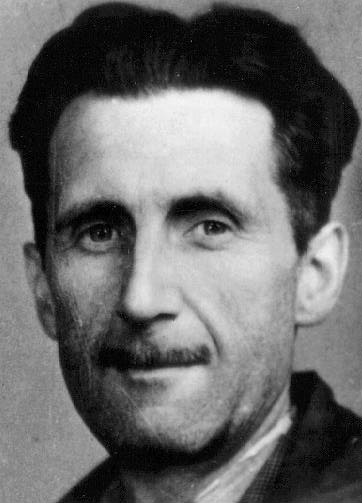
Orwell’s press card portrait, 1943
Attempts at describing a definitely other-worldly happiness have been no more successful. Heaven is as great a flop as Utopia though Hell occupies a respectable place in literature, and has often been described most minutely and convincingly.
It is a commonplace that the Christian Heaven, as usually portrayed, would attract nobody. Almost all Christian writers dealing with Heaven either say frankly that it is indescribable or conjure up a vague picture of gold, precious stones, and the endless singing of hymns. This has, it is true, inspired some of the best poems in the world:
Thy walls are of chalcedony,
Thy bulwarks diamonds square,
Thy gates are of right orient pearl
Exceeding rich and rare!But what it could not do was to describe a condition in which the ordinary human being actively wanted to be. Many a revivalist minister, many a Jesuit priest (see, for instance, the terrific sermon in James Joyce’s Portrait of the Artist) has frightened his congregation almost out of their skins with his word-pictures of Hell. But as soon as it comes to Heaven, there is a prompt falling-back on words like ‘ecstasy’ and ‘bliss’, with little attempt to say what they consist in. Perhaps the most vital bit of writing on this subject is the famous passage in which Tertullian explains that one of the chief joys of Heaven is watching the tortures of the damned.
The pagan versions of Paradise are little better, if at all. One has the feeling it is always twilight in the Elysian fields. Olympus, where the gods lived, with their nectar and ambrosia, and their nymphs and Hebes, the ‘immortal tarts’ as D.H. Lawrence called them, might be a bit more homelike than the Christian Heaven, but you would not want to spend a long time there. As for the Muslim Paradise, with its 77 houris per man, all presumably clamouring for attention at the same moment, it is just a nightmare. Nor are the spiritualists, though constantly assuring us that ‘all is bright and beautiful’, able to describe any next-world activity which a thinking person would find endurable, let alone attractive.
George Orwell (writing as “John Freeman”), “Can Socialists Be Happy?”, Tribune, 1943-12-20.
August 4, 2019
QotD: The post-WW2 American army
They were not half so good soldiers as the bronzed men who followed Rommel in the desert, or the veterans who slashed down toward Bastogne.
They were well armed, but their weapons were no better than those of United States design, if as good.
But the American soldier of 1950, though the same breed of man, was not half so good as the battalions that had absorbed Rommel’s bloody lessons, or stood like steel in the Ardennes.
The weapons his nation had were not in his hands, and those that were were old and worn.
Since the end of World War II ground weapons had been developed, but none had been procured. There were plenty of the old arms around, and it has always been a Yankee habit to make do. The Army was told to make do.
In 1950 its vehicles in many cases would not run. Radiators were clogged, engines gone. When ordered to Korea, some units towed their transport down to the LST’s, because there was no other way to get it to the boat. Tires and tubes had a few miles left in them, and were kept — until they came apart on Korean roads.
In Japan, where the divisions were supposedly guarding our former enemies, most of the small arms had been reported combat unserviceable. Rifle barrels were worn smooth. Mortar mounts were broken, and there were no longer any spare barrels for machine guns.
Radios were short, and those that were available would not work.
Ammunition, except small arms, was “hava-no.”
These things had been reported. The Senate knew them; the people heard them. But usually the Army was told, “Next year.”
Even a rich society cannot afford nuclear bombs, supercarriers, foreign aid, five million new cars a year, long-range bombers, the highest standard of living in the world, and a million new rifles.
Admittedly, somewhere you have to cut and choose.
But guns are hardware, and man, not hardware, is the ultimate weapon. In 1950 there were not enough men, either — less than 600,000 to carry worldwide responsibilities, including recruiting; for service in the ranks has never been on the Metropolitan Life Insurance Company’s preferred list of occupations.
T.R. Fehrenbach, This Kind of War: A Study in Unpreparedness, 1963.
August 3, 2019
QotD: The 1968 election and the schizoid break of the American media
Fortunately for the Democrats, what The Media wanted and what the Democratic Party wanted were in the same ballpark for most of the next three decades. But then Bill Clinton happened, as my students would write. He played The Media’s Messiah fantasies for all they were worth, such that every bobblehead in the country was still defending him as Liberalism’s avatar even as he was governing (in the few odd moments he bothered) as Newt Gingrich’s mini-me and acting like a frat boy on nickel beer night at the strip club.
You just don’t get over something like that.
Which brings us to the elections of 2000 and 2004. Boy do these look different in hindsight! […] I knew The Media was all-in on the Democrat, like they always are. But at the time, I thought that was a tactical decision. That is, I really believed that their attacks on W. were calculated political moves, designed to drag Gore and especially Kerry over the finish line. I thought that only the Mother Jones types were delusional, Iranian mullah-style fanatics.
Nope. The Media — ALL of them — really did see W. as the antichrist, the Twelfth Invisible Hitler (as the Z Man likes to put it) come to destroy the world. So when despite all their sacrifices to Moloch the Chimperor won, The Media went full retard. Like UFO cultists who keep the faith by telling themselves only their fervent prayers staved off the apocalypse, The Media convinced themselves that only more Social Justice would do …
Severian, “The Spirit of ’68”, Rotten Chestnuts, 2019-07-01.
August 2, 2019
QotD: What we mean by “civilization”
Which is when the dime dropped and I realized you guys immediately translated civilization to “as good as we have or better.” Which, of course, made me giggle. Because I’d have liked you to tell a Roman, with their world-bestriding empire that they weren’t civilized. Or, before that a classical Greek.
Understand I am not imagining others before us had the internal combustion engine, or steam, or trains, or … Sure, they might have, but that’s a heck of a coincidence, since those things usually come about by an individual stroke of genius, and even when they do they often aren’t used the way we did (Romans and their mechanical toys.)
To imagine other civilizations of which we’ve forgotten every trace followed exactly the same route we did to the same place we’re at requires believing that inventing steam and the internal combustion engine and harnessing electricity is as natural to humans as dams to beavers.
Now, maybe that’s true. It would certainly make for a very good science fiction story. (Short story, I think. Too much of a punchline thing for a novel.) BUT the odds defy rationality.
I was imagining, you know “builds houses of wood or stone. Domesticated SOME animals. Has villages and cities. Might have trade over long routes. MIGHT have had wheeled vehicles.” (The last, as we know, one can have quite sophisticated civilizations without.)
Look, it’s not your fault. Since the seventies, we’ve been bombarded by crazy BS about superior aliens or superior lost civilizations. (And before that, there was a trickle of it, too, going back I think to the eighteenth century, just couched in different terms.) You’ll get stuff about how the pyramids were built of stones that floated at the sound of a certain note. (A C note, or the equivalent, I bet. “Listen, Mac, you take this stone to the top of the pyramid, I give you a C Note. A hundred Amontheps in your pocket, bucko. Buys a lot of fish and falafel.”)
Part of this, and part of the reason it intensified since the seventies were the “unilateral disarmament people.” You know, those jokers who wanted us to get rid of our own nukes and stand disarmed in front of the USSR, who would then realize we were peaceful, and not attack, and everyone would live in peace and harmony with rainbows and farting unicorns. Yes, it was a stupid and crazy idea since the continued survival of the USSR depended on plunder and conquest. But I’ll remind you our last president still believes that bag of moonshine. All of it, including the unicorn farts.
Sarah Hoyt, “We Are The Superior Civilization”, According to Hoyt, 2017-05-15.
August 1, 2019
QotD: Small government provides little scope for special interest lobbying
The growth of government, in turn, raises the payoff available to special interest groups. With a higher payoff to special interest groups, this encourages the formation of new special interest groups to share in the payoff. A larger government can support a larger number of special interest groups. Thus, as government grows, more special interest groups form. The formation of special interest groups in turn increases the demand for special interest legislation, cause a further growth in government spending.
Randy Holcombe, An Economic Analysis of Democracy, 1985.
July 31, 2019
QotD: Foreshadowing Nuremberg
Orwell’s press card portrait, 1943
Mussolini, in “Cassius’s” book, after calling his witnesses, enters the box himself. He sticks to his Machiavellian creed: Might is Right, vae victis! He is guilty of the only crime that matters, the crime of failure, and he admits that his adversaries have a right to kill him — but not, he insists, a right to blame him. Their conduct has been similar to his own, and their moral condemnations are all hypocrisy. But thereafter come the other three witnesses, the Abyssinian, the Spaniard and the Italian, who are morally upon a different plane, since they have never temporized with Fascism nor had a chance to play at power politics; and all three of them demand the death penalty.
Would they demand it in real life? Will any such thing ever happen? It is not very likely, even if the people who have a real right to try Mussolini should somehow get him into their hands. The Tories, of course, though they would shrink from a real inquest into the origins of the war, are not sorry to have the chance of pushing the whole blame onto a few notorious individuals like Mussolini and Hitler. In this way the Darlan-Badoglio manoeuvre is made easier. Mussolini is a good scapegoat while he is at large, though he would be an awkward one in captivity. But how about the common people? Would they kill their tyrants, in cold blood and with the forms of law if they had the chance?
It is a fact that there have been very few such executions in history. At the end of the last war an election was won partly on the slogan “Hang the Kaiser”, and yet if any such thing had been attempted the conscience of the nation would probably have revolted. When tyrants are put to death, it should be by their own subjects; those who are punished by a foreign authority, like Napoleon, are simply made into martyrs and legends.
What is important is not that these political gangsters should be made to suffer, but that they should be made to discredit themselves. Fortunately they do do so in many cases, for to a surprising extent the war-lords in shining armour, the apostles of the martial virtues, tend not to die fighting when the time comes. History is full of ignominious getaways by the great and famous. Napoleon surrendered to the English in order to get protection from the Prussians, the Empress Eugénie fled in a hansom cab with an American dentist, Ludendorff resorted to blue spectacles, one of the more unprintable Roman emperors tried to escape assassination by locking himself in the lavatory, and during the early days of the Spanish Civil War one leading Fascist made his escape from Barcelona, with exquisite fitness, through a sewer.
It is some such exit that one would wish for Mussolini, and if he is left to himself perhaps he will achieve it. Possibly Hitler also. It used to be said of Hitler that when his time came he would never fly or surrender, but would perish in some operatic manner, by suicide at the very least. But that was when Hitler was successful; during the last year, since things began to go wrong, it is difficult to feel that he has behaved with dignity or courage. “Cassius” ends his book with the judge’s summing-up, and leaves the verdict open, seeming to invite a decision from his readers. Well, if it were left to me, my verdict on both Hitler and Mussolini would be: not death, unless in is inflicted in some hurried unspectacular way. If the Germans and Italians feel like giving them a summary court-martial and then a firing-squad, let them do it. Or better still, let the pair of them escape with a suitcaseful of bearer securities and settle down as the accredited bores of some Swiss pension. But no martyrizing, no St Helena business. And, above all, no solemn hypocritical “trial of war criminals”, with all the slow cruel pageantry of the law, which after a lapse of time has so strange a way of focusing a romantic light on the accused and turning a scoundrel into a hero.
George Orwell, “Who are the War Criminals?”, Tribune, 1943-10-22.
July 30, 2019
QotD: Business versus economics
Erwin Rommel, edited by B.H. Liddell Hart in The Rommel Papers, 1953.
July 29, 2019
QotD: Put up your dukes!
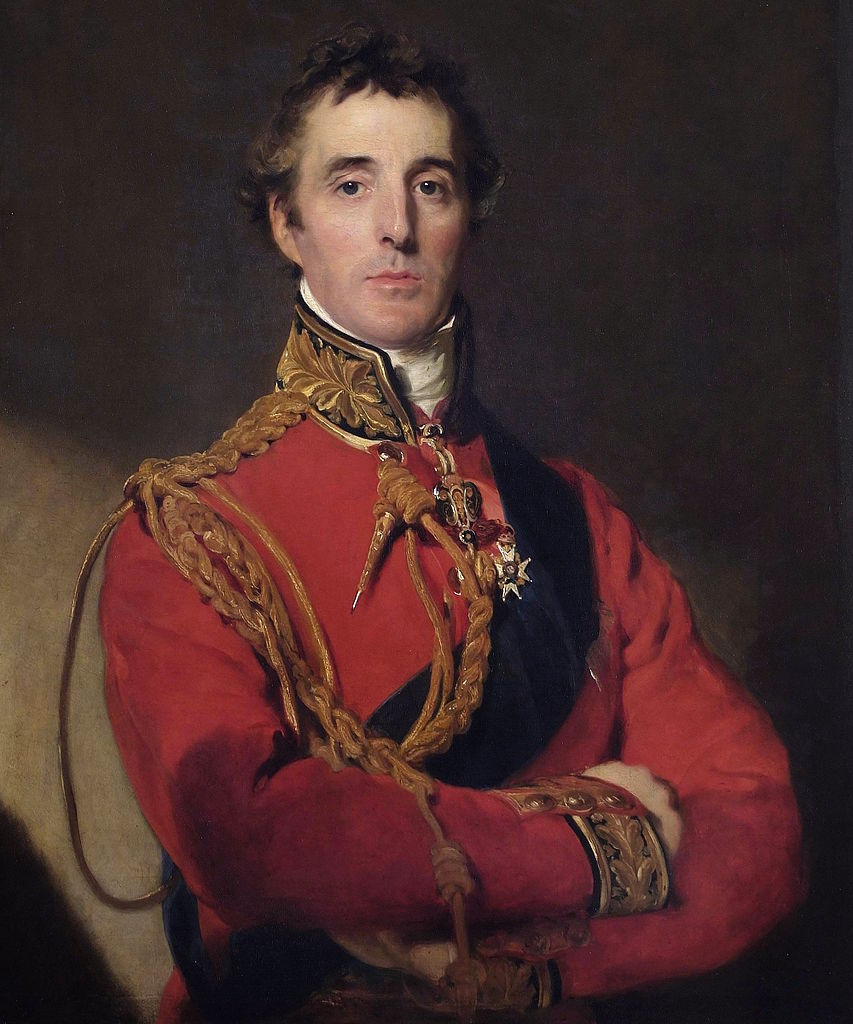
Arthur Wellesley, 1st Duke of Wellington (1769–1852) by Thomas Lawrence, circa 1815-1816.
Wikimedia Commons.The phrase “duke it out”, meaning “fight”, appears to derive ultimately from a nickname of one of the Great Captains, the Duke of Wellington (1769-1852).
It seems that the Duke had a rather prominent nose, so distinctive, in fact, that his troops often referred to him as “Old Nosey”. So the word “duke” soon became a synonym for “nose” in working class English slang, attested during Wellington’s own lifetime. That, in turn, led to the rise of the threat “bust your duke”, meaning “punch your nose”, and thus to “duke buster” as slang for “fist”, which was soon shortened to “duke”.
By further evolution, the phrase “put up your dukes” developed as an invitation to fight and “duke it out” became slang for “fight”.
While some etymologists apparently do not agree with this derivation, it’s worth noting that there is in London a mini-monument to the ducal proboscis, suggesting how notable it was.
Al Nofi, “Al Nofi’s CIC, Issue 472”, Strategy Page, 2019-06-01.
July 28, 2019
QotD: Anglo-Italian relations, 1922-1940
Orwell’s press card portrait, 1943
The history of British relations with Mussolini illustrated the structural weakness of a capitalist state. Granting that power politics are not moral, to attempt to buy Italy out of the Axis — and clearly this idea underlay British policy from 1934 onwards — was a natural strategic move. But it was not a move which Baldwin, Chamberlain and the rest of them were capable of carrying out. It could only have been done by being so strong that Mussolini would not dare to side with Hitler. This was impossible, because an economy ruled by the profit motive is simply not equal to rearming on a modern scale. Britain only began to arm when the Germans were in Calais. Before that, fairly large sums had, indeed, been voted for armaments, but they slid peaceably into the pockets of the shareholders and the weapons did not appear. Since they had no real intention of curtailing their own privileges, it was inevitable that the British ruling class should carry out every policy half-heartedly and blind themselves to the coming danger. But the moral collapse which this entailed was something new in British politics. In the nineteenth and early twentieth centuries, British politicians might be hypocritical, but hypocrisy implies a moral code. It was something new when Tory M.P.s cheered the news that British ships had been bombed by Italian aeroplanes, or when members of the House of Lords lent themselves to organized libel campaigns against the Basque children who had been brought here as refugees.
When one thinks of the lies and betrayals of those years, the cynical abandonment of one ally after another, the imbecile optimism of the Tory press, the flat refusal to believe that the dictators meant war, even when they shouted it from the house-tops, the inability of the moneyed class to see anything wrong whatever in concentration camps, ghettos, massacres and undeclared wars, one is driven to feel that moral decadence played its part as well as mere stupidity. By 1937 or thereabouts it was not possible to be in doubt about the nature of the Fascist régimes. But the lords of property had decided that Fascism was on their side and they were willing to swallow the most stinking evils so long as their property remained secure. In their clumsy way they were playing the game of Machiavelli, of “political realism”, of “anything is right which advances the cause of the Party” — the Party in this case, of course, being the Conservative Party.
All this “Cassius” brings out, but he does shirk its corollary. Throughout his book it is implied that only Tories are immoral. “Yet there is still another England,” he says. “This other England detested Fascism from the day of its birth… this was the England of the Left, the England of Labour.” True, but only part of the truth. The actual behaviour of the Left has been more honourable than its theories. It has fought against Fascism, but its representative thinkers have entered just as deeply as their opponents into the evil world of “realism” and power politics.
“Realism” (it used to be called dishonesty) is part of the general political atmosphere of our time. It is a sign of the weakness of “Cassius”s position that one could compile a quite similar book entitled The Trial of Winston Churchill, or The Trial of Chiang Kai-shek, or even The Trial of Ramsay MacDonald. In each case you would find the leaders of the Left contradicting themselves almost as grossly as the Tory leader quoted by “Cassius”. For the Left has also been willing to shut its eyes to a great deal and to accept some very doubtful allies. We laugh now to hear the Tories abusing Mussolini when they were flattering him five years ago, but who would have foretold in 1927 that the Left would one day take Chiang Kai-shek to its bosom? Who would have foretold just after the General Strike that ten years later Winston Churchill would be the darling of the Daily Worker? In the years 1935-9, when almost any ally against Fascism seemed acceptable, left-wingers found themselves praising Mustapha Kemal and then developing tenderness for Carol of Rumania.
George Orwell, “Who are the War Criminals?”, Tribune, 1943-10-22.
July 27, 2019
QotD: Ban roses!
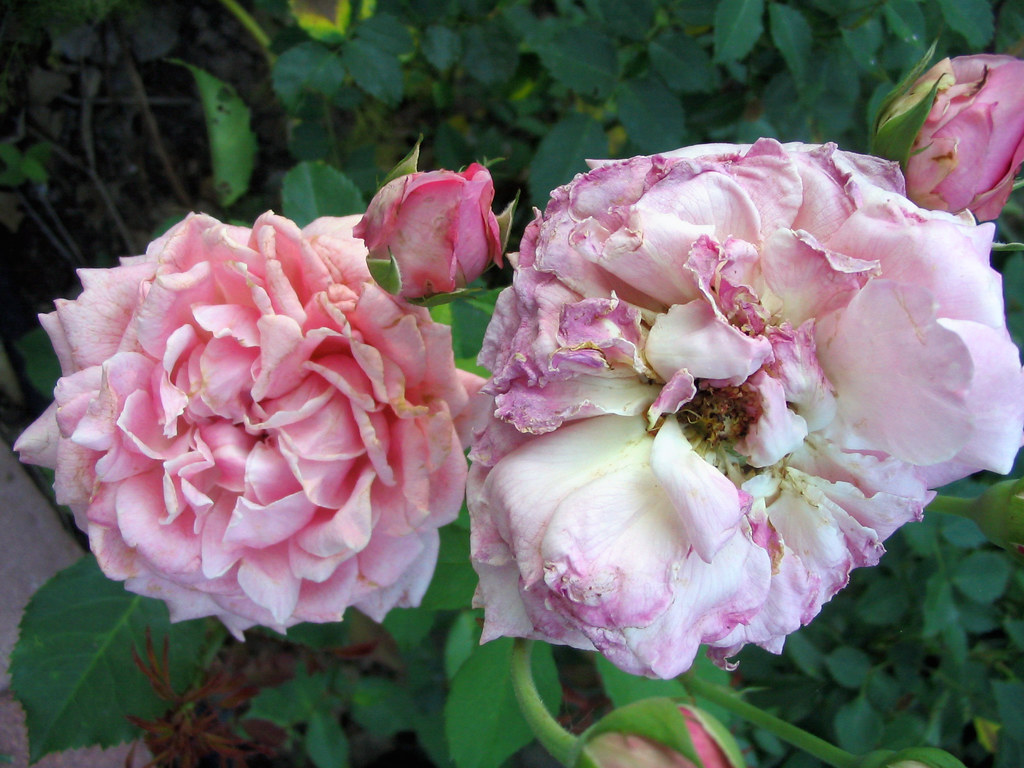
“roses 2007”by katecat is licensed under CC BY-NC-SA 2.0
Be honest: the roses one encounters in daily life are, mostly, hideous. Think of the colors: syphilitically inflamed orange, or highlighter-pen salmon, or nylon pink, or overripe-banana yellow. How often have you bent to smell a neighbor’s rose, ready to snort up a lungful of Turkish-delight deliciousness, only to discover no scent at all? The names, too — Newly Wed, Scentimental, Golden Smiles, Admiral Rodney, Bright ‘n’ Breezy — put breeders of pedigree dogs to shame. But worst of all is the plant itself: drab little leaves, plagued with leprous brown spots or grazing aphids; prickled shoots whipping in the wind above gnarled, charmless trunks. And no one knows how to prune them. Invariably either overdisciplined or scrubby, viciously trained into a municipal pygmy or as amateurishly hacked at as a young porcupine with a home haircut, the vast majority are tragic shadows of the perfect rose in its ruffled, scented bounty.
What’s more, they are dangerous. Which other common garden plant requires one to wear chainmail to perform the simplest tying-in, sharpened secateurs for ceaseless deadheading, a full hazmat outfit in which to spray it with the toxins required to keep it pretty? Haven’t you heard the stories of gardeners who, after a single rose-thorn puncture, lost an arm, or more? Would you keep a shark in your front yard? Precisely.
Charlotte Mendelson, “Let’s Ban Roses”, The New Yorker, 2017-06-21.


July 26, 2019
QotD: Preparing for war
T.R. Fehrenbach, This Kind of War: A Study in Unpreparedness, 1963.


