
The widths of the Pacific continued unaltered for millions of years. Temperatures scarcely dropped there in the Ice Ages. Generation after generation of Pacific birds were able to evolve in an almost completely stable world. Birds which somehow or other had arrived on remote islands branched into different species. In the Atlantic, there was hardly time to do that between the Ice Ages […] in the Atlantic endemics — species confined to particular places — only rarely evolved.
What you see when the puffins arrive in the spring is a product of this history. The Atlantic, for the past 2.74 million years has been a place of coming and going, unsettled at the deepest of levels, a system always ready to flip from relatively beneficent to deeply unaccommodating. Life does not have the time here to develop the mass of differentiated variety it has within the security of the Pacific.
[…]
The result is that now in the North Atlantic there is relatively little local variation. Species have evolved to cope with the variability and have wide ranges across the latitudes. The Pacific is a mosaic of local land-based varieties; the Atlantic the exclusive realm of the ocean travellers, birds which have distance embedded in their way of being.
Adam Nicholson, The Seabird’s Cry: The Lives and Loves of Puffins, Gannets and Other Ocean Voyagers, 2017.
July 25, 2019
QotD: Ice ages as evolutionary drivers
July 24, 2019
QotD: The failure of the Republican cause in the Spanish Civil War
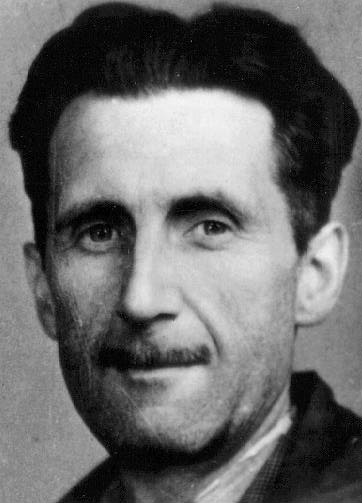
Orwell’s press card portrait, 1943
The backbone of the resistance against Franco was the Spanish working class, especially the urban trade union members. In the long run — it is important to remember that it is only in the long run — the working class remains the most reliable enemy of Fascism, simply because the working-class stands to gain most by a decent reconstruction of society. Unlike other classes or categories, it can’t be permanently bribed.
To say this is not to idealize the working class. In the long struggle that has followed the Russian Revolution it is the manual workers who have been defeated, and it is impossible not to feel that it was their own fault. Time after time, in country after country, the organized working-class movements have been crushed by open, illegal violence, and their comrades abroad, linked to them in theoretical solidarity, have simply looked on and done nothing; and underneath this, secret cause of many betrayals, has lain the fact that between white and coloured workers there is not even lip-service to solidarity. Who can believe in the class-conscious international proletariat after the events of the past ten years? To the British working class the massacre of their comrades in Vienna, Berlin, Madrid, or wherever it might be seemed less interesting and less important than yesterday’s football match. Yet this does not alter the fact that the working class will go on struggling against Fascism after the others have caved in. One feature of the Nazi conquest of France was the astonishing defections among the intelligentsia, including some of the left-wing political intelligentsia. The intelligentsia are the people who squeal loudest against Fascism, and yet a respectable proportion of them collapse into defeatism when the pinch comes. They are far-sighted enough to see the odds against them, and moreoever they can be bribed — for it is evident that the Nazis think it worth while to bribe intellectuals. With the working class it is the other way about. Too ignorant to see through the trick that is being played on them, they easily swallow the promises of Fascism, yet sooner or later they always take up the struggle again. They must do so, because in their own bodies they always discover that the promises of Fascism cannot be fulfilled. To win over the working class permanently, the Fascists would have to raise the general standard of living, which they are unable and probably unwilling to do. The struggle of the working class is like the growth of a plant. The plant is blind and stupid, but it knows enough to keep pushing upwards towards the light, and it will do this in the face of endless discouragements. What are the workers struggling for? Simply for the decent life which they are more and more aware is now technically possible. Their consciousness of this aim ebbs and flows. In Spain, for a while, people were acting consciously, moving towards a goal which they wanted to reach and believed they could reach. It accounted for the curiously buoyant feeling that life in Government Spain had during the early months of the war. The common people knew in their bones that the Republic was their friend and Franco was their enemy. They knew that they were in the right, because they were fighting for something which the world owed them and was able to give them.
One has to remember this to see the Spanish war in its true perspective. When one thinks of the cruelty, squalor, and futility of War — and in this particular case of the intrigues, the persecutions, the lies and the misunderstandings — there is always the temptation to say: “One side is as bad as the other. I am neutral”. In practice, however, one cannot be neutral, and there is hardly such a thing as a war in which it makes no difference who wins. Nearly always one stands more or less for progress, the other side more or less for reaction. The hatred which the Spanish Republic excited in millionaires, dukes, cardinals, play-boys, Blimps, and what-not would in itself be enough to show one how the land lay. In essence it was a class war. If it had been won, the cause of the common people everywhere would have been strengthened. It was lost, and the dividend-drawers all over the world rubbed their hands. That was the real issue; all else was froth on its surface.
George Orwell, “Looking back on the Spanish War”, New Road, 1943 (republished in England, Your England and Other Essays, 1953).
July 23, 2019
QotD: Science of the ancient Greeks
The problem with all this is not just that the scholars of the Mouseion were rather more interested in the textual variants of Pindar’s paianes than studying physics, but also a common modern misunderstanding about the nature of Greek “science”. Many modern people, including modern scientists, hear about the Greeks discussing motion or “atoms” or doing geometry to measure the circumference of the Earth or the distance to the Sun and assume that they were doing “science” in the modern sense of the word. Historians also sometimes refer to Greek natural philosophy as “science” and popularisations of the history of science draw simplistic direct lines between things like Greek discussions of “atoms” and modern atomic theory. But this obscures the fact that Greek proto-science was, while a distant lineal ancestor of the modern sciences, very unlike them in many important respects. At best, it was a highly rational attempt at understanding fundamental precepts of the physical and natural world. But it used induction and common sense more than measurement and experiment. There were exceptions (mainly in geometry and its related field, astronomy), but the Greeks were usually not interested in empirical measurement and so were usually even less interested in genuine experiments. Most Greek proto-science was a highly abstract and philosophical affair, based on some observations, but without modern ideas of carefully designed and repeatable experiments with calibrated measurement and attendant mathematics. Most of their “science” was done by sitting around, thinking and talking about concepts, not by actually dropping weights from towers – though they did do thought experiments which sometimes led to correct conclusions and sometimes did not. Their “science” was not our science.
This means that a Greek conversation about “atoms” was largely an abstract and metaphysical exercise about the philosophical nature of a thing and how many times it could be divided conceptually and what this may mean; the word comes from the Greek ἄτομος meaning “unhewn, uncut, indivisible”. No Greek philosopher walked away from such a conversation and decided to try to build some equipment to explore the physical nature of atomic structure and would probably have considered such an idea absurd. Nor would they have taken the step of considering that different forms of matter, liquid or gas were made up of different combinations of atoms and so decide to experiment with these substances to understand this better, since this was completely contrary to their (erroneous) conception of the “Four Elements” of Earth, Air, Water and Fire. The nature of Greek thought did allow them to draw useful and often correct conclusions about the physical universe, but it also set up barriers to the true scientific method that they simply did not and could not cross.
This was one of the reasons there was no direct link between their proto-scientific “science” and technology. Natural philosophy was, as the term would suggest, the preserve of philosophers. In a world where most of the population had to be devoted to agricultural production and most of the rest often barely got by, sitting around and talking about abstractions like “atoms” was a rich man’s luxury. Most philosophers either came from the upper class (though maybe its lower echelons in many cases) or had rich patrons or both, which meant most philosophers had little interest in making or inventing things: that was generally the preserve of lowly mechanics and slaves. Again, there were exceptions to this – Archimedes seems to have had some interest in the engineering applications of his ideas, even if most of the inventions attributed to him are probably legends. On the whole, however, lofty Greek philosophers didn’t think to soil their hands with something as lowly as inventing and making things.
Tim O’Neill, “The Great Myths 5: The Destruction Of The Great Library Of Alexandria”, History for Atheists, 2017-07-02.
July 22, 2019
QotD: Vivid vacation memories
Ten days in a far-off land produces a richer treasury of detailed memories than 10 weeks back home. But what is behind this phenomenon? And does it teach us something about living a full life?
One answer comes from Claude Shannon, a titan of computer science still under-appreciated outside his field. In 1948, Shannon published one of his two profound contributions, A Mathematical Theory of Communication.
One of the implications of Shannon’s theory is that a message can be compressed to the extent that it is predictable. Anyone who has played the guessing game of Hangman knows that once a few letters are in place, the remainder are usually easy to guess. Similarly: sntnces wth vwls rmvd sty cmprhsbl. Ritualised conversations (“How are you?” “Very well, thank you. How are you?”) can be heavily compressed; poetry, perhaps, less so.
A movie can be compressed because, between cuts, each frame tends to resemble the previous one. A compression algorithm can start with the first frame after the cut and store a series of “diffs” — changes from the previous frame. The faster and more dramatic the movement or transitions, the harder a video is to compress, because the diffs are almost as big as the original frames.
Although the parallel is not exact, much the same thing seems to be going on with our memories of life. The brain is not a video recorder; we recall the gist. Sometimes the gist is very brief. If I get up in the morning at the usual time, eat my customary breakfast and catch my usual train to the office, why should my brain trouble itself to remember this day two weeks after the fact? The diffs are barely worth bothering with. In contrast, fresh experiences defy compression: the diffs are too big.
Tim Harford, “Why going on holiday gives us more memories”, Financial Times, 2019-04-26.
July 21, 2019
QotD: History in a totalitarian age
Orwell’s press card portrait, 1943
I know it is the fashion to say that most of recorded history is lies anyway. I am willing to believe that history is for the most part inaccurate and biased, but what is peculiar to our own age is the abandonment of the idea that history could be truthfully written. In the past people deliberately lied, or they unconsciously coloured what they wrote, or they struggled after the truth, well knowing that they must make many mistakes; but in each case they believed that “facts” existed and were more or less discoverable. And in practice there was always a considerable body of fact which would have been agreed to by almost everyone. If you look up the history of the last war in, for instance, the Encyclopaedia Britannica, you will find that a respectable amount of the material is drawn from German sources. A British and a German historian would disagree deeply on many things, even on fundamentals, but there would still be that body of, as it were, neutral fact on which neither would seriously challenge the other. It is just this common basis of agreement, with its implication that human beings are all one species of animal, that totalitarianism destroys. Nazi theory indeed specifically denies that such a thing as “the truth” exists. There is, for instance, no such thing as “Science”. There is only “German Science”, “Jewish Science”, etc. The implied objective of this line of thought is a nightmare world in which the Leader, or some ruling clique, controls not only the future but the past. If the Leader says of such and such an event, “It never happened” — well, it never happened. If he says that two and two are five — well, two and two are five. This prospect frightens me much more than bombs — and after our experiences of the last few years that is not a frivolous statement.
But is it perhaps childish or morbid to terrify oneself with visions of a totalitarian future? Before writing off the totalitarian world as a nightmare that can’t come true, just remember that in 1925 the world of today would have seemed a nightmare that couldn’t come true. Against that shifting phantasmagoric world in which black may be white tomorrow and yesterday’s weather can be changed by decree, there are in reality only two safeguards. One is that however much you deny the truth, the truth goes on existing, as it were, behind your back, and you consequently can’t violate it in ways that impair military efficiency. The other is that so long as some parts of the earth remain unconquered, the liberal tradition can be kept alive. Let Fascism, or possibly even a combination of several Fascisms, conquer the whole world, and those two conditions no longer exist. We in England underrate the danger of this kind of thing, because our traditions and our past security have given us a sentimental belief that it all comes right in the end and the thing you most fear never really happens. Nourished for hundreds of years on a literature in which Right invariably triumphs in the last chapter, we believe half-instinctively that evil always defeats itself in the long run. Pacifism, for instance, is founded largely on this belief. Don’t resist evil, and it will somehow destroy itself. But why should it? What evidence is there that it does? And what instance is there of a modern industrialized state collapsing unless conquered from the outside by military force?
Consider for instance the re-institution of slavery. Who could have imagined twenty years ago that slavery would return to Europe? Well, slavery has been restored under our noses. The forced-labour camps all over Europe and North Africa where Poles, Russians, Jews and political prisoners of every race toil at road-making or swamp-draining for their bare rations, are simple chattle slavery. The most one can say is that the buying and selling of slaves by individuals is not yet permitted. In other ways — the breaking-up of families, for instance — the conditions are probably worse than they were on the American cotton plantations. There is no reason for thinking that this state of affairs will change while any totalitarian domination endures. We don’t grasp its full implications, because in our mystical way we feel that a regime founded on slavery must collapse. But it is worth comparing the duration of the slave empires of antiquity with that of any modern state. Civilizations founded on slavery have lasted for such periods as four thousand years.
When I think of antiquity, the detail that frightens me is that those hundreds of millions of slaves on whose backs civilization rested generation after generation have left behind them no record whatever. We do not even know their names. In the whole of Greek and Roman history, how many slaves’ names are known to you? I can think of two, or possibly three. One is Spartacus and the other is Epictetus. Also, in the Roman room at the British Museum there is a glass jar with the maker’s name inscribed on the bottom, “Felix fecit“. I have a mental picture of poor Felix (a Gaul with red hair and a metal collar round his neck), but in fact he may not have been a slave; so there are only two slaves whose names I definitely know, and probably few people can remember more. The rest have gone down into utter silence.
George Orwell, “Looking back on the Spanish War”, New Road, 1943 (republished in England, Your England and Other Essays, 1953).
July 20, 2019
QotD: Spices
Several lines of evidence indicate that spicing may represent a class of cultural adaptations to the problem of food-borne pathogens. Many spices are antimicrobials that can kill pathogens in foods. Globally, common spices are onions, pepper, garlic, cilantro, chili peppers (capsicum) and bay leaves. Here’s the idea: the use of many spices represents a cultural adaptation to the problem of pathogens in food, especially in meat. This challenge would have been most important before refrigerators came on the scene. To examine this, two biologists, Jennifer Billing and Paul Sherman, collected 4578 recipes from traditional cookbooks from populations around the world. They found three distinct patterns.
1. Spices are, in fact, antimicrobial. The most common spices in the world are also the most effective against bacteria. Some spices are also fungicides. Combinations of spices have synergistic effects, which may explain why ingredients like “chili power” (a mix of red pepper, onion, paprika, garlic, cumin and oregano) are so important. And, ingredients like lemon and lime, which are not on their own potent anti-microbials, appear to catalyze the bacteria killing effects of other spices.
2. People in hotter climates use more spices, and more of the most effective bacteria killers. In India and Indonesia, for example, most recipes used many anti-microbial spices, including onions, garlic, capsicum and coriander. Meanwhile, in Norway, recipes use some black pepper and occasionally a bit of parsley or lemon, but that’s about it.
3. Recipes appear to use spices in ways that increase their effectiveness. Some spices, like onions and garlic, whose killing power is resistant to heating, are deployed in the cooking process. Other spices like cilantro, whose antimicrobial properties might be damaged by heating, are added fresh in recipes.
Thus, many recipes and preferences appear to be cultural adaptations adapted to local environments that operate in subtle and nuanced ways not understood by those of us who love spicy foods. Billing and Sherman speculate that these evolved culturally, as healthier, more fertile and more successful families were preferentially imitated by less successful ones. This is quite plausible given what we know about our species’ evolved psychology for cultural learning, including specifically cultural learning about foods and plants.
Among spices, chili peppers are an ideal case. Chili peppers were the primary spice of New World cuisines, prior to the arrival of Europeans, and are now routinely consumed by about a quarter of all adults, globally. Chili peppers have evolved chemical defenses, based on capsaicin, that make them aversive to mammals and rodents but desirable to birds. In mammals, capsicum directly activates a pain channel (TrpV1), which creates a burning sensation in response to various specific stimuli, including acid, high temperatures and allyl isothiocyanate (which is found in mustard or wasabi). These chemical weapons aid chili pepper plants in their survival and reproduction, as birds provide a better dispersal system for the plants’ seeds than other options (like mammals). Consequently, chilies are innately aversive to non-human primates, babies and many human adults. Capsaicin is so innately aversive that nursing mothers are advised to avoid chili peppers, lest their infants reject their breast (milk), and some societies even put capsicum on mom’s breasts to initiate weaning. Yet, adults who live in hot climates regularly incorporate chilies into their recipes. And, those who grow up among people who enjoy eating chili peppers not only eat chilies but love eating them. How do we come to like the experience of burning and sweating — the activation of pain channel TrpV1?
Research by psychologist Paul Rozin shows that people come to enjoy the experience of eating chili peppers mostly by re-interpreting the pain signals caused by capsicum as pleasure or excitement. Based on work in the highlands of Mexico, children acquire this gradually without being pressured or compelled. They want to learn to like chili peppers, to be like those they admire. This fits with what we’ve already seen: children readily acquire food preferences from older peers. In Chapter 14, we further examine how cultural learning can alter our bodies’ physiological response to pain, and specifically to electric shocks. The bottom line is that culture can overpower our innate mammalian aversions, when necessary and without us knowing it.
Joseph Henrich, The Secret of Our Success: How Culture Is Driving Human Evolution, Domesticating Our Species, and Making Us Smarter, 2015.
July 19, 2019
QotD: “Re-imagining” Notre-Dame de Paris
So far their proposals have included apiaries and swimming pools, and all of them look like greenhouses for the cultivation of marijuana. And why not? After all, Baudelaire wrote a book about les paradis artificiels, that is to say those induced by psychoactive substances, and is not a spire an arrow pointing up to heaven? All conceptions of paradise are artificial in the sense than none of us has any direct knowledge of such a location; perhaps, in the spirit of ecumenical multiculturalism, a kind of Muslim-style paradise could be created under the glass roof (I shall refrain from describing it because young people might read this).
Of course, there is no end to the uses to which this prime space might be put. There could, for example, be a three-Michelin-star restaurant there. Think of the rent it would pay, the prices it could charge! The French state (which is responsible for the upkeep of the building) would — or at least could — be relieved of financial anxiety about it.
This proposal might be objected to because it would not be socially inclusive enough; the Pope would not countenance it because it would exclude illegal immigrants (except, perhaps, as plongeurs). The customers would be mainly wealthy foreigners, Russian oligarchs, Gulf oil sheikhs, and the like, and while this might assist with France’s yawning commercial deficit, it would do little for social justice, the ultimate aim of human existence, by which is meant the reduction of everything to the lowest common denominator.
Theodore Dalrymple, “What to Do With Notre-Dame?”, Taki’s Magazine, 2019-05-25.
July 18, 2019
QotD: “They might speak English, but they don’t speak Western”
But something happened to me last night, I had a kind of realization. It suddenly hit me WHY that is.
It’s because Harry Potter is literally all they collectively know.
Schools don’t teach history anymore.
They no longer teach the canon of Western literature.
They certainly don’t teach the Bible.So Millennials literally have no points of common reference. It’s not that they all just want to look like complete morons by infantilizing their political metaphor to the level of a children’s book, it’s that they have no other choice.
They’re literally bereft of the allegorical language of the West. I’m sure there’s some Harry Potter monster analogy I could use to explain it to them, how it’s like monsters have come along and literally stolen their ability to speak, their common language, and their birthright.
They can no longer express or understand the set of references we have from our past, our most prized stories, and our culture’s religious quotations. They can’t do Shakespeare, Milton, or even Mark Twain because they’ve never learned any of these while they were being taught Indonesian multicultural dancing and given participation awards. They don’t know what happened at Hastings in 1066, at Runnymede in 1215, or even at Sarajevo in 28th June 1914, because they were being given feminist diversity training instead of learning the history of their civilization. They certainly don’t know what “the least of these” refers to or where it comes from, as a recent event with a White House staffer proved.
They’ve lost the entire allegorical language of the West. They might speak English, but they don’t speak Western. To them, it’s like a foreign, dead, alien language. A set of stories they do not know.
RPGPundit, “Harry Potter and the way Millennial Leftists Don’t Even Speak Western Anymore”, The RPGPundit, 2017-02-02.
July 17, 2019
QotD: “The United States government [became] the greatest and most potent maker of criminals in any recent century”
But then he noticed what happened to his addicted patients. They didn’t stop using. Instead, “here were tens of thousands of people, in every walk of life, frantically craving drugs that they could in no legal way secure,” he wrote in one of his books. “They craved the drugs, as a man dying of thirst craves water. They must have the drugs at any hazard, at any cost.”
At the same time, Smith Williams realized that the drug war was “in effect ordering a company of drug smugglers into existence.” Because pharmacists could no longer sell these drugs, the Mafia and other criminal organizations stepped in, selling a vastly inferior product at extortionate prices. In the pharmacies, morphine had cost two or three cents a grain, but the criminal gangs charged a dollar.
The death rate among addicts rose, and those who survived began to behave very differently. An official government study had found that, before the drug war kicked in, three-quarters of self-described addicts had steady and respectable jobs: some 22% were wealthy, while only 6% were poor. They were more sedate as a result of their addiction, but they were rarely out of control or criminal. Yet faced with the need to meet these extortionate new prices, many of the men started to commit property crimes, and many of the women started to steal or prostitute themselves.
So Smith Williams watched as the drug war created two waves of crime: first a wave of violent criminal drug-dealers, and then a wave of criminality among addicts. “The United States government,” Henry wrote in shock, had become “the greatest and most potent maker of criminals in any recent century.”
Johann Hari, “A 1930s California story shows why the war on drugs is a failure”, Los Angeles Times, 2017-06-16.
July 16, 2019
QotD: Wartime atrocities
Orwell’s press card portrait, 1943
I have little direct evidence about the atrocities in the Spanish civil war. I know that some were committed by the Republicans, and far more (they are still continuing) by the Fascists. But what impressed me then, and has impressed me ever since, is that atrocities are believed in or disbelieved in solely on grounds of political predilection. Everyone believes in the atrocities of the enemy and disbelieves in those of his own side, without ever bothering to examine the evidence. Recently I drew up a table of atrocities during the period between 1918 and the present; there was never a year when atrocities were not occurring somewhere or other, and there was hardly a single case when the Left and the Right believed in the same stories simultaneously. And stranger yet, at any moment the situation can suddenly reverse itself and yesterday’s proved-to-the-hilt atrocity story can become a ridiculous lie, merely because the political landscape has changed.
In the present war we are in the curious situation that our “atrocity campaign” was done largely before the war started, and done mostly by the Left, the people who normally pride themselves on their incredulity. In the same period the Right, the atrocity-mongers of 1914-18, were gazing at Nazi Germany and flatly refusing to see any evil in it. Then as soon as war broke out it was the pro-Nazis of yesterday who were repeating horror stories, while the anti-Nazis suddenly found themselves doubting whether the Gestapo really existed. Nor was this solely the result of the Russo-German Pact. It was partly because before the war the Left had wrongly believed that Britain and Germany would never fight and were therefore able to be anti-German and anti-British simultaneously; partly also because official war-propaganda, with its disgusting hypocrisy and self-righteousness, always tends to make thinking people sympathize with the enemy. Part of the price we paid for the systematic lying of 1914-17 was the exaggerated pro-German reaction which followed. During the years 1918-33 you were hooted at in left-wing circles if you suggested that Germany bore even a fraction of responsibility for the war. In all the denunciations of Versailles I listened to during those years I don’t think I ever once heard the question, “What would have happened if Germany had won?” even mentioned, let alone discussed. So also with atrocities. The truth, it is felt, becomes untruth when your enemy utters it. Recently I noticed that the very people who swallowed any and every horror story about the Japanese in Nanking in 1937 refused to believe exactly the same stories about Hong Kong in 1942. There was even a tendency to feel that the Nanking atrocities had become, as it were, retrospectively untrue because the British Government now drew attention to them.
But unfortunately the truth about atrocities is far worse than that they are lied about and made into propaganda. The truth is that they happen. The fact often adduced as a reason for scepticism — that the same horror stories come up in war after war — merely makes it rather more likely that these stories are true. Evidently they are widespread fantasies, and war provides an opportunity of putting them into practice. Also, although it has ceased to be fashionable to say so, there is little question that what one may roughly call the “whites” commit far more and worse atrocities than the “reds”. There is not the slightest doubt, for instance, about the behaviour of the Japanese in China. Nor is there much doubt about the long tale of Fascist outrages during the last ten years in Europe. The volume of testimony is enormous, and a respectable proportion of it comes from the German press and radio. These things really happened, that is the thing to keep one’s eye on. They happened even though Lord Halifax said they happened. The raping and butchering in Chinese cities, the tortures in the cellars of the Gestapo, the elderly Jewish professors flung into cesspools, the machine-gunning of refugees along the Spanish roads — they all happened, and they did not happen any the less because the Daily Telegraph has suddenly found out about them when it is five years too late.
George Orwell, “Looking back on the Spanish War”, New Road, 1943 (republished in England, Your England and Other Essays, 1953).
July 15, 2019
QotD: The Canadian Broadcasting Corporation
CBC’s television and online news departments are a haunted museum of bloat, larding tons of valuable content with tiresome victim-mongering; endless why-didn’t-the-government-prevent-this stories; Trudeau propaganda snaps beamed straight in from the Prime Minister’s Office; a dumb, tawdry nightly newscast; an opinion section that pays writers way over market (though, ahem, nothing more than what’s fair!); Canadian Press wire copy of which a lavishly resourced public broadcaster has no earthly need; and an entire clickbait department that’s stealing digital advertising revenue from private-sector outlets. It has no clear mandate to do much of this in the first place — indeed, the Heritage Committee recommended getting CBC out of digital revenue altogether — and unlike CBC Radio and SRC, I’m not aware of a single human being who supports the TV/online status quo.
Chris Selley, “Federal government should stop trying to help private media and fix the CBC”, National Post, 2017-06-20.
July 14, 2019
QotD: The legacy of the original hippies
Not now I’m older and wiser, I don’t. Beneath the kaftan of every other hippie beats the heart of a fascist — the intolerance, the zeal, the control-freakery — and it all stems from that moment, pinpointed in the documentary, when a left-wing activist and Berkeley drop-out named Jerry Rubin had a sudden insight: that there were more hippies than there were radicals.
The unfortunate result of this was that Rubin and his ilk realised that they could prey like vampires on these fluffy-headed flower children and turn their innocent yearning for peace, love and drug-addled sex into something much more dangerous, whose effects we are ruing to this day.
All that long hair, those beads, the patchouli, the starry eyes, the psychedelic sounds of the Grateful Dead; they were really just a kandy-kolored, tangerine-flake Trojan Horse for the values — or rather the anti-values — that have gone on to make our culture so weak, decadent and vulnerable to destruction by more iron-willed invaders.
This was, of course, exactly what influential campus thinkers of the time such as German-born cultural Marxist philosopher Herbert Marcuse wanted. For them, free love, female emancipation, black empowerment, the groovy rejection of authority and pursuit of the self — all sugar-coated with a great soundtrack and lashings of lovely psychotropics — were really just a means to an end: the death of the family, the dismantling of the system, and, ultimately the destruction of western civilisation.
James Delingpole, “Hippies gave us wonderful things, but they left an evil legacy too”, The Spectator, 2017-06-10.
July 13, 2019
QotD: The severe spotlight deprivation (SSD) sufferer
I confronted a SSD sufferer recently. I was delivering a keynote. The questioner was not – and his ostentatiously displayed knowledge was as dated as his shiny silver suit. After, he approached me in the lunch room and stated: “It will be great to see how your career develops from here.”
I had published 17 books when he offered that comment. He had not. If I was any more developed, my breasts would occupy two time zones. But the mediocrity of SSD sufferers rarely allows facts to inform the movements of their restless tongues.
Tara Brabazon, “Fifty shades of conference feedback”, Times Higher Education, 2017-07-06.
July 12, 2019
QotD: Warmongers, propaganda, and the intelligentsia
Orwell’s press card portrait, 1943
Our memories are short nowadays, but look back a bit, dig out the files of New Masses or the Daily Worker, and just have a look at the romantic warmongering muck that our left-wingers were spilling at that time. All the stale old phrases! And the unimaginative callousness of it! The sang-froid with which London faced the bombing of Madrid! Here I am not bothering about the counter-propagandists of the Right […]; they go without saying. But here were the very people who for twenty years had hooted and jeered at the “glory” of war, at atrocity stories, at patriotism, even at physical courage, coming out with stuff that with the alteration of a few names would have fitted into the Daily Mail of 1918. If there was one thing that the British intelligentsia were committed to, it was the debunking version of war, the theory that war is all corpses and latrines and never leads to any good result. Well, the same people who in 1933 sniggered pityingly if you said that in certain circumstances you would fight for your country, in 1937 were denouncing you as a Trotsky-Fascist if you suggested that the stories in New Masses about freshly wounded men clamouring to get back into the fighting might be exaggerated. And the Left intelligentsia made their swing-over from “War is hell” to “War is glorious” not only with no sense of incongruity but almost without any intervening stage. Later the bulk of them were to make other transitions equally violent. There must be a quite large number of people, a sort of central core of the intelligentsia, who approved the “King and Country” declaration in 1935, shouted for a “firm line against Germany” in 1937, supported the People’s Convention in 1940, and are demanding a Second Front now.
As far as the mass of the people go, the extraordinary swings of opinion which occur nowadays, the emotions which can be turned on and off like a tap, are the result of newspaper and radio hypnosis. In the intelligentsia I should say they result rather from money and mere physical safety. At a given moment they may be “pro-war” or “anti-war”, but in either case they have no realistic picture of war in their minds. When they enthused over the Spanish war they knew, of course, that people were being killed and that to be killed is unpleasant, but they did feel that for a soldier in the Spanish Republican army the experience of war was somehow not degrading. Somehow the latrines stank less, discipline was less irksome. You have only to glance at the New Statesman to see that they believed that; exactly similar blah is being written about the Red Army at this moment. We have become too civilized to grasp the obvious. For the truth is very simple. To survive you often have to fight, and to fight you have to dirty yourself. War is evil, and it is often the lesser evil. Those who take the sword perish by the sword, and those who don’t take the sword perish by smelly diseases. The fact that such a platitude is worth writing down shows what the years of rentier capitalism have done to us.
George Orwell, “Looking back on the Spanish War”, New Road, 1943 (republished in England, Your England and Other Essays, 1953).
July 11, 2019
QotD: English is weird
The first thing that got us from there to here was the fact that, when the Angles, Saxons and Jutes (and also Frisians) brought their language to England, the island was already inhabited by people who spoke very different tongues. Their languages were Celtic ones, today represented by Welsh, Irish and Breton across the Channel in France. The Celts were subjugated but survived, and since there were only about 250,000 Germanic invaders – roughly the population of a modest burg such as Jersey City – very quickly most of the people speaking Old English were Celts.
Crucially, their languages were quite unlike English. For one thing, the verb came first (came first the verb). But also, they had an odd construction with the verb do: they used it to form a question, to make a sentence negative, and even just as a kind of seasoning before any verb. Do you walk? I do not walk. I do walk. That looks familiar now because the Celts started doing it in their rendition of English. But before that, such sentences would have seemed bizarre to an English speaker – as they would today in just about any language other than our own and the surviving Celtic ones. Notice how even to dwell upon this queer usage of do is to realise something odd in oneself, like being made aware that there is always a tongue in your mouth.
John McWhorter, “English is not normal”, Aion, 2015-11-13.


