
An email from a correspondent, who is not in Guam, reminds me to remind gentle reader of a truth I take for self-evident, but perhaps others don’t. We personalize the State. I do myself, when I refer to it as Big Brother, Big Sister, Twisted Nanny, &c. But this is a conceit. As anyone caught in the jaws of Big Shark should realize, it doesn’t think like a human. It thinks more like a mechanism. Of course, when the mechanism has selected one’s own person for food — I am thinking here of the Revenue Department, but government agencies are all much the same — little can be done. One might beg for mercy, but the thing is not designed to dispense mercy. That is not its function. Its function is to absorb protein.
Guvmint agents themselves — the cells and their switches — are task-oriented. Each signed off his right to make humane judgements when he took the job.
We used to have reactionary courts, to restrain the creature. Now we have progressive courts, to urge it on.
Among the foibles of democracy, is the notion that “the peeple” are somehow in control. The people, however, consist of persons, with their quite various moral flaws, which tend to cancel each other. They elect politicians for show. This helps them put a human face on the enterprise, so they have someone to blame at the electoral intervals. It is true that a government with a majority and a will can alter the course of history: usually by putting more sharks in the tank. And that the policy wonks are, arguably, human. But they are cells themselves, within Leviathan.
We live, I say from time to time, in an age of “total war” and “total peace.” The one condition resembles the other: a command economy, focused on results. We have, as it were, totalitarianism with a human face. It is a kind of smiley face, painted on the tip of the missile.
David Warren, “Notes from the sheepfold”, Essays in Idleness, 2017-08-11.
September 25, 2019
QotD: Big government is not human
September 24, 2019
QotD: Conditions for the rise of tyrants in the Greek city states
Force can only ever be part of the answer. The poor have always been the majority, and sometimes the great majority. Armies of mercenaries to protect the rich have not always been available, and they have never by themselves been sufficient to compel obedience on all occasions in every respect.
Force, therefore, has always been joined by religious terrors. In Egypt, the king was a god, and the privileged system of which he was the head was part of a divine order that the common people were enjoined never to challenge. In the other monarchies of the near east, the king might not actually be a god. But all the priests taught that he was part of a divinely ordained order that it was blasphemy to challenge.
In the Greek city states until about a century before the birth of Epicurus, securing the obedience of the poor had not been a serious problem. There had been some class conflict, even in Athens. But most land was occupied by smallholders, and excess population could be decanted into the colonies of Italy and the western Mediterranean. There were rich citizens, but they were usually placed under heavy obligations to contribute to the defence and ornament of their cities.
Then a combination of commercial progress and the disruptions of the war between Athens and Sparta created a steadily widening gulf between rich and poor. There was also a growing problem of how to maintain large but unknown numbers of slaves in peaceful subjection.
The result was a class war that destabilised every Greek state. The sort of democracy seen in Athens could survive in a society where citizens were broadly equal. Once a small class of rich and a much larger class of the poor had emerged, there was a continual tendency for democratic assemblies to be led by demagogues into policies of levelling that could be ended only by the rise of a tyrant, who would secure the wealth of the majority — but who could secure it only so long as the poor could be terrified into submission. Once they could not be terrified by the threat of overwhelming force, they would rise up and dispossess the rich, until a new tyrant could emerge to subdue them again.
Unlike in the monarchies of the near east, no settled order could be maintained in Greece by religious terrors. During the sixth and fifth centuries, the Greek mind had experienced the first enlightenment of which we have record. There had been a growth of philosophy and science that revealed a world governed by laws that could be uncovered and understood by the unaided reason.
Now, enlightenments are always dangerous to an established religion. And the Greek religion was unusually weak as a counterweight to reason. The Greeks had no conception of a single, omnipotent God the Creator. Instead, they had a pantheon of supernatural beings who had not created the world, but were subject to many of its limitations. These were frequently at war with each other, and so they could be set against each other by their human worshippers with timely sacrifices and other bribes. They did not watch continually over human actions, and beyond the occasional punishment and reward to the living, they had no means of compelling observance of any code of human conduct.
And so, when the intellectual disturbance of philosophy and science spilled over into demands for a reconstruction of society in which property would be equalised, there was no religious establishment with the authority to stand by the side of the rich.
Sean Gabb, “Epicurus: Father of the Englightenment”, speaking to the 6/20 Club in London, 2007-09-06.
September 23, 2019
QotD: Harry Truman’s second thoughts about the CIA
… it got out of hand. The fella … the one that was in the White House after me never paid any attention to it, and it got out of hand. Why, they’ve got an organization over there in Virginia now that is practically the equal of the Pentagon in many ways. And I think I’ve told you, one Pentagon is one too many.
Now, as nearly as I can make out, those fellows in the CIA don’t just report on wars and the like, they go out and make their own, and there’s nobody to keep track of what they’re up to. They spend billions of dollars on stirring up trouble so they’ll have something to report on. They’ve become … it’s become a government all of its own and all secret. They don’t have to account to anybody.
That’s a very dangerous thing in a democratic society, and it’s got to be put a stop to. The people have got a right to know what those birds are up to. And if I was back in the White House, people would know. You see, the way a free government works, there’s got to be a housecleaning every now and again, and I don’t care what branch of the government is involved. Somebody has to keep an eye on things.
And when you can’t do any housecleaning because everything that goes on is a damn secret, why, then we’re on our way to something the Founding Fathers didn’t have in mind. Secrecy and a free, democratic government don’t mix. And if what happened at the Bay of Pigs doesn’t prove that, I don’t know what does. You have got to keep an eye on the military at all times, and it doesn’t matter whether it’s the birds in the Pentagon or the birds in the CIA.
Harry S. Truman, quoted by Jeff Deist, “Truman Was Right About the CIA”, Mises Wire, 2017-03-08.
September 22, 2019
QotD: “Light reading” aka trash novels
She had the habit of reading, formed early, and could often be found lost in a book. To her mind literature was meant for an escape: from nursing, housework, and raising difficult children. So if the book was arduous, it was also useless. “You can’t be serious all the time,” she would say, “you have to take a break from it sometimes.” To which I would reply, “But surely you can be serious some of the time.” For I wasn’t only a viper. I was also a little jackass.
David Warren, “Summer reading”, Essays in Idleness, 2017-08-08.
September 21, 2019
QotD: Smartphones
Chris Selley, “Silly to blame the smartphone for everything we’ve done wrong with it”, National Post, 2017-08-08.
September 20, 2019
QotD: Red Flag laws for politicians
Red Flag laws for Congress.
Any Congresscritter says or does, something unConstitutional, anyone should be able to file a Red Flag violation and have that politician’s powers to write bills, attend sessions of Congress, vote, draw a taxpayer-funded paycheque, live in a mansion in Washington DC, or anything else tied to the job of being a Congresscritter immediately suspended.
There would be a hearing within fourteen days before a judge in their home district, where the Representative or Senator would be given the opportunity to show where in the Constitution what they said, or the law they proposed, or the action they did, was explicitly authorised, and if they can show that, their rights to all the goodies of being an elected representative of the People would be restored.
If they can’t, then they can sit at home for a year and twiddle their thumbs. Not allowed into the Capitol, no drawing a paycheque, no voting, no proposing bills, nothing added to their pension funds, zip, zero, NADA to do with being an elected official.
And their party doesn’t get to fill that slot. Their party doesn’t get to vote on their behalf. Their party doesn’t get to help them with re-election.
No, that Congresscritter, and the seat they occupy, goes into the penalty box for a year.
After a year, if their term in office hasn’t expired, they can take up their duties again.
Unless, and until, they mention violating the Constitution again, and someone files another Red Flag complaint.
Lawdog, “Sauce for the goose…”, The Lawdog Files, 2019-08-06.
September 19, 2019
QotD: Parliament and democracy
But you see we’ve never worked out the relationship between the fact that we’ve got two sovereigns. There is the legal sovereign which is the Crown in Parliament and there is the real, political sovereign which is the sovereign people behind them. But what we did, and this is why Bercow’s behaviour is so disastrous; it’s why Theresa May’s behaviour has been so catastrophic: what we developed thanks to Erskine May and the Parliamentary Handbook and endorsed by Dicey, we developed a whole series of devices. They were conventions that turned MPs from more or less representatives into more or less delegates. And what are these things? They’re party affiliation. They are manifestos. They’re standing on a ticket and they’re being whipped when they’re in the house. That is the thing that binds them to the popular vote. No MP; Dominic Grieve was not elected in a personal capacity. He was elected because he stood as a Tory on a Tory manifesto which promised Brexit. That man did not dissent at the time. His claims to dignity, his claims to acting honourably, are totally false.
There are other rules in Erskine May about the procedures of Commons business which gives the government the basic control of the parliamentary timetable. Otherwise what happens is the house just dissolves into a talking shop. Becuase MPs have refused to vote for any deal: they’re strong in the negative but they’re hopelessly weak in the positive. They can’t agree on anything. We developed a series of conventions in the 1880s that turn MPs into something like the representatives of the people and what has systematically happened in this Parliament: we have broken those conventions.
Theresa May’s loss of the election and her absurd notion that you can keep people with completely contradictory opinions on a main platform of government policy in the same party broke down the whipping system. Bercow broke down the government’s control of legislation. And you’re left with this chaotic mess.
David Starkey talking to Brendan O’Neill on the Brendan O’Neill Show, 2019-09-15. (Transcription from The Great Realignment)
September 18, 2019
QotD: Debunking the notion of “peaceful” Vikings
[…]
Which brings us to the next part. All through the exhibit, people told us over and over again that the Vikings were — contrary to legend — peaceful, peaceful I tell you. Most of the Vikings were, after all, farmers and householders.
I wasn’t buying it. Yeah, sure, most Vikings, if you count women, children, and people to old to go aViking, just stayed put. But no civilization where dying in bed gets you sent to Hel (which was cold rather than hot but much like our Hell) is a peaceful one. In the same way I didn’t buy the continuous reassurances there were as many women as men aboard those ships. Cooeeeeee! Really? The men saddled themselves with a liability likely to get pregnant, give birth, etc AND be weaker in battle? That’s … amazing. Oh, I forget. The idiots writing these cards think women are naturally as strong and physically as fast as men and that the “patriarchy” is a six-thousand-year-old conspiracy to hide this. Sure, there probably was the occasional female in a male role. Contrary to much bleating on the left, the patriarchy didn’t enforce strict gender roles, life generally did, and there are always outliers, and Helga the Ugly who could lift a pig under each arm, probably was allowed to join the guys in their expeditions. For one, who was going to tell her no? For another, no guy ever got drunk enough for her to be at risk.
Other than that, sure, there were as many women as men aboard Viking ships. Coming back from a raid. They called those women “slaves.”
[…]
But no, like the beliefs in powerful women Vikings, (who apparently can ONLY be powerful by pillaging and plundering. Being mistress of a farm is not enough), and in peaceful Vikings too they’re simply an upending of long-held beliefs about something. I.e. if Western culture has long believed something, progressives will believe the opposite, because that’s about as hard as any of them can reason, and congruent with their initial mission to topple civilization so perfect communism will emerge.
Sarah Hoyt, “I Aten’t Dead”, According to Hoyt, 2017-07-27.
September 17, 2019
QotD: Rent-seeking
By the same token, the state’s personnel, seeing opportunities to sell favors, are just as likely to initiate the privilege-seeking process. In this sense, public choice scholars are right when they see the political arena as a series of exchanges. The big difference with the marketplace, however, is that in the political arena the largest group of people is forced to participate.
The bottom line on privilege-seeking, which should interest the left, is this: the people with the greatest access to power will not be those the left cares most about, but those who run Boeing and ExxonMobil and GE and Lockheed Martin. Wealth transfers will tend overwhelmingly to be upward.
Sheldon Richman, “TGIF: What the Left Should Like about Public Choice”, The Libertarian Institute, 2017-07-28.
September 16, 2019
QotD: If we’d been taken over by aliens, how would we know?
- Our schools in America teach that the system under which America lives, from constitutional protections to (relatively … very relatively) free markets are evil and the cause of all evils in the world.
- Our schools further teach that all the problems in the world at large are the fault of “Imperialists” to include not just America, but the West which is America’s mother culture. They ignore the sins of other nations, many of which, still today, commit female mutilation and slavery, to concentrate ONLY on the West and the sins of the West, thereby obviating any possible pride the students might have in their own culture.
- Further, the schools, under the guise of environmentalism, promote the view that humanity is the worst plague on the planet. Without pointing out that any species can drive others to extinction, or that humans are the only species capable of self-regulating their impact on the environment, they concentrate on those extinctions humans have caused and fantasize that without humans the world would be a paradise.
- Without pointing out the difficulty of global censuses or that in fact we don’t and can’t know how large the world population is, our learning institutions, our cultural institutions, even our entertainment continually scare us with the idea of overpopulation. Without taking into account that there are more trees now in North America than when the colonists arrived, they picture humanity as creating deserts. Schools push middle schoolers to sign agreements never to reproduce.
- As if this weren’t enough, feminists picture women – in Western, well off, more or less equalitarian (at least before the law as it existed before feminist tampering made it take sides with women most of the time) systems – as perpetual victims, stoke a sense of outrage and anger at any and all males, and encourage women to consider normal intercourse “rape” and marriage a prison.
- As if this weren’t enough, the insanity has descended to preaching that there is no such thing as biological sex, and that one’s gender is a sort of “mood” which can be determined before a child is even fully developed. Parents giving hormones to children, to change their sex before the age of reason (let alone physical or emotional maturity) and effectively encouraging castration/neutering and precluding future generations aren’t considered deranged abusers. In fact, educational and medical establishments will encourage parents to thus destroy their progeny and will take the children away if the parents don’t do it, on the flimsiest of pretexts based on stereotypes, such as a boy who disdains male toys, or a girl who doesn’t like dolls. The rich panoply of human expression is ignored in a – dare we say it – alien attempt to make individual people fit stereotypes.
- Three generations into this, our leading lights in intellectual life, be it fiction, non-fiction, academia or even research, get plaudits and advancement ONLY from conclusions and policies that objectively hurt humans and prevent humans from reproducing. A subset of this is hate of the West, the most successful culture in the world, ever, in terms of extending life, preventing early death, preventing or curing disease and preventing and curing famine. Another and even more vociferous subset is the hatred of America, which took all of Western virtues and made them more so.
If aliens, hostile to the very idea of humanity and wanting to prevent us from prospering, let alone going into space (another cause that all so called “progressives” hate with a burning passion and try to prevent by all means possible, from telling us that there is still need on Earth so we shouldn’t spend money on going to space, to telling us that we must first learn to “take care of this planet” to just sustained screaming that the human plague shouldn’t propagate) had managed to take control of our culture, what would they do differently?
Sarah Hoyt, “What if We Have Been Invaded by Aliens?”, PJ Media, 2017-07-21.
September 15, 2019
QotD: “Whenever I hear the word ‘culture’ I reach for my Browning”
Ditto with Islamic terrorists, incidentally. Unless we can see them, sometimes, from the angle that makes them most attractive, we miss the whole picture. Know the enemy, I say. The worst psychopath may offer to share some droll humour. It is my firm belief that even liberals and progressives can be charming, sometimes.
I wonder which part of Mr Browning’s works Herr Goering would reach for? Would it be an earlier work, as Paracelsus or Sordello? A later, such as Jocoseria or Asolando? Me, I think I would start with a dilatory romp through the Dramatic Idylls, then hunker down with The Ring and the Book.
David Warren, “Include me in”, Essays in Idleness, 2017-08-30.
September 14, 2019
QotD: America and its army
When so ordered, they went to war. Spreading themselves thinner still, they commanded and trained the civilians who heeded the trumpet’s call. The civilians did the fighting, of course — but they did it the Army’s way.
In 1861 millions of volunteers donned blue or gray. Millions of words have been written on American valor, but few books dwell on the fact that of the sixty important battles, fifty-five were commanded on both sides by West Pointers, and on one side in the remaining five.
In 1917 four million men were mustered in. Few of them liked it, but again they did things the way the professionals wanted them done.
The volunteers came and went, and the Army changed not at all.
But since the Civil War, the Army had neither the esteem nor the favor of public or government. Liberal opinion, whether business-liberal or labor-liberal, dominated the United States after the destruction of the South, and the illiberal Army grew constantly more alienated from its own society.
In a truly liberal society, centurions have no place. For centurions, when they put on the soldier, do not retain the citizen. They are never citizens to begin with.
There was and is no danger of military domination of the nation. The Constitution gave Congress the power of life or death over the military, and they have always accepted the fact. The danger has been the other way around — the liberal society, in its heart, wants not only domination of the military, but acquiesence of the military toward the liberal view of life.
Domination and control society should have. The record of military rule, from the burnished and lazy Praetorians to the juntas of Latin America, to the attempted fiasco of the Légion Étrangére, are pages of history singularly foul in odor.
But acquiesence society may not have, if it wants an army worth a damn. By the very nature of its mission, the military must maintain a hard and illiberal view of life and the world. Society’s purpose is to live; the military’s is to stand ready, if need be, to die.
Soldiers are rarely fit to rule — but they must be fit to fight.
The military is in essence a tool, to be used by its society. If its society is good, it may hope to be used honorably, even if badly. If its society is criminal, it may be, like the Wehrmacht, unleashed upon a helpless world.
But when the Wehrmacht dashed against the world, it was brought to ruin, not by a throng of amateurs, but by well-motivated, well-generaled Allied troops, who had learned their military lessons.
T.R. Fehrenbach, This Kind of War: A Study in Unpreparedness, 1963.
September 13, 2019
QotD: Orwell’s campaign against the jackboot
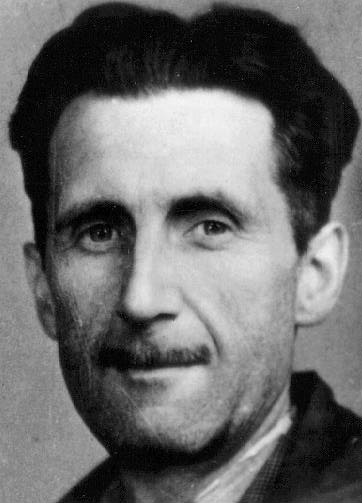
Orwell’s press card portrait, 1943
In spite of my campaign against the jackboot — in which I am not operating single-handed — I notice that jackboots are as common as ever in the columns of the newspapers. Even in the leading articles in the Evening Standard, I have come upon several of them lately. But I am still without any clear information as to what a jackboot is. It is a kind of boot that you put on when you want to behave tyrannically: that is as much as anyone seems to know.
Others besides myself have noted that war, when it gets into the leading articles, is apt to be waged with remarkably old-fashioned weapons. Planes and tanks do make occasional appearances, but as soon as an heroic attitude has to be struck, the only armaments mentioned are the sword (“We shall not sheathe the sword until”, etc., etc.), the spear, the shield, the buckler, the trident, the chariot and the clarion. All of these are hopelessly out of date (the chariot, for instance, has not been in effective use since about A.D. 50), and even the purpose of some of them has been forgotten. What is a buckler, for instance? One school of thought holds that it is a small round shield, but another school believes it to be a kind of belt. A clarion, I believe, is a trumpet, but most people imagine that a “clarion call” merely means a loud noise. One of the early Mass Observation reports, dealing with the coronation of George VI, pointed out that what are called “national occasions” always seem to cause a lapse into archaic language. The “ship of state”, for instance, when it makes one of its official appearances, has a prow and a helm instead of having a bow and a wheel, like modern ships. So far as it is applied to war, the motive for using this kind of language is probably a desire for euphemism. “We will not sheathe the sword” sounds a lot more gentlemanly than “We will keep on dropping block-busters”, though in effect it means the same.
One argument for Basic English is that by existing side by side with Standard English it can act as a sort of corrective to the oratory of statesmen and publicists. High-sounding phrases, when translated into Basic, are often deflated in a surprising way. For example, I presented to a Basic expert the sentence, “He little knew the fate that lay in store for him” — to be told that in Basic this would become “He was far from certain what was going to happen”. It sounds decidedly less impressive, but it means the same. In Basic, I am told, you cannot make a meaningless statement without its being apparent that it is meaningless — which is quite enough to explain why so many schoolmasters, editors, politicians and literary critics object to it.
George Orwell, “As I Please” Tribune, 1944-08-04.
September 12, 2019
QotD: Canadians and Europeans
“The typical British family,” he writes, “looks much more like the typical German family than the typical American family. We eat Italian food. We watch Spanish soccer. We drive German cars. We work Belgian hours. And we buy second homes in France. Above all, we bow before central government as only true Europeans can.”
He has a point, though cultural similarities are not always determinative: Canadians eat American food, watch American sports, drive American cars, work American hours (more or less), and buy second homes in Florida. But they still bow down before central government as only true Europeans can.
Mark Steyn, Telegraph, originally posted to the old blog (no longer online), 2004-09-30.
September 11, 2019
QotD: Male versus female social structure
Female social structure is more fluid. It’s based more on group identity than on individual characteristics. You tend to have one woman who is kind of in charge, your queen bee as it were. Those in her favor circle around her, and the circles continue outward until you have the women who are not part of the group. They aren’t at the bottom of the pile, they pretty much don’t exist. At least, if they’re lucky they don’t. One’s position in the social hierarchy can change at any time, to include who the queen bee is. Remember the scene in Mean Girls where Regina tries to sit at the lunch table with the other plastics but isn’t wearing the right color clothes? She was just knocked out of her position in the social hierarchy.
In a social structure like this, there’s no room for difference of opinion or people who stand out too much. If an individual, even by noncompliance, threatens the group identity; she will gain the ire of the entire group. They will hunt her without mercy until she complies with the demands of the group, is removed from their reach by either death or physical distance (which is getting much harder with the internet), or manages to win enough females to her side to either form a new group around her or replace the existing leader. The last option allows her to push her standard on the group as a whole. There is no option to live and let live. In other words, female social structure is closer to the Borg than the complex world we currently enjoy.
I can already hear the cries of, “But women aren’t violent!” If you’re talking about direct violence, you’re mostly right. Women are not men, and we don’t hunt in the way that men do. Our weapons are usually words and emotions, not direct violence. Instead of a brawl in which two people fight it out and determine which is the strongest, you’re looking at extreme emotional abuse for anyone who is outside the group and unlucky enough to have their attention. Emotional abuse attacks a person in the most deeply personal of ways, and the scars it creates are more damaging than the physical scars of a beating. We wonder why girls who stand out grow so bitter, but if you’re a little too pretty or a little too different, other girls swarm on you and rip you apart with constant emotional abuse. They attack who you are at the base of your being, your very self-perception. This is why you see truly beautiful women who struggle to see their worth. Other girls have been ripping into them since the nursery, and it only gets worse as they get older. Boys court you and try in their awkward boyish way to get your attention, but you’re mostly convinced that it’s a cruel joke they’re playing on you, because of course you aren’t pretty or smart or special. The scars run deep and never fully heal.
“outofthedarkness”, guest posting at According to Hoyt, 2017-08-09.


