
Supposing an emperor was persuaded to wear a new suit of clothes whose material was so fine that, to the common eye, the clothes weren’t there. And suppose a little boy pointed out this fact in a loud, clear voice …
Then you have The Story of the Emperor Who Had No Clothes.
But if you knew a bit more, it would be The Story of the Boy Who Got a Well-Deserved Thrashing from His Dad for Being Rude to Royalty, and Was Locked Up.
Or The Story of the Whole Crowd Who Were Rounded Up by the Guards and Told “This Didn’t Happen, OK? Does Anyone Want To Argue?”
Terry Pratchett, Thief of Time, 2001.
December 24, 2019
QotD: Fairy tales
Comments Off on QotD: Fairy tales
December 23, 2019
QotD: British meals – puddings
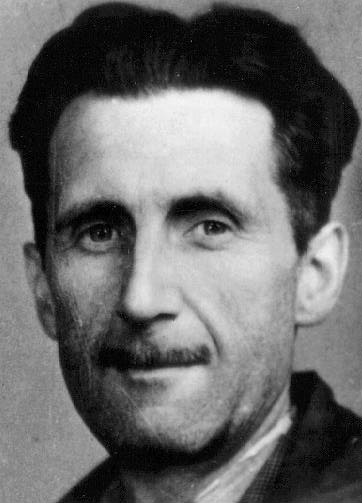
Orwell’s press card portrait, 1943
Suet crust, which appears in innumerable combinations, and enters into savoury dishes as well as sweet ones, is simply ordinary pastry crust chopped beef suet substituted for the butter or lard. It can be baked, but more often is boiled in a cloth or steamed in a basin covered with a cloth. Far and away the best of all suet puddings is plum pudding, which is an extremely rich, elaborate and expensive dish, and is eaten by everyone in Britain at Christmas time, though not often at other times of the year. In simpler kinds of pudding the suet crust is sweetened with sugar and stuck full of figs, dates, currents or raisins, or it is flavoured with ginger or orange marmalade, or it is used as a casing for stewed apples or gooseberries, or it is rolled round successive layers of jam into a cylindrical shape which is called roly-poly pudding, or it is eaten in plain slices with treacle poured over it. One of the best forms of suet pudding is the boiled apple dumpling. The core is removed from a large apple, the cavity is filled up with brown sugar, and the apple is covered all over with a thin layer of suet crust, tied tightly into a cloth, and boiled.
British pastry is not outstandingly good, but there are certain fillings for pies and tarts which are excellent, and which are hardly to be found in other countries. Treacle tart is a delicious dish, and the large or small mince pies which are eaten especially at Christmas, but else fairly frequently at other times, are almost equally good. The mince-meat with which they are filled is a mixture of various kinds of dried fruits, chopped fine, mixed up with sugar and raw beef suet, and flavoured with brandy. Other favourite fillings are jams of various kinds, lemon curd – a preparation of lemon juice, yolk of egg and sugar – and stewed apples flavoured with lemon juice or cloves. An apple pie is often given an exceptionally fine flavour by including one quince among about half a dozen apples.
The other main category of puddings – milk puddings – is the kind of thing that one would prefer to pass over in silence, but it must be mentioned, since these dishes are, unfortunately, characteristic of Britain. They are preparations of rice, semolina, barley, sago or even macaroni, mixed with milk and sugar and baked in the oven. The one made with barley is somewhat less bad then the others: the one made with macaroni is intolerable to any civilised palate. As all of these puddings are easy to make, they tend to be a stand-by in cheap hotels, restaurants and apartment houses, and they are one of the chief reasons why British cookery has a bad name among foreign visitors.
There are, of course, XXX countless other sweet dishes, including the whole range of jellies, blancmanges, custards, soufflés, ice puddings, meringues and what-nots, which are much the same in all European counties. A few oddments which do not fit into any of the above categories are pancakes – British pancakes are thinner than those of most countries, and are always eaten with lemon juice, – batter pudding, which is made of much the same ingredients as Yorkshire pudding, but is steamed instead of being baked and is eaten with treacle, and baked apples. The apples are cored but not peeled, filled up with butter and sugar, and cooked in the oven: it is important that they should be served in the dish in which they are cooked With cooked fruit of any kind British people always eat cream, if they can get it. In the West of England a particularly delicious kind of clotted cream is made by slowly simmering large pens of milk and skimming off the cream as it comes to the surface.
George Orwell, “British Cookery”, 1946. (Originally commissioned by the British Council, but refused by them and later published in abbreviated form.)
Comments Off on QotD: British meals – puddings
December 22, 2019
QotD: Impulses and regrets
Don’t wait until you have the time to really relax and enjoy it. That will be approximately three decades from now, and it’s highly possible you won’t be able to enjoy it. I will never forgive myself for passing up a chance to go to trapeze school in my late 20s. I figured I could always do it later, little suspecting that in my early thirties my lower back would decide to take up amateur dramatics. At least somebody got to perform.
Megan McArdle, “After 45 Birthdays, Here Are ’12 Rules for Life'”, Bloomberg View, 2018-01-30.
Comments Off on QotD: Impulses and regrets
December 21, 2019
QotD: Blogging
Scott Adams, 2004-11-11.
Comments Off on QotD: Blogging
December 20, 2019
QotD: Ontario pubs
Nicholas Pashley, Notes on a Beermat: Drinking and Why It’s Necessary, 2001.
Comments Off on QotD: Ontario pubs
December 19, 2019
QotD: The “fitness club” scam
Here’s how you talk yourself into a
gymfitness club membership: “I need to get in shape. So I’ll buy a club membership. That way, I can go whenever I want.” In Festinger’s taxonomy […] you’re at step 2: You’ve taken a significant action in line with your belief.Gymsfitness clubs add a further refinement of late-20th century marketing, in that they offer you a yuuuuge “discount” off the outrageously-high signup fee, but the underlying psychological process is the same.And now you’re set up for the disconfirmations — that is, all those times you think about going to the gym, but don’t actually go. Objectively you’re wasting your money, but psychologically you’re committed to the idea of yourself as someone who does “fitness” — you’re in a fitness club, after all! And since everyone you know is doing the same thing — fully 75% of conversations one overhears at Starbucks are soccer moms griping about how they need to work out, but just can’t find the time — you’re in, all the way, […].
The “climate change” scam works the same way. When she’s on the campaign trail pimping the “Green New Deal,” Fauxcahontas Warren knows she doesn’t have to pitch it to the eco-freaks; they’d vote for her no matter what. She has to pitch it to the normies, fitness club-style. That’s where the “climate change” nomenclature really pays off. It’s shockingly easy to get people convinced of a lunatic belief. All you have to do is a) get ’em early, and b) overload them with “evidence.” You know the drill: These days, we’re lectured practically from birth that we must Do Something! for The Environment! … and the “evidence” for this, of course, is the ceaseless, dramatic variation in daily temperature the un-indoctrinated call “weather,” plus all the other dramatic variations in climate that didn’t happen. So long as you pitch it with complete self-righteousness, people with the critical thinking skills of five year olds will fall in line every time.
Then all you have to do is get people to take action … which the government, in all its wonderful helpfulness, has already done: Low-flow toilets, those stupid twisty “light” bulbs, toilet paper that either shreds on contact with skin or sandpapers your asshole off, plastic straw bans, mandatory recycling, you name it. And I’m sure y’all realize by now that the fact that none of this stuff actually works is a feature, not a bug. Since it’s the disconfirmations that get you. That’s the pitch to the normies — you obviously care about “the environment,” in the same way you care about “fitness.” Just as the “fitness club” owners will happily keep cashing your checks while you remain a diabetic lardass, so Fauxcahontas will keep cashing your checks while the weather stubbornly remains the weather …
Severian, “What Happens if the UFO Actually Comes?”, Rotten Chestnuts, 2019-09-25.
Comments Off on QotD: The “fitness club” scam
December 18, 2019
QotD: Approaching 60
Well, it’s just a number. I feel engaged with my times, apart from them as well; amused, concerned, optimistic, and not scared: I’ve been on 7 cruises since I bought my last suit and the pants still fit with a 29″ waist. My eyes are crap but my eyes have always been crap. I look older but why shouldn’t I? I have the same energy I had when I was 20, except I know more. I’ve done everything I wanted to do and regret nothing. Hoorah!
James Lileks, The Bleat, 2017-11-29.
Comments Off on QotD: Approaching 60
December 17, 2019
QotD: The mass cowardice of the Baby Boomers
The mythical hippy-drippy boomer even gave birth to another myth that refuses to die, that of their conservative Millennial offspring. Considering this all started 20 years ago with a limp Michael J. Fox sitcom, it is time to retire the played out joke before it gets flipped onto the next generation. Holo-headline 2031: “Look! The conservatives have hippie kids!”
Yet history will show that, for all their organizing skill and moral sensitivities, the boomers took a pass on actually changing one hellish state policy rather than have a few uncomfortable conversations with their kids. Gotta have that moral high ground even at the kitchen table, it seems. Boomers have collaborated and shamelessly switched sides on the war on drugs with full knowledge of the repercussions. If the greatest generation had landed at Omaha Beach, pissed themselves, tossed their weapons into the sea, and begged to serve as Nazi slop-boys, then you might have an equivalent act of mass cowardice.
Jeff A. Taylor, “Boomer or Bust: Reflections of a generational refugee”, Reason, 2004-12-14.
Comments Off on QotD: The mass cowardice of the Baby Boomers
December 16, 2019
QotD: The Great Pestilence of 1348
England, below the Ribble and Tees, is special, thanks to the Domesday Book of the invading, tax-loving Normans, and their general propensity to good record-keeping. The towns and villages ennumerated in 1086 can be traced to the present day; nineteen in twenty are still there. Having figures to start, and through the parish books later, we can track an economic and demographic history with an accuracy possible in no other country. We can know, for instance, of the population boom through the twelfth and thirteenth centuries, which had slackened well before the “Black Death.” And with that boom, impressive advances in farming, technology, and building, as today. Nothing conduces to technical improvement, as a bit of crowding.
This proportion I cited — the nineteen-in-twenty (or more) — which I have from reading in economic history mostly years ago, fascinates my attention. We know large tracts were depopulated, we find the archaeological evidence easily enough. They were planting rye within the walls of Winchester, and many other towns. Everywhere, they had elbow-room again. Our deep ecologists would have been pleased — those who think life on this planet would be better had a few billion souls not been born. As Christianity, and environmentalism, are mortally opposed, and the fourteenth century was overwhelmingly Christian, I expect complaints of overpopulation were differently expressed at the time. Mostly it would have been moaning from younger brothers about the distribution of inherited land.
Always, there have been younger brothers. Always, there have been survivors. What delighted me was the speed with which all the vacant places were filled. As we’ve seen, too, after ghastly wars, demography abhors a vacuum.
David Warren, “Death the real illusion”, Essays in Idleness, 2017-11-04.
Comments Off on QotD: The Great Pestilence of 1348
December 15, 2019
QotD: Naming military actions
Not that there’s anything wrong with a dose of belligerent overkill in your naming conventions…
Posted on the old blog (no longer online), 2004-09-09.
Comments Off on QotD: Naming military actions
December 14, 2019
QotD: Chocolate, Ankh-Morpork style
Terry Pratchett, Thief of Time, 2001.
Comments Off on QotD: Chocolate, Ankh-Morpork style
December 13, 2019
QotD: Labelling matters a lot in political discussions
Don Boudreaux, “Quotation of the Day…”, Café Hayek, 2017-11-09.
Comments Off on QotD: Labelling matters a lot in political discussions
December 12, 2019
QotD: Economic sophistication in ancient Greece
There is the anecdote of Thales the Milesian and his financial device, which involves a principle of universal application, but is attributed to him on account of his reputation for wisdom. He was reproached for his poverty, which was supposed to show that philosophy was of no use. According to the story, he knew by his skill in the stars while it was yet winter that there would be a great harvest of olives in the coming year; so, having a little money, he gave deposits for the use of all the olive-presses in Chios and Miletus, which he hired at a low price because no one bid against him. When the harvest-time came, and many were wanted all at once and of a sudden, he let them out at any rate which he pleased, and made a quantity of money.
Whether this is a true story about Thales, or even of market conditions in Miletus, is of no importance. What is important is the unvoiced background to the story. It cannot easily be taken as an instance of the predatory capitalism that Polanyi and Finley are willing to grant to the ancient world. Thales decided that there would be a good olive crop. He did not buy olive presses. Instead, he took out options on them. He and those who dealt with him, seem to have understood the nature of the deal made. When it turned out that Thales had predicted right, he seems to have had no trouble enforcing his contracts. This assumes a familiarity of the courts with such contracts, and a commercial state of mind either among the peoples of Chios and Miletus, or — assuming the story is apocryphal — among Aristotle’s Athenian audience.
Many of the Greek city states were considerable trading centres. They lack any detailed commercial histories. Certainly, no ancient writer thought it consistent with the dignity of history to describe their economic structure and the causes of their commercial greatness. But this casual anecdote must stand in place of the unwritten histories as evidence for thriving and sophisticated financial economies.
Sean Gabb, “Market Behaviour in the Ancient World: An Overview of the Debate”, 2008-05.
Comments Off on QotD: Economic sophistication in ancient Greece
December 11, 2019
QotD: Charles I and the Civil War
Charles I was a Cavalier King and therefore had a small pointed beard, long flowing curls, a large, flat, flowing hat, and gay attire. The Roundheads, on the other hand, were clean-shaven and wore tall, conical hats, white ties, and sombre garments. Under these circumstances a Civil War was inevitable.
The Roundheads, of course, were so called because Cromwell had all their heads made perfectly round, in order that they should present a uniform appearance when drawn up in line.
Besides this, if any man lost his head in action, it could be used as a cannon-ball by the artillery (which was done at the Siege of Worcester).
For a long time before the Civil War, however, Charles had been quarrelling with the Roundheads about what was right. Charles explained that there was a doctrine called the Divine Right of Kings, which said that:
(a) He was King, and that was right.
(b) Kings were divine, and that was right.
(c) Kings were right, and that was right.
(d) Everything was all right.
But so determined were the Roundheads that all this was all wrong that they drew up a Petition called the Petition of Right to show in more detail which things were wrong. This Petition said:
(a) That it was wrong for anyone to be put to death more than once for the same offence.
(b) Habeas Corpus, which meant that it was wrong if people were put in prison except for some reason, and that people who had been mutilated by the King, such as Prynne, who had often had his ears cut off, should always be allowed to keep their bodies.
(c) That Charles’s memorable methods of getting money, such as Rummage and Scroungeage, were wrong. But the most important cause of the Civil War was Ship Money
Charles I said that any money which was Ship Money belonged to him; but while the Roundheads declared that Ship Money could be found only in the Cinq Ports, Charles maintained that no one but the King could guess right which was Ship Money and which wasn’t. This was, of course, part of his Divine Right. The climax came when a villager called Hampden (memorable for his dauntless breast) advised the King to divine again. This so upset Charles that he went back to Westminster, and after cinquing several ports burst into the House of Commons and asked in a very royal way for some birds which he said were in there. The Parliament, who were mostly Puritans, were so shocked that they began making solemn Leagues and Countenances. Charles therefore became very angry and complaining that the birds had flown raised his standard at Nottingham and declared war against Hampden and the Roundheads.
The War
At first the King was successful owing to Prince Rupert of Hentzau, his famous cavalry leader, who was very dashing in all directions. After this, many indecisive battles were fought at such places as Newbury, Edgehill, Newbury, Chalgrove Field, Newbury, etc., in all of which the Cavaliers were rather victorious.
The Roundheads therefore made a new plan in order to win the war after all. This was called the SelfDenying Ordnance and said that everyone had to deny everything he had done up to that date, and that nobody was allowed to admit who he was: thus the war could be started again from the beginning. When the Roundheads had done this they were called the New Moral Army and were dressed up as Ironclads and put under the command of Oliver Cromwell, whose Christian name was Oliver and who was therefore affectionately known as `Old Nick’. Cromwell was not only moral and completely round in the head but had a large (round) wart on the nose. He was consequently victorious in all the remaining battles such as Newbury, Marston Moor, Edgehill (change for Chalgrove), Naseby, Newbury, etc.
Blood and Ironclads
When Charles I had been defeated he was brought to trial by the Rump Parliament so-called because it had been sitting for such a long time and was found guilty of being defeated in a war against himself, which was, of course, a form of High Treason. He was therefore ordered by Cromwell to go and have his head cut off (it was, the Roundheads pointed out, the wrong shape, anyway). So romantic was Charles, however, that this made little difference to him and it is very memorable that he walked and talked Half an hour after his Head was cut off.
On seeing this, Cromwell was so angry that he picked up the mace (the new and terrible Instrument of Government which he had invented) and, pointing it at the Head, shouted: “Take away that Marble,” and announced that his policy in future would be just Blood and Ironclads.
W.C. Sellar & R.J. Yeatman, 1066 And All That, 1930.
Comments Off on QotD: Charles I and the Civil War
December 10, 2019
QotD: British breakfast – “Not a snack but a serious meal”
After the meat course comes bread, or more often toast, with butter and orange marmalade. It must be orange marmalade, though honey is a possible substitute. Other kinds of jam are seldom eaten at breakfast, and marmalade does not often appear at other times of [the] day. For the great bulk of British people, the invariable breakfast drink is tea. Coffee in Britain is almost always nasty, either in restaurants or in private houses; the majority of people, though they drink it fairly freely, are uninterested in it and do not know good coffee from bad. Of tea, on the other hand, they are extremely critical, and everyone has his favourite brand and his pet theory as to how it should be made. Tea is always drunk with milk, and it is usual to brew it very strong, about one spoonful of dry tea leaves being allowed for each cup. Most people prefer Indian to Chinese tea, and they like to put sugar in it. Here, however, one comes upon a class distinction, or more exactly a cultural distinction. Virtually all British working-people put sugar in their tea, and indeed will not drink tea without it. Unsweetened tea is an upper-class or middle-class habit, and even in those classes it tends to be associated with a Europeanised palate. If one made a list of the people in Britain who prefer wine to beer, one would probably find that it included most of the people who prefer tea without sugar.
After this solid breakfast – and even now, in a time of rationing, it is usual to eat a fairly large bulk of food, chiefly bread, at breakfast – it is natural that the midday meal should be somewhat lighter than it is in many other countries.
George Orwell, “British Cookery”, 1946. (Originally commissioned by the British Council, but refused by them and later published in abbreviated form.)
Comments Off on QotD: British breakfast – “Not a snack but a serious meal”


