
In colonial India, Kali’s notoriety boomed. For in her both coloniser and colonised found a figurehead. Corrupted by the British, Kali was spun as a sexually depraved, blood-swigging black sorceress. As William Ward phrased it in his encyclopaedia, “She exhibits altogether the appearance of a drunken frantic fury … on whose altar victims annually bleed”. Such descriptions, deemed by Indians to be reductively fixated on her destructive powers to the omission of her maternal reserve, activated a movement for her reclamation and turned her into an icon in the struggle for Indian independence in the late-nineteenth century. Put on calendars, cigarette packets, matchboxes, and subject of hugely popular prints, Kali was embraced as a vision of freedom. The reverence for her was inseparable from politics. And it took just two decades after India gained its freedom for a politician to exploit it.
Indira Gandhi — the daughter of one of the freedom movement’s protagonists Pandit Nehru and India’s first and only female prime minister — chose consciously to co-opt this divinity in service of burnishing her own self-image. Indeed, during her first spell in office, from 1966-1977, Indira’s image was as prolific as the colourful printed pictures of the tantric goddess splashed across India’s towns and bazaars. Her appearance was, understandably, more benign. But in India’s jostling visual marketplace her image — big smile and bobbed black hair shot with a streak of white framed by a demure uttariya (veil) — was as inescapable as any deity’s.
Indira played the demagogue superbly. But just as her popularity among Indians soared, and her political confidence grew, those around her began equating her strong, intolerant, and cold politics with female divinities and their overwhelming powers. According to a hugely contentious apocryphal story, Indira’s young rival Atal Bihari Vajpayee, who would go on to succeed her as prime minister, was so overcome by devotion at the sight of her gallantry during India’s war with Pakistan in 1971 that he called her Ma Durga — Kali’s mother.
Cleo Roberts, “Indira Gandhi: a gift from the gods?”, The Critic, 2020-10-15.
January 25, 2021
QotD: Indira Gandhi’s exploitation of the goddess Kali
January 24, 2021
The dangers of depending on “experts”
David Warren considers the vastly expanded role of “experts” in our public discourse:

Having no degree in either field, I try not to write what will be contradicted by an expert. On the other hand, “expert” has become a murky concept. Once we had to distinguish only between demonstrated credible experts, and villains. Common sense could usually tell them apart. But with the growth of our “sophistication,” the category of villainy has been much expanded. We have a category of institutionally credentialled experts who aren’t exactly liars, but more like what Harry G. Frankfurt defined as “bullshitters.” They struggle to remain plausible, but are using their expertise to advance interested views. And, having such motives — in opposition to the plain pursuit of truth — they seek publicity, and angle to obtain it.
As Dr Frankfurt hinted, in his short philosophical treatise on this topic (On Bullshit, 2005), these can be, and usually are, more trouble than old-fashioned liars. For a real liar knows he is lying, and can be caught out. By comparison, the modern media expert avoids what is strictly checkable, not only to protect himself, but from indifference for truth. He is, according to me, the intellectual descendant of the mediæval Nominalists, adumbrating words, not realities. While less intelligent than his predecessors, he carries on the tradition of saying that something is true because he says so.
“Consensus science” is of this nature. In it, truth can be negotiated, or imposed. While the weather next Saturday will be known to the living, a prediction for much later in the century has no meaning. From the number of variables in play, I can tell you with certainty, that woke “climatologists” are talking bosh; and every signature on their consensus I may add to my list of persons to ignore. This is elementary stuff: and I do try to stick to what is elementary, and foreseeable.
The success rate, for elaborate predictions, remains, at this point in our history, zero-point-zero. But it is becoming so also for the present, and past. The Batflu, here, is current primary example. Owing to obvious manipulation, we cannot know much about its effects. In rough terms, we can know that they are exaggerated, because almost every expert has a vested interest in getting the numbers up, and those who disagree will be punished. The same is true for all the popular remedies, including such nonsense as mangle-wearing, and obsessive social distancing. No legitimate research lies behind either, so we must assume the purposes for various lockdown orders are not actually the Batflu.
QotD: The “returned ballot”
Here’s what you do. You go into the polling station, show your ID (in Canada voters must identify themselves). The officer crosses you off the voting list, and gives you a ballot. Then you say, “I wish to return this ballot.” He says, “Thank you, sir,” and takes out his returned ballot book. (It need be nothing special: a school exercise book will do.) He copies your name into that, along with your address. (It is the only way to get your preference recorded.) You thank him, then wander off through the boobs who came to vote for somebody.
One has oneself, in effect, just voted for “none of the above.” This is the theory.
In practice the officer, who may or may not speak English or French, but probably needed the money, looks puzzled and a little frightened. He has no idea what you are talking about. You dig in, to provide a patient lesson in elementary civics. He won’t have a book, but you have brought along a cahier with “Returned Ballots” written on the cover in large capitals with a felt pen, and some heraldry doodled above it. To be helpful, you have already written your name and address on the first line. He consults all the other polling staff then says, “Thank you, sir.”
When, later, you check the results, you will not find a single returned ballot mentioned. Perhaps you were counted among the spoilt ones.
Now if you had been counted, and had persuaded a plurality of your fellow citizens to do likewise in, say, the riding of Parkdale (about one-in-four would triumph in most Canadian ridings; one-in-six if the turnout were low enough), the election is annulled. A by-election must then be called, in which none of the previous candidates may stand.
David Warren, “Let’s be practical”, Essays in Idleness, 2018-09-15.
January 22, 2021
Hypocrisy is bad (for mere humans) but ostentatious hypocrisy is reserved for the powerful
David Warren notes the two very different kinds of hypocrisy on display during these fallen days:
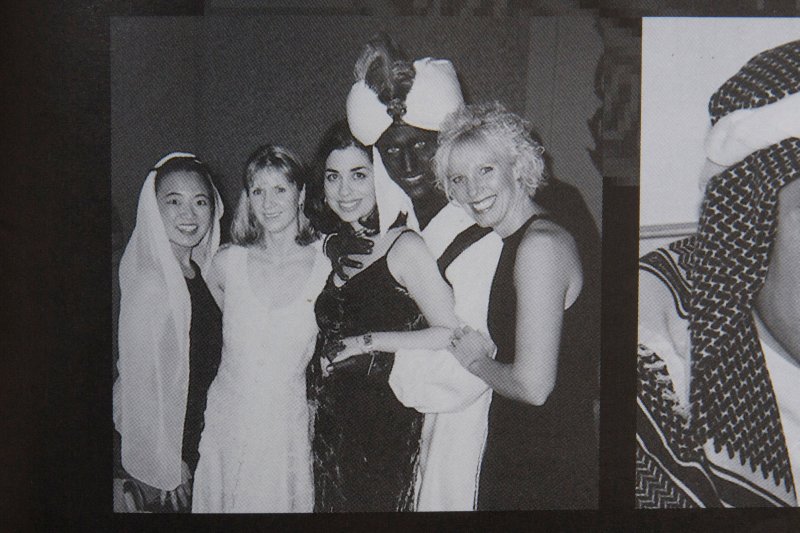
Justin Trudeau with dark makeup on his face, neck and hands at a 2001 “Arabian Nights”-themed party at the West Point Grey Academy, the private school where he taught.
Photo from the West Point Grey Academy yearbook, via Time
Hypocrisy is often dismissed as a humdrum moral vice; rather as pæderasty, or buggery, or commissioning abortions: things considered very grave in the past, but now quite acceptable among progressive persons. One feels almost cruel, or envious, to criticize the adept hypocrite. How dare we try to withdraw the air in which he lives and breathes? “Zero tolerance” is directed at more serious vices, such as having wrong opinions, or voting Republican.
As Paul Valéry said, “Power without abuse loses its charm,” and when, for instance, a governor who proclaims crippling Batflu restrictions is seen ignoring them, he is outraged. His critics are his opponents, he reasons; they really ought to be investigated first!
A milder, general criticism is sometimes made, about the lifestyles of the rich and famous. How is it that prominent environmentalists burn so much jet fuel in their travels from one conference to another, at the world’s most lavish resorts? Shouldn’t they go about in sackcloth and ashes, as they tell us to do?
This is to misunderstand their hypocrisy. We assume they are motivated by greed, and the love of pleasure, the way we would be. But why must it be piled on so thick? Many a jetsetter hardly uses the jacuzzis. He takes a quick shower, because he has another aeroplane to catch.
Yes, most people are attracted to the sumptuous, but in a fine and private way. They rarely encourage the paparazzi, or wish to be watched over their fences and walls. They hire security, to scare trespassers away. Servants, up to a point, must be endured, but in the past they could be ignored, the way we ignore appliances. I may not have a toaster, but I do have a stove, and could swear that it is staring at me. But it was manufactured in the 1960s, so I needn’t fear it has an Internet connexion. And besides, if it did, it wouldn’t be reporting to the tabloids, but to technical staff. We try to ignore them, at least so long as we can pretend they are equivalent to our maids and butlers.
January 21, 2021
QotD: The Laurentian Elite and the “new Canada” of the 1960s
Because the Liberals were so successful in creating this new identity, conservatives, especially Western conservatives (understandably) felt alienated in this new Canada. Brimelow gave some intellectual heft and crafted a coherent theory around why conservatives felt this way.
The broader narrative Brimelow, and others, put forward is that Canada’s British heritage was central to our identity and sense of who we are, but that this identity was destroyed by the Liberals who then built a new one in their own image. In the 1960s, Canadian Liberalism became self-consciously post-British, and the 1960s really do represent an approximate decade in which the “old Canada” died and a “new Canada” was born. The 1960s weren’t just a time of social change, they marked the end of the British Empire, the start of the Quiet Revolution, and of course most symbolically saw the replacement of the Red Ensign with the Maple Leaf flag. The battles between Diefenbaker and Pearson (and Pierre Trudeau) work as a stand in for the divide between old British Canada and new Liberal Canada.
Ben Woodfinden, “True North Patriotism and a Distinctly Canadian Conservatism”, The Dominion, 2020-10-20.
January 20, 2021
“Canada Post … is not to act as the censor of mail or to determine the extent of freedom of expression in Canada”
Colby Cosh on a recent incident in Regina where a Canada Post employee took it upon himself to act as a local censor for people on his delivery route:

Today’s idiot of the day is not, perhaps surprisingly, the Regina postman who got suspended for refusing to deliver the Epoch Times, the oddball anti-communist newspaper that’s affiliated with China’s persecuted Falun Gong religious movement. Don’t get us wrong: Ramiro Sepulveda is clearly a bit of a nitwit. He seems to believe that a newspaper founded by commie-hating Chinese-Americans is designed to provoke hatred toward “Asian communities in North America.”
Sepulveda didn’t want to deliver free copies of the Times to non-soliciting customers because it “spits lies.” Perhaps regrettably, the strong reaction by Canada Post means that our junk mail, quite a lot of which consists of boastful missives from politicians, is not destined to be fact-checked and aggressively suppressed by the corporation’s rank and file.
Sepulveda was properly punished for not doing his job. And Canada Post used the opportunity to promote its content-neutrality as an agent of the state, although it did not quite dare to use the phrase “statutory monopoly.” In a statement to the broadcasters who reported on Sepulveda’s off-piste personal fact-checking, the agency said: “Canada Post is obligated to deliver any mail that is properly prepared and paid for, unless it is considered non-mailable matter. The courts have told Canada Post that its role is not to act as the censor of mail or to determine the extent of freedom of expression in Canada.”
They might have added that access to the mail has been denied to individuals for spreading hatred only a handful of times in the history of the country; this, too, is as it ought to be, and it is certainly not postal employees who ought to be improvising such bans. Ideally, all postmen would be doing their best not to create the suspicion that they are eyeballing what is sent to our homes with the intention of ringing up a reporter and causing a fuss. Say what you like about these poor toilers: most of them never give us any reason to doubt their discretion.
Larry Correia (mostly) leaves Facebook
SF author Larry Correia has spent a lot of time in “Facebook jail” for posting things that the admins considered unacceptable under their constantly changing guidelines, so he’s finally bidding adieu to the platform:
I’m paring down my FB presence. For the last week I’ve only been on for a brief time each day. I’ll be taking that down even further. I’ll be posting links when I blog for the people who stick around. There’s a few groups I use here that I can’t get the equivalent resource anywhere else yet (but I’m currently banned from posting in all groups anyway). And that’s about it.
Basically, I’m done being a content creator for these censorious pieces of shit. Guys like me write stuff which gets shared hundreds of times and gets thousands of people commenting/participating. FB uses that free content to keep people corralled here so they can mine your data.
And then when us content creators get uppity, they fuck us over with impunity while their ideological allies get a pass. But then we come crawling back again and again, like abused trailer park wives, because we don’t want to abandon the kids (as in the communities we spent the last ten years building before the relationship turned abusive).
I’ve stuck around because I didn’t want to hurt my business/sales. This is still the best place to reach the most people the fastest. We made it that way. All us content creators foolishly moved over here back when Facebook promised to be one thing. Now that they’ve pulled a bait and switch, the content creators feel trapped.
In good conscience, this can’t continue. I’m done helping these parasites. Facebook is trash. We all know it. We’ve all seen it. We’re just here because of inertia.
Over the last decade, working with some stupendous moderators and great fans, we built a gigantic, thriving, fun, fan page here on Facebook. It’s one of the bigger author fan pages on the internet where the author can still actually talk to his fans. Being able to interact there was great. But Facebook took that from me on a whim. They banned me from my own group because of what I MIGHT say.
However we prepared a fallback. There’s another Monster Hunter Nation fan page over on MeWe. I’ll be posting there instead from here on. If the fans want to keep posting here, great, but I won’t be. I can’t even post this to my own FB fan page, which illustrates just how screwed up this situation is.
We’ll see how long that lasts, until Big Tech finds some way to squish every place they can’t control.
My primary place will still be my blog, monsterhunternation dot com. There is an email newsletter there you can sign up for which is only book related stuff, no politics. I’m on MeWe under my same name. I was on Parler as @monsterhunter45, though I never really used it, and I have no idea if that place is going to survive. I’ll be looking into other alternatives as well.
January 16, 2021
QotD: Make companies product-focused again
But pretty much anything else … please just STFU unless it is directly related to the business. I get that certain “life style” brands might want their logo in a Formula One car or on Eddie Izzard’s frock. But I am not interested in how inclusive the local bookstore is, nor do I want to hear that an auto-parts shop is proud of the blasted NHS.
I do not even want any companies declaiming how much they support causes I like, let alone ones that I either oppose or which just make me roll my eyes at the sheer presumption of their marketing department. For me, this is negative marketing. I already avoid certain shops and restaurants that prominently display their “social awareness” to me: they are actually doing the opposite, emphasising that I am not their target market. So I take them at their word and if I can easily get what they sell elsewhere from someone who doesn’t, that is what I always do.
Make companies product-focused again.
Perry de Havilland, “Make companies product-focused again”, Samizdata, 2020-09-30.
January 13, 2021
Driving people offline will break essential political feedback loops
Larry Correia on the ongoing purge of Trump supporters from many social media networks:
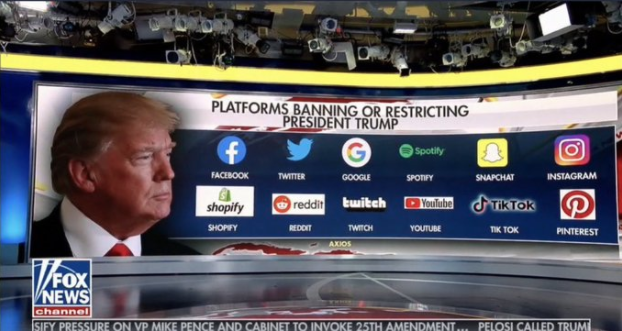
Screencap of a Fox News report on the social media networks that have deplatformed President Donald Trump, January 2021.
For all of history when people have a problem they have been able to talk about it and hash it out. Solutions to complex problems don’t spring fully formed into existence the instant you note the problem. You get ideas from others. Their perspectives help you better articulate the issue and recognize consequences you didn’t expect.
Lawyers know law, engineers know engineering, artists know art, so on. So when there is a big problem that spreads across multiple fields, of course you need to talk it over with people who know those areas, because they know things you don’t. Being smart in one area doesn’t automatically make you an expert in others. We all need help. Big problems require discussion and brainstorming. Even if it isn’t effective, it’s still useful for the clever people who can make solutions to be able to listen to what the regular populace thinks and feels so that they can get the scope and understand how the problem hurts the public.
In the old days these conversations happened at churches, taverns, colleges, that kind of thing. All the famous places where big solutions to big problems were hashed out have a historical marker on them today. For us, those things are now illegal or stifled and we get the internet.
So of course the people who don’t see the problems as problems — or sometimes they are the problem — are trying to stop the rest of us from discussing the problems or they are trying to control where and how the conversations happen. Since they benefit from the problem, they will squash or sabotage people talking about solutions. It is in their best interests to do so, and when you give a bully a stick, they will beat you with it.
The topic of the current problem isn’t the important thing. This is our public square now whether we like it or not. We have foolishly abdicated the public square and now we are paying the price. Of course they can’t just let people they don’t like converse. That’s dangerous to their positions.
So when information they don’t like appears, they hide it. If they can’t hide it, they “fact check” it, and often that’s just a headline screaming false followed by an article full of straw grasping excuses they know most people won’t read. The goal is to shut you up or discredit you.
In the old days, at your pub or church, your drinking buddies or co-religionists probably shared your concerns and faced the same problems. So at least you were working toward a common goal. But now, big tech doesn’t want that. They don’t like groups or forums that don’t share their orthodoxy. They want/need to keep you here, and they need strangers to constantly kick in the doors and blunder in to tell you that you are stupid or crazy, that way we waste time arguing with them. It used to be a village had one idiot. When we talk now we get to deal with a thousand villages worth of idiot.
January 12, 2021
“Big Tech” flexes the muscles and squeezes down the Overton Window online
In the FEE Daily newsletter, Brad Polumbo outlines the collusive mass deplatforming of President Trump and many of his high profile supporters:
Screencap of a Fox News report on the social media networks that have deplatformed President Donald Trump, January 2021.
Amid the fallout from the January 6 attack on the US Capitol, President Trump has been banned from just about every social media platform.
This crackdown is, frankly, unprecedented.
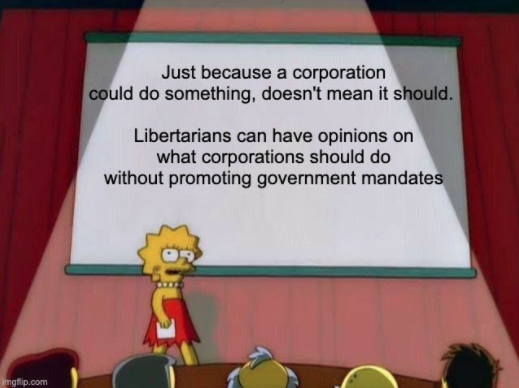
To be sure, social media and tech companies are private companies, and are not bound by the First Amendment. They have no legal obligation to host President Trump’s speech.
But there’s a question beyond can here that ranges into the should.
And I, for one, find it extremely disturbing that the elected President of the United States — who just weeks ago received roughly 75 million votes — is deemed beyond the pale of acceptable speech by Silicon Valley overlords who are overwhelmingly left-wing. Especially so given that these same platforms still allow the literal Chinese Communist Party to post pro-genocide propaganda and allow the members of the Iranian regime to openly foment violence.
The least consumers can demand is some consistency. Personally, I would find it much more reasonable for companies like Twitter to remove individual posts, including by President Trump, that violate rules — like fomenting violence — than to erase prominent political figures from the digital conversation entirely.
We should all want to see a free and open discourse online promoted by the companies we patronize. At the same time, none of this is cause for government control of the internet or meddling with the Section 230 liability shield.
If conservatives don’t like how Twitter CEO Jack Dorsey regulates content, they’d hate how Kamala Harris would do it.
January 11, 2021
QotD: Conspiracy theories
In modern times, the conspiracy theory has been formalized. The assassination of John Kennedy is probably when this formalization process began. For example, a conspiracy theory needs a series of hard to accept coincidences. In the case of Kennedy, we have the amazing marksmanship of the shooter and then his unlikely assassination at the hands of a Jewish gangster, while he was in police custody. The Jack Ruby part is what made the whole thing perfect for the conspiracy theorists.
The first step in a conspiracy theory is that the obvious answer or the official answer must be eliminated as a lie or implausible. In the case of the Kennedy assassination, the start of the conspiracy dynamic was the dismissal of Oswald as the lone actor. It is a variation on the old Sherlock Holmes line. Once you eliminate the parsimonious explanation, then the more complex and convoluted explanations become more plausible. That opens the door to endless speculation.
We see this with the QAnon cult on-line. All of it starts with the assumption that the obvious answer is wrong. For example, it is plainly obvious that Bill Barr is covering up the FBI spying scandal. He’s had years to do what should have taken a few months. Instead of accepting that rather obvious and plausible explanation, the QAnon people reject it and instead weave wildly complex theories about how half of Washington is about to be charged with crimes.
Another aspect of the formal conspiracy theory is the liberal use of the associative property to connect unrelated events. Person A knows Person B and Person B once had lunch at the same place as Person C. If any of these three people can be tied to the event in question, then it is assumed the other two are connected. The weakest associations are enough to assume a conspiracy. The associative property is an essential element of the modern conspiracy theory.
In the case of Kennedy, for example, organized crime is a popular player, because Jack Ruby was a minor criminal. His tenuous association with organized crime opens the door for linking any number of underworld characters with the assassination. It also opens the door for all sorts of theories about the Kennedy administration’s connections to organized crime. The associative property then ties communism, organized crime and the Cuba situation to the assassination.
The Z Man, “Conspiratorial Rule”, The Z Blog, 2020-10-01.
January 10, 2021
Has the United States reached the same tipping point Canada reached in 1982?
David Warren considers the 1982 tipping point in Canada to have been the implementation of Pierre Trudeau’s Constitution:
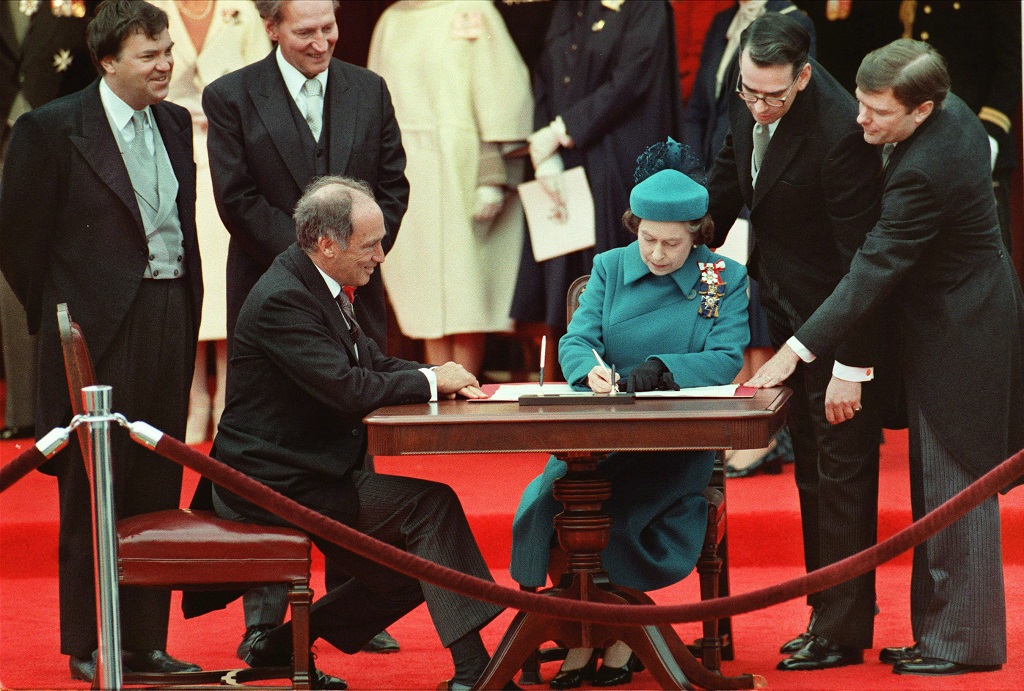
Queen Elizabeth II signs Canada’s constitutional proclamation in Ottawa on April 17, 1982 as Prime Minister Pierre Trudeau looks on.
There are two principal political parties in modern America (in which I include up here). In the Natted States, the population is divided roughly equally between those of “progressive” and “regressive” habits of mind; in the Canadas, the former have come to dominate.
The tipping point was reached much earlier up here, and the new “metapower” (Foucault’s term) was seized, politically, from within the Liberal Party. The strategy was to disenfranchise the “conservative” half of the electorate, by undermining all national institutions, and hosing down Canada’s previous identity. I’d count, say, 1982, as the point of no return. That identity was replaced, definitively, under a revised Trudeau constitution, with a new “multicultural” identity, in which citizens were themselves redefined, from free persons whose rights were inalienable, to interchangeable clients of an omnipotent State, which could dispense rights whenever it was in the mood — and withdraw them whenever the mood changed; however frequently.
This is the Democrat strategy in the larger, and still less amenable, country next door. As Andrew Breitbart and Antonio Gramsci might agree, this is an essentially cultural process. Politics are visible at the tip of the iceberg, but “progress” requires a more thorough “cleansing,” of old cultural norms. The cancer metastasized more from Hollywood, than from Washington DC. The takeover of the Democratic Party as the vanguard “agent of change” was only part of the institutional takeover of America. As important was the takeover of the mass media, and even corporate boardrooms. Those who weren’t “progressive” would now be “cancelled”: must cease to be.
All cultural change has a religious dimension. The Democrat representatives of the “powers and principalities” mentioned by Saint Paul, are characteristically godless, themselves. But they depend on a massive, core constituency of low-information, low-intelligence, easily manipulated urban voters.
Those who can still see the stars at night tend to remain in the ancient, God-fearing default. In the cities, where the masses may not grasp that milk comes from cows, let alone that someone must milk them, the belief that the economy is based on government cheques is more common. That is the god of the populous cities, and for most city-dwellers, not voting for their “godless god” of progress, seems a kind of heresy.
The idea that such heretics should be deprived of their freedom, starting with freedom of speech, does not appeal to the “rural” voter, including people like me — a “country hick” type who paradoxically lives in the city. The idea that laws and constitutions should be flexible, to accommodate the latest schemes of a progressive technocratic élite, doesn’t flourish among us country bumpkins. But to the efficiency experts in the city, what is our problem?
January 9, 2021
The (declining) power of the political cartoon
In Quillette, Jack Reilly outlines the rise of political cartooning from (of all people) Martin Luther to the present day, as it faces the final phase of its long career:
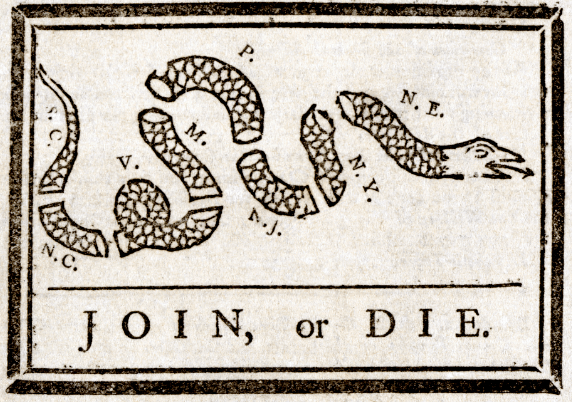
The first influential cartoon published in an American newspaper has traditionally been credited to Benjamin Franklin, who drew his famous serpent divided into eight parts with the legend Join, or Die — the message being that fellow colonists must band together to repel the enemy forces then threatening their territory. Long after Franklin’s death, the image would be dusted off for reuse by supporters of American unity.
Thomas Nast, whom many consider to be the greatest editorial cartoonist of all time, rose to prominence during the Civil War. Still in his early 20s, the young German immigrant began producing such arresting pro-Union material that Abraham Lincoln — flipping Napoleon’s rueful commentary about James Gillray on its head — referred to Nast as “our best recruiting agent.”
During the national election of 1864, conducted amidst the Civil War, the Democrats pushed a platform of reconciliation with the slaving south. In response, Nast created his famous Compromise with the South cartoon, depicting an injured union soldier, bowing his head and lifelessly shaking hands with a victorious confederate who stands atop the grave of a fallen Yankee, with Lady Liberty weeping in the foreground. The epitaph on a tombstone reads “In memory of the Union heroes who died in a useless war.” Nast’s lurid but masterful image created a sensation, and showed how politically powerful the cartooning medium could be in an age of mass newspaper readership. Two months later, Abraham Lincoln defeated the Democrat candidate, George McClellan, to secure a second term.
In the decades following the war, Nast would continue to elevate the medium to high art. In 1871, he began an ongoing series for Harper’s Weekly attacking the corruption of Tammany Hall, the Democratic political machine that controlled New York politics. Nast so mercilessly lampooned William M. “Boss” Tweed as the machine’s ringleader, that Tweed was heard to rage, “Stop them damn pictures! I don’t care a straw for your newspaper articles. My constituents can’t read. But they can’t help seeing them damn pictures!”
Eventually, Tweed was convicted of money laundering. (He attempted to escape justice by absconding to Spain, but was soon apprehended by Spanish officials, who reportedly recognized him with assistance from Nast’s cartoons.) As for Nast himself, he’d go on to conceive of the elephant as a symbol for the Republican party, popularize the use of the donkey for the Democrats, and help create the modern image of Santa Claus that Americans have come to love.
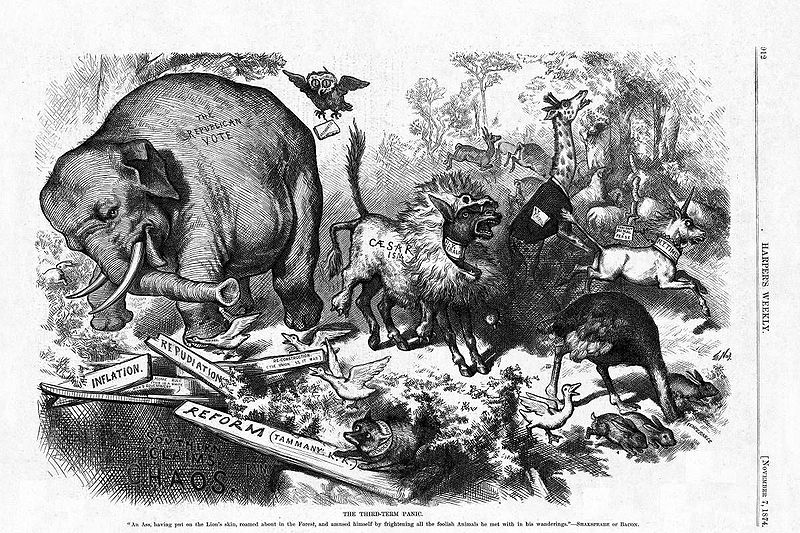
“The Third-Term Panic”, by Thomas Nast, originally published in Harper’s Magazine on 7 November 1874.
A braying ass, in a lion’s coat, and “N.Y. Herald” collar, frightening animals in the forest: a giraffe (“N. Y. Tribune”), a unicorn (“N. Y. Times”), and an owl (“N. Y. World”); an ostrich, its head buried, represents “Temperance”. An elephant, “The Republican Vote”, stands near broken planks (Inflation, Repudiation, Home Rule, and Re-construction). Under the elephant, a pit labeled “Southern Claims. Chaos. Rum.” A fox (“Democratic Party”) has its forepaws on the plank “Reform. (Tammany. K.K.)” The title refers to U.S. Grant’s possible bid for a third presidential term. This possibility was criticized by New York Herald owner and editor James Gordon Bennett, Jr.
Image and caption via Wikimedia Commons.
January 6, 2021
The Use and Abuse of the US Postal System (feat. Mr. Beat)
The Cynical Historian
Published 10 Oct 2020Thanks to Private Internet Access for sponsoring this video. Click here to get 77% off and 3-months free: http://www.privateinternetaccess.com/…
We’ve been seeing a lot of coverage about the post office here in the United States. A lot of folks talk about the history of it, but generally in a piecemeal fashion. The fact most of this commentary lacks is that the post office has always been a political tool, from its beginnings even before the US Constitution. Interestingly enough, what it has been used for over the years has changed substantially, but it is always a harbinger of the up and coming dominant ideology. The post office is a cornerstone of our democracy. The postal system in the United States is uniquely important.
Check out Mr. Beat’s video: https://www.youtube.com/watch?v=favVdKa6cRQ
————————————————————
Connected videos:
3:30 – 1776 | Based on a True Story: https://youtu.be/xY4Te8Qm07A
9:15 – What caused the Mexican-American thing? https://youtu.be/HTmSN4Exci0
9:15 – What Caused the Texas Revolution? https://youtu.be/lDWH-DC74Pk
9:25 – California Gold Rush: https://youtu.be/W1dmyx6LBKA
9:30 – History of California: https://www.youtube.com/playlist?list…
11:30 – The Sectional Crisis: https://youtu.be/Ff2AKILyi0o
14:05 – History of Voting by Mail: https://www.youtube.com/watch?v=favVd…
18:25 – Trains and Oil in California: https://youtu.be/0Ef0Ir-hbFc
18:30 – The History of Early Flight: https://youtu.be/sPgxuD0uYYE
20:35 – US Veterans History: https://youtu.be/ANUqaNykuRs
————————————————————
references:
The United States Postal Service: An American History (Washington, DC: United States Postal Service, 2020). https://about.usps.com/publications/p… [PDF]USPS’s website has a trove of information on their history: https://about.usps.com/who-we-are/pos…
The national postal museum is run by the Smithsonian and includes numerous research articles available to anyone on their website: https://postalmuseum.si.edu/research-…https://www.nationalgeographic.com/hi…
————————————————————
Support the channel through PATREON:
https://www.patreon.com/CynicalHistorian
or by purchasing MERCH: teespring.com/stores/the-cynical-hist…
LET’S CONNECT:
Discord: https://discord.gg/Ukthk4U
Twitter: https://twitter.com/Cynical_History
Subreddit: https://www.reddit.com/r/CynicalHistory/————————————————————
Wiki: The United States Postal Service (USPS; also known as the Post Office, U.S. Mail, or Postal Service) is an independent agency of the executive branch of the United States federal government responsible for providing postal service in the United States, including its insular areas and associated states. It is one of the few government agencies explicitly authorized by the United States Constitution.
The USPS traces its roots to 1775 during the Second Continental Congress, when Benjamin Franklin was appointed the first postmaster general. The Post Office Department was created in 1792 with the passage of the Postal Service Act. It was elevated to a cabinet-level department in 1872, and was transformed by the Postal Reorganization Act of 1970 into the United States Postal Service as an independent agency. Since the early 1980s, many direct tax subsidies to the USPS (with the exception of subsidies for costs associated with disabled and overseas voters) have been reduced or eliminated.
————————————————————
Hashtags: #history #USPS #USMail

QotD: George Bernard Shaw’s views on eugenics
The Irishman’s opinions are, however, coming back to mangle and even smash his reputation. A group of students at RADA have called for Shaw’s name to be removed from the drama school’s theatre as part of an anti-racism action plan. This matters, because Shaw provided for the school in his will, and last year the royalties from his work contributed more than £78,000 to RADA. Yet the accusation that the renowned theatre college “celebrates historical figures who embraced racist ideologies” does have a certain merit. Problem is, as has been debated myriad times: do, can, and should we separate an artist’s work from their period, character and ideas? If the ghosts of anachronism and historical assumptions are never to be exorcised, there are an awful lot of people who will fail and fall to the wide-awake litmus test.
Shaw did indeed write, that, “The only fundamental and possible socialism is the socialisation of the selective breeding of man” and, chillingly, “A part of eugenic politics would finally land us in an extensive use of the lethal chamber. A great many people would have to be put out of existence simply because it wastes other people’s time to look after them.” He lectured for the Eugenic Education Society, praised Stalin (naturally) the early Mussolini, and even Hitler as late as 1935. He abandoned most of all this in his old age but never made any formal apology.
He was also an incisive critic of imperialism, mercilessly exposed establishment hypocrisy, opposed war and oppression throughout his career, and cared passionately about actors and writers – the very people at RADA trying to expunge his name from their place of learning. And here’s another challenge and even embarrassment for those who would remove the social engineers from the litany of the great and the good: many of their harshest opponents were not others on the left but, in Edwardian Britain and in the 20s and 30s, conservative Roman Catholic writers led by G.K. Chesterton and Hilaire Belloc.
Michael Coren, “Eugenics and the intellectual left”, The Critic, 2020-09-16.


