Quotulatiousness

June 14, 2020

QotD: The seen gains and unseen losses of high tariffs

Filed under: Economics, Politics, Quotations, USA — Tags: , , , — Nicholas @ 01:00

Sure, there are gains to the workers and firms protected by tariff walls from their fellow Americans’ ability to trade freely with foreigners. But these protected firms’ resulting higher outputs are produced with resources from elsewhere in the economy. Output and opportunity in other parts of the economy shrink. American firms diverted by tariff walls into producing, say, more steel, rejoice. But this rejoicing ignores the jobs that these tariff walls destroy elsewhere in America and the loss of output from other domestic industries.

It’s easy to rejoice when a wall, literal or figurative, enriches you. And it’s even easier when the destruction wrought elsewhere by that wall is invisible. When a tariff wall causes people in Louisiana and Oregon to pay higher prices for steel made in Pittsburgh, no one can know how they would otherwise have used the extra funds they now pay to Pennsylvania steel producers. But those funds must be diverted from somewhere.

Yet because those somewheres are many, no one domestic industry suffers any great loss from higher steel tariffs. The destruction wrought by tariff walls is dispersed and, hence, invisible. But the sum of the losses is greater than the gain to domestic steel producers.

Americans on the whole are made poorer.

Don Boudreaux, “Mr. Trump, don’t build those walls!”, Pittsburgh Tribune-Review, 2016-11-22.

June 13, 2020

QotD: The liberal media

Filed under: Humour, Media, Politics, Quotations — Tags: , , , , — Nicholas @ 01:00

As I have pointed out myself, the more one knows about a subject, the more conservative one becomes towards it. Conversely, the less one knows, the more liberal he becomes, and inclined to embrace “progress” and “reforms.” Even a Communist may prove a very conservative stamp collector, once he learns something about philately. It’s only economics he knows nothing about.

This is a universal principle. Everyone knows something about something, and is very backward on that which he knows. The one exception may be journalists, who know nothing about anything, and are therefore liberal all round.

David Warren, “I’ll be a Welshman”, Essays in Idleness, 2018-03-01.

June 12, 2020

An unwelcome return to the 1960s

Filed under: History, Media, Politics, USA — Tags: , , , — Nicholas @ 05:00

David Warren reflects on how many parallels we’re seeing in the current year to the worst aspects of the 1960s:

Young “hippie” standing in front of a row of National Guard soldiers, across the street from the Hilton Hotel at Grant Park, at the Democratic National Convention in Chicago, August 26, 1968. Photo by Warren K. Leffler for US News & World Report via Wikimedia Commons.

As an old Cold Warrior, and once “science kid,” whose childhood developed through the 1960s, there is nothing that ought to surprise me. We have Antifa today; we had the Weather Underground then. We have parallels to every event I witnessed through the idiot box of adolescence, and vice versa. Even the destruction of American cities by riots and crime isn’t new; nor the supine response of our liberal leaders. The obvious left bias of news and entertainment was the same then as now, only less shrieking. The replacement of flatfoot journalists, with malicious ideological clowns from the universities, then a work in progress, was by the end of the last century, complete. The poison spread, through all media of information. We’ve reached an Age of Unreason to match Robespierre’s, and seem now to be waiting for a Napoleon.

Charlatans are the handmaids of paganry. That the charlatans slide into violent insurrection, even against the better pagan customs, is not something historically new.

The alternative is improbable: another Age of Faith. This would necessarily include a subsidiary restoration of faith in science — in the modest belief that if we follow the facts where they lead, as opposed to where we want them to go, a lost perception of cosmological order will also be, willy-nilly, restored. “Modern science” — an unambiguously Christian construct — depends entirely on one assumption. It is, that a universe God created will make sense. Logic, or the principle of non-contradiction, will hold up, and where it doesn’t seem to be doing so, it is not God, but we, who have got it wrong.

By the inversion of “values,” at the present day, the sane views are labelled as “psycho.” The truth is not the true, but what we (or our masters) want to call true. This “truth” is “settled,” from one moment to another; and is not to be discovered, but imposed.

J.K. Rowling on her most recent “cancellation”

I know a lot of Harry Potter fans are upset with their formerly favourite author for her stance on transgenderism … or what they’ve heard about her stance … or what their friends have said about her stance … so J.K. Rowling has posted an essay on her own site explaining what happened and how she has been coping with being “cancelled” so many times:

… as a much-banned author, I’m interested in freedom of speech and have publicly defended it, even unto Donald Trump.

The fourth is where things start to get truly personal. I’m concerned about the huge explosion in young women wishing to transition and also about the increasing numbers who seem to be detransitioning (returning to their original sex), because they regret taking steps that have, in some cases, altered their bodies irrevocably, and taken away their fertility. Some say they decided to transition after realising they were same-sex attracted, and that transitioning was partly driven by homophobia, either in society or in their families.

Most people probably aren’t aware – I certainly wasn’t, until I started researching this issue properly – that ten years ago, the majority of people wanting to transition to the opposite sex were male. That ratio has now reversed. The UK has experienced a 4400% increase in girls being referred for transitioning treatment. Autistic girls are hugely overrepresented in their numbers.

The same phenomenon has been seen in the US. In 2018, American physician and researcher Lisa Littman set out to explore it. In an interview, she said:

“Parents online were describing a very unusual pattern of transgender-identification where multiple friends and even entire friend groups became transgender-identified at the same time. I would have been remiss had I not considered social contagion and peer influences as potential factors.”

Littman mentioned Tumblr, Reddit, Instagram and YouTube as contributing factors to Rapid Onset Gender Dysphoria, where she believes that in the realm of transgender identification “youth have created particularly insular echo chambers.”

Her paper caused a furore. She was accused of bias and of spreading misinformation about transgender people, subjected to a tsunami of abuse and a concerted campaign to discredit both her and her work. The journal took the paper offline and re-reviewed it before republishing it. However, her career took a similar hit to that suffered by Maya Forstater. Lisa Littman had dared challenge one of the central tenets of trans activism, which is that a person’s gender identity is innate, like sexual orientation. Nobody, the activists insisted, could ever be persuaded into being trans.

The argument of many current trans activists is that if you don’t let a gender dysphoric teenager transition, they will kill themselves. In an article explaining why he resigned from the Tavistock (an NHS gender clinic in England) psychiatrist Marcus Evans stated that claims that children will kill themselves if not permitted to transition do not “align substantially with any robust data or studies in this area. Nor do they align with the cases I have encountered over decades as a psychotherapist.”

The writings of young trans men reveal a group of notably sensitive and clever people. The more of their accounts of gender dysphoria I’ve read, with their insightful descriptions of anxiety, dissociation, eating disorders, self-harm and self-hatred, the more I’ve wondered whether, if I’d been born 30 years later, I too might have tried to transition. The allure of escaping womanhood would have been huge. I struggled with severe OCD as a teenager. If I’d found community and sympathy online that I couldn’t find in my immediate environment, I believe I could have been persuaded to turn myself into the son my father had openly said he’d have preferred.

When I read about the theory of gender identity, I remember how mentally sexless I felt in youth. I remember Colette’s description of herself as a “mental hermaphrodite” and Simone de Beauvoir’s words: “It is perfectly natural for the future woman to feel indignant at the limitations posed upon her by her sex. The real question is not why she should reject them: the problem is rather to understand why she accepts them.”

As I didn’t have a realistic possibility of becoming a man back in the 1980s, it had to be books and music that got me through both my mental health issues and the sexualised scrutiny and judgement that sets so many girls to war against their bodies in their teens. Fortunately for me, I found my own sense of otherness, and my ambivalence about being a woman, reflected in the work of female writers and musicians who reassured me that, in spite of everything a sexist world tries to throw at the female-bodied, it’s fine not to feel pink, frilly and compliant inside your own head; it’s OK to feel confused, dark, both sexual and non-sexual, unsure of what or who you are.

I want to be very clear here: I know transition will be a solution for some gender dysphoric people, although I’m also aware through extensive research that studies have consistently shown that between 60-90% of gender dysphoric teens will grow out of their dysphoria. Again and again I’ve been told to “just meet some trans people.” I have: in addition to a few younger people, who were all adorable, I happen to know a self-described transsexual woman who’s older than I am and wonderful. Although she’s open about her past as a gay man, I’ve always found it hard to think of her as anything other than a woman, and I believe (and certainly hope) she’s completely happy to have transitioned. Being older, though, she went through a long and rigorous process of evaluation, psychotherapy and staged transformation. The current explosion of trans activism is urging a removal of almost all the robust systems through which candidates for sex reassignment were once required to pass. A man who intends to have no surgery and take no hormones may now secure himself a Gender Recognition Certificate and be a woman in the sight of the law. Many people aren’t aware of this.

June 11, 2020

Current year Iconoclasm

Filed under: History, Politics, USA — Tags: , , , , — Nicholas @ 03:00

In an Areo article from last year, Alexander Adams discusses the phenomenon of iconoclasm:

The 1931 demolition of the Cathedral of Christ the Saviour in Moscow.
Public domain image via Wikimedia Commons.

Behind any campaign is the campaigner: the activist convinced of his own righteousness.

The political activist reserves to himself the right to retrospectively edit our history for his satisfaction by removing monuments, those fixtures of civic life, embedded in the memories of generations. The activist often knows almost nothing about the object of his hatred — merely a garbled caricature of a person caught up in the conditions of her age — but the activist acts as if he were not also caught up in the conditions of his own age.

Iconoclasm is an expression of domination and a demonstration of willingness to act — illegally and unethically — to impose the will of one group over an entire population. It asserts control over all aspects of society. It sets a challenge that will elicit a strong reaction. Iconoclasm is a warning that the protection of law and social conventions no longer applies and that the cause will be promoted through physical force if necessary.

The campaigner argues that public art, accumulated piecemeal over 1,000 years of history, must reflect our society and values today — even if that means altering or erasing stories of the values our past society expressed via its monuments, or suppressing evidence of how we arrived at our current situation. The left-wing activist wants to celebrate current-day multiculturalism, but mostly he wants to erase evidence of the historic monoculturalism that preceded it.

Our willingness to live with historical relics we feel ambivalence towards is a demonstration of our toleration of dissent. Likewise, an openness to imagining ourselves in past times — constrained by the conventions and laws of a different era — forces us to question common assumptions about the completeness of our knowledge and our moral certainty. If we can make this leap of empathy, we can free ourselves of ideological possession. We have the ability to empathize with both slave and slave owner. Empathy makes it harder to justify destruction of the cultural relics of an older age or silence the voices of individuals, who might share insights into life.

The toleration we extend towards symbols of former regimes and proponents of ideas with which we disagree shows our willingness to be honest about our nations’ pasts. To accept our flaws as a necessary part of our development is to display the maturity, restraint and empathy that define the confident yet self-critical nation. For if we cannot stand the sight of a dead political opponent carved in stone, how can we restrain ourselves in the face of a living political opponent who speaks against us?

June 9, 2020

It was scientifically inevitable for the Communists to win the Cold War – as foretold in the prophecies

Sarah Hoyt on the “script” that progressives operated under during the Cold War and almost unchanged in detail to the present day, too:

Krushchev, Brezhnev and other Soviet leaders review the Revolution parade in Red Square, 1962.
LIFE magazine photo by Stan Wayman.

… the Cold War had two sides: the USSR and our elites, who had been corrupted and taken over for a long time thanks to the communist agents who had long-marched through our media, our entertainment and our bureaucracy.

Heinlein claimed the Democrats had been taken over by communists, secretly, by the 40s. I have no reason to doubt him. I’m sure most of the bureaucracy and governments in Europe had been taken over that way also.

Even so called conservatives assumed communism would eventually win, because according to the numbers coming out of the USSR and the reporters visiting the USSR — anyone know where Duranty is buried? there should be a line to piss on his grave — they were just so much more efficient. Scientific governance, you know? And anyway, technology was going to be so advanced that most humans would be unemployable, and by the way, there were more and more humans every year, so it was impossible to have all these bourgeois luxuries. So communism, efficient, compassionate, communism was the future, the only way.

The realists who saw it was the only way were willing to do anything to bring it about. Because the people who weren’t as intelligent/well informed would otherwise destroy the world and bring about unimaginable catastrophe.

“Conservatives” were merely those who wanted communism to arrive slower and be a little less violent. Communism with a human face. Socialism on the way to communism. Easing us into our role as cogs in the machinery of the future — where there was no room for personal frills or really emotions — with gentle pneumatic shocks, instead of with the excesses of the Russian and Soviet revolution.

All of this btw is based on three glaring fallacies (phaluscies, since you have to be a dickhead to believe them particularly now.)

1- People are a drain not an asset. They are also a sort of robot incapable of changing behavior in response to changing circumstances.

2- Wealth can’t grow, nor can the carrying capacity of the Earth improve. So since humans can’t respond to reduced infant mortality by having fewer children, the only way to feed everyone is to reduce everyone’s rations. Forever.

3- It is possible for “the best”, properly educated people to be utterly selfless and to administer everyone’s wealth equally and for the common good. They will not revel in power, nor will they avail themselves of any excess. Because, they are absolutely moral and all seeing.

Note the left is still running this script. And some on the right too (Hello, Pierre Delecto!) not to mention all of Europe, left and right. Also note #1 conflicts with the left idea that they can bring about a future in which humans change to be all selfless, etc. But that’s actually complicated and tied in to their myths, which honestly are a Christian heresy, complete with paradise lost.

I know when they started out, the USSR thought it could “engineer” a new human. Homo Sovieticus. But I don’t know enough of Soviet myth to know what underlay that. Maybe it was a behaviorist thing and they thought humans could be trained into being completely selfless automatons. I know by the time I was reading communist theorists (no, I didn’t buy their arguments, but I was required to read them, given when and where I grew up) in the seventies, the philosophy had fallen prey to the agitprop notion that people in madhouses in the US were political prisoners just as in the USSR. (BTW this is part of what underlay the closing of the madhouses.) And that was part of a push in the seventies, as the malfeasance of USSR was starting to be glaring, amid escaped dissidents and escaping information. The push was to “prove” that both systems were equally bad. (The left is still flogging that dead equine, too. So Cubans and Venezuelans are starving? So how many people die of anomie and not being loved enough under capitalism? REEEEE.) So, since Soviets put dissidents in mad houses, so did we. But that necessitated that people who widdled on themselves and/or thought they were a lampshade with a set of dishes thrown in be completely sane “political dissidents”. The only way to do this was to attribute anything communists don’t like to “insanity brought about by capitalism.” This led to crazier byways of thought. For instance, it led to the idea of the pre-historic, pre-agriculture paradise, where everyone was equal, there was no poverty, need, greed, or the heartbreak of psoriasis. A sub-branch of the church believed women were in charge and everyone worshiped the mother goddess. And some of these “scientific, atheist socialists” also believe the goddess actually exists, though G-d doesn’t.

David Friedman had a different formulation for the utopian world many progressives wish for the rest of us:

In the ideal socialist state power will not attract power freaks. People who make decisions will show no slightest bias towards their own interests. There will be no way for a clever man to bend the institutions to serve his own ends. And the rivers will run uphill.

How we are supposed to view the rioting protests in major US cities

Filed under: Media, Politics, USA — Tags: , , , , , — Nicholas @ 03:00

David Thompson shares the essential parts of a Vice article, telling us insufficiently woke dullards how to think about the ongoing civil unrest in many American cities after the death of a man at the hands (well, technically the knees) of Minneapolis police:

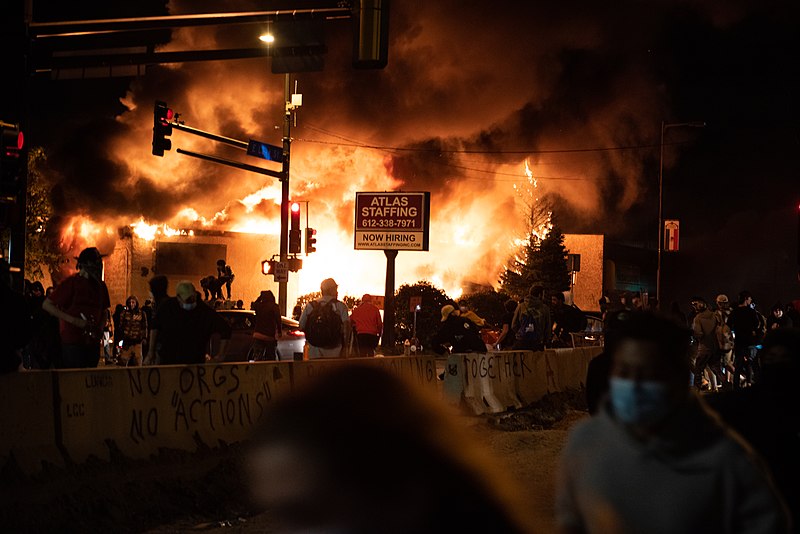
A building burning in Minneapolis following the death of George Floyd.
Photo by Hungryogrephotos via Wikipedia.

In the pages of Vice, a moral lecture, delivered from on high:

    How to Talk to Relatives Who Care More About Looting Than Black Lives.

As an exercise in question-begging and dense, self-satisfied presumption, it’s quite a thing, that headline. It’s very now.

Among those of us deemed insufficiently woke and therefore suspect, questions may arise. For instance, in what way will those “black lives” be improved by the destruction of local infrastructure, local businesses, and the subsequent, perhaps dramatic, reduction in trust and goodwill? And what if the stores and homes in question — the ones being smashed, stripped of their contents and set ablaze — are owned by people who happen to be black, as has often been the case? What if the places being looted and vandalised with abandon, indeed exultation, are depended on by people who also happen to be black, whether as customers or employees? Given the levels of material, social and economic destruction, should these people be content, indeed pleased, to be former employees? Unemployed people who now have no local grocer, or garage, or pharmacy?

Alas, such considerations appear to have eluded the keen mental processes of the article’s author, Ms Rachel Miller, a young woman who dutifully declares her pronouns and boasts of being a “Buzzfeed alum.”

    If you’re not Black but want to support BLM, having fraught conversations with your kinda (or definitely) racist loved ones will likely not be fun, but it’s a very worthy undertaking.

Right from the off we’re informed, firmly, that any perceptible reservations about looting and rioting, or reservations about the Black Lives Matter movement — say, regarding its demented far-left agenda, its racial tribalism, and the stated goal of abolishing capitalism, prisons and the police — must be taken as an indicator of being “kinda (or definitely) racist.” Wokeness is not, it seems, a recipe for cognitive subtlety. “Some people,” we’re told, “appear to be far more worried about the fate of a Nordstrom or Target store than that of the actual human lives of protesters.” Again, one might deduce that only those protesting with, shall we say, physical enthusiasm have “actual human lives,” unlike their victims, whose hopes and livelihoods can be gleefully destroyed as an act of righteous liberation. From local amenities.

QotD: Groupthink

Filed under: Politics, Quotations — Tags: , — Nicholas @ 01:00

[Groupthink author Irving] Janis’s first rule is that a group of people come to share a particular way of looking at the world which may seem hugely important to them but which turns out not to have been based on looking properly at all the evidence. It is therefore just a shared, untested belief.

Rule two is that, because they have shut their minds to any evidence which might contradict their belief, they like to insist that it is supported by a “consensus.” The one thing those caught up in groupthink cannot tolerate is that anyone should question it.

This leads on to the third rule, which is that they cannot properly debate the matter with those who disagree with their belief. Anyone holding a contrary view must simply be ignored, ridiculed, and dismissed as not worth listening to.

Christopher Booker, “Groupthink on Climate Change Ignores Inconvenient Facts”, Foundation for Economic Education, 2018-02-24.

June 8, 2020

Andrew Sullivan can’t write about the riots or he’ll lose his job

Filed under: Business, Media, Politics, USA — Tags: , , , — Nicholas @ 03:00

I’d wondered why he hadn’t directly addressed the biggest news item in the United States over the last week:

What has happened to New York media? Just as the New York Times was experiencing its own Inner Mongolia Moment over the now notorious Sen. Tom Cotton “Send in the Troops” op-ed, the Maoists at New York magazine were going after their best columnist, Andrew Sullivan.

Sullivan revealed on Twitter yesterday that his column wouldn’t be appearing. The reason? His editors are not allowing him to write about the riots.

Presumably Sullivan’s editors are frightened that he might make the radically bourgeois point that looting and violence are wrong.

Cockburn understands that Sullivan is not just forbidden from writing for the New York magazine about the riots; his contract means he cannot write on the topic for another publication. He is therefore legally unable to write anything about the protests without losing his job — at the magazine that, in 1970, published Radical Chic, Tom Wolfe’s brilliant and controversial excoriation of progressive piety. It’s the bonfire of the liberals!

June 6, 2020

Cognitive dissonance is real

Filed under: Cancon, Media, Politics — Tags: , — Nicholas @ 03:00

Matt Gurney had a discussion with one of his readers that left him shaking his head in disbelief:

The reader haughtily asked if I’d ever make such a criticism for a Liberal.

I said yes.

The reader didn’t believe me, and said, oh yeah, show me an example?

As it so happened, I actually had a column of mine open in another tab; I was referring back to it for research. +

The column in question contained a perfect example of me saying a very comparable thing about a Liberal as I had about the Conservative. So I had, OK, here you go. Pasted the link and replied.

And the reader replied right away. The reader was very confused.

The reader had questions about how I could criticize both a Conservative and a Liberal. The reader asked about agendas — who had insisted I write one piece, and why had they then permitted me to write the other?

I wrote both on my own initiative, I explained. +

And I made criticisms of both gentlemen, the Conservative and the Liberal, because they’d both done things that pissed me off.

The reader didn’t believe this was possible. There had to be another explanation, or an ulterior motive. +

I eventually disengaged. But I’ve been thinking about that all day. There’s a grown-ass person in Canada, totally literate and presents very normally, who really struggled to understand that someone could be critical of both the left and right without being compromised.

END

June 4, 2020

Trudeauvian “performative sanctimony” on display … again

Filed under: Cancon, Government, Media, Politics — Tags: , , , , — Nicholas @ 03:00

Chris Selley on the Prime Minstrel’s latest attempt to virtue signal on racial issues:

Justin Trudeau with dark makeup on his face, neck and hands at a 2001 “Arabian Nights”-themed party at the West Point Grey Academy, the private school where he taught.
Photo from the West Point Grey Academy yearbook, via Time

In agonizing for 21 seconds before answering a question about President Donald Trump’s threat to send the military after civilian protesters in American cities, Prime Minister Justin Trudeau likely risked causing as much trouble as he was hoping to avoid. Those who would like to see him denounce the president in full throat might be as annoyed as those who think he should accept there’s nothing Canada can really do to help and look out for our own best interests while the socio-political nightmare plays out.

Trudeau’s response wasn’t anything inspiring or novel or revolutionary. “It is a time for us as Canadians to recognize that we too have our challenges — that black Canadians and racialized Canadians face discrimination as a lived reality every single day,” he said. “There is systemic discrimination in Canada, which means our systems treat Canadians of colour, Canadians who are racialized, differently than they do others.”

He continued: “We need to see that, not just as a government and take action, but we need to see that as Canadians. We need to be allies in the fight against discrimination. We need to listen, we need to learn and we need to work hard to figure out how we can be part of the solution on fixing things.”

But here, at least, he was getting to the nub of the issue: To the extent the federal government can make things better for marginalized Canadians, Trudeau is the guy driving the boat. To read some of his ministers’ pensées, you would think they were just regular folks.

[…]

In the meantime, however, you can bet the farm we will soon learn that the Liberals’ changes to impaired driving laws — allowing police to stop and breathalyze drivers without any suspicion of impairment — have disproportionately affected black and Indigenous drivers in particular. Literally everybody saw it coming except Trudeau and his ministers.

OK, I’m kidding — they saw it coming too. They might want to log off, dial down the performative sanctimony and think on that a while.

QotD: Islamofascism

Filed under: Middle East, Politics, Quotations, USA — Tags: , , , , — Nicholas @ 01:00

The great silence by left-leaning Western feminists, and other large parts of the left, to human rights abuses carried out in the name of Islam is, to see it as its kindest, caused by an overdeveloped sense of tolerance or cultural relativism. But it is also part of the new anti-Americanism. Look at American Christian fundamentalism, they say.

Dislike of George Bush’s foreign policy has led to an automatic support of those perceived to be his enemies. Paradoxically, this leaves the left defending people who hold beliefs that condone what the left has long fought against: misogyny, homophobia, capital punishment, suppression of freedom of speech. The recent reaffirmation by Iran’s Ayatollah Khamenei of the fatwa against Salman Rushdie has been met by virtual silence; as has the torture and murder in Iraq of a man who would be presumed to be one of the left’s own — Hadi Salih, the international officer of the Iraqi Federation of Trade Unions. The hard left these days is soft on fascism, or at least Islamofascism.

The religious right in America would, if it could, wind back access to abortion and some other women’s rights. But as far as I am aware, no Christian fundamentalist in the US has suggested banning women from driving cars, or travelling without their husbands’ permission, or forcing them to cover their faces. Contrary to popular opinion, one is not the same as the other.

Pamela Bone, “The silence of the feminists”, The Age, 2005-02-04

June 2, 2020

“Calling a modern ‘artist’ a poseur is like calling water wet — what could possibly be the point?”

Filed under: History, Media, Politics — Tags: , , , , — Nicholas @ 05:00

Severian on modern “art” and its practitioners:

Picasso’s “Guernica” in mural form in the town of Guernica.
Photo by Papamanila via Wikimedia Commons.

Leszek Kolakowski, in his essay collection Is God Happy?, wrote several fascinating essays on Communism vs. other forms of Socialism, such as Fascism and generic Leftism. He notes that while Communism proper attracted lots of serious intellectuals and artists, who produced some works of real merit, generic “Leftism” had few, and Fascism almost none.

He also notes the degeneration of art on the Left. I don’t want / am not qualified to get deep into the weeds of art history, but let me use an example (mine, not Kolakowski’s): Pablo Picasso vs … oh, pick an artist, they’re all Lefties … let’s say Andy Warhol. Noting that “important” can be diametrically opposed to things like “good,” “aesthetically pleasing,” etc., we can all agree that both were important artists. Whatever else their differences, the most obvious one was:

Sincerity.

Picasso was a lifelong member of the Communist Party. He was also a sincere artist (which, again, can be miles away from “good;” I personally can’t stand Picasso’s art). Guernica is wildly overrated, and its sentiment jejune — we all agree that bombing civilians is bad, mmkay? — but at least it’s sincere. Warhol, on the other hand, never took a sincere breath in his life. Making your work superficial on purpose doesn’t absolve you from the sin of superficiality. Warhol (and Roy Lichtenstein, and the rest of the “Pop Art” crowd) gave wannabes permission to substitute “being ironic” for “having something to say,” and there’s your modern art in a nutshell. Calling a modern “artist” a poseur is like calling water wet — what could possibly be the point?

Which brings us back to Kolakowski. He notes that there are apostates aplenty from Communism, and they all seem compelled to write big long books full of critical self-examination. Cheering for the murder of millions would do that, one supposes… except that, as Kolakowski says, you can’t find one single ex-Leftist doing it. Hell, is there such a thing as an ex-Leftist, as opposed to an ex-Communist? Kolakowski couldn’t find one (as of 1995, I think), and I can’t think of one either. Every former radical I’m aware of was just that — a radical, a card-carrying Communist or at least a virulent fellow-traveler, e.g. David Horowitz. We probably all have heard of someone waking up one day (say, after 9/11) realizing that the Democratic Party they’d been knee-jerk voting for all their lives was out to lunch, but do you know of any True Believers seeing the light?

Antifa

Filed under: Government, Law, Politics, USA — Tags: , , , , , — Nicholas @ 03:00

Arthur Chrenkoff welcomes the move to designate the Antifa movement as domestic terrorists:

“antifa 8973ag” by cantfightthetendies is licensed under CC BY 2.0

President Trump’s decision to designate Antifa as a terrorist organisation is long overdue.

Whether you call them a terrorist organisation or a criminal organisation – or both – the underlying facts are the same: Antifa is a network of groups committed to a violent revolution to overthrow the democratic system of government and replace it with some sort of a communist “dictatorship of proletariat”, whoever the current proletariat is supposed to be (which does not in the end matter very much, because it’s all about the party organisation rather than “the masses”). To effect such revolution, Antifa uses tactics of violence against people it considers enemies as well as destruction of property. Remember, these people are not Scandinavian social democrats or even Bernie and AOC-style “democratic socialists” who advocate and follow a democratic and peaceful path of transformation to achieve their objectives of building what they consider a better and more just society. Antifa are thugs who desire to tear down and destroy the current political and economic order and erect their utopia on its ashes. They want to abolish democracy, capitalism, liberalism and all the other existing institutions in favour of a Marxist-Leninist state — or just for the fun of it if they are more of an anarchist rather than communist frame of mind. Groups whose the entire modus operandi is based on breaking law and criminal activity have no legitimate place in a democratic society. Antifa are the political organised crime.

The label Antifa has been used and abused too long to muddy the waters and confuse people — many of whom, granted, want to be confused. Because fascism is objectively bad (and considers so by an overwhelming majority of people), calling themselves “anti-fascist”, Antifa seeks to claim the moral high ground and the role of the good guys who stand up to white supremacists, neo-Nazis and other extreme element. But you cannot simply judge people by who their enemies are, or who they say their enemies are — you also have to judge them by their intentions, actions and aims. In the Second World War, the United States and the United Kingdom and their Western allies were anti-fascist, but so was the Soviet Union. Stalin hated fascists (except for a period of two years in 1939-41 when he collaborated with them). This did not make him a good guy, even if for the Allies at the time it made him the lesser of the two evils. Coincidentally, for Stalin the label “fascist” was a very broad one, applying not just to German Nazis and their sympathisers but to anyone opposed to communism and the Soviet Union and so in turn opposed by them, including at times even social democrats and other non-revolutionary socialists {“social fascists” in the Stalinist nomenclature). And so it is for Antifa — we are all fascists, from the few skinheads at the political fringes to all the mainstream parties and ideologies of both the right and the left. Just as in Russia in 1917 onward and all the other communist countries in history, your position on the democratic political spectrum can never give you an ultimate immunity, it only determines the order in which you will be shot (left-wingers and anarchists last, because they can be used the longest by the forces of revolution).

May 31, 2020

On “spontaneous” riots

Filed under: Law, Media, Politics, USA — Tags: , , , , — Nicholas @ 03:00

David Warren had a brush with a riot as a youngster — not as a participant, but as a near-victim — so the psychology of riots has a personal edge:

To a trained observer, the organizers of the riot stand out. They are dressed distinctly, they are giving orders; they are directing the attacks. They will usually be wearing expensive communications equipment. A drama coach would notice that their harangues are premeditated and rehearsed, to stir violence. That anger in the crowd was available to them, as their raw material, goes without saying; their art consists of “weaponizing” it.

Fascists — the real ones, in pre-war Italy and Germany — were masters of this art. So were the Communists with whom they had streetfights. The blackshirts today, a near-monopoly of the Left, descend from this rich tradition. When Antifa and other leftist scum shut down public discussions in universities and elsewhere, they may use the latest technology, but to old-fashioned ends.

What is alarming is not that these people exist — radical evil is a fact in human nature — but that they are given permission to act lawlessly. Rather than arrest and prosecute them, the liberal authorities agree to silence the legitimate speaker. They are trying to avoid confrontation, with people who sought confrontation, and will seek a larger confrontation next time. The prestige of these devils in human flesh is increased by their victories.

An injustice, such as the apparent murder of George Flynn by a vicious cop, while three more stood and watched, was the pretext for the riots. It was convenient for aggravating racial tensions, by which the Democrat party hopes to retrieve black votes that had been getting away from them. I would not wish to omit this dimension of the permission they grant to rioters. Politics are a cynical business.

But note, the mostly white folk in Antifa, prefer black neighbourhoods to start race riots, for that is where resentments will be easiest to exploit. (Masks help to conceal their whiteness.) This means that the victims of the riots, whose property and businesses are gutted, will also be mostly black. The media elide this aspect of the lawlessness, because they want Republicans to be defeated, too.

The moral stench is overpowering.

« Newer PostsOlder Posts »

Powered by WordPress