
It is hard to know, but most likely the conspiracy theory is one of the oldest parts of human society. In fact, the popularity of conspiracy theories is probably a good measure of social trust. Low-trust societies, like you find in the Middle East, tend to be shot through with conspiracy theories. High trust societies in Northwest Europe tend to have less of it, but even they are prone to bouts of conspiracy mongering. The Great Fear that swept through rural France is a good example.
In modern times, the conspiracy theory has been formalized. The assassination of John Kennedy is probably when this formalization process began. For example, a conspiracy theory needs a series of hard to accept coincidences. In the case of Kennedy, we have the amazing marksmanship of the shooter and then his unlikely assassination at the hands of a Jewish gangster, while he was in police custody. The Jack Ruby part is what made the whole thing perfect for the conspiracy theorists.
The first step in a conspiracy theory is that the obvious answer or the official answer must be eliminated as a lie or implausible. In the case of the Kennedy assassination, the start of the conspiracy dynamic was the dismissal of Oswald as the lone actor. It is a variation on the old Sherlock Holmes line. Once you eliminate the parsimonious explanation, then the more complex and convoluted explanations become more plausible. That opens the door to endless speculation.
We see this with the QAnon cult on-line. All of it starts with the assumption that the obvious answer is wrong. For example, it is plainly obvious that Bill Barr is covering up the FBI spying scandal. He’s had years to do what should have taken a few months. Instead of accepting that rather obvious and plausible explanation, the QAnon people reject it and instead weave wildly complex theories about how half of Washington is about to be charged with crimes.
Another aspect of the formal conspiracy theory is the liberal use of the associative property to connect unrelated events. Person A knows Person B and Person B once had lunch at the same place as Person C. If any of these three people can be tied to the event in question, then it is assumed the other two are connected. The weakest associations are enough to assume a conspiracy. The associative property is an essential element of the modern conspiracy theory.
In the case of Kennedy, for example, organized crime is a popular player, because Jack Ruby was a minor criminal. His tenuous association with organized crime opens the door for linking any number of underworld characters with the assassination. It also opens the door for all sorts of theories about the Kennedy administration’s connections to organized crime. The associative property then ties communism, organized crime and the Cuba situation to the assassination.
The Z Man, “Conspiratorial Rule”, The Z Blog, 2020-10-01.
January 11, 2021
QotD: Conspiracy theories
January 10, 2021
Has the United States reached the same tipping point Canada reached in 1982?
David Warren considers the 1982 tipping point in Canada to have been the implementation of Pierre Trudeau’s Constitution:
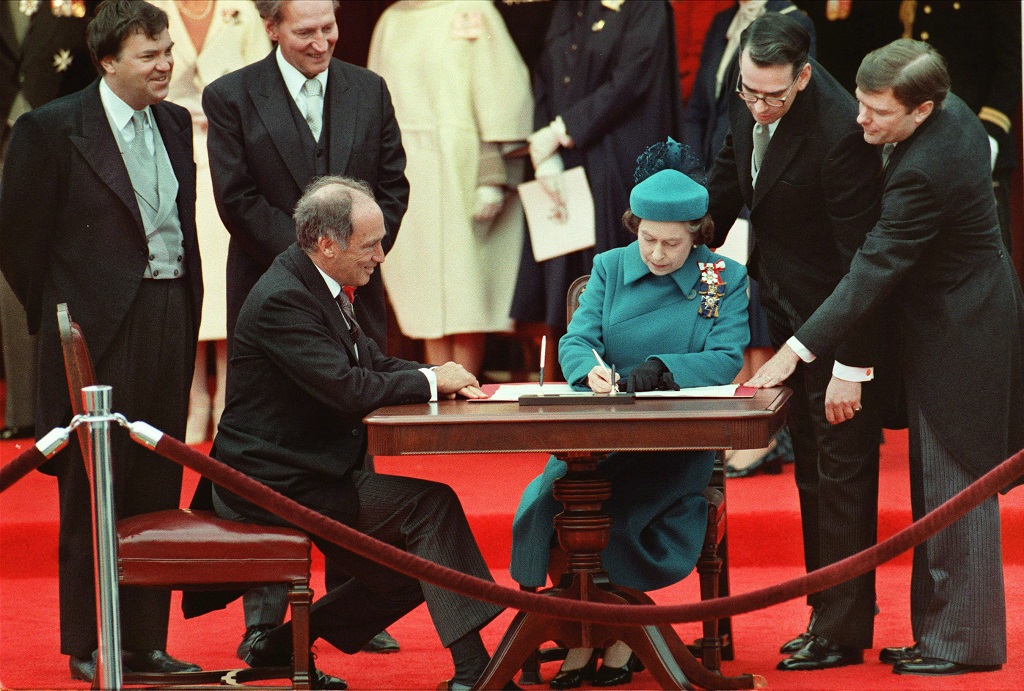
Queen Elizabeth II signs Canada’s constitutional proclamation in Ottawa on April 17, 1982 as Prime Minister Pierre Trudeau looks on.
There are two principal political parties in modern America (in which I include up here). In the Natted States, the population is divided roughly equally between those of “progressive” and “regressive” habits of mind; in the Canadas, the former have come to dominate.
The tipping point was reached much earlier up here, and the new “metapower” (Foucault’s term) was seized, politically, from within the Liberal Party. The strategy was to disenfranchise the “conservative” half of the electorate, by undermining all national institutions, and hosing down Canada’s previous identity. I’d count, say, 1982, as the point of no return. That identity was replaced, definitively, under a revised Trudeau constitution, with a new “multicultural” identity, in which citizens were themselves redefined, from free persons whose rights were inalienable, to interchangeable clients of an omnipotent State, which could dispense rights whenever it was in the mood — and withdraw them whenever the mood changed; however frequently.
This is the Democrat strategy in the larger, and still less amenable, country next door. As Andrew Breitbart and Antonio Gramsci might agree, this is an essentially cultural process. Politics are visible at the tip of the iceberg, but “progress” requires a more thorough “cleansing,” of old cultural norms. The cancer metastasized more from Hollywood, than from Washington DC. The takeover of the Democratic Party as the vanguard “agent of change” was only part of the institutional takeover of America. As important was the takeover of the mass media, and even corporate boardrooms. Those who weren’t “progressive” would now be “cancelled”: must cease to be.
All cultural change has a religious dimension. The Democrat representatives of the “powers and principalities” mentioned by Saint Paul, are characteristically godless, themselves. But they depend on a massive, core constituency of low-information, low-intelligence, easily manipulated urban voters.
Those who can still see the stars at night tend to remain in the ancient, God-fearing default. In the cities, where the masses may not grasp that milk comes from cows, let alone that someone must milk them, the belief that the economy is based on government cheques is more common. That is the god of the populous cities, and for most city-dwellers, not voting for their “godless god” of progress, seems a kind of heresy.
The idea that such heretics should be deprived of their freedom, starting with freedom of speech, does not appeal to the “rural” voter, including people like me — a “country hick” type who paradoxically lives in the city. The idea that laws and constitutions should be flexible, to accommodate the latest schemes of a progressive technocratic élite, doesn’t flourish among us country bumpkins. But to the efficiency experts in the city, what is our problem?
January 9, 2021
The (declining) power of the political cartoon
In Quillette, Jack Reilly outlines the rise of political cartooning from (of all people) Martin Luther to the present day, as it faces the final phase of its long career:
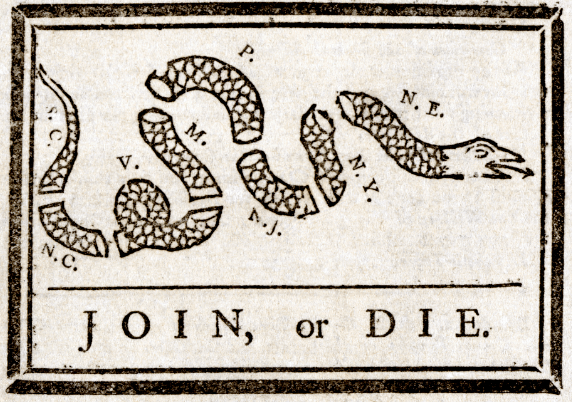
The first influential cartoon published in an American newspaper has traditionally been credited to Benjamin Franklin, who drew his famous serpent divided into eight parts with the legend Join, or Die — the message being that fellow colonists must band together to repel the enemy forces then threatening their territory. Long after Franklin’s death, the image would be dusted off for reuse by supporters of American unity.
Thomas Nast, whom many consider to be the greatest editorial cartoonist of all time, rose to prominence during the Civil War. Still in his early 20s, the young German immigrant began producing such arresting pro-Union material that Abraham Lincoln — flipping Napoleon’s rueful commentary about James Gillray on its head — referred to Nast as “our best recruiting agent.”
During the national election of 1864, conducted amidst the Civil War, the Democrats pushed a platform of reconciliation with the slaving south. In response, Nast created his famous Compromise with the South cartoon, depicting an injured union soldier, bowing his head and lifelessly shaking hands with a victorious confederate who stands atop the grave of a fallen Yankee, with Lady Liberty weeping in the foreground. The epitaph on a tombstone reads “In memory of the Union heroes who died in a useless war.” Nast’s lurid but masterful image created a sensation, and showed how politically powerful the cartooning medium could be in an age of mass newspaper readership. Two months later, Abraham Lincoln defeated the Democrat candidate, George McClellan, to secure a second term.
In the decades following the war, Nast would continue to elevate the medium to high art. In 1871, he began an ongoing series for Harper’s Weekly attacking the corruption of Tammany Hall, the Democratic political machine that controlled New York politics. Nast so mercilessly lampooned William M. “Boss” Tweed as the machine’s ringleader, that Tweed was heard to rage, “Stop them damn pictures! I don’t care a straw for your newspaper articles. My constituents can’t read. But they can’t help seeing them damn pictures!”
Eventually, Tweed was convicted of money laundering. (He attempted to escape justice by absconding to Spain, but was soon apprehended by Spanish officials, who reportedly recognized him with assistance from Nast’s cartoons.) As for Nast himself, he’d go on to conceive of the elephant as a symbol for the Republican party, popularize the use of the donkey for the Democrats, and help create the modern image of Santa Claus that Americans have come to love.
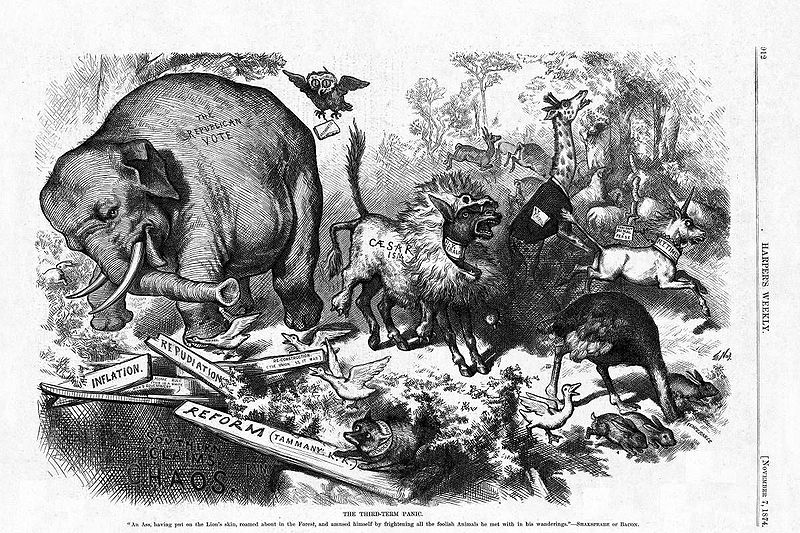
“The Third-Term Panic”, by Thomas Nast, originally published in Harper’s Magazine on 7 November 1874.
A braying ass, in a lion’s coat, and “N.Y. Herald” collar, frightening animals in the forest: a giraffe (“N. Y. Tribune”), a unicorn (“N. Y. Times”), and an owl (“N. Y. World”); an ostrich, its head buried, represents “Temperance”. An elephant, “The Republican Vote”, stands near broken planks (Inflation, Repudiation, Home Rule, and Re-construction). Under the elephant, a pit labeled “Southern Claims. Chaos. Rum.” A fox (“Democratic Party”) has its forepaws on the plank “Reform. (Tammany. K.K.)” The title refers to U.S. Grant’s possible bid for a third presidential term. This possibility was criticized by New York Herald owner and editor James Gordon Bennett, Jr.
Image and caption via Wikimedia Commons.
January 6, 2021
The Use and Abuse of the US Postal System (feat. Mr. Beat)
The Cynical Historian
Published 10 Oct 2020Thanks to Private Internet Access for sponsoring this video. Click here to get 77% off and 3-months free: http://www.privateinternetaccess.com/…
We’ve been seeing a lot of coverage about the post office here in the United States. A lot of folks talk about the history of it, but generally in a piecemeal fashion. The fact most of this commentary lacks is that the post office has always been a political tool, from its beginnings even before the US Constitution. Interestingly enough, what it has been used for over the years has changed substantially, but it is always a harbinger of the up and coming dominant ideology. The post office is a cornerstone of our democracy. The postal system in the United States is uniquely important.
Check out Mr. Beat’s video: https://www.youtube.com/watch?v=favVdKa6cRQ
————————————————————
Connected videos:
3:30 – 1776 | Based on a True Story: https://youtu.be/xY4Te8Qm07A
9:15 – What caused the Mexican-American thing? https://youtu.be/HTmSN4Exci0
9:15 – What Caused the Texas Revolution? https://youtu.be/lDWH-DC74Pk
9:25 – California Gold Rush: https://youtu.be/W1dmyx6LBKA
9:30 – History of California: https://www.youtube.com/playlist?list…
11:30 – The Sectional Crisis: https://youtu.be/Ff2AKILyi0o
14:05 – History of Voting by Mail: https://www.youtube.com/watch?v=favVd…
18:25 – Trains and Oil in California: https://youtu.be/0Ef0Ir-hbFc
18:30 – The History of Early Flight: https://youtu.be/sPgxuD0uYYE
20:35 – US Veterans History: https://youtu.be/ANUqaNykuRs
————————————————————
references:
The United States Postal Service: An American History (Washington, DC: United States Postal Service, 2020). https://about.usps.com/publications/p… [PDF]USPS’s website has a trove of information on their history: https://about.usps.com/who-we-are/pos…
The national postal museum is run by the Smithsonian and includes numerous research articles available to anyone on their website: https://postalmuseum.si.edu/research-…https://www.nationalgeographic.com/hi…
————————————————————
Support the channel through PATREON:
https://www.patreon.com/CynicalHistorian
or by purchasing MERCH: teespring.com/stores/the-cynical-hist…
LET’S CONNECT:
Discord: https://discord.gg/Ukthk4U
Twitter: https://twitter.com/Cynical_History
Subreddit: https://www.reddit.com/r/CynicalHistory/————————————————————
Wiki: The United States Postal Service (USPS; also known as the Post Office, U.S. Mail, or Postal Service) is an independent agency of the executive branch of the United States federal government responsible for providing postal service in the United States, including its insular areas and associated states. It is one of the few government agencies explicitly authorized by the United States Constitution.
The USPS traces its roots to 1775 during the Second Continental Congress, when Benjamin Franklin was appointed the first postmaster general. The Post Office Department was created in 1792 with the passage of the Postal Service Act. It was elevated to a cabinet-level department in 1872, and was transformed by the Postal Reorganization Act of 1970 into the United States Postal Service as an independent agency. Since the early 1980s, many direct tax subsidies to the USPS (with the exception of subsidies for costs associated with disabled and overseas voters) have been reduced or eliminated.
————————————————————
Hashtags: #history #USPS #USMail

QotD: George Bernard Shaw’s views on eugenics
The Irishman’s opinions are, however, coming back to mangle and even smash his reputation. A group of students at RADA have called for Shaw’s name to be removed from the drama school’s theatre as part of an anti-racism action plan. This matters, because Shaw provided for the school in his will, and last year the royalties from his work contributed more than £78,000 to RADA. Yet the accusation that the renowned theatre college “celebrates historical figures who embraced racist ideologies” does have a certain merit. Problem is, as has been debated myriad times: do, can, and should we separate an artist’s work from their period, character and ideas? If the ghosts of anachronism and historical assumptions are never to be exorcised, there are an awful lot of people who will fail and fall to the wide-awake litmus test.
Shaw did indeed write, that, “The only fundamental and possible socialism is the socialisation of the selective breeding of man” and, chillingly, “A part of eugenic politics would finally land us in an extensive use of the lethal chamber. A great many people would have to be put out of existence simply because it wastes other people’s time to look after them.” He lectured for the Eugenic Education Society, praised Stalin (naturally) the early Mussolini, and even Hitler as late as 1935. He abandoned most of all this in his old age but never made any formal apology.
He was also an incisive critic of imperialism, mercilessly exposed establishment hypocrisy, opposed war and oppression throughout his career, and cared passionately about actors and writers – the very people at RADA trying to expunge his name from their place of learning. And here’s another challenge and even embarrassment for those who would remove the social engineers from the litany of the great and the good: many of their harshest opponents were not others on the left but, in Edwardian Britain and in the 20s and 30s, conservative Roman Catholic writers led by G.K. Chesterton and Hilaire Belloc.
Michael Coren, “Eugenics and the intellectual left”, The Critic, 2020-09-16.
January 5, 2021
Lockdowns are inducing a kind of cultural autism (but especially among our self-imagined “betters”)
Last month, Douglas Murray looked at how the various shades and degrees of lockdown in most western nations have disrupted normal socialization patterns and created odd and unusual social feedback to various stimuli:
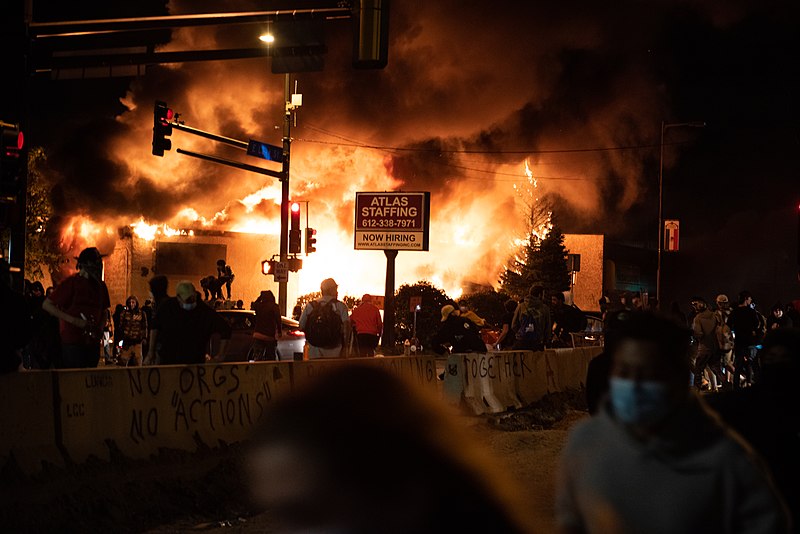
A building burning in Minneapolis following the death of George Floyd.
Photo by Hungryogrephotos via Wikipedia.
This year has seen a series of extraordinary events. First and foremost are the unprecedented lockdowns, which have removed from almost all our societies not just our ability to congregate, but also almost all of our social antennae. It is not just actors, comedians or public speakers who have lost that mechanism: we all have to some extent.
“Will this statement/opinion/joke go down well or badly?” is a fine judgement call. In public and relative private we all try things out and experiment all of the time. Take away all audiences beyond your immediate household and we must all subject ourselves to some other way of testing which way the wind is blowing. The only such device left is the online world, which — as should be obvious to all by now — has its own problems.
And so, during the middle of the oddest mass psychological experiment in history, came the death of George Floyd in May and the rapid escalation of the Black Lives Matter movement. A movement that attempted to push, inveigle and eventually intimidate itself into almost every walk of life inside America and beyond.
In Britain, institutions as far away from the scene of the crime as the British Library and Cambridge University seemed to think that the death of an unarmed black man at the hands of a Minnesota police officer (currently awaiting trial on a charge of murder) demanded some kind of response, lest they be accused of being insufficiently devout.
In ordinary times, people might have been able to get a sense of where other people stood on such a matter. Did users of the British Library really feel any culpability for events in Minnesota? Were things so bad in the state of race relations in America and across the western world (only the western world, naturally) that a stance was required — indeed demanded — of everyone? For a time, it seemed so. Almost every major British institution, including all its universities, issued statements about the death of a man in police custody on another continent, in a jurisdiction over which we have precisely zero control, and similar levels of influence.
“Taking the knee” became one of the emblems of obedience, or subservience, to the cause. Soon, even questioning the reverence of that hallowed, brand new tradition was cause to be pummelled online. And when all gatherings of more than six were banned by law, what other world mattered?
QotD: Tax “loopholes”
Nope. They’re just laws. These “loopholes” exist because at some point in time congress (both democrat and republican both!) decided that they wanted to promote some type of behavior or discourage some other behavior. So they basically put a reward into the law saying if you do this thing we like, you’ll pay less taxes! Or the opposite, congress wanted to discourage some behavior, so if you do that thing we don’t want, it will cost you more.
Both sides have done this forever, state and federal. We want you to drive electric cars so if you buy an electric car you get a tax break this year. YAY! Uh oh, we want you to stimulate the economy by buying this kind of machinery faster, so you have to depreciate your assets this other way or you’ll pay more! BOO! You get a discount for paying your employees health insurance, YAY! Oh, wait … Not that kind of health insurance. BOO!
So on and so forth, up and down, these perks come and go, all based upon whatever behavior congress is trying to promote at that time (or what favors they are doing for their friends). Why was mortgage interest deductible? Because at one point congress said “we really want people to own houses!” Even regular people have things that are considered “loopholes” to somebody.
So when the blue check mark journalism major (who probably dropped out of PoliSci because “there’s too much math”) declares that it is immoral that some rich dude didn’t pay his fair share because he used loopholes, those are basically a bunch of meaningless buzz words strung together to prey on the feelings of the gullible.
Larry Correia, “No, You Idiots. That’s Not How Taxes Work – An Accountant’s Guide To Why You Are A Gullible Moron”, Monster Hunter Nation, 2020-09-28.
January 4, 2021
QotD: Repressing the facts in genetic research
In fact, given the state of our present knowledge, I judge all three of these outcomes are near certain. I have previously written about some of the evidence in Racism and Group Differences. The truth is out there; well known to psychometricians, population geneticists and anyone who cares to look, but surrounded by layers of denial. The cant has become thick enough to, for example, create an entire secondary mythology about IQ (e.g., that it’s a meaningless number or the tests for it are racially/culturally biased). It also damages our politics; many people, for example, avert their eyes from the danger posed by Islamism because they fear being tagged as racists. All this repression has been firmly held in place by the justified fear of truly hideous evils – from the color bar through compulsory sterilization of the “inferior” clear up to the smoking chimneys at Treblinka and Dachau. But … if the repressed is about to inevitably return on us, how do we cope?
It’s not going to be easy. I saw this coming in the mid-1990s, and I’m expecting the readjustment to be among the most traumatic issues in 21st-century politics. The problem with repression, on both individual and cultural levels, is that when it breaks down it tends to produce explosions of poorly-controlled emotional energy; the release products are frequently ugly. It takes little imagination to visualize a future 15 or 20 years hence in which the results of behavioral genetics are seized on as effective propaganda by neo-Nazis and other racist demagogues, with the authority of science being bent towards truly appalling consequences.
Eric S. Raymond, “A Specter is Haunting Genetics”, Armed and Dangerous, 2010-06-19.
January 3, 2021
Arthur Koestler’s Darkness at Noon ranks with Orwell’s Nineteen Eighty-Four
James E. Hartley on why Koestler’s 1941 novel should be seen as a prescient guide to modern-day “wokeness”:
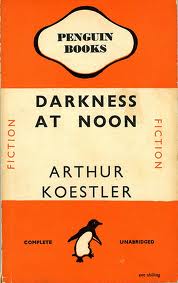
The puzzling thing about wokeness is not that it is fashionable among a small subset of the Campus Left. One should never be surprised by what is fashionable among college faculty and students. The curious question is how these ideas broke out of the academic asylum and met acquiescence among a large group of people who should have known better.
The answer is found in a book which should have never fallen off the radar: Arthur Koestler’s Darkness at Noon. First published in 1941, it was — along with 1984 — one of the great books about totalitarianism written in the 1940s. Widely praised when it was published, the book was enormously influential in fostering the consensus view of post-war anti-communism. In 1998, Modern Library published a list of the 100 best English novels of the 20th century; Darkness at Noon was ranked eighth, five places above 1984.
The plot of the novel itself is fairly simple. The story begins with the imprisonment of Nicholas Rubashov, one of the heroes of the communist revolution in a country which is clearly the Soviet Union. Decades after the revolution, Number 1 (read: Stalin) has assumed power. Rubashov is imprisoned on the absurdly false charges of plotting to kill Number 1. The entire novel takes place in prison, as Rubashov is interrogated and eventually comes to voluntarily confess at a public trial to crimes he did not commit. He is then shot.
The novel explores the philosophical puzzle of why Rubashov would join with what has obviously become a murderous cult run by a totalitarian who is solely interested in amassing enough power to stamp his will upon the whole country. Rubashov, a devoted communist to the end, abandons his principles and bit by bit comes to accede to demands of the new generation who are seeking scapegoats and ritualistic confessions of guilt.
What is the nature of the new generation? One of the Party officials interrogating Rubashov explains:
There are only two conceptions of human ethics, and they are at opposite poles. One of them is Christian and humane, declares the individual to be sacrosanct, and asserts that the rules of arithmetic are not to be applied to human units. The other starts from the basic principle that a collective aim justifies all means, and not only allows, but demands, that the individual should in every way be subordinated and sacrificed to the community — which may dispose of it as an experimentation rabbit or a sacrificial lamb.
The individual does not matter. The group matters. What is good for the group is by definition good, regardless of whether it is good for the individual. As the interrogators make abundantly clear, no individual has the right to stand in the way of the group. The Party represents the group, and thus no individual has the right to oppose the Party.
January 2, 2021
QotD: The Opposite Rule of Progressives
That was in fact the case. The Left has well funded “volunteer” operations to bus in protesters when needed. Often they are paid by their union, like we saw in Wisconsin with the teacher unions. It is a form of projection, for the most part, but in politics it is a way to shift the focus away from whatever crooked stuff they’re doing. One of the oldest tricks in politics is to falsely accuse your opponent of something, so the story is about the other guy denying it, not about whatever you are doing. […] For as long as I’ve been alive, there have been theories about why there is a Left and Right in American politics. All of these theories claim the mantel of science and all of them come from the Left. The reason for this is, at some level, the Left knows they are not working from facts and reason, but rather a set of beliefs. Rather than confront that, they accuse everyone that opposes them of holding irrational beliefs and acting from emotion.
The formula goes like this. They assign to themselves qualities they wish they possessed, but don’t. “Open minded” always makes the list along with “smart” and “unconventional.” Who would not want to be a smart, open minded guy, who is a little off-beat? Gosh that sounds just like the protagonist of every cool TV show and movie! Then they usually assign some bad qualities to the mythical right-winger or conservative. Then they produce a “study” that confirms all of this as science!
I’ll note that liberals have a long list of words for the people on the other side of the hive walls. You never hear liberals talk about the differences between libertarians and paleo-cons or neocons and paleos. To the liberal, they are part of the undifferentiated other on the other side of the wall. Often they avoid this and rely on their cartoon version of the conservative, which is usually a blend of the 1950’s sitcom dad and a prison guard. It’s Ward Cleaver with a closet full of Nazi uniforms.
The Z Man, “The Opposite Rule of Liberalism”, The Z Blog, 2013-11-15.
January 1, 2021
QotD: Buying “organic” food
Take “no GMOs” for starters. That’s nonsense; it’s barely even possible. Humans have been genetically modifying since the invention of stockbreeding and agriculture; it’s what we do, and hatred of the accelerated version done in a genomics lab is pure Luddism. It’s vicious nonsense, too; poor third-worlders have already starved because their governments refused food aid that might contain GMOs. And without GMOs it’s more than possible that the new wave of wheat rust, once it really gets going, might condemn billions to death.
Vegan? I’ve long since had it up to here with the tissue of ignorance and sanctimony that is evangelical veganism. Comparing our dentition and digestive tracts with those of cows, chimps, gorillas, and bears tells the story: humans are designed to be unspecialized omnivores, and the whole notion that vegetarianism is “natural” is so much piffle. It’s not even possible except at the near end of 4000 years of GMOing staple crops for higher calorie density, and even now you can’t be a vegan in a really cold climate (like, say, Tibet) because it’ll kill you. In warmer ones, you better be taking carnitine and half a dozen vitamins or you’re going to have micronutrient issues sneak up on you over a period of years.
OK, I give on gluten-free. Some people do have celiac disease; that’s a real need. But “no trans fat”? Pure faddery, or the next thing to it. The evidence indicting trans fats is extremely slim and surrounded by a cloud of food-nannyist hype. I hate helping to keep that sort of balloon inflated with my dollars.
Who could be against “fair trade”? Well, me … because the “fair trade” crowd pressures individual growers to join collectives with “managed” pricing. If you’re betting that this means lazy but politically adept growers with poor resource management and productivity prosper at the expense of more efficient and harder-working ones, you’ve broken the code.
Finally, “pesticide-free”. Do I like toxic chemicals on my food? No … but I also don’t fool myself about what happens when you don’t use them. This ties straight back to the general cluster of issues around factory farming. Without the productivity advantages of pesticides, synthetic fertilizer, and other non-“organic” methods, farm productivity would plummet. Relatively wealthy people like me would cope with reduced availability by paying higher prices, but huge numbers of the world’s poor would starve.
I buy “organic” food because it tastes better and I can, but I feel guilty about reinforcing all the kinds of delusion and superstition and viciousness that are tied up in that label. We simply cannot feed a world population of 6.6 billion without pesticides and factory farming and GMOs and preservatives in most bread; now, and probably forever, “organic” food will remain a luxury good.
Try telling its political partisans that, though. Hyped on their belief in their own virtue, and blissfully ignorant about scale problems, they have already engineered policies that have cost thousands of lives during spot famines. The potential death toll from (especially) anti-GMO policies is three orders of magnitude higher.
And my problem reduces to this: how can I buy the kind of food I want without supporting dangerous delusions?
Eric S. Raymond, “Organic guilt”, Armed and Dangerous, 2010-08-23.
December 30, 2020
This is why the word “unexpectedly” gets such a workout in media these days
David Warren on “unexpectedly” negative results from policies born of virtue-signalling “good intentions” by self-styled progressives:
The expression, “unintended consequences,” is a charitable dodge. It is what old-fashioned, polite, civic-minded people say about the fallout from progressive social policies. It implies that their authors have overlooked something, or made some innocent mistake. For unfortunately, the policies do the exact opposite of what was promised. Surely the “reformers” didn’t mean to force decent, reasonable people to do things that any decent, reasonable person would consider to be satanic. Yet somehow, that was the result.
By contrast, these reformers despise the tactics of the bourgeois. Rather than argue, they prefer to drown out their opponents with slogans. Rather than coherently reply, they characterize any asking questions as “fascist,” “misogynist,” “racist,” “hate criminals,” &c. Those who have exposed scandals are personally smeared, slandered, doxxed. This isn’t new. It is the way the Left has always “debated,” going back long before Lenin. Once they have the police working for them, opponents get the knock in the middle of the night.
There are, incidentally, two kinds of “reform,” corresponding to the two political persuasions. One happens without planning, and is an organic response to things no longer working properly. Try, in good faith, to make the old system work, and it will subtly change. The “problems” fix themselves, when they are allowed to. The other kind is “reform” according to a theory. A huge, mostly imaginary “problem” is created, so a “solution” may be imposed. Every tool must be applied, to get everyone onside for the task: fake news, fake science, fake history, and miscellaneous fakery. For as every godless person knows, “the end justifies the means.”
Luckier than most, raised in “liberal” environments, I was able to discern this from an early age. By chance I acquired many friends who were refugees from Communist (especially Soviet-occupied) countries. But it was not just that. Having been trained counter-culturally, by non-conformist “classically liberal” teachers, and also having learnt to read for myself, I was already fairly alert. The clincher for me was a native disposition, not only to think independently, but to resist being a putz. It was not in my nature to assume that the enemies of real liberalism (which requires honesty) had good intentions. Reason, and experiment, demonstrated that they had not.
For instance, I early realized that leftwing factions formed a Party of Privilege. Every policy they advanced favoured individuals with relatively more wealth and power, against individuals with less. Unions were a good example. They represented the better-paid. The labour laws they advocated were designed to exclude the young and the poor from labour-market competition. They secured the allegiance of thuggish union members through crassly self-interested schemes. They opposed legitimate rewards for labour; for skill and hard work. Instead they enforced universal mediocrity, and punished intelligent enterprise. Legitimate labour interests, once represented by cooperative and self-managing guilds, were replaced by the interests of (untalented) union organizers.
December 28, 2020
Titania McGrath, unmasked
In The Critic, Andrew Doyle talks about creating the “Titania McGrath” persona on Twitter and what happened after he was “outed” as the writer behind the tweets:
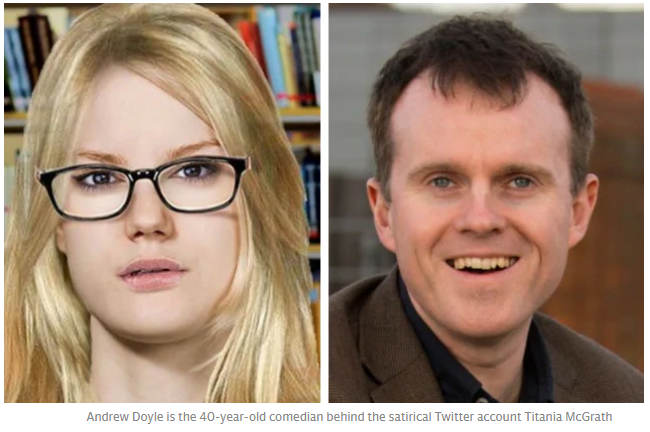
My most recent “outing” was as the writer of Titania McGrath, an intersectional activist who began life on Twitter in order that she might chastise the unwoke for their moral impurity and proclaim her infinite virtue to the cybersphere. For those of you who are not on Twitter — that’s the 80 per cent of the country who actually value their time on earth — you may not be aware that such self-aggrandising behaviour is considered acceptable. On Twitter, it’s the norm. It’s effectively a digital playground in which grown adults toss their half-baked opinions around like pies in that scene from Bugsy Malone.
From Titania’s earliest appearance, I resolved to stay anonymous — not to cause mischief, but more for the fun of it. If people believed she was real, I reasoned, I could enter into dialogue with her detractors. This meant that the satirical impact would not be restricted to what Titania said, but how others reacted to her. Her tweets are designed to ridicule the excesses of the social justice left, but her interactions tend to expose the folly of those on the right who take her at face value and lose their temper. As such, her targets are not limited to one side of the political spectrum.
[…]
Having been revealed as the author, most of this venom was now channelled in my direction. The extent of the abuse was often unfathomable, and some even went so far as to send direct threats of violence. It’s a curiosity of our times that the most vicious and bullying online behaviour tends to be exhibited by those who claim to be on the side of empathy and compassion.
I have never quite understood the kind of anger that comedy and satire can provoke. As someone who has seen my fair share of stand-up, I have often found that the best response to a joke that does not amuse me is simply not to laugh. It would never occur to me to berate other members of the audience for their poor taste, or to take to social media and complain about the comedian in question. As someone who does not suffer from narcissistic personality disorder, I am well aware that my personal sense of humour is not the benchmark for the entirety of humankind. When it comes to comedy criticism, “that’s not funny” is about as insightful as “that’s not erotic”. Try telling a fetishist that studded PVC nuns’ habits are objectively devoid of sexual appeal, and he will probably be able to show you some homemade videos that will quickly prove you wrong.
It is of course entirely natural to feel displeasure when one’s worldview is being ridiculed. I do not blame the poor writer for the Observer who suggested that copies of Titania’s first book would be given to every person in Hell, and that “lampooning the language of social justice is a cheap shot”. I have some sympathy for her position. If I were absorbed in an ideology that mistrusts humour and perceives that jokes have the potential to “normalise hate”, I would doubtless be similarly vexed by anyone who had the temerity to mock it. But that’s the trouble with religious belief. However important it seems to one’s sense of personal identity, there is no way to protect our icons from desecration by unbelievers.
December 17, 2020
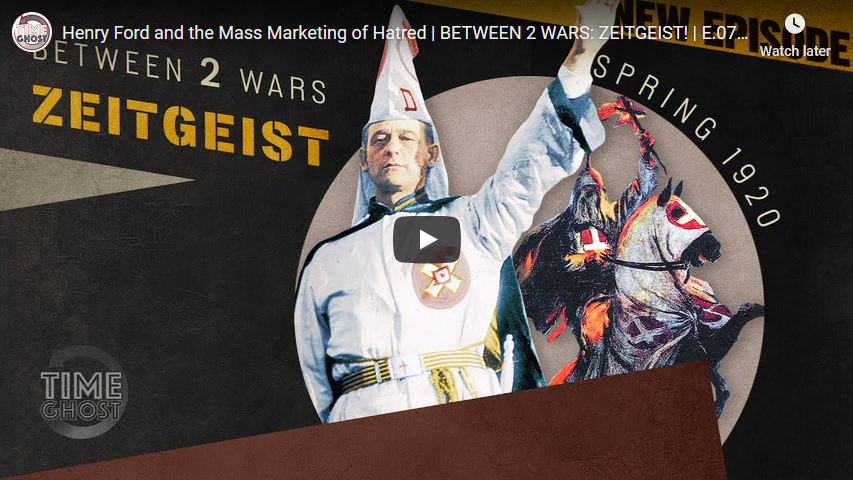
Henry Ford and the Mass Marketing of Hatred | BETWEEN 2 WARS: ZEITGEIST! | E.07 – Spring 1920
TimeGhost History
Published 16 Dec 2020Racist conspiracies are on the rise in America. But other hysterias are also lessening. Will there be a return to normalcy?
Join us on Patreon: https://www.patreon.com/TimeGhostHistory
Hosted by: Indy Neidell
Written by: Indy Neidell and Francis van Berkel
Director: Astrid Deinhard
Producers: Astrid Deinhard and Spartacus Olsson
Executive Producers: Astrid Deinhard, Indy Neidell, Spartacus Olsson, Bodo Rittenauer
Creative Producer: Maria Kyhle
Post-Production Director: Wieke Kapteijns
Research by: Indy Neidell and Francis van Berkel
Image Research by: Daniel Weiss
Edited by: Daniel Weiss
Sound design: Marek KamińskiColorizations:
Daniel Weiss – https://www.facebook.com/TheYankeeCol…
Spartacus Olsson
Mikolaj UchmanSources:
Some images from the Library of Congress
Portrait from Bibliotheque Nationale FrancaiseFrom the Noun Project:
– agreement by Vectors Point
– film camera by Chanut is Industries, TH
– cowboy man by Adrien Coquet
– Protest by Juan Pablo Bravo
– Immigrants by Luis Prado
– pair figure skating by Andrei Yushchenko
– singles figure skating by Andrei Yushchenko
– Letter by Mochammad Kafi
– speech by Juan Pablo Bravo, CL
– universe by Icongeek26
– Arrow by IconTrack
– Galaxy By VictorulerSoundtracks from Epidemic Sound
– One More for the Road – Golden Age Radio
– “First Responders” – Skrya
– “Guilty Shadows 4” – Andreas Jamsheree
– “Slow Discovery” – Cobby Costa
– “Try and Catch Us Now” – David Celeste
– “The Inspector 4” – Johannes Bornlöf
– “Deviation In Time” – Johannes Bornlof
– “Disciples of Sun Tzu” – Christian AndersenArchive by Screenocean/Reuters https://www.screenocean.com.
A TimeGhost chronological documentary produced by OnLion Entertainment GmbH.
December 15, 2020
QotD: TedX
sanctimoniousubiquitous Ted Talks programme, is more inclusive than official Ted because they have added a random letter ‘X’ into the word. On an unrelated note, TedX London have decided to start using the totally real and not at all just made-up word “Womxn” when they talk about members of the female persuasion, chapettes, fillies, gels, y’know, charming, delightful, non-men – them. They told anormal personbigot on Twitter who asked why they were using the word “womxn”: “No, that’s not a typo: ‘womxn’ is a spelling of ‘women’ that’s more inclusive and progressive. The term sheds light on the prejudice, discrimination, and institutional barriers womxn have faced, and explicitly includes non-cisgender women.” But are TedX really the inclusive group they claim to be? Trans Media Watch, a pro-trans lobby group told the BBC it would never use the word Womxn: “because we feel it’s important for people to recognise that trans women are women. Trans women aren’t a special, separate category.” So it turns out “women” is the most inclusive term after all. If TedX London hasn’t been cancelled by the end of the week then Twitter’s not what it was.David Scullion, “UN-Believable”, The Critic, 2020-09-09.


