
Published on 21 May 2015
The big success of the Gallipoli Campaign never came, thousands of soldiers died and so Winston Churchill is forced to resign. At the same time August von Mackensen is pushing back the Russians and forcing them to hide in Przemyśl fortress – the same fortress they just conquered from the Austro-Hungarians a few weeks earlier.
May 22, 2015
Przemyśl Falls Again – Winston Churchill Gets Fired I THE GREAT WAR Week 43
Comments Off on Przemyśl Falls Again – Winston Churchill Gets Fired I THE GREAT WAR Week 43
The trains of war – the military application of steam power
James Simpson on the revolution in military affairs triggered by the development of the steam engine and the railways:

Navvies working on the Grand Crimean Central Railway, 1854. Charles Walker: Thomas Brassey, Railway Builder, 1969. (via Wikipedia)
Trains were cutting-edge weapons of war in the 19th century — and all the major powers were figuring out how to deploy them. The Europeans learned how to move troops by train. The Americans — how to fight on rail cars. The British, meanwhile, found they could dominate an empire from the tracks.
In today’s world of tanks, bombers and submarines, it’s perhaps hard to believe that the train was once an amazingly mobile weapons platform. They might be locked to their rails, but for over a century trains were the fastest means of hauling troops and artillery to front lines across the world.
The invention of the railway shaped warfare for a century. Rails allowed force projection across immense distances — and at speeds which were impossible on foot or by horse.
[…]
The first demonstration of the military efficacy of the railroads was the 1846 Polish Uprising. Prussia rushed 12,000 troops of the Sixth Army Corps, with guns and horses, to the Free City of Krakow to help put down the Polish rebellion. In this period of nationalist uprisings, Russia and Austria also used their railroads against similar uprisings from 1848 to 1850.
A lack of infrastructure and experience stifled the success of these early endeavors. Due to a lack of rolling stock, suitable platforms and double-track stretches, the trains sometimes operated far slower than a man could march on foot.
Austria was first to get it right. In 1851, the Austrian Empire shuttled 145,000 men, nearly 2,000 horses, 48 artillery pieces and 464 vehicles over 187 miles.
Comments Off on The trains of war – the military application of steam power
May 21, 2015
This year will be the last in the air for XH558, the last of the Avro Vulcan bombers
At The Register, Lester Haines explains why the trust that operates XH558 is having to ground the aircraft permanently:
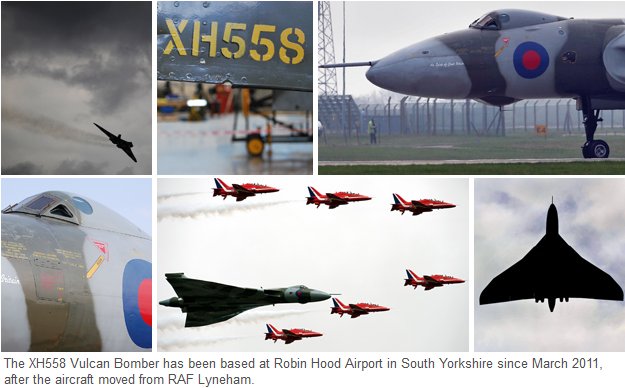
The Vulcan To The Sky Trust has announced “with considerable sadness” that this summer will be the public’s last chance to catch Avro Vulcan XH558 thundering through British skies, as the legendary V-bomber will be permanently grounded at the end of this flying season.
The trust explains that the axe will fall because “three expert companies on whom we depend – known as the ‘technical authorities’ – have together decided to cease their support at the end of this flying season”.
It elaborates:
At the heart of their decision are two factors. First, although we are all confident that XH558 is currently as safe as any aircraft flying today, her structure and systems are already more than ten percent beyond the flying hours of any other Vulcan, so knowing where to look for any possible failure is becoming more difficult. These can be thought of as the ‘unknown unknown’ issues, which can be impossible to predict with any accuracy. Second, maintaining her superb safety record requires expertise that is increasingly difficult to find.
Keeping XH558 in the air has been an epic undertaking, and not without wing-and-a-prayer moments involving last-minute injections of cash.
Comments Off on This year will be the last in the air for XH558, the last of the Avro Vulcan bombers
John Monash – Australia’s greatest general
Strategy Page reviews a new biography of Australia’s General John Monash:
The centennial of the First World War has brought forth renewed public interest and additional scholarly study of that still controversial conflict, variously the last 19th century imperial war and the first modern war. When its great generals are enumerated, one named by relatively few outside the Antipodes is Australian Army Corps commander John Monash (1865-1931), this despite Field Marshal Viscount Montgomery’s declaration half a century after the Armistice that Monash was “the best general on the Western Front in Europe,” and historian Sir Basil Liddell Hart’s even stronger accolade as “the greatest general of World War I by far.” Yet in the three-volume Cambridge History of the First World War, there is not one mention of him.
Monash, it must be said, has not been entirely overlooked. He was knighted in the field by George V (as a Knight Commander of the Order of the Bath) and subsequently given the title Knight Grand Cross of the Order of St. Michael and St. George, and in his homeland his name graces a university (indeed, the publisher of the book under review), a scholarship, a town and even a freeway. Nevertheless, in Maestro John Monash, former Australian Deputy Prime Minister Tim Fischer argues that Sir John has been wronged by history and not given his due. In a breezy hagiography (Fischer vehemently denies that characterization, protesting that his biography is “warts and all,” however, he downplays or dismisses most of the “warts” cited, e.g., other generals also had mistresses, and while he made mistakes at Gallipoli, he learned from them) and advocacy piece, he makes a justifiable case for Monash’s posthumous promotion to field marshal (backdated to 1930). Had he been promptly promoted postwar, rather than in 1929, to general (that is, full or four-star general), Fischer points out logically, he likely would have been promoted by the king one step up in rank to field marshal.
In his account of Monash’s life and military career, Fischer details the many obstacles faced and surmounted by “the most innovative general” of the war. His sobriquet for Monash, “maestro,” comes from Sir John’s comparison of a “perfected modern battle plan” to a “score for an orchestral composition.” Indeed, while some British and French generals were still thinking in terms of cavalry charges, sabers and bayonets, drawing on his engineering background, Monash made concerted use of infantry, artillery, tanks, aircraft and radio in (to quote him) “comprehensive holistic battle plan[s].” His strategy’s success became evident in thwarting Germany’s final westward push and smashing through the Hindenburg Line, in the 93-minute Battle of Hamel and the second Battle of Amiens, which German General Ludendorff later called “the black day of the German Army in the war,” victories achieved while Monash was still a lieutenant general (three stars). “Never has a general who did so much to help win a world war … been so unacknowledged,” affirms Fischer, returning to his theme.
Comments Off on John Monash – Australia’s greatest general
May 20, 2015
Ask what “Red Team” can do for you
At Strategy Page, a look at the “Red Team revolution”:
Red Teams came out of wargaming. There, the “Red” team represented the enemy, while the “Blue” team played the good guys. Beginning in the late 1970s the U.S. Army adopted a form of wargaming based on historical models but where commanders are presented with very realistic situations for future battles. This was applying to wargames the old phrase, “train as you fight, and fight as you train.” But in addition to providing more realistic games for training, this style of wargames also made it possible to analyze war plans as never before. In the past, your war plans didn’t really get a workout until you were in combat against a real, live Red Team (the enemy). The new wrinkle was that it was now easier to have your own people provide an effective, if not perfect, Red Team experience because of all those officers with wargame experience.
So now the senior commanders of the U.S. Army have been sending Red Teams around to the major commands, to play devil’s advocate to whatever war plans senior commanders and their staffs have come up with. It’s not new, really. The concept of “devil’s advocate” has been around for a long time. But now the army has institutionalized it and used more powerful techniques (wargaming) to implement it.
This all began back in the 1980s, when realistic wargaming was catching on, especially among the students at the Command and General Staff School (C&GSS) and the Army War College AWC). The younger officers at the C&GSS were particularly enthusiastic, and they came to be known as the “Jedi Knights,” mainly because the analytic skills obtained from playing lots of wargames, gave them a seemingly magical ability to find flaws in war plans. That’s what the Red Teams are all about, Jedi Knights on steroids. Since then the Staff School at Leavenworth has established courses for training Red Team members, some of the courses are 18 weeks long.
And what would the poor Red Team officers do when, as in Japanese wargaming before the Battle of Midway, the Blue force commanders “re-floated” most of the losses, thereby winning the game (but losing the war)? You don’t subordinate the Red Team to the local commander:
The Red Teams all report to the head of the army, which insures that none of the commanders they are working with try to pull rank. The Red Teams give the Chief of Staff of the army regular reports on how effective the many war plans developed in the army combat units are holding up to scrutiny, which is a unique capability in the military world.
Comments Off on Ask what “Red Team” can do for you
Scuttled Soviet submarines in the Arctic
The Soviet Union had a remarkably casual approach to disposing of nuclear-powered submarines that were no longer useful in active service:
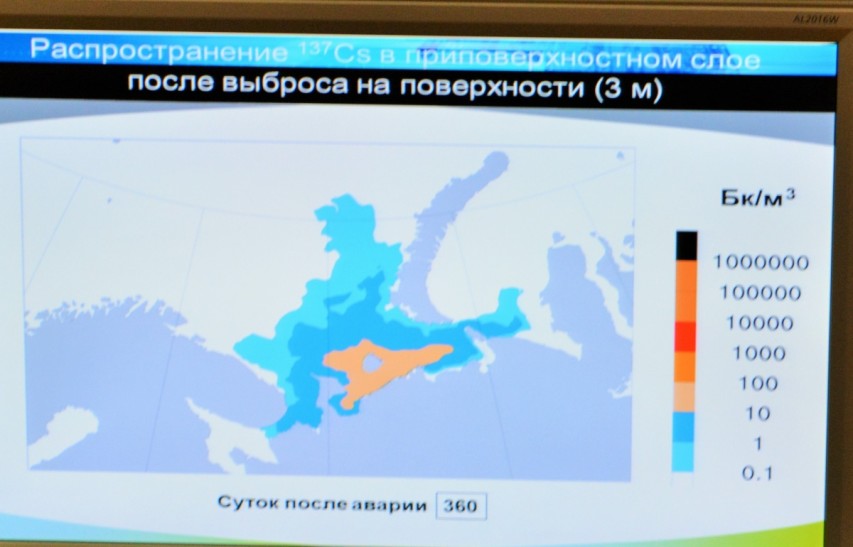
Russian scientists have made a worst-case scenario map for possible spreading of radionuclides from the wreck of the K-159 nuclear-powered submarine that sank twelve years ago in one of the best fishing areas of the Barents Sea.
Mikhail Kobrinsky with the Nuclear Safety Institute of the Russian Academy of Science says the sunken November-class submarine can’t stay at the seabed. The two reactors contain 800 kilos of spent uranium fuel.
At a recent seminar in Murmansk organized jointly by Russia’s nuclear agency Rosatom and the Norwegian environmental group Bellona, Kobrinsky presented the scenario map most fishermen in the Barents Sea would get nightmares by seeing.The map shows expected spreading of radioactive Cs-137 from potential releases from the K-159 that still lays on the seabed northeast of Murmansk in the Barents Sea.
Some areas could be sealed off for commercial fisheries for up to two years, Mikhail Kobrinsky explained.
Ocean currents would bring the radioactivity eastwards in the Barents Sea towards the inlet to the White Sea in the south and towards the Pechora Sea and Novaya Zemlya in the northeast.
Comments Off on Scuttled Soviet submarines in the Arctic
May 19, 2015
The Tin Foil Hat Brigade and Jade Helm 15
Tom Kratman on the overtly paranoid reactions to the upcoming Jade Helm exercise:
In about two months, exercise Jade Helm 15 is scheduled to kick off. This is a two-month long special operations exercise, spread out across the southwest of the country, from Texas to California. It has the Tin Foil Hat Brigade, Right Wing Regiment1, demonstrating all the calm and relaxed demeanor (I am, of course, kidding), as well as the typical paranoid delusions (not kidding at all), for which it and its members are justifiably famous.2
Never having actually enlisted with the Tin Foil Hat Brigade, my initial reaction to exercise Jade Helm 15 was a resounding, “ho hum,” and my reaction to the TFHB reaction was, “As Christ probably would have said if He’d thought about it, ‘The loons ye shall have with ye always.’”
To be fair to the TFHB, though, whenever the New York Times3 and Washington Post4 agree that something like this is clearly harmless, it’s possibly time to inventory our stocks of ammunition and break out the banana oil to make sure our protective masks are in good working order. In other words, their enthusiastic and unquestioned agreement constitutes a rebuttable presumption that FEMA is about to open concentration camps.
However, rebuttable presumptions are there to be rebutted. This week and next I’m going to limit my rebuttal to the notion that the exercise is inherently suspicious because it is so militarily useless and unnecessary as to be indefensible. To do that we need to get into a little history, a bit of doctrine, and a touch of dogma.
[…]
1 Which in general demeanor much resembles the TFHB, Left Wing Regiment.
2 Just Google it; there are too many examples for me to illustrate without appearing to be playing favorites.
3 http://www.nytimes.com/2015/05/07/us/conspiracy-theories-over-jade-helm-get-some-traction-in-texas.html?_r=0
4 http://www.washingtonpost.com/news/morning-mix/wp/2015/04/29/jade-helm-15-a-military-simulation-draws-scrutiny-and-wild-speculation-in-texas/
Comments Off on The Tin Foil Hat Brigade and Jade Helm 15
The 1982 amphibious landings at San Carlos Water
Think Defence looks back at the successful amphibious landings in the Falkland Islands by a less-than-fully-prepared British military:
If the amphibious operations in Normandy were unprecedented because of the scale those in 1982 in the Falkland Islands were equally remarkable, nor for scale but for the huge distance involved. Another breathtaking feature of Operation Corporate was the speed in which it was mounted and the degree of improvisation that would in the end, be needed.
One might argue that even taking into account Inchon and Suez it was the worlds most complex and demanding amphibious operation since D-Day.
Since VE day and Suez the UK’s amphibious capabilities had dwindled both in scale and capability, the Royal Marines concentrating on their Northern Europe role.
When Argentina invaded the Falkland Islands in 1982 the scale of the challenge had many echoes of D-Day; a need for joint service cooperation and a number of technical challenges to overcome for example. What we did not have was the luxury of time, no time to develop new and novel solutions, no time for testing and no time for practice beyond what was available on the journey south.
Due to the short timescales British Rail could not reposition their rolling stock to get the War Material Reserve (about 9,000 tonnes just for 3CDO, 30 days combat supplies and 60 days of general stores) to the ships so instead, a fleet of RCT and civilian trucks were used.
More or less, we went with what we had.
In little over a month from the invasion, the first ships had departed the UK on their 8,000 mile journey South.
There is no need to recount the general history of the campaign but from a ship to shore logistics perspective there were a number of equipment and capabilities available to Commodore Clapp and Brigadier Thompson worth describing.
Earlier posts on the Falklands War can be found here.
Comments Off on The 1982 amphibious landings at San Carlos Water
May 15, 2015
Artillery Crisis on the Western Front – The Fall of Windhoek I THE GREAT WAR Week 42
Published on 14 May 2015
The 2nd Battle of Ypres is still going but no side can gain a decisive advantage. The main reason on the British side is a lack of artillery ammunition. Even the delivered shells are not working correctly. But even the German supply lines are stretched thin. At the same time German South-West Africa falls to South African troops under Louis Botha.
Comments Off on Artillery Crisis on the Western Front – The Fall of Windhoek I THE GREAT WAR Week 42
Women in front-line combat trades
At Strategy Page, a look at the political desire to fully integrate women into the combat arms:
In 2014, after years of trying to justify allowing women into the infantry, artillery and armor and special operations forces, the U.S. government decided to just order the military to make it happen and do so without degrading the capabilities of these units. While the army was inclined the just say yes, find out what quotas the politicians wanted and go through the motions, others refused to play along. SOCOM (Special Operations Command) and the marines pointed out that the research does not support the political demands and that actually implementing the quotas could get people killed while degrading the effectiveness of the units involved. This is yet another reason why many politicians do not like the marines and are uneasy about SOCOM.
But action had to be taken and orders were orders. The various services opened up some infantry training programs to women and have discovered two things. First (over 90 percent) of women did not want to serve in any combat unit, especially the infantry. Those women (almost all of them officers) who tried out discovered what female athletes and epidemiologists (doctors who study medical statistics) have long known; women are ten times more likely (than men) to suffer bone injuries and nearly as likely to suffer muscular injuries while engaged in stressful sports (like basketball) or infantry operations. Mental stress is another issue and most women who volunteered to try infantry training dropped out within days because of the combination of mental and physical stress. Proponents of women in combat (none of them combat veterans) dismiss these issues as minor and easily fixed, but offer no tangible or proven solutions.
Back in 2012 the U.S. Army and Marine Corps were ordered to come up with procedures to select women capable of handling infantry and special operations assignments and then recruit some women for these jobs. This had become an obsession with many politicians. None of these proponents of women in the infantry have ever served in the infantry, but they understood that if they proceeded without proof that women could handle the job, that decision could mean getting a lot of American soldiers and marines killed. The politicians also knew that if it came to that, the military could be blamed for not implementing the new policy correctly.
So far the tests, overseen by monitors reporting back to civilian officials in Congress and the White House, have failed to find the needed proof that women can handle infantry combat. The main problem the military has is their inability to make these politicians understand how combat operations actually work and what role sheer muscle plays in success, or simply survival. But many politicians have become obsessed with the idea that women should serve in the infantry and are ignoring the evidence.
Comments Off on Women in front-line combat trades
May 14, 2015
A new application for “dazzle” camouflage

RMS Olympic by Arthur Lismer 1919 (via Wikipedia).
Military History Now looks at some of the more eye-catching camouflage schemes of the world wars and suggests that something like it may have a modern application:
… nearly a century after the advent of dazzle, Dr. Nick Scott-Samuel of the University of Bristol believes that similar camouflage patterns painted on the sides of today’s jeeps and armoured cars will make it harder for enemy combatants to get a fix on military vehicles.
“Scott-Samuel, is the first to find evidence that dazzle camouflage can affect perception of speed – but only if the camouflaged object is moving quickly,” says a spokesperson with the British school. “These findings suggest that, while it would probably not have successfully distorted ships’ speeds in the two World Wars, dazzle camouflage could play a role in today’s battlefields where fast-moving army vehicles frequently come under attack from shoulder-launched, rocket-propelled grenades.”
Scott-Samuel arrived at his conclusion after putting volunteers through a series of visual tests. Researchers asked subjects to estimate the distance and speed of camouflaged objects in computer-simulated environments.
Participants observing virtual objects with dazzle patterns believed the targets were moving as much as 7 percent slower than they really were. Those who viewed unmarked objects were more likely to correctly estimate their speeds.
Scott-Samuel says the results indicate that military vehicles bearing dazzle patterns would be harder to hit than those painted with ordinary drab colours.
Comments Off on A new application for “dazzle” camouflage
May 12, 2015
The Sky Was The Limit – World War 1 In The Air I THE GREAT WAR
Published on 11 May 2015
World War 1 saw several completely new technologies develop rapidly. The airplane itself was only a few years old but pioneering engineers soon saw its potential for military use. For recognisance and later as fighter or bomber, World War 1 had huge impact on aviation and warfare in general. This special episode gives you an idea about the obstacles that had to be overcome.
Comments Off on The Sky Was The Limit – World War 1 In The Air I THE GREAT WAR
Step aside, Sun Tzu, Heinlein’s Starship Troopers is the new guide to warfare
In Popular Mechanics, Joe Pappalardo makes the claim that Robert Heinlein’s 1959 novel Starship Troopers is replacing Sun Tzu’s Art of War due to its greater relevance to 21st century warfare:

It’s not just generals and soldiers who keep the The Art of War in print. Businessmen, coaches, and lawyers all seem to get something out of Sun Tzu’s 6th century military tome — memorizing and repeating passages that speak to the tactics and strategy of success, whether that’s on Wall Street or in a war zone.
But for all its long-lasting cultural influence, the book is limited by its lack of specifics. “Know your enemy” and “win without fighting” are all well and good, but such axioms don’t really help today’s GI prepare to deploy with a robotic squadmate or decide what information to place on a digital head’s-up display. Modern warriors, surrounded by sophisticated gear and nuanced rules of engagement, need to meditate on the balance between technology and soldier, man and machine, civilian and veteran. For that kind of wisdom, they must go to military science fiction — and one great book in particular.
Robert A. Heinlein’s Starship Troopers, published in 1959, is aging remarkably well. The tome chronicles the early military career of Johnnie Rico, who fights alien arachnids while clad in a heavily armed exoskeleton. The troopers drop from orbit one by one to wreak havoc on whatever target the Sky Marshal deems worthy of the attention. It’s a cool adventure novel with a soldier’s eye view that doubles a treatise on modern warrior culture, the limits of military technology, and the awful glories of fighting infantry. There’s a reason military academies like West Point recommend cadets read the book.
Like Sun Tzu’s masterpiece, Heinlein’s abounds with quotable axioms. You may not hear overly intense car salesman quoting from Starship Troopers anytime soon, but here are six reasons why the book is a practical guide to 21st century warfare.
Comments Off on Step aside, Sun Tzu, Heinlein’s Starship Troopers is the new guide to warfare
May 11, 2015
After 74 years, the remains of HMS Urge discovered off the Libyan coast
In The Telegraph a report on the discovery of a Royal Navy submarine wreck from 1942:

British U class submarine HMS Urge underway. (via Wikipedia)
A Royal Navy submarine paid for by a town holding dances and whist drives is believed to have been discovered more than 70 years after it vanished during the Second World War.
The British submarine HMS Urge was paid for by the townspeople of Bridgend, South Wales, but sunk without trace in the Mediterranean in 1942.
It disappeared while making a voyage from the island of Malta to the Egyptian city of Alexandria – and families of the 29 crew and 10 passengers never knew what happened.
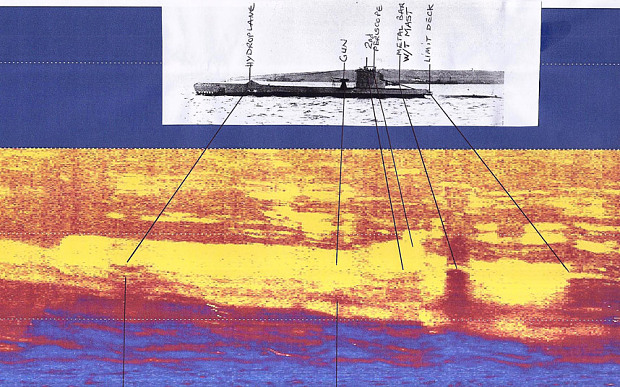
For more than 70 years, its resting place has remained a mystery. But a 76-year-old scuba diver claims he has discovered its wreck 160ft (50m) below the waves off the Libyan coast.
Comments Off on After 74 years, the remains of HMS Urge discovered off the Libyan coast
May 10, 2015
In the Netherlands, 1945, nobody “swaggered”
David Warren on the task of the First Canadian Army after liberating The Netherlands:
It wasn’t only the liberation, but what our boys did after, in that devastated country. The Netherlands — but Canadians call her “Holland” — had suffered proportionally more than any other country the Wehrmacht had crushed and occupied, and would continue to suffer — famine — after their final defeat. The bastards blew the dikes to slow our allied advance. Breached, the lands flooded; … deaths heaped on deaths.
Victory is sweet, but there was no swagger, from the Dutch still mired in Hell.
And memorably, neither from our boys, who had liberated them. They didn’t swagger. Instead, they set down their guns and their helmets and went to work — spontaneously, voluntarily, on the enormous task of repair; of fixing the dikes and clearing the farms of salt-mud and debris. Of breaking the stones, and smoothing the roads, and shifting the rubble. The food bags, too, were starting to arrive, from Canada and the States — the tins and boxes; the cigarettes and medical supplies; and the candy, for the little children.
This wasn’t the Marshall Plan. It was three years before that. The Royal Canadian Air Force was dropping food from the sky, as fast as it could. (Our pilots read, “Thank you Canadians!” on rooftops.) Crates and drums were being discharged through the busted ports, wheat and flour from our Prairies. Yet thousands were still perishing from hunger.
And more: all the stuff sent by unorganized people, to wherever they thought it would do some good; to Germany as well as Holland; to wherever people must be desperate and starving. And back home our boys’ own families were throwing themselves into action, packing and shipping; and slipping in the letters of love and encouragement to strangers and new friends over the sea.
We were already hand-in-glove with the Dutch, from sheltering their royal family in exile. The magnificent Queen Wilhelmina, scourge of politicians (Churchill called her “the only real man” among all the exiled governors in London), no longer speaking in the nights, through the radio. For she had returned, to a rapturous welcome. And now, too, their little princess — Margriet Francisca — born in Ottawa Civic Hospital, in a maternity ward that had been declared Dutch sovereign territory for the occasion.
Every year, the tulips still come from Holland to decorate our Parliament Hill. And Dutch kids are still taught in school how to sing, “O Canada.”
Comments Off on In the Netherlands, 1945, nobody “swaggered”


