
Published on 9 Feb 2015
In the run up to the 100 yr anniversary of the end of the First World War Michael Portillo travels across France and Belgium to find out the history of raiways of the past and present….
February 17, 2017
Railways Of The Great War With Michael Portillo Part 1 A Railway War Begins
Comments Off on Railways Of The Great War With Michael Portillo Part 1 A Railway War Begins
February 16, 2017
“Secretive Army Special Mission Unit Offers Support to Leftist Overthrow of Trump Administration”
Whoa! Shit just got real!*
In recent months, ill-informed Leftists who have spent the last 8 years repeatedly telling the public that they do not “need” guns and have no reason to fear the Federal Government (except of course for the police) have discovered that they are totally unprepared to carry out the violent overthrow of the Trump Administration and the revolution that they feel our country so desperately needs.
Those pleas for a military-led coup had gone unanswered (and largely laughed at) by members of the Armed Forces until yesterday, when a little known Army Special Mission Unit responded to left-wing demands for a military removal of the Commander-in-Chief.
Known only as the “E4 Mafia,” this unit appears nowhere in U.S. Army organizational charts but reportedly acts as a major influence in every single Army organization operating across the globe. Because no one in our organization ever served in the military, and because it serves our political agenda (and our research is limited to Wikipedia), it can only be assumed that the E4 Mafia is one of numerous Army Special Mission Units such as Delta Force and SEAL Team Sixty.
The support of “E4M” does not come cheap, however. The following list of demands was passed to Article 107 News in an effort to ensure widest dissemination to sympathetic revolutionaries (Editor’s Note: This message received A LOT of editing for both spelling/grammar and content prior to re-publication here).
H/T to John Ringo, who commented:
You forgot to add ‘top secret’ Army unit. ‘So top secret it appears in no FOIA requests and is officially disavowed by all military sources. A Pentagon spokesman when asked about them responded with a string of obscenities before being led away crying…’
Comments Off on “Secretive Army Special Mission Unit Offers Support to Leftist Overthrow of Trump Administration”
February 14, 2017
Reconstructive and Plastic Surgery During World War 1 I THE GREAT WAR Special
Published on 13 Feb 2017
Filmed at Romagne 14-18 museum: http://romagne14-18.com
Plastic and reconstructive surgery saw rapid development during World War 1. Modern medical care and better equipment increased the chances of survival for the soldiers. But these survivors were often disfigured or lost limbs as a result. To help them return to a somewhat normal life, reconstructive surgeons developed methods to restore their faces and aided them with prosthetics.
Comments Off on Reconstructive and Plastic Surgery During World War 1 I THE GREAT WAR Special
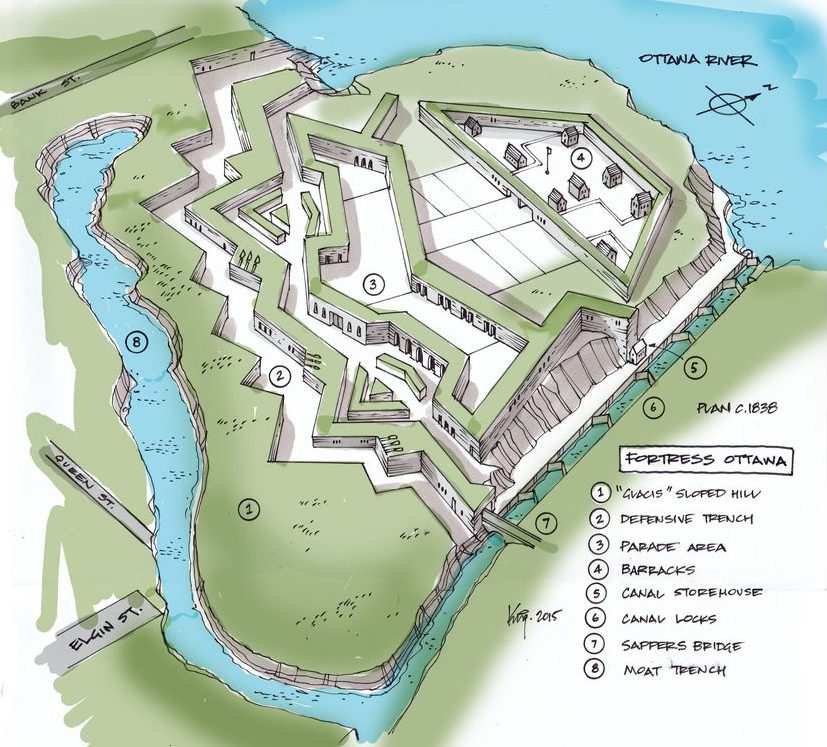
Fortress Ottawa, a post-War of 1812 alternative use for Parliament Hill
Colby Cosh linked to this Ottawa Citizen article by Andrew King:
Mapped out with defensive moats, trenches and cannon placements, Bytown’s sprawling stone fortification on the hill was a typical 19th century “star fort,” similar to Fort George in Halifax, also known as Citadel Hill, and the Citadelle de Québec in Quebec City. The “star fort” layout style evolved during the era of gunpowder and cannons and was perfected by Sebastien Le Prestre de Vauban, a French engineer who studied 16th century forts designed by the Knights of Malta. A star fort built by the order with trenches and angled walls withstood a month-long siege by the Ottoman Empire. This layout remained the standard in fort design until the 20th century.
Ottawa’s planned fortress would have also integrated a water-filled moat trench to the south, where Laurier Street is now, to impede an attack. On the northern side, the natural limestone cliffs along the Ottawa River would have served as a defensive measure. Access and resupply points were at the canal near the Sappers Bridge, and a zigzagging trench with six-metre-high stone walls would have run parallel to Queen Street. Parliament Hill, with its gently sloping banks to the south, was called a “glacis” positioned in front of the main trench so that the walls were almost totally hidden from horizontal artillery attack, preventing point-blank enemy fire.
Conceptual image by Andrew King of the “alternate reality” where Fortress Ottawa came to be.
After the rebellions were quashed and the threat of an attack from the United States fizzled out by the mid-1850s, Canada abandoned plans to fortify Bytown.
In 1856, the Rideau Canal system was relinquished to civilian control, and three years later Bytown was selected as the capital of the Province of Canada. The grand plans for Ottawa’s massive stone fortress were shelved and the area that would have been Citadel Hill became the scene of a different kind of battle, that of politics.
Comments Off on Fortress Ottawa, a post-War of 1812 alternative use for Parliament Hill
February 12, 2017
Recap Of Our Trip To Verdun I THE GREAT WAR Special
Published on 11 Feb 2017
Exploring the Verdun Area: http://www.meusetourism.com/en/mobile-apps/around-verdun.html
Verdun Game: http://verdungame.com
The Restaurant: http://www.les-colimencarts.fr/
Comments Off on Recap Of Our Trip To Verdun I THE GREAT WAR Special
February 11, 2017
Britain’s “silent service” reported to be the “absent service” right now
In The Register, Gareth Corfield relays reports that the Royal Navy has no submarines currently available for sea duty:
None of the Royal Navy’s seven attack submarines are deployed on operations at the moment, according to reports, which potentially threatens the security of Britain’s nuclear deterrent.
The Sun reported this morning that six of the seven boats are in maintenance – except for the seventh, HMS Astute, which is still undergoing sea trials.
Her sister Astute-class boat, HMS Ambush, is still undergoing repairs after ramming a civilian tanker in 2016 while hosting wannabe sub captains undergoing the Perisher submarine command course.
The main uses of attack submarines, as distinct from the four Vanguard-class boats that carry the UK’s Trident nuclear deterrent, are twofold.
As their name suggests, attack submarines can be used to attack the enemy – or, in the modern world’s uneasy peace with Russia, trail their submarines and naval vessels around the high seas, gathering vital intelligence on their sound signatures and electronic emissions for later analysis.
Attack submarines can also be used as escorts for other vessels, using their advanced sensors to sweep the seas for hostile ships such as Russia’s infamous intelligence-gathering trawlers, as well as doing secret squirrel tasks such as dropping off Special Forces in remote shore locations. British attack boats also deploy on intelligence-gathering missions into the seas around Russia and have chased Russian submarines away from Britain’s territorial waters.
Comments Off on Britain’s “silent service” reported to be the “absent service” right now
February 10, 2017
Bulgaria Digs In At Doiran – The Final Blow Against The Senussi I THE GREAT WAR Week 133
Published on 9 Feb 2017
While the US breaks off diplomatic relations with Germany in response to unrestricted submarine warfare, the Western Front is rather quiet. On the Macedonian Front, the Bulgarian Army is digging in at Doiran. They built a formidable defence network without the Entente realising it and this week 100 years ago the British get a first taste of that. The British also deal the final blow against the Senussi tribesmen on the Libyan Front.
Comments Off on Bulgaria Digs In At Doiran – The Final Blow Against The Senussi I THE GREAT WAR Week 133
Goodbye To A Great Ship (1958)
Published on 13 Apr 2014
Full title reads: “Helensburgh. Goodbye To A Great Ship”.
Helensburgh, Scotland.
LV Battleship HMS Duke of York in the breakers yard at Helensburgh. LV Looking down on the bows. GV Duke of York in the breakers yard. LV Looking at the massive guns on the foredeck. CU Broken life-belt from the Duke of York. LV Panning shot showing lifeboats lying amongst other rubble on the deck. CU One of the lifeboats.
Library shots. GV Duke of York putting to sea during her hey-day. SV White ensign flying from the mast. GV Panning shot as the Duke of York puts to sea, name can be seen on the stern. GV Duke of York at full steam sailing between two other ships. LV Head on shot as the Duke of York ploughs through the sea.
Shots in breakers yard. GV Elevated shot looking down over the foredeck gun turrets. SV Massive guns. GV Elevated shot of a man with an acetylene cutter cutting away at the base of a gun turret for scrap.
LV Interior shot of a Hungarian refugee working on the bridge during the breaking operations. GV Scrap metal lying in the breakers yard. SV Panning shot of same. SV Man with acetylene cutter cutting through thick girder. LV Section of the battleship being loaded onto railway trucks. GV Looking across the breakers yard to the Duke of York in the background.
Comments Off on Goodbye To A Great Ship (1958)
February 9, 2017
The Year of Battles Comes To An End I THE GREAT WAR WW1 Summary Part 8
Published on 8 Feb 2017
With the end of the Battle of Verdun, the year 1916 ends. A battle that was described as “World War 1 in a microcosm” and has been remembered in infamy ever since. Late 1916 also brings political shake-ups, an end to the Romanian campaign and new action in the Middle East. And still no end in sight.
Comments Off on The Year of Battles Comes To An End I THE GREAT WAR WW1 Summary Part 8
February 7, 2017
The Hindenburg Line – Ludendorff’s Defence In Depth I THE GREAT WAR Special
Published on 6 Feb 2017
1916, the Year of Battles, had strained Germany’s resources everywhere but especially on the Western Front they needed to defend their captured territory against an ever growing number of Entente Forces. Erich Ludendorff decided to shorten the front line where possible and built a new “Defence In Depth” line: The Siegfried Line. This defensive network was supposed to grind the Entente forces down while freeing up more German resources.
Comments Off on The Hindenburg Line – Ludendorff’s Defence In Depth I THE GREAT WAR Special
Mad Dog’s plan to fix the US military
John Donovan linked to this Forbes article, saying “This fixes ‘stuff’. It doesn’t fix the GO corps, nor fix the lost institutional knowledge won over decades. But, every journey begins with a single step. And I await (I have no doubt it’s forthcoming, in due course) the plan to fix our inarticulate strategic malaise.”
Secretary of Defense James Mattis has issued his initial campaign plan for rebuilding America’s military, pursuant to a presidential directive signed January 27. If Congress provides necessary funding, the Mattis plan would reverse a steady erosion of the joint force’s warfighting edge that resulted from caps on military spending during the Obama years. In fact, the plan may usher in a surge of spending on new military technology unlike anything seen since the Reagan years.
All four of the military services General Mattis oversees would get a boost, but the biggest beneficiary during President Trump’s tenure will be the service that is currently in the direst straits — the Army. That’s because the fixes the Army needs can be implemented more quickly than expanding the Navy’s fleet or fielding a new Air Force bomber. In fact, making the Army healthy again could be largely accomplished during Trump’s first term — which is a good thing since it is pivotal to deterring East-West war in Europe.
[…]
The Mattis campaign plan consists of three steps, aimed at quickly closing readiness gaps and then building up capability. Like I said, the Army benefits most in the near term because what it needs can be fielded fairly fast. Step One in the Mattis plan is to deliver to the White House by March 1 proposed changes to the 2017 budget fixing readiness shortfalls across the joint force. Readiness includes everything from training to maintenance to munitions stocks.
Step Two, delivered to the White House by May 1, would rewrite the 2018 military spending request for the fiscal year beginning October 1 to buy more munitions, invest in critical enablers, grow the size of the force, and fund demonstration of new capabilities. Step Three, based on a revised national defense strategy, would lay out a comprehensive military modernization program for the years 2019-2023. The revised strategy would include a new “force sizing construct” that would boost the size of all the services, but especially the Army.
It’s odd to hear the world’s largest and most capable military power being described in terms that would more accurately describe, say, the Canadian Army: “So if Congress goes along, the Mattis campaign plan is eminently feasible, and the U.S. Army in particular can be brought back from the brink.”
Comments Off on Mad Dog’s plan to fix the US military
February 6, 2017
QotD: General officer ranks in the Waterloo campaign
There were a lot of generals involved in the campaign in northern France and Flanders that began on June 14, 1815, and culminated in the memorable Battle of Waterloo on June 18th. Altogether there were 240 of them, to command nearly 360,000 troops. And since the troops came from a lot of different armies — British, French, Prussian, Netherlands, Hanover, Brunswick, and a few others, telling the generals apart can be a bit confusing.
[…]
Note that the rank structure is not really comparable to that prevailing today in the U.S. Army. The functional equivalent of a British major general or a French general de brigade or marechal de camp would actually be brigadier general based on their commands. The French rank system was actually much more complicated than may appear from the table. To begin with, the highest actual rank in the army was general de division. Marechal de l’Empire was technically a distinction, not a rank. Now it gets really complicated. A corps commander who was officially a general de division might by courtesy be designated a general de corps d’armee. However, a general de division might also sometimes be referred to as a lieutenant-general, particularly if he was functioning in a staff position. Meanwhile, the chief-of-staff of the army was designated major general. In addition, an officer commanding a brigade was more likely to be designated a marechal de camp (i.e., “field marshal”) rather than general de brigade, which was reserved for officers with special duties, such as the commanders of the regiments of the Garde Imperial. This complexity had developed as a result of the Revolution, which favored functional titles for military officers, chef de battailon for example, rather than major. Unfortunately, staff personnel often required rank, so the old Royal hierarchical titles of rank survived for a long time alongside the functional Revolutionary ones.
Further complicating matters was the fact that in all the armies an officer’s social rank was often used rather than his military rank. Thus, although Wellington was a Field Marshal he was usually referred to as “His Grace, the Duke” without his military rank. In Wellington’s case this could become quite complicated, as he was a duke thrice over, the Portuguese and Spanish having created him such even before the British, and he was also a Prince of the Netherlands. As each of these gave him a different title, references to him in Portuguese, Spanish, or Dutch works can easily become obscure. For example, to the Portuguese he was the Duque de Douro, and one Portuguese language history of the Peninsular War nowhere uses any other name for him. Then there is the problem of multiple ranks. Wellington, for example, was a field marshal in the British, Prussian, Netherlands, and Portuguese armies, as well as being a Capitan General in the Spanish Army. Although none of the other officers in the campaign had so many different ranks, several held more than one. For example, the Prince of Orange was a Dutch field marshal and a general in the British Army, while the Duke of Brunswick, who commanded his division in his capacity as duke, was also a lieutenant-general in the British Army.
Al Nofi, “Al Nofi’s CIC”, Strategy Page, 2000-02-01.
Comments Off on QotD: General officer ranks in the Waterloo campaign
February 5, 2017
Smoking – Hearing Protection – Sanitation I OUT OF THE TRENCHES
Published on 4 Feb 2017
This week Indy talks about the smoking habits of the soldiers, how sanitation was organised in the trenches and how soldiers protected their ears during fighting.
Comments Off on Smoking – Hearing Protection – Sanitation I OUT OF THE TRENCHES
February 4, 2017
QotD: The US Army’s new pistol
It has set off the usual round of pontificating and second-guessing on forums and in blog posts as everybody asserts reasons why their own particular snowflake gun should have been picked. Expect flurries of comments about bore axis and “But plastic!” and grip angle from people who don’t shoot, except for the no doubt thousands of flawless rounds their Taurus or whatever has fired. (I’ll wager the couple of boxes they tell you it’s fired when they’re trying to sell it are a lot closer to the true round count than the thousands they claim when arguing on the internet. Logbook or GTFO, Sparky.)
Yeah, I carry a Glock. I’ve carried an M&P, and I’ll probably switch to a P320 in the next couple years when I get bored of working with Glocks. They’re pretty much interchangeable and, unlike a lot of other pistols I’ve sampled over the years, have all been largely trouble-free.
Personally, I think the MHS contest could have been as satisfactorily resolved by throwing a P320, an M&P, and a Glock 17 into a sack, spinning it around a few times, and reaching in and pulling one out. They all work fine, and if there’s a less crucial weapon in modern warfare than the pistol, it probably attaches to bayonet lugs.
Tamara Keel, “So…”, View from the porch, 2017-01-25.
Comments Off on QotD: The US Army’s new pistol
February 3, 2017
Germany Resumes Unrestricted Submarine Warfare I THE GREAT WAR Week 132
Published on 2 Feb 2017
This week 100 years ago, Germany goes all in and resumes unrestricted submarine warfare, their goal is to starve Britain out of the war before Germany cannot continue the war. All doubts are brushed aside and all shipping around the British Isles will be sunk without warning. At the same time, the economic situation in Russia gets worse and worse and winter prevents any major action.
Comments Off on Germany Resumes Unrestricted Submarine Warfare I THE GREAT WAR Week 132


