
Published on 30 Jan 2017
During World War 1, German submarines were a major thread to shipping routes of the Entente everywhere. The Royal Navy and and her allies had to come up with defence mechanisms against the silent hunters. They deployed flying boats and airships to spot the enemy U-Boats, harassed them with depth charges and mines. But the most effective measure against them proved to be the convoy.
January 31, 2017
Anti-U-Boat Strategy and Tactics in World War 1 I THE GREAT WAR Special
Comments Off on Anti-U-Boat Strategy and Tactics in World War 1 I THE GREAT WAR Special
January 29, 2017
Native Americans In WW1 – Superstitions – Paint Jobs I OUT OF THE TRENCHES
Published on 28 Jan 2017
Another exciting episode of Out Of The Trenches – this week Indy talks about Native Americans in the war, soldier superstitions and custom paint jobs for vehicles.
Comments Off on Native Americans In WW1 – Superstitions – Paint Jobs I OUT OF THE TRENCHES
January 27, 2017
Nivelle’s Spring Offensive – Royal Conspiracy In Greece I THE GREAT WAR Week 131
Published on 26 Jan 2017
Germany is about to unleash unrestricted submarine warfare again which might draw the United States into the conflict – but the Germans are not worried. The German Kaiser is instigating with his sister in Greece and Nivelle has big plans for a decisive battle in spring.
Comments Off on Nivelle’s Spring Offensive – Royal Conspiracy In Greece I THE GREAT WAR Week 131
January 24, 2017
Sharpshooters and Snipers in World War 1 I THE GREAT WAR Special
Published on 23 Jan 2017
Snipers in World War I on the Western Front were used for psychological warfare in quieter times and during offensive to destroy key enemy positions like machine gun emplacements. While the French and the German Army started with rules and regulations for these troops, the British Army quickly had to adapt.
Comments Off on Sharpshooters and Snipers in World War 1 I THE GREAT WAR Special
January 23, 2017
Ironclads The Great Ships Broadside Collection History Channel Documentary
Published on 13 Oct 2015
Covering some of the same territory is my post on British battleship design from the end of the Napoleonic era to the 1880s.
Comments Off on Ironclads The Great Ships Broadside Collection History Channel Documentary
January 22, 2017
German Jäger Corps – Russian Steamroller – Pickelhaube I OUT OF THE TRENCHES
Published on 20 Jan 2017
Indy sits in the chair of wisdom again to answer your questions about the First World War. This time we talk about the German Jäger Corps, the Pickelhaube and compare the Russian Army of WW1 to the Soviet Army of WW2.
Comments Off on German Jäger Corps – Russian Steamroller – Pickelhaube I OUT OF THE TRENCHES
January 21, 2017
Fighting on Alpine Peaks – Call for Self Determination I THE GREAT WAR Week 130
Published on 19 Jan 2017
The winter of 1916/1917 is the harshest one so far in the war. Nowhere do the soldiers suffer from these extreme conditions than on the Italian Front in the Dolomites. The fighting there is fierce already but the cold, avalanches and height make it even more brutal. After the failed peace negotiations, the cry for ethnic self determination can still be heard all around the world. And German foreign secretary Arthur Zimmermann sends a fateful telegram to Mexico that is today remembered as the Zimmermann-Telegram.
Comments Off on Fighting on Alpine Peaks – Call for Self Determination I THE GREAT WAR Week 130
January 19, 2017
QotD: Elphy Bey rides again
William G. K. Elphinstone (1782-1842) commanded the British 33rd Regiment of Foot (later the Duke of Wellington’s regiment, and today incorporated in the Yorkshire Regiment), and was almost certainly the worst battalion commander in any of the armies during the campaign. His troops broke at Quatre Bras and lost their colors at Waterloo, which he afterwards tried to cover up by secretly ordering new colors; a deception that failed to retrieve the regimental honor. He went on to prove quite possibly the most inept officer ever to command an army, when, as a major general during the First Afghan War (1839-1842), he dithered on so heroic a scale that, of his 4,000 troops and 10,000 camp followers, only one man escaped death or capture.
Al Nofi, “Al Nofi’s CIC”, Strategy Page, 2015-06-18.
Comments Off on QotD: Elphy Bey rides again
January 17, 2017
Vice Chief of the Defence Staff relieved of duty
Vice Admiral Mark Norman, former head of the Royal Canadian Navy, was relieved of duty as Vice Chief of the Defence Staff on Monday. Details are sketchy, but Robert Fife and Steven Chase report on the highly unusual activity for the Globe and Mail:
Vice-Admiral Mark Norman was relieved of his duties as the Canadian military’s second-highest-ranking officer over alleged leaks of highly classified information, The Globe and Mail has learned.
A source said General Jonathan Vance, chief of the defence staff, ordered Mr. Norman’s removal after an investigation of “pretty high-level secret documents” that had allegedly been leaked.
The source would not provide further information on the nature of the sensitive leaks. It is unknown whether the alleged leaks were to journalists, business interests or another country.
The military is offering no explanation for this extreme measure which took place Monday morning.
Vice-Adm. Norman has served in the Forces for 36 years and was previously in charge of the Royal Canadian Navy. He commanded the Royal Canadian Navy for more than four-and-a-half years until General Vance appointed him as vice-chief in January 2016.
The use of the term “temporary” to describe Admiral Norman’s relief may indicate that further investigation is required (my speculation), but no official explanation has been provided yet.
Comments Off on Vice Chief of the Defence Staff relieved of duty
The Kingdom of Hungary in WW1 I THE GREAT WAR Special
Published on 16 Jan 2017
The Kingdom of Hungary was an integral part of the Austro-Hungarian Empire. Hungarian soldiers fought on almost all fronts of World War 1. The Battle of Limanowa was one of their most remembered victories where Hungarian troops fought off the Russian army. But the end of World War 1 was not in 1918 and but in 1920 with the treaty of Treaty of Trianon.
Comments Off on The Kingdom of Hungary in WW1 I THE GREAT WAR Special
January 16, 2017
100 years ago today
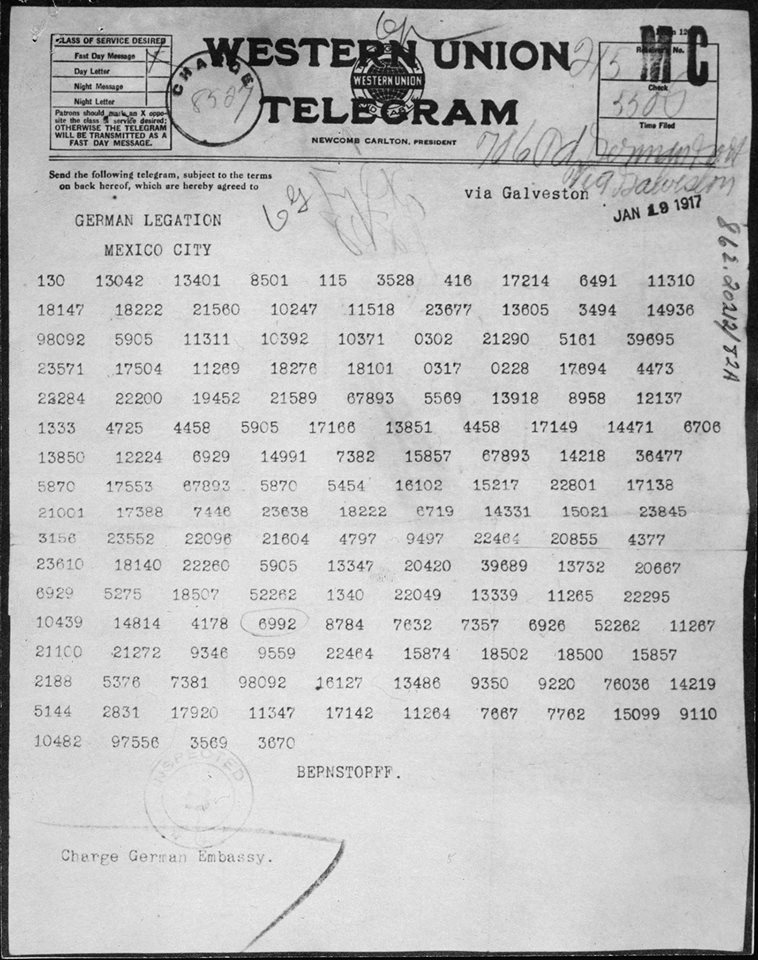
From the Facebook page of The Great War:
On this day 100 years ago, a coded telegram was sent by German foreign secretary Arthur Zimmermann to German Ambassador to Mexico, Heinrich von Eckardt. In this telegram, Zimmermann instructed von Eckardt to offer Mexico a military alliance and financial support against the United States should they not remain neutral. This was a possibility since Germany was about to unleash unrestricted submarine warfare by February 1, 1917.
To understand this telegram, it is important to understand that talks about military cooperation and even a military alliance between Mexico and the German Empire had been going on since 1915 already.
The telegram was sent via the American undersea cable since the German cable was interrupted by the British when the war broke out. US President Woodrow Wilson had offered the Germans to use their cable for diplomatic correspondence. What neither Wilson nor the Germans knew: The cable was monitored by the British intelligence at a relay station in England. Furthermore, the British codebreakers of Room 40 had already cracked the German encryption.
The biggest challenge for the British now was to reveal the content of this telegram without admitting that they were monitoring the cable while ensuring it had the desired impact.
Comments Off on 100 years ago today
January 15, 2017
American Elections – Ottoman Sultan – Austro-German Relations I OUT OF THE TRENCHES
Published on 14 Jan 2017
It’s time for the Chair of Wisdom again where Indy sits to answer all of your questions about World War 1. This week we talk about the 1916 presidential elections in the US, the Ottoman Sultan Mehmed V and the relations between Germany and Austria-Hungary.
Comments Off on American Elections – Ottoman Sultan – Austro-German Relations I OUT OF THE TRENCHES
Corporate sponsors should have no place at national memorial sites
Ted Campbell reacts to the news that corporate logos will be included at the updated Vimy Ridge Centre:
I’m not faulting Prime Minister Justin Trudeau nor Veterans Affairs Minister Kent Hehr for starting this, but they can and should put a stop to it. The business of getting the private sector to “support” public projects is not new and, generally, the public, including me, approves of it: in almost all cases it is good to have commercial sponsorships … almost all. National memorials are different […]
The Welcome Centre of the Canadian National Vimy Memorial in France flying the Canadian Red Ensign ( 1868 – 1921 version ). This flag along with The Maple Leaf fly at national memorial as Canada was only using the Red Ensign at the time of the First World War Engagement.
I don’t doubt the generosity or patriotism of Bell Canada or WalMart are anyone else, but a few things have to be sacrosanct, and our national memorials honouring our war dead must be amongst them.
Let is be very clear: it is the visitors’ centre, not the memorial itself that is being rebuilt and I’m guessing that the officials close to the project can see a very big difference between the little visitors’ centre building and the memorial, proper, but I, and many others, do not and will not; If the see even an understated, dignified sign in the visitors’ centre they will likely conclude that a corporation is, now, responsible for the whole monument. From the very first moment one sets foot on the land which France ceded, in perpetuity, to Canada it is “our” place, honouring our war dead and, more broadly, the significance of our contribution to the Great War. It is a small, $10 million, project and I am sure that officials will say that they are only trying to make the best use of their budget so that they can devote more to providing much needed care to veterans by spending less on this little building … and I would, normally, applaud them, but not on this.

Comments Off on Corporate sponsors should have no place at national memorial sites
January 13, 2017
No Peace For The Wicked I THE GREAT WAR Week 129
Published on 12 Jan 2017
This week 100 years ago there was talk about peace between the great warring nations. But even after millions of casualties, starving people at home and more escalation on the horizon, the situation didn’t seem bad enough for one of them to give in on their demands. At the same time, the fighting in Romania continues and the political situation in Russia becomes ever more dire.
Comments Off on No Peace For The Wicked I THE GREAT WAR Week 129
January 11, 2017
Luigi Cadorna – The Generalissimo I WHO DID WHAT IN WW1?
Published on 10 Jan 2017
Luigi Cadorna was the Italian Chief of Staff when World War 1 broke out and when Italy joined the conflict a year later. He was a man of tradition and believed that most important factor of military success was the will and determination of his soldiers. During the numerous Battles of the Isonzo River, this doctrine proofed disastrous for his troops.
Comments Off on Luigi Cadorna – The Generalissimo I WHO DID WHAT IN WW1?


