
The failure of the earlier League of Nations was crucial to preparing the way for the Second World War. Today, we see none of this, with most participants — excepting North Korea and Iran — still playing by the rules. This is where we return to Nevil Shute. Twice, using his technical expertise, Shute attempted to predict future war in a novel, and twice he got it wrong. With On the Beach, the author wrote of a 37-day war that “had flared all around the northern hemisphere”. Albania had dropped a “cobalt bomb” on Naples, which escalated into wider conflicts and eventually a Russo-Chinese exchange.
As one of Shute’s characters, a scientist, explained, “The trouble is, the damn things got too cheap. The original uranium bomb cost about fifty thousand quid towards the end. Every little pipsqueak country like Albania had a stockpile of them, and every little country that had that, thought it could defeat the major countries in a surprise attack”. Significantly, Shute’s future war, set in 1963, wasn’t triggered by the usual NATO-Warsaw Pact arsenals of nuclear weapons, but the proliferation of them elsewhere. Then, as now, it is not Russian or Chinese aggression that should worry those with nightmares of nuclear cataclysm, but that of other countries. Thanks to the NPT, IAEA and the UN, these possibilities are contained. Today, the world’s weapons of mass destruction stand at one tenth of their number during the Cold War.
Indeed, the very origins of the current Ukraine crisis illustrate how the international order has managed to contain potential proliferation. When the Soviet Union disintegrated in 1991, Ukraine possessed the world’s third largest nuclear arsenal, greater than those of Britain, France and China combined. Kyiv soon realised it couldn’t afford to maintain the warheads and remain a credible nuclear military power. A solution was found, whereby the weapons would be destroyed, but only in exchange for security assurances that the United States and Russia would respect Ukraine’s independence, sovereignty and territorial integrity.
What Ukraine signed on 5 December 1994 was the Budapest Memorandum of Security Assurances, in which Bill Clinton for the United States, Boris Yeltsin for Russia and John Major for Great Britain promised to protect Ukraine and its territorial integrity in recognition of Kyiv surrendering the protection of its nuclear arsenal. There was no mention of military guarantees, which Ukraine assumed were implied. Additionally, Kyiv promised to adhere to the Non-Proliferation Treaty (NPT).
After the annexation of Crimea by Russia in 2014, the G7 nations complained that Russia had breached the Budapest Memorandum. Vladimir Putin replied evasively that since, in his view, a new regime had seized power from Ukraine’s previously pro-Moscow premier Viktor Yanukovych, “Russia has not signed any obligatory documents with this new state”. Since then, Russia has lied and prevaricated over its betrayal of Budapest. In 2016, Sergey Lavrov went so far as to claim, “Russia never violated Budapest memorandum. It contained only one obligation, not to attack Ukraine with nukes” — a gross distortion of the Memorandum’s many obligations.
However, the West responded in 2014 only with mild economic sanctions. Arguably, the apathy of the anti-interventionist Barack Obama and David Cameron, influenced by a London awash with Russian money, emboldened Vladimir Putin. Few experts disagree that had the West responded in 2014 as they did in 2022, Russia’s expansionist ambitions into Ukraine would have ended long ago. Yet, there is plenty of room for optimism. The Russo-Ukraine conflict has not spread because of the international order and its treaties. Apart from North Korea and Iran, neither of whom have quite perfected their devilish devices, nuclear proliferation of third parties has been held in check.
The Kremlin shows no sign of taking steps to escalate to a nuclear level. It is not in its interests, or those of its allies, to do so. None of the 32 nations who recently abstained from condemning Russia in the 24 February UN vote would welcome Vladimir Putin and his cronies flinging nukes around. The qualified support of major powers like China, India and Pakistan is attached to the cheap oil and arms procurements they have negotiated with Moscow. Any hint of Tsar Vladimir “going nuclear” would see their abstentions morph into support for the West. Putin, for all his rhetoric, cannot afford to go it alone with just the six who voted with him at the UN. In military terms, they offer nothing.
The world’s various international arms treaties provide plenty of optimism that this will remain a regional war. So far, Putin’s threats have melted away as the morning mist. The scenario he implies, akin that in On the Beach and other nuclear-war-scare novels and films, is so unlikely as to be discounted. They and all the rest of the post-apocalyptic genre are written as nail-biting entertainment, not history or current affairs.
Peter Caddick-Adams, “Putin, Shute and nukes”, The Critic, 2023-03-09.
June 22, 2023
QotD: Nuclear non-proliferation and the Russo-Ukraine war
June 21, 2023
“Luttwak tweets with unparalleled Boomer energy, primarily in a write-only mode, at times seemingly oblivious to the waves he causes”
John Psmith reviews the second edition of Edward Luttwak’s Coup d’État: A Practical Handbook. I read the first edition in the mid-70s, when it seemed like coup attempts were an almost weekly news item from any number of exotic tropical locations:
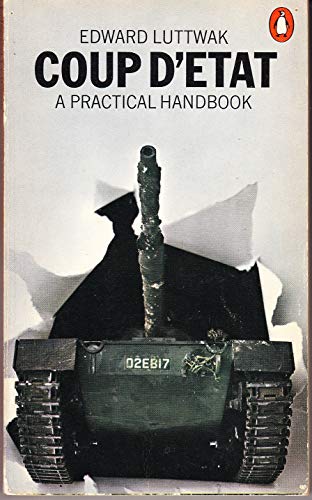
First things first: you need to get the revised, second edition of this book. Why? Because the introduction to the second edition is an excuse for the author to brag about all the bloodstained and bullet-riddled copies of the first edition that have been found among the personal effects of palace security chiefs, spymasters, and air force officers. Perhaps, he gloats, they should have read it more carefully, or perhaps they should have waited for the second edition.
None of this should come as a surprise if you follow Edward Luttwak on Twitter, where his account is characterized by a judicious degree of irascibility and gloating. Yes, I regret to inform you that he’s on Twitter. But unlike some of my other favorite authors who succumbed to the analgesic call of the Great Blue Bird, the medium has not totally destroyed him yet. Luttwak tweets with unparalleled Boomer energy, primarily in a write-only mode, at times seemingly oblivious to the waves he causes. This is good, because it means we get to read his internal monologue, but without the reward loop of social media hacking his amygdala and progressively turning him into a self-parody.
Or perhaps his descent into self-parody was arrested by the fact that he was already a bit of a self-parody. Luttwak came from a Jewish family in communist Romania, spent some time in Palermo where he totally wasn’t involved in the war between the authorities and the mob,1 and provided “consulting services to multinational corporations and government agencies, including various branches of the U.S. government and the U.S. military”, before retiring to the life of gentleman scholar and cattle rancher (and prolific Twitter poaster) in rural Argentina. Along the way he picked up a PhD and wrote a massive pile of books about history, war, diplomacy, and political theory, all while pissing off the authorities in those fields with his epistemic trespassing.
But all of that was still far in the future when he wrote this book about coups. When the non-recommended first edition came out, Luttwak was a tender twenty-six years old, and working tenderly as a consultant for the energy industry in Africa and the Middle East. This raises some questions, questions that Luttwak absolutely refuses to answer, sometimes coyly and sometimes vehemently. Were I concerned about my reputation as a third-world fixer for oil companies, I would simply not write a practical guide to launching coups, but to each his own.
What is a coup? Also known as a putsch, a palace rebellion, or my personal favorite, a pronunciamiento; there are a lot of words for it, many of them in Spanish (you know what they say about Eskimos and their words for snow). The basic definition is a bloodless or almost bloodless extrajudicial transfer of power whereby a group of conspirators is able to turn the machinery of the state against itself, seizing control quickly and cleanly and without triggering a civil war. Note how different this is from other sorts of exceptional transfers of power. In a revolution, all of the institutions in a society are burned down and replaced. A coup is the opposite — only the very top level of the system is swapped out, and the new boss quickly and seamlessly resumes ruling through the machinery of the old regime. Ideally, citizens who aren’t especially politically engaged wouldn’t even notice.
This leads us to a guess as to the most coup-friendly sorts of polities: ideally they should be highly centralized and efficient bureaucratic states, but with very low democratic engagement or popular investment in politics. The first half is important, because without an efficient government machine, there’s nothing for the coup plotters to grab onto. A coup is an action by a tiny group of people who would lose instantly in any fair fight — the only chance they have is to magnify their power by hijacking a system that was already pretty good at controlling the country. It also helps that soldiers, policemen, and citizens in a bureaucratized society are already conditioned to obey impersonal authority, and therefore are more likely to do what the new guy says if he’s careful to use the old, familiar forms. Anarchists love to talk about how anarchy is like a vaccination against foreign occupation, because occupiers generally lack the state capacity to administer newly acquired territories without existing state machinery to co-opt, and that argument is even more true for coups.
1. Also unclear: which side he was not-involved on.
Scuttling of the German High Seas Fleet at Scapa Flow, Orkney, 21 June 1919 in the Great War
CEFRG (Canadian Expeditionary Force Research Group)
Published 3 Apr 2020The German High Seas Fleet decided to sink as many of its own ships as possible to prevent them from falling into Allied hands. In total, 52 of 74 ships were sabotaged to keep them from Britain, France, Italy and the USA. Most of these nations wanted a share for their navies, and knowing she could not have them all to herself, Britain wanted the ships scrapped to prevent other nations from gaining naval superiority.
On the morning of 21 June 1919, the British fleet left Scapa Flow for exercises, and Rear Admiral Sydney Freemantle, commander of the 1st Battle Squadron guarding the ships, planned to return two days later to board and seize the ships.
Already occupying Germany west of the Rhine, the Allied Powers expected Germany to accept all articles of the Treaty of Versailles by 23 June, and threatened to occupy territory east of the Rhine if all demands were not met. German Rear Admiral Ludwig von Reuter, following orders he had received after the breakdown of negotiations, seized the opportunity with the British fleet having just left the harbour, gave the order to scuttle all ships as his crews opened seacocks, torpedo tubes and portholes to flood them, and once again hoisted the flag of the Imperial German Navy.
The final battle casualties of the Great War occurred on this day, with nine German sailors killed and sixteen wounded by the British during brawls when they refused to help save the ships. For his part, von Reuter was imprisoned along with 1,800 of his men, but was released the following year. Upon his return to Germany, he was praised as the man who had preserved the honour of the German High Seas Fleet (in typical fashion, Freemantle had angrily accused von Reuter of having behaved without honour).
Of the 52 ships scuttled in 1919, seven remain at the bottom of the sea today. They are registered under the Ancient Monuments and Archaeological Areas Act 1979, and provide some of the best shipwreck diving in Europe.
June 19, 2023
Patterns of incompetence
In Palladium, Harold Robertson says that complex systems that we all depend on will not have the resilience to survive our society-wide failure of competence:

Graphic for Rhode Island College’s Office of Diversity, Equity and Inclusion.
At a casual glance, the recent cascades of American disasters might seem unrelated. In a span of fewer than six months in 2017, three U.S. Naval warships experienced three separate collisions resulting in 17 deaths. A year later, powerlines owned by PG&E started a wildfire that killed 85 people. The pipeline carrying almost half of the East Coast’s gasoline shut down due to a ransomware attack. Almost half a million intermodal containers sat on cargo ships unable to dock at Los Angeles ports. A train carrying thousands of tons of hazardous and flammable chemicals derailed near East Palestine, Ohio. Air Traffic Control cleared a FedEx plane to land on a runway occupied by a Southwest plane preparing to take off. Eye drops contaminated with antibiotic-resistant bacteria killed four and blinded fourteen.
While disasters like these are often front-page news, the broader connection between the disasters barely elicits any mention. America must be understood as a system of interwoven systems; the healthcare system sends a bill to a patient using the postal system, and that patient uses the mobile phone system to pay the bill with a credit card issued by the banking system. All these systems must be assumed to work for anyone to make even simple decisions. But the failure of one system has cascading consequences for all of the adjacent systems. As a consequence of escalating rates of failure, America’s complex systems are slowly collapsing.
The core issue is that changing political mores have established the systematic promotion of the unqualified and sidelining of the competent. This has continually weakened our society’s ability to manage modern systems. At its inception, it represented a break from the trend of the 1920s to the 1960s, when the direct meritocratic evaluation of competence became the norm across vast swaths of American society.
In the first decades of the twentieth century, the idea that individuals should be systematically evaluated and selected based on their ability rather than wealth, class, or political connections, led to significant changes in selection techniques at all levels of American society. The Scholastic Aptitude Test (SAT) revolutionized college admissions by allowing elite universities to find and recruit talented students from beyond the boarding schools of New England. Following the adoption of the SAT, aptitude tests such as Wonderlic (1936), Graduate Record Examination (1936), Army General Classification Test (1941), and Law School Admission Test (1948) swept the United States. Spurred on by the demands of two world wars, this system of institutional management electrified the Tennessee Valley, created the first atom bomb, invented the transistor, and put a man on the moon.
By the 1960s, the systematic selection for competence came into direct conflict with the political imperatives of the civil rights movement. During the period from 1961 to 1972, a series of Supreme Court rulings, executive orders, and laws — most critically, the Civil Rights Act of 1964 — put meritocracy and the new political imperative of protected-group diversity on a collision course. Administrative law judges have accepted statistically observable disparities in outcomes between groups as prima facie evidence of illegal discrimination. The result has been clear: any time meritocracy and diversity come into direct conflict, diversity must take priority.
The resulting norms have steadily eroded institutional competency, causing America’s complex systems to fail with increasing regularity. In the language of a systems theorist, by decreasing the competency of the actors within the system, formerly stable systems have begun to experience normal accidents at a rate that is faster than the system can adapt. The prognosis is harsh but clear: either selection for competence will return or America will experience devolution to more primitive forms of civilization and loss of geopolitical power.
H/T to Theophilus Chilton for the link.
June 18, 2023
Titanic Clash Looms In Pacific – WW2 – Week 251 – June 17, 1944
World War Two
Published 17 Jun 2023Japanese and American navies are heading for a showdown in the Philippine Sea, even as American forces land on Saipan in the Marianas in force. The Japanese have Changsha under siege in China, the Allies advance in both Normandy and Italy, the Soviets advance in Finland, and the massive Soviet summer operation is coming together and will begin in a matter of days.
(more…)
QotD: Good intentions do not automatically mean good results
Another United Nations agency, its peacekeeping force in Haiti, was responsible for the most serious epidemic of cholera of the twenty-first century so far. Before 2010, cholera had been unknown in Haiti despite the country’s poverty and lack of hygiene. Then, from 2010 to 2018, it suffered outbreaks of cholera that have affected perhaps a tenth of the population and caused between 10,000 and 80,000 deaths (the exact figure will never be known).
The evidence suggests that cholera was brought to Haiti by United Nations peace-keeping troops from Nepal. Whether Haiti needed peacekeeping troops at all may be doubted: at the time it suffered from civil unrest rather than from war. One suspects that the peacekeeping force was employed more to keep the Haitians from leaving Haiti than to keep the peace.
Be that as it may, some Nepali troops arrived fresh from a cholera epidemic in Nepal, established a camp next to the Artibonite River from which many Haitians drew their water. The Nepalis emptied their sewage directly into the river, and some of them were infected with the cholera germ. There was soon an outbreak of cholera among the local population of extraordinary violence. The Haitians guessed at once that the Nepali troops had brought the cholera, but this was strongly denied.
Theodore Dalrymple, “Negligence and Unaccountability at the United Nations”, New English Review, 2019-07-09.
June 17, 2023
Why Rommel Lost the Battle for North Africa
Real Time History
Published 16 Jun 2023The North African campaign of WW2 is one of the most famous ones. The almost mythical story of the British “Desert Rats” defeating Erwin Rommel’s Afrika Korps. But why did Rommel lose in North Africa?
(more…)
Webley-Fosbery Automatic Revolver
Forgotten Weapons
Published 9 Jun 2013This is an update to our previous video on the Webley-Fosbery, which was taken on a low-res camera in a dark room — hopefully this will be a big improvement!
The Webley-Fosbery was an early automatic handgun based on a revolver design. The top half of the frame slides back under recoil, recocking the hammer and indexing to the next round in the cylinder. They were made commercially in both .38 and .455 calibers, with the .455 version attracting interest from British Army officers into World War I.
June 15, 2023
See Inside King Tiger | Tank Chats Reloaded
The Tank Museum
Published 10 Mar 2023In this video, Chris Copson gives us a glimpse inside one of the most formidable German tanks of World War II – the King Tiger.
(more…)
June 14, 2023
Wednesday web-droppings
A few items that I didn’t feel required a full post of their own, but might be of interest:
- “Teacher, leave them kids alone!” – Middle schoolers staged a revolt on the day they were told to wear rainbow colors to celebrate pride. They wore red, white, and blue, and said their pronouns were “U.S.A.” Woke faculty is freaking out.
- Sir Humphrey answers the question “Is the Royal Navy still a truly ‘blue water navy’?“
- Brendan O’Neill is nostalgic for a long-distant past before everyone started sounding like off-brand Unabomber disciples.
- Tim Harford on “Giffen goods“
- Random meme of the day:

The sinking of Norwegian frigate HNoMS Helge Ingstad in 2018
CDR Salamander must follow Norwegian court cases more closely than I do … which is “not at all” in my case. Oddly, I was just thinking about the loss of HNoMS Helge Ingstad last week, and here’s follow-up information from the appeals process:
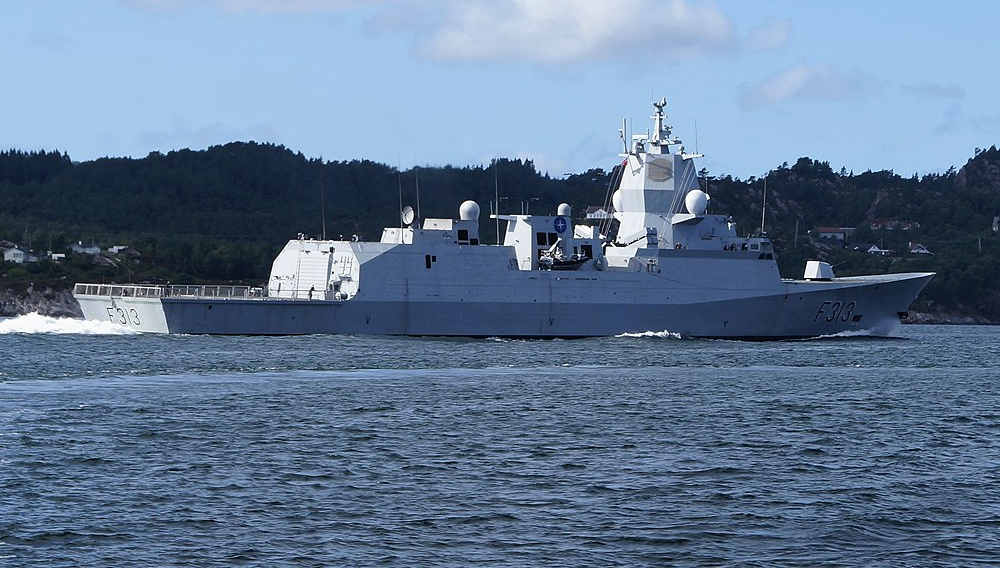
HNoMS Helge Ingstad, a Fridtjof Nansen-class frigate commissioned in 2009.
Photo detail via Wikimedia Commons.
The court case against the officer of the watch (vaktleder) and its appeals has brought the issue back to the front in Norway.
In yesterday’s Forsvarets Forums article (remember to translate it), retired Norwegian naval officer with multiple command tours, Hans Petter Midttun, outlines a must read wire brushing of the entire “optimal manning” concept.
You will see that his view of what it caused to the Norwegian Navy’s nightmare is a direct parallel of that happened to the US Navy in that horrible month of 2017; too much to do with too little people with too thin training.
Let’s dive in;
The Ministry of Defense (FD), the Defense Staff (FST) and the Norwegian Navy (SST) have, in my opinion, knowingly or unknowingly breached the prerequisites for proper operation of the frigates.
My claim is rooted in 23 years of frigate competence. I have held most of the operational positions in the frigate force. This includes the positions as ship commander at KNM Narvik and KNM Roald Amundsen, as well as a period at the Navy’s competence center and two periods as staff officer for the “shipowner”.
That is the extended way of saying, “I know you because I am you“. He’s raising his voice here because it is personal and he wants to go on the record that there are causes to this mishap much deeper than just the one officer on trial.
In light of the extensive changes that lay before the Armed Forces in 2004, we considered it crucial to describe the assumptions on which the staffing concept was based. It was not a new concept. It just hadn’t been described before. It had been developed as a consequence of continuous efficiency measures in the 90s.
One of our main messages was:
The Lean Manning Concept was not chosen because it was operationally smart. It was chosen because it enabled the Navy to man and sail (at the time) a balanced structure. It was an absolute minimum crew that could only work if all the prerequisites were met.
The last part — here on the Front Porch we describe that as “exquisite“. Everything — and everyone — has to work just right to make the formula work.
It doesn’t work that way outside the briefing room. Never does.
During a five-year period, the crew sailed one year less than what Nato considered necessary to maintain the operational level (for a frigate with a larger crew). But in addition, the crews never reached more than a maximum of 80 percent of their expected combat power. This meant that each year the training activity started at a lower level than the previous year.
You design minimum manning — and you get 80% of the minimum. It might work for awhile in peace — but it unquestionably won’t work in combat. Exactly the stew that contributed to the McCain & Fitzgerald collisions. Senior leaders try to convince everyone that 9-to-11 month deployments are a “new normal” and humans can do 100-hr work weeks for weeks to months on end with no downside. Just sadistic malpractice.
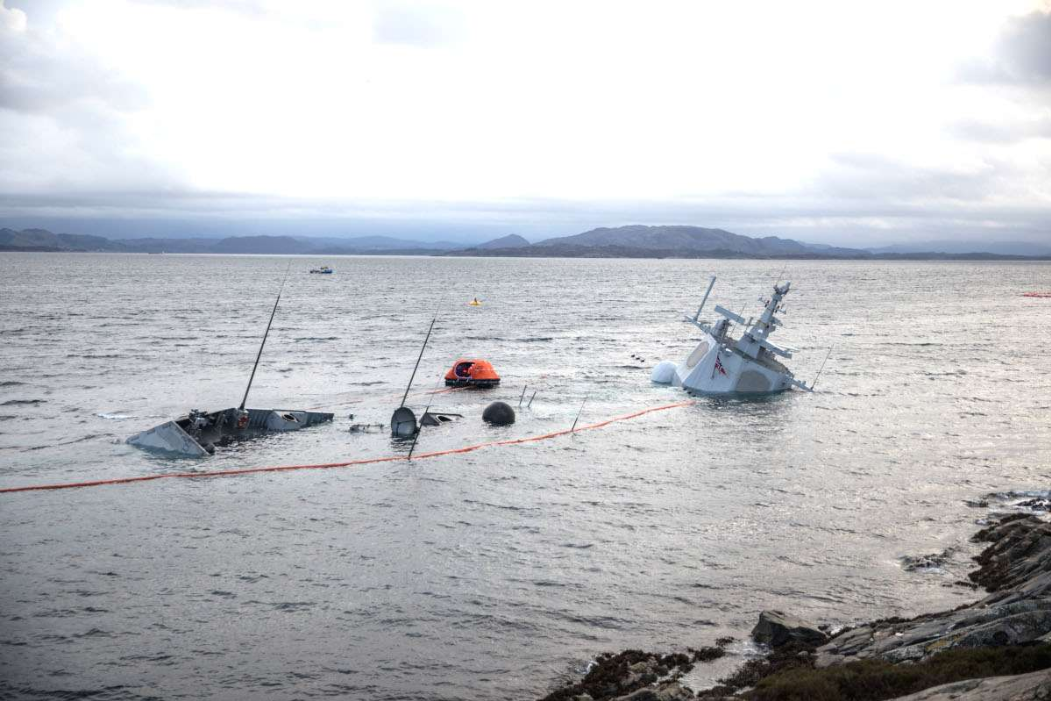
HNoMS Helge Ingstad after grounding, 13 November 2018. Immediately after the collision, the ship was run ashore to prevent it sinking, but she slowly slid down and eventually was almost completely underwater.
Photo via The Drive.
Michael Wittmann: The Fascination with the Panzer Ace of Villers-Bocage
OTD Military History
Published 13 Jun 2023American historian, Carlo D’Este seemed to have an intense admiration for Michael Wittmann, the SS Panzer ace best known for his actions at Villers-Bocage in Normandy on June 13 1944. This video shows why this problematic and even misplaced.
(more…)
Battle Of The Rivers (1944)
British Pathé
Published 13 Apr 2014Title reads: “Battle of the Rivers”.
Allied Forces invasion of France.
Various shots of mechanised units of the British and Canadian army preparing for assault on the Rivers Odon and Orne. Infantry mount the Sherman tanks and they head along the dusty road. Various shots of Sherman flail tanks passing camera (not flailing). Road bank collapses and one tank rolls onto its side
Various shots of Lancaster bombers over industrial area of Vaucelles. Aerial shots of bombs dropping from planes. Night shot of coloured markers cascading down to light up target area. More aerial shots, including L/S of Lancaster bomber crashing in flames.
Various shots of heavy artillery in action in the fields. Various shots of Royal Engineers putting Bailey Bridge across the Caen Canal. L/S of tanks crossing the bridge. Various shots of badly damaged industrial area near Caen. L/S of Canadian tanks on the move over open countryside and tracks. We see a soldier extinguishing flames where a tank’s grass camouflage has caught fire. The tanks cross a railway line.
Various shots of Winston Churchill being greeted by American officers as he arrives by plane in the Cherbourg area. He then tours the peninsula, looking at structures that were supposed to be V2 sites. M/S of Churchill climbing into spotter plane (“flying jeep”), piloted by Air Vice Marshal Broadhurst. Various shots of Churchill driving around Caen in an open-topped car, with him are Field Marshal Bernard Montgomery (Monty) and General Dempsey. Various shots of Churchill posing with a group of soldiers, he then spends some time chatting to them.
(more…)
QotD: In hindsight, calling it “Operation HONOUR” was quite ironic
Loyalty up, remember?
As a young soldier, I had actually worked for this particular NCO. He was an artifact of the Old Army and had a reputation as a hardman. He liked to brag about picking Friday night fights in Native bars out on the Prairies (he wore weighted gloves for extra knock-out power). He described to us in detail what he would do to his wife after a training weekend. He told us she would never say no, followed up with a chuckle and “like she has a choice”. If you were weak in his eyes, he’d belittle you publicly as a “queer” or a “faggot”. The funny thing was that this guy was overweight and never showed up for ruck marches or PT tests. His annual conduct-after-capture briefing was basically forty minutes of “you’re gonna get raped but that doesn’t make you gay”. One of his favourite war stories was about stray dog duty in Bosnia. He’d lure in the strays with peanut butter on the end of shotgun then blow their brains out. Riveting stuff.
Overnight I had gone from from being this man’s subordinate to being his superior, so when the General said we had a duty to report, I did my duty. The next week I was in front of the Regimental Sergeant-Major being asked why I was interfering with a strong NCO’s career prospects. That’s when I learned that loyalty up meant loyalty to the Regiment, and that sensitive matters such as this were handled internally and off the record. That one-way conversation was a major push towards putting in my application for the Regular Force. I didn’t want to be around that type of nonsense (“oh my sweet summer child” says the peanut gallery). Not long after I left, my former supervisor sexually assaulted the mess steward.
[…]
In February 2021, an investigation was opened into General Jonathan Vance, who had just finished his tenure as Chief of Defence Staff. Major Kellie Brennan, a subordinate of Vance at various times, accused him of a preventing her from disclosing their long-running affair. Since their relationship began in 2001, Vance had been married twice. DNA testing confirmed that Vance was the father of one of Brennan’s children, but he had never acknowledged or taken responsibility for the child. Vance plead guilty to obstruction of justice in March 2022 and received a conditional discharge with twelve months of probation.
The heat and light generated by an investigation of the outgoing Chief of Defence Staff led to an unprecedente level of scrutiny on the CAF’s senior leadership. In 2021 alone, the Governor General of Canada, the Minister of National Defence, the incoming Chief of Defence Staff, the Vice Chief of Defence Staff, Commander Canadian Special Operations Command, and Commander Military Personnel Command, amongst others, would resign, retire, or be re-assigned amidst allegations of impropriety. Since 2021, recruiting and retention levels have continued to free fall and the federal government has set aside $900 million in class-action lawsuit compensation for current and former CAF members who experienced sexual harassment, assualt, or discrimination. The social trap has been sprung.
“Shady Maples”, “A Question of Loyalty”, The Powder Horn, 2023-03-12.
June 13, 2023
After the Great War, the British army failed to plan for future conflicts
Robert Lyman outlines why Britain in general and the British army in particular were so materially and intellectually unready for the war that broke out in 1939:
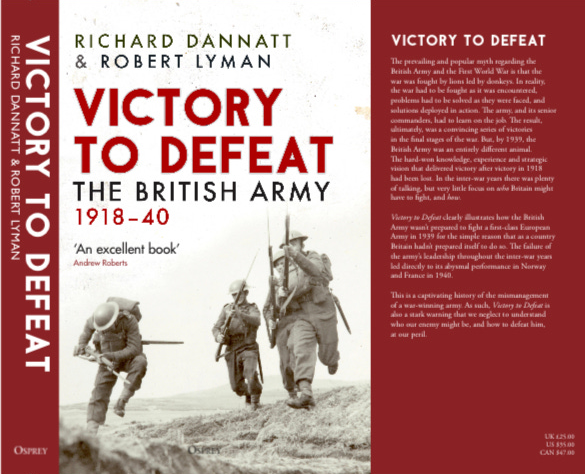
… the British Army was catastrophically unprepared for war in 1939. But it wasn’t just the Army that was unprepared. Despite a last-minute rush to re-arm, so too was the whole country. In Britain a deep-seated passivity had set in following the end the Great War. This belied the reality that in Europe the ending of the war in fact opened the door to unheralded political chaos and instability that was in time to overcome the forces of stability and would lead directly to yet another devastating war. In the years immediately following the arrival of peace in 1918 Britain hoped it could close the door on any future European or continent commitment and return to the halcyon days when its only security commitments were the defence of its widely flung Empire.
The weakness at the heart of British planning for war was a direct reflection of Britain’s strategic, political, societal and economic situation during the inter-war period. Britain – both the British public and the country’s various governments – simply wasn’t mentally prepared to go to war again so soon after the trauma of the Great War. As a result, it made no proper preparation for another full-on industrial war against a peer opponent on the continent. This was fundamentally a failure of political and military imagination; the inability to think through what a potential war might look like and to prepare for this possibility accordingly.
We have identified five primary causes of the decline of British military effectiveness in 1939. In the first place there was no clear strategic plan for the Army. Strategies are determined by having a clear understanding of who a future enemy might be. Following the end of the Great War, until the late 1930s no one seemed bothered to define this essential point of direction. There was a remarkably inadequate grand strategic conversation (i.e., at a national, governmental level) about the purpose, structure, and nature of the Army. There was plenty of talking, but very little of it focused on realistic determination as to who it might have to fight, and how. This was a problem, because it meant that Britain was unable to determine the precise structure its armed forces needed to be, and its cost. Was the focus of the army to be the continent, or the Empire, or both? No one knew. As a result, the last known plan reasserted itself – Imperial defence, à la 1914. This meant that the army wasn’t structured or equipped to fight a specified enemy in a defined set of circumstances. Instead, the British Army and its cousin, the Indian Army, was expected to be a generic jack-of-all-trades, without the structure, doctrine, training, or equipment to fight the type of war it had become the master of in 1918. While there was some doctrine, and considerable doctrinal debate, little was anchored in a clear definition of what future war was expected to look like. There was no operational design for the British Army derived directly from an analysis of the threat it faced. If it had done, the BEF would have been thoroughly prepared for the German Blitzkrieg in France and the Low Countries in 1940 or the similar Japanese Kirimoni Sakusen in 1941 and 1942. The British Army wasn’t prepared to fight a first-class European Army in 1939 for the simple reason that Britain hadn’t prepared itself to do so. Likewise, when it came to fighting the Japanese in 1941 and 1942 in Malaya and Burma, the British found that not only had it failed to prepare adequately for a potential Japanese invasion of its vulnerable Far Eastern colonies, but that it had no idea as to how to fight the Imperial Japanese Army. There were two connected failures here. The first was one of strategic preparedness, the blame for which was both governmental and strategic. The second was of training, doctrine and military preparedness by the British Army in Europe and Asia to fight. When they emerged out of their assault boats at Kota Bahru on the morning of 8 December 1942 the Japanese could as well have come from Mars, given how little the British knew about them and their warfighting methods.
Second, as a country, Britain was unprepared both politically and culturally for another war so soon after the last. In 1919 the country seemed to want to look backward to embrace the days of peace that had preceded the cataclysm of war, to drape itself with Edwardian comfort. It was tired and disillusioned, and felt no victor’s triumph. The country looked to itself, and to its Empire, eschewing the complications of commitments on continental Europe that had recently resulted in the loss of so much blood. The losses sustained in the Great War resulted in the overwhelming national sentiment that war must never again be undertaken as a form of politics. Clausewitz was dead. Part of this sentiment evidenced itself in the rise of pacifism. In the army, a pervasive belief existed that the Great War was an aberration, and nothing like it would again afflict western civilisation. Any lessons from the war were therefore irrelevant to the future structures or doctrine of the British Army, for whom the defence of the Empire was the crucial issue. But whether it liked it or not, the world was changing fast, in ways that Britain struggled to comprehend and from which it could not ultimately escape. The Russian Revolution, the rise of fascist dictators in Europe, isolationism in the USA (except for a new American assertiveness in Asia) and the increasing militancy of Japan, began changing the global landscape in ways that were hard to understand for a country seemingly once in total charge of the certainties of statecraft. Now it struggled to find its way in a new world of tension, turmoil and rapid change.
Third, no one in the British Army thought to capture the reasons for operational success in 1918. The dramatic reduction in troops numbers at the end of the Great War meant that those best able to convert the learning from 1918 into doctrine left for civilian life, taking their knowledge and experience with them. It was never recovered. There was therefore no template in the years afterward on which to build a successful military doctrine based on the successful warfighting experience that had culminated in the victories of 1918.
Fourth, political naivety led to a dramatic economic stringency being applied, including the underlying Treasury assumption in the early 1920’s of the ‘Ten Year Rule’, an assumption that kept rolling over, year after year. This meant that there wasn’t enough money to do what was necessary to protect British interests from impending harm. The Army butter was thinly spread on the imperial bread, with the result that insufficient investment was made in the core of the army’s warfighting capability. This stringency was exacerbated by the impact of the Great Depression at the end of the 1920s into the early years of the next decade.


