I don’t have a full-blown prescription for reform, but what I am sure is needed is a greater focus on basics, on principles, and less focus on the “flavour of the month”. Counter-insurgency — the topic that preoccupied Richard Holbrooke for much of his career — is a good example. It used to be understood that every insurgency was different; what may have worked in Malaya would not work in Indo-China because the insurgents were fighting for different reasons and in different ways and the lessons learned in Indo-China and Vietnam, and many were, would not be readily applied in Nicaragua or Yemen because, once again, the problem was different and none of the “solutions” from Malaya through to the First Gulf War would work in Afghanistan … but generals kept offering “the answer”, even when experience said that every single answer was wrong. There are a few well-tested principles for peacekeeping and low-intensity operations and peace-making and counterinsurgency but there is no “right way”, no process that works and can be taught on a six-week course. Canadian generals need to move all the “process” books to the bottom shelf of the bookcase and put the handful of “principles” books back on top. Ditto for all aspects of training; the tactics that worked in the Gulf War or Grenada are not going to work against China or Russia, and what we expected would “work” against a large, modern, well-equipped enemy in 1969 is unlikely to work against a large, well-equipped enemy now, a half-century later … even if some of the equipment looks almost the same.
The same applies to “cyber” or “information warfare”; there is no doubt that technology has changed the so-called “battlespace”, making it bigger and more complex by, in effect, adding an invisible dimension. We have been conducting “information operations” for decades, even millennia — I would argue that at the end of the Third Servile War (73-72 BCE) when Marcus Licinius Crassus crucified 6,000 of Spartacus’ followers on the Appian Way (it is not clear if Spartacus, himself was among them) that it was psychological warfare which is either a subset of or a near relation to information warfare. But the tools have changed and with them, tactics need to change, too, but some principles will remain as they were 2,000 years ago, or 100 years ago (the Zimmerman Telegram) or 75 years ago (Turing, the Enigma machine and Bletchley Manor).
Ted Campbell, “Following the blind leader (3)”, Ted Campbell’s Point of View, 2019-05-21.
July 2, 2023
QotD: Processes for fighting the last war
July 1, 2023
The Newfoundlanders at Beaumont-Hamel
Vlogging Through History
Published 12 Feb 2022Just after the explosion of the Hawthorn Ridge mine, the 29th Division assaulted German positions at Hawthorn Ridge and the Y Ravine outside the village of Beaumont-Hamel, suffering dreadful losses. No unit suffered more in that attack than the Newfoundland Regiment, part of the third wave that morning. Join me as we visit the Beaumont-Hamel Newfoundland Memorial.
(more…)
QotD: The ever-increasing size and number of artillery pieces in WW1 trench battles
So by the Second Battle of Artois (May, 1915), the barrage was four days long and included 293 heavy guns and 1,075 lighter pieces. At Verdun (February, 1916) the Germans brought in 1,201 guns, mostly heavy indirect fire artillery (of which the Germans had more than the French) with a shifting barrage that expected to fire 2 million shells in the first six days and 4 million during the first 18 days. At the Somme (1916) the British barrage lasted from the 24th of June to the attack on July 1 (so a seven-day barrage); a shorter barrage was proposed but could not be managed because the British didn’t have enough guns to throw enough shells in the shorter time frame. A longer barrage was also out: the British didn’t have the shells for it. By Passchendaele (1917) the British were deploying some 3,000 artillery pieces; one for every 15 yards of frontage they were attacking.
These efforts didn’t merely get to be more, but also more complex. It was recognized that if the infantry could start their advance while the shells were still falling, that would give them an advantage in the race to the parapet. The solution was the “creeping” barrage which slowly lifted, moving further towards the enemy’s rear. These could be run by carefully planned time-table (but disaster might strike if the infantry moved too slow or the barrage lifted too early) or, if you could guarantee observation by aircraft, be lifted based on your own movements (in as much as your aircraft pilots, with their MK1 eyeballs, could tell what was happening below them). […]
I find that most casual students of military history assume that these barrages generally failed. I suspect this has a lot to do with how certain attacks with ineffective barrages (e.g. the Somme generally, the ANZAC Corps’ attack at Passchendaele) have ended up as emblematic of the entire war (and in some cases, nationality-defining events) in the English-language discussion. And absolutely, sometimes the barrages just failed and attacks were stopped cold with terrible losses. But rather more frequently, the barrages worked: they inflicted tremendous casualties on defenders and allowed the attackers to win the race to the parapet which in turn meant the remaining defenders were likely to be swiftly grenaded or bayoneted. This is part of why WWI commanders continued to believe that they were “on the verge of a breakthrough”, that each attack had come so close, because initially there were often promising gains. They were wrong, of course, about being that close, but opening attacks regularly overran the initial enemy positions. Even the worst debacles of the war, like at the Somme, generally did so.
And at this point, you may be wondering if you’d been lied to, because you were always told this was a war where advances where measured in feet and meters instead of miles or kilometers and how can that be if initial attacks generally did, in fact, overrun the forward enemy positions? I’ll push this even further – typically, in the initial phases of these battles (the first few days) the casualty rates between attacker and defender were close to even, or favored the attacker. This is of course connected to the fact that the leading cause of battle deaths in the war was not rifle fire, machine guns, grenades, bayonets but in fact artillery fire and the attacker was the one blasting fixed positions with literal tons of artillery fire. So what is going on?
Because both sides quickly figured out that their forward positions were badly exposed to artillery barrages and began designing defenses in depth, with rear positions well out of the reach of all but the largest enemy artillery. For instance, most of the so-called “Hindenburg Line” (the Germans called it the Siegfriedstellung or “Siegfried Position”) was set in multiple lines […] The plan consisted of a thin initially defense which was assumed to fall in the event of an attack, but still featured channels made by heavy barbed wire and machine guns designed to inflict maximum casualties on an advancing force (and be dangerous enough to require the artillery barrage and planned assault). Then behind that was more open ground and then a second line of trenches, this time much more solid, with communications trenches cutting vertically and the battle positions horizontally, enabling reserves to be brought up through those trenches without being exposed to fire. Finally the reserves themselves were in a third line of trenches even further back, well outside of the enemy’s barrage (or indeed the range of all but their heaviest guns). Of course while your artillery is in the back, out of range of the enemy artillery, the enemy infantry is attacking into your artillery range. This keeps your artillery from being disabled into the initial barrage (you hope) so that it can be brought into action for the counter-attack.
And now the enemy of the attacker is friction (as we’ve discussed before with defense in depth). If everything possible goes right, you open with the barrage, your infantry sweeps forward, the creeping barrage lifts and you win the race to the parapet. The forward enemy defenders are either blasted apart by the barrage or butchered in their holes by your gas, grenades and bayonets. Great! Now you need to then attack again out of those enemy positions to get to the next line, but your forces are disorganized and disoriented, your troops are tired and your supplies, reinforcements and artillery (including many heavy guns that weigh many tons and shoot shells that also weigh 100+lbs a pop) have to get to you through the terrain the barrage created […]
So rapidly the power of your initial attack runs out. And then the counter-attacks, as inevitable as the rising sun, start. Your opponents can shell you from nice, prepared positions, while your artillery now has to move forward to support you. Their troops can ride railways to staging posts close to the front lines, advance through well-maintained communications trenches directly to you, while your troops have to advance over open group, under artillery fire, in order to support you. The brutal calculus begins to take its toll, you lose ground and the casualty ratios swings in favor of the “defender” (who to be clear, is now attacking positions he once held). Eventually your footholds are lost and both sides end up more or less where they started, minus a few hundreds or thousands of dead. This – not the popular image – this is the stalemate: the attacker frequently wins tactically, but operational conditions make it impossible to make victory stick.
The brutal irony of this “defensive” stalemate is that at any given moment in a battle that might last months and swing from offensive to defensive and back again that casualties typically favored the side which was attacking at any given moment. More ironic yet, the problem here is that the artillery itself is digging the hole you cannot climb out of, because it is the barrage that tears up the landscape, obliterating roads, making movement and communication nearly impossible for the attacker (but not for the defender). But without the barrage, there’s no way to suppress enemy artillery and machine guns to make it possible to cross no man’s land. Even with tanks, an attack without supporting artillery is suicide; enemy artillery will calmly knock out your tanks (which are quite slow; this is in 1918, not 1939).
The problem, for the attacker and the defender isn’t machine guns, it is artillery: the artillery that makes assaults possible in the first place makes actual victory – breaking through the enemy and restoring maneuver – impossible.
Bret Devereaux, “Collections: No Man’s Land, Part I: The Trench Stalemate”, A Collection of Unmitigated Pedantry, 2021-09-17.
June 30, 2023
QotD: Changing patterns of combat on the Great Plains
F.R. Secoy (op. cit.) essentially breaks warfare into four phases, which happen at different times in different places, based on if they have horses, guns, both or neither. Because horses entered the Great Plains from the South (via the Spanish) but firearms entered the region from the North (via the British and the French, the Spanish having prohibited gun-sales to Native Americans) and spread out from there, for a brief time many of these systems were active on the Plains at once, as both guns and horses diffused through the region.
In the pre-horse, pre-gun phase (described by McGinnis as well, op. cit., 8-9), battles consisted of long-range missile exchanges between warriors who stood behind large shields which protected their whole bodies. Native American warriors in this system also wore armor, heavy leather coats, laminated in multiple layers using thick hide with glue that was sometimes mixed with sand or gravel (one more example of how “leather armor” is almost always hardened leather armor, not modern clothing-leather). Some of this armor may have been effectively quilted leather as well. Clearly, there was plenty of concern about survivability here.
Both guns and horses were apt to disrupt this system. Horses allowed attackers to rapidly close the distance between the two opposing lines of shield-protected foot-missile-warriors, causing the shield-lines to drop away (though smaller shields, used on horseback to ward off arrows and blows were still used) and for both sides to seek instead the mobility of mounted fighting. That was not the end for armor though, because contact with a supply of horses meant contact with the Spanish, and the Apache at least swiftly adopted some of the Spanish methods of making leather “buff coats” into their own armor tradition and copied the shape and pattern of the buff coat itself (while often still making the material using their own tradition). As Secoy notes (op. cit., 18-20), our sources are quite clear that these forms of armor (both original and Spanish-influenced Native armors) were quite effective at resisting the archery fire that dominated both the pre-horse, pre-gun system and the post-horse, pre-gun system.
Meanwhile on the Northern Plains, while the horse had not yet arrived, firearms had, and these had different effects. Firearms spelled the end of the armor once they became common enough, since there was no protection which could resist bullets; some shield use survived, since arrows remained fairly common as well. But this didn’t lead to suicidal warfare. Instead – as had happened on the East Coast as well, Native Americans adapted their warfare to the increased lethality of firearms (on this, note Lee, op. cit. above) by mostly avoiding pitched battles as they became too lethal (which, by the by, the relatively low lethality of pitched battles pre-gunpowder is often taken to mean that Native North American warfare in general was low-lethality; this is wrong. As with most forms of non-state warfare, most of the killing happened in surprise raids and ambushes, which could be extremely lethal and were still quite common).
Once the horse and the firearm were both in wide use in an area, warfare shifted again. War parties became smaller, faster moving and more reliant on surprise (essentially an extension of the raiding-focus of the pre-horse, post-gun system to the high mobility horses supplied). Infantry battle dropped away entirely because it was too lethal and resulted in casualties that low-population density nomads could not sustain (the contrast with the much higher population-density agrarian United States, which was self-immolating in massively costly massed-infantry engagements during the American Civil War, 1861-1865, at exactly this time is striking). These are fairly big, noticeable changes in warfare patterns!
In short, the tactics used in all four of these systems were conditions by casualty aversion, which makes a lot of sense in the context of a low-population density society which simply cannot afford massive losses.
Bret Devereaux, “Collections: That Dothraki Horde, Part IV: Screamers and Howlers”, A Collection of Unmitigated Pedantry, 2021-01-08.
June 29, 2023
The End of Nazi Intelligence in 1944 – WW2 Documentary Special
World War Two
Published 27 Jun 2023After years of undermining the Nazi regime and aiding the resistance, Abwehr Chief Wilhelm Canaris finally loses his battle with Heinrich Himmler and the SS. The Abwehr Trojan Horse is no more, and German intelligence is at death’s door at the most crucial moment.
(more…)
Miller’s Musket Conversion: The Trapdoor We Have At Home
Forgotten Weapons
Published 15 Mar 2023In 1865, brothers William and George Miller of Meriden CT patented a system to convert percussion muskets to use the new rimfire ammunition that was becoming available. Between 1865 and 1867, the local Meridan Manufacturing Company converted 2,000 surplus US Model 1861 muskets (mostly made by Parker & Snow) to the Miller system, using .58 rimfire ammunition. The US military tested one of these conversions in 1867, and found it to suffer from some gas leakage and about a 3% misfire rate. There was no further Army interest, although the New York and Maryland state militias did both purchase small numbers of the guns.
(more…)
June 28, 2023
How to Fund a War: Lend Lease, Billion Dollar Gift, and Aid to Britain
OTD Military History
Published 27 Jun 2023Programs like Lend Lease, Mutual Aid, and the Billion Dollar Gift were support from Canada and the United States that helped Britain with war supplies and material in the darkest days of World War 2.
(more…)
June 27, 2023
“No one seems to understand what the hell just happened in Russia”
Discussing anything to do with the Russo-Ukraine war is difficult enough due to the signal-to-noise ratio in the information we get from both sides and (theoretically) disinterested observers. Trying to read the tea leaves in the events over the weekend was just an utter waste of time, despite the potentially earth-shaking possibilities being thrown up. The weekend dispatch from The Line doesn’t pretend to have any deep analysis to offer, which I think is by far the wisest approach:
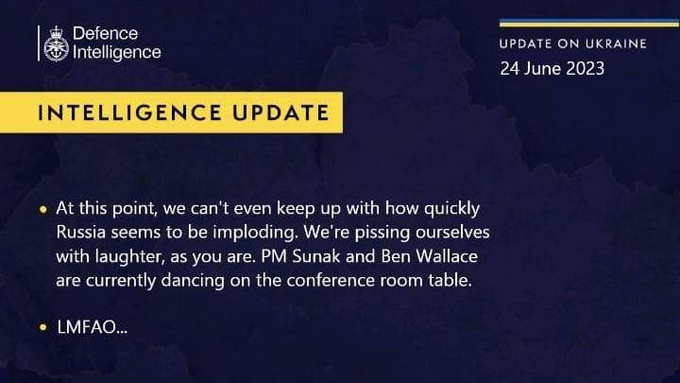
“Sir Humphrey Appleby” tweeted this, saying it was “the intelligence update slide every DI analyst secretly dreams of producing …
As we write this, roughly a day has passed since the sudden end of what briefly looked like a massive event with the potential to reshape global politics for a generation … before it fizzled. The rebellion of Russia’s Wagner mercenary group and its bolt toward Moscow was a stunning story, until it wasn’t. And that itself is a stunning story. Yevgeny Prigozhin, former chef and now Wagner leader, suddenly called off his mutiny, and it just … ended.
Really?
When the mutiny began on Friday, and especially when Wagner seized the southern city of Rostov, home to a major Russian military headquarters overseeing the invasion of Ukraine as well as a million other people, we were surprised, but the more we thought about it, we weren’t particularly shocked. There had been obvious signs of an imminent rupture of some kind in recent months; Line editor Gurney had wondered on Twitter how long it could last before something snapped. That was about three hours before the entire country seemed to snap and Prigozhin marched into Rostov and began moving north.
Events proceeded at a fairly frantic pace after that, with Wagner troops advancing almost all the way to Moscow while Russian security forces fortified the city and tore up roads along the route. It wasn’t clear to us that Wagner had enough men to actually take the city and potentially capture key members of the government. But it wasn’t clear that he didn’t: there are two sides of that equation — the troops Prigozhin had and the troops Putin could count on to oppose Wagner. It was the latter group that captured our interest.
Wagner encountered some resistance along the way, but not much. Most of Russia’s army is deployed in Ukraine, of course, and much of what’s left is now of famously poor quality and morale. But even those military and security forces that were able to block Wagner’s advance didn’t seem that interested in the job. There are reports that some units went over to Prigozhin’s side, but it seems that most of them just did … nothing in particular. And waited to see what happened. For a few hours, we wondered if Prigozhin’s small force would be just large enough in the face of a Russian military that seemed to have no appetite for battle on its own soil.
We can’t pretend to explain the bizarre conclusion to this chaotic day and a half, with an apparent deal brokered by Belarus seeing Wagner’s advance on Moscow called off, a broad amnesty granted to all participants and Prigozhin apparently set to continue to oversee Wagner’s global operations from Belarus in some kind of exile. This is all just wildly unrealistic. Prigozhin cannot be the last person around to realize that he’s put a target on his back and that he’ll soon experience some kind of fatal medical emergency or tragic tumble out of an open window. The moment his mercenaries took Rostov, he had only one path forward: all the way to the Kremlin. What the hell he’s thinking is frankly beyond our ability to guess, and we have fairly vivid imaginations. It’s baffling.
Nor will we try to guess what this will mean for Russia. In a situation like this, your Line editors would normally simply confess that we don’t have the deep knowledge of Russian domestic politics to turn ourselves into credible instant-experts on this. We’d seek out someone with that knowledge. We could interview them, solicit a column from them, or even — as we’ve done in the past — allow someone with deep expertise but who isn’t permitted to speak on the record in public to provide a blurb for one of these dispatches, to run under our shared byline. But in this case, we had to reject all those options, because at least for right now, all the experts seem as baffled as we are. No one seems to understand what the hell just happened in Russia.
We can say with at least reasonable confidence that if you happen to be named Vladimir Putin, it isn’t good. When Prigozhin announced that he was ending his mutiny and began withdrawing his forces from Rostov, the locals cheered them like some kind of conquering heroes. That’s gotta be on Putin’s mind. Also on his mind: the apparent, ahem, reluctance of much of his military and domestic security force to rally to his side during the crisis. This has wounded Putin. Time will tell how badly. Time will also tell how many other people in Russia today have carefully watched recent events, have adjusted their understanding of the facts on the ground there, and are now pondering a variety of intriguing options accordingly.
And the last thing time will tell is what Putin feels he must now do to assert his authority, such as it is. We must recall that whatever Putin’s domestic troubles, he has problems on the battlefield, too. While we haven’t yet seen major breakthroughs by Ukrainian forces, they are not yet fully committed, and their counteroffensive does seem to be making gradual progress in multiple sectors. Events of recent days can only hurt Russia’s combat performance and morale.
We wish we could offer you all a more firm and decisive statement to wrap all this up. But the best we can honestly promise you is that we’ll keep pondering this, trying to figure out what the hell happened, and we’ll certainly be watching this. It’s been a strange war. And we suspect it might get stranger still before it finally ends.
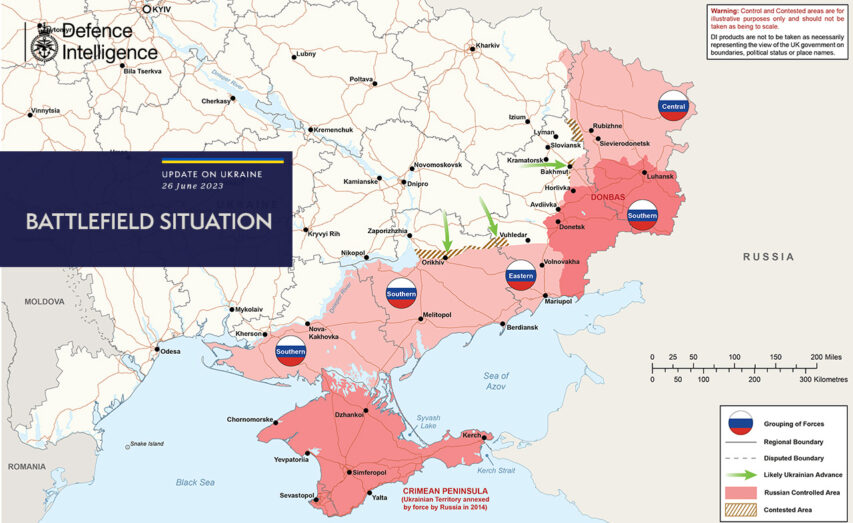
The most recent Defence Intelligence update map from the British Ministry of Defence shows what is thought to be a reasonably accurate representation of the battlefront in eastern Ukraine:
Uncancelled History with Douglas Murray | EP. 05 Winston Churchill
Nebulous Media
Published 20 Dec 2022Andrew Roberts joins Douglas Murray on this episode to discuss Winston Churchill. The two discuss the soldier, writer and prime minister in detail, leaving nothing off limits. Should the British Bulldog stay cancelled?
(more…)
June 26, 2023
DShK-38: The Soviet Monster .50 Cal HMG
Forgotten Weapons
Published 10 Mar 2023In 1925 the USSR began a program to develop a heavy machine gun for antiaircraft use. After some initial experimentation with a converted Dreyse machine gun, they brought in Degtyarev to scale up his recently-adopted light machine gun to the task. Degtyarev’s first design was ready in 1930, and underwent testing until 1933. It was designated the DK, and used a 30-round drum magazine. This contributed to an unacceptably low rate of fire (~360 rpm), and the feed system was replaced by an ingenious development of Georgiy Shpagin to use belts instead.
Fitted with the Shpagin feed system, the DShK finished field testing in 1939 and was adopted as the model 1938. Production was slow, and the guns were not used on anything like the scale of American M2 use during World War Two. A total of about 9000 were in use at the end of the war, although the subsequent update to the DshKM (aka DShK 38/46) pattern would see it fitted to many armored vehicles, and total production eventually topped one million.
This example is a very early production 1939 example, most likely a Finnish capture piece from the Winter War or Continuation War.
(more…)
June 25, 2023
The Greatest Pincer Movement in Military History – WW2 – Week 252 – June 24, 1944
World War Two
Published 24 Jun 2023The Red Army surges forward in Operation Bagration, a mighty new offensive to destroy German Army Group Centre. Fighting continues in Normandy, Italy, and Finland. The United States Navy tears the heart out of the Imperial Japanese Navy in the Philippine Sea even as the Imperial Japanese Army has success in China. The British and Indian armies lift the siege of Kohima.
(more…)
June 24, 2023
The Most Reliable and Versatile Sub-orbital Rockets Ever Made; the Black Brant Sounding Rockets
Polyus
Published 31 Aug 2018The Black Brant series of sounding rockets was a great success and a proud contribution to the global race for space. While not as glamorous as an orbital rocket, the Black Brants helped scientists from around the globe research and better understand the Aurora and the Earth’s ionosphere.
(more…)
June 23, 2023
The Combat Engineers of D-Day – WW2 Special Documentary
World War Two
Published 22 Jun 2023How do you blast through the obstacles and minefields on the beaches of Normandy? How do you get thousands of tonnes of tanks, guns, and men into the fight? And what about reopening the shattered French ports? You need men who are as skilled in construction as they are destruction. You need the engineers.
(more…)
FG-42: Perhaps the Most Impressive WW2 Shoulder Rifle
Forgotten Weapons
Published 8 Mar 2023The first production version of the FG42 used a fantastically complex milled receiver and a distinctive sharply swept-back pistol grip. A contract to make 5,000 of them was awarded to Krieghoff in late spring of 1943, but by the fall its replacement was already well into development. The milled receiver used a lot of high-nickel steel which was becoming difficult for Germany to acquire, and it was decided to develop a stamped receiver to ease production obstacles. Ultimately only about 2,000 of the early Type E FG42 rifles were actually made, and only 12 or 15 are registered in the US. They are a remarkably advanced rifle, and extremely interesting.
(more…)
June 22, 2023
CDR Salamander’s proposal to “encourage” NATO countries to meet or exceed their agreed defence targets
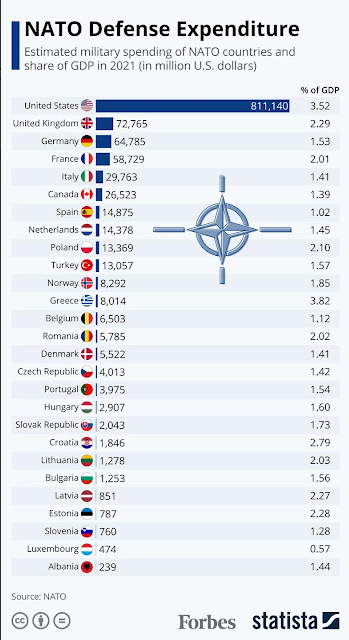
 Canada has been a notorious defence freeloader since the first Trudeau government took office in 1968. Every Canadian government since then — until the current government started telling our allies we had no intention of meeting our treaty commitments — has made more-or-less sincere noises about getting back to the 2% of GDP minimum defence budget and none have done much to make it happen (we’re around 1.39% at the moment). Several years ago, CDR Salamander proposed a new way to allocate NATO leadership roles according to how close to the minimum each member country has managed to get, and it’s surprising that something of the sort hasn’t already been implemented:
It should bring to the front that NATO can no longer allow unserious nations to play like they are anything but security free-riders. They need to contribute their fair share or pay some consequence. Alliances have benefits and responsibilities. You should not have one without the other.
While percentage of GDP is an imperfect measure of contribution, it is better than all the other ones. It is as simple benchmark of national effort.
As these are the best numbers we have, let’s look at 2021 and then forward.
It is amazing that after all Russia has shown Western Europe — both of its nature and the nature of modern warfare — that so many of our NATO allies continue to slow walk defense spending, doing the very minimum to be a full and fair partner in the alliance.
Russian victory — however they define it — or Russian defeat — however Ukraine defines it – will not change the geography or nature of Russia. She is not going anywhere.
[…]
There is so much deferred spending from our free-riding European allies.
Between 1999 and 2021, EU combined defence spending increased by 20%, according to reports by the European Defence Agency. That compares with a 66% increase by the US, and 292% by Russia and 592% by China, over the same period.
“Out years” are where dragons live, so anyone not on guide-slope to 2%+ by the end of 2023 — when one way or another the Russo-Ukrainian War should be over — will find someway to not get there in a wave of excuses and bluffing.
We should call their bluff.
As such, and this is generous, we need to finally pursue PLAN SALAMANDER for NATO “Flags-to-Post” that I first proposed almost six years ago.
In NATO, General and Flag Officer billets are distributed amongst nations in a rather complicated way, but this formula is controlled by NATO – and as such – can be changed.
Entering argument: take the present formula for “fair distribution” and multiply by .75 any nation that spends 1.5% to 1.99% GDP on defense. Multiply by .5 any nation that spends between 1.25% to 1.499%. Multiply by .25 1.0% to 1.240%. If you fall below 1%, you get nothing and your OF5 (Col./Capt) billets are halved.
1.25x for 2.01%-2.25%. 1.5X for 2.26%-2.75%; 1.75x for 2.76% -3.0%. 2x for +3.01%.
The math gets funky when a lot of people get over 2%, but we can refine it later. Doesn’t cost a penny and will unquestionably get the attention of those nations. Trust me on this. By January 1st, 2024 no more excuses. A small and symbolic punishment, but a good start that may be all that is needed. This is not the second half of the 20th Century any more.