
Canada remains unmatched in its ability to turn somebody else’s tragedy into a debate about our own neuroses.
Paul Wells, quoted by Mark Steyn, Western Standard 2005-01-31.
March 1, 2024
QotD: Canadian neuroticism
Comments Off on QotD: Canadian neuroticism
February 29, 2024
The incredibly harmful Online Harms Act
Michael Geist thinks a substantial part of the Online Harms Act should be removed:

Having a spent virtually the entire day yesterday talking with media and colleagues about Bill C-63, one thing has become increasingly clear: the Criminal Code and Human Rights Act provisions found in the Online Harms Act should be removed. In my initial post on the bill, I identified the provisions as one of three red flags, warning that they “feature penalties that go as high as life in prison and open the door to a tidal wave of hate speech related complaints”. There is no obvious need or rationale for penalties of life in prison for offences motivated by hatred, nor the need to weaponize human rights complaints by reviving Human Rights Act provisions on communication of hate speech. As more Canadians review the bill, there is a real risk that these provisions will overwhelm the Online Harms Act and become a primary area of focus despite not being central to the law’s core objective of mitigating harms on Internet platforms.
Indeed, these concerns are already attracting media coverage and were raised yesterday in columns and commentary from Andrew Coyne and Professor Richard Moon, who I think rightly describes the core provisions of the Online Harms Act as “sensible and workable” but notes that these other provisions are troubling. Bill C-63 is effectively four bills in one: (1) the Online Harms Act, which forms the bulk of the bill and is focused on the duties of Internet platforms as they respond to seven identified harms, (2) the expansion of mandatory child pornography reporting requirements to include those platforms, (3) the Criminal Code provisions, which opens the door to life in prison for committing offences that are motivated by hatred of certain groups, and (4) the changes to the Canadian Human Rights Act, which restores Section 13 involving communicating hate speech through the Internet as a discriminatory practice. The difference between the first two and the latter two is obvious: the first two are focused on the obligations of Internet platforms in addressing online harms, while the latter two have nothing directly to do with Internet platforms at all.
The Criminal Code and Human Rights Act changes originate in Bill C-36, which was introduced in 2021 on the very last sitting day of the Parliamentary session. The bill died on the order paper with an election call several weeks later and did not form a core part of either the online harms consultation or the 2022 expert panel on online harms. These provisions simply don’t fit within a legislative initiative that is premised on promoting online safety by ensuring that social media services are transparent and accountable with respect to online harms. Further, both raise legitimate concerns regarding criminal penalties and misuse of the human rights complaint system.
At the National Post, Carson Jerema points out that under the Online Harms Act, the truth is no defence:
As much as the Liberals want everyone to believe that their proposed online harms act is focused almost exclusively on protecting children from predators, and that, as Justice Minister Arif Virani said, “It does not undermine freedom of speech,” that simply isn’t true. While the legislation, tabled Monday, could have been much worse — it mercifully avoids regulating “misinformation” — it opens up new avenues to censor political speech.
Under the bill, condemning the Hamas massacre of 1,200 people on Oct. 7, could, under some circumstances, be considered “hate speech”, and therefore subject to a human rights complaint with up to $50,000 in penalties. As part of the new rules designed to protect Canadians from “online harms”, the bill would reinstate Section 13 of the Canadian Human Rights Act, the hate speech provision repealed under the Harper government.
The new version is more tightly defined than the original, but contains the same fatal flaws, specifically that truth is no defence and that what counts as hate speech remains highly subjective.
Under the new Section 13: “it is a discriminatory practice to communicate or cause to be communicated hate speech by means of the Internet or any other means of telecommunication in a context in which the hate speech is likely to foment detestation or vilification of an individual or group of individuals on the basis of a prohibited ground of discrimination”.
It is distressingly easy to imagine scenarios where everyday political speech finds itself under the purview of the Canadian Human Rights Commission. Criticizing Hamas and the murderous ideology that motivates it could, to some, be seen as “likely to foment detestation or vilification” against a group, especially if the condemnation of Hamas notes that Palestinians generally support the terrorist group or that Hamas is driven by religious fanaticism.
Dan Knight calls it “the sequel no one asked for”:
Morning my fellow Canadians and lets break into the liberals latest sequel with Bill C-63 the its failed predecessor, Bill C-36, which is a sequel nobody asked for in the saga of online hate speech legislation. We’re witnessing a government’s second attempt to police what you can say online.
Now, the Liberal government in Canada initially put forward Bill C-36. This bill aimed to tackle extreme forms of hate speech online. It sought to bring back a version of a section that was repealed from the Canadian Human Rights Act in 2013. Why was it repealed, you might ask? Because critics argued it violated free speech rights. But here we are, years later, with the Liberals trying to reintroduce similar measures under the guise of combating hate speech. Under the proposed changes, folks could be fined up to $20,000 if found guilty of hate speech that identifies a victim. But here’s the kicker: the operators of social media platforms, the big tech giants, are initially left out of the equation. Instead, the focus is on individuals and website operators. Now, the government says it plans to hold consultations over how to make these social media platforms more accountable. But the details are hazy, and the timeline is, well, as clear as mud.
The justice minister of Canada has framed these amendments as a way to protect the vulnerable and hold individuals accountable for spreading hatred online. But let’s be clear: there’s a thin line between protecting individuals and infringing upon free speech. And that line is looking blurrier by the day in Canada. Critics, including the Opposition Conservatives, have voiced concerns that these measures could curb freedom of speech and be difficult to enforce. They argue that the government’s efforts might not just be about protecting citizens but could veer into controlling what can and cannot be said online. And when the government starts deciding what constitutes “hate speech”, you have to start wondering: Who gets to draw that line? And based on what standards?
And, just when you thought it couldn’t get any more Orwellian, enter the pièce de résistance: the Digital Safety Commission of Canada. Because, clearly, what’s missing in the fight against “hate speech” is another layer of bureaucracy, right? Another set of initials to add to the alphabet soup of governmental oversight. So, here’s the deal: this newly minted commission, with its CEO and officers — oh, you better believe there will be officers — is tasked with overseeing the online speech of millions. And let me tell you, nothing says “independent” like a government-appointed body policing what you can and cannot say on the internet. I can just imagine the job postings: Now Hiring: Online Expression Regulators, proficiency in silencing dissent highly valued.
Comments Off on The incredibly harmful Online Harms Act
Arizona GOP pushes to legalize hunting down suspected illegal immigrants with deadly force! Film at 11!
Chris Bray reports on this utterly abhorrent piece of proposed legislation that will literally condemn any brown person in the state of Arizona to be murdered out of hand by evil red-hatted Trump supporters … or will it?
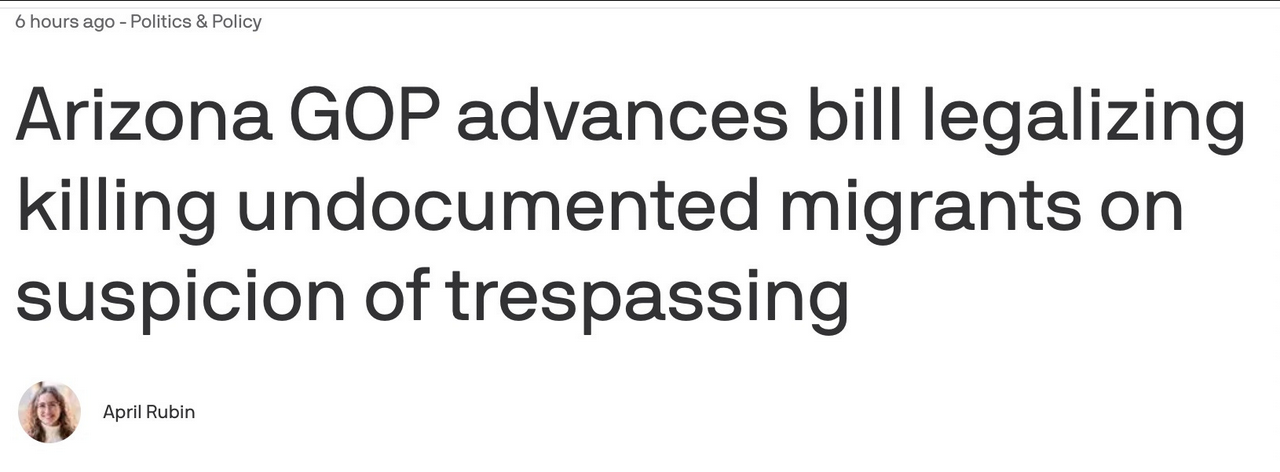
Republicans in the Arizona legislature have advanced a bill that would allow anyone in the state to just casually gun down any migrant anytime they feel like that filthy brown person might be trespassing. You can trust that this is really happening, because it’s in the news.
Delightfully, Axios reporter April Rubin trained at the New York Times. Here’s how she starts this story:
Arizona Republicans are advancing a bill that would allow people to legally kill someone accused of attempting to trespass or actively trespassing on their property.
The big picture: The legislation, which is expected to be vetoed if it reaches the state’s Democratic governor, would legalize the murder of undocumented immigrants, who often have to cross ranches that sit on the state’s border with Mexico.
These monsters, they’re legalizing the murder of undocumented migrants.
So, as always, let’s read the actual bill:
A person in lawful possession of property can threaten deadly force, or potentially use deadly force, in response to an act of criminal trespassing: You can go out on your property with a gun and tell a trespasser to get lost.
But Subsection B is the key to the actual use of deadly force, and journalists aren’t saying anything about it (emphasis added): “A person may use deadly physical force under subsection A only in the defense of himself or third persons as described in sections 13-405 and 13-406,” existing sections of Arizona state law. The bill explicitly references an existing legal standard for the use of deadly force.

Comments Off on Arizona GOP pushes to legalize hunting down suspected illegal immigrants with deadly force! Film at 11!
February 28, 2024
The rise of the “Pretendian” is an inevitable consequence of academia’s ultra-woke culture
Freddie deBoer summarizes why we’ve seen a vast increase in the number of Pretendians in western academia, but especially in Canada and the United States (and we can be almost certain that there are a lot more who haven’t yet been revealed, because the incentives to pretend are so enticing):

“The Pretendians”, a CBC documentary – https://www.cbc.ca/passionateeye/episodes/the-pretendians
- Certain jobs in academia are highly prized
- There are far more applicants than openings for those jobs and so competition for them is incredibly fierce
- Representing yourself as a member of an underrepresented minority significantly improves your odds of getting such a job, and in certain fields representing yourself as a person of indigenous descent improves those odds dramatically
- Indigenous identity is easy to fake and difficult to disprove, and the cost of accusing someone else of faking it, in academia, can be very high indeed
- Most crucially of all, the social culture of academia strongly prohibits speaking frankly about these facts
Jay Caspian Kang’s new piece on the “Pretendian” crisis in academia is deeply researched and compulsively readable, and read it you should. But fundamentally everything you need to know about the problem is in the numbered list above. You’ve created a fiercely competitive process in which a segment of people are given a very large advantage, there are few if any objective markers that can disprove that someone is a member of that segment, and you’ve declared it offensive to question whether someone really is a member of that segment, outside of very specific scenarios. (When I was in academia people spoke very darkly about the concept of ever questioning someone’s indigenous identity, called it the act of a colonizer, etc etc.) The obvious question is … what did you think was going to happen? Humanities and social sciences departments have, through the conditions described above, rung the dinner bell for people pretending to have indigenous heritage. They now act shocked when such people show up. I find it disingenuous and untoward. This behavior is the product of the incentives that you yourself built. Of course it’s a stain on the integrity of the fakes. But you made it inevitable that this would happen. Reap what you sow.
Accusations aplenty, but still no clear evidence
Michelle Stirling outlines the establishment of the North West Mounted Police (today’s Royal Canadian Mounted Police) and their role in driving out American whiskey traders and criminal gangs who had invaded the Canadian west, and the initial role of Sir John A. Macdonald in setting up the first residential schools for First Nations children:

Kamloops Indian Residential School, 1930.
Photo from Archives Deschâtelets-NDC, Richelieu via Wikimedia Commons.
It is clear that the claim of “mass graves” of children allegedly found by Ground Penetrating Radar (GPR) at the former Kamloops Indian Residential School is false. The main reason is that there is no list of names of missing persons — over the course of 113 years of Indian Residential Schools, which saw 150,000 students go through the system, some staying for a year, most for an average of 4.5 years, some staying for a decade or more and graduating, and some orphans being taken in to the school as children, then remaining to work as Indigenous staff — these many thousands of children passed through Indian Residential Schools, their parents enrolling and re-enrolling them year after year.
And there is no list of names of missing persons.
There are many claims of missing persons.
Some of these claims are quite fatuous — with one person claiming that in their Band, every family had four or five children who went missing at that school. Another person claimed that their grandfather had ten siblings disappear in that school.
If that were true, the Band would have ceased to exist.
Despite these claims, there are no missing persons records.
And every student who went to that school is documented on the Band’s Treaty rolls, in documents of the Indian Agent, in the enrollment forms at the Department of Indian Affairs, along with the student’s medical certificate for entry, and in the quarterly reports of the department.
In fact, the Indigenous population of Canada grew from about 102,358 in 1871 to now 1.8 million.
It seems that the claim of a “mass grave” on the former Kamloops Indian Residential School site was timed to “nudge” the approval of the United Nations Declaration of the Rights of Indigenous People through parliament — which it did! The bill had been “stuck” as six provinces had requested delay and clarity on key issues. Once the claim of “mass graves” surfaced — boom!
Less than a month after the “mass graves” news shot round the world, shocking the global community that Canadians — once known as international peacemakers, were actually hideous murderers of Indigenous children — UNDRIP swept through the Canadian Parliament with no objection.
A day later, China accused Canada of genocide, citing the Kamloops “mass graves” find as proof. For those of you following the concerns about China’s alleged interference in elections in Canada, this rather convenient timing might set off some alarm bells.
If anything, the RCMP should be investigating this matter on grounds of false pretences or fraud. But the RCMP appear to have transferred the investigation of the Kamloops “mass grave” to the people who claimed to have found them! Ground Penetrating Radar (GPR) can only identify “disturbances” under ground, not bodies or coffins. In fact, based on previous land use records, most likely the GPR found 215 clay tiles of an old septic trench.
Comments Off on Accusations aplenty, but still no clear evidence
QotD: When the rules in the dating market all changed
Under the old dispensation, back before the Clinton Era (1988-2001), everyone acknowledged that there were a lot of users and abusers, douchebags and parasites and losers, out there in the world. That being the case, simply being an all-around ok guy with a steady job — what the PUAs came to term “beta providers” — was, in itself, a pretty solid resume in the dating market. “Just be yourself” was every guy’s dad’s advice when it came to dating, and back then it was pretty solid, since it was assumed that the decent job etc. flowed from being a decent human being. And since every girl’s mom was telling her complementary things, the system worked … until it didn’t, and you can date the change precisely: June 6, 1998, the premiere of the HBO series Sex and the City.
[…] Everyone has met one of those “one of the guys”-type girls. They’re great fun, and while you know what I mean when I say they’re not necessarily marriage material as-is, you therefore also know what I mean when I say they really are what feminists all claim to be: Strong, confident women. They are what they are, and they know it, take it or leave it.
The problem is, most women — and, it goes without saying, all feminists — aren’t “strong, confident women”, in the same way the vast majority of guys aren’t naturally “alpha males”. That’s the dialectic I’ve been trying to get at in this series of posts. Sex and the City, as much as every episode needs to be burned and the ashes shot into deep space, was just the manifestation of a long-developing process. Thanks to all that “self-esteem” shit that started in the Seventies, sometime in the Clinton Era a critical mass of young women decided that what they needed was to be “strong” and “self-confident”. But they didn’t know how to do that, because the people telling them this were fat lesbian college professors. Then HBO, sensing a valuable market niche, got into the act …
Sex and the City […] is the gayest show in the history of television. Carrie and the Gals don’t act like women; they act the way women think men act — which is to say, they act like gay men. Recall that the late 1990s also saw an explosion of female “comedians”, whose one “joke” was some version of “I got my period today, but damn, I still crave dick.” (Sex and the City, you’ll recall, was pitched as a comedy). And that’s a serious problem, because as every straight guy has said at least once in his life, being gay would be fabulous if not for the “sex with guys” part. I mean, how awesome would it be (every young man thinks), if you could reorient your whole life around your crotch?
Severian, “Mental Middlemen III: SATC”, Rotten Chestnuts, 2021-05-06.
Comments Off on QotD: When the rules in the dating market all changed
February 27, 2024
Thank goodness we don’t get all the CBC we pay for!
In the dim, dark recesses of history … say twenty-five years ago … the CBC was what the government still seems to believe it is: a credible, trusted source of news and entertainment. In truth, it was never as loved as some might claim, as it had a deep bias in favour of Quebec and Ontario issues and tended to only occasionally remember the rest of the country. The federal government has been subsidizing the CBC, yet the network’s audience has shrunk to the point that it’s rare to encounter anyone who consumes very much of the programming on offer. Part of that is just the sheer variety of other options available to Canadians and part of it is the CBC’s sour, toxic, hectoring tone when lecturing about “the current thing”. Far from being a major player in upholding Canadian culture, the CBC is clearly one of the major factors that are destroying it:

… looking at the viewer and listener stats for the CBC, our national behemoth, which eats up $1.5 billion annually, and which amounts to 50% of the media dollars spent, is equally disheartening. The state spends another $600 million supporting once-successful media because “internet”. CBC television is watched by 3.9% of Canadians and only 0.8% watch CBC News. Again, half of all media dollars, half. Half is spent engaging less than 4% of Canadians. CBC radio is considered reasonably good, and is listened to by 10%, despite its vindictive calling out of anyone who disagrees with their hard socialist stance. As to other mainstream media, propped up by government via hundred of millions, it is still shedding staff and readers in double digits.
Despite every conceivable advantage, advertising on the CBC dropped 20% during the pandemic. In fact, they are so disliked that CBC is hiring “close protection security” for the next two years. They are so disliked, they have turned off commenting on their various programs. They are so disliked that there is a brand of coffee called “Defund the CBC”. This isn’t passive ignoring, this is active dislike to the point of needing bodyguards.
Why? Because our media show us to ourselves as racist, stupid, sexist, stupid, stupid and more stupid. And while they are at it, shallow and violent. That is the real reason, and the only reason CanCon is dying. They hate us. Why? The only people who have thrived during the past twenty years in Canada when private and public wealth doubled then doubled again, are the ones who live off the government, whether through mandated consulting in the enviro and other business, or direct granting or though quasi-private-sector jobs that are heavily subsidized. Public Private Partnerships have to be the most fiendish way to flat out loot the public ever been invented. Or straight up public sector jobs which are among the most lushly funded and unionized in the known universe, the number of which have grown 400% in the last ten years. Do or did you get six weeks of paid holiday a year?
And do they hate us, in fact correcting us is how they get the grants, the jobs, the subsidy. Everything they do is meant to fix us deplorable Canadians.
Sit at a downtown Toronto dinner party as I have, with say, the head of CBC drama, as I have and listen to just how much they hate the rest of Canada. Why? They hate the rest of Canada because they feel guilty. They know they are cheating and they know they are stealing. I tell ya, I needed close protection security — this woman was terrifying. “Sit Down While I’m Talking to You“, she roared at me.
Javier Milei gets ghosted by US media after posting rare budget surplus in Argentina
Jon Miltimore on Argentine President Javier Milei’s good economic news that the legacy US media are resolutely ignoring:
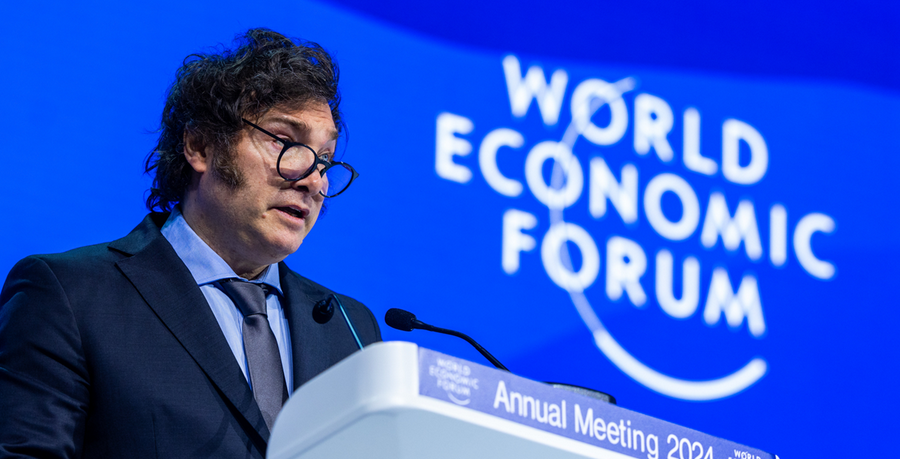
Argentine President Javier Milei speaking at the World Economic Forum gabfest in Davos, Switzerland, January 2024.
Photo by Flickr – World Economic Forum | CC BY-NC-SA 2.0
Argentines witnessed something amazing last week: the government’s first budget surplus in nearly a dozen years.
The Economy Ministry announced the figures Friday, and the government was $589 million in the black.
Argentina’s surplus comes on the heels of ambitious cuts in federal spending pushed by newly-elected President Javier Milei that included slashing bureaucracy, eliminating government publicity campaigns, reducing transportation subsidies, pausing all monetary transfers to local governments, and devaluing the peso.
Milei’s policies, which he has himself described as a kind of “shock therapy,” come as Argentina faces a historic economic crisis fueled by decades of government spending, money printing, and Peronism (a blend of national socialism and fascism).
These policies have pushed the inflation rate in Argentina, once one of the most prosperous countries in Latin America, above 200 percent. Today nearly 58 percent of the Argentine population lives in poverty, according to a recent study.
And Milei rightfully blames Argentina’s backward economic policies for its plight — policies that, he points out, are spreading across the world.
“The main leaders of the Western world have abandoned the model of freedom for different versions of what we call collectivism,” Milei said in a recent speech in Davos. “We’re here to tell you that collectivist experiments are never the solution to the problems that afflict the citizens of the world — rather they are the root cause.”
The revelation that Argentina has done something the US government hasn’t done in more than two decades — run a budget surplus — seems like a newsworthy event.
Yet to my surprise, I couldn’t find a word about it in major US media — not in the New York Times, the Associated Press, the Washington Post, or Reuters. (The New York Sun seems to be the only exception.)
I had to find the story in Australian media! (To be fair, the Agence France Presse also reported the story.)
One could argue that these outlets just aren’t very interested in Argentina’s politics and economics, but that’s not exactly true.
The Associated Press has covered Argentinian politics and Milei extensively, including a recent piece that reported how the new president’s policies were inducing “anxiety and resignation” in the populace. The same goes for Reuters and the other newspapers.
A cynic might suspect these media outlets simply don’t wish to report good news out of Argentina, now that Milei is president.
Comments Off on Javier Milei gets ghosted by US media after posting rare budget surplus in Argentina
QotD: The role of the scholar
Of course, fraudulent scholars have always existed, but it seems to me — not that I’ve conducted a study of the matter — that clear dishonesty by leading scholars no longer elicits widespread condemnation and no longer discredits the guilty parties to the extent that it used to. The Nancy MacLean affair [her book Democracy in Chains (2017) was an extended character assassination of Nobel Prize winning economist James M. Buchanan] is clear-cut. Thomas Piketty’s work is either blatantly dishonest or spectacularly incompetent. And many other examples might be adduced. Ideology, it seems, has overwhelmed scholars in the humanities and social sciences to an unprecedented degree.
Scholars should be seeking the truth, the whole truth, and nothing but the truth, however much they appreciate that this objective can never be attained fully. They are obliged to strive. If they clearly are not trying, indeed, are twisting and turning in the ideological wind above all, real scholars should drum them out of their professions as unworthy of recognition by genuine scholars.
Bob Higgs, Facebook, 2019-08-28.
Comments Off on QotD: The role of the scholar
February 26, 2024
Time to pry the smartphones from the clutches of our dopamine-addicted youngsters?
A couple of articles this weekend deal with the already acknowledged problem of dopamine addiction especially among the young whose brains and personalities are still in the formative stages. First, here’s Christopher Gage reporting with some delight that British schoolchildren are going to have to learn how to cope with a full school day without the electronic binkies they’ve grown so dependent on:
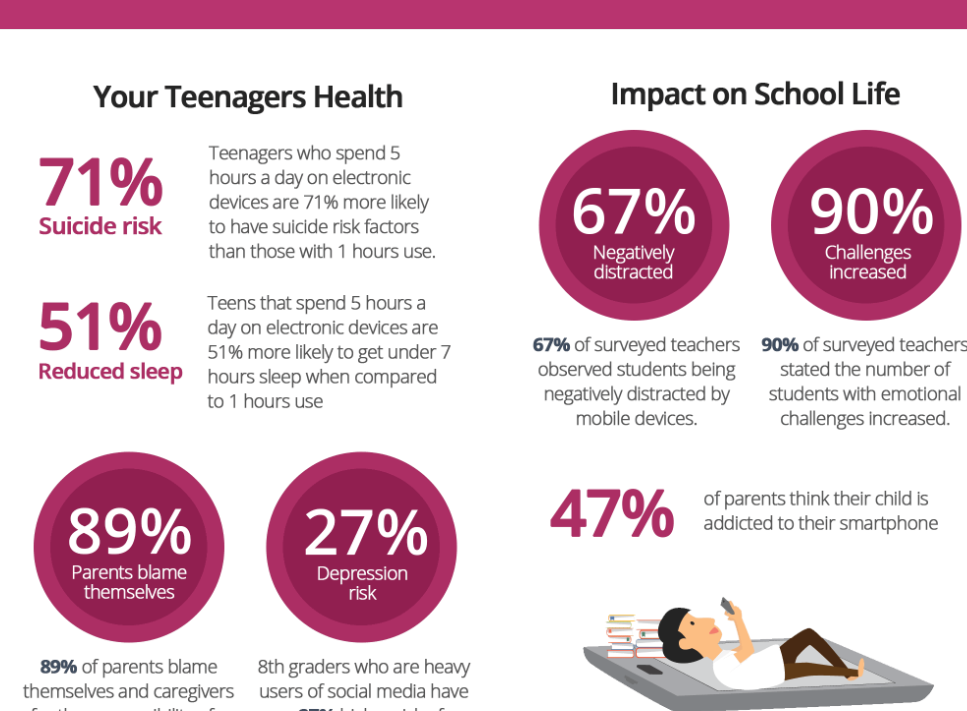
Detail of an article at bankmycell.com
I long for the day when gawking at one’s phone like a lobotomy patient invokes derision. Don’t you know your filthy addiction pollutes every atom of our society? You selfish bastard. You perverts should be ashamed of yourselves, etc. That day is on the horizon.
This week, British lawmakers banned smartphones in schools. Those pocket perils are lobotomising those whom sentimentalists call “the nation’s future”. Denied their devil devices, schoolchildren will endure hours of reading, thinking, and writing. Heaven forbid, they’ll talk to their friends and teachers in flesh and blood.
In these matters, I am militant. Children are not vessels of wisdom and wonder corrupted by a cruel world. They’re ignorant. By teaching them how to think and live, adults civilise children. That bleeping burping buzzing beehive in their pockets renders that civilising mission impossible.
Many disagree. But their knee-jerk reaction to this “knee-jerk reaction” crashes against concrete evidence. Smartphones erode concentration, dull critical thinking, blunt memory, and shred retention. The monstrous equation: Smartphones plus face-hugger apps equals ignorant, depressed, anxious youths.
Yes, technology invites moral panic. Plato worried that the written word would mulch minds into mush. But this is serious.
Last year, Dr Vivek Murthy, the United States surgeon general, issued a rare public health advisory. Across 19 pages, Dr Murthy warned that the effects of social media on adolescent mental health were “not fully understood”.
“There are ample indicators that social media can also have a profound risk of harm to the mental health and well-being of children and adolescents,” he said.
And what did we say? Not much. We had more important matters to attend. If I remember correctly, on that very day, Kim Kardashian revealed on Instagram her latest arse or her newest boyfriend.
However, serious people think this is a serious problem. Dr Benjamin Maxwell, a director of child and adolescent psychiatry at Rady Children’s Hospital in San Diego, said he is “immensely concerned” by a study linking social media and poor mental health. That “highly stimulating environment” may corrode “cognitive ability, attention span and memory during a time when their brains are still developing,” Maxwell said. “What are the long-term consequences? I don’t think we know.”
The UN’s education, science, and culture agency says the more young Jack scrolls through TikTok and the like, the lower his grades sink.
Countless studies show smartphones and their face-hugger apps — designed by behavioural psychologists to addict and milk the user — worsen anxiety, depression, and self-esteem. Not to mention lining up children for the predation of bullies 24/7.
Psychologists Jonathan Haidt and Jean Twenge are the canaries in the cultural coalmine. They say HMS Progress is crashing toward the icebergs — rising rates of suicide, depression, and anxiety. To them, the evidence is almost irrefutable. Turn back now, they say, or the ship sinks.
The second item is a follow-up by Ted Gioia to his post on dopamine culture last week:
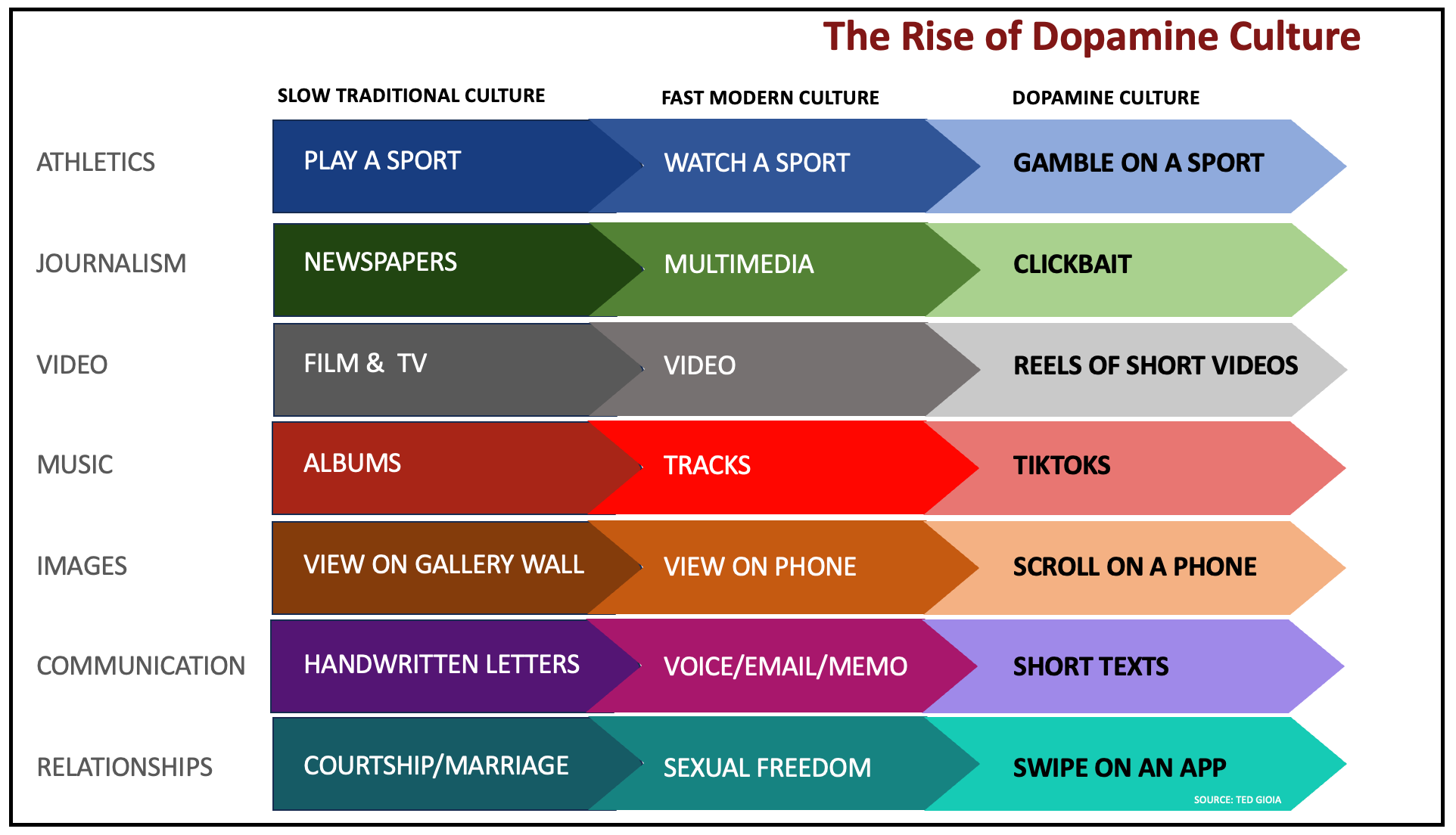
My article on “dopamine culture” has stirred up interest and (even more) raised concerns among readers who recognize the symptoms I described.
One of the illustration went viral in a big way. And I’ve gotten requests from all over the world for permission to translate and share the material. (Yes, you can all quote generously from the article, and reprint my charts with attribution.)
This image was shared widely online
But many have asked for more specific guidance.
What can we do in a culture dominated by huge corporations that want us to spend hours every day swiping and scrolling?
I find it revealing and disturbing that readers who work on the front lines (in education, therapy, or tech itself) expressed the highest degree of alarm. They know better than anybody where we’re heading, and want to find an escape path.
Here’s a typical comment from teacher Adam Whybray:
I see it massively as a teacher. Kids desperately pleading for toilet breaks, claiming their human rights are being infringed, so they can check TikTok, treating lessons as though they’re in a Youtube reaction video, needing to react with a meme or a take — saying that silence in lessons scares them or freaks them out.
One notable difference from when I was at school was that I remember a lesson in which we got to watch a film was a relief or even pleasurable (depending on the film). My students today often say they are unable to watch films because they can’t focus. I had one boy getting quite emotional, begging to be allowed to look at his phone instead.
Another teacher asked if the proper response is to unplug regularly? Others have already embraced digital detox techniques of various sorts (see here and here).
I hope to write more about this in the future.
In particular, I want to focus on the many positive ways people create a healthy, integrated life that minimizes scrolling and swiping and mindless digital distractions. Many of you have found joy and solace — and an escape from app dependence — in artmaking or nature walks or other real world activities. There are countless ways of being-in-the-world with contentment and mindfulness.
Today I want to discuss just one bedrock of real world life that is often neglected — or frequently even mocked: Ritual.
I know how much I rely on my daily rituals as a way of creating wholeness and balance. I spend every morning in an elaborate ritual involving breakfast, reading books (physical copies, not on a screen), listening to music, and enjoying home life.
Even my morning coffee preparation is ritualistic. (However, I’m not as extreme as this person — who rivals the Japanese tea ceremony in attention to detail.)
I try to avoid plugging into the digital world until after noon.
I look forward to this daily time away from screens. But my personal rituals are just one tiny example. There are many larger ways that rituals provide an antidote to the more toxic aspects of tech-dominated society.
Below I share 13 observations on ritual.
Comments Off on Time to pry the smartphones from the clutches of our dopamine-addicted youngsters?
The Freedom Convoy’s European echoes
Niccolo Soldo on the widespread protests against the EU and various national governments’ intrusive and anti-human attempts to restrict or destroy European farmers in pursuit of their climate change agenda:

I wish there was a way to measure the gulf between ruling elites and the people that they lord over. Don’t Political Scientists have such a methodology already on hand? I don’t know.
What I do know is that this gulf is very palpable on both sides of The Pond, and that this gulf shows no signs of narrowing any time soon. Whether the issue is migration, crime, COVID-19, etc., it seems that the views of the people are simply ignored by those who can and do ignore them, and proceed to make policy that suits their own interests and the interests of their allies and class.
Judging by American media reporting, you would most likely not be aware that massive farmers’ protests are rocking the European continent as we speak. From Portugal to Poland, farmers are protesting the EU’s drive to push policies like “Net Zero” in order to “combat Climate Change” … policies that would severely impact the livelihoods of our food producers. These proposed changes are entirely top-down, indicative of just how divorced the Brussels elites are from the daily lives of the people whose lives they wish to upend with a stroke the pen. “Oppose us? You must be far right … probably a Nazi too.”
The “far-right” political libel against hard-pressed farmers is really a sign of how far the EU elites have lost touch with the reality of life for the peoples of Europe. We should ignore the slurs, and get behind the fighting farmers.
The protests by angry farmers have spread across the European Union, with mighty convoys of tractors blockading roads and cities from Romania to Rome, from Portugal to Poland, from Bulgaria to Brussels and beyond.
There might be some national variations in the farmers’ specific demands. But what unites them all is opposition to the way that the EU elites are subordinating agricultural policy to their Green agenda and Net Zero obsession, leading to more hardship for farmers and higher food prices for other Europeans.
As tractor convoys blockaded German cities in January, farmers’ association president Joachim Rukwied spelt out that they were protesting not just against the government’s proposed cuts in fuel subsidies, but against an EU-wide system where “agricultural policy is being made from an unworldly, urban bubble and against farming families and rural areas”.
This week in Poland, 62-year-old protesting farmer Janusz Bialoskorski told the media that, “They’re talking about climate protection. But why should it be done at farmers’ expense?” Farmers, he pointed out, are not responsible for industrial pollution, and “nor do we fly to Davos on our jets”.
Pitchfork Populism. The fact that the elites in Brussels have invited this in a year when elections for the EU’s Parliament are scheduled to occur indicates just how out of touch they really are.
These farmers are now in the front line of a wider populist revolt, against those elitists who DO fly in their private jets to the World Economic Forum in luxurious Davos, Switzerland, where they lecture the rest of us about how to save the planet by sacrificing our living standards.
Their protests expose the yawning gap between the high-minded talk of the Brussels Green oligarchy, and the grim reality of what those Net Zero policies mean for normal people in the muddy fields of Flanders or on the supermarket shelves of Florence.
If you can’t shut them up, call them “far right”:
Last weekend, UK Observer newspaper (Sunday sister of the liberal Guardian), the most pro-EU voice in the British media, worried aloud about how the European farmers’ cause “has been enthusiastically adopted by a resurgent populist far-right”.
Similar fears have repeatedly been expressed in the Brussels-backing news media this year: “Brussels struggles to placate farmers as far-right stokes protests,” and “EU farmers egged on by the far-right” (Financial Times); “How the far-right aims to ride farmers’ outrage to power in Europe” (Politico); “Far-right harvests farmers’ anger across Europe” (France 24) etc., etc.
The EU establishment and its media pals are so out of touch with the reality of people’s lives that they apparently imagine Europe’s naïve farmers are protesting only because they have been “egged on” or “stoked up” by “far-right” agitators. The idea that these farmers might be entirely reasonable, hard-working people who are simply at the end of their collective tether with EU bureaucracy seems beyond the comprehension of those bureaucrats and their media mouthpieces.
“A Silent War on Farming”:
As the title of a recent report by the think-tank MCC Brussels puts it, Europe’s agricultural communities are facing nothing less than a “Silent War on Farming,” waged from Brussels.
For decades, EU agricultural policy was about the efficient, cheap, and safe production of food to feed the peoples of Europe and ensure that the continent never suffered famine again. Now, that policy has instead been captured by Green ideology, which demands that farmers use less land and less intensive methods to produce lower emissions. In sum, that must mean less farming—and less food being produced.
Farmers are bearing the brunt of the ideologically-driven regulations imposed by the EU, with falling incomes and the closure of family farms. The rest of Europe faces a scarcity-driven surge in prices—with shortages being met by food imports from countries with far higher emissions than the EU’s hi-tech farming sector.
For many Europeans now supporting the farmers, however, this is about even more than the price of food on their table. Farming and rural communities are at the heart of traditional European ideas of community and self-image. People who live far from the countryside can now identify with farmers who are resisting the same sort of threat to their way of life that they see posed by, for example, EU policies on mass migration.
All Brussels seems to be able to do these days is pass laws to micromanage the lives of Europeans, while increasing the contempt that these same people have for them.
QotD: Lockdown rebuttal
Nor were lockdowns “essential”. As Nocera and McLean note,
… the weight of the evidence seems to be with those who say that lockdowns did not save many lives. By our count, there are at least 50 studies that come to the same conclusion. After The Big Fail went to press, The Lancet published a study comparing the COVID infection rate and death rate in the 50 states. It concluded that “SARS-CoV-2 infections and COVID-19 deaths disproportionately clustered in U.S. states with lower mean years of education, higher poverty rates, limited access to quality health care, and less interpersonal trust – the trust that people report having in one another.” These sociological factors appear to have made a bigger difference than lockdowns (which were “associated with a statistically significant and meaningfully large reduction in the cumulative infection rate, but not the cumulative death rate”.)
Second, the lockdowns were, contra Mr. Orrell’s claim, utterly unprecedented. Isolating individuals known to be infected, such as Typhoid Mary, is a categorically different measure than locking down whole societies. Such lockdowns were never used until China locked Wuhan down in early 2020. Here again are Nocera and McLean: “On April 8, 2020, the Chinese government lifted its lockdown of Wuhan. It had lasted 76 days – two and a half months during which no one was allowed to leave this industrial city of 11 million people, or even leave their homes. Until the Chinese government deployed this tactic, a strict batten-down-the-hatches approach had never been used before to combat a pandemic. Yes, for centuries infected people had been quarantined in their homes, where they would either recover or die. But that was very different from locking down an entire city; the World Health Organization called it ‘unprecedented in public health history’.”
It’s jarring to encounter in an essay that features many excellent arguments – as Mr. Orrell’s does – such irrational and utterly uninformed claims as Mr. Orrell offers about lockdowns.
Donald J. Boudreaux, responding to an article by Brent Orrell in Law & Liberty, 2023-10-31.
1. “COVID Lockdowns Were a Giant Experiment. It Was a Failure.” Intelligencer, October 30, 2023.
Comments Off on QotD: Lockdown rebuttal
February 25, 2024
Who Killed Canadian History?
I was not aware that it has been a full twenty-five years since J.L. Granatstein published his polemical Who Killed Canadian History?:
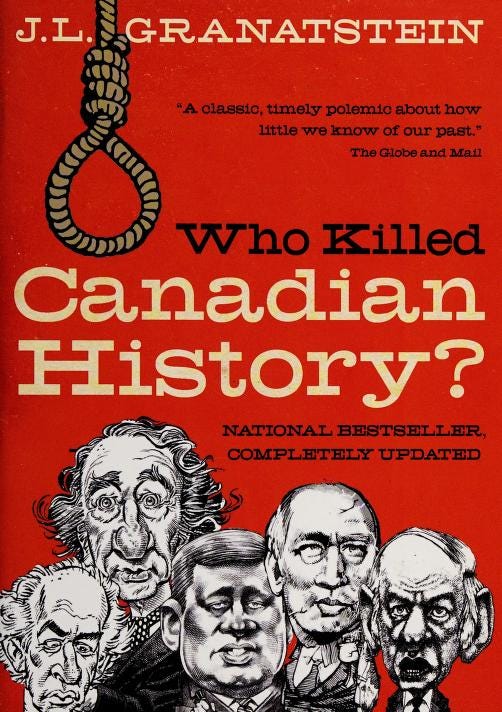
In that work, Granatstein asserts that the rationale for the history taught in Canadian schools was political, not historical. And sexism and racism were being taught, not history.
In the postmodern era, the priority of vast areas of history teaching and historiography, and Granatstein is far from the only academic who noticed this, transitioned from evidence and facts, to morals and emotions. Western oppression became the source of historiographical obsession. And the practice, which has shaped Western historiography since at least the turn of the twentieth century, of injecting moral judgements adjacent to facts and timelines, became entrenched.
This has happened because important areas of historiography, and historical pedagogy, have been subsumed into social sciences. My 9 and 11 year old children do not have a history class. What they learn about history, which isn’t much, is in a class called “social studies”. My son, who is in grade 6, and who was never previously taught anything about the Holocaust, is learning about Nazis Germany’s persecution of the Jews in the most obscure way. His introduction to the Holocaust included a lesson pertaining to the MS St. Louis, a passenger ship carrying 907 Jewish refugees fleeing Nazi persecution that was refused entry into Canada in 1939.
The ship’s Jewish passengers were safely returned to four European countries, but tragically 254 were later killed in the Holocaust. A terrible outcome. Indeed, one of the rare dark stains on Canada’s otherwise quite exemplary record of offering sanctuary to refugees. But if Canadians at the time had known that refusing entry to the MS St. Louis would result in the cold-blooded murder of 254 innocent people, would they have allowed entry? A question not raised in my son’s class.
As well, what Canadians knew or didn’t know about the genocidal ambitions of the Nazis did not come up in my son’s classroom discussions. Indeed, that would be too complex and nuanced for 12 year old’s. They also did not discuss conditions in Canada at the time that may have played a role in the consequential decision to turn away the MS St. Louis. Nor did they mention the Evian Conference, which occurred the year prior to the MS St. Louis‘ ill-fated arrival to Canada.
The Evian Conference of 1938 was held in the French resort town of Évian-les-Bains. There were 32 participating nations, including Canada, who were “to seek, by international agreement, avenues for an orderly resettlement of (Jewish) refugees from Germany and Austria”. Shockingly, at the close of the talks, none of the nations involved had offered to accept any Jewish refugees.
From the London Spectator (1938):
If the Conference has not been a complete failure, it has achieved little to boast about, all the States sympathizing and none desiring to admit refugees. Even the United States, as prime mover, offers no more than the quota.
My son did not come away from his class with an impression that Canada was not alone in its reluctance to accept refugees. This, and other such lessons, seem as if they are designed to implant a sense of revulsion over Canada’s past failures, instead of patriotism over its achievements and victories. What a disservice to young Canadian learners.
This cherry-picked event from history, which doesn’t really deal with the Holocaust, but assumes kids will appreciate related events that occurred over the backdrop of the Holocaust, is doubly misleading in that it presents Canada as a racist country hostile to refugees, before establishing that the opposite was (and is) overwhelmingly true throughout the arc of Canadian history up to the present.
It’s not even clear if my son took away from the lesson that Hitler was the far bigger villain, compared to his “racist colonial” country of Canada.
Clearly, Canada eventually let in Jewish people, and people from all ethnicities. We became the world’s first multiculturalism, and our large cities are among the most cosmopolitan and multicultural places in the world. This needs to be established first for young learners of Canada’s story. Clearly established, before one starts teaching the exceptions to the rule. But my son is getting some weird blend of oddities presented as introductory material to larger subjects which hold historical conclusions opposite to the ones the cherry-picked exceptions portray. It only makes sense that these exceptional events are selected deliberately for political, not educational, reasons.
Twenty-five years ago, Granatstein wrote of Canadian schools,
The material taught stressed the existence of anti-Aboriginal, anti-Metis, and anti-Asian racism, as well as male sexism and discrimination against women, as if these issues were and always had been the primary identifying characteristics of Canada … The history taught is that of the grievers among us, the present-day crusaders against public policy or discrimination. The history omitted is that of the Canadian nation and people.
Who Killed Canadian History? also criticized the teacher-curated practice whereby early exposure to Canadian history is random and discontinuous concerning time periods and individuals, and “without much regard for chronology”. Exactly what I have been experiencing with my kids, decades after Granatstein identified the problem.
Comments Off on Who Killed Canadian History?
Canadian publishing “has been decimated since Ottawa took an active interest in it and while federal policies haven’t been the whole problem, they’ve been vigorous contributors”
In the latest SHuSH newsletter, Ken Whyte contrasts the wholesome intentions of the Canadian federal government on cultural issues with the gruesome reality over which they’ve presided:

Even James Moore, [Liberal cabinet minister Melanie] Joly’s Conservative predecessor in the heritage department, applauded her initiative as good and necessary, although he warned it wouldn’t be easy. Moore had wanted to do the job himself, but his boss, Stephen Harper, didn’t want to waste political capital on fights with the arts community. He told Moore his job in the heritage department was to sit on the lid.
Joly got off to a promising start, only to have her entire initiative scuppered by a rump of reactionary Quebec cultural commentators outraged at her willingness to deal with a global platform like Netflix without imposing on it the same Canadian content rules that Ottawa has traditionally applied to radio and television networks. Liberal governments live and die by their support in Quebec and can’t afford to be offside with its cultural community. Joly was shuffled down the hall to the ministry of tourism.
She has been succeeded by four Liberal heritage ministers in five years: Pablo Rodriquez, Steven Guilbeault, Pablo Rodriguez II, and Pascale St-Onge. Each has been from Quebec and each has been paid upwards of $250,000 a year to do nothing but sit on the lid.
The system remains broken. We’ve discussed many times here how federal support was supposed to foster a Canadian-owned book publishing sector yet led instead to one in which Canadian-owned publishers represent less than 5 percent of book sales in Canada. The industry has been decimated since Ottawa took an active interest in it and while federal policies haven’t been the whole problem, they’ve been vigorous contributors.
Canada’s flagship cultural institution, the CBC, is floundering. It spends the biggest chunk of its budget on its English-language television service, which has seen its share of prime-time viewing drop from 7.6 percent to 4.4 percent since 2018. In other words, CBC TV has dropped almost 40 percent of its audience since the Trudeau government topped up its budget by $150 million back in the Joly era. If Pierre Poilievre gets elected and is serious about doing the CBC harm, as he’s threatened since winning the Conservative leadership two years ago, his best move would be to give it another $150 million.
The Canadian magazine industry is kaput. Despite prodigious spending to prop up legacy newspaper companies, the number of jobs in Canadian journalism continues to plummet. The Canadian feature film industry has been moribund for the last decade. Private broadcast radio and television are in decline. There are more jobs in Canadian film and TV, but only because our cheap dollar and generous public subsidies have convinced US and international creators to outsource production work up here. It’s certainly not because we’re producing good Canadian shows.
[…]
When the Trudeau government was elected in 2015, it posed as a saviour of the arts after years of Harper’s neglect and budget cuts. It did spend on arts and culture during the pandemic — it spent on everything during the pandemic — but it will be leaving the cultural sector in worse shape than it found it, presuming the Trudeau Liberals are voted out in 2025. By the government’s own projections, Heritage Canada will spend $1.5 billion in 2025-26, exactly what it spent in Harper’s last year, when the population of Canada was 10 percent smaller than it is now.
That might have been enough money if the Liberals had cleaned up the system. Instead, they’ve passed legislation that promises more breakage than ever. Rather than accept Joly’s challenge and update arts-and-culture funding and regulations for the twenty-first century, the Trudeau government did the opposite. Cheered on by the regressive lobby in Quebec, it passed an online news act (C-18) and an online streaming act (C-11) that apply old-fashioned protectionist policies to the whole damn Internet.
This comes on top of the Liberals transforming major cultural entities, including the CBC and our main granting bodies, The Canada Council and the Canada Book Fund, into Quebec vote-farming operations. The CBC spends $99.5 per capita on its French-language services (there are 8.2 million Franco-Canadians) and $38 per capita on Canadians who speak English as the first official language. The Canada Council spends $16 per capita in Quebec; it spends $10.50 per capita in the rest of Canada. The Canada Book Fund distributes $2 per capita in Quebec compared to $.50 per capita in the rest of the country. Even if one believes that a minority language is due more consideration than a majority language, these numbers are ridiculous. They’re not supporting a language group; they’re protecting the Liberal party.
Comments Off on Canadian publishing “has been decimated since Ottawa took an active interest in it and while federal policies haven’t been the whole problem, they’ve been vigorous contributors”
Battleships – Ruling the Waves Across the 7 Seas – Sabaton History 124 [Official]
Sabaton History
Published Nov 16, 2023They were as much symbols of national pride as they were mighty weapons of war, but they were indeed MIGHTY. Dreadnoughts, battleships, super battleships — Sabaton has covered them in songs more than once, and today we dive into the battleship craze of the early 20th century: the Age of the Battleship!
(more…)
Comments Off on Battleships – Ruling the Waves Across the 7 Seas – Sabaton History 124 [Official]


