
Some great men are born great, some achieve greatness, and some have great catchphrases said to them. James Doohan is an honorary member of that last category. He was the guy who spent four decades on the receiving end of the request to “Beam me up, Scotty” – if not on TV, where no character on Star Trek ever actually uttered the words, at least in real life, where fans would cheerfully bark the injunction across crowded airport concourses in distant lands, and rush-hour freeway drivers would lurch across four lanes of traffic to yell it out the window at him. Elvis is said to have greeted him with the phrase, and Groucho, too. There are novels with the title, and cocktails. On Highway 375 to Roswell, New Mexico, you can stop at the Little A-Le-Inn and wash down your Alien Burger with a Beam Me Up, Scotty (Jim Beam, 7 Up and Scotch).
It wasn’t supposed to be the catchphrase from the show: that honor was reserved for Gene Roddenberry’s portentous sonorous orotund grandiosity – the space-the-final-frontier-boldly-going-where-no-man’s-gone-before stuff. The beaming was neither here nor there: it was a colloquialism for matter-energy transit, or teleportation – or, more to the point, a way of getting from the inside of the space ship to the set of the planet without having to do a lot of expensive exterior shots in which you’ve got to show the USS Enterprise landing and Kirk, Spock et al disembarking. Instead, the crew positioned themselves in what looked vaguely like a top-of-the-line shower, ordered Scotty to make with the beaming, and next thing you know they were standing next to some polystyrene rocks in front of a backcloth whose colors were the only way of telling this week’s planet from last week’s. “Beaming” was the special effect – the one that saved Star Trek from having to have any others.
Mark Steyn, “Beam Movie Actor”, Steyn Online, 2020-02-15.
January 24, 2025
QotD: Star Trek‘s transporter
January 22, 2025
“If this country MAIDs itself in the next 18 months, we at The Line know what slogan belongs on Canada’s epitaph”
The Line‘s editors gathered up the first day’s worth of Donald Trump II – The Trumpening and sifted out the bits particularly relevant to the dysfunctional Dominion to the north:

Donald Trump successfully trolled Canada’s hypersensitive political class about Canada becoming the 51st state of the union. The anguished butthurt still pains them.
What is happening right now was absolutely foreseeable. No one can claim with a straight face that U.S. tariffs could not have been foreseen on January 21, 2025, a full eight years to the day that Donald Trump was inaugurated for the first time. It’s not 2016, anymore. Nobody was blindsided.
Your Line editors wrote plenty of columns over the past decade noting that even if Donald Trump the man were not re-elected, the protectionist and reactionary currents that pushed him to power were still ascendant in America. The Biden admin was a reprieve, an opportunity for Canada to make necessary internal changes to withstand those currents.
And what did this country do with that time?
Jack all.
We at The Line have been scratching our noggins trying to think of single meaningful Canadian reform or improvement to come out of Trump 1. We did nothing to strengthen ourselves internally by an iota. Not a single lesson was learned.
It’s entirely possible that we were inevitably going to be dinged by some U.S. administration and, perhaps, this was not avoidable. No one can fully mitigate all risks. Granted.
But we can certainly do literally anything to address risks that are highly probable. Instead, we have absolutely degraded both our moral and financial capacity to be resilient in the face of economic threats; and that degradation is the direct result of almost ten years of Liberal party priorities, inactions, or choices ranging on files from crime, to market diversification, to being truly useful to our international allies, to failures on interprovincial trade.
This wasn’t unforeseen. We were willfully blind. That’s different.
We ignored the looming threat in part because our government was distracted by COVID. But also also because Canada’s political culture is too immature to make hard decisions, or to have real debates about trade offs or priorities.
Justin Trudeau is the kind of prime minister who would rather run the kind of country that lets him spout off on Jake Tapper about compassion and $10-day-day daycare and dental programs than NATO spending.
What about the scads of taxpayer cash we’ve squandered on things like “superclusters”? What if we had prioritized strategically crucial projects like Northern Gateway or Energy East, instead of letting them die under the mantra of: “no business case”.
Remember when Germany and Japan came asking after our natural gas supplies in the wake of the Russian invasion of Ukraine? What if we had spent oh, say, $13 billion, on fast tracking some kind of natural gas facility to supply our international allies because doing so served a strategic national interest rather than a pure economic one.
We didn’t pull that number from the air, by the way: that’s what Canada subsequently committed to subsidies for EV plants in southern Ontario — something for which there was a scant “business case” before, and virtually none now that Trump has decided to scrap EV subsidies. It’s looking not-great, Bob. Not great at all.
See, that’s the problem with running a low-productivity, highly centralized griftocracy that is more invested in expanding entitlements, symbolic action and emotional gratification than actually doing anything. We are now severely limited in our capacity to respond in the face of serious economic threats. We can talk a good game. We can bluster. We can invest in more symbolic retaliatory action; but we have utterly squandered the internal resilience required to mount a real fight in even a trade war, much less a kinetic one.
And we at The Line can’t help but note the deafening silence from our international allies as well. They think we’ve got it coming, too. Perhaps there’s “no business case” for sticking their necks out on our behalf.
The first time a big new battery plant was subsidized, I thought it was a bad idea. Then it happened again and again. This is exactly why you don’t want your government at any level “picking winners”! Ross McKitrick had a series of tweets discussing this and other noteworthy executive orders issued (thread on Threadreader, but that may not be available for long):
“Do not give institutional power to activists” or “moral projects to bureaucrats”, but “Progressivism systematically does both”
Lorenzo Warby on the dangers of enabling totalitarians and suffering the useful idiots in any political system:

The overthrow of Robespierre in the National Convention on 27 July 1794, Max Adamo (1870),
Wikimedia Commons.
Do not give institutional power to activists, as activism — being power without responsibility that readily lauds bad behaviour — attracts manipulative “Cluster B” personalities. Moreover, activism degrades realms of human action by imposing pre-conceived outcomes and constraints on them. We can see this is in all the entertainment franchises whose internal logics of story and canon have been debauched in the service of political messaging.1
Do not give moral projects to bureaucrats, as such projects elevate the authority of the bureaucrats who become moral masters, devaluing the authority of the citizens turned into moral subjects, and so undermines any ethic of service to said citizenry. Such projects also frustrate accountability, as the grand intentions can, and will, be used to shield the bureaucrats from scrutiny. Indeed, moral projects rapidly become moralised projects, whose grand intentions protects, even aggrandise, the self-interest of the bureaucrats.2
Progressivism systematically does both — give institutional power to activists and moral projects to bureaucrats. Hence progressivism has so often proved disastrous for human flourishing. Indeed, it has a powerful tendency to use the grandeur of its moral intentions to free itself from moral constraints: to be moralised, rather than moral.
As various folk “walk away” from what left-progressivism has become, a common sentiment is some version of “this is not the Left I remember” or “this is not what the Left used to stand for”. Yet, one of the striking things about Post-Enlightenment Progressivism (aka “wokery”) within contemporary societies is how thoroughly it is replicating mechanisms of social control familiar to any student of Communism, of Marxist Party-states.
This “not the Left I joined” is typically a notion of “the Left” that does not include Lenin, Stalin, Mao, Pol Pot, Mengistu, Ceausescu … So it is an historically illiterate, “wouldn’t-it-be-nice”, Leftism. Yet it is precisely the Left that does include Lenin, Stalin, Mao, Pol Pot, Mengistu, Ceausescu and so on whose echoes are being played out in our societies.
When we look around our contemporary societies, we have commissars/political officers (aka DEI officers, intimacy consultants, sensitivity readers, bias response teams, etc); Zhdanovism, in the remarkable ideological conformism in the arts, entertainment and gaming (usefully discussed here); Lysenkoism in science journals, especially the genderwoo sex-is-non-binary nonsense, though genetics research and male-female differences also have aspects of it; and censorship that was originally paraded as stopping “hate speech”, now being purveyed as anti-dis/mis/mal-information. Critical Pedagogy — which has become influential in Education Faculties and teacher training — is explicitly about replicating Mao’s Cultural Revolution model of permanent revolution. We have the same, disastrous, patterns of institutional power to activists and moral projects to bureaucrats.
1. There is a large difference from the “we want to be included, we want a say” activism that abolished first the slave trade and then slavery, that abolished laws against Jews and Catholics, that gave us universal male and then female suffrage — what I have called the Emancipation Sequence. Such political movements included previously excluded folk in freedoms and political processes that already existed. They did not give institutional power to activists nor moral projects to bureaucrats.
2. The institutional shrinkage of the Church has not abolished the meaning-and-morality role it used to play, it has just shifted it into academe and the welfare state apparat, making both simultaneously more arrogant and less functional.
QotD: The Who
But I’ll tell you right now, there ain’t no Moon over there. I mean, good Lord: OF COURSE Keith Moon and John Entwistle were a difficult rhythm section for a guitarist to play in front of. Have you listened to those records? Professionals have talked about how watching Moon play up close was an exercise in constant suspense — you would see him take off at the start of the bar and go roaming around the drum kit and wonder how he could possibly make it back in time. He usually did make it — when he wasn’t so zonked he was falling off his stool, which is also a thing that happened sometimes.
This intricate, frantic quality is what made Moon the most inimitable of the great rock drummers — someone whose style you could recognize in a matter of seconds if he were playing on biscuit tins — but the difficulty of playing in front of a notional “timekeeper” so adventurous, and particularly doing it in concert, ought to be self-evident.
The standard advice for a rock guitarist in this predicament would be to make sure he had a very steady, unadventurous bass player to anchor the group. And the bassists for many excellent groups do, in fact, secretly stick to four or five notes they’re real comfortable with. But Entwistle offered Moon-like challenges as part of a rhythm section, albeit without inducing the same terror. At any moment his left hand might start leaping like a salmon on the fretboard, and if he played half notes in one bar, this was no guarantee he wouldn’t be doing startling, blinding sixteenths in the next.
That’s what makes Who records Who records; that’s what lifts the best ones above even the empyrean level of Townshend’s songwriting. But it meant, as Pete explained in his apology, that he could never step out and “shred” as a guitarist. The entire structure of the traditional rock group was topsy-turvy with the Who, and Townshend, whose ego is at least as big as the next fellow’s (spoiler: it’s bigger), was forced in some regard to be the responsible one, the custodian of the rhythm.
Colby Cosh, “Leave Pete Townshend alone!”, National Post, 2019-11-29.
January 20, 2025
“You can’t have genuine equality for women while also letting them duck through the trap door of but I didn’t mean it, like children, when their choices have unhappy outcomes”
Kat Rosenfield shares her concerns about what the accusations against Neil Gaiman indicate about the problems with allowing women to be legally unreliable narrators:

There’s a moment in the Gaiman exposé where the main accuser, Scarlett Pavlovich, sends him a text message asking him how he’s doing. Gaiman says he’s struggling: he’s heard from people close to him that Pavlovich plans to accuse him of rape. “I thought that we were a good thing and a very consensual thing indeed,” he writes.
“It was consensual (and wonderful)!” she replies.
Except: she doesn’t mean it. We know this because Lila Shapiro, the author of the piece, breaks in to tell us as much:
Pavlovich remembers her palms sweating, hot coils in her stomach. She was terrified of upsetting Gaiman. “I was disconnected from everybody else at that point in my life,” she tells me. She rushed to reassure him.
But also, we know this because she didn’t mean it is sort of an ongoing theme, here. And that’s what I want to talk about.
By this point in the article we’ve been instructed, explicitly and repeatedly, that you can’t assume a relationship was consensual just because all parties involved gave consent. “Sexual abuse is one of the most confusing forms of violence that a person can experience. The majority of people who have endured it do not immediately recognize it as such; some never do,” Shapiro writes in one section. In another, she explains that it doesn’t matter if the women played along with Gaiman when he asked them to call him “master” or eat their own feces because “BDSM is a culture with a set of long-standing norms” to which Gaiman didn’t strictly adhere (as the meme goes, it’s only BDSM if it comes from the BDSM region of France, otherwise it’s just sparkling feces-eating sadomasochism.)
Shapiro spends a lot of time thumbing the scale like this, and for good reason: without the repeated reminders that sexual abuse is so confusing and hard to recognize, to the point where some victims go their whole lives mistaking a violent act for a consensual one, most readers would look at Pavlovich’s behavior (including the “it was wonderful” text message as well as her repeated and often aggressive sexual overtures toward Gaiman) and conclude that however she felt about the relationship later, her desire for him was genuine at the time — or at least, that Gaiman could be forgiven for thinking it was. To make Pavlovich a more sympathetic protagonist (and Gaiman a more persuasive villain), the article has to assert that her seemingly self-contradictory behavior is not just understandable but reasonable. Normal. Typical. If Pavlovich lied and said a violent act was consensual (and wonderful), that’s just because women do be like that sometimes.
Obviously, this paradigm imposes a very weird, circular trap on men (#BelieveWomen, except the ones who say they want to sleep with you, in which case you should commence a Poirot-style interrogation until she breaks down and confesses that she actually finds you repulsive.) But I’m more interested in what happens to women when they’re cast in this role of society’s unreliable narrators: so vulnerable to coercion, and so socialized to please, that even the slightest hint of pressure causes the instantaneous and irretrievable loss of their agency.
The thing is, if women can’t be trusted to assert their desires or boundaries because they’ll invariably lie about what they want in order to please other people, it’s not just sex they can’t reasonably consent to. It’s medical treatments. Car loans. Nuclear non-proliferation agreements. Our entire social contract operates on the premise that adults are strong enough to choose their choices, no matter the ambient pressure from horny men or sleazy used car salesmen or power-hungry ayatollahs. If half the world’s adult population are actually just smol beans — hapless, helpless, fickle, fragile, and much too tender to perform even the most basic self-advocacy — everything starts to fall apart, including the entire feminist project. You can’t have genuine equality for women while also letting them duck through the trap door of but I didn’t mean it, like children, when their choices have unhappy outcomes.

January 19, 2025
Mark Carney is a serious man … that doesn’t mean he’d be a good political leader
The Line‘s Jen Gerson likes Mark Carney, but she hastens to add that this isn’t necessarily good news for Mr. Carney as she felt the same way about Jim Prentice who was very briefly Premier of Alberta but “demonstrated the political nous of a chicken nugget” and quickly was out of power:

Then-Governor of the Bank of Canada Mark Carney at the 2012 Annual Meeting of the World Economic Forum in Davos, Switzerland.
WEF photo via Wikimedia Commons.
I learned the most valuable lesson from that period of political reporting, one I try to carry with me unto this very day: Never, never let one’s personal feelings about an individual candidate corrupt one’s political analysis. And if you think about it, this is a very important lesson to learn.
I am not a normal person. That which appeals to me is very unlikely to find purchase with sane, feeling voters who hold ordinary jobs and live lives filled with meaningful human connections and real, not-political conversations.
I was thinking about this as I watched Mark Carney announce his intention to run as Liberal leader in Edmonton on Thursday. Carney is a serious man. He has a real CV and a long list of meaningful accomplishments. He’s a man who seems to understand that the “good old times are over”. He’s a man who has navigated several international crises — as he was keen to point out. He’s a man who despises the excesses of both the right and the left. He’s a man who is is focused on building Canada’s economy.
He’s a man who has correctly identified one of the Conservatives’ core weaknesses, their tendency to channel legitimate anger and grievance into thin slogans that offer few substantive plans toward the kinds of significant changes that this country will be required to make. The fact that Carney is making this critique while coming to the fore without offering any substantive plans of his own is only to be expected considering the timeline’s he’s working with, I suppose.
Regardless, Carney is giving Jim Prentice Energy. Jean Charest Energy. Jeb! Energy.
I like him.
[…]
For that matter, if Carney wants to present himself as a strong supporter of Canada, a defender of our sovereignty in the face of America’s re-articulated expansionist ambitions, why did he preempt his leadership launch with an appearance on The Daily Show? What message are we to take from this: that Carney is well liked and respected by the American political milieu that was roundly trounced by Donald Trump?
It doesn’t signal a lot of faith in Canada as a cohesive cultural concept to soft launch your political leadership campaign through a marshmallow chat with an American comedy host. (As an aside, I realize that foreigners aren’t real to Americans, but I’m begging literally any television journalist on a mainstream U.S. network to stop treating our politicians like kawaii pets [Wiki] on loan from a northern Democrat utopia that exists only in their minds. These people can handle hard questions — even about matters that are important to an American audience; like, for example, Canada’s delinquent NATO spending.)
Did Mark Carney not believe that the CBC that I presume he will be campaigning to preserve was up to the challenge of doing the first interview with him? Look, I wouldn’t turn down a chat at Jon Stewart’s table if I got the call, but if the best possible way to reach potential Liberal leadership voters in 2025 is to pop onto American TV, we might as well pack it in, call ourselves 51 and be done with it.
By the way, in case anyone hasn’t yet pointed it out; the average age of a Daily Show audience member is 63. The audience is in steep decline, and it doesn’t even air on any Canadian TV channels anymore. To watch the Carney clip, Canadians have to seek it out on Apple TV or YouTube. Usually the day after because the target demo is usually in bed by 9 p.m. MST now.
California’s wildfire plight
Theophilus Chilton on the end of California dreamin’:

Southern California has had a REALLY rough week. Wildfires, started by arsonists and driven by the Santa Ana winds, have burned thousands of acres in the city and county of Los Angeles and destroyed over $150 billion worth of property (and counting). As I write this, the fires still burn and largely remain uncontained, even as new blazes break out. It is a disaster of epic proportions, striking one of the richest and most economically and culturally relevant portions of the country.
Never ones to let a crisis go to waste, the Left responded to this disaster by … focusing on climate change. Not empty fire hydrants, not drained reservoirs, not incompetent leadership, but climate change. These fires, we have been breathlessly assured, are the result of ever-worsening climatic conditions in the region, drying it out and making it susceptible to this kind of affliction. Never mind that observers since Spanish times consistently noted the same kind of weather conditions and hazards that we see today, which suggests that maybe things aren’t actually changing all that much. Of course, those who are blaming climate change fail to recognise the fundamentally chaotic, nonlinear nature of the Earth’s biosphere and the interactions of its constituent parts, something governed by complexity (in the chaos/complexity theory sense of the term). As a result, it’s somewhat foolish to try to draw a direct, causal link between two variables (such as atmospheric CO2 content and temperature) which depend upon nonlinear interactions with hundreds of other factors. Thankfully, they don’t seem to be getting much traction with this.
So what did create the conditions that burned down Los Angeles?
First of all, there was the implementation of a number of policies driven by the state’s radical environmentalist lobby. Thanks to the fanatics, common sense policies that would help to mitigate the region’s inherent fire hazard went undone. Regular controlled burns of underbrush are a standard conservation technique in dry areas that help to thin out brush and prevent wildfires from getting out of control. Building a sufficient number of desalination plants is a good way for coastal desert areas to provide themselves with abundant fresh water for things like drinking, watering crops, filling reservoirs, and fighting fires. In fact, filling reservoirs for future needs would make a lot of sense. But all of these things are “unnatural” and might have “negative impacts” on local wildlife and whatnot.
Another contributory issue is the state’s policies towards the chronically homeless and its de facto sanctuary status for illegal aliens. The Reagan-era deinstitutionalisation of the homeless has been a nationwide disaster for years and California’s particular policies have made the situation in their state even worse. For decades, California has regularly seen wildfires caused by untended campfires started by homeless junkies getting out of control, which the state’s liberal approach to its indigent population has only made more prevalent. Likewise, California’s harbouring of illegal aliens has created a situation in which the state is flooded with masses of hostile foreign elements, some of whom have been caught starting fires all around the LA basin and creating the current catastrophe.
Then there is the fact that California has systematically implemented a set of DEI policies for its governmental workers, including its firefighters. As a result, the state’s leadership in the relevant departments is very good at “promoting inclusion,” but not so good at dealing competently with emergencies when they take place. Indeed, Los Angeles’ mayor Karen Bass and LAFD Chief Kristen Crowley presided over budget cuts for the city’s firefighting capabilities while adding layers of “diversity and inclusion” bureaucracy aimed at systematically de-white-maleing the department and depriving it of the demographic most prone to self-sacrifice and overall technical competence. That reflects trends across the board in which the state and the city have regularly spent more on gay choirs and social justice artwork than they have on necessary functions of government.
January 16, 2025
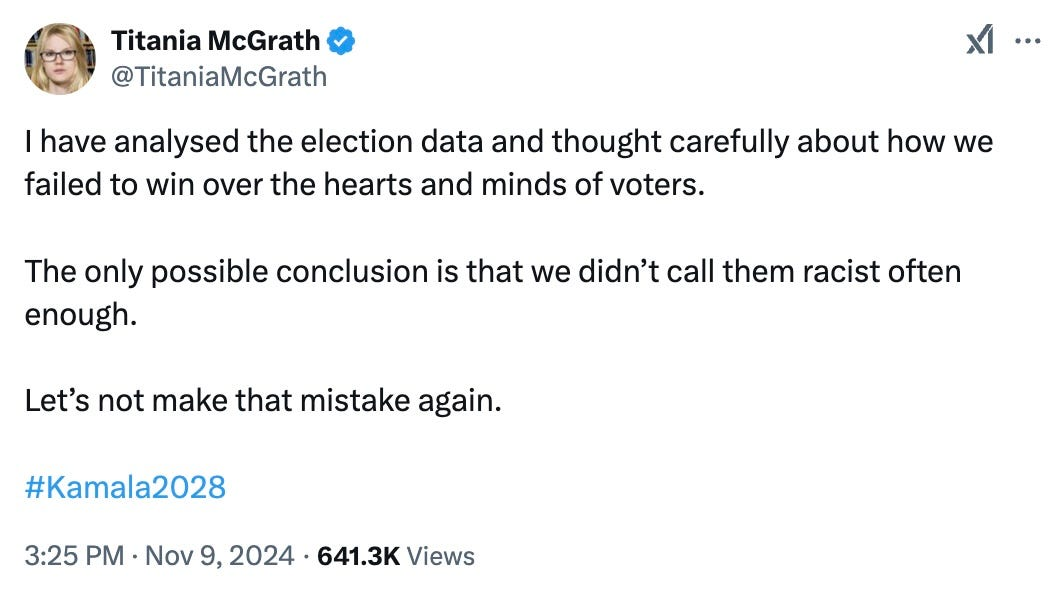
“The only possible conclusion is that we didn’t call them racist often enough”
Apparently there are still a lot of US politicians who think that letting men compete in womens’ sports is not only okay, but praiseworthy:
Of all the absurdities of the culture war, perhaps the most egregious is the normalisation of the idea that men should be able to identify their way into women’s sports. We are living through a period of mania, so we cannot clearly see how this will look to future generations. But I have little doubt that all those photographs of hulking men towering over women on winners’ podiums will be the memes of the future. “Can you believe they let this happen?” they’ll say, scratching their AI-enhanced cyborg heads.
Wherever one stands on Donald Trump, there can be little doubt that his imminent arrival at 1600 Pennsylvania Avenue will act as a corrective to this problem. Yesterday, the House of Representatives passed the Protection of Women and Girls in Sports Act with its goal of preventing males who identify as female from participating in school sports. If passed into law, schools that attempt to defy the ban would have their federal funds withheld. The bill was introduced by Republican representative Greg Steube of Florida, and makes clear that it will be a violation of federal law “for a recipient of Federal financial assistance who operates, sponsors, or facilitates an athletic program or activity to permit a person whose sex is male to participate in an athletic program or activity that is designated for women or girls”.
One of the most astonishing aspects of the passing of this bill was the voting outcome. 216 Republicans and only 2 Democrats (Vicente Gonzales and Henry Cueller) voted for the motion. Is it really that controversial that sex, as the bill puts it, “shall be recognized based solely on a person’s reproductive biology and genetics at birth”? You will recall the outcry back in November when Democratic politician Seth Moulton admitted that he objected to mixed-sex contact sports in schools. “I have two little girls,” he said, “I don’t want them getting run over on a playing field by a male or formerly male athlete. But as a Democrat, I’m supposed to be afraid to say that”. For this he was branded a “transphobe” and a “Nazi cooperator”, because we all know that one of the top priorities of the Third Reich was the preservation of women’s rights.
Moulton failed to retain his backbone for the latest vote (he called the bill “too extreme”), but his previous comment had been striking for its honesty. He was willing to openly state that fear was the key factor in the reticence of Democrats on this issue. It cannot be the case that only two Democratic members of the House take the view that there is no advantage in sports conferred by male puberty. Surely most of them must have glanced at a biology textbook from time to time. The charitable conclusion is that they have been browbeaten into voting ideologically, not that they genuinely don’t know that there exist anatomical differences between men and women.
Disturbingly, this vote would seem to suggest that the Democrats are not learning their lessons from the election, and instead are determined to double down on the very attitude that cost them the White House.
The allegations against author Neil Gaiman
I haven’t read the article in question, but it certainly looks ugly if even a few of the allegations turn out to be true:
New York magazine has just published a very long investigative piece on alleged sexual misconduct by the author Neil Gaiman, both contextualizing previously-known allegations and introducing new ones. Writer Lila Shapiro, who clearly did an awful lot of legwork, found several new women who allege various forms of bad sexual behavior against Gaiman. It’s all very serious and disturbing, obviously. I have nothing to contribute and no one cares what I think about such things, so we can leave that story there.
But I’m afraid that Shapiro’s piece does again force me to think about New York‘s story last year about Andrew Huberman. You could be forgiven for thinking “New York‘s SIMILAR story last year about Andrew Huberman,” but this would not be a correct characterization; where Gaiman is accused of many acts that, if true, rise to the level of sexual misconduct, including rape, the Huberman piece contains no such allegations. Huberman is accused of dating multiple women at the same time without the knowledge of all involved, of infidelity generally, and there’s a bizarre fixation on his regular tardiness. It is not a MeTooing piece. And the trouble, I’m afraid, is that the piece was written, edited, packaged, and promoted in a way that inevitably gave audiences the impression that such allegations were included — that Andrew Huberman had been MeToo’d.
The fact that the piece contains no allegations of that type, but seems to have been very deliberately associated by New York, its author Kerry Howley, the magazine’s social media channels, and their many media kaffeeklatsch allies with MeToo stories, was a terrible error in editorial judgment. The Gaiman story helps underline why: this shit is so serious that we can’t afford to play around with these types of narratives. The Rolling Stone University of Virginia gang rape fraternity initiation story, a narrative that fell apart under the barest scrutiny and should never have survived even an amateur journalistic investigation, did a lot of damage in our ongoing efforts to take sexual assault on campus seriously. There’s a higher bar to clear with this stuff for that reason, and the Huberman story utterly failed to clear it.
The story’s presentation in the magazine was draped with innuendo, with as many leading terms and dark implications as can be stuffed in. The image on the cover is styled and colored to make him look sinister. People associated with New York tweeted about the piece as if it was a nuclear bomb, using the kind of language that we’ve grown accustomed to when a MeToo story is published and kills a career. I would argue that the story is deliberately written in the slow-burn reveal style that is typically deployed in MeToo stories — that’s deployed, in fact, in the Gaiman story. (There it makes sense, because the slow burn leads to actual accusations.) At every opportunity, the story exaggerates the implication of a man who, yes, was a shithead to some women he dated. The article is forever presenting quotidian-if-unfortunate behaviors and acting as though we should interpret those behaviors as worthy of the kind of censure that has been brought to bear by men guilty of sexual misconduct in the MeToo era. “I experienced his rage,” says one of Huberman’s exes, suggesting some sort of domestic violence situation, when in fact that’s a reference to a verbal argument — again, maybe unfortunate, but simply not in the world of misconduct.
The magazine’s internal references to the piece, and their social media, played up the usual teasing manner of such publicity, broadly hinting at bad behavior in the realm of sex and romance. The repeated phrase used was “manipulative behavior, deceit, and numerous affairs”. I don’t need to tell you that many people, trained by six-plus years of reading about sexual misconduct, are going to assume that a vast cover story in one of the country’s biggest magazines about a man’s bad behavior and deceit towards his partners is going to be a MeToo story. As many would go on to say, the fanfare and length and publicity about the piece themselves implied that it was a MeTooing. After all, what else would justify that level of attention?
January 15, 2025
Is there anything climate change can’t do?
Seen on social media earlier this week:
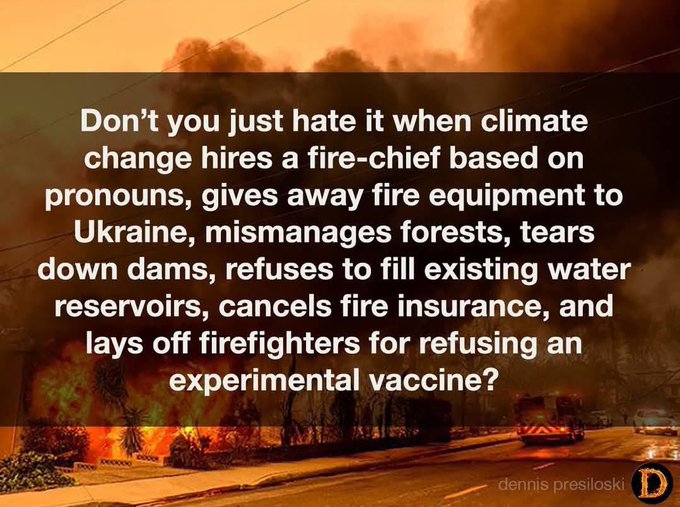
Confirming this, Chris Bray talks about current reporting on the wildfires in and around Los Angeles:
In his much-discussed piece on the Los Angeles fires at the Free Press, Leighton Woodhouse looks to Mike Davis for a narrative foundation. In his book Ecology of Fear, Woodhouse notes, Davis “argued that the area between the beach and the Santa Monica Mountains simply never should have been developed. No matter what measures we take to prevent it, those hills are going to burn, and the houses we erect upon them are only so much kindling.” Malibu and the Palisades, the land of hard living. That’s why so many rich and famous people lived there: because it was so inherently miserable and dangerous.
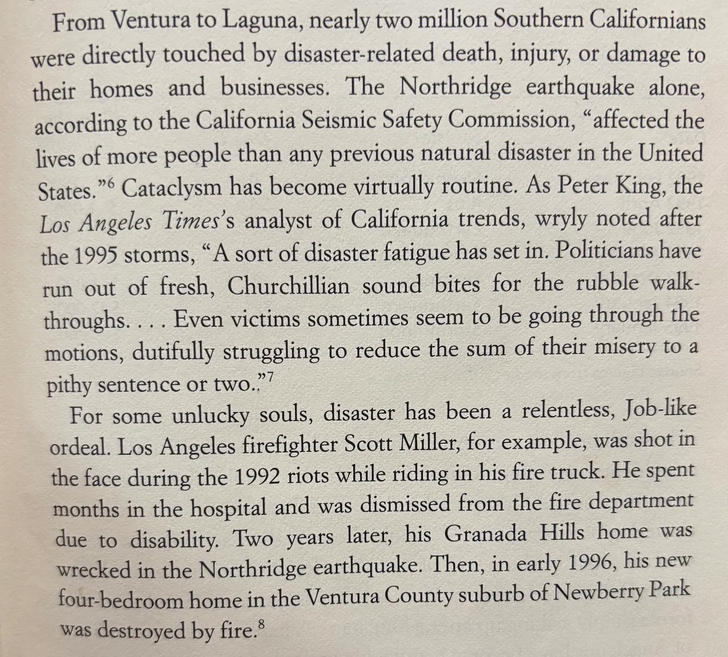
Mike Davis was full of shit for thirty years — he died in 2022 — and I’ve been rolling my eyes at him throughout. He described Los Angeles as an “apocalypse theme park”, a place of ruin and pain, populated by hardened survivors who, “dutifully struggling”, stagger on through the “Job-like ordeal” of clinging to a brutal landscape.
Also, Sierra Madre has bears. The Los Angeles suburbs are a place of horror and agony, because they back into the mountains, where blood-clawed wild animals prowl and stalk and slaughter. Places where life is especially grim and sanguinary, pgs. 240-41: Bradbury, La Crescenta, Glendora, the areas around the hellscape of Santa Barbara. A poodle was eaten by a mountain lion in Bradbury once, as neighbors gaped in open-jawed terror, YET STILL DO FOOLS ENDURE THE HORROR OF LIVING IN SUCH A PLACE.
Current real estate listings in Bradbury, a gated hillside community incorporated as an independent city in the San Gabriel Valley with a population of about 900 people:
How then would ye endure such horror, oh pilgrim, to live thus amid such blood and death? How bearest thou brutal existence upon this land?
Famously, in 1999, the Los Angeles Times, which used to be a newspaper, ran a long story examining Mike Davis and his vision of Southern California. It’s full of sentences like this:
- Los Angeles’ most provocative social critic has stretched, bent and broken more than a few facts in “Ecology of Fear,” his latest, darkly themed work on the urban area he claims to love.
- … more than a third of the time there were factual problems with his work.
- Davis concedes the error.
- Davis does not say where he got this piece of information.
- “I honestly don’t know what I’m referring to,” Davis said.
- Some of Davis’ mistakes involve mergers of fact and fiction, including making up a quote.
- Davis attributes the false quote to a mix-up.
- Then he takes readers on a partial flight of fantasy …
- An examination of the Malibu Times article shows that Davis made up the parts about the jewels, the hair color, the kayakers’ occupations, the evidence of their callous classism and the ethnicity of their maids.
- Davis is mischievously unrepentant.
- Davis also merges fact and literary fiction, without acknowledgment, while arguing that Pomona, like other older, outer suburbs, is dying.
And so on.
The Times concluded that Davis could be read as “a polemicist, who makes cogent, incisive arguments on big themes”, but not as “a historian who is expected to be reliable, even on details”.

German democracy continues to reel under continued pressure from Elon Musk
Wasn’t it just the other day that the progressive legacy media in the US were accusing Elon Musk of being Hitler? Apparently his day job(s) aren’t keeping him busy enough because the German progressive legacy media are singing the same song:
The Christmas holidays are over, the politicians and the media have awakened from their winter sleep, and Germany finds itself in the thick of an election campaign. Almost every day there is a new poll, and in almost every new poll, Alternative für Deutschland gets stronger. An Infratest dimap poll published on 9 January (survey conducted from 6–8 January) pegs them at 20%; a Forschungsgruppe Wahlen poll published on 10 January (survey conducted from 7–9 January) has them at 21%; and the latest INSA poll, published today (survey conducted from 6–10 January) places them at 22%:
For the centre-right CDU and CSU, the story is the opposite – one of a steady decline from the low- to mid-30s in December, to around 30% or just below in the latest surveys. The right-leaning vote overall is holding steady, at around 51%. Support is merely wandering from the acceptable Union parties behind the cordon sanitaire. Every day the establishment loses a few more seats; they vanish into the abyss of the Brandmauer, and the hurdles to the lusted-after CDU/CSU-Green coalition grow ever higher.
Some of this is surely down to the Musk Effect. Musk’s endorsement of the AfD and his conversation with Alice Weidel on Thursday (however much a disappointment I found it be) has surely normalised the party for a small but significant number of German voters. The media vilification of the American tycoon is as unbalanced and hysterical as it is unconvincing …
The latest cover of Stern magazine: “Attack on our election: Fake news, cyber warfare and rabble-rousing – this is how Elon Musk and Vladimir Putin are manipulating the German election.”
… and it comes all too late. Until December, Musk enjoyed mainstream credibility in Germany; our rulers eagerly celebrated his Gigafactory in Berlin-Brandenburg as a sign that all was not so terrible for German industry after all. They made Musk into a symbol for the carbon-free, electrical-vehicle future that awaits us all. It is hard to turn around in an instant and reconstruct the man as literally Hitler.


January 14, 2025
Andrew Sullivan on the “grooming gangs” scandal in Britain
These rape gangs have been operating for more than a decade in English towns and cities yet the government does everything it possibly can to avoid taking action, for fear of being accused of racism (or perhaps fear of what they’d discover if they did properly investigate) and losing all those Muslim votes:

The first response of most human beings to news of irredeemably evil acts is to ask who committed them. And if the answer makes us deeply uncomfortable, we tend to move on pronto. You see this most obviously on social media with news of an atrocity. Was the shooter white, a Democrat, a Republican, Muslim, MAGA, woke, trans? And where did the victim fit into these categories?
Our priors instantly color our moral judgment, and even our sense of the seriousness of the offense. And the temptation simply to deny what seems to be in front of our nose can be overwhelming.
[…]
The more intense the horror, the more powerful the instinct to doubt when you first hear of it. The sex-abuse scandal in my own church first numbed and incapacitated me. It took some time for me to see the totality of what had happened, and how deeply it had destroyed Catholic moral authority. Again, when I first read about, say, the Catholic school for deaf children where a priest had picked his victims among those whose parents did not know sign language, the feeling of horror was almost too much to process at all. And as with the Bush administration’s torture policy, it took even more time to grasp how this moral rot had been enabled by the very top.
This is why, I think, the scandal of Britain’s Pakistani rape-gangs, and the institutional negligence toward tens of thousands of underage victims over several years, has had a second burst of life. A serious national inquiry on the scandal was conducted years ago (its recommendations not yet implemented). But several towns with the worst records were omitted from that inquiry; and the sheer scale and depravity of what happened has finally begun to sink in. The precipitant was Elon Musk pontificating about the scandal on X, as part of his campaign to bring down Keir Starmer.
The details are hard to absorb. Think of the hideous abuse suffered by that extraordinary French woman, Gisèle Pelicot, sedated and raped by dozens of French men, organized by her husband. Now think of that kind of organized gang-bang — but make it close to ubiquitous in some towns and the victims under-age girls: raped, brutalized, mutilated, beaten, their lives destroyed. Yes, it was that bad. Tens of thousands of rape victims across the country. This is how one British judge addressed some culprits at sentencing:
You coerced her into providing sex to vast numbers of strangers. Up to four or five men would be invited to addresses so they could have sex with her … Threats were made to kill her … If she resisted, she would be coerced. Customers would become angry … If oral sex was required, her head would be pushed down, her hair pulled and she would be slapped. Strangers would burn her with cigarettes. A stranger almost throttled her. One deliberately scratched her vagina with his nails. One inserted a hairbrush into her vagina.
The victim was just 13 years old. And she wasn’t unconscious. In just one town, a “conservative estimate is that approximately 1,400 children were sexually exploited” between 1997 and 2013. And in communities dominated by men of Pakistani origin, largely from the Mirpuri region of Kashmir, who held huge sway over the police and local community — just like the Catholic Church in Boston — cover-ups were routine.
Among the abuse concealed: gang-rapes of a single minor by 20 men; putting a pump into a girl’s anus so more men could penetrate her at once; and constant threats of murder of the girls or their families if anyone spoke up. In one case, a minor was arrested and charged with prostitution for having oral sex in a car with a john. When she attended her trial, she discovered that the magistrate in charge of her case was the man she’d fellated. No one knows the full number of minor girls affected, but it is in at least the tens of thousands, and possibly in the six figures.
Why was this allowed to go on for so long? For the same reason the Catholic Church covered up child rape for decades, and Dick Cheney covered up torture. Because the orthodoxies of Catholicism, of the American military, and, in this case, the multicultural experiment were respectively involved. These orthodoxies were sacred, their cultural power extreme. Catholic Boston, conservative America, and elite liberal Britain therefore defended their own orthodoxies for a very long time. And with every successful deflection of responsibility, the number of victims increased.
The truth damns the multicultural project in Britain. Rather than integrating these men of Pakistani heritage, insisting that they adopt the laws and mores of the native population, and treating them like everyone else, the UK elites celebrated cultural difference, enabled the siloing of these populations, bemoaned their own white working-class populations, and forbade any criticism of Islam. So if you called out this stuff, you were instantly called racist. After all, to accuse a non-white minority of raping white girls was a trope right out of white-supremacist fever dreams. And yes, it is a hideous racist trope — from the depths of the American South. But sometimes the trope is the truth.
In all the major cases, I’ve found no reported evidence of Pakistani or Muslim girls being groomed and raped — only poor, white natives. The justification among the rapists, moreover, was that these non-Muslims were sluts who were asking for it and beneath contempt. Racist insults were common as these girls were brutally abused. These were not just rapes, but hate crimes of a grisly sort.
The deliberate enshittification business plan of every “tech” company
It may be hard to believe, but once upon a time we actually used to look forward to new technology releases and updated software. I know, I know, that’s asking you to believe fairy tales in our current “enshittification-as-a-service” technology dystopia. The Bone Writer — who worked in the same tech field that I once did — clearly understands why the promise of new technology has turned so negative:

Dead technology. Not because they’re broken, but because they’re no longer supported and THEREFORE no longer work.
I was straightening some stuff/junk up and came upon a pile of my e-Waste. It’s a damn shame that electronics devices are a planned obsolesce when they shouldn’t be. Especially the tablets and e-readers that would still work if the mothership, the corpo HQ, the evil Tech Bros, actually cared about their customers at all.
Do we need legislation that offers up some sort of tax write off incentive to get companies to support their shit for at least 10 years? I know what you’re saying … “That’s not a free market economy.” Yeah … well … The tech sector broke the free market economy a long time ago and now they actively hurt everyone with their greed and drive to force people into what comes next, every month to 3 months to 1 year.
That’s another reason prices never come down on tech stuff. They put out something new monthly to yearly, with just a small addition to the software or the design. Then they push it on people as if it is the BEST thing there ever was, creating FOMO. Then, some people will upgrade with every new device or software version sold.
[…]
Agile is the Devil’s Tool for Creating More Waste
Agile is the method that is used to push new software and updates out continuously. Get those updates out there and keep that device or software looking shiny but hold back the good stuff for the next big release. Even though the current iteration can likely support the next big release, we’re not going to do that. This way we can sell more shit to people and they will have FOMO so they will buy it up. Even though, the next big release isn’t all that great anyway… They consumer will eat it up.
Recycle It
The activist techies will just say, “Go ahead and recycle the old stuff.” As if it really gets recycled. More often than not (only 10% of recycled stuff actually gets recycled), it gets buried or sent to other countries to be disassembled and buried there, out of site. Both the tech sector and fashion industry are guilty of this. Meanwhile, YOU are told that if you recycle, you are doing your part to clean up the world, when you’re really just sending stuff elsewhere to pollute a third world country. Sleep easy though, it isn’t in YOUR backyard.
January 13, 2025
Muttering something about “manifest destiny” while glancing north
The Line‘s weekly dispatch is, as usual, mostly behind the paywall but the portion visible to cheapskates contains much of interest:
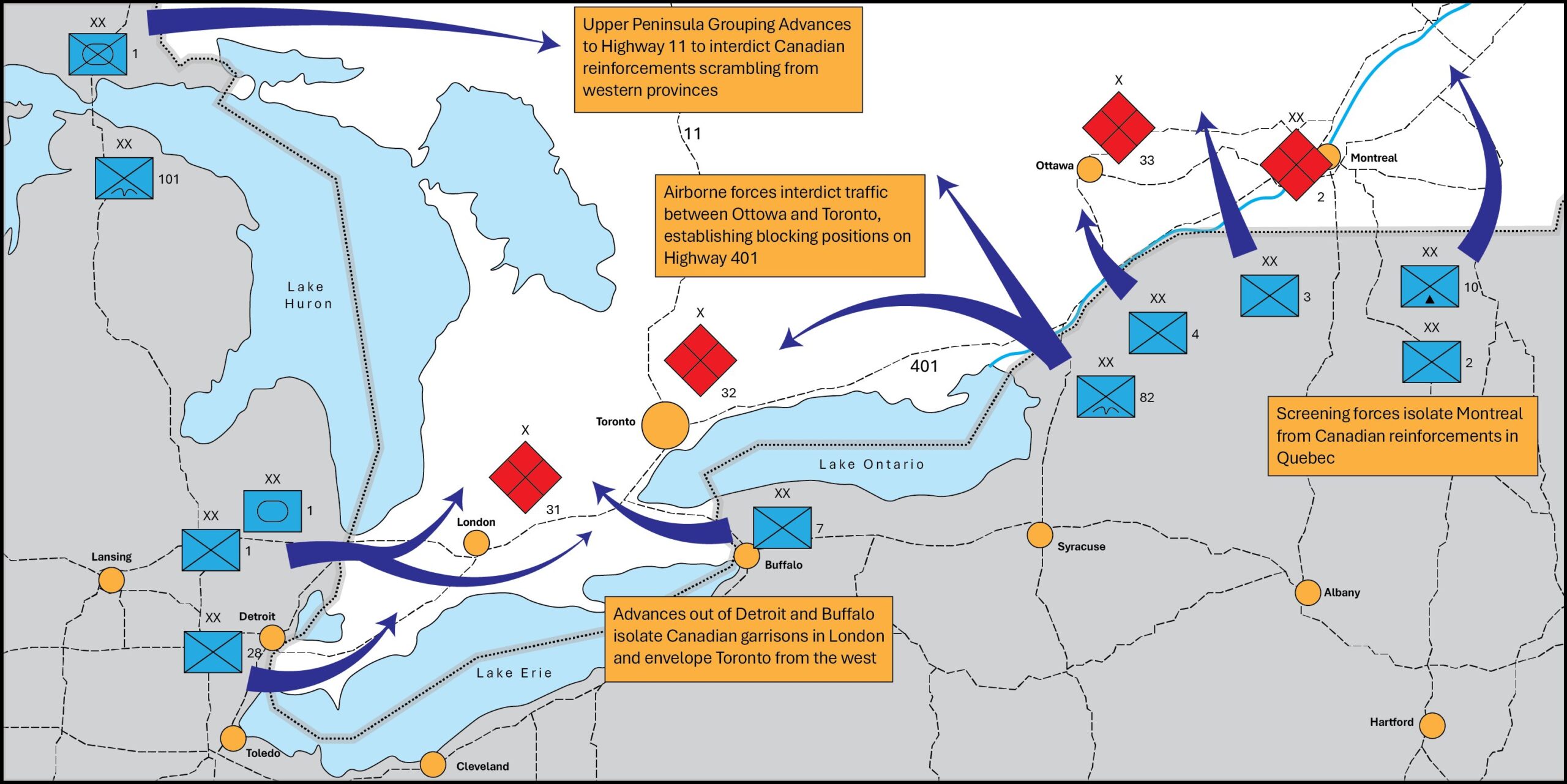
Manifest Destiny, 2025? Big Serge’s updated map for the old US War Plan Red for a military invasion of Canada.
It’s no coincidence that as Canada’s leadership devolved into its own navel, the very-soon-to-be-inaugurated Donald Trump escalated his provocations. This week, Trump threatened to use “economic force” to push Canada to bend the knee. Meanwhile, we cannot help but notice that the idea of a Canadian state is starting to gain significant traction in even moderate and mainstream American conservative circles. Meanwhile, we’ve got Alberta Premier Danielle Smith supping with Kevin O’Leary and Jordan Peterson down in Mar-a-Lago.
Tap tap. May we suggest that you peruse the safety cards tucked into the back of your seat, buckle up, and take note of your nearest emergency exits?
Whether we are talking about some kind of economic union, or a full-blown annexation, the fact that at least some in America are reviving the term “Manifest Destiny” is a possibility that we can no longer afford to dismiss as mere trolling. While we hope that the Trump administration is going to be so bogged down with other policy priorities that “Canada 51” is soon overshadowed, your Line editors have been game theorying out a host of possible scenarios and … none of them look great. If Trump et al get serious about this idea — and, again, we have no way to know if they will get serious about this idea — then we at The Line fear that Canada is in for some serious turmoil in the coming few months.
As I said in an email to Severian the other week, “… Canada will have very little ability to react to whatever Hitler, er, I mean “Trump” will do as soon as he’s inaugurated. It was clear before this that Trudeau cared very little about ordinary Canadians’ lives, but this really is dereliction of duty on a cosmic scale. If Trump does follow through with that huge tariff, the Canadian economy is likely to collapse, as we’re so deeply intertwined with the US on so many levels. Sadly, this might make it even more attractive to Trump, as it would absolutely encourager les autres on a global scale. If the BOM is willing to destroy the economy of his closest trading partner, what might he do to France? Or Germany? Or South Korea?” Back to the dispatch:
To explain our alarm, let’s first look at another news item to cross the desk. This week, Justin Trudeau travelled south to attend the funeral of Jimmy Carter, and stopped at the CNN studios for a quick interview with Jake Tapper on the way through.
On the whole, we think his interview was fine. Look, Trudeau’s been through a lot in the last few days, and considering the circumstances, it’s not reasonable to expect a breakthrough performance. So we’re being a bit unkind to nitpick, but something he said during that interview deserves scrutiny.

Justin Trudeau got far too comfortable with being treated as a progressive superstar, not only among the sycophants with CBC nametags but even on the international stage … perhaps especially on the international stage. Trudeau was always inclined to the performative in everything he did, and he might well only feel fully alive when cameras are rolling. The evidence certainly seems to point in that direction.
The “most prolific Canadian actor” meme was mildly amusing during Trudeau’s first term in office, as he went out of his way to put on elaborate costumes and to perform for the audience. This sort of thing was understandable if not particularly welcome to those who wanted Canada to be taken seriously by our allies and trading partners. It was clichéd to joke about what novelty socks Trudeau was wearing at any given international event … because it was his trademark. As was the clearly diminished respect he got as his time in office went on.
When asked about Trump’s provocations, Trudeau affirmed Canadians’ pride in their own sovereignty by noting — half jokingly, we presume — that we fundamentally define ourselves as “not American”.
Firstly, this is not a particularly diplomatic jibe to be launched at actual ordinary Americans; it made us wince to consider how it must have landed to CNN’s ordinary watching audience.
Secondly, if the only way in which Canadians can define themselves nowadays is “not-American”, Jeez, that’s an extraordinarily thin peg upon which to hang a hat.
This stuff matters.
It is to wince. However, even that pathetic response was better than launching into yet another diatribe about Trudeau’s firm conviction that Canadians are all genocidal white supremacist morons, I guess.
The ability of a population to withstand neighbourly aggression — “economic force”, if you will — depends on two things. The first is internal social cohesion and identity. The second is what the aggressor is willing to do or offer in order to secure capitulation.
In this case, the second part of that equation is outside our control. So we look to the first: does Canada have a strong sense of self right now? Do its leaders command the moral authority necessary to create the social cohesion required to withstand a period of sustained material sacrifice?
If we are “not Americans”, it rather asks the question why aren’t we Americans? And, more crucially, what are we actually willing to give up in order to preserve that independence?
A people can be rallied to make extraordinary sacrifices for a greater ideal, including the ideal of independent nationhood. Look at the sacrifices of blood and treasure made every day in Ukraine, for example.
If necessary, Canadians can band together and survive on lentils and supply managed dairy and eggs for many months or years. We can pull together through a period of inconceivable material hardship — but only if we’re doing it for something. Canadians, as per usual, can talk a big game, but how many of us are willing to suffer a real collapse of our quality of life to preserve a quasi-ironic, tautological, or negative self-identity?
Before Trudeau’s time in office, I wouldn’t have thought to question Canadians’ pride in their country and willingness to defend it. Nearly ten years later, Trudeau and his minions have done a fantastic job of undermining any kind of patriotic enthusiasms in our “post-national state”, haven’t they?
We at The Line don’t believe there is even a vanishingly small chance of the Americans using martial force to secure Canada — and if they choose to amass a brigade at the border on Monday morning, we’re all taking the Pledge of Allegiance by noon, so let’s not grace this fantasy with a lot of real consideration.
I’d love to refute that, but it’s probably true, at least in the more densely populated areas of southern Canada … the US could send a brigade north to Vancouver, another to Calgary, another to Winnipeg, and one to Montreal. Thanks to the lower lakes, it’d take a bit more to secure Toronto and Ottawa but not a lot more. We literally couldn’t stop them, both because our very limited troops are not positioned to stop an invasion from the south and because they’re not even close to being in a ready-to-move condition. Even our local reserves would have to be notified, travel to their local armouries, be issued weapons and the very limited amount of ammunition kept in local storage and by the time they were ready, there’s a foreign flag waving over Queen’s Park and Parliament hill.
Big Serge’s map at the top of this post vastly overstates the number of US troops necessary to secure the major population areas.
However, it is worthwhile to imagine it as a pure thought experiment: what would you really be willing to give up in order to continue to be “not-American”.
Your investment savings? Your property? Your house? Would you sacrifice the life of your child, or your grandchild, to preserve the legal independence of Canada?
We ask this question not because we think it’s going to come to that, but rather because these questions test the integrity of our national concept. They allow us to examine our resilience, and our willingness to withstand an assault of an economic or moral nature. And, folks, we’re just not convinced that our national resilience is very high at the moment.
Well, I’m sure a lot of new Canadians would want the rest of us to defend the place while they take advantage of all the government and corporate positions that need to be “diversified” … surely us evil white supremacists are willing to lay it all on the line for a more diverse society, right?
It was interesting to us to note, this week, that the most powerful moral appeal for the concept of nationhood was proposed in a Globe and Mail oped by Jean Chrétien. While we salute the old patriot, we can’t help but point out that he’s, well, very old — 91, to be precise.
We at The Line have a sneaking suspicion that Canadian patriotism and, more importantly, a willingness to make serious sacrifices to preserve that patriotism, is going to decline precipitously by age cohort in any well-constructed survey of the topic.
Would the young fight to preserve Canada against the Russians or the Chinese? Yes, we think our fellow Canadians could absolutely be called upon to make serious sacrifices to circumvent the rule of autocrats and dictators. But to prevent being subsumed by the — checks notes — wealthiest and most powerful democratic nation on earth (presuming America stays that way)? A nation that shares almost all of our essential values; one that looks and sounds just like us, and would probably provide a better set of opportunities to our kids? The place an increasing number of us are going to do start business and receive timely medical care?
Why?
Why would we do that? Can someone — anyone — please articulate a vision, here? Is anyone in our leadership class even trying?
It’s been noted many times that people are willing to charge even bare-handed into machine guns and cannons for things like “Liberté, égalité, fraternité“, but nobody is going to man the ramparts for “peace and good government”.
We put a lot of the blame for this on Justin Trudeau, and on the identitarian politics that consciously sought to undermine national legitimacy in the pursuit of progressive ends. But, if we’re being honest, we think this complacency of identity predates these social movements by many decades.
The Liberal Party as an institution owns a lot of it for the ways in which the “Natural Governing Party” has tied national identity to its preferred partisan policy options, at the direct expense of more transcendental and bi-partisan national self concepts. The Liberals have usurped “Canada” into a party brand
The national flag is effectively the Liberal Party flag … thanks Mr. Pearson!
and marshalled the very concept of “patriotism” to build consensus for picayune material entitlements. Trudeau couldn’t even help but do this in his CNN interview with Jake Tapper this week: “We delivered $10-a-day childcare. We’re delivering a dental care program that provides free dental care for people who don’t have coverage. We’re moving forward on a price on pollution that puts more money in the pockets of eight out 10 Canadians.”
We suppose Trudeau found that argument very compelling argument to Americans marvelling at Canada’s inability to meet its basic NATO commitments.
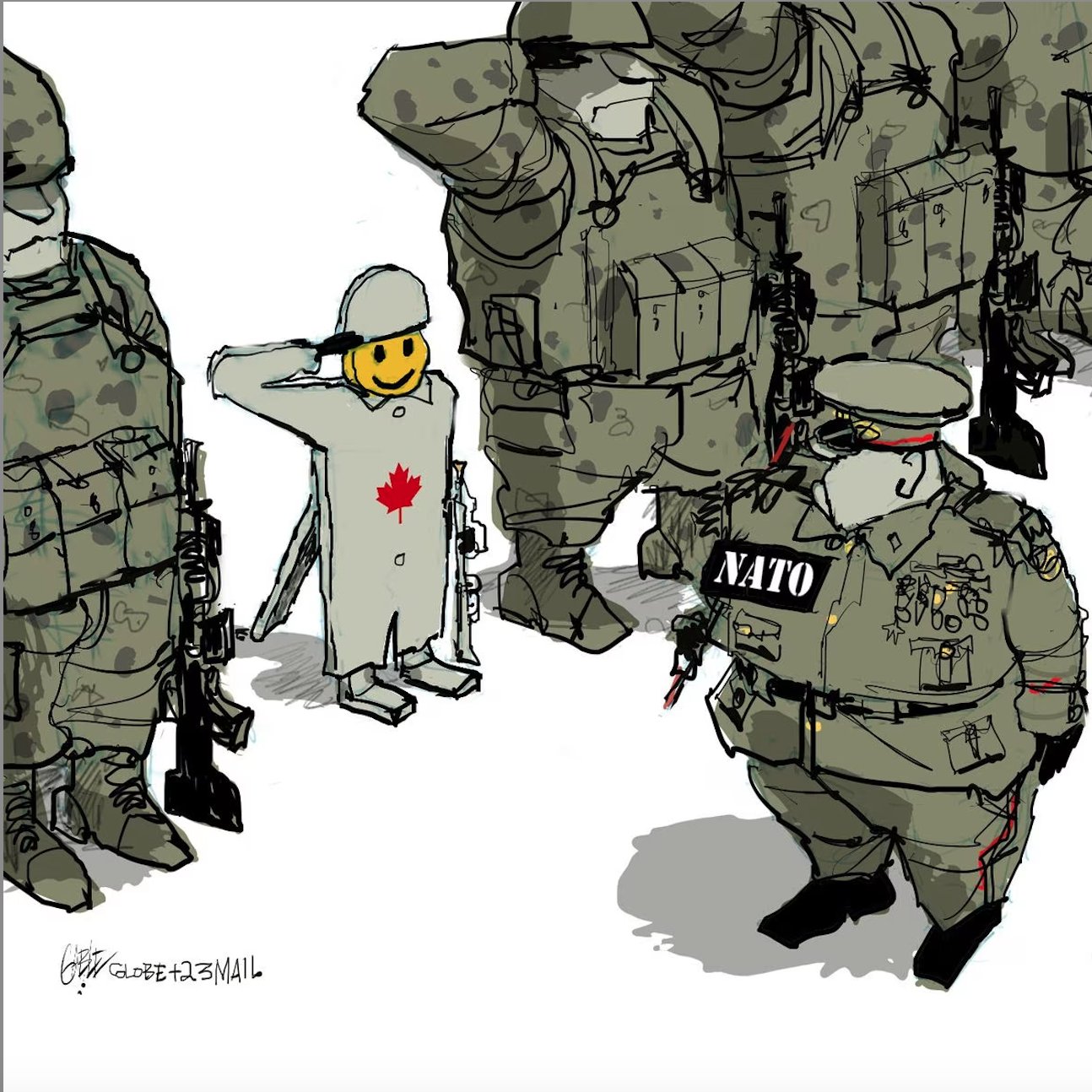
The weird thing is that Trudeau could have deflected a lot of these criticisms by our NATO allies almost painlessly without spending any more money directly on the Canadian Armed Forces — “It’s well known that Justin Trudeau has no time for military issues, but it’s surprising that he hasn’t done a few things that wouldn’t increase the actual spending on the CAF, but would be “bookkeeping” changes that would shift some existing government spending into the military category, like militarizing the Canadian Coast Guard. (That is, moving the CCG from the Fisheries and Oceans portfolio into the National Defence portfolio, not actually putting armaments on CCG vessels. Something similar could be done with the RCMP, switching it from Public Safety to National Defence with no other funding or operational changes.) That Trudeau hasn’t chosen to make even these symbolic changes shows that he actively opposes fulfilling the commitment his government has made twice in the last ten years for reasons of his own.”
This tactic has been very electorally effective for the Liberals, no doubt, but it’s also reduced the idea of “Canada” to a smug transactional exchange. “Canada” as nothing more than what provinces and citizens can wheedle out of the commonweal in transfer payments, equalization cheques, and grandiose but poorly executed national program spending. At least we’re better than America, though, right? We’re “not American!” — we’re so much more thoughtful and compassionate, as evidenced by the entitlements we’ve voted for ourselves, secure in the knowledge that the troglodytes to the south will spend and bleed and die for our coddled asses if Russia lobs a missile from the North.
Canada has become a question of what we, citizens, are able to get, rather than one of what we’re willing to give. And we’re smarmy, preachy assholes about it, to boot. (There’s a very famous political quote we could drop in here about what citizens can do for their countries and vice versa, but you’ll know why we aren’t, if you can guess the quote! It would be a little on the nose.)
A nation that is unwilling to make serious sacrifices of blood and treasure to protect its own sovereignty is a nation that is going to cease to be a nation sooner or later — and if we judge Canada by its commitment to its military, ours is a nation that has regarded itself as a quasi-ironic post-modern punchline for many generations now.
January 11, 2025
Euphemizing organized gang rapes of children as “grooming” won’t work much longer
It’s possible that the current upswell of anger about the decade-long cover-up of organized child rape gangs in English towns and cities may come to nothing … or it could result in a complete breakdown of law and order:
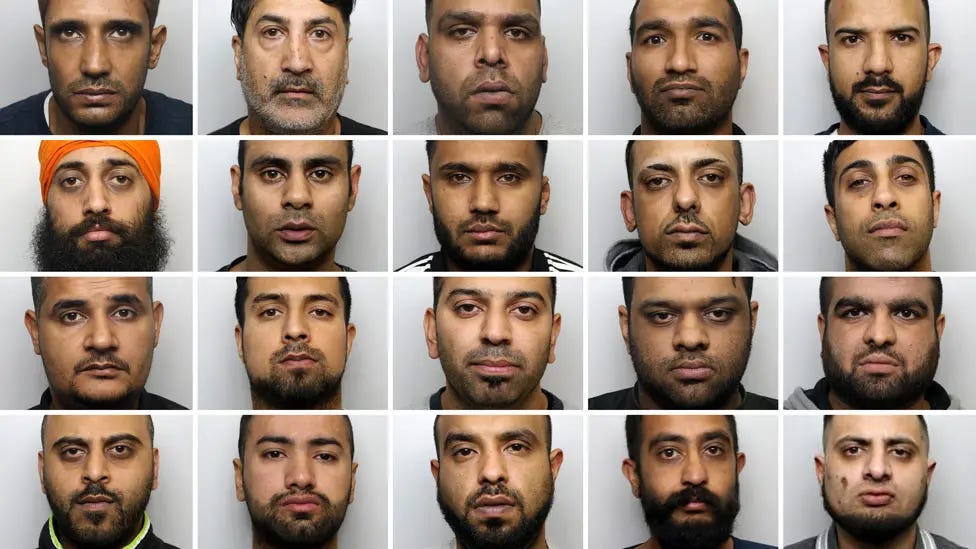
Like professional basketball, those accused of being members of “grooming gangs” tend to be monocultural.
The grooming gang thing has really blown up in the past couple of weeks. I’m not sure wholly why myself but a couple of guesses.
One is that the media really couldn’t report all that much — and for the same reason that Tommy Robinson got jailed one time around. Because there have been multiple ongoing cases and full reporting of one could — and probably would too — prejudice a jury in subsequent cases. So, those ongoing cases mean that the subject is more or less sub judice and can’t, in volume or detail, be talked about.
Thus things like Guardian reporting. Where you get the news that a gang has been tried, found guilty, sent off to jail. And no comment on who they were. Well, except for a list of names all of which are, shall we say, less than Anglo Saxon or even Viking in origin. We all draw our own conclusions at that point.
[…]
The number of abused — which means children raped, recall, arses blown up with pumps so that adult dicks can multiply penetrate to be detailed — starts to be counted up into the thousands. The tens of thousands perhaps.
There’s a point there at which I don’t think that normal societal agreement to allow the authorities to handle things works any more. At some point along that spectrum then significant civil violence breaks out.
Which brings me to the two questions. What is that number which, when known, leads to actual riots? And no, I don’t mean 15 meatheads lobbing half bricks at the police. Actual real and sustained loss of civilian authority control. The second, obviously, is are we going to reach that number?
In short, what is the level of betrayal of these girls that leaves the mob triumphant over law and order?
What really worries me is that I have a horrible — even if still slight at this point — suspicion that there was enough vileness done to enough young girls that we’re going to find out.
On Substack, Francis Turner shares concerns about the mass rapes of children and young women over too many years:
The scandal has been going on for at least 25 years and probably a decade more. That means that every year around 1000 new girls have been gang raped by the gangs.
Every year around 1000 new girls have been gang raped by the gangs
There are roughly 300,000 girls of each year cohort in the UK so that means one in around 300 girls of any age group has been gang-raped. Given that there are large chunks of the UK which are not places where the ~50 identified rape gangs have operated and indeed are places without residents of the relevant ethnicity (primarily Pakistani and Somali in a couple of cases) that means that the number goes way up in those areas. It seems likely that in one those 50 areas the ratio of new victims to their year group is more like 1 in 100 or 1%, especially when you remove the Pakistani girls that probably weren’t targeted even if some of them were in fact abused at home.
In places like Telford if you see a school year group photo for any year in a Comprehensive school in the last 30+ years at least one of the girls in that photo was being gang-raped
If successful steps had been taken in ~2010 to stop the abuse then about 15,000 girls would not have been gang-raped.
The Tory party and civil service disgust of Tommy Robinson has had the result that about 5000 girls were gang raped between when Tommy Robinson started going about the issue in around 2018 and 2023 when Sunak finally set up the national Grooming Gangs Taskforce.
If Substack would let me do a table this would be easier. However here is a summary of girls gang-raped under the prime ministers of this century based on a simple linear model
Starmer: 500 (to date)
Sunak: 1700
Truss: <100
Johnson: 3000+
May: 3000
Cameron: 6000+
Brown: 3000-
Blair: 10,000Probably half of Blair’s 10,000 was before anyone was aware that this was a systemic problem, but it was known to be a potential problem by at least 2004 when
[a] Channel 4 documentary about claims young white girls in Bradford were being groomed for sex by Asian abusers is delayed as police forces warn it could inflame racial tensions. It was finally shown three months later.
If the UK had got serious about stopping grooming gangs back in 2004 then over half of the gang rape victims could have been saved from such a terrible experience.
Take that 35,000 number a different way. There are roughly 35 million women in the UK. So one in a 1000 women in the UK have been gang-raped over the decades.


