Quotulatiousness

April 30, 2011

The Toronto Sun goes full gonzo on Jack Layton

Filed under: Cancon, Media, Politics — Tags: , , , — Nicholas @ 11:52

In an earlier post, I was wondering if the mainstream media was going to give Jack Layton and the NDP the same kind of coverage that they had been devoting to the Liberal and Conservative campaigns. Instead of doing the same thing, one of Toronto’s newspapers decided to channel their British tabloid counterparts:

Jack Layton was found laying naked on a bed by Toronto Police at a suspected Chinatown bawdy house in 1996, a retired Toronto police officer told the Toronto Sun.

The stunning revelation about the current leader of the New Democratic Party comes days before the federal election at a time when his popularity is soaring.

When the policeman and his partner walked into a second-floor room at the Toronto massage parlour, they saw an attractive 5-foot-10 Asian woman who was in her mid-20s and the married, then-Metro councillor, lying on his back in bed.

Layton was cautioned by police and released without being charged.

So no crime was committed, no charges were laid, and it happened in 1996. Perfect time to pull it out at the very end of an election campaign.

“When police decide they need to make an arrest, he said, they find a way to make an arrest”

Filed under: Cancon, Law, Media — Tags: , , , , , — Nicholas @ 11:38

Not the finest day in Albertan justice:

Charges have been dropped against three Alberta men accused of shooting dead a pregnant wild horse and tossing its body down a hillside. For more than a year, the RCMP and the Crown were sure they had the right guys. They even charged the then-12-year-old son of Jason Nixon, one of the accused. But then, just as the trial began, the defence produced an important piece of exculpatory evidence: The horse hadn’t been shot.

The Mounties had assumed it had been. They were operating on a tip from a man named Dave Goertz. Mr. Goertz, as everyone involved in the case knew, was a crackhead and a meth addict. He reported the crime after a local group that defends Alberta’s wild horse population posted a $25,000 reward.

[. . .]

Apparently, the word of a drug addict was enough for the guardians of our justice system to arrest three innocent men and run them all the way to trial, costing them their jobs, a small fortune and untold grief.

[. . .]

The horse had been badly decomposed, apparently, by the time police found it, so determining whether it had been shot wasn’t possible. And yet, lacking critical evidence, the province proceeded with its prosecution for wilfully killing and careless use of a firearm. The three men faced a maximum of five years in prison.

This kind of thing, said defence lawyer Willie deWit, “is what happens in our system a lot of times.” When police decide they need to make an arrest, he said, they find a way to make an arrest. They ignore anything that might exculpate the accused, and seize on anything that feeds their assumptions of guilt.

April 29, 2011

QotD: The NFL draft is “The Oscars for Straight Men”

Filed under: Football, Humour, Media, Quotations — Tags: , — Nicholas @ 13:59

Some comedian once called the NFL Draft “The Oscars for Straight Men,” and there is something to that label. While everyone will “grade” the teams’ drafts, and fans will argue and kibitz about who their team should have drafted, there are no definitive winners or losers. One of the more ridiculous aspects of the day is how every team claims to have gotten the players they wanted or rated highest. Just once, it would be thrilling to hear a general manager come out and say, “Look, we know he’s a reach, but all of the guys we rated highest were picked already, the coach and head scout got into a screaming match, the clock was ticking down and so I flipped a coin. Knowing his pain-in-the-tush agent, he’s probably going to hold out most of training camp, anyway.”

Jim Geraghty, “Why Is the Draft So Engrossing to NFL Fans?”, National Review, 2011-04-29

NDP surge extremely taxing for . . . NDP candidates?

Filed under: Cancon, Media, Politics — Tags: , , , , , , , — Nicholas @ 11:35

I’ve worked on political campaigns for minor party candidates (provincial and federal Libertarians) who had to keep their campaigning to the weekend and after-work slots because they still had to earn a living during the election. I find it hard to believe that so many candidates for a “major” party are running part-time candidacies:

There’s a standard-bearer in Quebec who went on a Las Vegas vacation for a week because she didn’t want to lose her deposit. She also reportedly spoke French so poorly that a local radio station had to scotch an interview rather than air the exchange. Another candidate went to the Caribbean and one travelled to France. There’s a Toronto candidate who has not campaigned at all, can’t be reached, and, judging by a Toronto Star report, quite possibly is an apparition. There are all kinds of students who, presumably, did not have the pesky constraints of full-time work that weighed down Mr. Larkin.

None of these things are unusual — third-place parties usually have a fair bit of cannon fodder — but it is unusual for anyone to be asking about them. And that’s what’s happening to the NDP. People are asking about them, and about the party and its platform, far more than they were last month, or even early last week.

It’s what naturally happens when an also-ran finds itself suddenly very much in the running. The key question for the NDP is: Can it manage four days of impromptu scrutiny?

That will depend on how the traditionally Liberal media handles this unexpected surge from the left: they know how to find awkward quotes and disreputable connections for candidates on the right, but generally have treated leftists with a faint air of “isn’t that cute?” rather than as serious campaigners. Can they apply the same standards in a mirror image?

It’s possible that they will give Jack Layton a much rougher ride than they have so far:

Jack Layton himself is also now facing a different sort of question about his own policies from reporters travelling with him. He was asked on Thursday about how his platform, which calls for a price on carbon, would affect gasoline prices. One analysis says the NDP plan would add 10¢ a litre at the pumps. Mr. Layton insisted that an ombudsman would be able to keep oil companies from raising prices for consumers, but he disagreed that he was proposing to regulate gasoline prices. Reporters described the exchange, which included questions about the AWOL candidates, as “testy” and “heated,” which has been rare for the NDP leader thus far. And testy exchanges lead to stories about how a leader is “on the defensive” or “responding to critics.” Eventually they can become “embattled.” (In the case of Mr. Ignatieff, a report on Thursday referred to him as “beleaguered.”)

“Tone matters,” explains Prof. Matthews. “People do respond to the media. Not everyone, of course, not the partisans and not the people who aren’t paying any attention, but there are people who take their cues from the coverage.”

Update: Publius points out that the situation could be at least as good as last season’s CBC offerings:

Everyone has been stunned by the NDP surge. The newly minted Sun News has started calling it an “Orange Crush,” which is a gross insult to a fine fizzy beverage. No one has been more surprised than the NDP. For years the party has run non-entity place holders in most ridings, as they did this time around. One of them is a Quebec barmaid who took a vacation mid-campaign, which says everything you need to know about the NDPs organization in Quebec. Now some of those ridings are competitive. We could have MPs in the next Parliament that were “accidentally” elected. There’s a sitcom in there somewhere.

April 27, 2011

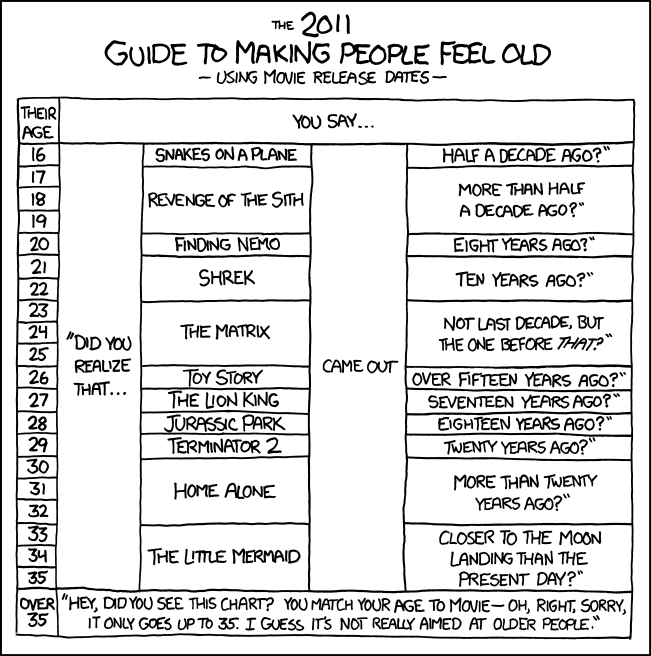
The xkcd Guide to Making People Feel Old

Filed under: Humour, Media — Tags: , — Nicholas @ 07:32

xkcd Guide to Making People Feel Old
Original here.

High computer use linked to “smoking, drunkenness, non-use of seatbelts, cannabis and illicit drug use, and unprotected sex”

Filed under: Cancon, Health, Media, Technology — Tags: , , , — Nicholas @ 07:20

Talk about upsetting the stereotype of basement dwelling, dateless nerds:

The revelations come in research conducted lately in Canada among 10 to 16-year-olds by epidemiology PhD candidate Valerie Carson.

“This research is based on social cognitive theory, which suggests that seeing people engaged in a behaviour is a way of learning that behaviour,” explains Carson. “Since adolescents are exposed to considerable screen time — over 4.5 hours on average each day — they’re constantly seeing images of behaviours they can then potentially adopt.”

Apparently the study found that high computer use was associated with approximately 50 per cent increased engagement with “smoking, drunkenness, non-use of seatbelts, cannabis and illicit drug use, and unprotected sex”. High television use was also associated with a modestly increased engagement in these activities.

According to Ms Carson this is because TV is much more effectively controlled and censored in order to prevent impressionable youths seeing people puffing tabs or jazz cigarettes while indulging in unprotected sex etc. The driving without seatbelts thing seems a bit odd until one reflects that old episodes of the The Professionals, the Rockford Files etc are no doubt torrent favourites.

April 26, 2011

Archaeology as a form of collectivism

Filed under: Americas, History, Media — Tags: , , , , , — Nicholas @ 09:19

L. Neil Smith was watching an old archaeology show on Netflix the other day:

What this otherwise interesting and enjoyable documentary on the early Mayans whined about — even more than Third World agricultural techniques — was the fact that descendants of these ancient people were venturing out in the thulies without government approval or, more importantly, academic sanction, finding pyramids and other structures abandoned by their ancestors before tenured treasure-hunters could, burrowing into them and laying claim to their inheritance, which they then used to supplement the crappy income that comes of subsistence farming.

These people were constantly referred to as “looters” by the documentary’s writers and the featured academics, who, unbelievably, begrudge them — and their hungry children — what Indiana Jones’ girlfriend Marian Ravenwood accurately called “little bits of junk”, a phrase that I firmly believe should be tattooed across every academic archaeologist’s torso simply to remind him of the proper priorities in life.

Backwards, so he can see it in the bathroom mirror.

Or upside-down, across his stomach.

Robert Bakker of hotblooded dinosaur fame has criticized proposed laws that make amateur paleontology a crime, pointing out that most good finds begin with non-professionals stumbling across interesting new materials. Unfortunately, many such laws are already in place for archaeology, with government, in effect, preclaiming everything under the topsoil before it’s discovered, a clear-cut case of underground Marxism.

You often hear supporters of such laws snort, “That ought to be in a museum!” when they spot some desirable something on a collector’s mantlepiece. But isn’t it infinitely better off there, than hidden in a museum basement where most “nationalized” artifacts and fossils end up? And given the miserable track record socialism has earned in every other field of human endeavor, isn’t it socialists who belong in a museum?

Believe me when I attest that archaeology is important to me for many reasons and has been since I was about five years old. Much like paleontology, it tells us where we are by showing us where we’ve been. Sometimes it explains how we got this way and warns us of mistakes we shouldn’t make again. And it’s just plain splendiferously mysterious and interesting — like an old adventure radio serial. My very lovely and talented wife is preparing herself even now for a second career in archaeology. She’d like to be curator of a private museum in the Southwest.

What fun we’re going to have!

But not only is there nothing under the ground worth depriving some poor farmer’s family of a meal, of arresting, jailing, possibly killing him over, there is yet another extremely important ethical consideration.

Or two.

What, precisely, is the moral distinction between a pot-hunting farmer, on the one hand, digging into a hill and extracting something for profit that will improve his life and the lives of his kids, and a college professor, on the other hand, from some faraway country, doing exactly the same thing for profit in the form of tenure and scientific prestige?

April 25, 2011

LM Bujold’s Cryoburn is a Hugo nominee

Filed under: Books, Media — Tags: , — Nicholas @ 10:01

Lois is delighted to announce that her most recent Vorkosigan novel, Cryoburn has been nominated for a Hugo award:

The Hugos are voted by the membership of the annual World Science Fiction Convention, this year to be held in Reno, Nevada, Aug. 17 – 21: http://www.renovationsf.org/

Both attending and supporting members have the right to vote on the Hugos. In recent years, almost all of the fiction nominees end up being made available on-line, by various links, so the opportunity to be a truly informed voter is better than ever.

CryoBurn is my ninth nomination in the best novel category. My prior novel nominees (title and year of publication) were:

Falling Free (1988)
The Vor Game (1990) *
Barrayar (1991) *
Mirror Dance (1994) *
Memory (1996)
A Civil Campaign (1999)
The Curse of Chalion (2001)
Paladin of Souls (2003) *
CryoBurn (2010)

* — award bestowed

As chance would have it, about the year my work first started garnering nominations, the WorldCons hit on the idea of giving all the nominees a little Hugo lapel pin/tie tack, in the shape of the traditional rocket, by way of memento. (I immediately thought of them as “Hugo seeds” — take it home, cultivate assiduously, and maybe next year it will grow into a full-sized one. This proved to actually work…) The pins quickly caught on, and became a tradition. Over the years, I collected quite a handful of these, together with some Nebula pins and other oddments. (I think the shrunken head of Howard P. Lovecraft, the pin for the World Fantasy Award, probably qualifies and an oddment.)

April 24, 2011

Duceppe throws down the gauntlet: “This election is a battle between… Canada and Quebec”

Filed under: Cancon, Media, Politics — Tags: , , , , , , — Nicholas @ 13:20

The rise of the NDP in Quebec is forcing Bloc Québécois leader Gilles Duceppe to take a much stronger line against Jack Layton:

The NDP’s newfound status proved jarring enough for Duceppe to make a strident, emotional appeal to his base Saturday:

“This election is a battle between… Canada and Quebec,” said a message Saturday from the Bloc leader’s Twitter account.

He later erased that note and replaced it with a toned-down appeal for all sovereigntists to back his party. The message is a clear departure from previous campaigns that saw Duceppe work to broaden his appeal beyond sovereigntist voters.

“This election is not a left-right battle, but a battle between federalists and sovereigntists,” said the later message from Duceppe’s account. “Between the parties of the Canadian majority and Quebec.”

There are even anti-NDP attack ads, including a new one from the Liberals featuring a yellow traffic light and the message, “Not so fast, Jack.”

The Liberals have been forced to pay more attention to the NDP than they had planned, especially with the parties in a statistical tie in the latest polls. Liberal Leader Michael Ignatieff was even booed loudly at at hockey game last night, which has only been lightly mentioned in the media. His low personal popularity is starting to be seen as a big reason for the Liberals’ plight in the polls — although it can’t be the only reason.

The NDP’s financial promises are one area the Liberals can safely attack:

The Liberals are pointing out a series of alleged exaggerations in the NDP platform, saying the promises are based on invented revenues like a supposed $3.6 billion that would come in the first year of a climate cap-and-trade system. The Liberals call it, “fantasy money.”

The Liberals also heaped ridicule on the NDP promise to hire 1,200 new doctors and 6,000 nurses for the bargain-basement rate of $25 million.

They said the NDP promise to save $2 billion by slashing subsidies to the oil sands overstates the possible savings by four times, and that the math is similarly wonky on the NDP’s pledge to crack down on foreign tax havens.

“It’s time to take a close look at what Jack Layton’s saying to the Canadian people. The numbers add up and up and up,” Ignatieff said.

“Mr. Layton has got a platform that when you look at it closely has . . . $30 billion of spending, which we think is not going to be good for the economy and he derives it from sources we just don’t think are credible.

“He’s got a cap-and-trade system that’s going to deliver $3.5 billion in the first year. We don’t even have a cap and trade system. It’s science fiction.”

April 23, 2011

QotD: The debunking problem in media

Filed under: Media, Quotations, Science — Tags: , , , , , — Nicholas @ 12:23

[. . .] the second issue is how people find out about stuff. We exist in a blizzard of information, and stuff goes missing: as we saw recently, research shows that people don’t even hear about retractions of outright fraudulent work. Publishing a follow-up in the same venue that made an initial claim is one way of addressing this problem (and when the journal Science rejected the replication paper, even they said “your results would be better received and appreciated by the audience of the journal where the Daryl Bem research was published”).

The same can be said for the New York Times, who ran a nice long piece on the original precognition finding, New Scientist who covered it twice, the Guardian who joined in online, the Telegraph who wrote about it three times over, New York Magazine, and so on.

It’s hard to picture many of these outlets giving equal prominence to the new negative findings that are now emerging, in the same way that newspapers so often fail to return to a debunked scare, or a not-guilty verdict after reporting the juicy witness statements.

All the most interesting problems around information today are about structure: how to cope with the overload, and find sense in the data. For some eyecatching precognition research, this stuff probably doesn’t matter. What’s interesting is that the information architectures of medicine, academia and popular culture are all broken in the exact same way.

Ben Goldacre, “I foresee that nobody will do anything about this problem”, Bad Science, 2011-04-23

April 20, 2011

More on the use of “kettling” by the police

Filed under: Britain, Law, Liberty, Media — Tags: , , , , — Nicholas @ 12:35

Patrick Hayes considers the “kettling” technique beloved of modern metropolitan police forces in the face of protest:

This is not in any way to defend kettling, which restricts basic freedoms of movement and protest. Being kettled is a deeply frustrating experience. You are penned into a small area with thousands of other protesters for hours on end, with no access to toilets or provisions and little to no knowledge of when the police will let you go. This repressive police technique should be abolished.

However, the emergence of kettling does not reflect a new era of police ‘barbarism’ or ‘gross police brutality’, as some have claimed. Rather, the logic behind kettling seems to be an attempt by the authorities to adapt to a new kind of aimless protesting.

[. . .]

The rise of kettling speaks to changes within the authorities too. This tactic reveals a new desire amongst the police to avoid engaging with protesters directly, to avoid beating and controlling them as they might have tried to do in the past. Instead, the police have developed mostly risk-averse, hands-off tactics for demos, of which kettling is a prime example.

Kettling is really a damage-limitation exercise. The hope is that in pinning protesters into one small area they will eventually become sedate or fall asleep after they have let off enough steam. In a bizarre turn of events, the police now even hand out glossy brochures explaining to protesters what kettling is all about and why the police do it. Kettling is analogous to parents sending children to the ‘naughty step’ to get them to calm down.

Indeed, in the absence of any clear collective ideas, protesters have in many ways become reliant on kettling as a focal point for their radicalism. Protests have turned into games of cat-and-mouse, as youths try to avoid being penned in by the police, using Twitter to organise flash mobs and effectively playing peek-a-boo with the police. The protesters achieve a semblance of collectivity through the experience of being trapped together in a kettle.

Modern bigotry

Filed under: Britain, Media, Politics — Tags: , , — Nicholas @ 12:27

Brendan O’Neill says that the worst form of bigotry today is the liberal elites’ view of the working classes:

We often hear of self-loathing Jews, but what about self-loathing proles — working-class people who look back with contempt at the communities they had the misfortune to grow up in? There’s a very good example of it in today’s Guardian, in this column by Lynsey Hanley, a woman who has made a writing career on the back of the fact that she grew up on a council estate. (It is testament to the middle classes’ continuing colonisation of the media that Ms Hanley can be treated as a curious novelty by Granta and the Guardian, almost as a messenger from some distant, dark planet, simply because she once lived in social housing.) Ms Hanley writes of the “terrible ignorance” of the community she used to live in, prior to her moral and mental rescue by “metropolitan elite liberal values”.

Perhaps keen to assure her current employers that she is now one of them and has been scrubbed clean of any trace of working-class brutishness, Ms Hanley sneers at the “view of life” that held strong in the community she was born into. These people were “paranoid, suspicious, mistrustful, misogynist and racist”, she says. She heaps disdain on the “social conservatism” of white working-class communities, which are given to “silently or violently rejecting anyone who is different or who expresses a different opinion to that of the crowd”. Thankfully for her (and let’s face it, probably for the community she was born into), Ms Hanley escaped from this “crowd” (in pre-PC times they called it “the mob”) by embracing what she refers to as metropolitan, liberal values. She pleads with New Labour not to ditch these values, since there might be other “provincial working-class teenagers” who, like Ms Hanley, also want to be rescued.

[. . .]

What’s more, Ms Hanley’s dutiful provision of moral porn for the chattering classes, who so enjoy reading about the weird goings-on in mysterious council estates over breakfast, speaks to the prejudices that are rife amongst the community she has now embraced: the “metropolitan liberal elite”. The great irony of this elite’s war on the wantonness, gluttony, slothfulness and bigotry of the little people is that it is fuelled by a bigotry of its own, a respectable, PC form of bigotry — one which treats the white working classes as unenlightened Daily Mail drones in need of moral deliverance by sussed outsiders. It is not the working classes who “silently or violently reject anyone who is different”; rather it’s this increasingly intolerant metropolitan elite, which can’t even abide the fact that some communities eat and drink differently, never mind think differently, to itself. In presenting Britain as being neatly split between a morally superior race of liberals and mongrel race of paranoid racists, Ms Hanley and others are unwittingly rehabilitating the very prejudices that originally fuelled the politics of racism in the 19th century: a mean-spirited, Malthusian view of Britain’s own native lower classes as morally defunct.

April 18, 2011

Happy thought of the day

Filed under: Law, Liberty, Media, Technology, USA — Tags: , , , , — Nicholas @ 15:43

Darlene Storm offers this cheery little nugget of information (from a post back in December):

Dear Americans: If you are not “authorized” personnel, but you have read, written about, commented upon, tweeted, spread links by “liking” on Facebook, shared by email, or otherwise discussed “classified” information disclosed from WikiLeaks, you could be implicated for crimes under the U.S. Espionage Act — or so warns a legal expert who said the U.S. Espionage Act could make “felons of us all.”

As the U.S. Justice Department works on a legal case against WikiLeak’s Julian Assange for his role in helping publish 250,000 classified U.S. diplomatic cables, authorities are leaning toward charging Assange with spying under the Espionage Act of 1917. Legal experts warn that if there is an indictment under the Espionage Act, then any citizen who has discussed or accessed “classified” information can be arrested on “national security” grounds.

H/T to Bruce Schneier for the link.

April 17, 2011

Steve Paikin on moderating the leaders’ debate

Filed under: Cancon, Media, Politics — Tags: , — Nicholas @ 09:55

Everyone is watching the debate to hear what the leaders say. Nobody tunes in to watch the moderator, so the best moderator is the one who manages to keep the debate moving smoothly but remains mostly invisible to the viewers. Steve Paikin was the moderator for the leaders’ English language debate this time around. He has a post on his experiences:

I’ve had the honour of moderating two previous federal leaders’ debates, and both times, the four minutes of waiting for the top of the clock can be agonizing. It’s not an exaggeration to say that in 2006 — the first time I ever participated in a leaders’ debate at any level — I felt like vomiting during those four minutes. Yes, I was that petrified.

So I cracked a joke.

“I don’t know what you guys are so nervous about,” I said to them. “You’ve all done this before. I never have.”

For all the criticism that he’s wooden and humourless, it was actually then opposition leader Stephen Harper who had a funny comeback.

“Yeah,” he said, “but you’ve got someone talking in your ear to help you. We’ve got nothing.”

So how about that whole “being invisible” part of the moderator’s role?

For some reason, I always seem to mess something up. The first time in 2006, I had forgotten to turn off my BlackBerry. As I was reading the introduction, I felt it buzz. How embarrassing was it going to be to have my phone ring as I was 30 seconds into my script. Somehow, I reached down and silenced it as I was reading the intro. Then the TelePrompter broke, so I quickly had to find my place in the script and keep reading, trying to make it all look seamless. Was someone trying to give me a heart attack?

This year, I somehow managed to kick the wiring out of the monitor on my desk, again, while reading the intro, meaning I spent the entire two hours flying blind. I couldn’t see the videos of the questions and couldn’t see what shots were being used during the broadcast. I spent the first five minutes of the debate playing with the wires, trying to reattach them, hoping the camera wasn’t catching me trying to play technician. Ultimately, I gave up.

Was the debate a good television experience? I don’t know. I never saw it.

Atlas Shrugged has good opening day in the theatres

Filed under: Liberty, Media — Tags: , — Nicholas @ 08:31

No, I haven’t seen the movie. But that’s more because I’m not much of a moviegoer. Others have seen it:

Let’s look at the numbers first. According to BoxOfficeMojo.com, Atlas Shrugged: Part 1, which was filmed with a meager $5 million budget, brought in $683,000 on Friday, the film’s opening night. It placed 13th overall in total box office receipts for the day. Not too shabby.

There is another interesting metric that BoxOfficeMojo.com provides. It breaks down a film’s estimated gross on a per theater basis. This is a fair thing to do considering Atlas Shrugged was only shown in 300 theaters and, say, Rio, the number one grossing film for the day, was shown in 3,826.

Atlas Shrugged’s per theater gross was $2,277, ranking third for the day. Rio’s per theater gross, on the other hand, was $2,666. One has to wonder, then, if Atlas Shrugged’s opening day would have grossed more if it would have received a wider release. After all, it’s per theater take was very near the number one grossing film for the day.

The critics have generally panned the movie, but the RottenTomatoes.com users have given it a 3.8 out of 5, which is quite positive.

« Newer PostsOlder Posts »

Powered by WordPress