
Quotulatiousness

February 5, 2012

Your Super Bowl TV watching schedule

Filed under: Football, Humour, Media — Tags: , , , , , — Nicholas @ 11:54

Scott Stinson charts exactly what will happen over the long, long, long, long, long, long, long hours of the pre-game show leading up to kickoff sometime in the next 48 hours:

Planning to watch the Super Bowl? A little leery about the six-and-a-half-hour pre-game show? Fear not, we can provide you with an approximate guide for what you will see. Read this, then spend time with your family instead. Win-win! (All times approximate, by which we mean made up.)

12:00 p.m. NBC’s broadcast is coming to you live from Indianapolis, which means we begin with Bob Costas trying to: (a) argue that Indianapolis is a great place and that the game is somehow more meaningful for being there; and (b) keep a straight face

12:32 p.m. First shot of Patriots tight end Rob Gronkowski walking on his injured ankle. Will he play? Will he be effective? Fortunately, we have six hours to listen to people come up with ever more inventive ways to say “maybe.”

12:45 p.m. Costas gives an earnest speech about Indianapolis, home of the iconic Colts franchise. Not mentioned: Most of the iconic stuff happened in Baltimore, before the owner snuck the team out of town in the dead of night. In Indy, the history of the franchise’s fortunes can be summed up as “crappycrappycrappyPeytonManningcrappy.”

1:02 p.m. Time to soak in some of the exciting moments from the official “tailgate” party, which is in fact nowhere near a parking lot. Musical act falls under the category of “Popular Enough Once That Some People in Audience Have Heard of Them, But Not So Popular That We Would Want Them on TV For Long.” So, Fleetwood Mac, Alabama or 3 Doors Down.

1:04 p.m. The real question here is whether the performance rivals that of the tailgate party a few years back, when Journey appeared and caused America to collectively wonder when Steve Perry turned into a Fillipino guy with long hair.

Update: For those of you who only watch the Super Bowl for the ads (and I know there are lots of you), Reuters has most of the “big” ads collated into one post for your convenience. This is especially useful for those of us north of the 49th parallel, where many of the ads will be overlaid with the same crappy commercials we’ve seen all year. I’m not normally a fan of “there ought to be a law” solutions, but I’d be less than upset if CRTC regulations prohibited showing the same commercial 6-8 times per hour. (If nothing else, that level of repetition probably irritates potential customers more than it attracts them.)

Update, 6 February: It looks like the Reuters collection in the first update was intended to emphasize the lamest of the ads. There’s another collection in the National Post with more. (I don’t follow hockey, but I did think the Budweiser hockey ad was well done, even if they just stole the idea from an improv group.)

I didn’t realize the President also inherited the droit de seigneur

Filed under: Books, History, Media, Politics, USA — Tags: , , , — Nicholas @ 11:30

After all this time, I doubt that anyone is particularly surprised by yet another revelation from the “Camelot” days of JFK’s presidency:

She always called him “Mr. President” — not Jack. He refused to kiss her on the lips when they made love. But Mimi Alford, a White House intern from New Jersey, was smitten nonetheless.

She was in the midst of an 18-month affair with the most powerful man in the world, sharing not only John F. Kennedy’s bed but also some of his darkest and most intimate moments.

In her explosive new tell-all, Once Upon a Secret: My Affair with President John F. Kennedy and Its Aftermath, Alford, now a 69-year-old grandmother and retired New York City church administrator, sets the record straight in searingly candid detail. The book, out Wednesday was bought by The Post at a Manhattan bookstore.

February 4, 2012

“Fake the oath” to become the new “Jump the shark”

Filed under: Cancon, Government, Media — Tags: , , — Nicholas @ 12:26

Chris Selley wonders why anyone outside the Ottawa media bubble would care about the Sun Media (or as Paul Wells usually spells it in his tweets, “Sun Meida”) faking the citizenship ceremony for a TV broadcast:

“Let’s do it. We can fake the Oath.” That is the universally accepted money quote, courtesy of a Sun News producer, to come out of this week’s fracas involving the fledgling cable news network, the Ministry of Citizenship and Immigration and a citizenship ceremony that wasn’t quite what it seemed. On Oct. 19, during Citizenship Week, Sun viewers were told they were watching 10 people become Canadian citizens. Instead they were watching 10 citizens, six of whom were federal bureaucrats, reaffirm their Canadian citizenship.

“Congratulations to all of the new Canadians here,” co-host Alex Pierson gushed. “Ten of you here at Sun News Network, finally Canadian citizens!”

“Fake the Oath” certainly has the ring of legend. I think it could be to the Canadian media what “jump the shark” is to situation comedy. An example: “Oh for God’s sake, [insert media outlet], a talking dog on YouTube is news now? You guys have finally faked the Oath!”

But having gone through the documents behind this story, which were obtained by Canadian Press through Access to Information, I’m struggling to understand the amount of coverage this story got. Well, OK, I sort of understand it: Pointing and laughing at Sun Media is a national pastime among journalists and liberals these days. What I can’t figure out is how this matters.

In praise of Her Majesty the Queen

Filed under: Britain, Cancon, History, Media — Tags: , , , — Nicholas @ 11:33

Conrad Black goes full monarch in his latest column:

The Queen has an outstanding record of absolutely unblemished service, through tumultuous changes and always having to endure suggestions of impending obsolescence — not just of the monarchy itself, but of its various separate functions, especially the ambiguous positions of head of the Commonwealth and supreme governor of the Church of England.

The 1950s were a constant round of independence ceremonies, mainly for countries that had a very rocky start and little aptitude for premature emancipation from unfashionable colonials status. This made for ever larger and more incongruous Commonwealth meetings, as the shared British traditions that supposedly united the “British Dominions, realms and territories beyond the seas” frayed and became always more threadbare except, perhaps, among the former so-called “white Dominions.”

In this present time of glaring, intrusive, nasty media, it is hard to imagine the proportions of the Queen’s achievement in serving 60 years, every one of them as one of the most prominent and publicized people in the world, without one gaffe, one embarrassing photograph, one injudicious utterance or slip on a banana peel, literal or metaphoric.

[. . .]

Queen Elizabeth II has personified the British middle-class virtues: moderation, unflamboyant consistency and unflappable reliability. It hasn’t always been exciting, and in satirical magazines such as Private Eye and on the BBC, she has paid a price for that and was lampooned for decades for stiff formality and stilted phrases — “My husband and I,” etc.

James Delingpole in the Daily Mail

Filed under: Environment, Media, Politics, Science — Tags: , , — Nicholas @ 11:03

A somewhat longer article than his usual Telegraph pieces:

Just imagine a world where you never had to worry about global warming, where the ice caps, the ‘drowning’ Maldives and the polar bears were all doing just fine.

Imagine a world where CO2 was our friend, fossil fuels were a miracle we should cherish, and economic growth made the planet cleaner, healthier, happier and with more open spaces.

Actually, there’s no need to imagine: it already exists. So why do so many people still believe otherwise?

[. . .]

The turning point towards some semblance of sanity in the great climate war came in November 2009 with the leak of the notorious Climategate emails from the University of East Anglia.

What these showed is that the so-called ‘consensus’ science behind Anthropogenic Global Warming (AGW) — ie the theory that man-made CO2 is causing our planet to heat up in a dangerous, unprecedented fashion — simply cannot be trusted.

The experts had, for years, been twisting the evidence, abusing the scientific process, breaching Freedom of Information requests (by illegally hiding or deleting emails and taxpayer-funded research) and silencing dissent in a way which removes all credibility from the scaremongering reports they write for the Intergovernmental Panel on Climate Change.

February 3, 2012

Great moments in advertising

Filed under: Environment, Europe, Media — Tags: , , , , — Nicholas @ 09:55

This is not one of them:

BMW apologized after a PR strategy to pay for the naming rights to a weather system backfired — that system turned into the deep freeze that’s claimed dozens of lives across Europe.

The goal was to promote BMW’s Mini Cooper brand by paying Germany’s meteorological office 299 euros ($392) to name a system “Cooper” — a practice in place since 2002 to help fund weather monitoring work in Germany. Unfortunately for BMW, the system it was assigned to turned out to be a killer.

On the face of it, this seems like a pretty stupid notion: pay money to associate your brand with a major weather disturbance? Didn’t BMW’s PR folks notice that the association most people have with named weather is negative?

Walter Kirn profiles Gingrich

Filed under: Media, Politics, USA — Tags: , , — Nicholas @ 09:50

A new column in GQ on the 2012 presidential race:

There are some things you don’t know you want until you get them and some that you don’t know you don’t until they’re yours. Take perfection. Now that Republicans have found in Romney pretty much all the qualities they’ve clamored for in modern presidential candidates—an aura of personal and public decorum, a record of civic-minded accomplishment backed by a record of fierce free-market self-enrichment, all wrapped up in a senior-edition beach bod and a profile fit for a gold coin—they don’t seem as wild for them as as they once were. Sure, they’re proving willing to accept Mitt (largely on the assumption that others will like him, which is how social-climbing teens choose prom dates) but what many of them now lust for in their hearts, as do certain non-Republicans who’ve caught the fever despite themselves, is something they never imagined tolerating, let alone secretly, irresistibly craving: a primordial walking gargoyle of pre-monogamous political id. Newt Gingrich, who seems to inhabit a middle state between swamp thing and statesman, frog and prince, is an arresting specimen in his own right, but as the fascination of a party whose base holds that man was created in God’s image without any scaled or beaked transitional versions, he’s an unaccountable astonishment.

He’s also an unshakable addiction. Like a drunken traveling salesman who hits on a freaky new sexual position during a night of Motel Six carnal fumbling, Newt has managed to put his stubby finger on a collective pleasure center—some undiscovered orgasmic political ganglia—that will require quadrennial stimulation from here on out. Whether he wins even one more delegate hardly matters in the screwy new scheme of things. As a style, as an archetype, he’s already prevailed, changing forever the nature of the game and earning the love of everyone who’s felt the game becoming sclerotic recently, the way games do when the money grows enormous, the press coverage relentless, and the players remain the same. Just as JFK and Reagan accustomed Americans to a higher standard of dashing glamor in Oval Office types, Newt has habituated a numbed electorate to a new level of effervescent perversity. He’s probably unelectable, it’s true. He’s entirely unforgettable, that’s truer. He has opened a process that’s routinely disparaged as a mere horse race, shallow and routine, to a whole new animal: the bred-for-mayhem Georgia kicking mule.

February 2, 2012

A textbook case of how PR should not be conducted

Filed under: Books, Media, Politics, USA — Tags: , — Nicholas @ 09:32

Ben Smith recounts the public relations moves the Obama White House used in an unsuccessful attempt to kill Jodi Kantor’s not-particularly damaging book The Obamas:

One can argue that the once-dominant writing exercise known as the book — a collection of words roughly 4,000 tweets long — is increasingly difficult for the modern media to digest.

But a skillful promotional campaign can help such a weighty work get traction even in today’s blink-and-you-miss-it news cycle. The White House recently showed how it’s done; the problem is, the Obama administration had hoped to bury this book, not praise it.

[. . .]

But now that the dust has settled and the shooting war between Kantor and the White House has waned, it’s clear that the decision to go to DEFCON 3 may well have been a tactical goof for the White House, which wound up largely validating — in caricature — the very themes of the book that it wanted to discredit: Michelle Obama’s continuing adjustment to her role as first lady and the reactive and sometimes hair-trigger political operation around her.

The White House air war also may have been good for sales: Kantor’s title remains on the best seller lists. The book, which is deeply reported and nuanced, also has been well-reviewed.

“What was so surreal was watching what looked like a classic political attack play out — except that some of it was directed at me,” Kantor, a reporter for The New York Times, said in an interview. “I got a lot of support from other reporters who felt they had been attacked or treated harshly by this White House. It’s not like this came out of nowhere.”

Repost: A tribute (of sorts) to Wiarton Willie

Filed under: Cancon, Humour, Media — Tags: , , , — Nicholas @ 00:01

John Scalzi, several years ago, wrote a tribute to Wiarton Willie, who was in the news in an unaccustomed way at the time:

To tell you the truth, the most disturbing thing is not that the groundhog died — certainly this animal earned his eternal rest — but that his handlers couldn’t think of anything better to do but tell a festival crowd that he had croaked. Those kids in the crowd will be forever traumatized. Groundhog Day will no longer be a happy time, but a constant reminder of death and mortality in the bleak midwinter. 10 years from now, I expect that Wiarton, Canada will become the new North American epicenter of dark, gothic teenage poetry.

Lying frozen in the snow
The groundhog soul resides far below
Gone to a place of doom and gray
Now winter will always stay.
Die Groundhog Die!
Mommy and Daddy Lied!

But wait, there’s more:

Now, on to the groundhog Wiarton Willie, who, as you know from yesterday’s entry, died before Groundhog Day and whose body was photographed lying in state in a dinky little pine coffin. Or was it? Now news comes from the sordid little burg of Wiarton, Canada, that the rodent corpse in the coffin was not Wiarton Willie at all, but a stuffed stand-in. The real Willie was apparently found so decomposed that the gelatinous remains were unsuitable for public display. So the town elders found a stuffed groundhog that just happened to be lying around (apparently the body of a previous “Wiarton Willie,” who was no doubt poisoned by the current, and now rotting, Willie in an unseemly palace coup), plopped it into that Barbie coffin, and presented the remains to a horrified public. Here’s the groundhog you’ve all been waiting for! And he’s dead! Winter for the next ten years!

The people of Wiarton meant well, I’m sure. But I’m having serious doubts as to their combined mental capacity. First off, the real Willy was found in a state of advanced decomposition, which means he had been dead for weeks. Weeks. How could that happen? This rodent is the cornerstone of Wiarton’s entire tourism economy for the month of February, and no one bothers to check on him from time to time? Did they just stick him in a cage after last Groundhog Day and then forget to feed him? Every kid in the world had a hamster they forgot to feed, but you’re usually, like, five at the time. These were actual adults. They say he was hibernating when he died. Sure he was. I used that excuse about the hamster.

February 1, 2012

Frank Furedi on the fast-growing “religion” of Atheism

Filed under: Media, Religion — Tags: , , — Nicholas @ 09:30

It’s no longer just a lack of belief in a deity: it’s taking on the trappings of an actual religion, complete with high priests, saints, and heretics:

Where atheism was once depicted as a dangerous and subversive creed, today it is often portrayed as an enlightened outlook that perches on the moral highground. But what is often overlooked is that the growing cultural affirmation of atheism has been paralleled by a big transformation in its meaning.

It is important to note that, historically, atheism was not a standalone philosophy. Atheism does not constitute a worldview. It simply signifies non-belief in God or gods. This rejection of the idea of a god could be based on scepticism towards the notion of a higher being, an unwillingness to follow dogma, or a commitment to rationality and science. But whatever the motive, atheism reflected an attitude towards one specific issue, not a perspective on the world. Most atheists defined themselves through an assertive identity, whether they called themselves democrats, liberals, socialists, anarchists, fascists, communists, freethinkers or rationalists. For most serious atheists, their disbelief in god was a relatively insignificant part of their self-identity.

Today, in contrast, atheism takes itself very seriously indeed. With their zealous denunciation of religion, the so-called New Atheists often resemble medieval moral crusaders. They argue that the influence of religion should be fought wherever it rears its ugly head. Although they demand that religion should be countered by rational arguments, their own claims often verge on the irrational and hysterical. Of course, there has always been an honourable atheist tradition of irreverence and irreligious contempt for dogma. But today’s New Atheism often expresses itself through a doctrinaire language of its own. In a simplistic manner it equates religion with fanaticism and fundamentalism. What is striking about its denunciation of fundamentalism is that it is frequently made in the dogmatic, polemical style of those it claims to oppose. The black-and-white world of theological dogma is reproduced in the zealous polemic of the atheist moraliser.

January 31, 2012

Homeland Security Theatre: The case of the “Destroy America” Brit twits

Filed under: Bureaucracy, Law, Media, USA — Tags: , , , , — Nicholas @ 12:09

Jim Harper sifts through the evidence in the “Destroy America” Twitter case:

The Department of Homeland Security has been vague as yet about what actually happened. It may have been some kind of “social media analysis” like this that turned up “suspicious” Tweets leading to the exclusion, though the betting is running toward a suspicious-activity tipline. (What “turned up” the Tweets doesn’t affect my analysis here.) The boastful young Britons Tweeted about going to “destroy America” on the trip — destroy alcoholic beverages in America was almost certainly the import of that line — and dig up the grave of Marilyn Monroe.

Profoundly stilted literalism took this to be threatening language. And a failure of even brief investigation prevented DHS officials from discovering the absurdity of that literalism. It would be impossible to “dig up” Marilyn Monroe’s body, which is in a crypt at Westwood Memorial Park in Los Angeles.

[. . .]

Other facts could combine with Twitter commentary to create a suspicious circumstance on extremely rare occasions, but for proper suspicion to arise, the Tweet or Tweets and all other facts must be consistent with criminal planning and inconsistent with lawful behavior. No information so far available suggests that the DHS did anything other than take Tweets literally in the face of plausible explanations by their authors that they were using hyperbole and irony. This is simple investigative incompetence.

If indeed it is a “social media analysis” program that produced this incident, the U.S. government is paying money to cause U.S. government officials to waste their time on making the United States an unattractive place to visit. That’s a cost-trifecta in the face of essentially zero prospect for any security benefit.

January 30, 2012

The battle of the stereotypes over the “Page 3 girls”

Filed under: Britain, Liberty, Media — Tags: , , — Nicholas @ 10:01

In spiked, Gabrielle Shiner explains that she doesn’t want or need the “Turn Your Back on Page 3” campaigners to pre-select what she’s allowed to see in the newspaper:

With the Leveson Inquiry currently insisting that the press bares all, campaign groups such as Turn Your Back on Page 3 have spotted an opportunity to force the tabloid’s topless ladies to cover themselves up. And all in the name of protecting girls like me from being terrorised by tits.

The campaign to get bare chests banned is certainly not short of grand claims. Apparently, Page 3 and its like perpetuate sexism by, ‘at best, encouraging and endorsing negative attitudes towards us and within us, and at worst, [encouraging and endorsing] acts of violence committed against us’. According to campaigners, the government therefore has a responsibility to satiate these campaigners’ appetite for paternalism, which they believe equates to ‘stamping out sexism once and for all’.

The Turn Your Back on Page 3 campaigners are right about one thing: an offensive misrepresentation of women exists in society. But it is this group of self-appointed saviours that has offended. The group parades itself as representative of women in order to justify forcing its views on the public. But if these supposed advocates of women’s rights were serious about liberties, they would not condone such bans.

And it is not just that the campaigners are unjustified in speaking on behalf of women — they have also misrepresented women and men. These campaigners present women as pitiful animals teeming with self-loathing. Men are depicted as uncontrollable beasts who are so mesmerised by the breasts on Page 3 that these images, at best, define their perception of women for evermore and, at worst, turn them to violence.

January 29, 2012

EFF says “Keep Twitter Honest”

Filed under: Law, Liberty, Media, Technology — Tags: , , , , — Nicholas @ 12:47

The Electronic Frontier Foundation explains the facts about Twitter’s recent announcement that it will be able to remove Tweets on a country-by-country basis:

Yesterday, Twitter announced in a blog post that it was launching a system that would allow the company to take down content on a country-by-country basis, as opposed to taking it down across the Twitter system. The Internet immediately exploded with allegations of censorship, conspiracy theories about Twitter’s Saudi investors and automated content filtering, and calls for a January 28 protest. One thing is clear: there is widespread confusion over Twitter’s new policy and what its implications are for freedom of expression all over the world.

Let’s get one thing out of the way: Twitter already takes down some tweets and has done so for years. All of the other commercial platforms that we’re aware of remove content, at a minimum, in response to valid court orders. Twitter removes some tweets because they are deemed to be abuse or spam, while others are removed in compliance with court orders or DMCA notifications. Until now, when Twitter has taken down content, it has had to do so globally. So for example, if Twitter had received a court order to take down a tweet that is defamatory to Ataturk — which is illegal under Turkish law — the only way it could comply would be to take it down for everybody. Now Twitter has the capability to take down the tweet for people with IP addresses that indicate that they are in Turkey and leave it up everywhere else. Right now, we can expect Twitter to comply with court orders from countries where they have offices and employees, a list that includes the United Kingdom, Ireland, Japan, and soon Germany.

Twitter’s increasing need to remove content comes as a byproduct of its growth into new countries, with different laws that they must follow or risk that their local employees will be arrested or held in contempt, or similar sanctions. By opening offices and moving employees into other countries, Twitter increases the risks to its commitment to freedom of expression. Like all companies (and all people) Twitter is bound by the laws of the countries in which it operates, which results both in more laws to comply with and also laws that inevitably contradict one another.

China and the censorship state

Filed under: China, Government, Liberty, Media — Tags: , , , , , — Nicholas @ 12:02

Rebecca MacKinnon in the National Post on the ways and means of ensuring “harmony” in China’s corner of the internet:

In fall 2009, I sat in a large auditorium festooned with red banners and watched as Robin Li, CEO of Baidu, China’s dominant search engine, paraded onstage with executives from 19 other companies to receive the “China Internet Self-Discipline Award.” Officials from the quasi-governmental Internet Society of China praised them for fostering “harmonious and healthy Internet development.” In the Chinese regulatory context, “healthy” is a euphemism for “porn-free” and “crime-free.” “Harmonious” implies prevention of activity that would provoke social or political disharmony.

China’s censorship system is complex and multilayered. The outer layer is generally known as the “great firewall” of China, through which hundreds of thousands of websites are blocked from view on the Chinese Internet. What this system means in practice is that when one goes online from an ordinary commercial Internet connection inside China and tries to visit a website such as hrw.org, the website belonging to Human Rights Watch, the web browser shows an error message saying, “This page cannot be found.” This blocking is easily accomplished because the global Internet connects to the Chinese Internet through only eight “gateways,” which are easily “filtered.” At each gateway, as well as among all the different Internet service providers within China, Internet routers — the devices that move the data back and forth between different computer networks — are all configured to block long lists of website addresses and politically sensitive keywords.

These blocks can be circumvented by people who know how to use anti-censorship software tools. It is impossible to conduct accurate usage surveys, but it is believed likely that hundreds of thousands of Chinese Internet users deploy these tools to access Twitter and Facebook every day. Yet researchers estimate that out of China’s 500 million Internet users, only about 1% or so (a number somewhere in the single-digit millions — still a large number of people but not enough percentage-wise to shape majority public opinion) use these tools to get around censorship, either because most do not know how or because they lack sufficient interest in, or awareness of, what exists on the other side of the “great firewall.”

January 28, 2012

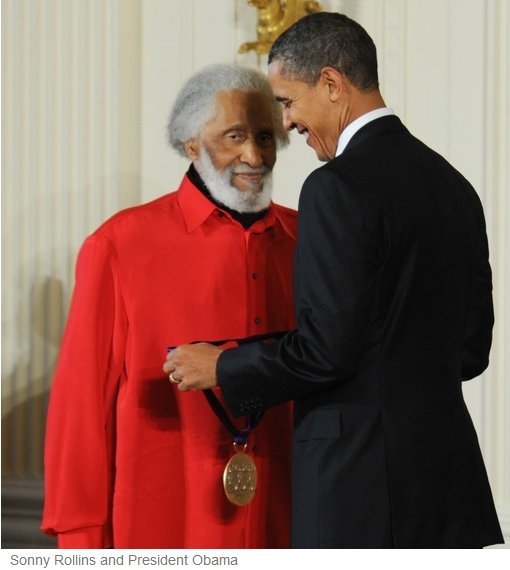
Sonny Rollins honoured, but Kennedy Center misses an opportunity

Filed under: Media, USA — Tags: , , — Nicholas @ 13:14

One of the best jazzmen of the 20th century was recognized in an event at the Kennedy Center recently:

Was there a single jazz musician in the audience for the Kennedy Center Honors ceremony last month? Besides Sonny Rollins, that is, who was one of the five honorees. From what I saw on the CBS telecast of the ceremony, the only jazz musicians in the house were those hired hands who were on stage playing in Sonny’s honor. Is it possible that no other jazz players were there? It’s more likely that the show’s producers wouldn’t recognize a jazz musician even at close range, so all we got were long shots of the Obamas and movie and pop stars. At least the President and First Lady looked like they’d heard jazz before they got to the Center, and surely they appreciated Bill Cosby’s irony-laced introduction. But how many people in that bejeweled crowd had ever heard a note by the Saxophone Colossus?

Granted, it was great to see Sonny getting the honor, to watch the montage of images from his career and hear the narrative voiced by Cosby. Cos described his own surprise encounters with people in far flung places abroad who in the midst of their daily routines were listening to Rollins, then concluded his remarks by welcoming Sonny “home” to his native land. But notwithstanding the primacy of jazz in American performing arts, the music long ago lost its appeal for the masses, and even the curious may know little about its history and Newk’s place in it. Thus while Cosby’s comments spoke to his personal admiration for Rollins, the occasion called for something more, the kind of critically-grounded statement that a Stanley Crouch or Gary Giddins or Bob Blumenthal could have provided. But a teaching moment like this was squandered, while the most resonant image may have been the sign of Rikers Island displayed among Rollins’s personal landmarks.

« Newer PostsOlder Posts »

Powered by WordPress

