
H/T to Greg Mankiw for the link.
February 15, 2012
Shit happens: the economics version (NSFW)
Comments Off on Shit happens: the economics version (NSFW)
February 14, 2012
February 12, 2012
Interested in early SF pulps?
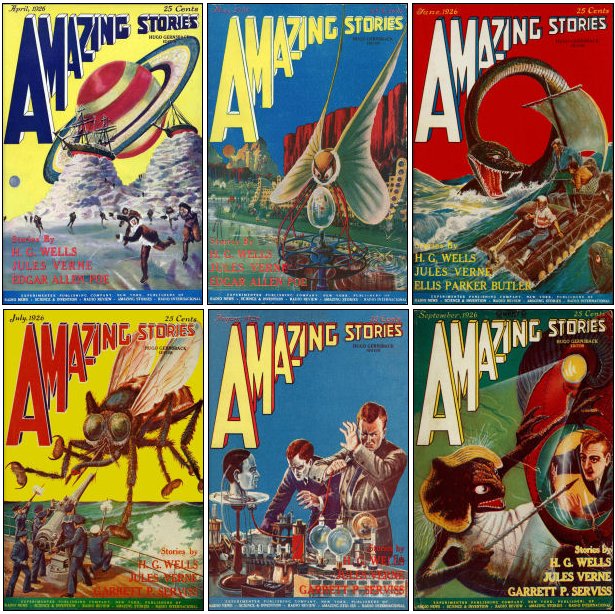
You can now read the full text, including pictures and ads, of the first six issues of Amazing Stories online:
The Pulp Magazines Project has just posted the first several issues of Amazing Stories. Read the classic pulp magazine edited by Hugo Gernsback in all its scanned-in glory, with stories by H.G. Wells, Jules Verne, Edgar Allan Poe, Murray Leinster and more.
Comments Off on Interested in early SF pulps?
February 11, 2012
Alan Moore: “Without wishing to overstate my case, everything in the observable universe definitely has its origins in Northamptonshire”
Alan Moore on the origins of the Guy Fawkes mask and its role in the Anonymous protests:
When parents explained to their offspring about Guy Fawkes and his attempt to blow up Parliament, there always seemed to be an undertone of admiration in their voices, or at least there did in Northampton.
While that era’s children perhaps didn’t see Fawkes as a hero, they certainly didn’t see him as the villainous scapegoat he’d originally been intended as.
At the start of the 1980s when the ideas that would coalesce into V for Vendetta were springing up from a summer of anti-Thatcher riots across the UK coupled with a worrying surge from the far-right National Front, Guy Fawkes’ status as a potential revolutionary hero seemed to be oddly confirmed by circumstances surrounding the comic strip’s creation: it was the strip’s artist, David Lloyd, who had initially suggested using the Guy Fawkes mask as an emblem for our one-man-against-a-fascist-state lead character.
When this notion was enthusiastically received, he decided to buy one of the commonplace cardboard Guy Fawkes masks that were always readily available from mid-autumn, just to use as convenient reference.
To our great surprise, it turned out that this was the year (perhaps understandably after such an incendiary summer) when the Guy Fawkes mask was to be phased out in favour of green plastic Frankenstein monsters geared to the incoming celebration of an American Halloween.
It was also the year in which the term “Guy Fawkes Night” seemingly disappeared from common usage, to be replaced by the less provocative ‘bonfire night’.
At the time, we both remarked upon how interesting it was that we should have taken up the image right at the point where it was apparently being purged from the annals of English iconography. It seemed that you couldn’t keep a good symbol down.
Comments Off on Alan Moore: “Without wishing to overstate my case, everything in the observable universe definitely has its origins in Northamptonshire”
February 10, 2012
Willpower, for good or evil
In the Guardian, Jon Henley reviews the new book by Roy F Baumeister and John Tierney:
Willpower: Rediscovering Our Greatest Strength distills three decades of academic research (Baumeister’s contribution) into self-control and willpower, which the Florida State University social psychologist bluntly identifies as “the key to success and a happy life”.
The result is also (Tierney’s contribution) readable, accessible and practical. It’s an unusual self-help book, in fact, in that it offers not just advice, tips and insights to help develop, conserve and boost willpower, but grounds them in some science.
Willpower is, Baumeister argues over lunch, “what separates us from the animals. It’s the capacity to restrain our impulses, resist temptation — do what’s right and good for us in the long run, not what we want to do right now. It’s central, in fact, to civilisation.”
The disciplined and dutiful Victorians, all stiff upper lip and lashings of moral fibre, had willpower in spades; as, sadly, did the Nazis, who referred to their evil adventure as the “triumph of will”. In the 60s we thought otherwise: let it all hang out; if it feels good, do it; I’m OK, you’re OK.
But without willpower, it seems, we’re actually rarely OK. In the 60s a sociologist called Walter Mischel was interested in how young children resist instant gratification; he offered them the choice of a marshmallow now, or two if they could wait 15 minutes. Years later, he tracked some of the kids down, and made a startling discovery.
[. . .]
What they found was that, even taking into account differences of intelligence, race and social class, those with high self-control — those who, in Mischel’s experiment, held out for two marshmallows later — grew into healthier, happier and wealthier adults.
Comments Off on Willpower, for good or evil
Lorne Gunter: Toronto Star imagines oil just “bubbles up out of the ground and we Westerners just run out with buckets to collect it?”
Lorne Gunter in the National Post:
As I read the Toronto Star’s editorial about Statistics Canada’s recently released 2011 census population data, it was hard for me not to imagine a plump, aging diva reclining on a brocade-covered chaise wailing, “I’m still beautiful! Really, I am.”
Entitled, “Census shows a fading Ontario? Don’t count on it,” the editorial makes the argument that it is “too simplistic” to claim “Ontario’s day is over.”
No one is making the case that Ontario can be dismissed as an afterthought. That is a concern without a cause.
[. . .]
But before anyone jumps to the conclusion that I, an Albertan, am pleased by Ontario’s decline, I’ll add that any trend that bodes ill for Ontario, eventually bodes ill for the country as a whole.
Canada needs a strong, prosperous, confident heartland. The West may be the new engine of the national economy, but that doesn’t mean the country can afford to have the old engine — Ontario — be idle.
The Star insults the West’s ingenuity and determination when it scoffs that “it’s relatively easy to grow based on resource extraction. Ontario does not have the luxury of sitting on gas and oil fields, so the task here is much harder.” Really? Have the paper’s editorial writers ever tried to find, extract, transport and refine oil and natural gas? Do they imagine the stuff bubbles up out of the ground and we Westerners just run out with buckets to collect it?
Comments Off on Lorne Gunter: Toronto Star imagines oil just “bubbles up out of the ground and we Westerners just run out with buckets to collect it?”
February 9, 2012
Paul Wells: Harper’s trip to China is going well
In his Maclean’s column, Paul “Inkless” Wells talks about the state of play in prime minister Stephen Harper’s visit to China:
The old-timers in the press gallery know how to defuse an announcement like this. We dust a toolkit from the early Chrétien days off. A Canadian prime minister shows up in a fancy Beijing ballroom with a bunch of business executives wielding Montblanc pens. A big number is being tossed around — say, “$3 billion.” But if we subtract the deals that would have happened anyway, and then subtract the deals that aren’t really deals — then we can wear that number down to some innocuous nub.
But while individual elements of Stephen Harper’s signing ceremony Thursday night in a fancy Beijing ballroom may not pan out, at some point the weight of evidence starts to suggest something real is going on. The evidence at hand comes, not just from Canadian sources, but from Chinese.
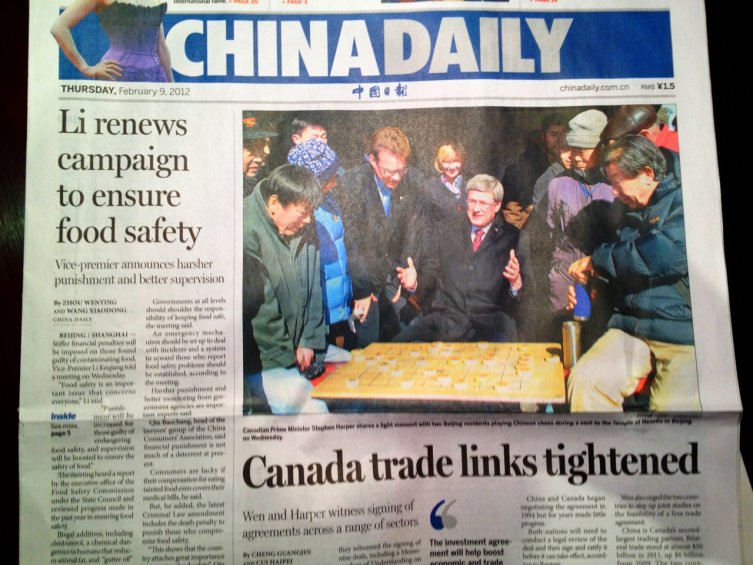
The first source of the morning was the semi-official English-language China Daily, which reserves real excitement for vice-premier Xi Jingping’s upcoming trip to the United States but which has been respectful, and a little more than that, toward Stephen Harper all week.
Later in the day came Harper’s bilateral meeting with Hu Jintao. Here, no trace of scolding for time spent posturing in the early years of Harper’s term as prime minister. Now, Hu said, “Mr. Prime Minister, you put a lot of value on Canada’s relationship with China and are strongly committed to promoting the practical cooperation between our two countries. I appreciate your efforts.” Translation: You’re out of the doghouse. Come here, ya big lug.
Update: David Akin contrasts the glowing reviews Harper is getting in the Chinese press this time with his 2009 visit:
I’ve travelled to a lot of spots around the world covering Prime Minister Stephen Harper’s international travels and I cannot recall him ever generating the kind of positive press he’s getting in this morning’s China Daily, the English-language state-run daily newspaper here.
A picture of Harper chatting with Chinese chess players during a visit Wednesday to the Temple of Heaven is the front-page top-of-the-fold main art here with a generally positive article about the two countries improving trade relationship. Inside, there’s two other pieces involving Canada and Harper.
[. . .]
Read between the lines here and China’s government is approvingly showing Canada’s prime minister to be a decent, pious individual deserving of China’s friendship and support.
That’s a sharp contrast to the China Daily‘s coverage of Harper’s 2009 visit. There was front-page coverage then too — of how Premier Wen dressed down Harper for letting the China-Canada relationship languish. The narrative in 2009 was that the Canadian prime minister was a wayward supplicant coming to China to seek forgiveness for his sins. Not this time: He is being profiled in the press as the leader “of a strong delegation of five ministers and 40 business leaders” who, along with Wen, witnessd “the signing of nine deals.” The reader of the China Daily on this Harper visit is meant to be impressed.
The heady mix of politics and religion: this is why there’s supposed to be a separation of church and state
At Reason, A. Barton Hinkle on the different ways the media reacts to religious issues under different presidents:
George W. Bush had one small office devoted to faith-based initiatives, and was savaged for it. Barack Obama, on the other hand, says faith drives much of his domestic agenda—and no one even blinks.
We are in “the fourth year of the ministry of George W. Bush,” cracked novelist Philip Roth in 2004. By then, several million gallons of ink already had been spilled warning that Bush’s “faith-based presidency” was “nudging the church-state line” (The New York Times) and was “turning the U.S. into a religious state” (Village Voice) and was “arrogant” and “troubling” (St. Petersburg Times) and was “pandering to Christian zealots” (Salon) and “imposing its values on the rest of us” (too many to name).
Obama has been just as overtly religious as Bush — “We worship an awesome God in the blue states,” he said in his 2004 keynoter at the Democratic National Convention — and even more aggressive about injecting faith into politics. In 2006, he praised a religious “Covenant for a New America.” In a 2008 speech in Ohio, he said religious faith could be “the foundation of a new project of American renewal” and insisted that “secularists are wrong when they ask believers to leave their religion at the door before entering into the public square.” He has kept Bush’s office of faith-based initiatives. In fact, “Obama’s faith-based office has given religious figures a bigger role in influencing White House decisions,” reported USNews in 2009.
At the National Prayer Breakfast last Thursday, the president began by noting that he prays every morning, and then devoted the rest of his speech to explaining the manifold ways in which his faith guides his policies. “I am my brother’s keeper and I am my sister’s keeper,” he said. That somnolent silence you hear is the guardians of church-state separation taking a nap.
Frankly, it still boggles my mind that there’s such a thing as a “National Prayer Breakfast” outside of the annual general meetings of churches.
Comments Off on The heady mix of politics and religion: this is why there’s supposed to be a separation of church and state
Michael Pinkus: Apathetic Ontario and the LCBO monopoly
In the latest issue of his OntarioWineReview.com newsletter, Michael Pinkus again expresses frustration with the government-run monopoly on retail sales of wine and spirits in Ontario:
I have made this point before when talking about the LCBO Food & Drink magazine, which competes directly with other publications in the province for advertising dollars; a magazine that is paid for by the people for the people, which sounds great and a pillar to build a country on, but not when you are competing against the very people who paid the money in the first place (magazine editors, publishers, writers, etc. are taxpayers too). One of the sad realities is that with each bottle a publisher buys they are paying to put themselves out of business.
It’s bad enough that the LCBO are the only game in town to buy booze … it’s bad enough that they waste millions of dollars a year on fancy stores (when they don’t have to) … it’s bad enough that a government run monopoly competes against their own populace and private enterprises for advertising revenue … but now they have to blow dollars on advertising themselves, buying expensive jingles and song rights … is that where you want your tax dollars to go? Could we not find better uses for this money, seriously? And what happened to social responsibility? They are advertising so we’ll buy more — does that seem counter-productive to the social responsibility pact. Heck, I don’t see this many ads for Premier Liquors out of Buffalo, and they have competition.
In the coming weeks we’ll look a little deeper into the LCBO, see what the Auditor General had to say, and read what the pundits are talking about. Find out why our booze prices are being raised mainly because we can’t be trusted as a society to police ourselves when it comes to drinking the devil’s liquid. I just can’t believe that all this is going down and nobody seems to be saying anything on the subject. Over the past few weeks I have been listening to CFRB: John Tory and Jim Richards both made mention, Richards went as far as to speak with Chris Layton (media relations mouthpiece for LCBO) — while both announcers shared their outrage with listeners over various aspects of the LCBO’s conduct (John: advertising; Jim: price raising), the apathetic Ontarians who bothered to call in had very little to say on the matter, many believing the LCBO is doing a bang up job.
A quick search of the blog shows that just about every mention of the LCBO is a negative one. No surprise there: the LCBO is a relic of the post-Prohibition era and is still run in a way that would be familiar to the state-owned “stores” of the old Soviet Union. They are undeniably better both in selection and in service than they used to be, but just about every positive change was wrought by the mere threat that the government of the day was looking at privatization as an option. As soon as the threat went away, the positive changes could be slowed or even stopped: after all, where else are you going to go to buy your wines and spirits?
Comments Off on Michael Pinkus: Apathetic Ontario and the LCBO monopoly
February 8, 2012
You can’t blame declining rates of marriage on poverty
Bryan Caplan explains:
I’m baffled by people who blame declining marriage rates on poverty. Why? Because being single is more expensive than being married. Picture two singles living separately. If they marry, they sharply cut their total housing costs. They cut the total cost of furniture, appliances, fuel, and health insurance. Even groceries get cheaper: think CostCo.
These savings are especially blatant when your income is low. Even the official poverty line acknowledges them. The Poverty Threshold for a household with one adult is $11,139; the Poverty Threshold for a household with two adults is $14,218. When two individuals at the poverty line maintain separate households, they’re effectively spending 2*$11,139-$14,218=$8,060 a year to stay single.
But wait, there’s more. Marriage doesn’t just cut expenses. It raises couples’ income. In the NLSY, married men earn about 40% more than comparable single men; married women earn about 10% less than comparable single women. From a couples’ point of view, that’s a big net bonus. And much of this bonus seems to be causal.
[. . .]
If being single is so expensive, why are the poor far less likely to get married and stay married? I’m sure you could come up with a stilted neoclassical explanation. But this is yet another case where behavioral economics and personality psychology have a better story. Namely: Some people are extremely impulsive and short-sighted. If you’re one of them, you tend to mess up your life in every way. You don’t invest in your career, and you don’t invest in your relationships. You take advantage of your boss and co-workers, and you take advantage of your romantic partners. You refuse to swallow your pride — to admit that the best job and the best spouse you can get, though far from ideal, are much better than nothing. Your behavior feels good at the time. But in the long-run people see you for what you are, and you end up poor and alone.
Tyler Cowen comments on the first part of Caplan’s post:
More plausibly it is the rise in female income (among other factors, including the rise of birth control, […]) which is behind the decline in marriage, but that doesn’t fit with traditional mood affiliation, which finds the rise in female income to be good (which it is), and the decline in marriage to be — neither good nor bad per se but not exactly worth celebrating. If you can blame capitalism and wage stagnation for the decline of the family among lower earners, so much the better for ideology but as a sociological proposition that is a very weak hypothesis (do you see convincing links to real sociological evidence, showing this to be the dominant factor? No) and as Caplan shows it doesn’t fit with the economics either.
Comments Off on You can’t blame declining rates of marriage on poverty
Help combat RRSHS (Relative Risk Scary Headline Syndrome)
Timandra Harkness on the latest “scare the shit out of people with blatant propaganda” campaign in Britain:
To put that another way, the campaign is suggesting that if 48,000 women all drank two large glasses of wine every night (it doesn’t specify for how long — a year, 20 years — this is a health campaign after all, so why would we need to see proper research citations?), then out of those assiduous drinkers an extra two would die in a year because they drank more than the government guidelines suggest.
It’s a classic case of RRSHS — Relative Risk Scary Headline Syndrome. Why bore people with a sober assessment of how likely something is to kill them when you can scream a terrifying figure at them instead? So what if they’re far more likely to die of something else?
And in fact, moderate drinking offers significant protection against heart disease, which kills one in three of us. ‘Apparently, two large glasses of wine, or more, a day could make me half as likely to die from a heart attack’, the plasticine figure could truthfully have said.
RRSHS is a variant of the “science by press release” variant of junk science.
Update: Tim Worstall loses his cool over the statistical lies being bandied around in this particular Nanny campaign:
Prime Minister David Cameron is known to have sympathy with the idea of minimum pricing, which medics say could save nearly 10,000 lives per year if set at 50p per unit.
Gosh, that’s amazing.
Alcohol related deaths in the UK rose to 9,031 in 2008, up from 8,724 the previous year.
Rilly? A slight rise in the cost of cheap booze will save more lives per year than are lost to all booze?
Hey, why not put it up to £50 a unit and we’ll all live forever?
Forgive me the crudity but I’ve really had it with cunts lying to get their bandwagons rolling.
And in the comments, “PJH” says:
One wonders, of course, if these figures are created in the same way as alcohol related admissions to hospitals.
“30% of this death was due to alcohol, 10% of that teetotaller’s death was due to alcohol, 14.243245% of that other death…”
Comments Off on Help combat RRSHS (Relative Risk Scary Headline Syndrome)
February 7, 2012
Terrorist training camp just north of Toronto!
According to former Toronto Star editor and Ryerson professor John Miller, we’ll be in the grip of terror later in February:
Here is an extended quote from his rant to show that I’m not taking this out of context one bit:
“Makes you wonder when was the last time a group of ideological warriors went north to train in the backwoods and plot to storm Parliament, blow up the CBC, seize the airwaves and spread terror across the land. Oh yeah, the Toronto 18 did that. Didn’t police arrest the lot of them and call them the gravest threat to our democracy?
“I think a weekend with Ezra and friends could be something just like that.
“The only thing that sets them apart from the Muslim extremists is that Sun Media will be charging you admission.”
Sorry, we’re not planning to storm Parliament. Maybe we’ll talk about writing some letters to our MPs. We’re not planning to blow up the CBC. We just want to privatize it. And we don’t believe in spreading terror across the land. In fact, we support our Canadian troops in the war against terror, and don’t want that little terrorist Omar Khadr let back in from Guantanamo Bay.
Miller ended by saying “the only thing” that makes us different from those terrorists is that we charge admission.
What a disgusting man.
Why did he liken me, my fellow Sun personalities and Sun readers to terrorists? For one reason only: We’re conservative, and we refuse to go along with him and the rest of the consensus media.
The fact that someone as vile as Miller has held senior posts at journalism schools and the largest newspaper in Canada is not surprising. Because both the Star and every j-school in the country believe in a uniform, official left-wing view.
They believe in every type of diversity — racial, sexual, ethnic — except for intellectual diversity.
Comments Off on Terrorist training camp just north of Toronto!
“London is too big and too anarchic to be seriously pasteurised by the games. It’s so big, so filthy, so nasty that it could probably eat twenty Olympiads for breakfast and spit out the Ferroconcrete bones.”
Faye Planer interviews Will Self in Bristol University’s Epigram on his views about the upcoming London Olympic extravaganza:
I hear that you are unenthusiastic about the prospect of the Olympics this summer. In your eyes, what is the greatest folly of this whole affair?
Rather unenthusiastic is putting it waaaaay mildly: I think the Olympics suck dogshit through a straw. People believe they encourage da yoof to take up running, jumping and fainting in coils — but this is nonsense. They’re a boondoggle for politicians and financiers, a further corruption of an already corrupt self-appointed international coterie of Olympian cunts, an excuse for ‘elite’ athletes to fuck each other, snarf steroids and pick up sponsorship deals, and a senseless hitching of infrastructural investment — if there’s any reality to this anyway — to a useless loss-trailing expenditure on starchitectural bollix. The stadia themselves are a folly. The new Westfield is a temple to moribund consumerism — in ten years time they’ll all be cracked and spalled; a Hitlerian mass of post-pomo nonsense.If the Olympics did not exist, would it be necessary to invent them?
They didn’t exist for thousands of years. The modern Olympics is a fatuous exercise in internationalism through limbering up and then running down to entropy. The modern Olympics have always been a political football — nothing more and nothing less — endlessly traduced and manipulated by the regimes that ‘host’ them. This one is no different, presenting a fine opportunity for the British security state apparatus and its private security firm hangers-on to deploy the mass-suppression and urban paranoiac technologies in the service of export earning. Some peace, some freedom.[. . .]
‘Really, one may say that the whole Olympic process was a pasteurisation of the city… the microbes disappeared and from a hygienic point of view maybe that was positive, but really what happened is that the variety was destroyed in the process…’ Manuel Vázquez Montalbán said this about the 1992 Barcelona Olympics. Do you believe that London is being pasteurised too?
No, I’m quite confident that London is too big and too anarchic to be seriously pasteurised by the games. It’s so big, so filthy, so nasty that it could probably eat twenty Olympiads for breakfast and spit out the Ferroconcrete bones.
H/T to Charles Stross for the link.
Comments Off on “London is too big and too anarchic to be seriously pasteurised by the games. It’s so big, so filthy, so nasty that it could probably eat twenty Olympiads for breakfast and spit out the Ferroconcrete bones.”
February 6, 2012
The Diamond Jubilee
Paul McMichael Nurse on today’s 60th anniversary of the start of the reign of Queen Elizabeth II.
Today marks the 60th anniversary of Elizabeth II’s accession to the Throne of Great Britain in February of 1952. There can hardly be many heads of state, past or present, who have witnessed so many major events over so long a period. Elizabeth has outlasted 12 British prime ministers, 10 Canadian ones and 11 U.S. presidents. Decolonization, the Cold War, the space race, civil rights for minority groups, various assassinations and international regime changes have all taken place during her reign. From the grim austerity days following the end of the Second World War to the technological wonders of the early 21st century, Elizabeth as princess and queen has seen Britain transform from a quasi-imperial nation to something less than the superpower it was a century ago.
A number of events are planned to celebrate this year’s Diamond Jubilee, capped by a massive flotilla of boats accompanying the queen’s barge up the Thames on June 3. Members of the Royal Family will visit all 15 countries of which the queen is head of state, and Elizabeth herself will travel extensively within the United Kingdom.
Royal jubilees are rare things at the best of times, but none rarer than 60th anniversaries. Over 1,000 years of British monarchy there have been only two Diamond Jubilees, and the last one occurred not in the last century, but the one before, in 1897, when Queen Victoria celebrated her own reign of 60 years. To this day, Victoria remains the longest-serving British monarch on record, ascending the throne on the death of her uncle William IV, in 1837, and seeing Britain grow into the most extensive global empire since Rome.
Update: Even some self-described anti-monarchists think she’s been a fine Queen:
But admiration for the monarch might be unexpected coming from me. After all, I’m a republican.
Heredity is just about the silliest method I can think of for selecting someone to govern a country. Think Kim Jong-Il.
[. . .]
It’s true that bad prime minister, premiers and presidents can stick around long enough to rot in office. But no elected leader gets to stay for 60 years. Democracies may be imperfect, but they are self-correcting in a way hereditary monarchies never can be.
So why such effusive praise for our Queen from such a staunch anti-monarchist? Because Elizabeth has been a remarkable queen, an inspirational queen, steadfast, steady, intelligent, balanced and above reproach. She has seldom, if ever, put a foot wrong. Without her pitch-perfect discharge of her duties, it is entirely possible the British monarchy would have gone the way of other European royalty decades ago.
In short, Elizabeth is the Queen we would have chosen to elect if a campaign were ever held to select our monarch. Heredity may have placed her on the throne, but had voters ever been asked, democracy would have kept here there. I can think of no elected leader who could have acted so impeccably in office to remain popular from 1952 until today. Indeed, if anything, the Queen is more popular today than at any time since the first years after her accession. And it is an earned popularity, a reward for her unwavering commitment to serve her subjects and the people of the Commonwealth.
Comments Off on The Diamond Jubilee
Brazil fights back against celebrity oppression
John Conroy on the recent backlash in Brazil against foreign celebrities using domestic issues as platforms for moralizing:
Film director James Cameron, responsible for Terminator, Titanic and, more recently, Avatar, has been working on a considerable side-project for a few years now. Cameron film fans shouldn’t get their hopes up, however. This side-project is more political than filmic. He has been trying to prevent the Brazilian government from constructing Belo Monte, the world’s third-largest hydroelectric dam, on the Xingu river which runs through the Amazonian rainforest.
[. . .]
But then something very curious happened. Another tribe of Brazilians, normally so fearful of being seen outside of their natural habitat, fought back. Geeky university students and their professors made a film with zero production values undermining every argument used by Cameron, the NGOs, the Kayapo and TV Globo. These are the myths they challenged:
- The Indians will have nowhere to live. Actually, a student from Brasilia University who has done little else but study the impact of the project on indigenous lands responded that not one of the indigenous lands in the region will be flooded. There are 12 indigenous territories near the project in an area of 56,000 square kilometres with 2,200 indigenous people living on them. That’s two-and-a-half times the size of Wales. Thirty consultative meetings were held in tribal villages and recorded on video.
- The dam and its reservoirs will flood and destroy 640 square kilometres of rainforest. Not exactly. The reservoirs will cover an area of 502.8 square kilometres of which 228 square kilometres are already within the body of the river itself.
- The dam will starve the Xingu National Park of water. This is not true. The students displayed a map revealing that the park is in fact 1,300 kilometres up river of the dam.
- For eight months of the year the region above the dam is nearly a desert making the dam inefficient and only capable of generating a third of its installed capacity. The implication here is that there is insufficient water to drive the turbines at full power. However, during the high-water period of the year, the river empties 28 million litres of water per second at the point of the turbines, creating an extraordinary potential energy generation of 11,233 megawatts (MW). Even at the river’s lowest levels in the month of October, it delivers 800,000 litres per second. The annual average energy production of Belo Monte will be 4,571MW, or 41 per cent of the potential generating capacity, not one third. This will power 40 per cent of Brazil’s entire residential energy consumption.
Comments Off on Brazil fights back against celebrity oppression


