
Quotulatiousness

March 10, 2012

“[A]theists and theists […] are quacking and waddling in the same way in different ponds”

Filed under: Media, Religion, USA — Tags: , , , , , — Nicholas @ 13:19

Kennedy expresses the idea that atheism is a religion and becomes “a minor celebrity and a major troll” to her social media circles:

I didn’t know what fire and brimstone was until I made a throwaway claim recently during an appearance on Real Time with Bill Maher. It seemed pretty unaudacious at the time, but by dropping the simple sentence “Atheism is a religion,” I opened a biblical floodgate of ridicule, name-calling, and abuse.

My Twitter feed and Facebook page became engorged with angry responses. “Your adherence into adulthood to what is usually an adolescent phase (Libertarianism), speaks volumes about your confirmation bias levels,” wrote Kernan. Touchstone Supertramp added; “Damn girl you got a big forehead.” A guy named Kevin and about 70 other people shared this bumper-sticker nugget: “‎If atheism is a religion, then off is a TV channel.” Liz wrote, “Kennedy, is that if atheism constitutes a religious belief than anorexia is whenever you don’t eat.” Michael wrote: “re·li·gion /riˈlijən/ Noun: 1. Whatever Kennedy says it is.” That was awesome. Beth called me a minor celebrity and a major troll—and it was also awesome to have somebody think I’m a celebrity.

[. . .]

Newberg and his late partner Eugene D’Aquili mapped various parts of the brain showing activation in specific areas when people were undergoing certain religious rituals or experiences, such as a shaman being in a trance or a Buddhist entering a mystical state. Regardless of the religion, the brain function was the same. Something was happening when these people experienced their version of religious phenomena, and the scans lit up like Robert Redford’s suit in The Electric Horseman.

This does not prove God exists, but it does show humans are wired or biologically predisposed to believe in something. When I interviewed him for this article, Newberg said his research demonstrates that “we are wired to have these beliefs about the world, to get at the fundamental stuff the universe is about. For many people, it includes God and for some it doesn’t. Your brain is doing its best to understand the world and construct beliefs to understand it, and from an epistemological perspective there is no fundamental difference.”

[. . .]

When atheists rail against theists (as many did on my Facebook page), they are using the same fervor the religious use when making their claims against a secular society. By calling atheism a religion, I am not trying to craft terms or apply them out of convenience. I just see theists and atheists behaving in the same manner, approaching from opposite ends of the runway. The entire discourse about religion stems from those who think they know more than the other guy. But what we really know is that we don’t know much. And we seem to share the same mechanism in our brains that drives us to make claims of faith and rationalism as a way of making sense of the great unknown.

You can call atheism a belief system, which Newberg guardedly does, or you can make a stronger assertion and say that atheists and theists, who have conveniently developed hate-tinged froth and vitriol for one another, are quacking and waddling in the same way in different ponds. Either way, they are ducks and atheism is a religion. At least it is in the hands of those who are so religious about their disbelief that they place the weight of the argument on the feathery shoulders of their believing brothers and sisters.

More on the story of the WWII poster “Keep Calm and Carry On”

Filed under: Books, Britain, History, Media, WW2 — Tags: , — Nicholas @ 00:02

That looks like my kind of book shop! If/when I’m next in Alnwick, I’ll have to stop in for a visit.

Earlier item about the poster here.

March 9, 2012

Number-crunching on the subject of pornography

Filed under: Health, Liberty, Media, Science — Tags: , , , , , — Nicholas @ 10:19

Garth Zietsman does the statistics on pornography. First the objections of various groups:

The sociological objection is that pornography decreased respect for long-term, monogamous relationships, and attenuates a desire for procreation. Pornography can “potentially undermine the traditional values that favor marriage, family, and children”, and that it depicts sexuality in a way which is not connected to “emotional attachment, of kindness, of caring, and especially not of continuance of the relationship, as such continuance would translate into responsibilities”

The religious/conservative objection is similar to the sociological objection. They argue that this industry undermines the family and leads to the moral breakdown of society. They say that it is amoral, weakens family values, and is contrary to the religion’s teachings and human dignity.

Some feminists argue that it is an industry which exploits women and which is complicit in violence against women, both in its production (where they charge that abuse and exploitation of women performing in pornography is rampant) and in its consumption (where they charge that pornography eroticizes the domination, humiliation, and coercion of women, and reinforces sexual and cultural attitudes that are complicit in rape and sexual harassment). They charge that pornography contributes to the male-centered objectification of women and thus to sexism.

Other objections are that the sex industry is sometimes connected to criminal activities, such as human trafficking, illegal immigration, drug abuse, and exploitation of children (child pornography, child prostitution). However these effects are related not so much to pornography as to prostitution.

Then a small sampling of the findings (it’s a long post):

Firstly (using the General Social Survey) I found no relationship between being pro the legality of porn, or propensity to watch porn, and pro social behaviors e.g. volunteer work, blood donation, etc.

We can dismiss the feminist (and sociological) charges of porn increasing sexual violence and leading to sexism. The USA, Sweden, Germany, Netherlands (2) and Japan were just some of the countries that suddenly went from no legal pornography to quite widespread availability and consumption of it. These studies all found that greater availability of, and exposure to, pornography does not increase the rate of sexual assaults on women, and probably decreases it (3). Japanese porn is quite frequently violent and yet even there rape decreased from an already very low base. It’s interesting that an increase in porn exposure decreases sexual violence only, and has no effect on other crime. Economists would put this down to a substitution effect.

Several countries have sex offender registers — mainly of pedophiles. A wide variety of professions are represented on these registers. Members of professions that supposedly promote morality e.g. clerics or teachers, are quite common on it yet conspicuously absent from such registers are men who have worked in the porn industry.

This study (1) found no relationship between the frequency of x-rated film viewing and attitudes toward women or feminism. From the GSS (controlling for IQ, education, income, age, race and ideology) I found that those who are pro the legality of porn are less likely to support traditional female roles, more likely to be against preferential treatment of either gender, and to find woman’s rights issues more frequently salient. Although I found that women’s rights issues are less salient to male watchers, and female watchers are less likely to think women should work, I also found that watching porn is unrelated to negative attitudes toward women and feminism.

In short exposure to and tolerance of pornography does not cause anti-social behavior (and may even reduce it in relation to sex) and does not get in the way of pro social behavior either.

H/T to Tyler Cowen for the link.

Rob Lyons on the lessons of Fukushima

Filed under: Environment, Japan, Media, Technology — Tags: , , — Nicholas @ 09:56

It’s almost exactly a year since the earthquake and tsunami that devastated Fukushima, and Rob Lyons summarizes the lessons we’ve learned from that disaster:

Sunday marks the first anniversary of the earthquake and tsunami that devastated the east coast of Japan on 11 March 2011. The quake, measuring 9.0 on the Richter scale, was the biggest ever to hit Japan and one of the biggest anywhere in the world in the past century. The resulting tsunami caused roughly 20,000 deaths. Yet, shockingly, the biggest issue about the disaster remains the resulting inundation of a nuclear-power plant at Fukushima, which so far appears to have caused precisely zero deaths from leaking radioactivity.

There are many valuable lessons to be learned from this tragedy. One is the importance of development. The earthquake and tsunami that affected the Indian Ocean on Boxing Day 2004 were only marginally larger, yet killed well over 200,000 people. Direct damage from the Japan earthquake was relatively small thanks to high building standards. Warnings allowed many people to escape the unprecedented seawater surge that followed, though video of the wall of water hitting coastal towns is still shocking. Even so, the world’s third largest economy will take a long time to recover fully from what happened. Thankfully, Japan has the resources to do that.

This, however, is not the main lesson being drawn from events a year ago. Around the world, the conclusion many commentators and politicians have drawn is that nuclear power is inherently dangerous and that we need to stop all future nuclear development. This is a perverse conclusion, absolutely flying in the face of the facts. The reaction against nuclear power post-Fukushima reveals much about the navel-gazing, risk-averse worldview that has such a paralysing effect on life in the developed world today.

March 7, 2012

Robot barf

Filed under: Media, Technology — Tags: , , — Nicholas @ 09:50

An amusing article at the Guardian about those hard-to-avoid QR codes:

The idea behind a Quick Response (QR) code is pretty simple, even useful, when applied correctly. You snap a picture of a code and your mobile phone whisks you off to a web page — no typing necessary. The problem is that the vast majority of people have no idea what the codes are, or that they are supposed to interact with them.

Most people look at a QR code and see “robot barf”, but marketers seem to think they are a must-have technology for their advertising campaigns. In their minds, eager consumers wander around with their smartphones, scanning square codes wherever they appear. As a result, the codes appear just about everywhere, and often in some really absurd places.

Being strangely fascinated by their misuse, we decided to collaborate on a Tumblr, wtfqrcodes, to document this ridiculous trend. We started the blog with about a dozen of our own pictures and invited visitors to submit their pictures as well. That’s where we’ve gotten some of our best stuff – we’ve been amazed at some of the places QR codes show up. It’s obvious that most companies just don’t understand the technology … and that’s a recipe for some very funny posts.

Used as they were originally intended, you encounter a bit of robot barf like this one:

You take a picture of it and it opens a URL or provides other encoded information. If it’s in a printed ad or on a billboard, you probably have an idea where it’ll take you. Encountering them outside their “natural habitat”: just the bare QR code with no other information, you don’t know where it’ll take you or what kind of content it’ll provide.

Perhaps the NFL doesn’t want too many people watching the 2009 NFC championship game right now

Filed under: Football, Media — Tags: , , , , , — Nicholas @ 00:03

I retweeted a post from the Daily Norseman yesterday to the effect that the NFL Network had, without warning, pulled a scheduled re-broadcast of the 2009 NFC championship between the New Orleans Saints and the Minnesota Vikings. Gregg Easterbrook perhaps explains why:

The Vikings-Saints NFC title game two years ago may have been where the Saints’ deliberate rule-breaking was worst. Immediately after that game, I wrote, “Saints players came after [Brett] Favre so hard — four times slamming him in ways that invited late-hit or roughing penalties, only two of which were called — Williams [seems to have] told his charges something along the lines of, ‘Pound Favre every time you can; we will take a couple of roughing flags in return for making an old guy worry about the next hit.'”

So did I do a good job by noting two years ago what is suddenly considered obvious? No, I did a terrible job. Yesterday I watched every New Orleans defensive snap of that game and found four, not two, instances in which unnecessary roughness should have been called against the Saints but was not. In retrospect, my column should have led with dirty play by the Saints. The four unnecessary roughness penalties that were not called:

  • On the game’s first snap, Favre handed off, turned away from the play and was hammered with a forearm to the chin by New Orleans linebacker Scott Fujita. Not only should a personal foul have been called — Fujita should have been ejected on the game’s first offensive snap. Instead, no call. Scott, were you paid for behaving like a street thug?
  • At 6:14 of the first quarter, after Favre released a pass he was hit with a forearm to the chin by safety Roman Harper. No flag. Roman, were you paid for delivering that cheap shot?
  • At 4:15 of the first quarter, Favre released a pass and then Darren Sharper slammed him in the chest with a foreman. No flag. Darren, were you paid for having low standards?
  • At 13:29 of the second quarter, Favre released a pass and then was hurled to the ground by Bobby McCray. No flag. Bobby, were you paid for doing something you should be ashamed of?

Reviewing the tape, another aspect of the game jumped out at me that I missed when watching live, and so far as I can tell, all sportscasters and commentators missed, too. Beginning midway through the first quarter, whenever Favre handed off, he immediately ran backward 10 yards — to get away from New Orleans late hits.

And the assistant coach who ran the bounty operation? What a piece of work he is:

Gregg Williams has a classy first name, but may be a man of twisted values. Monday on NPR’s “All Things Considered,” Mike Pesca dug up audio of Williams speaking after the Saints’ Super Bowl win. Williams says, “My whole life … I’ve been trying to get people to play nastier.” Can he seriously think lack of aggression is a problem in football? Williams also had this to say about his two sons’ youth football days: “I told their little league coaches my kids will play fast, they’re going to play nasty, they’re going to play tough. Tell the rest of the babies around them to speed up.”

What kind of a man boasts that his sons are nasty and denounces as “babies” 10-year-olds who want to participate in a sport safely? Williams needs to take a long look in the mirror — and by his distorted values, he has forfeited any claim to a leadership role.

The NFL has a bigger problem than figuring out how to discipline the New Orleans Saints players and coaching staff. Perhaps that is why no penalties have yet been announced. The bigger problem for the NFL is that they need to retain the aggression and the passion, yet clearly enforce and be seen to enforce the rules against deliberate attempts to harm other players. If they miss this opportunity, expect politicians (in an election year where media exposure is even more important than usual) to jump in and start trying to do it for them.

March 6, 2012

Nick Gillespie: Short memories and shorter tempers

Filed under: Humour, Media, Politics, USA — Tags: , , , — Nicholas @ 12:34

A very funny trip down a memory lane not quite in the same dimension as we currently occupy:

With Super Tuesday upon us like a plague of 24-hour locusts that threaten not just the GOP but the very fabric of the nation itself (a wool and Lycra blend explicitly forbidden in Leviticus, btw) which is being stripped more bare than the bride by her bachelors even or the dessert bar near closing time at a Golden Corral buffet, it’s as good a time as any to wonder:

Was it just four years ago that The New York Times was running stories about the deleterious effects of a long, drawn-out, bruising fight for the Democratic presidential nod?

[. . .]

Good god, how does the nation ever survive the primary process? Isn’t it a scientific fact that nobody has ever won the presidency after having gone through a difficult nominating race? Obama was forced to visit all 57 states (by his count) multiple times until he kept fainting on stage from exhaustion like that guy from the Black Crowes who used to be famous.

After all, hasn’t a poll just scientifically proved that the GOP is hurting its “brand” (you know: Depends-wearing, anti-government crackers who only leave their houses on the Medicare-purchased personalized motor scooters to cruise to the mailbox to pick up their Social Security checks and oil-company dividend checks) by not immediately appointing the candidate most likely to get smoked by Obama in November?

The only subgroup of Americans who have weaker memories than high school seniors (99 percent of whom contend that the War of 1812 was fought between the Crips and the Bloods over the last Cabbage Patch doll between 1983-1986) are political journalists, many of whom, you may recall, took Donald Trump and Herman Cain seriously.

Michael Kinsley: Of course it’s insincere

Filed under: Media, Politics, USA — Tags: , , , , , — Nicholas @ 12:25

I don’t listen to Rush Limbaugh and I’m not likely to start listening in the near future, so my concern about “Slutpocalypse” is neither deep nor lasting. Limbaugh used the term “slut” to describe a Georgetown law student who was pleading for free or subsidized birth control. He then was forced to apologize, and the apology was deemed insincere by media commentators far and wide. Michael Kinsley points out that they went about it in the wrong way to garner a sincere apology:

The people who want to drive Rush Limbaugh off the air are not assuaged or persuaded by his apology over the weekend. They say he was not sincere: He only apologized, for calling a Georgetown University law student a “slut” and a “prostitute,” because of pressure from advertisers.

Well, of course he wasn’t sincere. And of course he was only apologizing to pacify advertisers — who were getting pressured to pressure Limbaugh by these very critics. Oh, there might have been a political calculation, too, that he’d gone too far for the good of his ratings or his celebrityhood. But any apology induced in these circumstances is almost by definition insincere. You can’t demand a public recantation and then expect sincerity along with the humble pie. If they wanted a sincere apology, Limbaugh’s critics would have had to defend his right to make these offensive remarks, and then attempt to change his mind using nothing but sweet reason. Go ahead and try.

[. . .]

Of course, the insincerity is on both sides. The pursuers all pretend to be horrified and “saddened” by this unexpected turn of events. In fact, they are delighted. Why not? Their opponent has committed the cardinal political sin: a gaffe.

A gaffe, as someone once said, is when a politician tells the truth. This is a bit imprecise. The term “politician” covers any political actor, certainly including Rush. And the troublesome statement needn’t be the truth, as it certainly wasn’t in this case: more like “the truth about what he or she is really thinking.” The typical gaffe is what they used to call a “Freudian slip.” But, with all due respect to Freud, why should something a politician says by accident — and soon wishes he or she never said, whether true or not — automatically be taken as a better sign of his or her real thinking than something he or she says on purpose?

H/T to Radley Balko for the link.

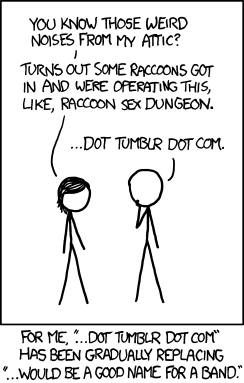
Meme replacement for “… is my next band name”

Filed under: Humour, Media, Randomness — Tags: , , , — Nicholas @ 00:10

(Remember to mouse-over for the rest of the joke, or click the image to see it on the xkcd site)

Australia’s “Ministry of Truth” founding document

Filed under: Australia, Law, Liberty, Media, Politics — Tags: , , , , — Nicholas @ 00:07

A rather alarming report to the Australian government by Ray Finkelstein recommends setting up a News Media Council to exercise control over political speech in the media, both professional (TV, radio, and newspapers) and amateur (bloggers, Facebookers, Twitterers, and other private individuals posting their opinions to the internet). It appears to be directed at climate change sceptics, but the provisions of the proposed body of rules will allow a great deal of control over all political speech:

The historic change to media law would break with tradition by using government funds to replace an industry council that acts on complaints, in a move fiercely opposed by companies as a threat to the freedom of the press.

The proposals, issued yesterday by Communications Minister Stephen Conroy, also seek to widen the scope of federal oversight to cover print, online, radio and TV within a single regulator for the first time.

Bloggers and other online authors would also be captured by a regime applying to any news site that gets more than 15,000 hits a year, a benchmark labelled “seriously dopey” by one site operator.

The head of the review, former Federal Court judge Ray Finkelstein, rejected industry warnings against setting up a new regulator under federal law with funding from government.

[. . .]

“News Media Council should have power to require a news media outlet to publish an apology, correction or retraction, or afford a person a right to reply,” the report states. It says this would be enforced through the courts.

The council would absorb the supervision of radio and TV current affairs by Canberra’s existing regulator, the Australian Communications and Media Authority, which ran the “cash for comment” investigation into talkback radio over many years.

The council would scrutinise online news sites that get more than 15,000 hits a year, clearing the way for government-funded action against amateur website operators who comment on news and current affairs. Greg Jericho, a prominent Canberra blogger on national politics, said: “The level of 15,000 hits a year, or about 40 hits a day, is seriously dopey.”

Some media executives privately dubbed the News Media Council as a potential “star chamber” because it would not have to give reasons for its decisions, which would not be subject to appeal

There’s a petition site at http://www.freespeechaustralia.com/ for those Australians who’d like to register their opposition to the new council.

Some excerpts from a Menzies House email from Timothy Andrews:

It is clear from the report, in particular paragraphs 4.31-4.42, that silencing climate realists is a major reason for these regulations: it is unashamedly explicit in this (and even uses the dirty trick of using polls from — wait for it — 1966 as evidence the media is pro-climate skeptic, and that — wait for it — only the ABC is unbiased!)

The size and scope of the proposed Super-Regulator is breathtaking. They will have the power to impose a “code of ethics”, force you to print views you don’t agree with as part of a ‘right of reply’, take you to court, and even make you take pieces down! Even personal blogs that get only 40 hits a day will be covered! To make matters worse, the SuperRegulator “would not have to give reasons for its decisions” and the decisions “would not be subject to appeal.” Even climate change websites in other countries like Watt’s Up With That will be covered by this!

[. . .]

11.69 Another aspect of jurisdiction concerns how the News Media Council will exercise its power over all internet publishers. Foreign publishers who have no connection with Australia will be beyond its reach. However, if an internet news publisher has more than a tenuous connection with Australia then carefully drawn legislation would enable the News Media Council to exercise jurisdiction over it.

Well, unless Australia is going to claim jurisdiction over the entire internet, I would imagine it will only prevent Australians from visiting foreign sites. I guess it’s a good thing that they’ve been getting friendlier with China: they can order up their national firewall from the same division of the People’s Liberation Army internet force.

James Delingpole points out that the usual suspects are involved in the process:

You can read the full 400 pages here, if you’re feeling masochistic. But Australian Climate Madness has a pretty good summary of the key issues of concern, starting with Pinkie Finkie’s proposal to create a new super-regulator called the News Media Council [missed a trick there, didn’t he? surely Ministry of Truth would have been more appropriate] which will impose its idea of fairness and balance not only on newspapers but even on blogs with as few hits as 15,000 a year.

But whose idea of fairness and balance?

It’s an astonishing fact that of the 10600 submissions received by the inquiry no fewer than 9600 were boilerplate submissions from left-wing pressure groups, led by Avaaz “a global civic organization launched in January 2007 that promotes activism on issues such as climate change, human rights, poverty and corruption.”

March 5, 2012

New TV shows to “glamourize” archaeology

Filed under: History, Media, Science, USA — Tags: , , , — Nicholas @ 14:26

This sounds particularly dire, on multiple levels:

On 20 March, Spike TV will premiere a new show called American Digger, while a show called Diggers on the National Geographic Channel made its debut 28 February. Both shows “promote and glorify the looting and destruction of archaeological sites,” Society for American Archaeology (SAA) President William F. Limp wrote in a message posted earlier this week to the SAA listserv.

The premise of American Digger, which is being hosted by a former professional wrestler, was laid out in a recent announcement by Spike TV. A team of “diggers” will “scour target-rich areas, such as battlefields and historic sites, in hopes of striking it rich by unearthing and selling rare pieces of American history.” Similar locales are featured in National Geographic’s Diggers. In the second episode, set in South Carolina, Revolutionary War and War of 1812 buttons, bullets, and coins were recovered at a former plantation.

After viewing the first two episodes of Diggers, Iowa’s State archaeologist John Doershuk posted a review to the American Cultural Resources Association listserv, in which he lamented: “The most damaging thing, I think, about this show is that no effort was made to document where anything came from or discussion of associations — each discovered item was handled piece-meal.”

H/T to A Blog About History for the link.

March 4, 2012

The continuing musical influence of Charles Mingus

Filed under: History, Media, USA — Tags: , — Nicholas @ 00:06

A post from a few weeks back, but still relevant:

Charles Mingus was recognized in his lifetime as a virtuoso bassist, accomplished pianist and bandleader. Today his enduring legacy may be as a major 20th-century composer. To grasp some sense of his growing importance, consider the fact that his entire body of work has been acquired by the Library of Congress. This is not only a first for jazz, but also for an African-American composer. At this death he left behind more than 100 albums and over 300 compositions — music that is still considered far ahead of its time. In the field of jazz, his is the largest legacy of composition in American music after Duke Ellington.

To think of Mingus as a jazz musician is correct — at least to a certain degree, but the term should be understood in its broadest sense. He was influenced by composers of many different stripes, and it wouldn’t be hard to find passages with as much kinship to Debussy as to gospel and blues. Imagine hearing jazz performed by bassoon, flute, bass clarinet and horn, and you begin to get the subtlety of this composer. Yes, of course, the saxophones, brass and rhythm sections are there too, but this is music that surprises at every turn. Listening beyond the instrumental colors takes us into a world whose treatment of harmony and time is truly unique. Mingus can easily shift between an almost stately blues pace to a double time passage that could have belonged to bebop, and just as fluently, he can take us back out of that hectic rate to his original pace without the least amount of discomfort to the listener. His chord changes are advanced, unpredictable and yet entirely “right” to the ear. To improvise in Mingus is to reach well beyond the tonal palette of traditional “changes”. His is a truly original voice.

I know very little about music, but I’ve loved almost every Mingus piece I’ve heard. He quickly became one of my favourite jazz performers.

March 2, 2012

Gary Johnson profiled in the Huffington Post

Filed under: Liberty, Media, Politics, USA — Tags: , , — Nicholas @ 11:22

Joel Sucher meets Gary Johnson:

At 59, Gary Johnson still projects the energetic aura of an athlete. But these days, the two-time Republican governor of New Mexico and imminent Libertarian Party Presidential candidate has the rumpled look of someone who spends too much time in Starbucks hunched over a laptop. At a sandwich shop near Rockefeller Center where we met for an interview last week, he talks with a quiet kind of energy: non-intimidating; a bit self-effacing, but sincere.

His voice is not mellifluous like Obama’s; his style is nothing like Mitt’s trying-too-hard; and his rhetoric is far from Santorum’s coarse and unbalanced rambling. Johnson’s speech lacks the “uhs,” “y’knows” or similar pauses that usually indicate a bad case of public overthink.

No, Johnson speaks with the conviction of a true believer, one convinced that abandoning the Republican Party for a run as a Libertarian will sow seeds that will take root — if not this year, then perhaps in 2016.

The preening and posturing of Romney and Santorum, looking to score at the socially conservative beauty contest, are anathema to Johnson. He wants to stick close to Libertarian core values, and if that means butting heads with former Libertarian Party presidential candidate (1988) Ron Paul, so be it.

The ugly twins: censorship and surveillance

Filed under: Government, Liberty, Media, Technology — Tags: , , , , , — Nicholas @ 10:27

Cory Doctorow in the Guardian:

There was a time when you could censor without spying. When Britain banned the publication of James Joyce’s Ulysses in the 1920s and 1930s, the ban took the form on a prohibition on the sale of copies of the books. Theoretically, this entailed opening some imported parcels, and it certainly imposed a constraint on publishers and booksellers. It was undoubtedly awful. But we’ve got it worse today.

Jump forward 80 years. Imagine that you want to ban www.jamesjoycesulysses.com due to a copyright claim from the Joyce estate. Thanks to the Digital Economy Act and the provision it makes for a national British copyright firewall, we’re headed for a system where entertainment companies can specify URLs that have “infringing” websites, and a national censorwall will block everyone in the country from visiting those sites.

In order to stop you from visiting www.jamesjoycesulysses.com, the national censorwall must intercept all your outgoing internet requests and examine them to determine whether they are for the banned website. That’s the difference between the old days of censorship and our new digital censorship world. Today, censorship is inseparable from surveillance.

March 1, 2012

A Kickstarter campaign for … Greece

Filed under: Europe, Greece, Humour, Media — Tags: , , — Nicholas @ 13:12

I guess it’s about their last available option:

Greece is a small country in the south of Europe known for inventing democracy and western philosophy and for its national motto, “Release the Kraken!” Our shores are a popular destination for backpackers and tourists wishing to relax amid sun-drenched beaches by day and intoxicated British tourists by night.

We wish to continue this good work, but to do so our creditors are demanding €14.5 billion ($18.6 billion) by March 20. We do not have this money, nor do we think we can raise it in time: Our asset sales have gone nowhere, and the EU has nixed our plan to close shop and re-open a few blocks away as “Greeze”. And so we come to you, our friends, for help.

A donation of any amount is appreciated, and gifts are available for those who give at premium levels. We promise these funds will be used only to pay down debt, and any funds received above the requested amount will be rolled over to our next, inevitable Kickstarter campaign.

« Newer PostsOlder Posts »

Powered by WordPress


