Quotulatiousness

May 12, 2013

SF novels for economists

Filed under: Books, Economics, Media — Tags: — Nicholas @ 09:38

Noah Smith cobbles together a list of science fiction novels that might be of interest to economists:

Diane Coyle has a blog post called “Classics for economists,” and someone on Twitter requested that I do a companion piece called “Science fiction for economists”, so here it is.

Really, most science fiction is about economics. What makes most future visions interesting is not just the technical particulars of the cool new Stuff, but the social ramifications. Here are some of the sci-fi books that I thought dealt with important economic issues in the most insightful and interesting ways. I also chose only books that I think are well-written, with well-conceived characters, engaging plots, and skillful writing.

1. A Deepness in the Sky, by Vernor Vinge

2. Makers, by Cory Doctorow

3. The Dispossessed, by Ursula K. LeGuin

4. Down and Out in the Magic Kingdom, by Cory Doctorow

5. Rainbows End, by Vernor Vinge

6. Accelerando, by Charles Stross

7. Lucifer’s Hammer, by Larry Niven and Jerry Pournelle

8. The Windup Girl, by Paolo Bacigalupi

9. The Moon is a Harsh Mistress, by Robert Heinlein

10. Schismatrix, by Bruce Sterling

11. Permutation City, by Greg Egan

12. Reamde, by Neal Stephenson

13. The Game of Thrones series, by George R.R. Martin

In addition to the ones I’ve marked in boldface (that is, I’ve read them and agree they belong on this list), I suspect Stephenson’s Reamde would be worth reading, although I didn’t like Anathem and Smith lauds that as being Stephenson’s “#1 awesomest book”. The best comment on this post is the first one by Anonymous: “When Hari Seldon predicted his exclusion from this list a single tear rolled down his cheek.”


Modernizing the “rules for radicals”

Filed under: Liberty, Media, Politics — Tags: , , , , — Nicholas @ 09:20

James Delingpole suggests that the Saul Alinsky playbook needs a bit of updating for the current radicals (that is, not the broadly left-wing radicals of Alinsky’s day):

Why do we need some new rules? Because the old ones were written in the 70s by a Marxist community organiser called Saul Alinsky. He had some useful ideas, many of which we can steal or adapt. But some of them are ill-expressed or incoherent. Eg Rule 10 “The major premise for tactics is the development of operations that will maintain a constant pressure upon the opposition.” I think he could have omitted that one, don’t you, without jeopardising his place in history as a great revolutionary thinker?

Who are we? Not the same as the radicals of Alinsky’s generation, that’s for sure. Alinsky’s radicals were broadly on the left: Che admirers; Black Panthers; communist revolutionaries; hippies; communitarians; environmentalists; radical feminists. The hegemony which they were trying to destroy was, very loosely, a conservative one.

Today, though, the positions have reversed. We new radicals are broadly — but not exclusively — of the right, not the left. Many of us would describe ourselves as conservatives, classical liberals, libertarians, UKIPers, Tea Partiers. Revolutionaries, yes, but in the traditions of Burke, Wilkes, Cobbett, and, indeed, the Minutemen and the Founding Fathers, rather than of Marx and Lenin. Some of us might not even think of ourselves as righties, but that’s OK, it’s the direction of travel that matters not the labelling.

We’re against: arbitrary authority; big government; high taxes; overregulation; corporatism; cosy stitch ups between the banksters, the lawyers and the political class; the EU; the UN; identity politics; eco-fascists; elf-n-safety; wind turbines; quantitative easing…

We’re for: empiricism; sound money; free markets; liberty; small government; low taxes; deregulation; cheap energy; rigour; meritocracy; integrity; equality of opportunity, perhaps, but most definitely not equality of outcome.

We’re on the right side of a culture war which currently we’re losing. Why are we losing? Not because we’re bad people. Not because we don’t have all the truth, all the logic, all the arguments on our side. We’re losing because, thanks to Alinsky, the enemy has a forty-year head start on us. They’ve got the techniques. All we’ve got is the moral high ground — except, the way Alinsky’s acolytes have brilliantly spun it, we don’t get to enjoy the benefits even of that.

May 11, 2013

The “Liberator” isn’t really a gun … it’s a political theatre prop

Filed under: Liberty, Media, Politics, USA, Weapons — Tags: , , , , — Nicholas @ 00:01

In The Register, Lewis Page points out that the 3D printed “Liberator” isn’t actually much of a gun at all:

People are missing one important point about the “Liberator” 3D-printed “plastic gun”: it isn’t any more a gun than any other very short piece of plastic pipe is a “gun”.

You can take my Liberator ... and shove it

You can take my Liberator … and shove it

Seriously. That’s all a Liberator is: a particularly crappy pipe, because it is made of lots of laminated layers in a 3D printer. Attached to the back of the pipe is a needlessly bulky and complicated mechanism allowing you to bang a lump of plastic with a nail in it against the end of the pipe.

An actual gun barrel is a strong, high quality pipe — almost always made of steel or something equally good — capable of containing high pressure gas. It has rifling down the inside, making it narrow enough that the hard, tough lands actually cut into the soft bullet jacket (too small for the bullet to actually move along, unless it is rammed with massive force). At the back end there is a smooth-walled section, slightly larger, into which a cartridge can be easily slipped.

It’s not much of a gun at all. But as with the old saying about the dancing bear, it’s not how well it dances but that it dances at all. After some 100,000 downloads, the company was requested to take the files offline on Thursday:

May 10, 2013

Is wine tasting bullshit?

Filed under: Business, Media, Wine — Tags: — Nicholas @ 09:41

There are lots of bullshit artists in the wine trade … and a lot of what is written about wine is definitely bullshit:

A real wine review

The human palate is arguably the weakest of the five traditional senses. This begs an important question regarding wine tasting: is it bullshit, or is it complete and utter bullshit?

There are no two ways about it: the bullshit is strong with wine. Wine tasting. Wine rating. Wine reviews. Wine descriptions. They’re all related. And they’re all egregious offenders, from a bullshit standpoint.

[. . .]

In 1996, research published in the Journal of Experimental Psychology concluded that wine experts cannot reliably identify more than three or four of a wine’s flavor components. Most wine critics routinely report tasting six or more. The wine review excerpted in the top image for this post, for example (which is a real review, by the way – somebody actually wrote those words about a bottle of wine, in earnest) lists the following components in the wine’s “principle flavor” profile: “red roses, lavender, geranium, dried hibiscus flowers, cranberry raisins, currant jelly, mango with skins [Ed. note: jesus wine-swilling christ – mango with skins?], red plums, cobbler, cinnamon, star anise, blackberry bramble, whole black peppercorn,” and more than a dozen other flavors that I refuse to continue listing lest my head implode.

Fun fact: MIT behavioral economist Coco Krume recently conducted a meta-analysis of the classifiers used in wine reviews, and found that reviewers tend to use “cheap” and “expensive” words differently. Cheap descriptors are used much more frequently, expensive ones more sparingly. Krume even demonstrated that it’s possible to guess the price range of a wine based on the words used in its review.

Even with all the evidence that the wine world is replete with marketing bullshit, there’s still great wine experiences to have, and you don’t need to wear an ascot and fake a snobby accent to enjoy it. As I wrote last year:

There are good wines and bad wines. There are good wines and better wines. But my experience has always been that there’s a point of diminishing returns beyond which you’re paying more money for no appreciable improvement in the quality of the wine. In other words, beyond that point, you’re paying for the prestige of the label or the mystique of the brand not for anything intrinsic to the liquid in the glass. [. . .] If you’re buying wine to have with a nice dinner, find your point of diminishing returns and don’t go beyond it: you’ll save yourself a lot of money over time and still enjoy your wine. If, on the other hand, you’re buying wine specifically to impress then go as expensive as you like.

Nine years of blogging

Filed under: Administrivia, Media — Tags: — Nicholas @ 00:01

Nine years is a very long lifespan for a blog. The vast majority of blogs don’t even make it to a first anniversary before the blogger loses interest and stops updating it. As I have no other particular claims to distinction, I’ll hang my hat on longevity. If I were to do it over again, I’d probably have come up with a different name for the blog, but for a spur-of-the-moment joke, it’s held up well enough. I guess.

One thing I don’t regret is not specializing in a particular area. I’m not an economist, or a military historian, or a political theorist, but I have interests in those areas that crop up relatively frequently here on the blog. I don’t generally post personal items, as there are lots of other venues (like Facebook) which are better suited to that sort of thing … and I live a fairly boring life, so exotic trips and exciting adventures are things I read about rather than experience directly. I especially don’t post about (past) employers or (current) clients in a way that they could be identified: that’s the sort of thing that tends to have only negative repercussions.

I did a retrospective round-up of the first year for the 2010 anniversary, the “best of 2005″ for 2011, and posts from 2006 last year. To stay on that path requires a look at what I posted in 2007 (and may still have some relevance or interest):

January, 2007

February, 2007

March, 2007 (a very busy month, resulting in very low blog output)

  • Our dystopian future?. “Brad Warbiany takes a moment to glance into his crystal ball and finds . . . shite”
  • “Good job, buddy!”. An extended comment from a regular reader becomes a full blog post.
  • Very disturbing development. “These guys are not exemplars of “warriors”. They’re parties to conspiracy and murder. That is not what soldiers do. The distinction may be a bit subtle for those raised on anti-war protests and anti-military propaganda, however. “

April, 2007

  • Toronto to export garbage at retail level. The social and political side of garbage collection.
  • The diet dilemma. The inevitable result of two trends: more sedentary adult life and cheaper food.
  • Why have an army at all?. A letter to the Toronto Star suggests that Canada has no actual need for any armed forces at all.
  • Everybody’s talking about it . . .. Some conversations just repeat on a regular basis. This discussion of how a criminal got his hands on the weapons he used in his crime could be copy-pasted into any month of the last decade.
  • Somehow, I’m not convinced. A long-standing problem with using US college students as guinea pigs for sociological experiments is that they’re not truly representative even of Americans, never mind non-westerners. Your results will be biased due to the sample you’re using.
  • Potential outages. Jon switched ISPs at the end of April. It took several days to get the blog up and running at the new ISP. An abortive effort was made to update to the then-current version of MovableType, but eventually he had to admit it wasn’t working properly and revert back to the older install.

May, 2007 (a death in the family meant another month of irregular updates)

June, 2007

July, 2007 re-employment took its toll on blogging output

August, 2007

September, 2007

October, 2007 (the job was consuming all my waking hours this month, so blog posts were very light indeed)

  • There’s no place like Florida. There’s just something … special … about Florida.
  • Voting day in Ontario. The election John Tory had to work really hard to lose. But he somehow managed the trick.
  • Micro microeconomics. I explain “Russon’s Law of Economics” as applied to the Ontario economy just before the entire North American economy hit the skids. In hindsight, this was a flashing red light about the near-term performance across all retail sectors.
  • The anti-age-effects movement. Rather than working toward mere longevity, put efforts into reducing or even eliminating the worst aspects of old age.

November, 2007 (deadline pressures at work kept blogging light)

December, 2007

May 9, 2013

Delingpole: Ferguson shouldn’t have apologized

Filed under: Economics, History, Media — Tags: , , , , — Nicholas @ 08:47

Although James Delingpole concedes that Ferguson pretty much had to apologize for his off-the-cuff remarks on Keynes, he still thinks it was the wrong thing to do:

I don’t think there’s much doubt about Keynes’s latent gayness: not without reason was he known as the ‘Queen of King’s’. And I’m not really sure that the fact that he later married and attempted (unsuccessfully) to have children proves anything very much. Unless, of course, you’re a modern, professional-offence-taking gay activist, in which case it’s the final clincher in your compelling argument that Ferguson is totally evil and really should lose his Lawrence A. Tisch professorship at Harvard right this second for — as one angry commentator put it — taking ‘gay-bashing to new heights’.

New heights? Really? As Jonah Goldberg has noted, it’s not like there’s anything particularly new or controversial in Ferguson’s theory, tossed off lightly in response to a question at an economics conference. ‘He was childless and his philosophy of life was essentially a short-run philosophy,’ wrote Schumpeter in his obituary of Keynes.

[. . .]

Which is why, of course, Niall Ferguson was forced to issue an apology. Not, I suspect — or rather, I hope — because he thought he’d done anything wrong, but because all too easily it could have become the chink in the armour into which his many enemies were able to insert their fatal stilettos. (I know whereof I speak here, you may recall.)

Here’s how it works: lots of liberal-lefties utterly loathe Ferguson for having committed the unforgivable crime of being an articulate and prominent exponent of right-wing views. Unfortunately, we don’t (yet) live in an era where voicing right-wing views is an indictable offence; so the way to get at such dangerously outspoken defenders of free markets, liberty and small government is through the back door, a bit like Al Capone eventually being done for tax evasion. Racism would have been the ideal charge (except Ferguson’s marriage to Ayaan Hirsi Ali scuppered that option); as too would perceived sexism (which did for Harvard president Larry Summers, remember); but the homophobia charge — had not Ferguson nipped it in the bud — would have surely worked its poison just as well in the end.

I perfectly understand why Ferguson apologised but I wish he hadn’t and I’m sure in his heart he knows he shouldn’t have done. As an economic historian, he’ll be familiar with Danegeld: the more you concede to the enemy, the more they’ll demand next time round.

May 8, 2013

Mark Sanford is back in politics, despite his past mistakes

Filed under: Media, Politics, USA — Tags: , , , , — Nicholas @ 08:36

I really didn’t expect former South Carolina governor Mark Sanford to win his bid for a seat in congress, but he not only won, he won convincingly:

‘Excuse me, do you know what’s going on here that it’s so crowded?”

I’m walking through a Publix parking lot in Mount Pleasant, S.C., to the Liberty Tap Room, and it’s 7:55 p.m. on Tuesday, May 7 — Election Day in the state’s first congressional district. A middle-aged woman is leaning out of her Suburban, frowning in the direction of the bar, trying to ascertain the reason for the plethora of TV news trucks and camera equipment.

“It’s Mark Sanford’s victory party,” I tell her.

She gapes at me, confused.

“Did he win?

Less than an hour later, the AP declares that the answer to that question is yes — and not just a yes, but a definite yes, by nine points, despite being outspent 4–1 and abandoned for all practical purposes by the national fundraising arm of his party. There will be lots of analysis in the days to come about what this election means, but one thing isn’t up for debate: Mark Sanford knows how to campaign, and his win here is due at least in part to his tireless canvassing and cheerful willingness to ask for the vote of anyone who would listen to him.

May 7, 2013

Chris Kluwe sees @OnionSports satire, responds appropriately

Filed under: Football, Humour, Media — Tags: , , — Nicholas @ 16:37

The Onion posted a short “editorial” “by” “Chris Kluwe”. The former Vikings punter responded that he’s quite capable of writing his own biting satire with extremely generous sprinklings of naughty words:

(more…)

The growing insecurity of the UK’s political classes

Filed under: Britain, Media, Politics — Tags: , , — Nicholas @ 10:59

In sp!ked, Tim Black explains why the modest electoral success of the UK Independence Party in last week’s council elections looms so large in the fears and worries of the major parties and their supporters:

Since the results came in at the end of last week, however, perspective has been singularly lacking. In fact, given the hysterical response among the political and media class to UKIP’s success, you could be forgiven for thinking UKIP had actually come out on top, not third to the UK’s two struggling main parties. Rarely has an electoral success prompted such agonising. UKIP, remember, is a party with fewer actual MPs than either the Green Party or the latest George Galloway Party (they both have one each). Yet while editorials have wrung their papers’ hands, tied as they are by party-political allegiance, and commentators have tried to make sense of just what has gone wrong and rightwards, it’s the party-political establishment which seems most traumatised.

[. . .]

This disparity between the fairly impressive UKIP election results and the massively depressive reaction among the political class does not really tell us that much about UKIP’s electoral performance itself. It testifies, rather, to the political class’s current sense of fragility. UKIP really didn’t have to do much to prompt angst and anger in Westminster; the UK political class’s own insecurity rendered it all too eager to turn this mid-term electoral drama into a long-term crisis, and, with it, to turn UKIP and its leader Farage into a threatening political force.

The roots of this insecurity are not hard to fathom. Isolated and deracinated, today’s main political parties are terrified of one thing in particular: the people, and those whom they support. To the modern Tory and Labour parties, popularity, grounded as they see it in the ‘prejudices’ of the people, is to be feared, not embraced. Hence in the shape of UKIP, they don’t see democracy, but demagoguery. There’s little doubt that UKIP, and in particular its leader Nigel Farage, do resonate in a way that the established parties do not. Where the main parties seek mainly to dodge and attribute blame for problems, UKIP are willing to offer up solutions. Where Cameron or Miliband talk unconvincingly in PR-conscious platitudes, Farage is always keen to speak his mind. To the political establishment, UKIP embodies popular sentiment. And that is why, in Farage’s words, UKIP’s election results have sent a ‘shockwave’ through the political establishment.

Cleveland in the news

Filed under: Law, Media, USA — Tags: , , — Nicholas @ 08:11

Dave Owens sent this along, saying “It may be the greatest TV interview ever.”

Fox cancels COPS after extremely long run

Filed under: Media, USA — Tags: , , , , — Nicholas @ 00:01

Andrew Kirell bids an unfond farewell to a show that spent all its time on the air glorifying the police:

After a 25-year run valorizing America’s police forces to the thumping reggae pulse of Inner Circle’s “Bad Boys,” Fox has canceled its weekly reality TV series COPS. To which we should say: good riddance.

Yes, the show is being picked up by all-things-manly cable network Spike TV, but critics of the increasing militarization of American police should celebrate nevertheless: the long-running series will no longer air its highly-selective take on “policing” to as large an audience as Fox’s Saturday night lineup.

Of all the police reality shows available for viewing today, COPS may actually be the most tolerable. Unlike its cop-shows-on-steroids successors, COPS often did a good job depicting the monotonies of police beat work, and the oddities of dealing with some of the more bizarre domestic disputes. That being said, the show’s legacy is one of glorifying and overlooking abuse through a highly-selective, heavily-edited depiction of “reality.”

As part of its 25-year-long weekly reveling in the humiliation of perps and victims alike, COPS provided a cringe-worthy dose of schadenfreude for those who enjoy hearty laughter at tatted-and-toothless caricatures being taken to task by virtuous, cowboy-like heroes. Viewers with a more skeptical eye, however, might recoil at police officers bragging about “tasing a man” or the weekly knee-in-the-back of a minority teenager for the victimless crime of carrying a bag of marijuana.

Yes, there are many violent crimes broken up by the hardworking police officers shown on COPS, with plenty of gracious victims being helped. But for every breaking up of domestic violence, there are embarrassing displays of arrogance. COPS‘ turning of serious matters into cheap entertainment has often been coupled with the willful neglect of serious issues like police misconduct and civil rights.

May 6, 2013

The Whole Earth Catalog was “the internet before the internet. It was the book of the future. It was a web in newsprint.”

Filed under: Books, Media, USA — Tags: , , — Nicholas @ 09:27

In the Guardian, Carole Cadwalladr profiles Stewart Brand and his early but vastly influential work, the Whole Earth Catalog:

Stewart Brand didn’t just happen to be around when the personal computer came into being; he’s the one who put “personal” and “computer” together in the same sentence and introduced the concept to the world. He wasn’t just a member of the world’s first open online community, the Well; he co-founded it. And he wasn’t just another of those 60s acid casualties; he was the definitive 60s acid casualty. Well, not casualty exactly, but he was there taking LSD in the days when it was still legal, with the most famous hipster of them all, Ken Kesey and his Merry Pranksters.

For nearly five decades, Stewart Brand has been hanging around the cutting edge of whatever is the most cutting thing of the day. Largely because he’s discovered it and become fascinated with it long before anyone else has even noticed it but, in retrospect, it does make him seem like the west coast’s answer to Zelig, the Woody Allen character who just happens to pop up at key moments in history. Because no one pops up like Stewart Brand pops up, right there, just on the cusp of something momentous.

[. . .]

This year marks its 45th anniversary. I have a slightly later, yellowing and decrepit edition, from 1971, though it’s the same oversized format. It’s the edition that sold 2m copies and won a US National Book award, and the tips on spot welding, home remedies for crabs (not the marine kind, I don’t think), dealing with drug busts, and building your own geodesic dome are rather delightfully quaint. (I especially like an extract from the underground guide to US colleges which states that, at the University of Illinois: “The hip chicks will do it. It is easier to find a chick who will have sex now than it was two years ago when things were extremely difficult.”) But it doesn’t even begin to convey the revolution that the Whole Earth Catalog represented.

But then, it’s almost impossible, to flick through the pages of the Catalog and recapture its newness and radicalism and potentialities. Not least because the very idea of a book changing the world is just so old-fashioned. Books don’t change anything these days. If you want to start a revolution, you’d do it on Facebook. And so many of the ideas that first reached a mainstream audience in the Catalog — organic farming, solar power, recycling, wind power, desktop publishing, mountain bikes, midwife-assisted birth, female masturbation, computers, electronic synthesizers — are now simply part of our world, that the ones that didn’t go mainstream (communes being a prime example) rather stand out.

May 5, 2013

If you pay too much attention to fonts, you will surely go mad

Filed under: Media — Tags: — Nicholas @ 10:02

Seth Godin offers a simple guide to typography for non-fontheads:

Setting type used to have just one function: is it readable? Then, to save money, a new question: Can we get a lot of words on a page?

The third question, though, is the most dominant for most people making a presentation, designing a website, scoping out a logo or otherwise using type to deliver a message: How does it look?

The answer is not absolute. In some situations, some cultures, some usages, one type looks fine and another looks garish or silly or just wrong. And the reason is that whether we realize it or not, type reminds us of something we’ve seen before.

[. . .]

Here’s the amateur’s rule of thumb: don’t call attention to your typeface choices unless you want the typeface to speak for you. Instead, start with the look and feel of the industry leaders and go from there. The shortcut that I learned from design pioneer (and the world’s first desktop publisher) John McWade: Use Franklin Gothic Condensed for your headlines and Garamond for your body copy. Change it if you want, but only when you want to remind me of something.

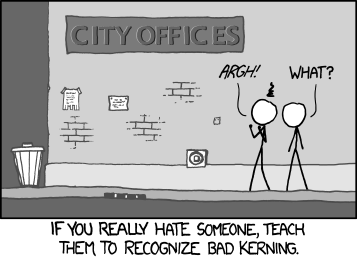
He also links to this highly appropriate xkcd comic:

I have never been as self-conscious about my handwriting as when I was inking in the caption for this comic.

Niall Ferguson apologizes for inappropriate comments about Keynes

Filed under: Economics, History, Media — Tags: , , — Nicholas @ 09:47

Historian and Harvard professor Niall Ferguson has issued an apology for some remarks he made about John Maynard Keynes at a conference in California:

I had been asked to comment on Keynes’s famous observation “In the long run we are all dead.” The point I had made in my presentation was that in the long run our children, grandchildren and great-grandchildren are alive, and will have to deal with the consequences of our economic actions.

But I should not have suggested — in an off-the-cuff response that was not part of my presentation — that Keynes was indifferent to the long run because he had no children, nor that he had no children because he was gay. This was doubly stupid. First, it is obvious that people who do not have children also care about future generations. Second, I had forgotten that Keynes’s wife Lydia miscarried.

My disagreements with Keynes’s economic philosophy have never had anything to do with his sexual orientation. It is simply false to suggest, as I did, that his approach to economic policy was inspired by any aspect of his personal life. As those who know me and my work are well aware, I detest all prejudice, sexual or otherwise.

May 3, 2013

Orwell’s Homage to Catalonia at 75

Filed under: Books, History, Media, Politics — Tags: , , , , , , — Nicholas @ 10:05

In the sp!ked review of books, Mick Hume looks at the book that got Orwell tossed out of the inner circle of leftist writers, not because it was bad, but because it was honest (and made Stalinism look too similar to Hitlerism):

George Orwell could have been killed twice in the Spanish Civil War. Once when he was shot in the throat by General Franco’s fascist forces; then when he was hunted by official Communist agents who, with the backing of Stalin’s Soviet Union, stabbed the revolution in the back and imprisoned, tortured and killed leading leftists and anarchists who were ostensibly on the same Republican side. Orwell learned the hardest way that the war against fascism in Spain was also a civil war against Stalinism.

Homage to Catalonia, Orwell’s famous account of his time in Spain from his arrival in Barcelona on Boxing Day 1936 to his escape in June 1937, has just reached its seventy-fifth anniversary. Like its author, the book almost didn’t make it either. The radical journalist and author’s usual publisher, Victor Gollancz, turned the book down without even seeing the manuscript, insisting that he would not publish anything ‘which could harm the fight against fascism’ by criticising the Communists.

Most of those from Britain and Europe who went to write about and fight in the Spanish Civil War took a similarly one-eyed view and followed the pro-Soviet line. What was unique about Orwell was that he hated fascism, but also stood apart from the official Stalinist-dominated left of his time. The radical maverick wrote about what he saw in Spain, rather than simply what he was told was true — although he also warned his readers to ‘beware my partisanship’ when seeking an objective account. He questioned the ‘official’ Stalinist-dictated account of events in Barcelona and elsewhere that was accepted around the world. This heresy made him the subject of a hate campaign when Homage to Catalonia was finally published in 1938, a campaign which continued well into the 1980s.

[. . .]

Orwell’s brilliant firsthand account of the conflict stands apart from and well above the I-was-there school of emotive, narcissistic war reporting we witness too often today. He also attempts to put his personal experiences into some proper political context, in two chapters now removed (at his request) from the narrative text and published at the end as appendices.

Here, Orwell closely interrogates and challenges the ‘official version’ of events in Barcelona, put about by the Communists and their many international apologists to justify their brutal repression of the non-Stalinist left. As he unravels the twisting of truth by propaganda organs such as the CPGB’s Daily Worker, you can almost see the ideas he was soon to express in his novels Animal Farm and Nineteen Eighty-Four. He is also cutting about the way that the Communists simply branded their opponents as ‘Social-fascists’ and ‘Trotsky-Fascists’ to avoid engaging in important political arguments. Many who express their admiration for Orwell today have yet to absorb his point that screaming ‘Fascists!’ in the faces of those you disagree with is not the same thing as making your case. ‘Libel’, as he concludes, ‘settles nothing’.

« Newer PostsOlder Posts »

Powered by WordPress