Quotulatiousness

August 1, 2013

Stereotypes of pornography consumers

Filed under: Britain, Media, Technology — Tags: , , , — Nicholas @ 13:05

James Delingpole had far too much fun writing this column:

You may be aware that David Cameron — as part of a secret, Lynton Crosby-inspired operation codenamed Suck Up Shamelessly To The Embittered Authoritarian Killjoy Harpies At Mumsnet — has decreed that as from next year the default option when you sign a contract with your new internet provider will be ‘No porn in this household, thank you. I think it’s a disgrace.’

Superficially (and does this coalition ever think any other way?) I can see this makes a lot of sense. After all, what do a growing national debt, falling living standards, rising inflation, skyrocketing energy prices, out-of-control immigration, Weimar-style money-printing, a burgeoning new housing bubble, a failed health service and a collapsing infrastructure matter when you’ve got the most important problem of our times, so to speak, in hand, viz. blokes sneaking a quick one off the wrist while their missus has popped down to Waitrose to stock up on Mabel Pearman’s Burford Brown eggs, Isigny Ste Mere unsalted butter and that Duchy Originals cider on special offer at just £1.45 a bottle?

According to James, nowadays women are about as likely to go looking for pornography on the internet as men are:

But according to some of my techie friends, this isn’t the case at all. They’re the ones who have to clear up all the viruses which you accidentally invited into your computer along when you were trying to Google the weather and mistakenly typed in ‘Romanian donkey babes xxx hardcore’ instead.

Here’s what one of them has to say: ‘The very worst I came across was a shared houseful of young ladies. It took over eight hours to do just the first pass with the antivirus software. That pass removed over 58,000 pieces of malware and spyware, and just under 2,000 viruses. It took all the next day to finish cleaning their computer. I told them it was the worst case of an infected computer I had ever come across, and one asked how it had happened for it to be so bad. Easy I said. Porn sites. They all went bright red and then the hilarity ensued, as the finger pointing started.’

[…]

I realise, of course, that there are still plenty of puritans out there who feel differently. To them I quote first Thomas Sowell: ‘What is ominous is the ease with which some people go from saying that they don’t like something to saying that the government should forbid it. When you go down that road, don’t expect freedom to survive very long.’ And second, Pastor Niemoller: ‘First they came for the wankers…’.

“That kind of grassroots power tends to make government officials jittery”

Filed under: Law, Media, USA — Tags: , , — Nicholas @ 12:34

J.D. Tuccille looks at the rise of Twitter … not so much its rise in users, but the rise in government interest and interference:

Twitter information requests 2012-13You know you’ve arrived as an online media operation when governments take an interest in who is speaking out, and make efforts to muzzle what’s published. That’s definitely the case with Twitter, the microblogging platform that started as an outlet for exhibitionist ADHD sufferers, only to become a powerful medium for sharing news and grassroots organizing. According to the company’s latest transparency report, governments around the world are issuing ever-more demands for information about the service’s users, and stepping up efforts to suppress tweeted content.

From January 1 through June 30 of this year, Twitter received 1,157 government requests for private information about users and accounts, up from 849 during the same period in 2012. Of those, authorities in the United States were responsible for 902 requests. Twitter complied in whole or part with 55 percent of all requests — 67 percent of those originating in the U.S.

Interestingly, roughly 20 percent of information requests issued by American authorities were “under seal,” meaning that Twitter was forbidden to fulfill its usual policy of informing users about requests for their private information.

QotD: Banksy and the lumpenintelligentsia

Filed under: Britain, Business, Media, Quotations — Tags: , , , — Nicholas @ 08:08

Better still is Banksy’s satirical picture, this one on a wall in London’s Essex Road, of two small children pledging allegiance, with hand on heart, to a Tesco plastic bag on a flagpole — actually an electric cable — being run up like a flag by a third child. Tesco is Britain’s largest supermarket chain, and its plastic bags, white with blue stripes and red lettering, litter the countryside, often flapping from trees or disfiguring hedgerows.

Of course, Banksy, as a spoiled child of a consumer society in which real shortage is unthinkable, has all the unexamined anticapitalist prejudices of the lumpenintelligentsia to whom he appeals. But it would be wrong to dismiss the satire of this image out of hand. Tesco, after all, issues a “loyalty card” called a Clubcard; every customer is asked at the checkout, now sometimes by machine, whether he has such a card. The card’s name implies that shopping repeatedly in the stores of one giant corporation rather than in those of another, in the hope of a small price rebate, constitutes membership in a club. You don’t have to be anticapitalist to think that such an idea debases the concept of human clubbability. (In the same way, the word “solidarity” is degraded in France by its association with the payment of high taxes extracted from citizens by force of law.) It is no new thought — but not therefore a false one — that at the heart of consumer society is often a spiritual vacuum, at least for many people. They fill the vacuum with meaningless gestures, such as loyalty to brands almost indistinguishable from one another. I have known murder committed over brands of footwear. Banksy’s image captures, both succinctly and wittily, the vacuum and what fills it.

You also don’t have to be anticapitalist to acknowledge that the power of corporations like Tesco is not altogether benign. The small and beautiful town in which I live when I am in England illustrates this. When my next-door neighbor decided to restore and redecorate his house, which dated from 1709, the local council’s conservation department demanded that the new lead flashing on his roof, invisible from the street, be stamped with a design of bees, presumably because it had been so stamped at some time in history. Certainly conservation is important and cannot be left entirely to individuals. But why was my neighbor bullied in this fashion when Tesco was permitted to open a store not 100 yards away with a frontage completely out of keeping with the town — an eyesore that affects the town’s aesthetic fabric infinitely more than the absence of bees on my neighbor’s invisible lead does? The great majority of British towns have been ruined aesthetically in a similar way, their main streets becoming dispiritingly uniform and ugly, no doubt through some combination of corporate power, bribery, and administrative incompetence. Bullying people like my neighbor is perhaps the officials’ overcompensation for their cowardice or dishonesty in the face of corporations. Banksy’s image therefore has some satirical depth to it.

Banksy’s attitude toward authority and property rights is the standard hostility of the lumpenintelligentsia. Here he is particularly hypocritical because, while maintaining that pose of hostility, he employs lawyers, owns private companies, and is reputed to be highly authoritarian in his dealings with his associates. Inside every rebel, goes the saying, there’s a dictator trying to get out.

Theodore Dalrymple, “The Discriminating Philistine: Banksy’s wit and talent don’t excuse his vandalism and juvenility”, City Journal, 2013-06

July 31, 2013

“What LEED designers deliver is what most LEED building owners want – namely, green publicity, not energy savings”

Filed under: Business, Environment, Media, USA — Tags: , , , — Nicholas @ 10:24

A bit of LEED debunking at The New Republic:

When the Bank of America Tower opened in 2010, the press praised it as one of the world’s “most environmentally responsible high-rise office building[s].” It wasn’t just the waterless urinals, daylight dimming controls, and rainwater harvesting. And it wasn’t only the Leadership in Energy and Environmental Design (LEED) Platinum certification — the first ever for a skyscraper — and the $947,583 in incentives from the New York State Energy Research and Development Authority. It also had as a tenant the environmental movement’s biggest celebrity. The Bank of America Tower had Al Gore.

The former vice president wanted an office for his company, Generation Investment Management, that “represents the kind of innovation the firm is trying to advance,” his real-estate agent said at the time. The Bank of America Tower, a billion-dollar, 55-story crystal skyscraper on the northwest corner of Manhattan’s Bryant Park, seemed to fit the bill. It would be “the most sustainable in the country,” according to its developer Douglas Durst. At the Tower’s ribbon-cutting ceremony, Gore powwowed with Mayor Michael Bloomberg and praised the building as a model for fighting climate change. “I applaud the leadership of the mayor and all of those who helped make this possible,” he said.

Gore’s applause, however, was premature. According to data released by New York City last fall, the Bank of America Tower produces more greenhouse gases and uses more energy per square foot than any comparably sized office building in Manhattan. It uses more than twice as much energy per square foot as the 80-year-old Empire State Building. It also performs worse than the Goldman Sachs headquarters, maybe the most similar building in New York — and one with a lower LEED rating. It’s not just an embarrassment; it symbolizes a flaw at the heart of the effort to combat climate change.

[…]

“What LEED designers deliver is what most LEED building owners want — namely, green publicity, not energy savings,” John Scofield, a professor of physics at Oberlin, testified before the House last year.

Governments, nevertheless, have been happy to rely on LEED rather than design better metrics. Which is why New York’s release of energy data last fall was significant. It provided more public-energy data for a U.S. city than has ever existed. It found the worst-performing buildings use three to five times more energy per square foot than the best ones. It also found that, if the most energy-intensive large buildings were brought up to the current seventy-fifth percentile, the city’s total greenhouse gases could be reduced by 9 percent.

Vikings training camp in full swing … and evil genius Rick Spielman is proven right again

Filed under: Football, Media — Tags: , , , , , — Nicholas @ 08:58

The Vikings are at their off-site training camp in Mankato this week, and the various fan blogs are doing a great job of covering the event (especially The Daily Norseman which has bloggers accredited and attending all open sessions). 1500ESPN has filled the void left when the great Tom Pelissero moved on to USA Today‘s sports department with Andrew Krammer (to team up with Judd Zulgad), while the main ESPN coverage is by Kevin Seifert. I hit my “maximum number of articles viewed” limit at the Minneapolis Star Tribune earlier this week, so the coverage from the St. Paul Pioneer Press is filling that gap for me until rollover.

I know most of you don’t much care for sports chatter, so I’ll put the rest of this post behind the curtain…

(more…)

July 30, 2013

The return of “lawful access”

Filed under: Cancon, Law, Liberty, Media, Technology — Tags: , , , , — Nicholas @ 07:56

Michael Geist on the Canadian implications of some information that was published in a Buzzfeed article about a Utah ISP and the NSA’s installation of a “little black box” in their network:

The article describes how a Foreign Intelligence Service Act (FISA) warrant allowed the NSA to monitor the activities of an ISP subscriber by inserting surveillance equipment directly within the ISP’s network. The experience in Utah appears to have been replicated in many other Internet and technology companies, who face secret court orders to install equipment on their systems.

The U.S. experience should raise some alarm bells in Canada, since the now defeated lawful access bill envisioned similar legal powers. Section 14(4) of the bill provided:

    The Minister may provide the telecommunications service provider with any equipment or other thing that the Minister considers the service provider needs to comply with an order made under this section.

That provision would have given the government the power to decide what specific surveillance equipment must be installed on private ISP and telecom networks by allowing it to simply take over the ISP or telecom network and install its own equipment. This is no small thing: it literally means that law enforcement (including CSIS) would have had the power to ultimately determine not only surveillance capabilities but the surveillance equipment itself.

While Bill C-30 is now dead, the government may be ready resurrect elements of it. Earlier this month, a cyber-bullying report included recommendations that are lifted straight from the lawful access package.

Was Caligula the victim of a historical smear campaign?

Filed under: Books, Europe, History, Media — Tags: , , , , , , — Nicholas @ 00:01

I confess, my views on Emperor Caligula (formally Gaius Julius Caesar Augustus Germanicus) were almost completely informed by the character in the novels I, Claudius and Claudius the God by Robert Graves. BBC News Magazine‘s Mary Beard thinks Caligula got a fearful load of bad press:

Of course, there had been some very nasty monarchs and despots before Caligula. But, so far as we know, none of his predecessors had ever ticked all the boxes of a fully fledged tyrant, in the modern sense.

There was his (Imelda Marcos-style) passion for shoes, his megalomania, sadism and sexual perversion (including incest, it was said, with all three of his sisters), to a decidedly odd relationship with his pets. One of his bright ideas was supposed to have been to make his favourite horse a consul — the chief magistrate of Rome.

Roman writers went on and on about his appalling behaviour, and he became so much the touchstone of tyranny for them that one unpopular emperor, half a century later, was nicknamed “the bald Caligula”.

But how many of their lurid stories are true is very hard to know. Did he really force men to watch the execution of their sons, then invite them to a jolly dinner, where they were expected to laugh and joke? Did he actually go into the Temple of the gods Castor and Pollux in the Roman Forum and wait for people to turn up and worship him?

It is probably too sceptical to mistrust everything that we are told. Against all expectations, one Cambridge archaeologist thinks he may have found traces of the vast bridge that Caligula was supposed to have built between his own palace and the Temple of Jupiter — so it was easier for him to go and have a chat with the god, when he wanted.

So the idea that Caligula was a nice young man who has simply had a very bad press doesn’t sound very plausible.

All the same, the evidence for Caligula’s monstrosity isn’t quite as clear-cut as it looks at first sight. There are a few eyewitness accounts of parts of his reign, and none of them mention any of the worst stories.

No revisionist slant on Caligula is complete without a few nasty cracks directed towards kindly old Uncle Claudius:

More topical though is the question of what, or who, came next. Caligula was assassinated in the name of freedom. And for a few hours the ancient Romans do seem to have flirted with overthrowing one-man rule entirely, and reinstating democracy.

But then the palace guard found Caligula’s uncle Claudius hiding behind a curtain and hailed him emperor instead. Thanks to Robert Graves, Claudius has had a good press, as a rather sympathetic, slightly bumbling, bookish ruler.

But the ancient writers tell a different story — of an autocrat who was just as bad as the man he had replaced. The Romans thought they were getting freedom, but got more of the same.

Considering what happened then, it’s hard not to think of the excitements and disappointments of the Arab Spring.

July 29, 2013

Why Germany is the venue for the loudest denunciations of NSA surveillance

Filed under: Europe, Germany, Government, Media, USA — Tags: , , , — Nicholas @ 09:14

Alex Harrowell explains the deep suspicions among Germans which long predate the NSA surveillance revelations:

Obviously, privacy and data protection are especially sensitive in Germany. After the Stasi, the centrality of big databases to the West German state’s response to the left-wing terrorists of the 1970s, and the extensive Nazi use of telephone intercepts during the seizure of power, it couldn’t really be otherwise. Privacy and digital activism is older and better established in Germany than anywhere else — in the US, for example, I consider the founding text of the movement to be the FBI vs. Steve Jackson Games case from 1990 or thereabouts, while the key text in Germany is the court judgment on the national census from ten years earlier. But the UK has a (strong) data protection act and no-one seems anywhere near as exercised, although they probably should be.

So here’s an important German word, which we could well import into English: Deutungshoheit. This translates literally as “interpretative superiority” and is analogous to “air superiority”. Deutungshoheit is what politicians and their spin doctors attempt to win by putting forward their interpretations and framings of the semirandom events that constitute the “news”. In this case, the key event was Snowden’s disclosure of the BOUNDLESS INFORMANT slides, which show that the NSA’s Internet surveillance operations collect large amounts of information from sources in Germany.

The slides don’t say anything about how, whether this was information on German customers handed over by US cloud companies under PRISM orders, tapped from cables elsewhere, somehow collected inside Germany, or perhaps shared with the NSA by German intelligence. This last option is by far the most controversial and the most illegal in Germany. The battle for Deutungshoheit, therefore, consisted in denying any German involvement and projecting the German government, like the people in question, as passive victims of US intrusion.

On the other hand, Snowden’s support-network in the Berlin digital activist world, centred around Jacob “ioerror” Applebaum, strove to imply that in fact German agencies had been active participants, and Snowden’s own choice of further disclosures seems to have been guided by an intent to influence German politicians. Der Spiegel, rather than the Guardian, has been getting documents first and their content is mostly about Germany.

In this second phase, the German political elite has shifted its feet; rather than trying to deny any involvement whatsoever, they have instead tried to interpret the possibility of something really outrageous as being necessary for your security, and part of fundamental alliance commitments which cannot be questioned within the limits of respectable discourse. The ur-text here is Die Zeit‘s interview with Angela Merkel, in which Merkel argues that she knew nothing, further that there was a balance to strike between freedom and security, that although some kinds of spying were unacceptable, the alliance came first. The effectiveness of this, at least in the context of the interview, can be measured by astonishingly uncritical questions like the one in which she was asked “what additional efforts were necessary from the Germans to maintain their competitiveness”.

H/T to Tyler Cowen for the link.

It’s the same joke over and over again … but it’s funny because it’s true

Filed under: Government, Humour, Media, USA — Tags: , , , — Nicholas @ 07:54

H/T to Nick Gillespie for the link.

July 28, 2013

Procol Harum and the Danish National Concert Orchestra and choir

Filed under: Media — Tags: , , — Nicholas @ 11:34

Procol Harum performing A Whiter Shade of Pale with the Danish National Concert Orchestra and choir at Ledreborg Castle, Denmark in August 2006

H/T to American Digest for the link.

Snowden is not the story

Filed under: Liberty, Media, Technology — Tags: , , , , — Nicholas @ 10:16

In the Observer, John Naughton makes a few corrections to the way the media is reporting the saga of Edward Snowden and his revelations about the NSA’s global surveillance operations:

Repeat after me: Edward Snowden is not the story. The story is what he has revealed about the hidden wiring of our networked world. This insight seems to have escaped most of the world’s mainstream media, for reasons that escape me but would not have surprised Evelyn Waugh, whose contempt for journalists was one of his few endearing characteristics. The obvious explanations are: incorrigible ignorance; the imperative to personalise stories; or gullibility in swallowing US government spin, which brands Snowden as a spy rather than a whistleblower.

In a way, it doesn’t matter why the media lost the scent. What matters is that they did. So as a public service, let us summarise what Snowden has achieved thus far.

Without him, we would not know how the National Security Agency (NSA) had been able to access the emails, Facebook accounts and videos of citizens across the world; or how it had secretly acquired the phone records of millions of Americans; or how, through a secret court, it has been able to bend nine US internet companies to its demands for access to their users’ data.

Similarly, without Snowden, we would not be debating whether the US government should have turned surveillance into a huge, privatised business, offering data-mining contracts to private contractors such as Booz Allen Hamilton and, in the process, high-level security clearance to thousands of people who shouldn’t have it. Nor would there be — finally — a serious debate between Europe (excluding the UK, which in these matters is just an overseas franchise of the US) and the United States about where the proper balance between freedom and security lies.

These are pretty significant outcomes and they’re just the first-order consequences of Snowden’s activities. As far as most of our mass media are concerned, though, they have gone largely unremarked. Instead, we have been fed a constant stream of journalistic pap — speculation about Snowden’s travel plans, asylum requests, state of mind, physical appearance, etc. The “human interest” angle has trumped the real story, which is what the NSA revelations tell us about how our networked world actually works and the direction in which it is heading.

July 24, 2013

Anti-porn UK MP gets hacked, threatens reporter who publicized the hack

Filed under: Britain, Liberty, Media, Politics — Tags: , , , , , — Nicholas @ 11:13

Apparently British Conservative MP Claire Perry doesn’t know a lot about the way the internet works, despite being described as an “architect” for David Cameron’s proposed porn blocker:

UK MP Claire Perry hacked

Claire Perry is the UK Tory MP who architected David Cameron’s idiotic national porno firewall plan. Her website was hacked and defaced with pornographic gross-out/shock images. When Guido Fawkes, a reporter and blogger, wrote about it on his website, Perry took to Twitter to accuse him of “sponsoring” the hack, and publicly announced that she would be speaking to his editor at the Sun (Fawkes has a column with the tabloid) to punish him for writing about her embarrassment.

Perry is so technologically illiterate that she can’t tell the difference between writing about someone hacking your website and hacking itself. No wonder she’s credulous enough to believe the magic-beans-peddlers who promise her that they’ll keep porn off the British Internet — a feat that neither the Chinese nor the Iranian governments have managed.

In spite of all the overheated rhetoric, there’s good news about race and crime in the US

Filed under: Law, Media, USA — Tags: , , — Nicholas @ 09:58

Radley Balko looks behind the scripted talking points to get at the actual data they’re ignoring:

Civil rights leaders and progressive activists have cited Zimmerman’s acquittal and the proliferation of robust self-defense laws as evidence of a “war on black men” — or, similarly, that it’s now “open season on black men.” Meanwhile, Zimmerman supporters and many on the political right have used the case to bring up old discussions of black-on-black murders in places like Chicago, and to argue that violence in black America is spiraling out of control. Both positions are cynical, and both tend to pit black and white America against one another.

But both are also wrong on the facts.

First, about the alleged “war on black men.” The argument here is that laws like Florida’s “Stand Your Ground” are encouraging white vigilantism, and moving white people to shoot and kill black people at the slightest provocation. But there just isn’t any data to support the contention. Black homicides have been falling since the mid-1990s (as have all homicides). Moreover, according to a 2005 Bureau of Justice Statistics report, more than 90 percent of black murder victims are killed by other black people. And if we look at interracial murder, there are about twice as many black-on-white murders as the other way around, and that ratio has held steady for decades.

However, it also isn’t true that black America is growing increasingly violent. Again, black homicides, like all homicides, are in a steep, 20-year decline. In fact, the rates at which blacks both commit and are victims of homicide have shown sharper declines than those of whites. It’s true that Chicago has had an unusually violent last few years, but this is an anomaly among big American cities. The 2012 murder rate in Washington, D.C., for example, hit a 50-year low. Violent crime in New York and Los Angeles is also falling to levels we haven’t seen in decades.

[…]

To get to the more sensational conclusion, the article considers interracial homicide as a percentage of total homicides. And indeed, measured that way the “rate” of interracial murder has gone up. But it’s an odd way to measure. The vast, vast majority of murders are intraracial. And, as noted, those murders have been dropping considerably. The interracial murder rate has been dropping, too. According to the Scripps Howard review, the raw number of black-on-white and white-on-black murders combined was about the same in 2010 as it was in the early 1980s. But the United States population has grown considerably in that time, from 227 million in 1980, to 315 million today. So if you measure it the way all other crime is measured, the interracial murder rate has dropped, not increased.

Actually, these sound like typical characteristics for political candidates

Filed under: Media, Politics, USA — Tags: , , , — Nicholas @ 09:37

Jim Geraghty talks about the treasure-trove of media gaffes that is the Anthony Weiner campaign:

We can still laugh at Anthony Weiner… and we will be laughing at him for a long time. But it is starting to feel like we’re watching a man with serious, deep-rooted psychological issues relating to his sexuality, his self-control, his ability to assess risk, his inability to admit the truth unless confronted with overwhelming evidence of his falsehoods, his willingness to see others as objects and God knows how many other issues…

[…]

Did anybody really think Weiner had really changed from the man caught in scandal two years ago? Some may have hoped that fatherhood would make him grow up some, and some may be surprised that he would be so reckless as to choose to run for mayor with additional women out there, waiting to tell their tales of his much more recent tawdry behavior… but did anybody really believe that he had turned over a new leaf and become a changed man? Back in June, BuzzFeed’s Ruby Cramer quoted professional therapists who contended Weiner’s description of his short stay at a psychiatric evaluation center did not come close to what they would consider serious treatment.

People go into politics for a lot of reasons – some altruistic or idealistic or principled, some base, and for many, a mix of both. A career in politics can provide an individual with a lot of what they desire – power, admirers, fame, money. Kissinger declared power to be the ultimate aphrodisiac, so perhaps political stature is indeed a great way to enhance one’s sex appeal. (Right now, half my male readers working in politics just mumbled to themselves, “I must be doing it wrong.”)

Clearly, those fulfilling those desires can be addictive. We’ve seen the comeback playbook executed by politician after politician, time after time, so that it has become a boring, predictable cliché; the more a candidate sticks to the playbook, the less persuaded we should be that there is any real remorse or acceptance of responsibility.

After the “deny, deny, deny” strategy (as Monica Lewinsky quoted Bill Clinton) blows up in a politician’s face, he admits some portion of the accusations, but denies others. (A “modified limited hangout.”) There may be counter-accusations; there is an acceptance of some consequences but not others. At the press conference, the wife may be rolled out as a human shield. There is an insistence that the focus on the scandal has been a distraction from the politician’s real work. There is an insistence that this wrongdoing was a private matter and not the public’s concern. The accusations are driven by partisan motives, anyway. There is an admission of sin and often a very public seeking of spiritual counsel from political allies who are religious figures. There is a soft-focus interview that appears to be an open confession but that remains vague on key details; the privacy of others will be cited. God will get mentioned a lot. And throughout it all, the politician remains convinced: I can come back from this. This isn’t the end of me. As his presidential campaign flopped and his sex scandal ticked like a time bomb, John Edwards was utterly convinced he could trade his endorsement for the running mate slot to either Barack Obama or Hillary Clinton; when that effort went nowhere, he set his sights on being attorney general or, ultimately, nominated to the Supreme Court.

They need this. They so, so need this. They really cannot go on to living a life outside the spotlight, just practicing law somewhere or running a hardware store. (Well, John Edwards is apparently returning to practicing law.)

The spoils of political victory – power, fame, groupies, lucrative post-elected-office jobs in lobbying or consulting – will always attract a certain number of unscrupulous head cases, egomaniacs, narcissists, and borderline unhinged. They will only go away when the voters say “no.”

July 23, 2013

Future monarchs and present-day “republicans”

Filed under: Britain, Government, Media — Tags: , , , — Nicholas @ 09:48

As you may have noticed, I haven’t devoted any space on the blog to coverage of the Duke and Duchess of Cambridge and their son. It’s not that I’m a rabid republican — I’m as much of a mild monarchist as a libertarian can be. What I have found even more tedious than the celebrity pregnancy coverage of the royal baby is the spitting and moaning coming from the “republican” side. Brendan O’Neill (a noted republican) points out that the moaners don’t actually represent real republicans:

So, the royal baby is finally here, and across Blighty the little people will have made themselves virtually bald through frenzied forelock-tugging, or perhaps busted their backs by bowing and scraping before their mewling future king. At least, that’s the impression that has been given by a certain breed of observer, the ironically public-allergic republicans who seem to hate the monarchy primarily because of the behaviour and emotions it induces in the plebs. Once, being a republican meant trusting the public (the clue was in the name) and believing it had the capacity to think and act rationally. Today, if the ostentatious chattering-class wailing about the mob hysteria over Kate’s baby is anything to go by, it means the opposite — it means despairing of the public and shaking a snobby head over its Stepford-like enthralment to all things monarchical.

As soon as it was announced that Kate was expecting, these shallow republicans started bemoaning the mass hysteria that would ensue. Britain will once again become ‘a nation of forelock-tuggers’, clever broadsheet people warned. Apparently, ‘forelock-tugging is all the rage’ in this supposedly modern nation, where the daft blob formerly known as the public is being kept non-angry about the recession and other horror stories through being dripfed info about Kate, Wills and their baby. In the words of the Mirror’s poetic Brian Reade, ‘Our austere country need not grieve, for Wills’ missus can conceive’. That has been the central message of most of the apparently rad commentary on Kate — that the plebs are easily bought off with photos of a pregnant princess and smiling prince. One columnist wrote of the ‘ready-to-whoop peasants’ waiting for news of Kate’s babe. A writer for the Independent said of Kate’s pregnancy, ‘Everyone laps it up… it makes plebs of us all’.

[…]

There are two annoying things about all this. The first is that it’s plain wrong to depict today’s media and public interest in Kate’s baby as a resuscitation of old-world royalist sentiment. Most of the public relates to Kate in the way they relate to celebs — not as a godly bearer of a babe whom we will one day bow before, but as another preggers celeb in nice clothes we can read about in our spare time; a posher Kim Kardashian, if you will. The House of Windsor has self-consciously cultivated a celebrity image for itself in recent years, sensing that its old imperial, mysterious, God-derived powers and so-called right to rule are on the wane in this era of profound crisis for traditionalism, and that celebrity is now a far more powerful source of authority than kingliness. Indeed, the popularity of Kate as just another celeb, albeit a super-A-list one, speaks to the moral diminution of monarchism as it was once understood, to the emptying-out of its alleged magic and power, not to its rehabilitation.

And secondly, this pleb-mauling republicanism is not republicanism at all. It is very often fuelled by an anachronistic desire to protect Kate from the prying eyes of the princess-hungry throng. We are putting poor Kate in a ‘gilded cage’, lefty columnists fret. Others claim we are hounding her — we have clearly ‘learned nothing since Princess Diana’. It’s a very odd republicanism which feels empathy for individual members of the royal family and disdain for the public. For me, editor of the uber-republican spiked, republicanism is not about sneering, but rather is about engagement, taking ourselves and the public seriously, talking about how society should be run, and by whom. And as the American revolutionary John Adams said, pursuing such republicanism means believing the public can be ‘sufficiently enlightened to disabuse themselves of artifice, imposture, hypocrisy and superstition’. Sadly, too few British republicans believe that these days.

Full points to Private Eye for their royal baby cover:
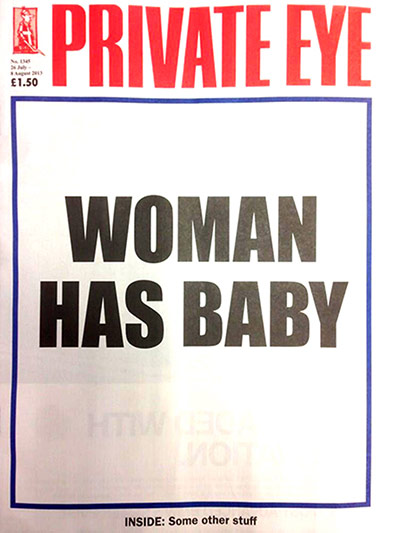
Private Eye

Update: Charles Stross — another republican — has an almost sympathetic view of the new prince’s future:

The kid is not going to have anything remotely approaching a normal life. For one thing, under current UK law, he isn’t eligible to vote. His ultimate career path is already known and if he doesn’t want to put up with it, tough: the pressure to conform to expectations is enormous — he was born under a life sentence. When he ends up in that final occupation he won’t even be eligible for a passport (for long and complex constitutional reasons). He’s going to be the subject of paparazzi attention for the rest of his life. He’s almost certainly going to be sent to a private boarding school of some variety (probably Eton, as with his father), to ensure that he’s exposed to normal people (for “public schoolboy” values of normality); this is normal for the royal family, and it’s worked on previous generations. The usual recipe is for it to be followed by university, then officer training in one of the branches of the military, before joining the Old Firm and learning the onerous duties of public ceremonies and diplomatic receptions. The royals get a particularly brutal work-out in return for their privileges: what other family business would expect an 87 year old great-grandmother to make over 400 public appearances per year?

But those are the traditional parameters of a crown prince’s upbringing. This prince is going to find things a little different because he’s going to be the first designated future British monarch to grow up in a hothouse panopticon, with ubiquitous surveillance and life-logging …

I expect there to be Facebook account-hacking attacks on his friends, teachers, and associates — and that’s just in the near term. He’s going to be the first royal in the line of succession to grow up with the internet: his father, Prince William, was born in 1982 and, judging by his A-level coursework, is unlikely to have had much to do with computer networking in the late 1990s. This kid is going to grow up surrounded by smartphones, smart glasses (think in terms of the ten-years-hence descendants of Google Glass), and everything he does in public can be expected to go viral despite the best efforts of the House of Windsor’s spin doctors.


« Newer PostsOlder Posts »

Powered by WordPress