
On August 2nd, 2013, 14-year-old Hannah Smith of Leicestershire, England, took her own life. She had been receiving cruel messages on the social networking site Ask.fm for months, and her parents concluded that cyberbullying was the main cause of her suicide. But then evidence emerged that the hatred Hannah had been receiving came from … herself — 98 percent of the messages were posted from the IP address of the computer she was using.
This tragic event inspired a research project by Sameer Hinduja and colleagues at the Cyberbullying Research Center in Florida. Their analysis of around 5,500 teenagers produced some surprising results: “We knew we had to study this empirically,” Hinduja remarked, “and I was stunned to discover that about 1-in-20 middle- and high-school-age students have bullied themselves online. This finding was totally unexpected, even though I’ve been studying cyberbullying for almost 15 years.”
Boys reported digital self-harm more often (7.1 percent) than girls (5.3 percent). Asked why they participated in such behaviour, their replies included: “I already felt so bad with myself that I wanted to make myself feel even worse” and “I wanted to see if someone really was my friend.” However, there were also those who claimed that they did it to justify their aggressive behaviour towards others, or just for fun, to see how others would react.
If teenagers are prepared to harm themselves in cyberspace to attain the status of victim, it should not be especially surprising that some adults do so in the real world. In the most notorious example of this behaviour, actor Jussie Smollett told police he had been the victim of a racist and homophobic attack on January 20th, 2019. He immediately found himself at the centre of media attention and public opinion. But the subsequent investigation revealed that Smollett had paid two men to assault him and that he had sent himself the threatening letters he had received the week before.
This was not an isolated incident. In his book Hate Crime Hoax, political scientist Wilfred Reilly analysed 346 alleged hate crimes and found that fewer than a third were genuine. He provides detailed descriptions of almost a hundred high-profile cases that never actually happened, most of which were supposed to have taken place on university campuses. Reilly concludes that, contrary to popular belief, we are not experiencing an epidemic of hate crimes, but an epidemic of hate crime hoaxes perpetrated by people searching for public attention and sympathy.
Nor is it only hate crimes that are the subject of hoaxes and false accusations. A meta-analysis conducted by Australian scholars Claire E. Ferguson and John M. Malouff in 2015 revealed that as many as 5.2 percent of all reported rape cases are false. The authors note, however, that their analysis only accounts for accusations that were disproven in the course of investigations — many others were never confirmed or were withdrawn for reasons unknown.
Tomasz Witkowski, “The Victims’ Race”, Quillette, 2021-08-27.
December 8, 2021
December 7, 2021
Sarah Hoyt on the nonsense of so many pandemic measures
Posting at Instapundit, Sarah Hoyt lists some of the many, many poor and even counter-productive public-health-theatre measures most western governments have been indulging in since the beginning of 2020:

Wuhan Institute of Virology.
Wikimedia Commons.
Let’s say you’re one of those insane people who dismissed the low numbers of death/serious illness aboard the Diamond Princess because apparently people on cruise ships have “top quality medical care” (Coo-ey! Is the sky made of candy floss in your world?) in what world — even a candy floss sky one — did it make sense to close local grocery stores but keep Walmart open? In what world did it make sense to direct flow in stores so everyone crammed in through the same door, and everyone walked the same path (thereby a crowded/grimy, etc. path)? In what world did reducing hours of stores make sense? In what world did it make sense to wear a mask to your table then remove it to eat? (Are you less contagious when sitting?) In what world did curfews make sense? In what world did mask mandates outside in botanic gardens and zoos make sense? In what world did it make sense that you were hectored for getting out and driving around, while remaining your car?
In what world did the government stomp on every — no matter how crackpot or inocuous — rumored treatment? In what world, despite all studies to the contrary, do two layers of thin fabric stave off viral infection? In what world are doctors and nurses laid off by the thousands during a supposed pandemic? And finally in what world does it make any sense that a completely ineffective — if not (the numbers are not trustworthy in the sense that we can’t trust anything from collection to reporting, but in the UK there are indications that way) counterproductive — vaccine is being forced on the population by government mandate?
The deaths of so many people — thanks to dodgy statistical reporting and frequent moving-the-goalpost sleights of hand we may not know exactly how many — are tragic, but the deliberate destruction of public trust in our governments, healthcare systems, and media reporting will continue for a long, long time to come. The Wuhan Coronavirus has not been the civilization-wrecker we were all told to fear, but the breakdown in trust will make us all more vulnerable the next time a serious disease strikes. Trust is earned, slowly, and rebuilding lost trust will be a much slower process.
December 6, 2021
QotD: Modern “Canadian culture” is a vast vanity press operation funded with lots of government money
CanCon is a heavy lift at the best of times, being close neighbors to that hulking great monster south of us which is the most creative culture on earth. That is why we spend billions every year to prop up our creators, our artists, who we love.
Except we don’t.
Film salaries are funded up to 50%, books, 30%, news media 60%, and yet … no one is watching, reading, or listening. It is like a giant vanity project which various foreign appointees can brandish in foreign capitals.
Last month I traced the sales of this year’s Canadian literary award winners and I suppose “best-sellers”. Their sales on Amazon, hardcover, soft cover and digital ranged from 4 books to 33 books per month, incomes hovering in the three figures. (Amazon accounts for roughly 70% of sales.) This during summer reading months where Canadians are at their lake shacks from coast to coast reading one would hope about themselves, the world they live in, and well … just curiosity.
Equally looking at the viewer and listener stats for the CBC, our national behemoth, which eats up $1.5 billion annually, and which amounts to 50% of the media dollars spent, is equally disheartening. The state spends another $600 million supporting once-successful media because “internet”.
CBC television is watched by 3.9% of Canadians and only .8% watch CBC News. Again, half of all media dollars, half. Half is spent engaging less than 4% of Canadians.
CBC radio is considered reasonably good, and is listened to despite the almost vindictive calling out of anyone who disagrees with their hard socialist stance. Despite every conceivable advantage, advertising on the CBC dropped 20% during the pandemic.
In fact, they are so disliked that CBC is hiring “close protection security” for the next two years. They are so disliked, they have turned off commenting on their various programs. They are so disliked that there is a brand of coffee called “Defund the CBC”. This isn’t passive ignoring, this is active dislike to the point of needing bodyguards.
Why?
Because our media show us Canadians as racist, stupid, sexist, stupid, stupid and more stupid. And while they are at it, shallow and violent.
That is the real reason, and the only reason CanCon is dying. They hate us.
Elizabeth Nickson, “Canadian Culture on the Ropes”, Elizabeth Nickson, 2021-09-01.
December 2, 2021
“Good idea, Judith. We shall fight the oppressors for your right to have babies, brother. Sister. Sorry.”
The power of Python compelled Stephen Green to write this:
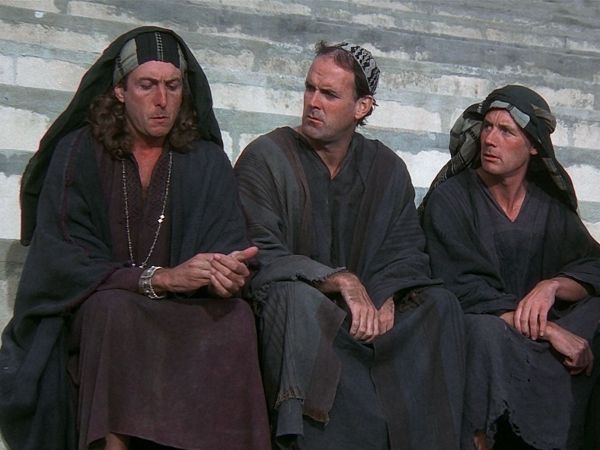
Stan: “I want to be a woman. From now on, I want you all to call me ‘Loretta’.”
Still from Monty Python’s Life of Brian, 1979.
Of all the jokes, gags, and barbs thrown in every direction, Jesus is the only figure shown respect. Monty Python trouper Eric Idle later said of Jesus, “What he’s saying isn’t mockable, it’s very decent stuff.”
For a non-believing, take-no-prisoners comedian like Idle, that’s practically a whole-hearted endorsement.
Instead, the film — Python’s only real film, the others were basically collections of sketches, even Holy Grail — is anti-authoritarian, anti-fanaticism, anti-nihilism, and anti-humorless prigs.
Life of Brian is, however, very pro-funny.
The Pythons even saved their sharpest barbs for political extremists and self-deluded lefties.
Case in point on that last observation: The classic Colosseum conversation between the would-be revolutionaries of the Judean People’s Front.
Or was that the People’s Front of Judea?
Regardless, take two minutes (clip below!) to bask in the comedic good sense that would get the cast and entire production crew canceled in our times.
The postmodern Left should probably cancel everyone who laughed at this scene, just to be safe.
Anyway, point-by-point, Monty Python satirically dissected the then-nascent cultural trends that have since come to dominate not only our culture, but also our politics and even our private lives.
Enjoy … although I will admit that re-watching this today, the laughs were a bit more bitter than they were when I first watched Life of Brian nearly 40 years ago.
December 1, 2021
Polling bias in a time of pandemic
At The Daily Sceptic, Mike Hearn looks at the often incredible poll results turned up by YouGov that seem to indicate that well over half the population of Britain are budding medical fascists who want nothing more than a full-on pandemic tyranny from now to the end of time:

Recently YouGov announced that 64% of the British public would support mandatory booster vaccinations and another polling firm claimed that 45% would support indefinite home detention for the unvaccinated (i.e., forced vaccination of the entire population). The extreme nature of these claims immediately attracted attention, and not for the first time raised questions about how accurate polling on Covid mandates actually is. In this essay I’m going to explore some of the biases that can affect these types of poll, and in particular pro-social, mode and volunteering biases, which might be leading to inaccurately large pro-mandate responses.
There’s evidence that polling bias on COVID topics can be enormous. In January researchers in Kenya compared results from an opinion poll asking whether people wore masks to actual observations. They discovered that while 88% of people told the pollsters that they wore masks outside, in reality only 10% of people actually did. Suspicions about mandate polls and YouGov specifically are heightened by the fact that they very explicitly took a position on what people “should” be doing in 2020, using language like “Britons still won’t wear masks”, “this could prove a particular problem”, “we are far behind our neighbours” and most concerning of all – “our partnership with Imperial College”. Given widespread awareness of how easy it is to do so-called push polling, it’s especially damaging to public trust when a polling firm takes such strong positions on what the public should be thinking and especially in contradiction of evidence that mask mandates don’t work. Thus it makes sense to explore polling bias more deeply.
[…]
Given the frequency with which large institutions say things about COVID that just don’t add up, it’s not entirely surprising that people are suspicious of claims that most of their friends and neighbours are secretly nursing the desire to tear up the Nuremberg Code. But while we can debate whether the chat-oriented user interface is really ideal for presenting multi-path survey results, and it’s especially debatable whether YouGov should be running totally different kinds of polls under the same brand name, it’s probably not an attempt to manipulate people. Or if it is, it’s not a very competent one.
When I was much younger, I’d very occasionally get a call on our land line from a polling firm. I’d sometimes take part in the poll, although I don’t recall every seeing any of the polls I took part in being published later. After a few years, I stopped taking part and now I hang up as soon as it’s clear that the call is from a polling company. Apparently I’m far from alone in this learned aversion to dealing with polls:
Online panel polling solves the problem of low phone response rates but introduces a new problem: the sort of people who answer surveys aren’t normal. People who answer an endless stream of surveys for tiny pocket-money sized rewards are especially not normal, and thus aren’t representative of the general public. All online panel surveys face this problem and thus pollsters compete on how well they adjust the resulting answers to match what the “real” public would say. One reason elections and referendums are useful for polling agencies is they provide a form of ground truth against which their models can be calibrated. Those calibrations are then used to correct other types of survey response too.
A major source of problems is what’s known as “volunteering bias”, and the closely related “pro-social bias”. Not surprisingly, the sort of people who volunteer to answer polls are much more likely to say they volunteer for other things too than the average member of the general population. This effect is especially pronounced for anything that might be described as a “civic duty”. While these are classically considered positive traits, it’s easy to see how an unusually strong belief in civic duty and the value of community volunteering could lead to a strong dislike for people who do not volunteer to do their “civic duty”, e.g. by refusing to get vaccinated, disagreeing with community-oriented narratives, and so on.
In 2009 Abraham et al showed that Gallup poll questions about whether you volunteer in your local community had implausibly risen from 26% in 1977 to a whopping 46% in 1991. This rate varied drastically from the rates reported by the U.S. census agency: in 2002 the census reported that 28% of American adults volunteered.
November 30, 2021
QotD: Getting to dystopia
Things are changing very fast. And, if we don’t fully understand why they’re changing and where they’re heading, we’re going to end up in one of those dehumanized dystopias — and very soon.
Mark Steyn, “Live Around the Planet: Tuesday January 22nd”, Steyn Online, 2019-01-22.
November 28, 2021
QotD: Hidden political pay-offs as “book advances”
True advances are, well, advances against expected future royalties. That’s why they’re called “advances”.
People expect that a J.K. Rowling book will produce at least $5 million in royalties, so you give her a $5 million advance on those royalties. You’re giving her a payment on her royalties in advance of actually seeing those sales.
But you do expect them.
You don’t pay her fresh royalties until the royalties she generates exceeds the initial advance on royalties you paid her.
When she makes $5 million and one hundred dollars, you send her a fresh check for one hundred dollars.
When these major media conglomerates, all left-leaning and most with business before the government, give millions to Hillary Clinton and Hunter Biden and Andrew Cuomo, there is no one at that company that expects the books will ever make that much in royalties.
They’re just payoffs. Or disguised political donations.
It’s not an “advance” if you cannot show a plausible stream of sales which will meet or exceed that “advance”.
Personally, I’d love to see some kind of law on this subject to force these large media corporations to prove that they have a genuine, rational belief that a Hunter Biden book will make $10 million in sales (which would justify a million dollar advance, assuming a royalty of 10%).
And I’d like to see their corporate officers sign certifications for the government that they’re not fudging the numbers. And that they understand that there might be prosecutions for perjury if they do lie about expected future royalties.
Much like people in the financial sector are constantly required to sign.
Why should media corporations be immune from such requirements?
And I’d love to see these disguised campaign donations treated and limited just like actual campaign donations.
Or, better yet: No “advances” for serving politicians, declared politicians who are running, or any politician ten years after his term of service ends. They can just take their royalty checks as royalties actually accrue.
If Hunter Biden really sells $10 million in books — LOL — then he’ll get that million dollars eventually in royalty payments. They’ll just come over the course of a year or two rather than all at once in an “advance” on future earnings.
If not — then not.
This isn’t stopping them from getting paid for books they sell — it’s to stop mega-media-corporations with business before the government, and a strong desire to pay off politicians they like, from giving “advances” to favored politicians that bear no relationship whatsoever to the actual expected royalties the books will generate.
Ace, “Ethics Agency Might Claw Back Cuomo’s $5 Million ‘Advance’ For His ‘Book'”, Ace of Spades H.Q., 2021-08-27.
November 24, 2021
Rousseau versus “original sin” in modern-day culture
In UnHerd, Mary Harrington ponders the two irreconcilable camps struggling for cultural supremacy in western countries, as most recently highlighted by the Kyle Rittenhouse trial in Kenosha, Wisconsin:

Portrait of Jean-Jacques Rousseau (1712–1778) by
Maurice Quentin de La Tour, circa 1753.
Wikimedia Commons.
The Rittenhouse argument is just such a case. It’s powered by a profound disagreement about human nature: one that fuels many of the most intractable modern culture wars, from Mumsnet bunfights about babycare to arguments about classroom discipline and what the police force is for.
Are humans naturally good given the right circumstances? Or are we flawed and in need of threats and guidelines to keep us on the straight and narrow? The split is a legacy of radical ideas stretching back to the revolutionary 18th century.
Perhaps the most famous proponent of intrinsic human goodness is Rousseau, who claimed in Emile (1762) that children are born virtuous. As Rousseau sees it, we only need freedom, love and the right environment to spontaneously come to an understanding of what’s right.
When Emile was first published, it stood in stark challenge to the then-dominant view, emerging from the Christian tradition, that humans are tainted by “original sin”. From this vantage point, we’re naturally flawed, and must always struggle against our less virtuous instincts. Rousseau’s claim so appalled adherents of this then-dominant view that copies of his book were burned in the street.
Today, though, the boot is on the other foot. The high-status view among contemporary elites is unmistakeably Team Rousseau.
At the tiniest scale, it’s expressed in the school of parenting that believes it’s wrong or even cruel to teach children how to live. I’ve written before about the currently popular ideas of “attachment parenting” and “gentle parenting”, which emphasise self-discovery in a loving environment over routine, authority or punishment — and about how these views skew wealthy and liberal.
In education settings, the same idea appears as “child-centred pedagogy”, an approach that emphasises individual pathways and discovery over rote learning and teachers as authority figures. And at the biggest scale, it crops up as the claim that all the root causes of crime are external to humans: poverty, trauma, discrimination and so on. From this perspective, if we could only replace policing with tailored community services that eliminated these root causes, there would no longer be any crime.
Even outbreaks of mass public disorder are treated by Team Rousseau as an unfortunate-yet-understandable response to bad governance: when BLM protesters in Baltimore toppled a statue of Christopher Columbus last year, the Democrat politician Nancy Pelosi responded by shrugging it off as a natural expression of that community’s wishes. If the community doesn’t want the statue, she said, “the statue shouldn’t be there”. From this vantage point, public unrest is something akin to the weather: a naturally-occurring phenomenon in which leaders must strive to create the conditions for goodness, or else “people will do what they do”.
November 23, 2021
Tucker Carlson’s new book The Long Slide
Wilfred M. McClay reviews Carlson’s collected essays for First Things:
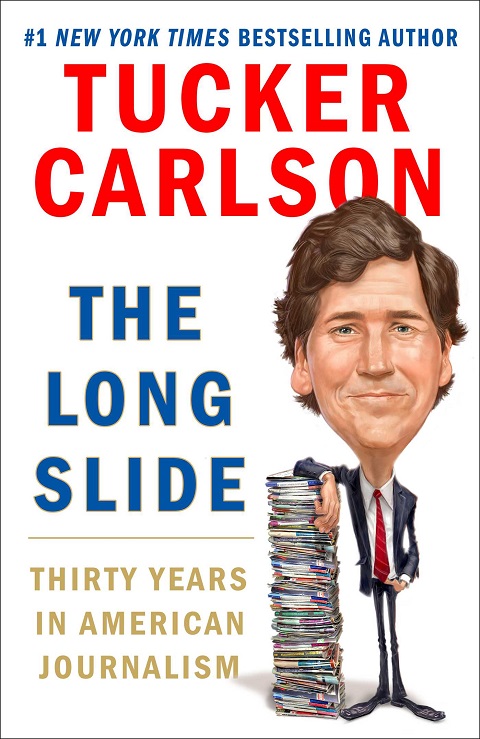
Tucker Carlson has become such a fixture in the world of cable-television news that it’s easy to forget he began his journalistic career as a writer. And a very good one at that, as this wide-ranging and immensely entertaining selection of essays from the past three decades serves to demonstrate. Carlson’s easygoing, witty, and compulsively readable prose has appeared everywhere from The Weekly Standard (where he was on staff during the nineties) to the New York Times, the Spectator, Forbes, New Republic, Talk, GQ, Esquire, and Politico, which in January 2016 published Carlson’s astonishing and prophetic article titled “Donald Trump is Shocking, Vulgar, and Right”. That essay has been preserved for posterity in these pages, along with twenty-two other pieces, plus a bombshell of an introduction written expressly for the occasion. More of that in a moment.
The first response of many of today’s readers, particularly those who don’t like the tenor of Carlson’s generally right-populist politics or the preppy swagger and bubbly humor of his TV persona, will be to dismiss The Long Slide as an effort to cash in on the author’s current notoriety by recycling old material to make a buck. That was my assumption when I first opened this collection. But the book has an underlying unity, and a serious message. It evokes a bygone age, an era of magazine and newspaper journalism that seems golden in retrospect, and is now so completely gone that one must strain to imagine that it ever existed at all. The simple fact is that almost none of these essays could be published today, certainly not in the same venues: They are full of language and imagery and a certain brisk cheerfulness toward their subject matter that could not possibly pass muster with the Twittering mob of humorless and ignorant moralists who dictate the editorial policies of today’s elite journalism.
Carlson’s writing style reflects the influence of the New Journalists such as Tom Wolfe and Hunter Thompson, who brought a jaunty, whiz-bang you-are-there narrative verve and high-spirited drama to the task of telling vividly detailed stories about unusual people and places, generally relating them in the first person. Carlson’s prose is not as spectacular as Wolfe’s or as thrillingly unhinged as Thompson’s. But it has its own virtues, being crystal clear, conversational, direct, and vigorous, never sending a lardy adjective to do the work of a well-chosen image, and never using gimmicky wild punctuation or stretched-out words to fortify a point. He’s a blue-blazer and button-down-collar guy, not a compulsive wearer of prim white suits or a wigged-out drug gourmand wearing a bucket hat and aviator glasses. But many of Carlson’s writings give the same sense of reporting as an unfolding adventure, a traveling road show revolving around the reactions and experiences of the author himself.
Carlson usually shows a certain fundamental affection for the people he writes about, even if he also ribs or mocks them in some ways. In particular, there is none of that ugly contempt for the “booboisie” and ordinary Americans that one finds, for example, in the pages of H.L. Mencken, and in a great deal of prestige journalism. Instead, he reserves his contempt for the well-heeled know-it-alls who genuinely deserve it. In that sense, the Carlson of these essays does not seem very different from the Carlson of today. He always has been a bit of a traitor to his class, and commendably so.
November 22, 2021
QotD: Canadian values
Robert Fulford, quoted in “Canada takes a new look at ‘fable’ of its image”, New York Times, 2005-05-25. (Link updated thanks to MILNEWS.ca in the comments.)
November 20, 2021
Meet The Last Artisans Making Traditional Bagpipes By Hand In Scotland’s Capital | Still Standing
Business Insider
Published 2 Jul 2021Bagpipes have been a symbol of Scottish heritage for centuries, but traditional artisans have faced stiff competition with the rise of mass manufacturing. Kilberry Bagpipes is now the last workshop in the capital city of Edinburgh where they still make them by hand.
For more information, visit:
https://kilberrybagpipes.com/——————————————————
#Bagpipes #Scotland #BusinessInsider
Business Insider tells you all you need to know about business, finance, tech, retail, and more.
Visit us at: https://www.businessinsider.com
BI on Instagram: https://read.bi/2Q2D29T
BI on Twitter: https://read.bi/2xCnzGF
BI on Amazon Prime: http://read.bi/PrimeVideoMeet The Last Artisans Making Traditional Bagpipes By Hand In Scotland’s Capital | Still Standing
From the comments:
Kilberry Bagpipes
1 month ago
It was a pleasure having you guys in to film with us! Thank you for putting together such a fantastic video illustrating what we do and why we do it! If anyone has any further questions or is keen to learn to play then please feel free to email us where we will be happy to help!All the best,
Dave and Ruari
The Kilberry Team

QotD: Cheating with both hands
Batches of counted votes can be very unbalanced towards either candidate or they can be large, but there is a strong inverse relationship between the two. The paper analyses a lot of data to show the improbability of both very unbalanced and very large. This is a good test because it tends to get past fraudsters, who are focussed on the raw margin of votes more than the ratio or the batch size.
A secondary tell – and this one is already well-known in fraud detection in third-world countries – is improbable ratios of the losing candidate to minor candidates, e.g. Trump getting little more than twice as many votes as the minor candidates in the second Michigan anomaly when the state’s average (calculated including that data point) was 31 to 1. The paper finds this combination of grossly-violated size-margin ratio and grossly-violated Trump-to-third-party ratio particularly suspicious (as do I). It also computes what happens if you pull these four data points in towards merely the 99th percentile of the size-margin relationship – leaving them still anomalous but not so wildly implausible. (Biden loses his alleged lead in all three states.) It also notes some related statistical oddities.
My guess is that the idea of the US waking up to what I’d woken up to – Trump the heavy odds-on favourite – terrified his enemies. Their pre-election narrative was that Trump would at first “appear” to win, after which “days and weeks of counting” (Zuckerberg) would show he had lost. But while Zuckerberg promised to “educate” America to believe in that, I think someone in the early hours of the 4th panicked that if the US electorate woke up to a bookies-call-it-for-Trump breakfast on Wednesday morning, that would never be erasable from the US mind, no matter how many votes they then “found”. So they made sure that didn’t happen. (You never know: it might yet be that what they did to prevent that becomes equally hard to remove from America’s consciousness. You don’t have to be a statistician to think a sudden step function in a smooth graph looks odd.)
So the good news is that my memory for numbers is working fine. The bad news is that I may lose a night’s sleep next election. The very first of the four anomalous points went into the Georgia vote totals soon after 6:30 AM my time – half-an-hour after the normal rising time of Donald Trump and Margaret Thatcher, I am told. (I guess the reason I’m not PM or president is that I’m usually asleep then.) When I first glanced at the results, I thought Georgia was surprisingly close given e.g. the Florida result, but if I’d missed the other three oddities as completely as Georgia’s, I’d have been far less cautious in reviewing the outcome.
Niall Kilmartin, “Good News! I can believe my eyes”, Samizdata, 2020-12-01.
November 19, 2021
Viewing-with-alarm … from afar
In Spiked, Simon Evans explains why he finds British commentary on US hot-button issues like guns and race to be frequently uninformed but remarkably certain of itself:

What many Brits believe every American carries in their pickup trucks or on their persons, probably.
As a Brit, there are few things less edifying, nor more unintentionally hilarious, than an American newspaper reporting on any very English scandal. A breach of some obscure royal protocol, perhaps, or an aspect of parliamentary procedure, often involving Black Rod, which despite the capital B, the Washington Post will have to explain, is not a racial epithet, or an ill-advised tribute act.
A personal favourite is when a provincial dietary preference has caught the New York Times‘ eye, having unexpectedly “caught on” nationwide. It is an innocent enough pleasure, watching Americans trying to distinguish black pudding from haggis, or indeed gravy from “chippy sauce”. Like watching the Dutch discuss the morality of bullfighting, or Korea debate a proposed rule change in top flight Buzkashi.
Yet put the sneaker on the other foot and watch British commentators angrily contend the moral and legal thrust of a case in which an American is on trial for using lethal force with a firearm, and we suffer something very like Gell-Mann Amnesia by proxy. We forget how important a little local knowledge might be, and our seasoned, tolerant, bemused respect for tradition and culture and specialist knowledge are gone within moments. Watching the Kyle Rittenhouse case approach a verdict, British commentators are a-froth with indignation at the palpable miscarriages of justice seemingly running unchecked only five short hours away across the globe. My God, he had a gun ! What more is there to say? And – do I have this right? – he crossed state lines ! The man’s a monster.
Not since the proroguing of parliament two years ago have so many people become acquainted so quickly with something so arcane as the crossing of state lines with intent to do mischief. Putting aside the fact that the weapon itself did not cross this fabled demarcation, what is striking is the evident lack of enthusiasm for certain other state lines, such as the one somewhat further to America’s south, or indeed the one etched around the British Isles, that currently seem to get crossed on a pretty frequent basis, with who knows what intent? Drawing attention to those lines is clearly racist.
It was GB Shaw who first made the observation that GB’s shores were separated from the US’s by an ocean of incomprehension, concealed by our sharing a common language.
Rather like urban Canadians, most British readers and viewers tend to agree with the opinions expressed in US mainstream media based largely in urban coastal areas:
So, we don’t get the full spectrum argument. Instead, we gratefully share the apparent horror and shame of the coastal elite, with their tertiary education and their teeth that meet in the middle, when confronted with their inland, inbred in-laws. We deplore the multi-decade epidemic of what seems, if you read the Washington Post and the NYT, to be the largely white, Wild West assassination culture that 2A concedes. Bullets sprayed around schools. Shopping malls, synagogues and mosques running with blood. A death toll out of all control. Murder, cold-blooded and cruel – and largely in the service of a bigotry, as often as not a racial bigotry, as old as the Appalachians hills.
This is, to put it as mildly as one can without choking, not quite the whole story. Do your own due diligence, it isn’t hard. The editors of the NYT can’t stop you acquainting yourself with the FBI crime statistics, and they put some of the more notorious outbreaks of flying lead into useful perspective.
But generally, we instead swallow like sugary cough syrup (believing it good for us, no matter how delicious it also is) the narrative that guns are largely in the hands and lovingly tended racks of homicidal white supremacists, paranoid death-spiral redneck survivalists, and a police force that is barely superior in discipline, racial enlightenment or legitimacy to a rounded-up posse of ad hoc lynch-happy vigilantes.
November 17, 2021
Environmental pessimism despite the facts
Alexander Hammond refutes one of the many, many articles preaching global environmental doom and disaster:
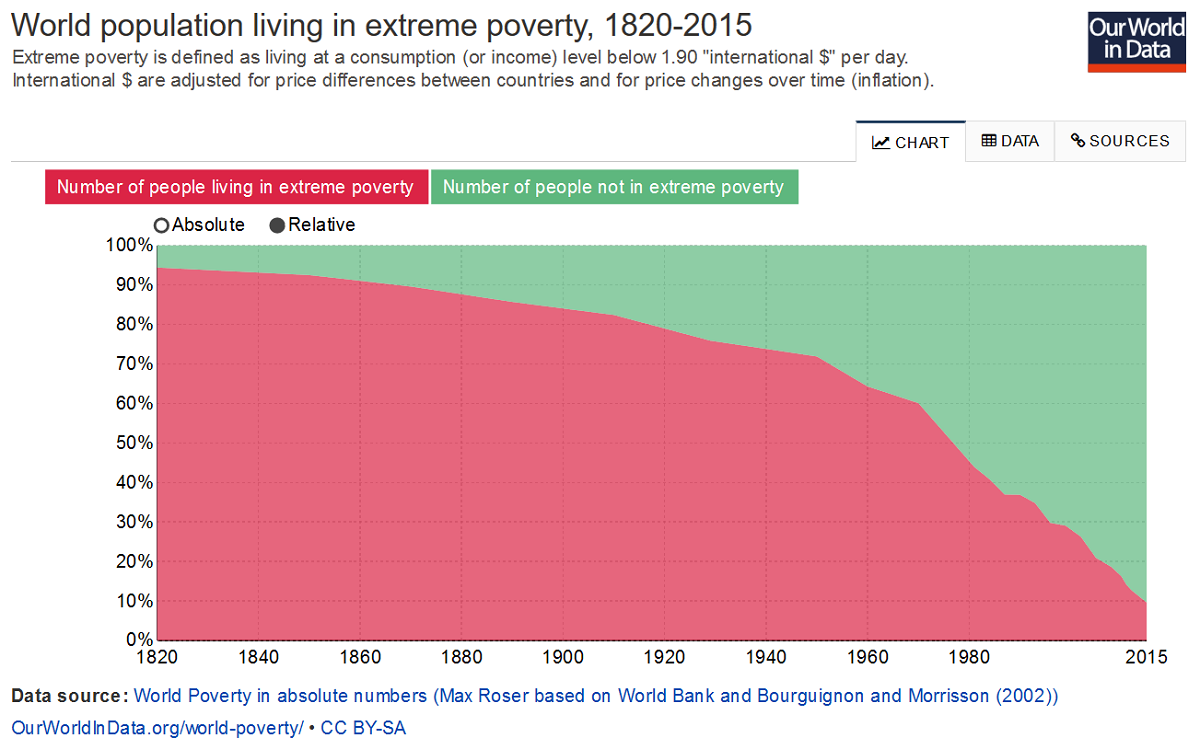
Last week, The Scotsman published an article by the journalist Anastasiia Zagoruichyk. In the piece, Zagoruichyk claims that thanks to climate change, fires, and deforestation in her native Ukraine, her children won’t get to experience childhood joys like “walking in the autumn forest, picking mushrooms and breathing fresh air.”
Forest coverage in Ukraine is, admittedly, a niche topic, but alarmism about the future of our forests and our children is unfortunately widespread. Indeed, it was not long ago that Extinction Rebellion founder Roger Hallam confidently declared that due to deforestation and other environmental damage, “our children are going to die in the next 10-20 years.” Thankfully for humanity, these far-fetched claims are not based in reality.
Contrary to what Zagoruichyk would have you believe, forest coverage in Ukraine has increased drastically in recent years. Between 1992 (the oldest data available) and 2020, the share of land in Ukraine covered by forest increased from 16.1 percent to 16.7 percent. While a 0.6 percentage point increase might seem like a small amount, this equates to an additional 3,622 square kilometers of forest – a land area roughly 1.5 times larger than the country of Georgia.
Globally, the world does continue to lose forest area. However, according to the United Nation’s Food and Agriculture Organisation (FAO), the rate of deforestation between 2010-2020 was 40 percent lower than in 1990-2000. At this rate, even without additional promises from world leaders at COP, the global deforestation rate will likely hit zero. Indeed, over the last 30 years, net afforestation has occurred in Europe (including Russia), North America, Oceania, and Asia.
The world’s two poorest regions, South America and Africa, are also the only ones that continue to experience net deforestation. This is no coincidence; many environmental scientists and commentators suggest that economic and ecological well-being are intimately related. According to one hypothesis, called the Environmental Kuznets Curve, a region’s environment worsens in tandem with economic growth but only until a certain income per capita is reached. At that point, people can afford to protect the environment, and ecosystems flourish. This environmental recovery has occurred across Europe and North America and is currently happening in China, Russia, India, and Vietnam.
Therefore, as South America and Africa continue to become richer, we can expect their rate of forest loss to slow and eventually reverse. Given this good news, why is there so much pessimism about the future of our forests? Zagoruichyk’s article offers some answers.
Earlier this month, Michael Shellenberger also had good-but-ignored environmental news to report in UnHerd:
No global problem has ever been more exaggerated than climate change. As it has gone from being an obscure scientific question to a theme in popular culture, we’ve lost all sense of perspective.
Here are the facts: in Europe, emissions in 2020 were 26% below 1990 levels. In the United States, emissions in 2020 were 22% below 2005 levels. Emissions are likely to start declining, too, in developing nations, including China and India, within the next decade. Most nations’ emissions will be bigger this year than last, due to post-Covid economic growth. But global emissions are still likely to peak within the next decade.
And the result will be a much smaller increase in global average temperatures than almost anyone predicted just five years ago. The best science now predicts that temperatures are likely to rise just 2.5-3°C above pre-industrial levels. It’s not ideal, but it’s a far cry from the hysterical and apocalyptic predictions of 6°C, made just a decade ago. A 3°C increase is hardly an existential threat to humanity.
Not that you’d know it, if you had half an eye on the headlines this summer. The floods, fires and heatwaves that plagued the world were, for many observers, proof that the impacts of climate change have already become catastrophic. In Europe, more than 150 people died in flooding. In the United States, wildfire season started earlier and lasted longer, razing hundreds of thousands of acres. Around the world, hundreds died from heatwaves.
But again, it’s worth reminding ourselves of the facts: there has been a 92% decline in the per decade death toll from natural disasters since its peak in the 1920s. In that decade, 5.4 million people died from natural disasters. In the 2010s, just 0.4 million did. Globally, the five-year period ending in 2020 had the fewest natural disaster deaths of any five-year period since 1900. And this decline occurred during a period when the global population nearly quadrupled — and temperatures rose more than 1°C degree centigrade above pre-industrial levels.
QotD: From Theda Bara to Lady Gaga
In 1933, the critic I.A. Richards, writing about “The Waste Land”, spoke of T.S. Eliot’s “persistent concern with sex, the problem of our generation, as religion was a problem of the last.” After the first world war, sexual experimentation and titillating smart talk became the hallmark of the emancipated new woman, who smoked, drank, bobbed her hair and danced the antic Charleston. Hollywood discovered that sex was great box office — leading to pressure from civic and religious groups for a production code, which movie-makers found ingenious ways to evade.
We are approaching the 100-year anniversary of Hollywood sex: Theda Bara’s incarnation as The Vamp in A Fool There Was (1915), a lurid femme fatale who slew overnight the lingering Victorian ideal of the pure, saintly woman-child, portrayed on screen by Mary Pickford and Dorothy and Lilian Gish. Theda Bara, like Lady Gaga, was a manufactured personality; although the studio publicity department claimed she was born in the Sahara to a French artist and Arabian princess, she was actually Theodosia Goodman, the daughter of a Jewish tailor in Cincinnati.
The sexual icon of 1920s Hollywood was Clara Bow, a madcap flapper who was probably falsely rumoured to have bedded the entire University of Southern California football team. Lithe Louise Brooks, with her signature bobbed hair, made landmark films of decadent eroticism in Germany. Wicked Mae West and lushly buxom Jean Harlow began the tradition of the sex bomb, which continued through Hedy Lamarr to Jane Russell and Marilyn Monroe, whose influence endures around the globe. But the cardinal sexual pioneer was Marlene Dietrich, who exploded on the international scene in 1930 as the heartless cabaret singer of The Blue Angel. In her subsequent films with the director Josef von Sternberg, Marlene toyed with transvestism (based on the drag balls of Weimar Berlin) and created the sophisticated look of hard glamour that remains a staple of fashion magazines.
Marlene was Madonna Louise Ciccione’s idol; the seductive, commanding Marlene permeates Madonna’s brilliant videos of the 1980s and the early ’90s, with their dominatrix, transvestite and bisexual motifs. Madonna wanted to play Marlene on film, but the idea was overruled by Marlene herself, who (as the proud daughter of a Prussian officer) decreed Madonna “too vulgar”.
Weimar cabaret was recreated in the 1972 film Cabaret, based on Christopher Isherwood’s Berlin stories. Bob Fosse’s dazzlingly aggressive choreography in that blockbuster film was adopted by Madonna for her videos and stage shows — all of which have been doggedly imitated by Lady Gaga. Gaga has borrowed so heavily from Madonna (as in her latest “Alejandro” video) that it must be asked, at what point does homage become theft? But the main point is that the young Madonna was on fire. She was indeed the imperious Marlene Dietrich’s true heir. Madonna’s incandescence is still on view in videos like “Open Your Heart”, “Vogue” and “Express Yourself”. However, for Gaga, sex is mainly decor and surface; she’s like a laminated piece of ersatz rococo furniture. Alarmingly, Generation Gaga can’t tell the difference. Is it the death of sex? Perhaps the symbolic status that sex had for a century has gone kaput; that blazing trajectory is over.
Camille Paglia, “Lady Gaga: The Death of Sex”, Sunday Times, 2010-09-12.


