
Thomas SowellTV
Published 17 Dec 2021
(more…)
August 28, 2023
Why Britain Advanced Before Other European Nations | Thomas Sowell
Comments Off on Why Britain Advanced Before Other European Nations | Thomas Sowell
August 22, 2023
With Bill C-18 about to come into effect, there is zero sense for the “tech giants” to start negotiating
Michael Geist explains why there are no incentives for Google and Meta to begin any kind of negotiations with the Canadian government over the ruthlessly self-destructive Online News Act:

The rhetoric around Bill C-18 has escalated in recent days in light of the awful wildfires in NWT and British Columbia. In my view, the issues associated with these tragic events have little to do with Meta blocking news links and the attempt to bring it into the conversation is a transparent attempt to score political points (the connectivity issues with some NWT communities completely taken offline for days is somehow never mentioned). The reality is that Meta was asked about just this scenario at committee and it made it clear that it would not block any non-news outlet links. That is precisely what has been happening and the government’s legislative choices should be the starting point for understanding why compliance with the law involves blocking a very broad range of news links that extend beyond even those sources that are defined as “eligible news outlets”.
The government and supporters of Bill C-18 talking points now emphasize two things in relation to Meta blocking news links: the law has yet to take effect and there is room to address their concerns in the regulation-making process. Both of these claims are incredibly deceptive, relying on the assumption that most won’t bother to read the actual legislation. If they did, they would see that (1) the law has received royal assent and can take effect anytime and (2) the regulation making process addresses only a small subset of Bill C-18 issues with most of the core issues finalized. In other words, the time to shape the law and address many of the key concerns was before the government repeatedly cut off debate in order to ensure it that received royal assent before the summer break.
Start with when the law takes effect. As noted above, the law has been passed and received royal assent. It is the law of the land and there is no scope for changes or amendments without a new bill that must be passed by Parliament. Section 93 establishes when the provisions come into force. The law initially envisioned a staged approach whereby certain sections would be proclaimed in effect by the government in stage one, followed by four additional stages, some of which were contingent on certain regulations coming into force. Yet at the last minute the government approved a Senate amendment that basically discarded the entire approach. Section 93(6) states:
(6) Despite subsections (1) to (5), any provision of this Act that does not come into force by order before the 180th day following the day on which this Act receives royal assent comes into force 180 days after the day on which this Act receives royal assent.
The entire law therefore takes effect no later than 180 days after royal assent, which is December 19, 2023. This change was included at the urging of the Canadian media sector (specifically Quebecor) which lobbied to have it take effect as soon as possible. Under this approach, the law can take effect at any time as the government need only issue the relevant Orders-in-Council. There is now little wiggle room. As of today’s post, the latest the law will take effect is in 120 days but it could happen well before that.
Once the law takes effect, the clock on negotiations and potential mediation and arbitration begins. The timelines are fixed in Section 19(1) of the law: 90 days to negotiate and 120 days for mediation. If there is no agreement and no request to the CRTC to extend the deadlines, the issue can go to final offer arbitration. To be clear, none of these timelines are subject to the regulation making process. They are fixed and they create obvious urgency for anyone facing compliance requirements.
The government threatened Meta and Google with mandated payment to Canadian news sources if their online services merely linked to articles or videos from those news sources. Meta and Google rationally decided that the tiny little Canadian market wasn’t worth the cost of paying CBC and other Canadian news outlets for the privilege of sending them readers and are in the process of obeying the letter of the new law and blocking such links on their respective platforms. They told the Canadian government that this is what they’d do if the law was passed in its current form, yet the government is pretending to be shocked and surprised that Meta and Google are going to obey the law.
After all, there’s no real risk that lives might be endangered because so many Canadians are used to getting their news by way of Facebook or Google, is there?
Comments Off on With Bill C-18 about to come into effect, there is zero sense for the “tech giants” to start negotiating
August 17, 2023
Lawfare as politics by other means
Chris Bray explains why getting rid of the Donald Trump candidacy wouldn’t even begin to solve the real problems in US politics today:
Donald Trump has been charged with crimes, so the Republican Party should drop him as a candidate and move on to someone else who hasn’t been indicted. That’ll solve the problem!
It won’t. The problem is lawfare. The Republican governor of Wisconsin defeated a recall effort, so Democratic district attorneys launched a long series of predawn raids on his supporters — until the courts made them stop. The Republican governor of Texas won four terms, but then was indicted by the office of a Democratic district attorney — for a budget veto, an action within his constitutional authority. Again, the courts intervened, and the legally absurd charges were dismissed.
Today, scumbag California Assemblyman Evan Low, a uniquely craven publicity chaser even by the local standards, proudly announces that he’s just introduced a legislative resolution calling for the federal government to open a criminal investigation into Florida Governor Ron DeSantis.
So. Get rid of Trump and nominate DeSan— oh, wait. Okay, name someone, anyone: Chris Christie, Vivek Ramaswamy, a utility nominee to be named later in exchange for three rookie infielders. Oh no, it turns out that the new nominee is under criminal investigation for [TBD]! As of, uh, tomorrow.
I have mixed feelings about Donald Trump, who supported pandemic lockdowns and school closures and the rushed development of mRNA injections with limited testing. Dumping him as a candidate because he’s been indicted misses the point. No Republican candidate will run for the presidency without being indicted, unless he’s a court-eunuch Mitt Romney figure, too safe to bother attacking.

Comments Off on Lawfare as politics by other means
August 13, 2023
Don’t worry about losing all your news links, citizen! The Liberal government’s Ministry of Propaganda will tell you everything you need to know!
The federal government still seems shocked and a little bit hurt that the “tech giants” are carefully obeying the letter of their new Online News Act instead of pumping millions of dollars into government-favoured media outlets. How dare Alphabet and Meta obey the law we wrote? We wanted to soak them for bribes subsidies to give to legacy corporations who can be depended upon to cheerlead our agenda!
Blocking of news links on Facebook and Instagram in Canada has becomes increasingly widespread in recent days, leading to a growing number of public comments from media outlets and reporters expressing surprise or shock about the scope of the link blocking. Indeed, outlets with blocked links include university student newspapers, radio stations, and foreign news outlets. While there may have been some errors (Facebook has a page to seek review of any blocked link decision), the inclusion of a very wide range of Canadian and foreign news outlets is no accident. Rather, it reflects the government’s Bill C-18 approach, which effectively covers all news outlets worldwide whose links are accessed in Canada. The Canadian government could have adopted a more targeted approach – for example, limiting the scope to news links from those news outlets eligible to negotiate agreements with Internet platforms under the law – but it instead went for the broadest possible approach that includes foreign news outlets with little or no connection to Canada.
Understanding why Bill C-18 covers news links from outlets who are not “eligible news businesses” under the law requires unpacking several provisions. First, start with the definition of a “digital news intermediary”, which states:
digital news intermediary means an online communications platform, including a search engine or social media service, that is subject to the legislative authority of Parliament and that makes news content produced by news outlets available to persons in Canada. It does not include an online communications platform that is a messaging service the primary purpose of which is to allow persons to communicate with each other privately.
This definition is critical since the only companies that are subject to Bill C-18’s requirement to negotiate agreements with news outlets are (1) those that qualify as DNIs under this definition and (2) meet the requirements found in Section 6 on a significant bargaining power imbalance. The absence of significant bargaining power imbalance is why companies such as Twitter, Microsoft or Apple are not subject to the law. That leaves Google and Meta, provided that they qualify as DNIs. The key phrase in the qualification requirement is that the companies “make news content produced by news outlets available to persons in Canada”. If the companies do not make news content produced by news outlets available to persons in Canada they are not DNIs and are not subject to the law.
[…]
… the government’s choice was to try to bring Meta and Google into the scope of the law by virtue of any news links to any news outlet anywhere in the world, even if those outlets have nothing to do with Canada or with the Bill C-18 system. Given Meta’s stated goal of complying with Bill C-18 by removing links to news content that would render it a DNI, the government’s legislative choice of covering all news links from all news outlets therefore effectively requires it to block all of those news links.
It takes a lot to make Google, of all companies, a sympathetic victim … yet Canada’s awesomely awful Liberal government aced it. Bananada strikes again!
Comments Off on Don’t worry about losing all your news links, citizen! The Liberal government’s Ministry of Propaganda will tell you everything you need to know!
August 3, 2023
“Tech giants” obey the law and block access to Canadian news sites to Canadian users
For some reason — despite a clamour of warnings from sensible observers — the Canadian government still seems shocked and surprised that the much-reviled “tech giants” have chosen to obey the new Online News Act and are actively blocking links to Canadian media outlets just as the law requires:

For months, supporters of Bill C-18, the Online News Act, assured the government that Meta and Google were bluffing when they warned that a bill based on mandated payments for links was unworkable and they would comply with it by removing links to news from their platforms. However, what has been readily apparent for months became reality yesterday: Meta is now actively blocking news links and sharing on its Facebook and Instagram platforms. The announcement does not reference Threads, but it would not surprise if news links are ultimately blocked on that platform as well. The company says that the blocking will take several weeks to fully roll out to all users, suggesting that it has learned from the over-blocking mistakes made in Australia and is proceeding more cautiously in Canada. By the end of the month, the world’s largest social media platform will become a news desert in Canada, with links to all news – both Canadian and foreign – blocked on the platform.
It is worth revisiting that it was only a couple of months ago that some industry leaders, lobbyists, and academics were assuring the Senate that the Meta threat was just a bluff. Kevin Desjardins of the Canadian Association of Broadcasters, referenced the Australian experience, and told the Senate committee studying the bill that “when legislated to do so, they will come to the table”. Sylvain Poisson of Hebdos Quebec confidently said “they made those threats in Australia and elsewhere and every time they back down”. Chris Pedigo of the U.S.-based Digital Context Next assured the committee “it’s important to understand what happens when these bills become law. In Australia, they moved quickly to secure deals. They have done similar work in Europe, and I expect it would happen quickly in Canada as well.” And Carleton professor Dwayne Winseck said “I am not worried. The threats they are making, they are doing this all around the world.”
Despite the assurances, the company was true to its word and blocking news links is now here. If this is a negotiation tactic, it’s a pretty strange one given that reports indicate the company is not talking to the government about potential changes to a law that has already received royal assent. Indeed, while the new Heritage Minister Pascale St-Onge urged the company to participate in the regulatory process, there is nothing in the regulations that could alter the fundamental principle in the bill of mandated payments for links. At best, the government could toss aside its commitment to stay out of negotiations by using the regulations to dictate to the supposedly independent CRTC how much needs to be spent in order to avoid Bill C-18’s final offer arbitration provisions. Government negotiating total payment value and eviscerating the CRTC’s independence does not inspire confidence and Meta reasonably wants no part of it, since the time to fix Bill C-18 was before it received royal assent, not after.
Bolded section mine: I didn’t realize that it wasn’t just Canadian media links that were being blocked … it’s all news sites in the world being hidden from Canadian users. That’s an escalation from what I’d originally understood. I don’t blame the “tech giants” at all, but it will be tough on older Canadians who’ve been depending on social media to keep them up-to-date on domestic and foreign news.
Comments Off on “Tech giants” obey the law and block access to Canadian news sites to Canadian users
July 30, 2023
QotD: Thomas Hobbes and Leviathan
… I’m not trying to cast Thomas Hobbes, of all people, as some kind of proto-Libertarian. The point is, for Hobbes, physical security was the overriding, indeed obsessive, concern. Indeed, Hobbes went so far as to make his peace with Oliver Cromwell, for two reasons: First, his own physical safety was threatened in his Parisian exile (a religious thing, irrelevant). Second, and most importantly, Cromwell was the Leviathan. The Civil Wars didn’t turn out quite like Hobbes thought they would, but regardless, Cromwell’s was the actually existing government. It really did have the power, and when you boil it down, whether the actually existing ruler is a Prince or a Leviathan or something else, might makes right.
One last point before we close: As we’ve noted here probably ad nauseam, modern English is far less Latinate than the idiom of Hobbes’s day. Hobbes translated Leviathan into Latin himself, and while I’m not going to cite it (not least because I myself don’t read Latin), it’s crucial to note that, for the speakers of Hobbes’s brand of English, “right” is a direction – the opposite of left.
I’m oversimplifying for clarity, because it’s crucial that we get this – when the Barons at Runnymede, Thomas Hobbes, hell, even Thomas Jefferson talked about “rights”, they might’ve used the English word, but they were thinking in Latin. They meant ius – as in, ius gentium (the right of peoples, “international law”), ius civile (“civil law”, originally the laws of the City of Rome itself), etc. Thus, if Hobbes had said “might makes right” – which he actually did say, or damn close, Leviathan, passim – he would’ve meant something like “might makes ius“. Might legitimates, in other words – the actually existing power is legitimate, because it exists.
We Postmoderns, who speak only English, get confused by the many contradictory senses of “right”. The phrase “might makes right” horrifies us (at least, when a Republican is president) because we take it to mean “might makes correct” – that any action of the government at all is legally, ethically, morally ok, simply because the government did it. Even Machiavelli, who truly did believe that might makes ius, would laugh at this – or, I should say, especially Machiavelli, as he explicitly urges his Prince, who by definition has ius, to horribly immoral, unethical, “illegal” (in the “law of nations” sense) behavior.
So let’s clarify: Might legitimates. That doesn’t roll off the tongue like the other phrase, but it avoids a lot of confusion.
Severian, “Hobbes (II)”, Founding Questions, 2020-12-11.
Comments Off on QotD: Thomas Hobbes and Leviathan
July 27, 2023
QotD: The causes of crime in Britain
Theodore Dalrymple, “Pray for Rain”, Taki’s Magazine, 2017-07-08.
Comments Off on QotD: The causes of crime in Britain
July 8, 2023
Iowa votes to re-impose child labour in ways that violate federal labour laws
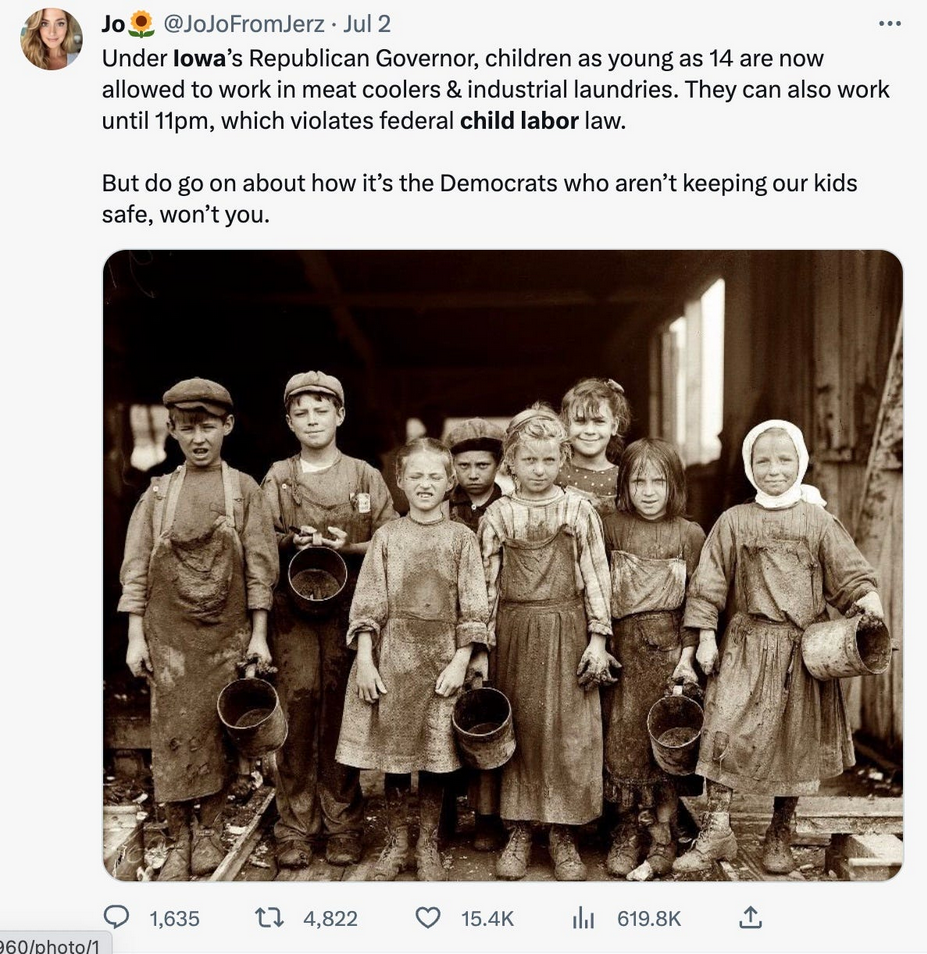
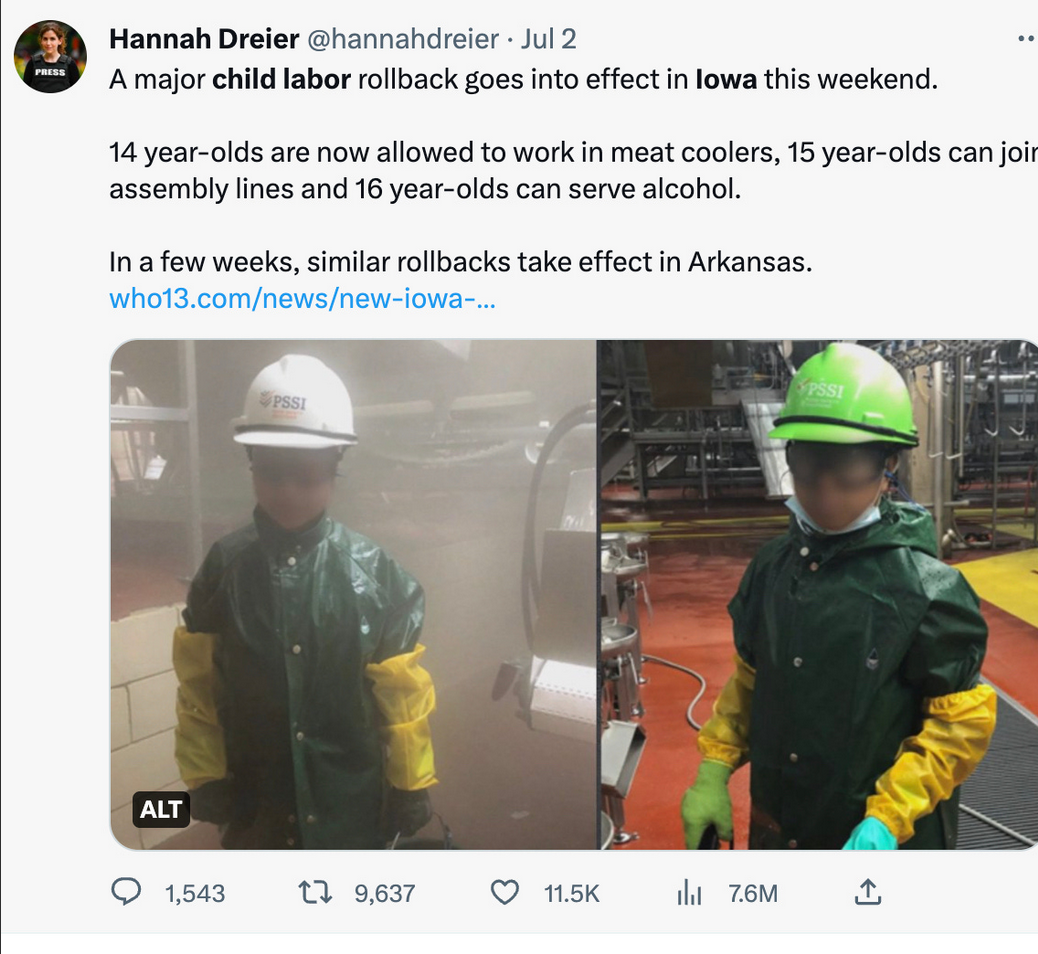
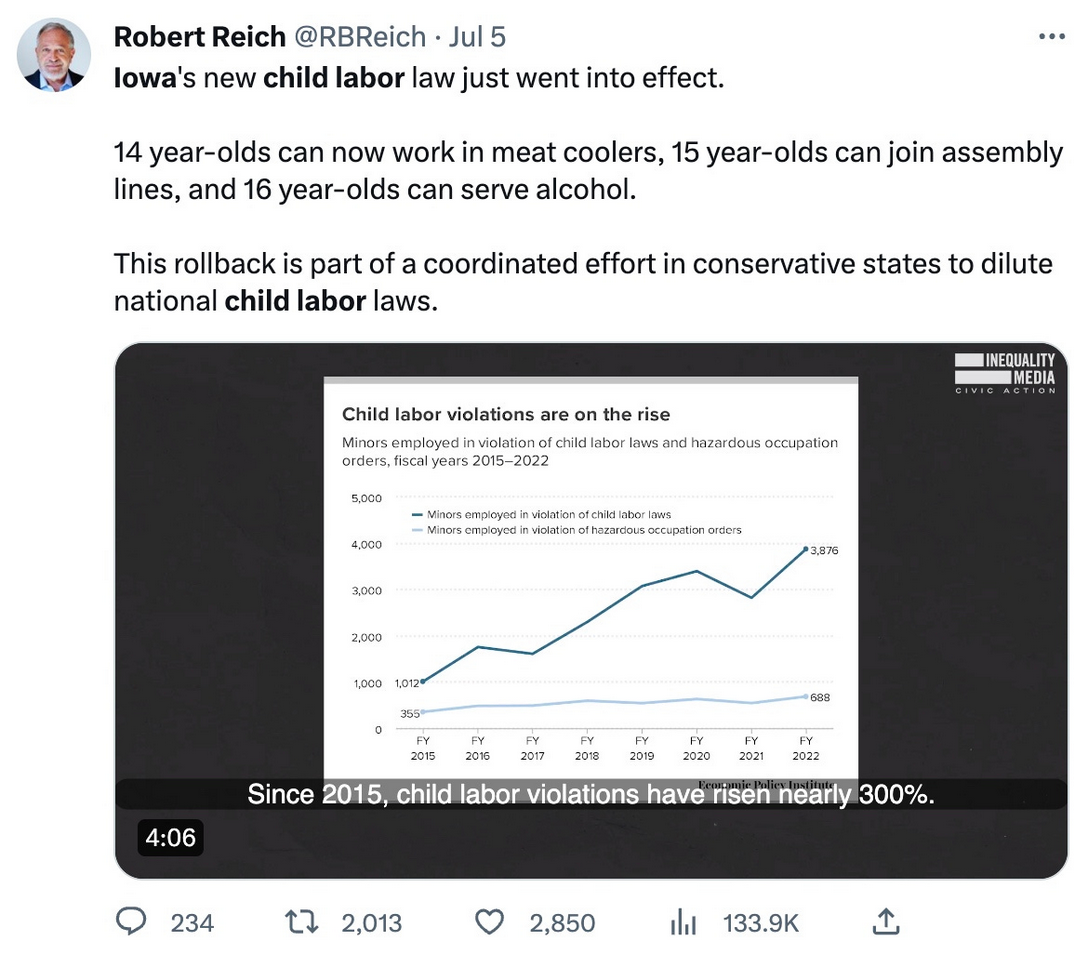
Chris Bray covers the breathless excitement of national media covering recent changes to Iowa labour laws:
Suddenly, though, this message is all over social media:
These messages are not exactly false, and not entirely true. They take note of a real development, but strip away all the limits and caveats to fake up the creation of a 21st-century Upton Sinclair novel. But the effects of this successful legislation — this is where it gets complicated.
Start here (or here) with Iowa Senate File 542: signed into law in May, took effect on July 1. A bunch of the first-glance shocking details are more complicated than the outrage-farming Twitter takes suggest: 16 year-olds can serve alcohol in restaurants, with at least two adults to supervise, but not in bars; 15 year-olds can work on assembly lines in school-based work training programs, with parental permission; teenagers can work until 11 p.m. in the summer, but not during the school year. Allowing a 16 year-old coffee shop waitress to bring you a beer strikes me as … not the end of the world?
But all of those details aside, the new Iowa law expands child labor (while ending some earlier measures allowing even younger workers to do a few jobs like migrant farm labor), and will, in fact, put 14 year-olds to work in what will look a great deal like adult settings. So red state legislatures are expanding child labor at the moment they’re banning gender mutila— uh, gender-affirming medical care for teenagers, and making that latter choice on the highly defensible grounds that teenagers lack the maturity to make decisions like that. So a 15 year-old working in a factory lacks the maturity to make adult decisions, is where we end up when we put all of this together.
Comments Off on Iowa votes to re-impose child labour in ways that violate federal labour laws
July 7, 2023
Justin Trudeau says that Canada is merely defending itself from the “attack” by Facebook
Prime Minister Justin Trudeau has never faced a situation he couldn’t get histrionic about:

The government escalated the battle over Bill C-18 yesterday, announcing that it was suspending advertising on Meta’s Facebook and Instagram platforms due the company’s decision to comply with the bill by blocking news sharing and its reluctance to engage in further negotiations on the issue. While the ad ban applies to federal government advertising, Liberal party officials confirmed they plan to continue political advertising on the social networks, suggesting that principled opposition ends when there might be a political cost involved. At issue is roughly $11 million in annual advertising by the federal government, a sum that pales in comparison to the Parliamentary Budget Officer’s estimate of at least $100 million in payments in Canada for news links from Meta alone.
In addition to raising the economic cost to Meta for stopping news sharing, Prime Minister Justin Trudeau increased the rhetoric, describing Canada as having been “attacked” by Meta and likening the government’s fight over the bill to defending democracy in Ukraine or during the Second World War [at 13:30]:
Facebook decided that Canada was a small country, small enough that they could reject our asks. They made the wrong choice by deciding to attack Canada. We want to defend democracy. This is what we’re doing across the world, such as supporting Ukraine. This is what we did during the Second World War. This is what we’re doing every single day in the United Nations.
There are strongly held views on both sides of the Bill C-18 debate, but the suggestion that stopping sharing news links on a social network is in any way comparable to World War 2 is embarrassingly hyperbolic and gives the sense of a government that has lost perspective on the issue. Canadian Heritage Minister Pablo Rodriguez has repeatedly described the manner of compliance with Bill C-18 as a business choice for the Internet companies, yet the Prime Minister now calls that choice an attack on the country.
If it were truly comparable to a world war, then surely the Liberal Party (joined by the NDP) would not continue to advertise on the platform. Yet since the 2021 election call, the party alone has run approximately 11,000 ads on Facebook and Instagram. That is separate from individual MPs, who have also run hundreds of ads. The Meta Ad Library provides ample evidence of how reliant the party has been on social media. For example, since the start of the year, Anna Gainey ran over 500 ads as part of her by-election campaign in Quebec. David Hilderley, who was a candidate in the Oxford by-election, ran approximately 180 ads on Facebook during the same timeframe.
Comments Off on Justin Trudeau says that Canada is merely defending itself from the “attack” by Facebook
June 26, 2023
America can’t build anything these days and “it’s all Ralph Nader’s fault”
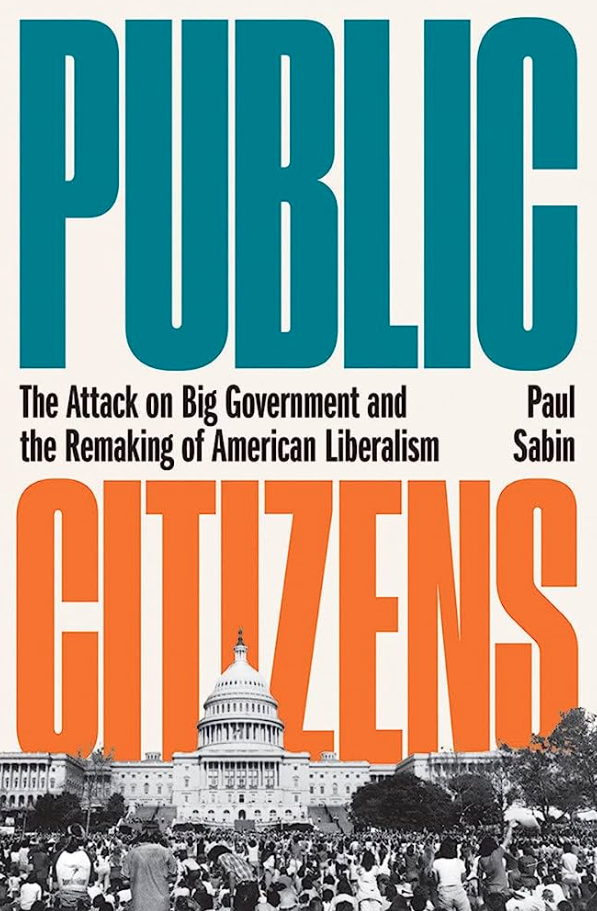
One of the readers of Scott Alexander’s Astral Codex Ten has contributed a review of Public Citizens: The Attack on Big Government and the Remaking of American Liberalism by Paul Sabin. This is one of perhaps a dozen or so anonymous reviews that Scott publishes every year with the readers voting for the best review and the names of the contributors withheld until after the voting is finished:
Today, pundits across the political spectrum bemoan America’s inability to build.
Across the country, NIMBYs and status-quo defenders exploit procedural rules to block new development, giving us a world where it takes longer to get approval for a single new building in San Francisco than it did to build the entire Empire State Building, where so-called “environmental review” is weaponized to block even obviously green initiatives like solar panels, and where new public works projects are completed years late and billions over budget — or, like California’s incredible shrinking high-speed rail, may never be completed at all.
Inevitably, such a complex set of dysfunctions must have an equally complex set of causes. It took us decades to get into this mess, and just as there’s no one simple fix, there’s no one simple inflection point in our history on which we can place all the blame.
But what if there was? What if there was, in fact, a single person we could blame for this entire state of affairs, a patsy from the past at whom we could all point our censorious fingers and shout, “It’s that guy’s fault!”
There is such a person, suggests history professor Paul Sabin in his new book Public Citizens: The Attack on Big Government and the Remaking of American Liberalism. And he isn’t isn’t a mustache-twirling villain — he’s a liberal intellectual. If you know him for anything, it’s probably for being the reason you know what a hanging chad is.
That’s right: it’s all Ralph Nader’s fault.
How’d he do it? By creating what’s now called the public interest movement: a new form of activism through which citizens force change — or, more often, block change — by suing the government. Though it was begun with the best of intentions and achieved some real good along the way, this political innovation led to the constipated governance we all complain about today.
How did a movement launched by an unassuming 30-year-old lawyer become the dominant form of activism in the country, and completely change the way our government operates?
To find out, we have to go back to a time before Ralph Nader had even hit puberty — the era of the New Deal.
[…]
It is the inherent nature of politics that no reform works forever, because the next generation of political entrepreneurs will inevitably discover new ways to bend the process to their will. Eventually, there will always be another Dick Fosbury revealing a way to work the system that no one saw coming.
Still, I do think some of the blame for the way this all panned out can be laid on Nader’s particular personal idiosyncrasies. His ironclad black-and-white view of the world, combined with his near-pathological aversion to dealmaking and compromise, made him uniquely suited to a form of activism that focused on regulatory and legal action rather than coalition-building and electoral politics. Nader was infamously rigid and inflexible, so it’s no surprise that his movement was too. But a less rules-oriented movement might have created fewer of the bureaucratic barriers that have now become a hindrance to progressive action.
Much like the movement whose story it tells, Public Citizens the book is a worthwhile project that nonetheless suffers from significant flaws. The main problem is that it can’t decide if it’s a historical narrative or a work of political theory. As a work of political theory, it doesn’t take nearly a strong enough stand — I’ve made explicit a lot of claims that are only lightly implied in the book. I think we’re making the same argument, but the book makes its argument with such a delicate touch that it’s hard to be 100% sure.
As a historical narrative, Public Citizens has a much simpler problem: it’s boring. The author writes like an academic (which, to be fair, he is), and the book is quite light on colorful details. The uncreative chapter titles (chapter three is called “Creating Public Interest Firms”) give you a taste of what the writing is like. One particularly egregious issue is how little biographical information is provided about Nader, even though the majority of the book is about him. For someone who apparently subscribes to the Great Man theory of history, the author includes surprisingly little information about the Great Men themselves. Any interesting biographical fact you read in this review — even something as basic as the fact that Nader never married—is almost certainly something I found through other sources.
Paradoxically, this book manages to be simultaneously boring and too concise. It’s over in less than 200 generously-spaced pages, and I frequently had to look stuff up on the internet to get a full understanding of what was going on. I get the sense that the author is trying to give this book mass appeal, but come on: anyone who’s willing to read a nerdy book like this is willing to read an additional hundred pages or so. Besides, Robert Caro and Ron Chernow have proven that people will read thousand-page tomes if the story is compelling and the details are juicy.
Basically, my critique of Public Citizens is like that old Catskills joke about the restaurant where the food is terrible — and the portions are too small.
Comments Off on America can’t build anything these days and “it’s all Ralph Nader’s fault”
June 25, 2023
British schoolchildren mock their oh-so-woke teachers
In Christopher Gage’s weekly round-up, I discovered that I shared a trait with Ted Kaczynski (“austere anarchist scholar” as US mainstream media might have described him). Not just any trait, but the one that ended up putting him in prison after nearly twenty years of sending bombs through the mail:

Elliot Rodger, Ed Kemper and Ted Kaczynski.
Photos from Quillette.
… Ted insisted on the proper use of the idiom, “You can’t eat your cake and have it, too”. Ted rejected the common and logically fraught version: “You can’t have your cake and eat it, too”. Indeed, you can. You must have your cake if you are to eat your cake. You cannot have your cake once you’ve eaten your cake.
That turn of phrase helped F.B.I agents snare Ted. His sister-in-law read his essay, recognised the writing style, and the peculiar diction, and then grassed him up to the rozzers.
For the record, this may be the only point of agreement I have with that noted austere scholar, although I’ve never read any of his writings to find out.
Another amusing incident involved children taking the Mickey out of ultra-progressive teachers in British schools:
Last week, schoolchildren in Sussex dropped themselves into the soup after suggesting that their fellow classmate is not actually a cat.
Two thirteen-year-old girls at Rye College were told they “should go to a different school” if they didn’t believe that a girl could identify as a cat.
During a “life education” class, the pair said there was “no such thing as agender” and: “If you have a vagina, you’re a girl, and if you have a penis, you’re a boy — that’s it.”
When they queried how someone could identify as a cat, the pair were blasted for questioning their classmate’s identity.
An investigation found children at schools across the land now identify as dinosaurs and horses. Another often dons a cape and demands to be acknowledged as a moon. Another identifies as Bambi.
After the hysteria simmered, it became obvious what was going on here. And it too became obvious that this is a good thing.
Reader, these children are taking the Mickey.
When confronted with obvious nonsense held by their preachy, supposedly superior teachers, these kids cannot resist mocking them to a nub.
After all, if one can identify as whatever one wants then that includes anything one wants. For teenagers primed with mischief, this is just too good a brew not to sup on a daily basis.
And it is a promising sign. Ridicule, the sharp-elbowed sister of truth, is essential to all progress. Clearly, these kids are unafraid to think for themselves and are determined to see that which is beyond their own nose.
Perhaps this is the beginning of the end of what almost everybody knows to be patent nonsense. As history assures us, once something becomes a laughingstock it soon dies of ridicule.
As James Thurber put it, that which cannot withstand laughter is not a good thing.
Comments Off on British schoolchildren mock their oh-so-woke teachers
June 24, 2023
Canada’s Online News Act already impacting news delivery for smaller outlets
A local site I use regularly has already begun to feel the negative effects of the federal government’s Online News Act (aka Bill C-18):

Durham Radio News (DRN) doesn’t normally post editorial content, but when local news is being attacked we refuse to stay silent.
Bill C-18 is now law and will have a very negative impact on local independent newsrooms such as DRN.
The bill forces major tech companies such as Google and Meta to pay news outlets for content.
The vast majority of referrals to our DRN site come from Facebook and Google.
Both platforms have been instrumental in growing our audience.
Despite multiple warnings from Meta and Google that they would block news, the Liberal government proceeded with Bill C-18.
It’s now law and in a statement Meta says news will no longer be available on Facebook and Instagram.
Google is expected to follow suit.
Both tech giants have publicly said they don’t make much money off links to news stories so it doesn’t make financial sense for them to pay news providers.
Prime Minister Justin Trudeau called their threats to remove news a bullying tactic and said it will not work with his government.
It really appears the Liberals thought they were bluffing, we now know they were not.
DRN has been trying to get our voices heard for months on the negative impact this bill would have on our business.
We were drowned out by larger media outlets who would stand to benefit from this bill.
We will not be naming other outlets and we don’t begrudge the financial help they are already receiving.
Meta provides funding through fellowships with some media partners, and it is these outlets that became greedy and were asking for more.
For them it doesn’t matter if they get kicked off social media platforms.
For us it will make a huge impact.
Comments Off on Canada’s Online News Act already impacting news delivery for smaller outlets
June 20, 2023
“Mendicino is a dead minister walking, and we suspect he knows it”
Belated (from me, not from them) section from this weekend’s update from the editors at The Line:

Paul Bernardo and Karla Homolka
Though you may find this hard to believe, based on what’s above, we were paying attention to some other things this week. The Ottawa vortex of ridiculousness continued at its usual clip. The government continues to try and find a defensible position on Paul Bernardo’s prison transfer to a medium-security prison. Alas for Mr. Trudeau, he’s been hit by a double-whammy of bad luck. Bernardo is an emotional trigger point with probably no rival across Canada. And the PM’s point man on this file is the hapless (!) Marco Mendicino, minister of Public Safety.
Let’s be clear: your Line editors are far too Vulcan-like to possess strong feelings about the transfer of Bernardo. We are of the right age to have grown up during the era of the Bernardo rapes, murders and eventual trial. He was the boogeyman of our youth. That being said, the important thing is that he dies miserable and alone behind bars. We aren’t particularly invested in which particular prison this happens. If there was a sensible reason for him to be moved to the Quebec facility, hey, whatever. He can rot in any suitable prison as far as we’re concerned.
The issue here, and it’s ridiculous that we have to spell this out, isn’t the transfer itself. Nor are we calling upon Trudeau or the federal government to become intimately involved in decision-making for prisoners, even high-profile ones. The only thing that turned this into a huge story was the latest peek it gave us into the Trudeau government. We have been confronted with — surprise! — more incompetence and dysfunction.
Mendicino’s staff had been repeatedly told about the pending transfer; no one told the boss. The PMO had been told, too. No one told that boss, either. Why tell the boss? So that they don’t get caught flatfooted by a scandal. This is basic issues management and internal communications, and we’re being shown, yet again, that the government is terrible at this. And, absurdly, Mendicino apparently has some of the best and brightest providing the adult supervision he so clearly needs: veteran political staffers were sent to his office after he beclowned himself during the gun-control fiasco a few months ago.
And this is the problem. We don’t care which cell holds Bernardo as he slides closer to hell. We do care about yet another data point in a pattern that has emerged with this government: they aren’t on top of their files, their offices aren’t well run, ministers aren’t properly briefed, and there seems to be zero accountability anywhere in this process. It was left to the Ottawa Parliamentary Press Gallery to hunt down Mendicino like ravenous cheetahs on a wayward gazelle after Mendicino had promised to brief them, and then no-showed. He also promised to brief them again later on Thursday, and failed to show up that time, too.
We know, we know. It’s hard to believe he’d lie. Marco Mendicino? An incompetent bullshitter? Say it ain’t so.
Mendicino is a dead minister walking, and we suspect he knows it. The government is obviously hell bent on getting to the summer break without sacking the minister, because to sack him, despite his manifest and repeated failings, would be to admit said failings, and this government will never do that. If they can get to the break, they can shuffle him off to the sweet oblivion of an obscure ministry, or even the back benches later on this summer. This is just the latest example of what Line editor Gerson has observed about these guys: tactically smart, but strategically dumb.
And, ahem, call us hopelessly naïve, but maybe the politics isn’t the point here? Canadians ought to have someone in the job of Public Safety minister — kind of an important role, you’ll agree — who is competent and well-supported by excellent staff. Instead we get this shitshow and frantic politicking to avoid handing the opposition a one-day media-cycle victory. It’s a bad look on the government. But it’s nothing we didn’t already know, we guess. They aren’t here to serve Canadians. They’re here to save themselves.
Comments Off on “Mendicino is a dead minister walking, and we suspect he knows it”
June 19, 2023
Patterns of incompetence
In Palladium, Harold Robertson says that complex systems that we all depend on will not have the resilience to survive our society-wide failure of competence:

Graphic for Rhode Island College’s Office of Diversity, Equity and Inclusion.
At a casual glance, the recent cascades of American disasters might seem unrelated. In a span of fewer than six months in 2017, three U.S. Naval warships experienced three separate collisions resulting in 17 deaths. A year later, powerlines owned by PG&E started a wildfire that killed 85 people. The pipeline carrying almost half of the East Coast’s gasoline shut down due to a ransomware attack. Almost half a million intermodal containers sat on cargo ships unable to dock at Los Angeles ports. A train carrying thousands of tons of hazardous and flammable chemicals derailed near East Palestine, Ohio. Air Traffic Control cleared a FedEx plane to land on a runway occupied by a Southwest plane preparing to take off. Eye drops contaminated with antibiotic-resistant bacteria killed four and blinded fourteen.
While disasters like these are often front-page news, the broader connection between the disasters barely elicits any mention. America must be understood as a system of interwoven systems; the healthcare system sends a bill to a patient using the postal system, and that patient uses the mobile phone system to pay the bill with a credit card issued by the banking system. All these systems must be assumed to work for anyone to make even simple decisions. But the failure of one system has cascading consequences for all of the adjacent systems. As a consequence of escalating rates of failure, America’s complex systems are slowly collapsing.
The core issue is that changing political mores have established the systematic promotion of the unqualified and sidelining of the competent. This has continually weakened our society’s ability to manage modern systems. At its inception, it represented a break from the trend of the 1920s to the 1960s, when the direct meritocratic evaluation of competence became the norm across vast swaths of American society.
In the first decades of the twentieth century, the idea that individuals should be systematically evaluated and selected based on their ability rather than wealth, class, or political connections, led to significant changes in selection techniques at all levels of American society. The Scholastic Aptitude Test (SAT) revolutionized college admissions by allowing elite universities to find and recruit talented students from beyond the boarding schools of New England. Following the adoption of the SAT, aptitude tests such as Wonderlic (1936), Graduate Record Examination (1936), Army General Classification Test (1941), and Law School Admission Test (1948) swept the United States. Spurred on by the demands of two world wars, this system of institutional management electrified the Tennessee Valley, created the first atom bomb, invented the transistor, and put a man on the moon.
By the 1960s, the systematic selection for competence came into direct conflict with the political imperatives of the civil rights movement. During the period from 1961 to 1972, a series of Supreme Court rulings, executive orders, and laws — most critically, the Civil Rights Act of 1964 — put meritocracy and the new political imperative of protected-group diversity on a collision course. Administrative law judges have accepted statistically observable disparities in outcomes between groups as prima facie evidence of illegal discrimination. The result has been clear: any time meritocracy and diversity come into direct conflict, diversity must take priority.
The resulting norms have steadily eroded institutional competency, causing America’s complex systems to fail with increasing regularity. In the language of a systems theorist, by decreasing the competency of the actors within the system, formerly stable systems have begun to experience normal accidents at a rate that is faster than the system can adapt. The prognosis is harsh but clear: either selection for competence will return or America will experience devolution to more primitive forms of civilization and loss of geopolitical power.
H/T to Theophilus Chilton for the link.
Comments Off on Patterns of incompetence
June 6, 2023
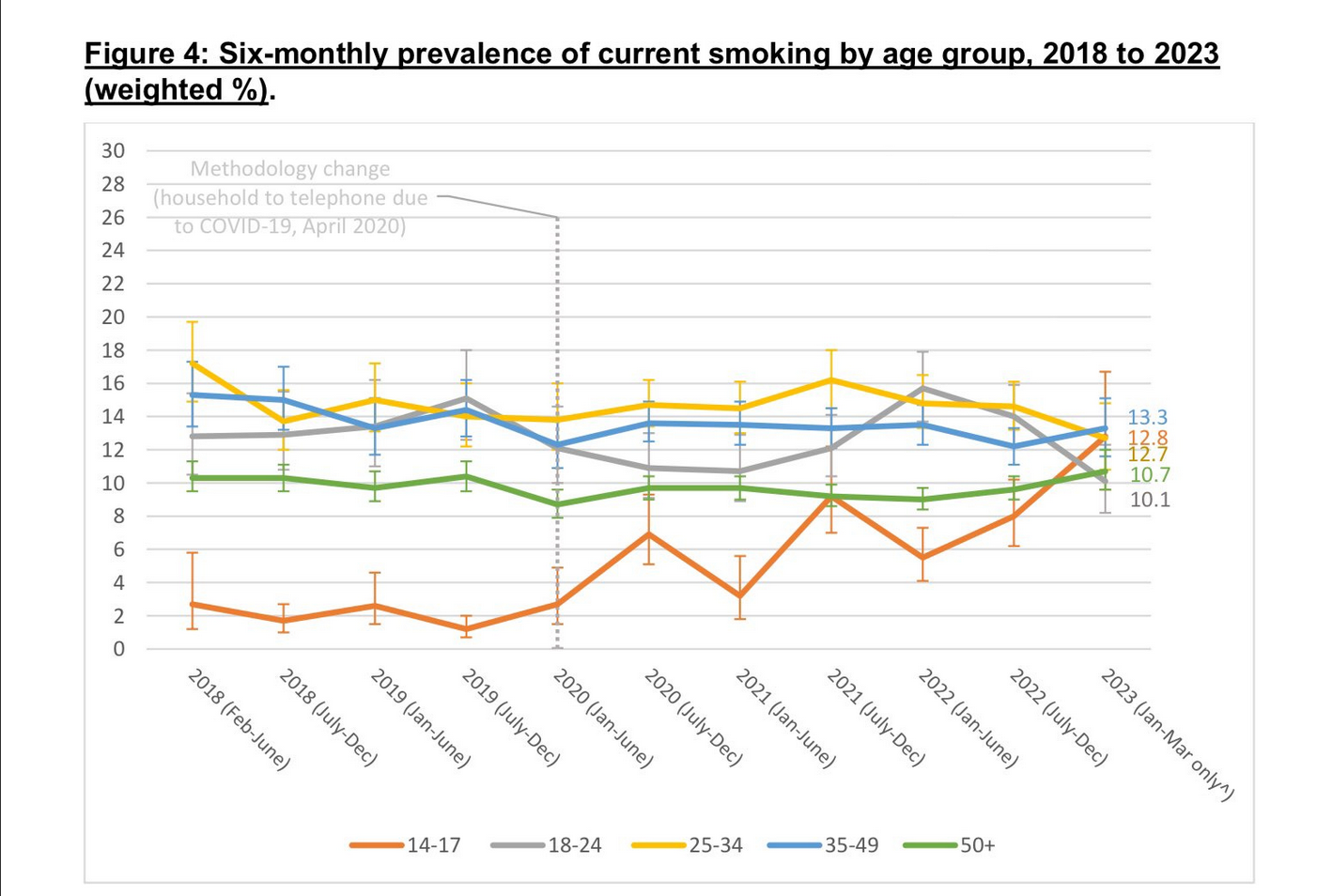
Australia’s “teen smoking rates rose sixfold between 2018 and 2023”
Christopher Snowdon on Australia’s determination to stamp out vaping … even at the cost of vastly increasing the number of tobacco smokers:
More bad news from the supposed world leader in tobacco control. Official figures show that teen smoking rates rose sixfold between 2018 and 2023, from 2% to 12.8%.
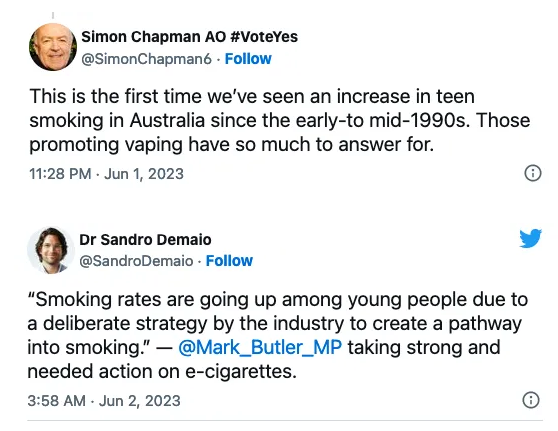
It’s been over a decade since Australia introduced plain packaging, a policy that the Southern hemisphere’s wrongest man, Simon Chapman, likened to a vaccine for lung cancer. Australia has had the highest cigarette taxes in the world for ages, the sale of nicotine e-cigarettes has always been illegal, and all they have to show for it is an insanely big black market for both tobacco and e-cigarettes, more children smoking and a whole bunch of people using unregulated vapes. The wowsers just can’t stop winning, can they?
Naturally, this has led to much soul searching among the tobacco control elite who are having to reassess their assumptions in the face of this overwhelming evidence of policy failure.
I’m joking, of course. They are doubling down again.
If you spoke to someone from the reality-based community, they would tell you that children find it easier to access a product when the market is in the hands of illicit traders because illicit traders don’t care who they sell to. They might also point out that the Australian government has gone out of its way to portray vaping as being at least as bad as smoking. School children in Australia are taught that vaping causes brain damage. Public health agencies produce websites that purport to tell people the facts about vaping but actually tell them lies and misleading half-truths.
Comments Off on Australia’s “teen smoking rates rose sixfold between 2018 and 2023”


