
… the basics of the confidence game have not changed all that much with the new technology. The confidence man gets his name because he is adept at winning the confidence of the mark. The mark then lowers his defenses and foolishly trusts the con man, rather than his own natural skepticism. The mark is manipulated into thinking the con man is a friend or at least someone who can be trusted. The con man then uses that trust to exploit the mark.
The way in which the con men does this is by flattery. The mark trusts the con man, because the con man finds small ways to confirm the beliefs of the mark. The adept grifter will be a good listener and pick up the little things that the mark thinks are important, like religious beliefs or opinions about personal matters. Seemingly out of the blue, the con man will express those same opinions, which flatters the mark. After all, everyone likes being told that their private opinions are smart.
That’s something you see with the internet grifters. They often have worn a lot of masks as they seek out on-line audiences. […]
Another aspect of the con that remains constant is how the con man uses his alleged status as a victim to work the mark. Con men will use their mark’s natural empathy to win their confidence. Today that often means claiming the big bad tech companies are censoring them. Alternatively, they will claim evil trolls are haunting their internet activity, causing them harm. The term troll has been changed from meaning someone seeking attention to something almost supernatural.
The Z Man, “Carny Town”, The Z Blog, 2019-12-29.
April 29, 2025
April 28, 2025
A potential positive to the explosion of AI-generated fake porn
The one thing we have always been able to predict with 100% confidence is that every new media will be used for pornography and crime, often in the same product. However, No Pasaran makes a case for there being a socially useful side to the ever-increasing realism of fake porn from popular LLM generators:
Seriously?! Am I the only person that sees the benefits of this “troubling trend” of online bullying?!
Think about it.
Blackmail is now a thing of the past.
That’s it.
It’s over.
Whether you are a teen or an adult, whether the photos are real or not, you can simply pass all of them off — indeed, you can do so nonchalantly — as fakes or deepfakes. To your classmates, to your spouse, to your constituents. Who will know whether you are fibbing or telling the truth? (Maybe you hardly know yourself …)
(In a totally different context, of course, that is exactly what Joe Biden’s White House did …)
As it happens, a considerable size of the audience for these sex photos/videos — maybe far more than half — will already be assuming that they’re fakes … (Thanks for the Instalink, Sarah.)
Depression at 16? Suicide at 17? Why fear sextortion at this point? Compliment instead the (anonymous) photo/video creators for doing a good job — for doing an outstanding job.
On my phone I keep receiving photos of Donald Trump tenderly cuddling with Joe Biden or Vladimir Putin or Stormy Daniels. Lots of apps now make you “repair” snapshots that are decades or (over) a century old, colorize them, and make them into mini-movies (the latest one I saw delighted me as it involved Civil War daguerreotypes from the 1860s).
I also keep receiving AI ads where, by combining a couple of photos of myself and of any girl (someone I know and am perhaps infatuated with or some rock or movie star or someone — Marilyn Monroe? Rudolph Valentino? Che Guevara? Queen Victoria? — who has been dead for decades) I can make myself hug or kiss that person — hungrily — on the mouth.
Years ago (long before AI), I was writing a TV script imagining a politician who was on national television and who was all of a sudden ambushed with private photos of him in a compromising position (with a woman other than his wife, with a man, with many women, with many men, at an orgy, in a BDSM cave, with a money shot, whatever …). Talk of falling victim; talk of bullying; talk of harassment (justified or otherwise)!
How should he react?
Ignore the content. And, with an admiring voice, let out a whistle and praise the work: “Wow, that’s well done!”
“What do you mean?!” interrupts the TV presenter, visibly frustrated. “No no no! Don’t tell me you are claiming they’re fake?! We have proof that you were seen at—”
Again, this was before AI, needless to say, which only made the politician’s next words even more startling: “It is so how admirable the degree to which studios have made progress with special effects!”
April 18, 2025
QotD: Literature in (and after) the late Western Roman Empire
Well, no.
Here I think the problem is the baseline we assess this period against. Most people are generally aware that the Greeks and Romans wrote a lot of things and that we have relatively few of them. Even if we confine ourselves only to very successful, famous Greek and Roman literature, we still only have perhaps a low single-digit percentage of it, possibly only a fraction of a percent of it. In our post-printing-press and now post-internet world, famous works of literature do not simply vanish, generally and it is intuitive to assume that all of these lost works must have been the result of some catastrophe or intentional sabotage.
I am regularly, for instance, asked how I feel about the burning of the Library of Alexandria. The answer is … not very much. The library burned more than once and by the time it did it was no longer the epicenter of learning in the Mediterranean world. Instead, the library slowly declined as it became less unique because other libraries amassed considerable collections. There was no great, tragic moment where countless works were all lost in an instant. That’s not how the chain of transmission breaks. Because a break in the chain of transmission requires no catastrophe – it merely requires neglect.
The literature of the Greeks and Romans (and the rest of the ancient iron age Mediterranean) were largely written on papyrus paper, arranged into scrolls. The problem here is that papyrus is quite vulnerable to moisture and decay; in the prevailing conditions in much of Europe papyrus might only last a few decades. Ancient papyri really only survive to the present in areas of hard desert (like Egypt, conveniently), but even in antiquity, books written on papyrus would have been constantly wearing out and needing to be replaced.
Consequently, it didn’t require anyone going out and destroying books to cause a break in the chain of transmission: all that needed to happen was for the copying to stop, even fairly briefly. Fortunately for everyone, Late Antiquity was bringing with it a new writing material, parchment, and a new way of putting it together, the codex or book. The transition from papyrus to parchment begins in the fourth century, but some books are still being produced in papyrus in the 7th century, particularly in the Eastern Mediterranean. Whereas papyrus is a paper made of papyrus stalks pressed together, parchment is essentially a form of leather, cleaned, soaked in calcium lye and scraped very thin. The good news is that as a result, parchment lasts – I have read without difficulty from 1200 year old books written on parchment (via microfilm) and paged through 600 year old books with my own hands. Because making it requires animal hide, parchment was extremely expensive (and still is) but its durability is a huge boon to us because it means that works that got copied onto parchment during the early middle ages often survive on that parchment down to the present.
But of course that means that the moment of technological transition from short-lived papyrus to long-lasting parchment was always going to be the moment of loss in transition: works that made it to parchment would largely survive to the present, while works that were not copied in that fairly narrow window (occupying Late Antiquity and the Early Middle Ages) would be permanently lost. And that copying was no simple thing: it was expensive and slow. The materials were expensive, but producing a book also required highly trained scribes (often these were monks) who would hand copy, letter by letter, the text for hundreds of pages. And, for reasons we’ll talk about later in this series, the resources available for this kind of copying would hit an all-time-low during the period from the fifth to the seventh centuries – this was expensive work for poor societies to engage in.
And here it is worth thus stopping to note how exceptional a moment of preservation this period is. The literary tradition of Mediterranean antiquity represents the oldest literary tradition to survive in an unbroken line of transmission to the present (alongside Chinese literature). The literary traditions of the Bronze Age (c. 3000-1200 BC and the period directly before antiquity broadly construed) were all lost and had to be rediscovered, with stone and clay tablets recovered archaeologically and written languages reconstructed. The Greeks and Romans certainly made little effort to preserve the literature of those who went before them!
In that context, what is actually historically remarkable here is not that the people of Late Antiquity and the Early Middle Ages lost some books – books had always been being lost, since writing began – but that they saved some books. Never before had a literary tradition been saved in this way. Of course these early copyists didn’t always copy what we might like. Unsurprisingly, Christian monks copying books tended to copy a lot more religious texts (both scriptures but also patristic texts). Moreover, works that were seen as important for teaching good Latin (Cicero, Vergil, etc.) tended to get copied more as well, though this is nothing new; the role of the Iliad and the Odyssey in teaching Greek is probably why their manuscript traditions are so incredibly robust. In any event, far from destroying the literature of classical antiquity, it was the medieval Church itself that was the single institution most engaged in the preservation of it.
At the same time, writers in the fifth, sixth and seventh centuries did not stop writing (or stop reading). Much of the literature of this period was religious in nature, but that is no reason to dismiss it (far more of the literature of the Classical world was religious in nature than you likely think, by the by). St. Augustine of Hippo was writing during the fifth century; indeed his The City of God, one of the foundational works of Christian literature, was written in response to the news of the sack of Rome in 410. Isidore of Seville (560-636) was famous for his Etymologies, an encyclopedia of sorts which would form the foundation for much of medieval learning and which in its summaries preserves for us quite a lot of classical bits and bobs which would have otherwise been lost; he also invented the period, comma and colon. Pope Gregory I (540-604) was also a prolific writer, writing hundreds of letters, a collection of four books of dialogues, a life of St. Benedict, a book on the role of bishops, a commentary on the Book of Job and so on. The Rule of St. Benedict, since we’ve brought the fellow up, written in 516 established the foundation for western monasticism.
And while we’ve mostly left the East off for this post, we should also note that writing hardly stopped there. Near to my heart, the emperor Maurice (r. 582-602) wrote the Strategikon, an important and quite informative manual of war which presents, among other things, a fairly sophisticated vision of combined arms warfare. Roman law also survived in tremendous quantities; the emperor Theodosius II (r. 402-450) commissioned the creation of a streamlined law code compiling all of the disparate Roman laws into the Codex Theodosianus, issued in 439. Interestingly, Alaric II (r. 457-507), king of the Visigoths in much of post-Roman Spain would reissue the code as past of the law for his own kingdom in 506 as part of the Breviary of Alaric. Meanwhile, back at Constantinople, Justinian I (r. 527-565) commissioned an even more massive collection of laws, the Corpus Iuris Civilis, issued from 529 to 534 in four parts; a colossal achievement in legal scholarship, it is almost impossible to overstate how important the Corpus Iuris Civilis is for our knowledge of Roman law.
And it is not hard again to see how these sorts of literary projects represented a continuing legacy of Roman culture too (particularly the Roman culture of the third and fourth century), concerned with Roman law, Roman learning and the Roman religion, Christianity. And so when it comes to culture and literature, it seems that the change-and-continuity knight holds the field – there is quite a lot of evidence for the survival of elements of Roman culture in post-Roman western Europe, from language, to religion, to artwork and literature. Now we haven’t talked about social and economic structures (that’s part III), so one might argue we haven’t quite covered all of “culture” just yet, and it is necessary to note that this continuity was sometimes uneven. Nevertheless, the fall of Rome can hardly be said to have been the end of Roman culture.
Bret Devereaux, “Collections: Rome: Decline and Fall? Part I: Words”, A Collection of Unmitigated Pedantry, 2022-01-14.
April 13, 2025
They really are trying to shut down “wrong” speech on the internet
I’ve always been a huge fan of free speech, which has been under continuous and escalating threat by many governments both in person and online. A side-note in the ongoing Canadian federal election has been Liberal leader Mark Carney’s commitment to addressing “online harm” as he defines it:

At a campaign rally in Hamilton, Ontario, Liberal leader Mark Carney unveiled what can only be described as a coordinated assault on digital freedom in Canada. Behind the slogans, applause lines, and empty rhetoric about unity, one portion of Carney’s remarks stood out for its implications: a bold, unapologetic commitment to controlling online speech under the guise of “safety” and “misinformation”.
We announced a series of measures with respect to online harm … a sea of misogyny, anti-Semitism, hatred, conspiracy theories — the sort of pollution that’s online that washes over our virtual borders from the United States.
He then made clear his intention to act:
My government, if we are elected, will be taking action on those American giants who come across [our] border.
The former central banker, who now postures as a man of the people, made it clear that if the Liberals are re-elected, the federal government will intensify efforts to regulate what Canadians are allowed to see, say, and share online. His language was deliberate. Carney condemned what he called a “sea of misogyny, anti-Semitism, hatred, conspiracy theories” polluting Canada’s internet space — language borrowed directly from the Trudeau-era playbook. But this wasn’t just a moral denunciation. It was a legislative preview.
Carney spoke of a future Liberal government taking “action on those American giants who come across our borders”. Translation: he wants to bring Big Tech platforms under federal control, or at least force them to play the role of speech enforcers for the Canadian state. He blamed the United States for exporting “hate” into Canada, reinforcing the bizarre Liberal narrative that the greatest threat to national unity isn’t foreign actors like the CCP or radical Islamists — it’s Facebook memes and American podcasts.
But the most revealing moment came when Carney linked online speech directly to violence. He asserted that digital “pollution” affects how Canadians behave in real life, specifically pointing to conjugal violence, antisemitism, and drug abuse. This is how the ground is prepared for censorship: first by tying speech to harm, then by criminalizing what the state deems harmful.
What Carney didn’t say is just as important. He made no distinction between actual criminal incitement and political dissent. He offered no assurance that free expression — a right enshrined in Canada’s Charter of Rights and Freedoms — would be respected. He provided no definition of what constitutes a “conspiracy theory” or who gets to make that determination. Under this framework, any criticism of government policy, of global institutions, or of the new technocratic order could be flagged, throttled, and punished.
And that’s the point.
Mark Carney isn’t interested in dialogue. He wants obedience. He doesn’t trust Canadians to discern truth from fiction. He believes it’s the job of government — his government — to curate the national conversation, to protect citizens from wrongthink, to act as referee over what is and isn’t acceptable discourse. In short, he wants Ottawa to become the Ministry of Truth.
In Britain, their equivalent to Canada’s “online harms” legislation has induced Bitchute to discontinue service to users in the UK:

A READER alerted us to this statement posted on the Bitchute homepage, visible to geolocated UK users:
After careful review and ongoing evaluation of the regulatory landscape in the United Kingdom, we regret to inform you that BitChute will be discontinuing its video sharing service for UK residents.
The introduction of the UK Online Safety Act of 2023 has brought about significant changes in the regulatory framework governing online content and community interactions. Notably, the Act contains sweeping provisions and onerous corrective measures with respect to content moderation and enforcement. In particular, the broad enforcement powers granted to the regulator of communication services, Ofcom, have raised concerns regarding the open-ended and unpredictable nature of regulatory compliance for our platform.
The BitChute platform has always operated on principles of freedom of speech, expression and association, and strived to foster an open and inclusive environment for content creators and audiences alike. However, the evolving regulatory pressures — including strict enforcement mechanisms and potential liabilities — have created an operational landscape in which continuing to serve the UK market exposes our company to unacceptable legal and compliance risks. Despite our best efforts to navigate these challenges, the uncertainty surrounding the OSA’s enforcement by Ofcom and its far-reaching implications leaves us no viable alternative but to cease normal operations in the UK.
Therefore, effective immediately, BitChute platform users in the UK will no longer be available to view content produced by any other BitChute user. Because the OSA’s primary concern is that members of the public will view content deemed unsafe, however, we will permit UK BitChute users to continue to post content. The significant change will be that this UK user-posted content will not be viewable by any other UK user, but will be visible to other users outside of the UK. Users outside the UK may comment on that content, which the creator will continue to be able to read, delete, block, reply and flag. Users outside the UK may share UK-user produced content to other users outside of the UK as normal. In other words, for users in the UK, including content creators, the BitChute platform is no longer a user-to-UK user video sharing service.
This is the exactly the kind of consequence we at TCW feared a result of the overly restrictive and poorly written Online Safety Act 2023, which has now come into force.
The way the technology works is that websites can use a geolocation service to analyse the IP address your internet service provider has given your service, and use this to determine where you are. Google does this to tailor ads to you, Amazon does this to get you the most convenient version of their website.
Now Bitchute are using this service to protect themselves from the UK Government’s overreach.
The good news: there is a way round this.
April 12, 2025
Carney’s Liberals promise to do something that’s been part of the legal code for decades
Among the Conservative and Liberal mis-steps of the election campaign this week, the promise by Liberal leader Mark Carney to pass legislation to boldly and courageously do something that has been part of the firearms laws for over 40 years deserves calling out:
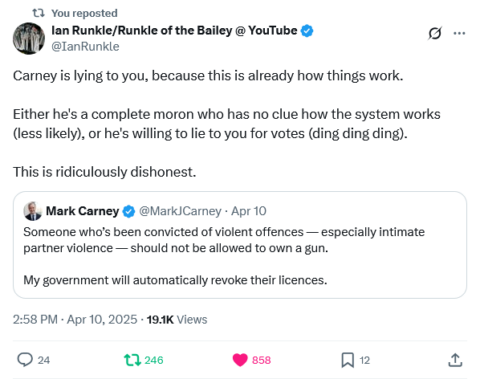
Your Line editors knew that guns were going to come into the campaign eventually. It’s one of the eternal issues for the Red Team, and while they seemed to have shied away from it a bit after some pretty brutal fumbling in Justin Trudeau’s later years, we figured it would be back eventually. And so it was on Thursday, when Liberal leader Mark Carney announced, as part of a package of crime policy proposals, that a re-elected Liberal government would make sure that guns were automatically taken from anyone convicted of a violent crime, including intimate partner violence.
*pulls hard on chain, activating bullshit klaxon*
See, here’s the thing, friends. First of all, to take Carney at his word here would require us accepting, even just for a moment, that this didn’t already happen. That up until Thursday of this week, the Liberals were hunky dory with people convicted of violent crimes, including intimate partner violence, keeping whatever guns they may own or wish to acquire.
That is, we suspect readers know, utter bullshit. Removing guns is already required in those circumstances, and it doesn’t even require a conviction. Police officers can seize any weapon of any type if it isn’t in the safety interest of any person, even without a warrant, and revoke any license they hold immediately.
Nobody is eligible to hold a license if it isn’t in the safety interest of a person — that’s literally the first eligibility criterion in the Firearms Act. Issuing a license requires the issuer to consider all past convictions, mental illnesses, history of violent behaviour, previous prohibitions, any potential intimate partner violence, and any potential harm to any person before they issue it. That is checked through a process called Continuous Eligibility Screening, where license holders are checked for “hits” against police systems every single day to determine whether they are still able to hold a license.
This is something almost no one outside Canada’s firearms-owning community understands, and The Line wants to underline this point — anyone with a firearms licence is automatically checked for any new legal issues that might render them unable to own firearms every single day. If you happen to find yourself hanging out with someone with a firearms licence, they were checked out by law enforcement within the last 24 hours. This includes your friends at The Line. The day you’re reading this is a day they passed another screening.
A conviction for a violent crime, it hardly need be said — well, actually, check that, apparently it does need saying — would render one rather ineligible! Not only is this already the law, but there are so many overlapping laws to deal with that exact scenario that it takes real effort to be ignorant of them. Weapon prohibition orders on conviction for violent offences? Already a thing at the federal and provincial levels. Prohibitions while on bail? Already a thing. Firearm seizures during divorces? Not automatic, but common, sometimes even where there is no history of violence or reasonable belief that violence is likely.
The Liberals know all this, especially since it was the Liberals who last changed these laws — though not to add the removal provisions, which largely already existed, but to remove any discretion or ability for rehabilitation.
Every party is fine with keeping guns away from domestic violence perpetrators. Carney making this an issue is bullshit. He’s counting on the public to not know enough to call him out on it.
It’ll probably work.
Oh, and by the way. If you don’t want to take our word for any of the above, you can just read the Firearms Act yourself. Relevant section, below.

April 2, 2025
Iceland’s “double standards about sex between adults and minors … exposes grey areas in victim-centered sanctimony”
Janice Fiamengo discusses the recent revelation that Iceland’s Minister for Education and Children’s Affairs, Ásthildur Lóa Thórsdóttir, had an affair with an under-age teen when she was in her 20s:

Last week, Ásthildur Lóa Thórsdóttir [right], Iceland’s Minister for Education and Children’s Affairs, was revealed to have had a sexual relationship with a teen boy decades ago, when she was 23 years old. The case vividly highlights the west’s double standards about sex between adults and minors, and it exposes grey areas in victim-centered sanctimony.
That the case occurred in Iceland, a feminist stronghold with a female president, a female prime minister, and a claimed “zero-tolerance policy for sexual abuse and exploitation of children“, is not at all surprising. No one seriously expects feminists to apply their touted compassion to male teenagers; and no one believes that their championing of gender equality includes sexual probity for women.
Iceland is so thoroughly feminist that in 2023, the prime minister herself joined other women on a one-day strike to demand, amongst other utopian objectives, “an end to unequal pay,” neatly sidestepping (while illustrating) that the so-called pay gap is caused primarily by women’s tendency to work fewer hours than men do. Female moral innocence is such a cherished belief of the Nordic island nation that it has designated 2025 as Women’s Year, with “12 months of events dedicated to progressing gender equality.” (Interested readers should consult a gushing Guardian article, “Women are the best to women“, which depicts Iceland as a near-idyllic women-led community in which men hardly figure.)
Clearly, when the most powerful woman in the country can take a day off to showcase women’s alleged lack of power, few women are prepared to consider their own potential abuse of it.
That brings us to the Minister for Children’s Affairs, who appeared flabbergasted last week to find that her long-ago sexual past has become fodder for unsympathetic public discussion and suggestions of serious impropriety. “I understand … what it looks like“, she is quoted as saying to reporters, seemingly exasperated at how difficult it is “to get the right story in the news today”. At 58 years of age, Thórsdóttir is being given a tiny glimpse into what thousands of men have experienced since feminism entered its Jacobin phase.
Over three decades ago, Thórsdóttir began a relationship with a 15-year-old boy who was attending her church group. He has been identified as Eirik Asmundsson. He was a troubled boy with a chaotic home life, and she was an adult member in the group; newspaper articles have said that she was a group counselor, which she denies. She claims that the relationship did not become sexual until the boy was 16, and that he pursued her.
Thórsdóttir eventually gave birth to a child — a son — when she was 23 and Asmundsson was 16. She claims, again contrary to news reports, that their sexual relationship was long over by then, having lasted only a few weeks. What is undisputed is that she forced the boy to pay child support for 18 years, long after she had met and married another man, which occurred about a year after the child’s birth. She also opposed numerous requests by her child’s father to form and maintain a relationship with his son. Overall, she treated the boy shamefully.
Naturally, if a male government minister had been found to have been sexually involved with, impregnated, and then split from a 15- or 16-year-old girl when he was 22, especially when he was part of a religious organization in which he had some degree of moral or spiritual influence over her, there would be no public doubt whatsoever about his culpability.
All news reports would have been condemnatory, and his protestations, if he had been naïve enough to make any, would have been in vain. There would have been a chorus of disapproving statements from his fellow politicians in the Icelandic parliament. He would have been forced to resign from government and would likely be facing criminal investigation, perhaps for custodial rape (sex with a youth in one’s employment, care, or custody).
In Thórsdóttir’s case, in contrast, there has been only a brief flurry of reports and limited personal fallout. She was forced to resign from her ministerial post, but she remains in government. That she has kept her job is extraordinary. The Daily Mail, while not defending her, waffled about her potential criminality, saying “The age of consent is 15 in Iceland, but it is illegal to have sex with anyone under the age of 18 if the adult holds a position of authority over them, as Thorsdottir is accused of doing“.
April 1, 2025
Marine Le Pen
Yet another right-of-centre European political leader has been taken out of the political arena. It’s starting to be a pattern, as the centre-left and the far left occupy a lot of the positions of power within the EU and are quite willing to use any tools at their disposal to remove actual or perceived threats to their stranglehold on the levers of power:

Marine Le Pen speaking in Lille during the 2017 French presidential election
Photo by Jérémy-Günther-Heinz Jähnick via Wikimedia Commons
Democracy is a sick joke, as the prosecution of Trump in America, Bolsonaro in Brazil, Imran Khan in Pakistan, Salvini in Italy, Georgescu in Romania, and now Le Pen in France, has displayed, unambiguously, to the whole world, if the world were capable of noticing, or thought. Each of these candidates stands accused of being a “populist” — i.e. likely to win an election, unless they had already won. Marine Le Pen is being put in prison, where the Democrats tried to put Trump (for up to 300 years on twisted and absurd charges), using the United States’ corrupt progressive judicial system. The specific charge brought against Le Pen was that she embezzled from the European bureaucracy. As all mainstream European politicians are constantly and obviously guilty of this, it was a convenient charge.
The parrot gallery is all singing that she is “far right”, this morning.
I am not your political reporter, and will not take the extravagant amount of space required to explain the detailed particulars of each case, when all are essentially simple. Democracy is a viciously corrupt system, in which the powers-that-be in each electoral district do what they think is necessary to maintain their dictatorship. Power is the only thing they care about, because with power, money can be appropriated. Truth is something they all despise. This has been my own experience, both here and abroad; and one must be a fool (though a “holy fool” perhaps) to stand up to a political establishment, for it will own even the opposition parties. (Find out what commands all-party agreement.)
I haven’t been following this story at all, and I have no idea whether the French court’s decision is fair or just, but it certainly is very convenient for those opposed to Le Pen and her party:
The French judicial system delivered a gut punch to the democratic process that ought to make any observer of history wince. Marine Le Pen, the firebrand leader of the National Rally (RN), has been convicted of embezzling European Parliament funds and barred from running for public office for five years — effective immediately. This ruling ensures she cannot contest the 2027 presidential election, a race she was poised to dominate with poll numbers hovering between 34-37%. The sentence — four years in prison (two suspended, two with an electronic bracelet) and a €100,000 fine — reads less like justice and more like a calculated assassination of a political movement. The French government and its courts have crossed a Rubicon, and the echoes of history suggest this won’t end quietly.
Let’s be clear: this isn’t about whether Le Pen is a saint. The charges stem from a scheme between 2004 and 2016, where she and 24 RN associates allegedly misused EU funds meant for parliamentary assistants to pay party staffers in France. The court claims €4 million was siphoned off, a serious accusation if proven beyond doubt. Le Pen denies it, calling it a “witch hunt” — language that resonates with anyone who’s watched populist leaders tangle with entrenched elites. But the real scandal isn’t the money; it’s the timing and the punishment. An immediate five-year ban, enforced even as she appeals, reeks of a system desperate to kneecap its most formidable opponent. This isn’t justice — it’s a power play, and the French state has a long, ugly history of bending the law to protect its own.
Rewind to 1793, when the French Revolution’s Committee of Public Safety turned the guillotine into a political tool. Robespierre and his ilk didn’t just execute aristocrats; they silenced dissenters under the guise of protecting the republic. Fast forward to the Third Republic in 1894, and you’ve got the Dreyfus Affair — Captain Alfred Dreyfus, a Jewish officer, falsely convicted of treason on flimsy evidence because the establishment wanted a scapegoat. The courts bowed to political pressure then, just as they seem to now. Le Pen’s conviction fits this pattern: a popular figure, reviled by the elite, taken out not by the ballot box but by judicial fiat. The presiding judge, Bénédicte de Perthuis, justified the immediate ban by citing “democratic public unrest” if a convicted embezzler were elected. But isn’t the greater unrest sparked by denying voters their choice?
eugyppius provides more information on the case against Le Pen:

Le Pen was convicted alongside eight other members of the Rassemblement national/Front national, and twelve parliamentary aides. She did not personally embezzle funds or enrich herself from EU coffers. Rather, prosecutors accuse her of directing aides to undertake work for her party while they were receiving salaries from the European Parliament. They claim this happened between 2004 and 2016, and that Le Pen and her associates misappropriated over four million Euros in this way. While nobody doubts the substance of the accusations, what Le Pen did was far from unusual and the sentence just seems ridiculous to me. Many European parliamentary representatives have used staff paid from parliamentary budgets for party projects – including Franziska Brantner, the present co-chair of German Green Party. Until recently this was a common practice, and even now the distinction between party and parliamentary work is not always easy to maintain, and both routinely and deliberately blurred.
Le Pen is a complex political figure, and she has not always been an unvarnished force for good. Her campaign to normalise the Rassemblement National (known as “dédiabolisation“, or “de-demonisation“) came at devastating cost to Alternative für Deutschland during last year’s European elections. In service of casting the Rassemblement National as something less than “far right”, Le Pen and her party attacked the AfD for their rhetoric surrounding “remigration” and even seized upon Maximilian Krah’s inept remarks about the Waffen-SS to kick the entire AfD delegation out of the Identity and Democracy faction of the European Parliament.
In the wake of these fireworks, some German commentators have suggested that the AfD undertake a de-demonisation campaign of their own, for example by distancing themselves from nationalist AfD politicians like Björn Höcke. Le Pen’s fate shows that programmes of optical moderation and attempts to claim the political centre provide no salvation. The European political establishment only claims to be worried about “the extreme right”; their true anxieties attach to their hold on power, and nothing else.
Le Pen’s sentence confirms an ominous anti-democratic tactic emerging across Europe, namely attacks on the passive suffrage of opposition politicians. At the start of this month, the Central Election Bureau of Romania withdrew Călin Georgescu’s right to run for office there, months after Georgescu emerged as the frontrunner in the first round of the presidential elections and the Romanian Constitutional Court annulled the vote. In Germany, schemes to attack passive suffrage have also been gaining ground, with the CDU and SPD openly planning to use this measure against anyone convicted more than once of the broad and ill-defined speech offence of “incitement”.
This is very bad, and I fear it is a symptom of something much worse.
March 27, 2025
Alaska legally required to use LNG ships that don’t exist thanks to the Jones Act of 1920
As J.D. Tuccille reports, Alaska is having to ask the US government for a waiver from the requirements of the 1920 Merchant Marine Act to allow them to legally transport their own liquid natural gas within the state:

“LNG Carrier Alto Acrux” by kenhodge13 is licensed under CC BY 2.0 
 .
.
Alaska is a cold state where residents need energy to keep the chill at bay. Fortunately, the state is blessed with natural resources, including abundant oil and natural gas that can help satisfy that need. Unfortunately, as I’ve written before, a nationalistic, century-old law requires that shipping between American ports be conducted only by U.S.–built and –flagged ships. And there aren’t any liquid natural gas tankers that satisfy the requirement. Now Alaska officials are seeking a waiver so they can use their own resources to resolve a growing energy crunch.
[…]
Over a century ago, Congress passed the Merchant Marine Act of 1920, better known as the Jones Act, mandating that “No merchandise … shall be transported by water…between points in the United States…in any other vessel than a vessel built in and documented under the laws of the United States and owned by persons who are citizens of the United States”. There’s more to it, but the nationalistic law, intended to protect American shipping, effectively barred transporting goods between American ports in foreign-built and foreign-flagged vessels. That means North Slope natural gas can be transported to Alaska’s populated south only in American tankers. If you can find any. You can’t.
“LNG carriers have not been built in the United States since before 1980, and no LNG carriers are currently registered under the U.S. flag,” the U.S. Government Accountability Office (GAO) reported in 2015. And, while you’d think that demand — not just in isolated states like Alaska and Hawaii, but also territories like Puerto Rico — would drive supply, there’s a huge hurdle. “U.S. carriers would cost about two to three times as much as similar carriers built in Korean shipyards and would be more expensive to operate,” the GAO added.
The GAO created its report at a time when Congress was considering extending the Jones Act to require that exports of natural gas be carried only in U.S.-flagged shipping. The GAO concluded that such a law would “increase the cost of transporting LNG from the United States, decrease the competitiveness of U.S. LNG in the world market, and may, in turn, reduce demand for U.S. LNG”.
Congress wisely dropped the idea of extending the Jones Act, but Alaskans are still stuck with the original law, waiting for nonexistent domestically-built LNG tankers to show up with loads of North Slope natural gas. If they don’t wait but instead try to ignore a law with which it’s impossible to comply, they risk millions of dollars in fines, since the federal Department of Justice vigorously enforces the Jones Act.
In 2017, the feds fined an energy company $10 million for transporting a drill rig from the Gulf of Mexico to Alaska’s Cook Inlet in a foreign-flagged vessel. The company planned to bring more natural gas to the resource-rich but energy-starved state.
March 21, 2025
Apparently the US Constitution elevates the judiciary over the other branches of government
Chris Bray on recent innovative judicial activism to constrain the evil machinations of the Bad Orange Man:
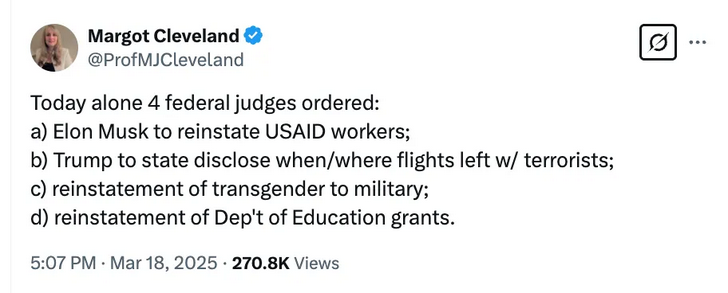
It won’t be news to anyone that the federal judiciary has decided Donald Trump has no authority as President of the United States but to serve and protect the status quo, absolutely without deviation. Change is unconstitutional. Policy is unconstitutional. But even by that standard, today has been very special.
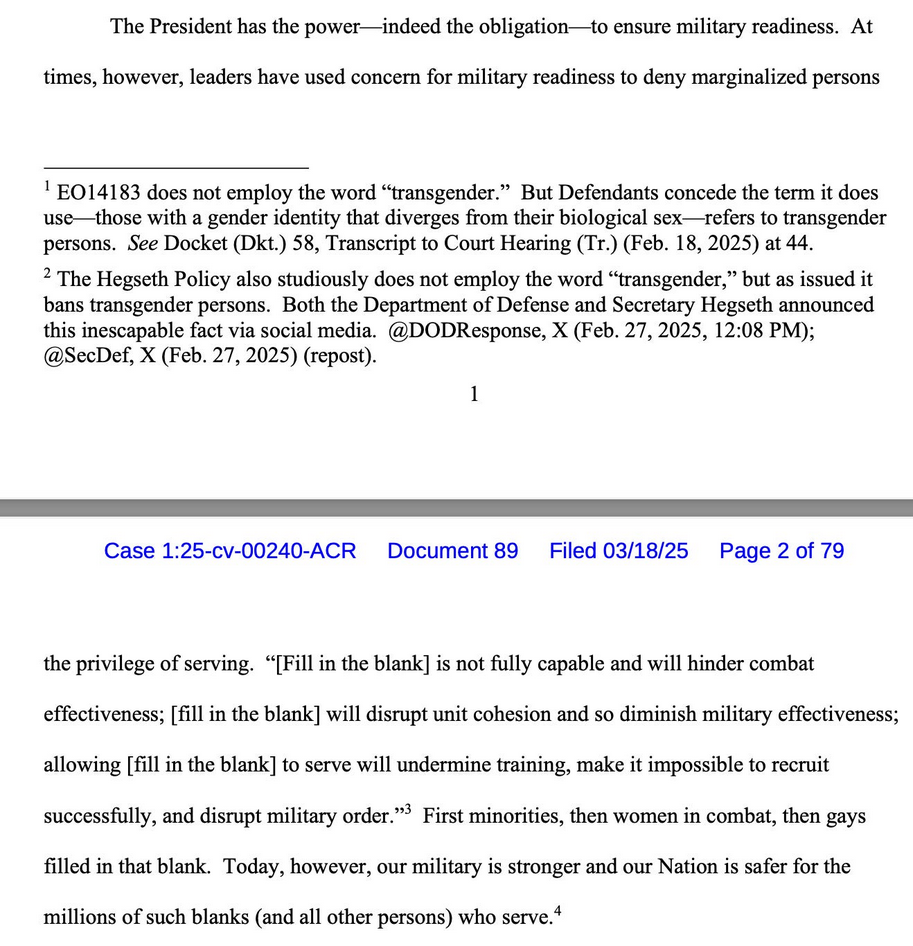
Without digging into all the details about everything, skim your way through a single judicial decision to begin to see what’s happening: the decision from District Court Judge Ana Reyes, ordering the Department of Defense to allow the continued service of transgender military personnel. You can click here to read it, or open the PDF file below.
This is not a judicial decision. I mean, it is a judicial decision, but it doesn’t represent judicial culture or a judicial outlook. At all. It’s a bitchy schoolgirl essay about being fair and not being mean, with healthy doses of platitudinous foot stompery. Screenshot, bottom of page one and top of page two:
“Today, however, our military is stronger and our Nation is safer for the millions of such blanks (and all other persons) who serve.” Because she says so, is why. The old bigoted American military was very weak. I don’t remember: Did the old dumb bigots ever even win any wars or anything?
[…]
Our military is much stronger now than it was when gay and transgender service wasn’t warmly encouraged, the end. (Stomps foot.) It’s a TikTok video formatted to look like a, you know, a judge thing. You can even agree with the judge and see that she hasn’t made an argument. “Today, however, our military is stronger.” Like when we beat the Taliban, or all the other wars we’ve won lately. This is the declarative reality in which a thing becomes true because you type it.
Now, watch this. Watch Judge Ana Reyes roll right over herself without noticing that she’s doing it. You don’t have to read past page two to see this.
On page one, she characterizes the reasoning — the premise the administration advanced to forbid military service by transgender personnel: “Service by transgender persons is ‘inconsistent’ with this mission because they lack the ‘requisite warrior ethos’ to achieve ‘military excellence’.” That’s it, those mean monsters! That’s their whole reason! They said trans people can’t serve because of, I don’t know, some stupid ethos thing. What does that even mean?

March 20, 2025
US Supreme Court to hear case that might overturn the Kelo decision
J.D. Tuccille discusses a US Supreme Court case on abuse of the power of eminent domain that might be the key to reversing the ridiculous Kelo precedent:

… the U.S. Supreme Court may soon overturn one of its worst decisions in recent memory — a ruling that justified government stealing property from its owners to pass it to better-connected private parties. On Friday, the court will decide whether to consider a New York case that could upset the precedents set by Kelo v. New London, an eminent domain battle that prompted books, a movie, and state-level legal reforms. While Kelo was a loss for anybody who wants to set boundaries around government power, the court could take the opportunity this week to set things right with Bowers v. Oneida County Industrial Development Agency.
Kelo Abandoned Basic Limitations on Government Power
In dissenting to the majority’s 2005 decision in Kelo allowing the taking of a house owned by Susette Kelo by the city government of New London, Connecticut to transfer it to a favored developer, Justice Sandra Day O’Connor quoted Calder v. Bull (1798): “[A] law that takes property from A. and gives it to B: It is against all reason and justice, for a people to entrust a Legislature with such powers; and, therefore, it cannot be presumed that they have done it”.
“Today the Court abandons this long-held, basic limitation on government power”, O’Connor added. “Under the banner of economic development, all private property is now vulnerable to being taken and transferred to another private owner, so long as it might be upgraded — i.e., given to an owner who will use it in a way that the legislature deems more beneficial to the public — in the process.”
That dissent was joined by Chief Justice William H. Rehnquist and Justices Clarence Thomas and Antonin Scalia. Also agreeing with the dissenters were a great many Americans horrified that the Supreme Court had signed off on the confiscation of private property so long as a potential new owner could show spiffy plans for the confiscated parcels and promise greater tax revenue. It wouldn’t even have to be a fulfilled promise — Susette Kelo’s house remained undeveloped when financing for the project fell through.
The response to Kelo included books, a movie — Little Pink House — and a wave of state-level court decisions and legislative efforts intended to rein-in the abuse of eminent domain.
Most States Have Reformed Eminent Domain — but Not New York
“Since Kelo v. New London, 47 states have strengthened their protections against eminent domain abuse, either through legislation or state supreme court decisions,” notes the Institute for Justice (I.J.). Of course, not all the reforms were created equal. I.J. grades the various efforts, with states like Florida getting an “A” grade and Connecticut — where the Kelo case occurred — lagging with a “D”. A 2009 study found that “states with more economic freedom, greater value of new housing construction, and less racial and income inequality are more likely to have enacted stronger restrictions, and sooner” on eminent domain.
And then there’s New York. I.J. gives that state an “F” because it failed to even attempt reform. In 2009, that state’s highest court conceded “it may be that the bar has now been set too low” as it approved seizure of private property for redevelopment. “But any such limitation upon the sovereign power of eminent domain as it has come to be defined in the urban renewal context is a matter for the Legislature, not the courts.” The legislature never acted.
March 16, 2025
Female sexual predators
Every civilized person rejects the notion that male sexual predators should be tolerated, yet few are willing to accept the notion that female sexual predators might even exist. They absolutely do exist and they do commit terrible crimes against their — often very young — victims, as Janice Fiamengo shows:
Even when we are aware that women prey on children, many of us can’t really believe it. When Florida Congresswoman Anna Luna, a Republican elected to the U.S. House of Representatives, proposed three new bills last year that would impose harsh penalties, “including the death penalty”, for various forms of sexual abuse, child pornography, and child sexual exploitation, it is impossible to believe that Luna thought any number of women would be executed for child rape, and nor will they be given the leniency that is shown to women in the criminal justice system (see Sonja Starr’s research).
Yet similar crimes to Ma’s are easily discovered. In the same month that Ma pled guilty, a Martinsville, Indiana teacher was charged with three counts of sexual misconduct against a minor, a 15-year-old boy who has alleged that as many as ten other students were raped by the same woman. The month before that, a New Jersey primary school teacher was charged with aggravated sexual assault against a boy who was 13 years old when she bore his child; it is alleged that she began raping the boy when he was 11. The month before that, a Tipton County, Tennessee teacher [pictured below] pled guilty to a dozen sex crimes against children ranging in age from 12-17 years old. It is thought that she victimized a total of 21 children.
In the same month, a Montgomery, New York teacher pled guilty to criminal sexual assault of a 13 year old boy in her class, whom she assaulted over a period of months. In the previous month, a San Fernando Valley teacher was charged with sexual assault of a 13 year old male student; police believe she victimized others also. Earlier in the year, a substitute teacher in Decatur, Illinois was charged with raping an 11 year old boy. These are just a few recent cases, and only those involving female schoolteachers. Female predators are also to be found amongst social workers, juvenile detention officers, and sports coaches.
The feminist position on male sexual abuse of women and girls has for a long time been that it is about power. Men rape and abuse, according to Susan Brownmiller [quoted above] and others, because they believe it their right as men to keep women subordinate. Rape compensates for male inadequacy and allows for the expression of men’s hostility toward women: it is not about lust but about men’s need to humiliate and degrade. As Paul Elam once noted in a Regarding Men episode, the theory is fatally weakened if even a single woman does the same thing. Feminists have responded by saying that female sexual abuse is fundamentally different from male, less dangerous to society, less hurtful to its victims.
While I was doing research for this essay, I happened upon a recent podcast discussion between Louise Perry, British author of The Case Against the Sexual Revolution, and Meghan Murphy, Canadian Substack author and editor of Feminist Current. The podcast was called “What Happened to Feminism?” and I tuned in because I have enjoyed their perspectives on other issues.
Perry and Murphy are both critics of feminism who remain, as their conversation confirmed, staunchly feminist and anti-male. At one point in the podcast (at about 50:00), the conversation turned to #MeToo, and especially to allegations against teachers. Having already agreed that 95% of MeToo allegations were true, or at least based on something real, the pundits went on to agree, with disconcerting laughter, that there was no comparison between a “crazy” woman who “had sex” with a male student in her class, and a “dangerous” man, a “predatory rapist”, who went after under-age girls in his power.
Murphy even trotted out the old chestnut that abused boys were “stoked about the situation” in getting with “the hot teacher”. After all, she chuckled, “Men are gross predators. Men are perverts. They can’t keep it in their pants.” Perry, seeming taken aback by Murphy’s vulgarity, nonetheless agreed that the sexual abuse of boys is in an entirely different category from that of girls: “It is so annoying to me,” she said, “when people will go around claiming that these are exactly the same”.
Indifference to the victimization of boys, and lack of shame in admitting it, could hardly have been more stark. I mention the podcast not because it was singularly outrageous but because the attitudes expressed in it are still so much the norm, even amongst women who claim to have rethought other feminist beliefs.


March 14, 2025
Greenland in the news again … and it’s not about Trump this time
Tim Worstall sums up coverage from The Guardian about a case involving the government of Greenland and a mining operation going to court for damages from the government’s change of policy:

So, here’s a case:
Fearing toxic waste, Greenland ended uranium mining. Now, they could be forced to restart — or pay $11bn
Gosh.
In 2021, Greenland went to the polls, in a contest to which uranium was so central, international media dubbed it “the mining election”. The people voted in a green, leftwing government, led by the Inuit Ataqatigiit party, which campaigned against uranium mining due to the potential pollution.
When it took power, the new government kept its campaign promise, passing legislation to ban uranium mining. While not primarily a uranium mine, the Kvanefjeld project would require unearthing the radioactive substance to extract its rare earth oxides, putting it in violation of the law.
Many Greenlanders celebrated the vote as a victory for health and the environment. But three years later, the company is suing Greenland for stopping its plans, demanding the right to exploit the deposit or receive compensation of up to $11.5bn: nearly 10 times the country’s 8.5bn krone (£950m) annual budget.
That part of it isn’t wholly biased. It is, roughly and around and about, true.
Just as an aside I think I met one of the lads behind the mining company once. Mickey Five Names was it? Management and all has changed since then but they were not, say, of the probity of the board of Rio Tinto. Just as an opinion, you understand.
Still, they signed a contract which allowed them to prospect and so they then spent money. The law stated that they would, naturally, advance to an exploitation licence. That’s what they got denied.
[…]
Everyone’s agreeing on what happened. Roughly they are at least. You Mr. Corporation can explore and if you find something you can dig it up and so make money back on your costs. Then the government changed its mind leaving the company facing the total loss of all it had spent.
So, who has to cough up here?
No one — really, no one at all — is saying that a government cannot change its mind. Or even that elections should not have consequences and that policy might change after having had one.
What is being said is that if you nick someone’s property then you’ve got to pay for it.
Well, is not issuing an exploitation licence that you said you would nicking someone’s property? That’s clearly arguable (I would say “Yes!” but then that’s me) so, where do we go to argue this?
March 8, 2025
The Federal Court of Canada rules in favour of Trudeau’s authoritarian instincts and actions
Apparently we’ve all been under a delusion that Parliament was the paramount elected body and therefore that the Prime Minister needed to operate within the rules of Parliament. The Federal Court saw it otherwise, as Dan Knight explains:
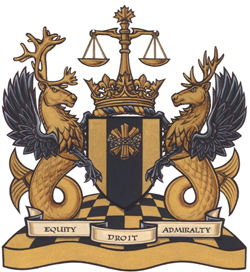
Arms of the Federal Court of Canada
If you’ve been following this case, you already know what’s at stake: whether Justin Trudeau — Canada’s most brazenly authoritarian Prime Minister in modern history — can shut down Parliament whenever he finds it politically inconvenient. Well, today, the Federal Court of Canada, in all its wisdom, just gave him the green light.
Chief Justice Paul S. Crampton released his decision, and while he acknowledged that the courts do have the power to review the Prime Minister’s use of prorogation, he ultimately ruled that Trudeau didn’t exceed his constitutional authority. That’s right — according to the Federal Court, it’s perfectly fine for a sitting Prime Minister to shut down Canada’s elected legislature while his party scrambles to pick a new leader. It’s fine to suspend oversight at a time when Canada is facing real, tangible threats, including Trump’s tariff war. It’s fine to use a legal loophole to avoid answering for one of the biggest financial scandals in Canadian history — the SDTC affair, which saw millions of taxpayer dollars funneled into thin air.
Let’s be very clear about what happened here. On January 6, 2025, Justin Trudeau stood at a podium and declared that Parliament — Canada’s most important democratic institution — was “paralyzed”. He said it was no longer working, that it needed a reset, and that in the meantime, he was resigning. Oh, and conveniently, during that time, the Liberal Party would be selecting a new leader.
Pause for a second and consider that. He wasn’t just shutting down debate on a single issue. He wasn’t suspending a single bill. He was shutting down Parliament entirely — the very institution meant to hold his government accountable.
Now, the Justice Centre for Constitutional Freedoms (JCCF) immediately called this out for what it was — an unlawful, undemocratic, and unconstitutional seizure of power. They filed a legal challenge, and in that case, they pointed out some pretty basic, irrefutable facts:
First, Parliament was not paralyzed. In the weeks leading up to prorogation, four separate bills had been passed. Does that sound like a government that isn’t functioning? Or does it sound like a Prime Minister who was simply looking for an excuse to silence his critics?
Second, and more importantly, Trudeau wasn’t shutting down Parliament to “reset” anything — he was doing it to save his own party. His government was crumbling. His ministers were resigning. His own caucus was at war with itself. And just as an election loomed over his head, he pulled the plug on Parliament, giving his party a clean slate while robbing opposition parties of their ability to challenge him.
And here’s the part the mainstream media will never report — this move wasn’t just about Trudeau’s political survival. It was also a blatant attempt to escape scrutiny over his government’s refusal to release documents related to the Sustainable Development Technology Canada (SDTC) scandal. If you don’t know what that is, it’s simple: Parliament ordered the Trudeau government to hand over records about how millions of taxpayer dollars mysteriously disappeared into politically connected environmental companies. The Trudeau government refused, defied Parliament, and then shut Parliament down before anyone could hold them accountable.
February 28, 2025
QotD: A jaundiced view of the feminist movement
Note that governments, back in the day, did not attempt to act as a nanny, warding off daily harms from unsafe commercial products, or was government in the business of educating the young, nursing the sick, or managing the personal lives of all the children of all ages inhabiting the nation.
The idea of the men who invented feminism was that propelling women into the workforce would increase the tax base, break apart the nuclear family, and increase sales of expensive drugs to promote temporary sterility.
Breaking the family in turn would make women more dependent on the government than on their menfolk, and draw the unreasoning admiration women typically bestow upon their protectors and breadwinners onto the Powers That Be. The fanatical devotion that mothers of convicts show, when they insist forever that their child is innocent, would then be channeled into the ballot box toward whatever demagogue with a vacant smile promised to remove dangerous liberty from the hands of the children, regardless of age, inhabiting the nation.
Pornographers like Hugh Hefner encouraged feminism on the grounds that it would increase vice, and hence the monetary gain from the public sale of vice.
Then, once women were in the workforce, excluding them from the military and other areas where men are better qualified was said to be a sign of hidden bigotry against them. The idea of this bigotry was so stupid that a new word had to be coined to hide its meaning, and that word is “sexism”.
The word “racism” — which at the time had a meaning — was decapitated and the word “sex” — and at the time this word also had a meaning — was sutured onto the neckstump, to produce a new word intended to denounce a nonexistent hatred and contempt felt by men against women.
There have been wars between races and tribes since time immemorial, and hatred between races and tribes. But the war between the sexes is not really a war, because both sides keep flirting with the other, and settling down, and having babies and suchlike.
John C. Wright, “No More Lads”, John C. Wright’s Journal, 2020-01-28.
February 26, 2025
QotD: The banality of crime
Cynical bastard that I am, I immediately wondered just how they’d managed this feat of law enforcement. College Town being, well, a college town, it had a surprisingly large police force, but the cops dealt overwhelmingly with quality-of-life stuff. I doubt they had more than one or two full time detectives (if that) chasing burglars; I don’t recall College Town ever having a homicide. They certainly didn’t have narcs on the force, is what I’m getting at, so how on earth did they disrupt this small-time, amateurish, yet still legit (on volume alone) drug smuggling operation?
I forget the details, but as you’d surmise from this story taking place in Clown World, they were fake and gay. I’m slightly fictionalizing, and slightly exaggerating, but it really was on the level of “A prowl car saw a guy driving erratically and pulled him over, at which point smoke started billowing out of the windows. The cop looked in and found a felony amount of pot sitting in a garbage bag on the front seat, and the driver copped a plea — he ratted out his supplier, and when the cops showed up with a warrant, that knucklehead, too, had his bales of marijuana sitting out in plain view on the living room couch.”
Most crime works like that, as it turns out. Even in the big cities, where police departments have bigger budgets and more combat power than a lot of European armies. Homicides, for instance, are 99% paperwork, I’m told. Everyone knows that Peanut shot Ray Ray over a pair of sneakers, not least because Peanut is walking around in the damn things, and probably still has the gun shoved in the waistband of his track suit, too. “Solving” the homicide is just a matter of putting the paperwork through. Stone cold whodunits, like big sophisticated undercover narcotics operations, are vanishingly rare, because the cost of enforcement, let’s call it, is extremely high.
I know, I know, The Wire was a tv show, but people I know who really do work in law enforcement say it’s close enough to the real thing for our purposes. Drug dealers down in the ‘hood aren’t nearly as smart and sophisticated and above all self-disciplined as the Barksdale Crew, but the basic principle is the same: Since the low-level people are inevitably going to get busted, make sure that the low-level people don’t have anything on the guys one level higher, and your drug dealing operation is more or less safe. Just as Peanut could probably get away with blasting Ray Ray in broad daylight if he were smart enough not to wear the shoes around, so the pot dealers in College Town could’ve gotten away with their operation more or less forever, provided they weren’t stupid enough to be driving around high on their own supply, with said supply in plain view in the passenger seat.
Severian, “The Cost of Enforcement”, Founding Questions, 2021-09-29.


