The Lee tank was an American hastily-made tank that saw action in the north African desert, and the Grant was a British version of the same vehicle. But there were also Lee tanks that were more like Grants. I try to explain the confusion.
Lindybeige: a channel of archaeology, ancient and medieval warfare, rants, swing dance, travelogues, evolution, and whatever else occurs to me to make.
▼ Follow me…
Twitter: https://twitter.com/Lindybeige I may have some drivel to contribute to the Twittersphere, plus you get notice of uploads.
As the British make spectacular advances in East-Africa, with even more spectacular advances on the horizon, South-Eastern Europe is getting increasingly tense.
Written and Hosted by: Indy Neidell
Produced and Directed by: Spartacus Olsson and Astrid Deinhard
Executive Producers: Bodo Rittenauer, Astrid Deinhard, Indy Neidell, Spartacus Olsson
Creative Producer: Joram Appel
Post-Production Director: Wieke Kapteijns
Research by: Indy Neidell
Edited by: Iryna Dulka
Map animations: Eastory (https://www.youtube.com/c/eastory)
Sources:
– Bundesarchiv
– Library of Congress
– IWM: E 6661
– National Library of Australia
– National Portrait Gallery
– Letter by Mochammad Kafi, post icon by Bonegolemfrom, from the Noun Project
– Photot of Goethe Medal by Mondfreund from Wikimedia Commons
– Eirik Sundvor, The Municipal Archives of Trondheim
Joseph Chambers invented a repeating flintlock weapon in the 1790s, and I think it is appropriate to consider it a “machine gun”. The design used a series of superposed charges in one or more barrels, with specially designed bullets that has hollow central tubes through them. This would allow the fire from a detonation charge to transit through a bullet at the rear and set off a subsequent charge. The result was a single trigger pull to use a flintlock action to start an unstoppable series of shots. Chambers made pistol and musket versions, as well as a full-on mounted machine gun.
He submitted his design to the fledgling US War Department in 1792, but it was not accepted. He brought the guns back to their attention when the War of 1812 was declared, and this time he found an eager client in the United States Navy. More than 50 of the machine guns were built and purchased to use on Navy warships. This version had 7 barrels, each loaded with 32 rounds, for a total of 224 shots, at (apparently) about a 120 round/minute rate of fire. The British found out about the guns and made some effort to reverse engineer them, and there was also interest in France, the Netherlands, and Spain. Ultimately, the potential unreliability of the system prevented more widespread adoption, but the gun is a fascinating example of early automatic firearms.
Thanks to the Liege Arms Museum for access to film this for you! If you are in Belgium, definitely plan to stop into the museum, part of the Grand Curtius. They have a very good selection of interesting and unusual arms on display.
If you happen to like our videos and have a few bucks to spare to support our efforts, check out our Patreon page where we’ve got a variety of perks for our Patrons, including Simon’s voice on your GPS and the ever requested Simon Whistler whistling package: https://www.patreon.com/TodayIFoundOut
The Great Courses Plus is currently available to watch through a web browser to almost anyone in the world and optimized for the US, UK, and Australian markets. The Great Courses Plus is currently working to both optimize the product globally and accept credit card payments globally.
Never run out of things to say at the water cooler with TodayIFoundOut! Brand new videos 7 days a week!
In this video:
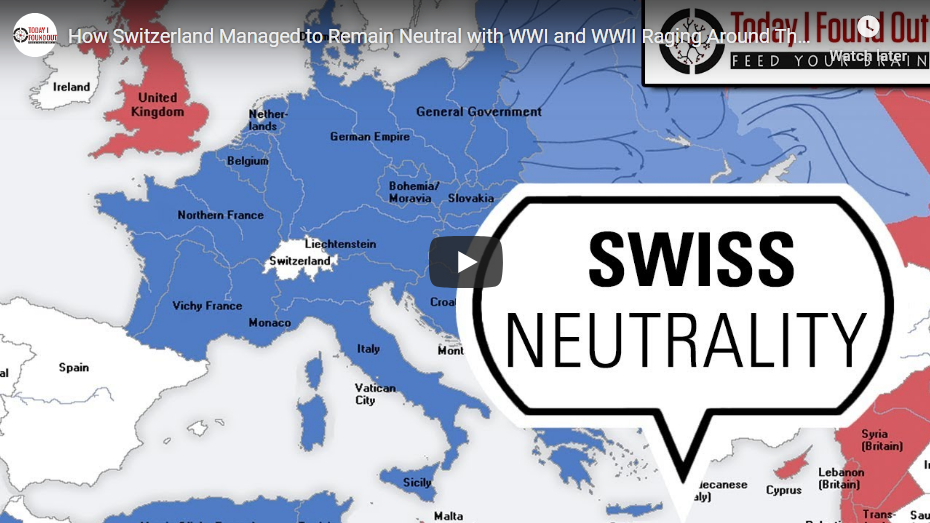
The tiny mountainous country of Switzerland has been in a state of “perpetual neutrality” since the major European powers of the time declared it as such during the Congress of Vienna after the end of the Napoleonic wars in 1815.
The NATO rifle trials of the early 1950s eventually chose the 7.62mm x 51mm cartridge, and the British and Belgians agreed on the FAL rifle to shoot it (and they thought the US would as well, but that’s another story). The British government formally accepted the FAL for troop trials, and in 1954 an order for 4,000 X8E1 rifles (with iron sights) and 1,000 X8E2 rifles (with SUIT 1x optical sights) was placed. These rifles were mechanically the same as what would be finalized as the L1A1 rifle, but they include a number of differing features. Both models had 3-position selector switches allowing automatic fire, and they also had manual forward assists on the bolt handles. The iron sights had top covers with integrated stripper clip guides, as there was concern that troops would have to manually reload their magazines, and stripper clips would speed this process up.
Many thanks to the Royal Armouries for allowing me to film these very scarce trials rifles! The NFC collection there — perhaps the best military small arms collection in Western Europe — is available by appointment to researchers:
This video is sponsored by Paradox Interactive. Indy shares his thoughts on what he thinks would have happened if the Spanish Revolution would have happened differently.
You can create your own alternate history in the grand strategy game Hearts of Iron IV! Discover it here: https://pdxint.at/37Po039
1982, on a group of islands far, far away from Great Britain. After the military junta of Argentinian Army General Leopoldo Galtieri had publicly declared that the Falkland Islands (Malvinas) were rightfully part of Argentinian territory, an invasion force succeeded in wrestling control away from their British owners. However Great Britain would not simply stand by and give the Falklands up. Instead a British task-force would make its way down to the Falklands, in an attempt to take back control of the islands by force. What followed was an undeclared war of 10 weeks, where British carriers and commandos fought against the entrenched Argentinian ground-forces for the ownership of the islands.
Watch more videos on the Sabaton YouTube channel: https://www.youtube.com/user/Sabaton?…
Listen to Sabaton on Spotify: http://smarturl.it/SabatonSpotify
Official Sabaton Merchandise Shop: http://bit.ly/SabatonOfficialShop
Hosted by: Indy Neidell
Written by: Markus Linke and Indy Neidell
Directed by: Astrid Deinhard and Wieke Kapteijns
Produced by: Pär Sundström, Astrid Deinhard and Spartacus Olsson
Creative Producer: Joram Appel
Executive Producers: Pär Sundström, Joakim Broden, Tomas Sunmo, Indy Neidell, Astrid Deinhard, and Spartacus Olsson
Post-Production Director: Wieke Kapteijns
Edited by: Iryna Dulka
Sound Editing by: Marek Kaminski
Maps by: Eastory – https://www.youtube.com/c/eastory
Overly Sarcastic Productions
Published 24 Apr 2015
Funny story: That half-second-long scream? Took me about four hours to record. I’m really bad at screaming and/or laughing on demand, so I sat down with some videos of the Game Grumps playing horror games and recorded my reactions to use whenever I need them. I now have a fifteen-second sound file of laughter and screams with varying degrees of shameful girliness.
Part 2 of the centuries-old trilogy has finally been summarized! Surely you’ve awaited this moment with bated breath. As always, I am happy to oblige.
Comments Off on Classics Summarized: Dante’s Purgatorio
The Nazi economy appears to do well during the 1930s. But this is largely myth, as the German economy under Hitler is based on a self destructive, ideologically or selfishly fuelled irrationality driven by conquest and criminal practice.
Soundtracks from Epidemic Sound:
– “Document This 1” – Peter Sandberg
– “March Of The Brave 10” – Rannar Sillard – Test
– “Ominous” – Philip Ayers
– “The Inspector 4” – Johannes Bornlöf
– “Disciples of Sun Tzu” – Christian Andersen
– “Guilty Shadows 4” – Andreas Jamsheree
– “Last Point of Safe Return” – Fabien Tell
– “Death And Glory 1” – Johannes Bornlöf
– “Easy Target” – Rannar Sillard
– “Split Decision” – Rannar Sillard
– “First Responders” – Skrya
– “The Charleston 3” – Håkan Eriksson
A TimeGhost chronological documentary produced by OnLion Entertainment GmbH.
From the comments:
Spartacus Olsson
1 day ago
From an intellectual viewpoint, this is perhaps the most challenging episode I have written in this series. First of all it’s hard to make economic policy interesting, even when it’s about the Nazis. It tends to get, well … grey. Second of all it’s not that easy to simplify things without completely losing the essence of what was going on. Third of all, I’m fighting an uphill battle against a post truth, political talking point based on … let’s just call it less than ingenious purposes.
Obviously that’s the idea that the Nazis were Socialists. And perhaps that is not so far fetched when you think of the name of their party, the way they framed their anti-semitic rhetoric in a way that it would sound friendly to the working class, and their absolute disregard for telling the truth about anything, and everything. But although we have painstakingly showed you the facts, I am painfully aware that it won’t make a difference to stop the nonsense out there and in here — some pundits will religiously stick to their ideas, because if they don’t, they might have to face that some of the ideas they have are mutual with the people they so desperately want to distance themselves from. The same happened with the far left between the 1930s and 1970s, when they tried with cramped desperation to frame Stalinism as a right wing, Fascist movement — Red Fascism was the term — obviously as much nonsense as the alt-right idea that Naziism is Socialism.
And is it important? Well yes and no — the dumbos will probably get worn out at some point, it’s after all quite challenging to look for ways to distort the record over, and over again. I don’t really care if the extremists try to push their mutual garbage in each other’s lap — as a supporter of democracy and humanism, I have no regard for either end. I do however have an incredible amount of respect for conservatives, liberals, and progressives who are equally dedicated to democracy and human rights — and there is where it matters.
When the far left tries to frame Stalinism as right wing, and the far-right tries to frame Naziism is left-wing, they are trying to co-opt a position of less extremism. It’s an invasive attempt for Communists and (real) Socialists to just look like regular Progressives, and Fascists and Nazis to just look like regular Conservatives. And that my friends is dangerous, to all of us, regardless of our nationality, creed, political affiliation, or opinion — because it is specifically our individual rights and democracy that is at stake in this game. That’s what they want to take away, or in some places stop from developing.
Comments Off on Why the Nazis Weren’t Socialists – ‘The Good Hitler Years’ | BETWEEN 2 WARS I 1937 Part 2 of 2
Anton Howes explains something that I’d wondered about in the latest edition of his Age of Invention newsletter:
Route of John Cabot’s 1497 voyage on the Matthew of Bristol posited by Jones and Condon: Evan T. Jones and Margaret M. Condon, Cabot and Bristol’s Age of Discovery: The Bristol Discovery Voyages 1480-1508 (University of Bristol, Nov. 2016), fig. 8, p. 43. Wikimedia Commons.
… in 1550 the English were still struggling with latitude. Their inability to find it, unlike their Spanish and Portuguese rivals, was one of the main things holding them back from voyages of exploration.
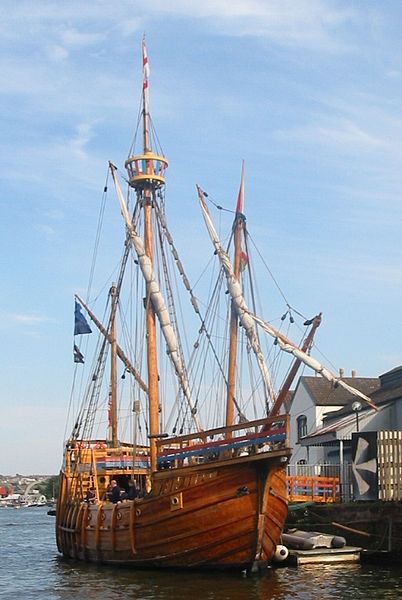
The replica of John Cabot’s ship Matthew in Bristol harbour, adjacent to the SS Great Britain. Photo by Chris McKenna via Wikimedia Commons.
The traditional method of navigation for English pilots was to simply learn the age-old routes. They were trained through repetition and accrued experience, learning to recognise particular landmarks and using a lead and line – just a thin rope weighted with some lead – to determine their location from the depth of the water. Cover the lead with something sticky, and you might bring up some sediment from the sea floor to double-check: a pilot would learn the kinds of sand and pebbles from to expect from different areas. And when they travelled out to sea, away from the coastline, they used a basic system of dead reckoning, taking their compass bearings from a known location, estimating their speed, and keeping in a particular direction for long enough. Or at least hoping to. They might keep track of their progress on a wooden traverse table, inserting pegs to indicate how far they had sailed, but it was ultimately a matter of rough estimation. Should they make any mistake — in terms of their speed, heading, or point of departure — they might easily get lost. But it was still a matter of trying to follow an already-known route. And English mariners of the 1550s did not even know that many routes.
For a voyage of exploration, by contrast, landmarks and sediment from the sea floor would be seen for the first time rather than recalled. By definition, there was no route to follow. So to launch their own voyages of discovery, the English needed to learn a new skill. They needed to look to the heavens.
Celestial navigation — measuring the altitude of heavenly bodies and then using geometry to determine one’s latitude on the earth’s surface — was by the 1550s already hundreds of years old. It had primarily been used to cross the deserts of North Africa and the Middle East — seas of sand, in which there might also be no landmarks from which to take bearings — and to navigate the Indian Ocean. Thus, while pilots in the Atlantic and the Mediterranean stuck to dead reckoning and soundings, Islamic navigators had for centuries used quadrants and astrolabes to take their bearings at sea. By the mid-fifteenth century, these instruments and techniques had found their way to Europe, where they were put to use especially by Portuguese, Spanish, and Italian explorers, along with additional instruments such as the cross-staff.
[…]
So for decades, English explorations relied on foreigners who either knew the routes that the English pilots didn’t, or who at least possessed the skill of mathematical, celestial navigation. The Italian explorer John Cabot (Zuan Chabotto), when he sailed to Newfoundland from Bristol in the late 1490s, was able to take latitude readings (he may even have been familiar with the older Islamic navigational practices, as he claimed to have visited Mecca). When Cabot died, the English expeditions that set out from Bristol in 1501-3 relied on Portuguese pilots from the mid-Atlantic islands of the Azores. And John Cabot’s son, Sebastian Cabot, who was involved in a few English expeditions, was so expert in mathematical navigation that he was eventually appointed pilot major for the entire Spanish Empire, making him responsible for the training and licensing of all its pilots — a position he held for three decades. When he led a voyage of exploration on behalf of Spain in 1526-30, a few English merchants became investors so that they could justify sending with him an English mariner, Roger Barlow, to secretly learn the Spanish routes across the Atlantic and have immediate knowledge if an onward route to Asia was discovered (as it turned out, South America got in the way).
Comments Off on So that’s why John Cabot got hired!
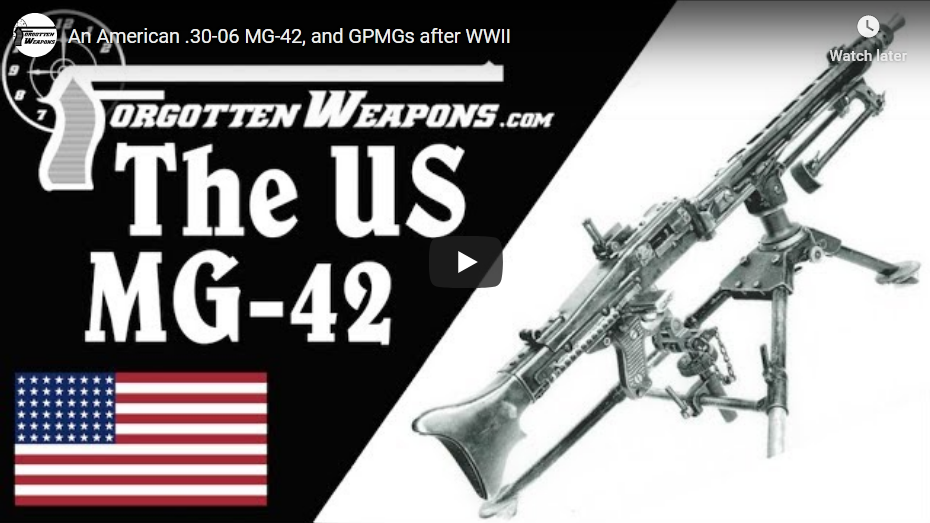
The perk for $100 Patrons is choosing a gun they would like me to find and film, and one such Patron (Mark) expressed a curiosity about US testing and lack of adoption of an MG-42 in .30-06 caliber. So, today we will discuss that (the trials gun was designated the T24) as well as why it took so long for the FN MAG to be developed and adopted.
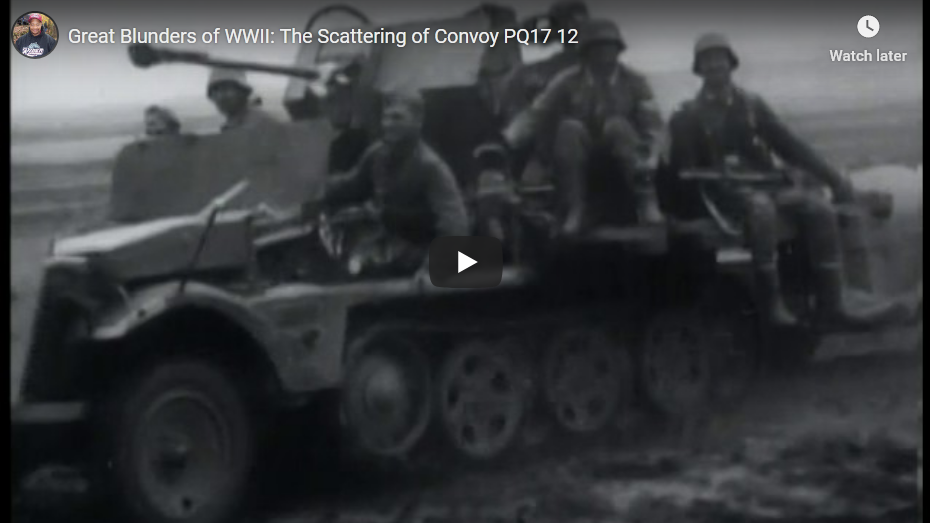
From the History Channel DVD series Great Blunders of WWII.
This is of interest for many reasons, but particularly because my late father-in-law served in the Royal Navy on the Arctic convoys and spent a full winter in the Soviet Union when his convoy couldn’t return before the ice closed the convoy route.
Comments Off on Great Blunders of WWII: The Scattering of Convoy PQ17