
Forgotten Weapons
Published 11 Apr 2026In 1958, Val Forgett of Navy Arms contracted with Beretta engineer Aldo Uberti to produce 1,000 reproductions of the Colt 1851 Navy revolver. That turned into the beginning of many decades of production of a wide variety of revolvers and rifles, from the LeMat to a line of Winchester lever actions. Fueled by both organized Cowboy Action competition and general widespread interest in these guns, Navy Arms grew very successful in the market, attracting many other companies who continue to exist to this day. Today I’m talking with Val Forgett’s son (also Val Forgett) about some of the interesting details of the business.
(more…)
August 29, 2026
The Origins of Aldo Uberti and Reproduction Cowboy Guns
Comments Off on The Origins of Aldo Uberti and Reproduction Cowboy Guns
QotD: Peter Green’s vengeance against the Hellenistic Age
… Alexander to Actium is a rich feast, enlivened throughout with Green’s flare for delicious details and legends that are possibly fanciful but too remarkable to leave out.
But telling the actual narrative of the Hellenistic world, however bizarre and entertaining it gets, is really only the superficial purpose of Alexander to Actium. No, the real point of the book, and the real reason to stick around for all 700 pages, is to witness Peter Green’s incredible, almost maniacal act of vengeance against an era he despises.
Whether it’s playwrights …
The poet-playwright Menander … has always struck me as a classic example of a growth industry created by papyrological accident.
… poets …
Callimachus, like Ben Jonson, has always had a rather better press than he deserves, and for much the same reason: his academic ideals and credentials can hardly fail to appeal to those other academics … I cannot help finding him at once pretentious and faintly distasteful, a literary exhibitionist with an unpleasant groveling streak about him, a sycophant implacable in his attacks on rival sycophants[.]
… philosophy …
Popular philosophies — and Stoicism must be accounted one of the most popular ever — almost always tend to have an intellectually suspect quality about them.
… coin portraits …
Prusias I of Bithynia is porcine, crass, and self-satisfied. The early kings of Pontus resemble nothing so much as a family of escaped convicts: Pharnaces I has the profile of a Neanderthaler, and Mithridates IV that of a skid-row alcoholic.
… or academia itself …
Museum faculty developed a reputation for symposia, frivolous research topics, and alcoholism: to anyone in the same profession there cannot fail to be a certain sense of deja vu.
… Green knows how to write a burn. It’s not simply that he’s a hater: his book about the Battle of Salamis overflows with love and admiration for the golden age Greeks who defeated the Persians. No, Green specifically has a bone to pick with the Hellenistic era and its rulers, its people, its art, and its ideas. For those who read for entertainment, the best part of Alexander to Actium isn’t the battles, the George R.R. Martin-esque politics, or the even more Martin-esque incest — it’s tagging along as Peter Green gets revenge on the Hellenistic Age by writing a definitive textbook about it, so that all students of history who come after him will read of his scorn and contempt.
Green’s harsh attitude is clear right from the preface, when he sets the book’s scope.
[I will not] devote specific sections either to law or to school education, on the grounds that during our period the first … was little more than an elaborate sham masking the realities of power, while the second offered nothing, in essence, but literary rote learning, elementary mathematics, music, athletics, and — most important — a rhetorical grab bag that would enable men at the top to talk their way into, or out of, anything.
Hellenistic historiography fares just as badly:
Polybius remains the only worthwhile historian of the Hellenistic period whose work substantially survives. Diodorus, as we are too often reminded, is a third-rate compiler … I have no wish to burden an already overlong book with yet another imaginative analysis of his chronological inconsistencies and synthetic rhetoric. Like Plutarch, he believed that one virtue of history lay in “recording the nobility of distinguished men, publicizing the vileness of the wicked, and in general promoting the good of mankind”. Successful statesmen, he thought, were righteous, while evil ones met with frustration: nothing, in short, succeeds like success. None of this inspires confidence.
From there the savagery continues almost non-stop, right down to the last page when Green ridicules imperial Roman literature for “guttering out” by the mid-2nd century. Virtually nothing escapes.1
Take philosophy, that most noble of ancient endeavors. The Hellenistic world’s biggest philosophical contribution was Stoicism. Today, Stoicism enjoys a good reputation for encouraging adherents to be stolid and uncomplaining in the face of difficulties. Green, though, puts the spotlight on Stoicism’s lesser-known traits like its determinism and pantheism, then singles it out as a shallow ideology perfect for helping elites rationalize their own hypocrisies.
Sandbach correctly notes that “the belief that the world was entirely ruled by Providence would have an appeal to the ruling class of a ruling people”. What Stoicism offered, in fact, was a built-in justification — moral, theological, semantic — for the social and political fixed order: it was the most powerful and subtle instrument of self-perpetuation that the Hellenistic ruling class ever conceived. The mere fact of anything happening meant that it had been fated to happen; and since nature was providentially disposed toward mankind, what was fated could not fail to be all for the best. This interesting version of determinism is most often presented as a source of comfort when things seemingly went wrong; but of course, as I have suggested, it would be of even greater benefit to those who were anxious to have some moral principles to offer the world in justification of ruthless self-interest. If it was bound to happen, it had to be right.
People have always wanted to learn the future, but Stoicism’s belief in a deterministic yet providential cosmos drove a tremendous increase in the popularity of astrology, divination, and other woowoo, often egged on by the philosophers themselves.2 Green even hypothesizes that Stoicism’s popularity directly sabotaged whatever nascent scientific progress there was in the late Hellenistic age.
Blake Neff, “GUEST REVIEW: Alexander to Actium, by Peter Green”, Mr. and Mrs. Psmith’s Bookshelf, 2025-10-20.
- Don’t assume that you, the reader, will be free from Green’s scorn. Green studied the classics at Cambridge back when standards were standards. The preface alone includes untranslated phrases in Greek, Latin, French, and even German, a norm that continues throughout the book for the first three languages (and for the fourth in the highly-entertaining footnotes). Green has no patience for the puny monolinguists of today.
- Posidonius of Apamea, one of the most famed Stoic writers of the ancient world, was also one of its most famed astrologers.
Comments Off on QotD: Peter Green’s vengeance against the Hellenistic Age
August 28, 2026
Orwell’s real-life inspiration for Animal Farm
Although I consider myself a fan of George Orwell’s work, it had never occurred to me that there might be a real Manor Farm that inspired its fictional counterpart in Orwell’s Animal Farm:
One of life’s small pleasures is the uncanny sensation of exploring a place previously encountered only in fiction. Those who have read Howards End by E. M. Forster will remember the vivid descriptions of the old property that Mrs Wilcox so adored. But are they aware that it exists in the real world in the form of Rooks Nest House near Stevenage? Similarly, fans of James Joyce’s Ulysses can step into Buck Mulligan’s shoes by visiting the Martello tower where he lived, still standing today at Sandycove just south of Dublin.
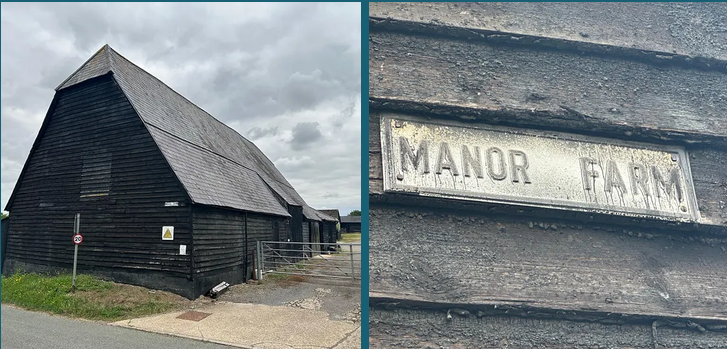
Locations that have been immortalised in novels tend to inspire a chill of familiarity. On a recent trip back to England I took one of my favourite country walks to another literary landmark. My house is not too far from Wallington, the village where George Orwell lived and worked from 1936 to 1940. It was here that he conceived Animal Farm (1945), and it was only by walking there myself that I discovered there is an actual “Manor Farm” – the apparent model for the farm in the novel – just a few hundred metres from where the great man lived.
The story opens with the farmer, Mr. Jones, locking up the hen houses for the night and making his way up to bed. Then the protagonists of our “fairy story” are introduced …
As soon as the light in the bedroom went out there was a stirring and a fluttering all through the farm buildings. Word had gone round during the day that old Major, the prize Middle White boar, had had a strange dream on the previous night and wished to communicate it to the other animals. It had been agreed that they should all meet in the big barn as soon as Mr. Jones was safely out of the way.
There follows Old Major’s famous speech to the animals in which he lays out his dream of revolution. The “big barn” remains to this day and is the first structure of Manor Farm that one sees from the road. The farm is still working, so I was reluctant to risk trespassing to see whether it still contains the raised platform from which the mighty beast – a porcine Lenin – delivered his oration. Still, it’s definitely there. It’s big, it’s a barn, and to settle all ambiguity it bears the sign of “Manor Farm”.
It’s worth a visit. There’s not so much as a pub in the village itself and, with its population of one hundred and fifty, you’ll be noticed if you start taking photographs. But walking along those lanes to the faint trilling of birdsong, it’s easy to find oneself momentarily seeing the village through Orwell’s eyes.
Orwell’s cottage on the corner of Kits Lane has a small plaque to commemorate his time there. This late seventeenth-century property used to be called “The Stores” because it was once a local shop. Orwell and his wife Eileen sold groceries here, as well as sweets and packets of aspirin. The income helped to offset the rent, and afforded him time to write in peace. If you do manage a visit, take note of the low front door. Orwell, being a tall man, would often bang his head against the ceiling.
Comments Off on Orwell’s real-life inspiration for Animal Farm
Hatshepsut – The Pharaoh they tried to Erase from History
Tasting History with Max Miller
Published 3 Mar 2026Fritters as they are depicted in ancient Egyptian tombs
City/Region: Egypt
Time Period: 15th Century B.C.E.Hatshepsut ruled as regent for, and then co-pharaoh with, her stepson, Thutmose III for twenty one years in the 15th century BCE. While she ruled, Egypt enjoyed a golden age as she opened trade routes, built monuments, and ensured that the economy thrived.
The inspiration for this recipe comes from the many paintings of food on temple walls in Egypt. One of these shows ball-shaped items piled up on a serving platter, which could be an ancient form of the modern dessert zalabiya.
Using ingredients available to ancient Egyptians around the time of Hatshepsut’s reign, I’ve made my interpretation of the food painted on the temple walls. They are delicious and full of wonderful cardamom flavor with a light crunch. I think they’re best served with a little honey for dipping.
(more…)
Comments Off on Hatshepsut – The Pharaoh they tried to Erase from History
QotD: Roman roads
That said, for the major viae publicae, the combination of archaeologically preserved examples and a few references in literary sources gives us a good sense of what “best practices” for Roman road construction were. To start with, obstructions were cleared and then a trench was dug where the road would go. The trench was then filled with three packed layers: a stone layer, then a gravel layer and finally a sand or cement layer. On this was placed the surface of stone blocks, cambered so that rainwater drained to the sides of the road. The stone surface was then held in place by an umbo (literally a “knob” or “swelling”, the same word is used for shield bosses) on the edges of the road. Within a town, the umbo might in turn border a stone sidewalk, but out in the countryside, that wasn’t present.
On the one hand, we know that the high-quality construction of Roman paved roads impressed in the ancient world; Dionysius of Halicarnassus proclaims them one of Rome’s three most magnificent works (alongside aqueducts and sewers, Dion. Hal. Ant. Rom. 3.67.5; note also in this vein Strabo 5.3.8; Plin. HN 36.125). On the other hand, we also know that not all Roman roads were built to the same high standard. While we know that various Roman legislation spelled out required road widths, for instance, the actual width of Roman roads varied widely. And while we’re here, I should note, the story you have heard that modern roadway width or standard railway gauge being based on Roman road width (or, heaven help us, Roman “war chariots”, a thing the Romans did not have) is rather wrong. Nor were they always well-constructed or maintained; Julian, for instance, bemoans a poorly maintained road in a letter to Libanius in 363.
Also, if I may stop a moment, one thing I hear frequently said about Roman roads is that their survival serves as some sort of indictment on modern road construction, “they don’t build them like they used to!” There are a few layered bad assumptions here. The first, of course, is survivorship bias; that road outside of Chalcis that Julian complained was sinking into a swamp probably isn’t available for us to see and similarly badly maintained or poorly constructed Roman roads are simply gone or only visible with archaeological methods and so unavailable for comparison. At the same time, modern roads are asked to do things which ancient roads were not; I do not suspect many Roman roads would last very long if hundreds of 20-ton (or more) trucks were rumbling over it daily. Indeed, preserved Roman roads outside of the cities often have deep ruts worn several inches deep in the stone from the passage of carts (carts and other vehicles were generally banned inside of Roman cities; city streets were for pedestrians). Finally we know that Roman roads, just like modern ones, required maintenance and reconstruction fairly regularly in the period of their use; Laurence (op. cit., 66) has a neat table of inscribed milestones on the Via Appia, for instance, referring to repair or reconstruction, with sections of the roadway repaired in stages from 97 to 110AD.
Nevertheless, the generally high quality of Roman roads, as noted, was recognized in antiquity and is still apparent in their survival today. In contrast to many unpaved sections of Persian royal roads, for instance, Roman viae publicae were paved as a matter of course and standard widths (c. 3.5m wide; the oldest Roman laws, the Twelve Tables, set a minimum width on straights of c. 2.4m though as noted this was not always followed) were fairly generous. And they tended to be well-engineered, with relatively flat surfaces (which are often quite a bit less flat today due to ground shifting as well as the erosion of concrete between paving stones) and straight lines, though the notion that all Roman roads were ruler-straight is, of course, wrong (though some are!). In particular, the Roman system of road construction, while it demanded considerable up-front labor costs, was seemingly designed to keep long-term maintenance demands low. This was a style of road building which accepted big up-front costs in exchange for lower long-term maintenance, which of course demands a lot of initial state capacity to manage the costs and labor demands (something Rome’s successors would mostly lack).
So as roads go, the Roman ones were uncommonly good (albeit with a wider degree of variation than is often appreciated), but the marvel of the Roman roads is not that they had a few good, paved roads – states had been building paved roads for some time, as noted above – but that they had a massive system of them. Scale, more than quality, was the Roman achievement here, though the quality was also quite high.
Bret Devereaux, “Collections: Roman Roads”, A Collection of Unmitigated Pedantry, 2023-06-02.
Comments Off on QotD: Roman roads
August 27, 2026
Britain’s Greatest Hero Never Existed!
The History Chap
Published 22 Apr 2026The most celebrated British hero of the First Anglo-Afghan War was brave, resourceful, and utterly magnificent under fire. He was also completely fictional – Harry Flashman.
Chris Green is The History Chap; telling stories that brings the past to life.
August 26, 2026
Octavian “found Rome a city of bricks and left it a city of marble”
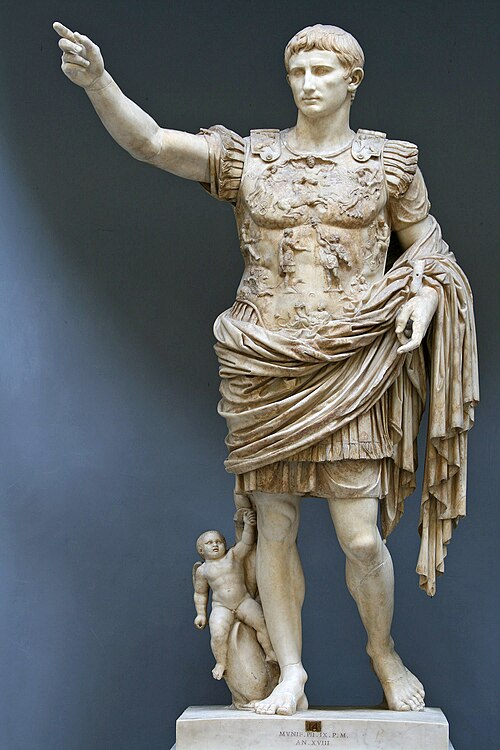
Octavian, if you’re new around here, is far better known as Augustus, the founder of the Principate. Over at SteynOnline, Tal Bachman continues his interesting series by touching on what the Roman Republic looked like to Octavian at the end of the civil wars:
Augustus of Prima Porta
Currently in the Chiaramonti Museum of the Vatican Museums (image from Wikimedia Commons).
So as Octavian thought about his grand plans for renewing Rome, he naturally thought of Virgil. He didn’t need anyone like Horace telling everyone to give up. He needed positivity. He needed the guy who might even have been prophesying about him as Rome’s savior (Octavian was only 23 when Virgil wrote about Rome’s boy-rescuer).
Besides, Virgil’s prophecy had so far proved quite correct: the oft-heralded imminent demise of Rome hadn’t arrived yet. Maybe it never would. In fact, for the first time in over a century, things were looking up. And they were looking up because of what had happened in the previous year and a half.
The most important thing had been Octavian’s victory over the traitor Mark Antony at the Battle of Actium, September of 31 BC. (None other than Octavian’s best friend, Marcus Agrippa, had masterminded the victory as commander of the navy. Over the years of tumult and civil war since Caesar‘s assassination, Marcus had revealed himself to be as much of a natural military genius as Octavian was a political genius).
With his victory over Antony, Octavian had demolished the last of the traitorous military contingents threatening Rome. Less than a year later, Antony and his lover, Queen Cleopatra of Egypt, committed suicide in Alexandria. Suddenly, after decades of bloodshed, the civil war had come to an end.
Or so it seemed. Octavian was too smart to count on that. After all, in politics, an end is never really an end; a beginning is never really a beginning. Each is only a connecting point in time between what has come before, and what will now come to pass. Above everything else, politics is the art of shaping those moments.
It was at just this sort of moment Octavian now stood. Finding himself the undisputed great man of Roman politics, he now controlled (in reality, if not always in law) Rome’s senate, all its provinces, its vast military, its vast resources, its bureaucracy and administration, its appointments, and the immensely valuable, recently-acquired grain powerhouse of Egypt. He also held great influence over the city’s religious activity as part of the sixteen member College of Pontiffs. Moreover, after Actium and Antony’s suicide, no internal or external threat remained. Octavian had spent years making war. Now, with every last foe vanquished, he needed to make — and preserve — peace. The question was how.
A full description of Octavian’s comprehensive answer to that question is beyond our scope here. But what we can explore briefly is how he pushed cultural, spiritual, religious, and even psychological renewal — particularly through Virgil’s Aeneid — and how translation can best communicate that to us.
On that note, it’s worth pointing out that Octavian’s intention wasn’t quite to Make Rome Great Again. It was far more ambitious: he wished to make Rome much greater than anyone had ever imagined it could be, and much greater than any other nation had ever been, or ever would be again. For this to happen, Rome, in a real way, had to start over.
For Octavian, starting over meant laying the right foundation in the right way. What was that foundation? Devout reconnection to the gods. Everything, he believed, would flow from this: peace, identity, cohesion, stability, lawful behavior, ethical behavior, contentment, prosperity, flourishing, valor, self-discipline, excellence, and more. Octavian would do what he could in politics to initiate this renewal; Virgil would do what he could in literature. Together with others in their circle, they would remind people what it meant to be truly Roman, starting with the very first Romans of all. They would tell, and re-tell, in a hundred different ways, the story of who they were, who they weren’t, where they’d come from, and what the gods wanted.
I’ve added links to my Roman Glossary for some of the names and events mentioned in the article.
Comments Off on Octavian “found Rome a city of bricks and left it a city of marble”
The Korean War Week 114 – Stalin’s Secret Plan – August 25, 1952
The Korean War by Indy Neidell
Published 25 Aug 2026Heavy rains prevent action in the field in Korea this week, so the big story worldwide is talks in Moscow between Josef Stalin and Chinese Foreign Minister Zhou Enlai. They talk about Five Year Defense Plans, artillery production, Soviet aid for the Chinese, and exactly how they see the war in Korea and what they think of the American forces.
00:00 Intro
01:09 Bunker Hill
01:51 South Korean Prisoners of War
02:44 Chinese Soviet Talks
05:06 Five Year Defense Plan
07:26 Artillery Production
11:23 Stalin and the USA …
12:52 Eisenhower and the War
16:05 Summary
16:18 Conclusion
18:29 Sign Up
Comments Off on The Korean War Week 114 – Stalin’s Secret Plan – August 25, 1952
Who Destroyed the Japanese Economy in WW2?
Real Time History
Published 20 Mar 2026As the war in the Pacific develops, the United States takes the fight to Japan itself – by crippling its economy, destroying its industry, and crushing civilian morale. To do this, American submarines and heavy bombers wage campaigns beneath the sea and above the clouds. And even 80 years later, there’s a fierce debate about which of these campaigns did more to bring Japan to its knees – perhaps even more than the atomic bombs.
(more…)
Comments Off on Who Destroyed the Japanese Economy in WW2?
August 25, 2026
The Halftrack That Made Blitzkrieg Possible
World War Two
Published 23 Aug, 2026The tanks get the glory. But Blitzkrieg could not work on tanks alone.
The Sd.Kfz. 251 was designed to solve one of the fundamental problems of armored warfare: how do you keep infantry moving fast enough to fight alongside the Panzers? Germany’s answer was an armored half-track that helped turn infantry from a slow-moving follow-up force into an integral part of the Panzer division’s combined-arms assault.
In this German Rearmament special, we trace the Sd.Kfz. 251 from clandestine development under the restrictions of the Treaty of Versailles to its first production runs on the eve of World War Two. We examine its design, its role in the emerging doctrine of Bewegungskrieg, its deployment in Poland and France, and the extraordinary range of variants that turned it into one of the Wehrmacht’s most versatile vehicles.
But the 251 also exposes the limits behind the image of a fully mechanized German war machine. It was complicated and expensive to manufacture, there were never enough of them, and most German infantry continued to march or rely on horses and trucks. Even as production soared later in the war, Germany’s shortages of fuel, materials, manpower, and industrial capacity increasingly overwhelmed the advantages its engineers and tacticians had created.
The Sd.Kfz. 251 helped make the early German style of armored warfare possible. It also became another example of a sophisticated weapon system serving a war of aggression that Nazi Germany ultimately lacked the resources to sustain.
This is the story of the half-track that made Blitzkrieg possible.
Never Forget.
Comments Off on The Halftrack That Made Blitzkrieg Possible
Rome’s annona civilis
In the late Roman Republic, the rapid increase among the urban poor in Rome itself eventually led to the Senate introducing food relief for the very poorest Roman citizens, the Annona civilis. It should be no surprise to anyone who’s been paying attention that giving away free stuff attracts people happy to accept free stuff:
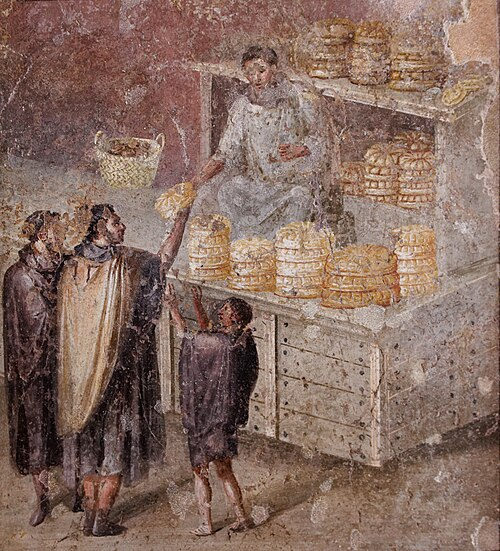
Rome handed out free grain to 40,000 citizens in 73 BC. By 46 BC, Julius Caesar found 320,000 people lining up for their monthly ration. That eight-fold expansion happened in under three decades, and it shows you how welfare states actually grow.
No Roman senator stood up and announced a plan to addict a third of the city to government bread. It happened incrementally, through political competition. Each magistrate who wanted votes expanded eligibility. Each expansion normalized the next one. The citizen who once considered the dole shameful eventually expected it, then demanded it, then organized politically to protect it.
This is the core mechanism free market thinkers have identified across every era: once you create a transfer program, you create a constituency for that program. Recipients vote. Administrators build careers. Grain merchants who supply the state develop a stake in keeping the contracts flowing. The political economy locks in.
Caesar, to his credit, actually cut the rolls back to 150,000 through verification audits. It was one of his more economically coherent moves, though the Senate still murdered him. His successors quietly let the numbers climb again.
What did the dole require? Massive grain imports from Sicily, Sardinia, and Egypt, organized through state logistics at state expense, funded by taxation and conquest. When the conquest revenue dried up, the obligation remained. Rome had written a check against future military success, and future military success eventually failed to arrive.
The lesson is not complicated. Distribute a benefit and you distribute dependency. Distribute dependency and you distribute political power to whoever controls the distribution. The grain dole didn’t weaken Rome overnight, but it made every subsequent reform politically impossible.
The simple-but-not-easy-fix is to only allow people not accepting the free stuff to vote. You can imagine just how well that would go down in an election campaign at any level, can’t you?
Battle Rifles in the Jungle: Guatemalan AR-10
Forgotten Weapons
Published 8 Apr 2026Guatemala was one of the handful of countries to purchase original AR-10 rifles, made at Artillerie Inrichtingen (AI) in the Netherlands. The sale was made by Sam Cummings, legendary arms dealer. He spent much of 1957 and 1958 traveling through Central and South America demonstrating the new AR-10 to virtually every country’s military. In Guatemala, his demonstration resulted in an immediate order for 450 rifles to be delivered to the Escuela Politécnica (the military academy) for more extensive testing. The guns were delivered in late 1958, with serial numbers between approximately 3000 and 3500 (they were made immediately following production of the Sudanese contract batch). These Guatemalan rifles are distinctive for their ventilated bayonet shrouds, which were provided on no other rifles. While none of the Guatemalan rifles were fitted with bipods, a shortage of regular hand guards led AI to fit many of them with leftover Sudanese contract hand guards contoured for folding bipod legs.
The Guatemalan AR-10s were sold as surplus by the Escuela Politécnica to an American importer in 1985, and they were brought into the US as a mix of parts kits and pre-86 Dealer Samples. Today, most of the intact and unmodified Dutch-production AR-10s in the US (including this example) are from the Guatemalan contract.
(more…)
Comments Off on Battle Rifles in the Jungle: Guatemalan AR-10
QotD: “… and called it macaroni”
I don’t know whether you need much in the way of background, but since some of you seem to enjoy the “inside baseball” stuff … History, as an academic discipline, has always suffered from a “source base” problem. We deal with artifacts; more specifically with documents. If it ain’t written down … see what I mean? This is why whoever-it-was wasn’t wrong when he said that History is just the biographies of Great Men. It’s the biographies of the best-documented men, anyway. I’m exaggerating for effect, obviously, but you see what I mean.
So when, in the Seventies, we had the “cultural turn“, a whole new series of techniques had to be developed to expand the source base. Some of those were good and necessary. Others … well, Wiki quotes Frederic Jameson, one of the most prominent early-90s obfuscators (Indie band name?):
The very sphere of culture itself has expanded, becoming coterminous with market society in such a way that the cultural is no longer limited to its earlier, traditional or experimental forms, but it is consumed throughout daily life itself, in shopping, in professional activities, in the various often televisual forms of leisure, in production for the market and in the consumption of those market products, indeed in the most secret folds and corners of the quotidian. Social space is now completely saturated with the image of culture.
Translated from the PoMo, it’s your standard, tiresome stuff about “critique”. Culture just IS Capitalism, which IS Consumerism, blah blah blah, you know the drill. It’s tedious, but it’s not entirely wrong — what people “consume” (in the egghead sense, not the biomechanical sense) can give us important clues about their world. So long as you avoid the teleological temptation (didn’t they tour with EVC?) of attributing everything to “Capitalism”, you can do good work.
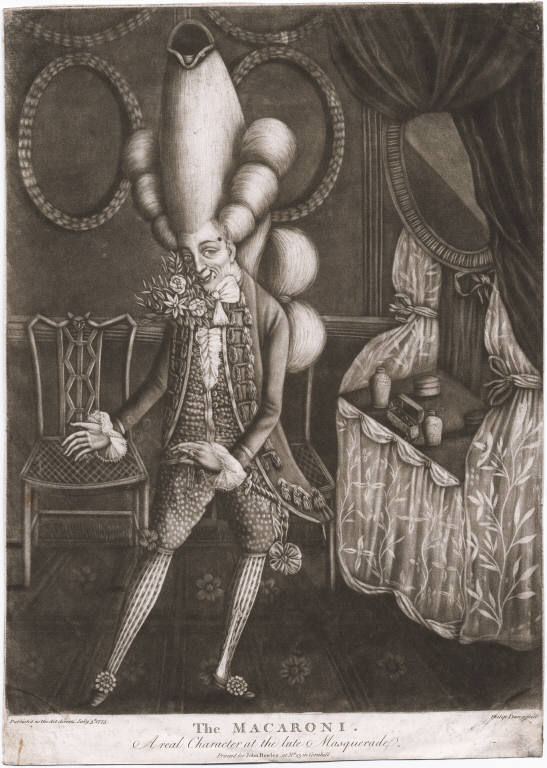
The “problem” with recent history is that the “centers of cultural production” do seem to be identifiable, and so are their motives. They are “Madison Avenue” and “to make money”, respectively, and so it’s easy — and profitable!! — to do the tiresome PoMo CultMarx thing. The further back into The Past you go, though … well, consider this:
As you can see from the caption, that style is called “macaroni” — like from the old song “Yankee Doodle,” which the Colonials appropriated in an early example of “owning the insult.” Wiki sez:
Stereotypically, men in the macaroni subculture dressed, spoke, and behaved in an unusually epicene and androgynous manner. The term “macaroni” pejoratively referred to a man who “exceeded the ordinary bounds of fashion” in terms of high-end clothing, fastidious eating, and gambling. He mixed Continental affectations with his British nature …
… The macaronis became seen in stereotyped terms in Britain, being seen as a symbol of inappropriate bourgeois excess, effeminacy, and possible homosexuality – which was then legally viewed as sodomy. At the time, homosexuality was frowned upon, and was even punishable by death. Many modern critics view the macaroni as representing a general change in 18th-century British society such as political change, class consciousness, new nationalisms, commodification, and consumer capitalism.
You see the typical “critical” blah blah blah there at the end, and it’s not wrong, just tedious, predictable, and tediously predictable. It’s also much harder to find a “purpose” for this behavior. It’s easy to do for the modern analogue of the macaroni, the hipster […] which Wiki documents extensively, because of course they do, it’s right there underneath “macaroni”. But the whole “culture industry” thing wasn’t there yet in the 18th century, so it might actually be down to an individual person. It’d be theoretically possible to find “the first macaroni” — it was the Marquis de Whatever, and he decided to dress like that because reasons, and all the best people decided to copy him, also because reasons, and that’s pretty much all your “cultural turn” can do, because that’s the only documentation we have.
Since we here are not bound by the canons of scholarship, however, we can speculate. I want to focus on this bit about macaronis:
In the 18th century, wealthy young British men traditionally took a trip around Europe upon their coming of age, known as the Grand Tour. Italy was a key destination of these tours. During their trip, many developed a taste for maccaroni, a type of pasta little known in Britain then, and so they were said to belong to the Macaroni Club, founded in 1764 by those returning from the Grand Tour. They would refer to anything that was fashionable or à la mode as “very maccaroni”.
That’s Information Velocity, preindustrial-style. They had to go there personally — or, at the very least, have access to the in-house journals of those who did:
The song “Yankee Doodle” from the time of the American Revolutionary War mentions a man who “stuck a feather in his hat and called it macaroni”. Dr. Richard Shuckburgh was a British surgeon and also the author of the song’s lyrics; the joke which he was making was that the Yankees were naive and unsophisticated enough to believe that a feather in the hat was a sufficient mark of a macaroni.
In America, only a select few persons would have access to that kind of thing, because only a few would move in those circles.
Go back a bit further, and cultural trends are far less traceable, but “centers of cultural production” are much easier to find, in one specific sense: They’re monasteries. And there you have a group which speaks a common language — extremely rare in the Middle Ages — is literate (ditto), and has something close to, if not caloric surplus, then at least “chronic caloric sufficiency”, I guess we’ll have to call it. Monks worked hard in the Middle Ages, by our standards, but not as hard as the peasantry. They were well-fed, or at least consistently fed, in a way the peasantry weren’t.
In other words, whatever Information Velocity existed in the Middle Ages, they had it. They made a virtue out of circulating books, and all those books were in a common tongue. Since they also produced books — indeed, were pretty much the only ones who did — they were also, by definition, au courant with whatever the high fashions were, because they illustrated the books that were such a crucial part of the aristocracy’s gift-giving culture.
Severian, “Monastic Vices”, Founding Questions, 2026-01-13.
Comments Off on QotD: “… and called it macaroni”
August 24, 2026
“Communism is an ideology designed to liquidate nations”
I nearly skipped this post by Celina, as it started off appearing to be pretty much of interest only to Australians, but that was just the opening sections:
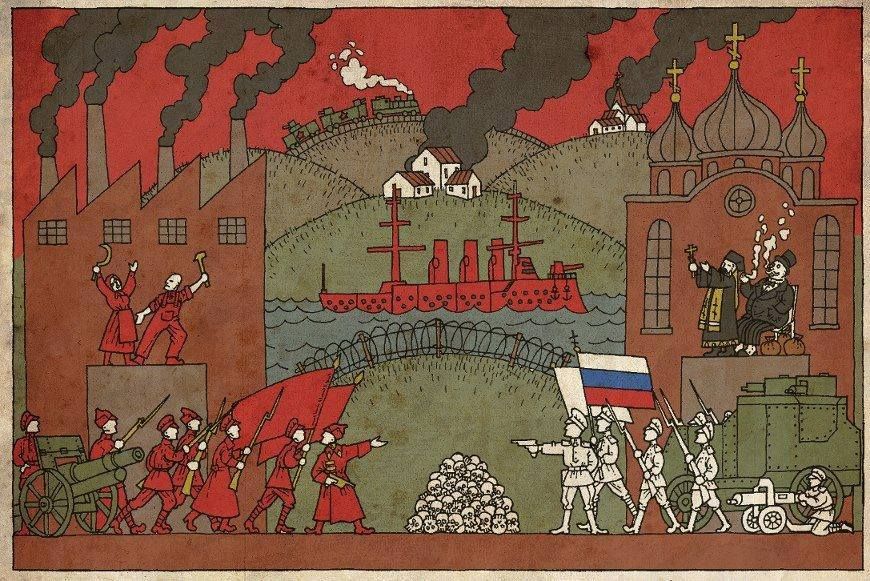
The Bolsheviks were the first governing power of the modern era to write the suppression of “national enmity” into a systematic criminal code. The RSFSR Criminal Code of 1922 penalised agitation and propaganda arousing national enmity or dissension, its successor, the 1926 Code, carried the provision forward as Article 59-7, under the chapter dealing with especially dangerous crimes against the order of administration, punishing “propaganda or agitation directed towards arousing national or religious enmity or discord”, with sharply escalated penalties, up to and including death, where the offence occurred in wartime or amid mass disturbances. From the earliest years of the Soviet state, in other words, speech about nationality was not a civil-society problem to be argued out, but a category of state crime sometimes punishable by death.
To understand why, it is necessary to understand something about communism that conservatives and libertarians have largely obscured. If you ask the average conservative what communism is, he will most likely start discussing government ownership, five-year plans, bread queues etc.
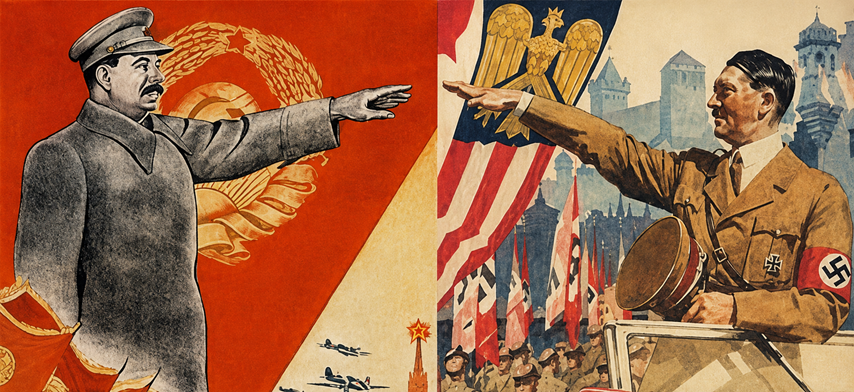
Communism, from this point of view, is essentially capitalism with the economic settings reversed. The government “does and owns everything“. This is why so much conservative analysis eventually degenerates into horseshoe theory: fascists liked government intervention and communists liked government intervention, therefore fascism and communism were basically versions of the same thing.
But that completely misses the ideological conflict which defined twentieth-century Europe. Communism was not just some economic theory about who should own what. It was an internationalist theory about who you are.
Communism is an ideology designed to liquidate nations. Literally.
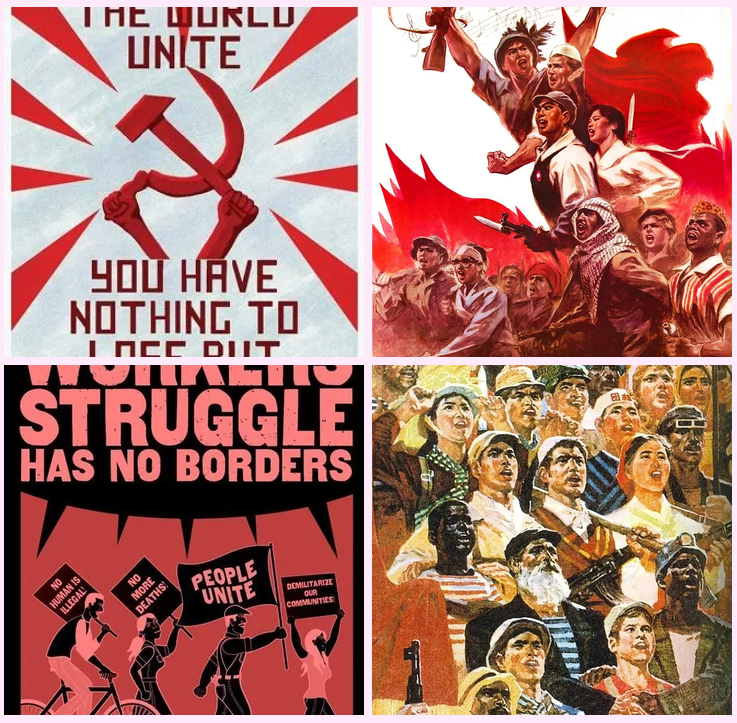
Marxism insisted that the fundamental political division of mankind was class. The worker was not ultimately supposed to understand himself principally as English, German, Italian, French or Russian. He belonged to the proletariat. His historical interests were shared with workers beyond the borders of his own country, while his supposed national solidarity with his own bourgeoisie concealed the class relationship upon which capitalism depended. Hence the language that runs through the entire communist tradition: Workers of the world, unite; The proletariat has no fatherland; No war but class war. You’re not Italian, you’re not German, you’re the proletariat, and all you have to lose is your chains.
The political logic here is blatantly obvious. Nationality competes with class consciousness, patriotism competes with proletarian internationalism. The nation tells a German worker that he shares something profound with another German who happens to own a factory. Marxism tells him that this solidarity is false and his real political brother is the French, Russian or Italian worker standing on the other side of the border.
That is why the nation became one of the great obstacles confronting revolutionary socialism. The theory said workers possessed common international class interests. Yet, history repeatedly demonstrated that workers continued to behave like members of nations.
In 1914, the workers of Europe did not unite against their governments and refuse the coming war. They rallied overwhelmingly to their respective countries. Socialist parties fractured along national lines. Men who Marxists expected to understand themselves as an international proletariat marched into battle as Germans, Frenchmen, Russians, Austrians and Britons. And the same problem returned after the Bolshevik Revolution.
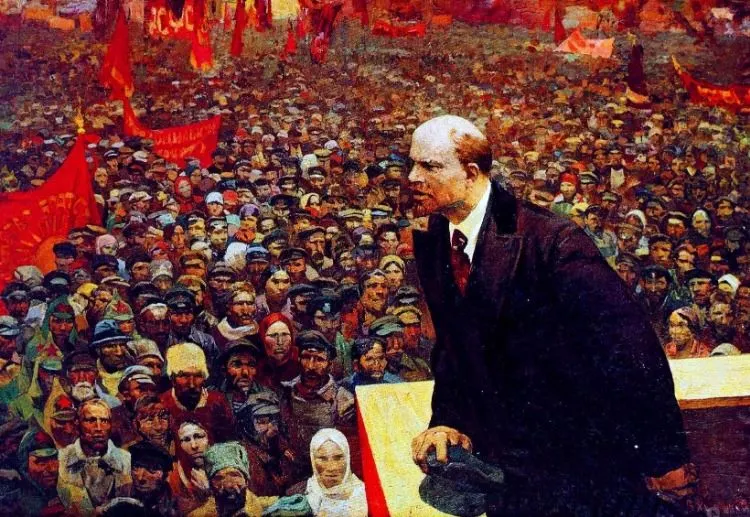
That is why the great twentieth-century conflict between communism and nationalism was not accidental. It was ideological. Communism was internationalist not in the banal sense that communists in different countries cooperated with one another, but in its conception of history itself. The nation was something history would ultimately transcend. Lenin said this openly: socialism aimed not simply to bring nations closer together, but eventually to “merge them“. Elsewhere he described the centralised state as a historical step towards the future “socialist unity of the whole world“.
Stalin, grasping this principle, forged civic nationalism as the indispensable stepping-stone toward that communist universalism. Inside the borders of the revolutionary state the old nationalities were to be liquidated into a single Soviet identity: you are not Ukrainian, you are not Russian, you are not Jewish, you are not Georgian, you are a Soviet patriot, loyal only to the revolution. That state, once purged of national loyalties, would then project its universalist ideology outward, seeking global hegemony by liquidating, in turn, every nation that still dared to resist it.
Update, 25 August: Welcome, Instapundit readers! Have a look around at some of my other posts you may find of interest. I send out a daily summary of posts here through my Substack – https://substack.com/@nicholasrusson that you can subscribe to if you’d like to be informed of new posts in the future.
The Ancient Greeks 04 – The Persian Invasion 4 – The Fall of Athens
seangabb
Published 26 Mar 2026Greece: A Brief History, c.700 BC – 500 AD
What happens when resistance fails?
In this lecture, we examine the dramatic collapse of Greek resistance after Thermopylae and the advance of the Persian army into central Greece. With the Spartan force destroyed, the road to Athens lay open.
We explore:
– The consequences of Thermopylae
– The evacuation of Athens under Themistocles
– The Persian capture and destruction of the city
– The psychological and strategic impact on the Greek world
– Why, at this moment, Persian victory seemed inevitableThis is the darkest point of the war for the Greeks — a moment when everything appears lost, and yet the story is far from over.
Comments Off on The Ancient Greeks 04 – The Persian Invasion 4 – The Fall of Athens


