
How these challenges were met varied between the two Imperial halves. The Hungarians dealt with the nationalities problem mainly by behaving as if it didn’t exist. The kingdom’s electoral franchise extended to only 6 per cent of the population because it was pegged to a property qualification that favoured the Magyars, who made up the bulk of the wealthier strata of the population. The result was that Magyar deputies, though they represented only 48.1 per cent of the population, controlled over 90 per cent of the parliamentary seats. The 3 million Romanians of Transylvania, the largest of the kingdom’s national minorities, comprised 15.4 per cent of the population, but held only five of the Hungarian parliament’s 400-odd seats. From the late 1870s, moreover, the Hungarian government pursued a campaign of aggressive ‘Magyarization’. Education laws imposed the use of the Magyar language on all state and faith schools, even those catering to children of kindergarten age. Teachers were required to be fluent in Magyar and could be dismissed if they were found to be ‘hostile to the [Hungarian] state’. This degradation of language rights was underwritten by harsh measures against ethnic minority activists. Serbs from the Vojvodina in the south of the kingdom, Slovaks from the northern counties and Romanians from the Grand Duchy of Transylvania did occasionally collaborate in pursuit of minority objectives, but with little effect, since they could muster only a small number of mandates.
In Cisleithania [the German Austrian half of the empire], by contrast, successive administrations tampered endlessly with the system in order to accommodate minority demands. Franchise reforms in 1882 and 1907 (when virtually universal male suffrage was introduced) went some way towards levelling the political playing field. But these democratizing measures merely heightened the potential for national conflict, especially over the sensitive question of language use in public institutions such as schools, courts and administrative bodies.
Christopher Clark, The Sleepwalkers: How Europe Went To War In 1914, 2012.
December 29, 2014
QotD: Austria-Hungary and the national minorities
December 28, 2014
Edward Luttwak on Napoleon’s modernization of European law
In the London Review of Books, Edward Luttwak starts his review of Britain against Napoleon: The Organisation of Victory, 1793-1815 by Roger Knight by contrasting British and European views of Napoleon’s legacy:
I can recall few heated arguments with my father, but I remember very well our Napoleon quarrel. After two years at a British boarding school, I had learned a fair amount of English and just about enough history to mention Wellington and Waterloo as we were approaching Brussels on a drive from Milan. To my great surprise, my father burst out with a vehement attack on ‘the English’ for having selfishly destroyed Napoleon’s empire. Wherever it had advanced in Europe, modernity had advanced with it, sweeping away myriad expressions of obscurantism and hereditary privilege, emancipating the Jews and all manner of serfs, allowing freedom of, and from, religion, and offering opportunities for advancement for the talented regardless of their origins. I do not recall his actual words, and he would hardly have put it as I have here, but that was certainly his meaning, and I remember his equal-opportunity quotation: ‘Every French soldier carries a field-marshal’s baton in his knapsack.’ I also remember his explanation of the reason he accused the English of being ‘selfish’: Great Britain was already on its way to liberty and did not need Napoleon, but Europe did, and Britain took him away.
In other words, for Jozef Luttwak of Milano, formerly of Arad, Transylvania, as for many others on the Continent (and not only the French), all the wars of Napoleon, all his victories, counted for little in evaluating the man and his deeds. What counted was the progressive moderniser, the law-giver of the Code Napoléon of 1804, actually the Code civil des Français, which was really a civil code for Europeans, since Napoleon’s empire français extended across the Low Countries to Jutland and into northwest Italy, and took in the ex-Papal States and Dalmatia (as Illyria), adding up to a good part of Western Europe. Nor was Napoleon’s Code as ephemeral as his victories. It endures as the core of civil law not only in France but in its former European possessions, and their former possessions too, encompassing ex-French Africa, all of Latin America and the Philippines by way of Spain, and Indonesia by way of the Netherlands, as well as Quebec and Louisiana.
Even that list understates the influence of the code, and therefore of Napoleon the moderniser. Its text conveyed three powerfully innovative principles whose influence transcended by far its actual legal application, and which no restoration could undo: clarity, so that all could know their rights if they could read, without the recondite expertise of jurists steeped in customary law, with its hundreds of exemptions, privileges and eccentricities; secularism, which inter alia replaced parishes with municipalities, thereby introducing civil marriage, part of an entirely new form of individual and civic existence; and the right to individual ownership of property – which untied the immobilised holders of communal property – and employment free from servile obligations.
It mattered greatly that these revolutionary principles were proclaimed by Napoleon, already a conservative and commanding figure – unlike the revolutionaries of 1789, who could not give an aura of authority to their Declaration of the Rights of Man and of the Citizen, which was itself soon challenged by the more egalitarian 1793 version, with both anyhow rejected by the upholders of privilege. In Napoleon’s vassal states (the Confederation of the Rhine, the Kingdoms of Spain, Italy and Naples, and the Grand Duchy of Warsaw), even where the code was not promulgated it was imitated, as was its drastically new style. Just as the florid convolutions and encrustations of rococo had been replaced by the linear elegance of the empire style, the thickets of customary law that Montesquieu had praised as barriers to despotism – as indeed they were, but only for privileged jurists – were replaced by the utterly systematic code, whose descending hierarchy of books, titles, chapters and sections that devolved into 2281 numbered paragraphs was itself infused with the new spirit of modernity. For Europeans of a liberal disposition, the code was a call to modernise not merely the law but society in its entirety – an impulse that would persist for decades.
December 27, 2014
Who should have been the allied commanders on D-Day?
Nigel Davies ventures into alternatives again, this time looking at who were the best allied generals for the D-Day invasion (for the record, he’s quite right about the best Canadian corps commander):
The truth is that any successful high command should maximise the chances of success of any campaign by choosing the ‘best fit’ for the job.
But that is not how generals were chosen for D Day.
(I would love to start with divisional commanders, but there are way too many, so for space I will start with Corps and Army commanders, and work up to the top).
The outstanding Canadian of the campaign for instance was Guy Simonds. Described by many as the best Allied Corps commander in France, and credited with re-invigorating the Canadian Army HQ when he filled in while his less successful superior Harry Crerar was sick, Simonds was undoubtedly the standout Canadian officer in both Italy and France.Lieutenant General Guy Simonds, commander of the 2nd Canadian Corps.
He was however, the youngest Canadian division, corps or army commander, and the speed of his promotions pushed him past many superiors. He was also described as ‘cold and uninspiring’ even by those who called him ‘innovative and hard driving’. It can be taken as a two edged sword that Montgomery thought he was excellent (presumably implying Montgomery like qualities?) But his promotions seemed more related to ability than cronyism, and his achievements were undoubted.
Should he have been the Canadian Army commander instead of Crerar? Yes. Arguments against were mainly his lack of seniority, and lack of experience. but no Canadian had more experience, and lack of seniority was no bar in most of the other Allied armies.
It comes down to the simple fact that the Allied cause would have been better served by having Simonds in charge of Canadian forces than Crerar.
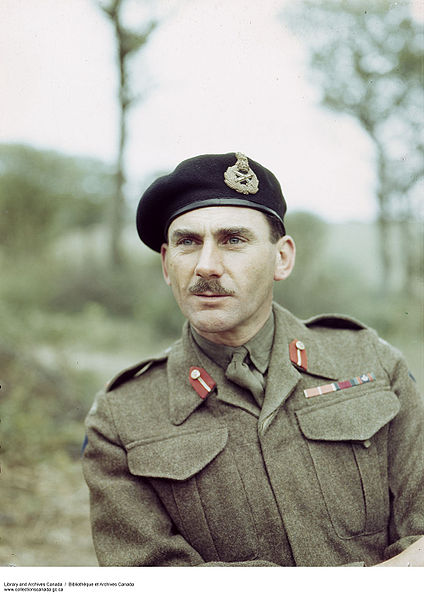
Simonds was a brilliant corps commander and (at least) a very good army commander, but he had one fatal flaw: he was no politician. Harry Crerar was a very “political” general, and played the political game with far greater talent than any other Canadian general. That got him into his role as army commander and his political skills kept him there despite the better “military” options available.
December 26, 2014
The First Battle of Champagne – Dying In Caucasus Snow I THE GREAT WAR Week 22
Published on 25 Dec 2014
Right before Christmas the allied powers begin the Champagne offensive, which will last several months. In the snow and the mud, and under horrible living conditions not only the soldiers suffer. The images of a war fought with honour and glory are finally over as even the white flag is used for ambushes. Far away in the mountains of the Caucasian, Russia and the Ottoman Empire are fighting a grim battle, too, in which many soldiers die during interminable marches in the snow wearing summer uniforms.
December 25, 2014
A Sign Of Friendship In The Midst Of War I THE CHRISTMAS TRUCE 1914
Published on 24 Dec 2014
Initially, everyone believed that this war would be over by Christmas, but on Christmas Eve 1914, soldiers were still facing each other in France, Belgium, throughout Eastern Europe, and all of the other theatres of war. But instead of shooting at each other, quite a few soldiers decided to sing and celebrate this night with their enemies. This happened in many places on the Western Front, and the commanding officers were not happy about it. In future, they would see to it that it did not happen again.
QotD: Reactionary views on American Progressives
In America, progressivism focuses on pointing out how terrible American culture is and how much other people’s cultures are better than ours. If we celebrate Columbus Day, we have to spend the whole time hearing about what a jerk Columbus was (disclaimer: to be fair, Columbus was a huge jerk). If we celebrate Washington’s birthday, we have to spend the whole time hearing about how awful it was that Washington owned slaves. Goodness help us if someone tries to celebrate Christmas – there are now areas where if a city puts up Christmas decorations, it has to give equal space to atheist groups to put up displays about how Christmas is stupid and people who celebrate it suck. That’s … probably not the way to maximize cultural unity, exactly?
We are a culture engaged in the continuing project of subverting itself. Our heroes have been toppled, our rituals mocked, and one gains status by figuring out new and better ways to show how the things that should unite us are actually stupid and oppressive. Even the conservatives who wear American flag lapel pins and stuff spend most of their time talking about how they hate America today and the American government and everything else associated with America except for those stupid flag pins of theirs.
Compare this to olden cultures. If someone in Victorian Britain says “God save the Queen!”, then everyone else repeated “God save the Queen!”, and more important, they mean it. “England expects every man to do their duty” is actually perceived as a compelling reason why one’s duty should be done.
It would seem that the Victorian British are more on the Mormon side and modern Americans more like the Unitarians. And in fact, the Victorians managed to colonize half the planet while America can’t even get the Afghans to stop shooting each other. While one may not agree with Victorian Britain’s aims, one has to wonder what would happen if that kind of will, energy, and unity of purpose were directed towards a worthier goal (I wonder this about the Mormon Church too).
Reactionaries would go further and explore this idea in a depth I don’t have time for, besides to say that they believe many historical cultures were carefully optimized and time-tested for unifying potential, and that they really sunk deep into the bones of the populace until failing to identify with them would have been unthinkable. The three cultures they most often cite as virtuous examples here are Imperial China, medieval Catholicism, and Victorian Britain; although it would be foolish to try to re-establish one of those exactly in a population not thoroughly steeped in them, we could at least try to make our own culture a little more like they were.
Once again, the Reactionary claim is not necessarily that we have to brainwash people or drag the Jews kicking and screaming to Christmas parties. It’s just that maybe we should stop deliberately optimizing society for as little unity and shared culture as humanly possible.
Scott Alexander, “Reactionary Philosophy In An Enormous, Planet-Sized Nutshell”, Slate Star Codex, 2013-03-03.
December 24, 2014
The Christmas Truce of 1914
Britain’s Royal Mail Group has released a hand-written letter posted by a participant in the Christmas Truce on the western front in 1914:
One hundred years ago tomorrow saw the historic truce between soldiers fighting in the trenches in the First World War and Royal Mail is a releasing a poignant letter recounting the moment.
Christmas Day 1914 saw a break in the fighting between allied forces and German soldiers on the Western Front.
It was the moment where troops on both sides put down their weapons, climbed out of the dug-outs and met in no man’s land, where they exchanged cigars and souvenirs, and where a historic football match was played.
In the letter, Captain A D Chater of the 2nd Battalion Gordon Highlanders, describes the extraordinary moment where the men stopped fighting to wish each other happy Christmas:
“Dearest Mother,
I am writing this in the trenches in my “dug-out” — with a wood fire going and plenty of straw it is rather cosy, although it is freezing hard and real Christmas weather.
I think I have seen today one of the most extraordinary sights that anyone has ever seen. About 10 o’clock this morning I was peeping over the parapet when I saw a German, waving his arms, and presently two of them got out of their trench and came towards ours. We were just going to fire on them when we saw they had no rifles, so one of our men went to meet them and in about two minutes the ground between the two lines of trenches was swarming with men and officers of both sides, shaking hands and wishing each other a happy Christmas…”
Captain Chater’s letter illustrates how regiments on both sides used the opportunity to bury their dead, referring to it as “lying between the lines”. It was also a rare moment they could simply go for long walk in the open without being shot at.
Captain Chater also describes another meeting in no-man’s land that further illustrates the unexpected good humour between enemy forces:
“We had another parley with the Germans in the middle. We exchanged cigarettes and autographs, and some more people took photos. I don’t know how long it will go on for — I believe it was supposed to stop yesterday, but we can hear no firing going on along the front today except a little distant shelling. We are, at any rate, having another truce on New Year’s Day, as the Germans want to see how the photos come out!”
Not only does Captain Chater’s letter paint a vivid picture of goodwill in the middle of “a war in which there is so much bitterness and ill feeling”, it reminds us that the conflict was not personal between the men on opposing sides. “The Germans in this part of the line are sportsmen if they are nothing else,” he writes, underlining the sense of uneasy trust that inspired the Christmas truce.
H/T to MilitaryHistoryNow.com for the link.
December 23, 2014
Turning the United States into something like Scandinavia
In his daily-or-so Forbes post, Tim Worstall explains the real reason why it will be somewhere between difficult and impossible to turn the United States into a Scandinavian mixed economy like Denmark:
The essence of the argument is that sure, we’d like quite a lot of equity in how the economy works out. Wouldn’t mind that large (but efficient! of which more later) welfare state. We’d also like to have continuing economic growth of course, so that our children are better off than we are, theirs than they and so on. And we can have that welfare state and equity just by taxing the snot out of everyone but that does rather impact upon that growth. So, the solution is to have as classically liberal an economy as one can, with the least regulation of who does what and how, then tax the snot out of it to pay for that welfare state. Not that Sumner put it in quite those words of course.
The lesson so far being that if the American left want to turn the US into Scandinavia, well, OK, but they’re going to have to pull back on most of the economic regulation they’ve encumbered the country with over the past 50 years.
The other point is an observation of my own. Which is that those Scandinavian welfare states are very local. To give you my oft used example, the national income tax rate in Denmark starts out at 3.76% and peaks at 15%. There’s also very stiff, 25-30% of income, taxes at the commune level. A commune being possibly as small as a township in the US, 10,000 people. The point being that this welfare state is paid for out of taxes raised locally and spent locally. Entirely the opposite way around from the way that the American left tells us that the US should work: all that money goes off to Washington and then the bright technocrats disburse it.
Instead they have what I call the Bjorn’s Beer Effect. You’re in a society of 10,000 people. You know the guy who raises the local tax money and allocates that local tax money. You also know where he has a beer on a Friday night. More importantly Bjorn knows that everyone knows he collects and spends the money: and also where he has a beer on a Friday. That money is going to be rather better spent than if it travels off possibly 3,000 miles into some faceless bureaucracy. I give you as an example Danish social housing or the vertical slums that HUD has built in the past. And if people think their money is being well spent then they’re likely to support more of it being spent.
[…]
So, the two things I would say need to be done as precursors to turning the united States into Scandinavia are the following. First we need to move back to a much less regulated, more classically liberal, economy. Secondly we need to push the whole tax system and welfare state provision down from the Federal government down to much smaller units. Possibly even right down to the counties. The first of these will generate the economic growth to pay for that expanded welfare state, the second make people more willing to pay for it.
If you find any American leftists out there willing to agree to these two preconditions do let me know. Because I’ve never met a single one who would think that those were things worth doing in order to get that social democracy they say they desire.
December 21, 2014
“Wicca is religion’s answer to the Liberal Democrats”
All the British newspapers have apparently decided that it’s worth column-inches devoted to the random Twitter comments of J.K. Rowling:
Of the various insights into the diversity of Hogwarts culture JK Rowling has been sharing on Twitter lately, one in particular caught my eye. It wasn’t the revelation, reported by the Guardian, that the school had Jewish wizards. (So what?) Nor was it that Hogwarts probably had a few poofs in it. (We knew that already, didn’t we?)
No: what tickled me was her remark that the only group she never envisaged in the achingly multi-culti Hogwarts School of Witchcraft and Wizardry was Wiccans, those faux-druidic attention-seekers and drop-outs obsessed with black candles, lesbianism and velvet gowns.
Wiccans and those oddballs who dress up in bizarro costumes, redolent of cheap seasonal medieval re-enactment camps, who believe in magic (or, as they hilariously insist on spelling it, “magick”) and the mystical forces of mother nature.
[…]
What most fans will have taken from that, I’m guessing, is: “Come off it, even by the standards of my totally invented fantasy-land full of mystical creatures, boy wizards and horcruxes, those people are off their trolleys.”
You can tell rather a lot about those respective newspapers by which details they chose to lead their reports with. The Guardian, with its creepy Jewish obsession, leapt on Rowling’s confirmation that Anthony Goldstein of Ravenclaw was semitic, while the Independent ran with her statement that “of course” Hogwarts would have been an LGBT-friendly place to learn how to magic up enchanted water.
What neither of them saw fit to give due prominence to, though, was the fact that Wiccans, hilariously, are the only group in the Harry Potter universe incapable of performing magic. You’d need a heart of stone not to laugh.
December 19, 2014
The Raid On Scarborough – A Failed Attempt at Intimidation I THE GREAT WAR Week 21
Published on 18 Dec 2014
German admiral Franz von Hipper reluctantly carries out his orders to bomb British coastal towns. And indeed, this attempt to intimidate British civilians only makes them more united. British propaganda gets another opportunity to portray Germans as bloodthirsty and brutal. Meanwhile, the French start a new offensive near Vimy on the Western Front.
December 18, 2014
The Tsar’s new clothes
At Samizdata, Johnathan Pearce suspects that the folks at NATO headquarters are not getting as much sleep these days as they used to:
… it appears that the image of Putin as this ruthless, chess-playing genius wrongfooting silly old Cameron, Merkel, and the chap with the funny moonface from France is not quite standing up to scrutiny. Here’s a report by Bloomberg:
“The foundations on which Vladimir Putin built his 15 years in charge of Russia are giving way. The meltdown of the ruble, which has plunged 18 percent against the dollar in the last two days alone, is endangering the mantra of stability around which Putin has based his rule. While his approval rating is near an all-time high on the back of his stance over Ukraine, the currency crisis risks eroding it and undermining his authority, Moscow-based analysts said.
In a surprise move today, the Russian central bank raised interest rates by the most in 16 years, taking its benchmark to 17 percent. That failed to halt the rout in the ruble, which has plummeted to about 70 rubles a dollar from 34 as oil prices dived by almost half to below $60 a barrel. Russia relies on the energy industry for as much as a quarter of economic output, Moody’s Investors Service said in a Dec. 9 report.
Now might also be a good time to remind ourselves of the “curse of natural resources”.
It would be worth wondering what are the odds that Putin can last a lot longer in power. That said, a sobering thought is that when regimes are in deep trouble, they can do desperate, crazy things, as Argentina did in 1982 by invading the Falklands. If I were a planner for NATO right now, I’d be having a nervous Christmas and New Year ahead of me.
December 17, 2014
Ferdinand Foch I WHO DID WHAT IN WW1?
Published on 15 Dec 2014
Ferdinand Foch was one of the most famous Entente generals of World War 1. He already began his military career in the Franco-Prussian war of 1870/71. Until the end of WW1 he rose to the rank of Commander in Chief of the allied forces. War had always been central to Foch’s life, though neither he nor anyone else really foresaw the size, scope, and horrors of World War One. In this video we’re showing his impressive life.
Carrying The Load – London Midland & Scottish Railway Documentary
Published on 20 Apr 2012
London Midland & Scottish Railway educational film that explains the role played by the railways during World War Two.
QotD: The mark of a true-born nobleman
Now, no one in my life that I could remember had ever been so damned civil to me, except toad-eaters like Speedicut who didn’t count. I found myself liking his lordship, and did not realize that I was seeing him at his best. In this mood, he was a charming man enough, and looked well. He was taller than I, straight as a lance, and very slender, even to his hands. Although he was barely forty, he was already bald, with a bush of hair above either ear and magnificent whiskers. His nose was beaky and his eyes blue and prominent and unwinking — they looked out on the world with that serenity which marks the nobleman whose uttermost ancestor was born a nobleman, too. It is I the look that your parvenu would give half his fortune for, that unrufflable gaze of the spoiled child of fortune who knows with unshakeable certainty that he is right and that the world is exactly ordered for his satisfaction and pleasure. It is the look that makes underlings writhe and causes revolutions. I saw it then, and it remained changeless as long as I knew him, even through the roll-call beneath Causeway Heights when the grim silence as the names were shouted testified to the loss of five hundred of his command. ‘It was no fault of mine,’ he said then, and he didn’t just believe it; he knew it.
George MacDonald Fraser, Flashman, 1969.
December 16, 2014
Anton Howes on what caused the industrial revolution
In the first post at his new blog, Anton Howes lays out one of the biggest questions about the 19th century:
What caused the Industrial Revolution?
By the term “Industrial Revolution”, the broadly accepted meaning is of (1) innovation-led, (2) sustained and (3) replicable economic growth.
Each of those adjectives are the source of some of the other important questions in the social sciences. Here are some brief summaries of the issues at hand, which I’ll maybe expand upon separately.
(1) Innovation-led
Innovation-led growth distinguishes itself hugely from what we might call ‘Ricardian’ or ‘Malthusian’ economic growth (it’s usually called ‘Smithian’, but that’s a topic for another time). Capital accumulation, population growth, conquest, and education, can all result in initial surges of economic growth. But this is soon brought to a standstill by the brutal reality of diminishing marginal returns, depreciation, and food shortages.
[…]
(2) Sustained
Innovation existed before the Industrial Revolution. Of course it did – you need look no further than the invention of agriculture, writing, bronze, crop rotations, horse collars, windmills, gunpowder, printing presses, paper, and bills of exchange to know that innovations have occurred throughout history before the IR.
The difference is that these were few and far between. Some of them, often grouped together, resulted in Golden Ages, or “Efflorescences” as Jack Goldstone likes to call them. The 1st Century early Roman Empire; the 8th Century Arab World; 12th Century Sung Dynasty China; the 15th Century northern Italian city-states; and 17th Century Dutch Republic are all good examples.
[…]
(3) Replicable
Perhaps most importantly, this miracle quickly spread. First to Belgium, across the Atlantic to the new-born USA, and then to the Dutch Republic still winding down from its own Golden Age, France, Northern Italy, and the multitude of German principalities.
In the last Century it spread to Japan, South Korea, Singapore, Hong Kong, China, Vietnam and Eastern European countries escaping the shadow of Communism.
In this Century it appears to finally be taking root in various African countries. Kenya, Tanzania and Rwanda in particular seem to be leading the way.
The more recent recipients of the IR are experiencing an unprecedented rate of growth, which in itself provides a further miracle in economic history. Britain’s sustained growth only initially manifested itself at less than 1% per year. It took about 100 years for Britain’s first doubling in GDP to occur.
More recent recipients can expect to grow at 7-10% every year, and sometimes even higher. To put that in perspective, growth at 7% per year would result in a doubling of the size of the economy in only 10 years. 10% a year in only 7 years.


