
Published on 19 Sep 2015
Time to look back on the First Crusade and talk about errors and stories that didn’t make the final cut! The religious nature of the First Crusade meant that many of the primary sources for it (certainly on the Christian side) had a vested interest in reinforcing the idea that the crusaders had the blessing of God. Untangling the truth from their stories reminds us that there is no such thing as “the real story” when it comes to history: our modern perspective cannot help but shape the way we see these events also, and even to the extent that we try to set aside our bias, the conflicting accounts mean we still have to conjecture about what’s most correct. This episode also features answers to questions posed by our supporters on Patreon!
October 28, 2015
Europe: The First Crusade – Lies – Extra History
October 27, 2015
Recap 3: August – October 1915 – Global Escalation I THE GREAT WAR – Summary
Published on 26 Oct 2015
Every three months we publish recap episodes that summarises the events of the First World War 100 years ago. In late summer and autumn 1915 the Russians were still on their Great Retreat on the Eastern Front. The Western Front was suffering from the Fokker Scourge and erupted with the Battle of Loos and a new Champagne offensive. At the same time, Gallipoli was still in dire straits and on the Isonzo Front, Luigi Cardona could still not gain any territory against Austria-Hungary.
QotD: The new censors
Governments began to treat those threatened for their opinions almost as harshly as those attacking them. Dutch legal authorities tried repeatedly, if unsuccessfully, to prosecute Mr. Wilders for “inciting hatred” with his film. He was briefly prohibited from entering Britain. In 2006, Tony Blair’s government passed the Racial and Religious Hatred Act — a kind of “blasphemy lite” law — ostensibly designed to protect all religions against threatening expression but generally understood as intended to limit hostile criticism of Islam. Both the U.S. and the European Union have entered into a dialogue in recent years with the 56 states of the Organization of the Islamic Conference, which is seeking an international law prohibiting blasphemy. In 2011, Secretary of State Hillary Clinton told the OIC that, while the First Amendment prevented the U.S. from prohibiting speech, the administration might still “use some old-fashioned techniques of peer pressure and shaming so that people don’t feel they have the support to do what we abhor.”
Admittedly, it is difficult to draw a clear line between criticism of an Islamic belief and an attack on Muslims who believe it. If you denounce a belief as absurd, you are implicitly criticizing the believers as credulous fools. Christians have to endure explicit denunciations of their faith all the time from such writers as Richard Dawkins and Sam Harris. And so they should. If you can’t stand the heat, don’t listen to hellfire sermons from atheists.
Hearing criticisms of your own convictions and learning the beliefs of others are training for life in a multifaith society. Preventing open debate means that all believers, including atheists, remain in the prison of unconsidered opinion. The right to be offended, which is the other side of free speech, is therefore a genuine right. True belief and honest doubt are both impossible without it.
It isn’t just some Muslims who want the false comfort of censoring disagreeable opinions. Far from it. Gays, Christians, feminists, patriots, foreign despots, ethnic activists — or organizations claiming to speak for them — are among the many groups seeking relief from the criticism of others through the courts, the legislatures and the public square.
John O’Sullivan, “No Offense: The New Threats to Free Speech”, Wall Street Journal, 2014-10-31.
October 26, 2015
Why Didn’t They Learn Anything From the American Civil War? I OUT OF THE TRENCHES
Published on 24 Oct 2015
Indy is sitting in the Chair of Madness again to answer your questions. And this time we are answering one big question that we get a lot: Why didn’t they learn anything from the American Civil War and its carnage?
Going price for a working Enigma machine – $365,000
Lester Haines reports on a recent record auction price for an Enigma machine:
A fully-functioning four-rotor M4 Enigma WW2 cipher machine has sold at auction for $365,000.
The German encryption device, as used by the U-Boat fleet and described as “one of the rarest of all the Enigma machines”, went under the hammer at Bonham’s in New York last night as part of the “Conflicts of the 20th Century” sale.
The M4 was adopted by the German Navy, the Kriegsmarine, in early 1942 following the capture of U-570 in August 1941*. Although the crew of U-570 had destroyed their three-rotor Enigma, the British found aboard written material which compromised the security of the machine.
The traffic to and from the replacement machines was dubbed “Shark” by codebreakers at Bletchley Park. Decryption proved troublesome, due in part to an initial lack of “cribs” (identified or suspected plaintext in an encrypted message) for the new device, but by December 1942, the British were regularly cracking M4 messages.
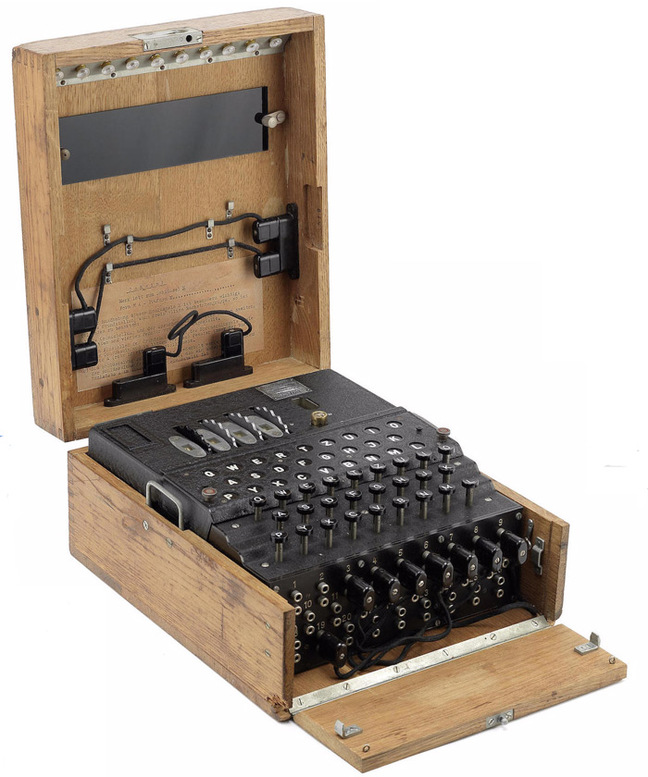
I recently read David O’Keefe’s One Day in August, which seems to explain the otherwise inexplicable launch of “Operation Jubilee”, the Dieppe raid … in his reading, the raid was actually a cover-up operation while British intelligence operatives tried to snatch one or more of the new Enigma machines (like the one shown above) without tipping off the Germans that that was the actual goal. Joel Ralph reviewed the book when it was released:
One Day in August, by David O’Keefe, takes a completely different approach to the Dieppe landing. With significant new evidence in hand, O’Keefe seeks to reframe the entire raid within the context of the secret naval intelligence war being fought against Nazi Germany.
On February 1, 1942, German U-boats operating in the Atlantic Ocean switched from using a three-rotor Enigma code machine to a new four-rotor machine. Britain’s Naval Intelligence Division, which had broken the three-rotor code and was regularly reading German coded messages, was suddenly left entirely in the dark as to the positions and intentions of enemy submarines. By the summer of 1942, the Battle of the Atlantic had reached a state of crisis and was threatening to cut off Britain from the resources needed to carry on with the war.
O’Keefe spends nearly two hundred pages documenting the secret war against Germany and the growth of the Naval Intelligence Division. What ties this to Dieppe and sparked O’Keefe’s research was the development of a unique naval intelligence commando unit tasked with retrieving vital code-breaking material. As O’Keefe’s research reveals, the origins of this unit were at Dieppe, on an almost suicidal mission to gather intelligence they hoped would crack the four-rotor Enigma machine.
O’Keefe has uncovered new documents and first-hand accounts that provide evidence for the existence of such a mission. But he takes it one step further and argues that these secret commandos were not simply along for the ride at Dieppe. Instead, he claims, the entire Dieppe raid was cover for their important task.
It’s easy to dismiss O’Keefe’s argument as too incredible (Zuehlke does so quickly in his brief conclusion [in his book Operation Jubilee, August 19, 1942]). But O’Keefe would argue that just about everything associated with combined operations defied conventional military logic, from Operation Ruthless, a planned but never executed James Bond-style mission, to the successful raid on the French port of St. Nazaire only months before Dieppe.
Clearly this commando operation was an important part of the Dieppe raid. But, while the circumstantial evidence is robust, there is no single clear document that directly lays out the Dieppe raid as cover for a secret “pinch by design” operation to steal German code books and Enigma material.
October 25, 2015
QotD: German culture and discipline
The Germans are a good people. On the whole, the best people perhaps in the world; an amiable, unselfish, kindly people. I am positive that the vast majority of them go to Heaven. Indeed, comparing them with the other Christian nations of the earth, one is forced to the conclusion that Heaven will be chiefly of German manufacture. But I cannot understand how they get there. That the soul of any single individual German has sufficient initiative to fly up by itself and knock at St. Peter’s door, I cannot believe. My own opinion is that they are taken there in small companies, and passed in under the charge of a dead policeman.
Carlyle said of the Prussians, and it is true of the whole German nation, that one of their chief virtues was their power of being drilled. Of the Germans you might say they are a people who will go anywhere, and do anything, they are told. Drill him for the work and send him out to Africa or Asia under charge of somebody in uniform, and he is bound to make an excellent colonist, facing difficulties as he would face the devil himself, if ordered. But it is not easy to conceive of him as a pioneer. Left to run himself, one feels he would soon fade away and die, not from any lack of intelligence, but from sheer want of presumption.
The German has so long been the soldier of Europe, that the military instinct has entered into his blood. The military virtues he possesses in abundance; but he also suffers from the drawbacks of the military training. It was told me of a German servant, lately released from the barracks, that he was instructed by his master to deliver a letter to a certain house, and to wait there for the answer. The hours passed by, and the man did not return. His master, anxious and surprised, followed. He found the man where he had been sent, the answer in his hand. He was waiting for further orders. The story sounds exaggerated, but personally I can credit it.
The curious thing is that the same man, who as an individual is as helpless as a child, becomes, the moment he puts on the uniform, an intelligent being, capable of responsibility and initiative. The German can rule others, and be ruled by others, but he cannot rule himself. The cure would appear to be to train every German for an officer, and then put him under himself. It is certain he would order himself about with discretion and judgment, and see to it that he himself obeyed himself with smartness and precision.
For the direction of German character into these channels, the schools, of course, are chiefly responsible. Their everlasting teaching is duty. It is a fine ideal for any people; but before buckling to it, one would wish to have a clear understanding as to what this “duty” is. The German idea of it would appear to be: “blind obedience to everything in buttons.” It is the antithesis of the Anglo-Saxon scheme; but as both the Anglo-Saxon and the Teuton are prospering, there must be good in both methods. Hitherto, the German has had the blessed fortune to be exceptionally well governed; if this continue, it will go well with him. When his troubles will begin will be when by any chance something goes wrong with the governing machine. But maybe his method has the advantage of producing a continuous supply of good governors; it would certainly seem so.
Jerome K. Jerome, Three Men on the Bummel, 1914.
October 23, 2015
The Crime That Shook the World – The Execution of Edith Cavell I THE GREAT WAR Week 65
Published on 22 Oct 2015
Edith Cavell was a British nurse serving in a nursing school in occupied Belgium. She was executed by the Germans for treason and espionage in Brussels. Her death and the surrounding atrocity propaganda caused a public outcry all over the world. At the same time the First World War continued like never before. The Third Battle of the Isonzo didn’t bring a decision between Austria-Hungary and Italy, in Gallipoli the troops were slowly withdrawn and the the Champagne offensive of the French army was still in full swing.
October 22, 2015
The decline of democracy in Turkey
Last week, Daniel Pipes looked at the increasingly dictatorial ambitions of Turkish president Recep Tayyip Erdoğan:
The Republic of Turkey is undergoing possibly its greatest crisis since the founding of the state nearly a century ago. Present trends suggest worse to come as a long-time Western ally evolves into a hostile dictatorship.
The crisis results primarily from the ambitions of one very capable and sinister individual, Turkey’s 61-year old president, Recep Tayyip Erdoğan. A career politician who previously served four years as the mayor of Turkey’s megacity, Istanbul, and then eleven years as the country’s prime minister, he forwards two goals hitherto unknown in the republic: dictatorship and full application of the Shari’a, Islam’s law code.
During his first eight years of power, 2003-11, Erdoğan ruled with such finesse that one could only suspect these two aspirations; proof remained elusive. This author, for example, wrote an article in 2005 that weighed the contradictory evidence for and against Erdoğan being an Islamist. A combination of playing by the rules, caution in the Islamic arena, and economic success won Erdoğan’s party, Justice and Development (Adalet ve Kalkınma Partisi, or AKP), increasing percentages of the vote in parliamentary elections, going from 34 percent in 2002, to 46 percent in 2007, to 50 percent in 2011.
That 2011 election victory, his third in succession, gave Erdoğan the confidence finally to remove the armed forces from politics, where they had long served as Turkey’s ultimate power broker. Ironically, this change ended the increasing democratization of prior decades for his fully taking charge allowed Erdoğan to develop an oversized ego, to bare his fangs, flex his despotic muscles, and openly seek his twin objectives of tyranny and Shari’a.
Indeed, Erdoğan made his power felt in every domain after 2011. Banks provided loans to the businessmen who kicked back funds to the AKP. Hostile media found themselves subject to vast fines or physical assault. Ordinary citizens who criticized the leader found themselves facing lawsuits, fines, and jail. Politicians in competing parties faced dirty tricks. Like a latter-day sultan, Erdoğan openly flouted the law and intervened at will when and where he wished, inserting himself into legal proceedings, meddling in local decisions, and interfering with police investigations. For example, he responded to compelling raw evidence of his own and his family’s corruption by simply closing down the inquiry.
Europe: The First Crusade – VI: On to Jerusalem – Extra History
Published on 12 Sep 2015
The Crusaders now held Antioch, but not securely. The Turks still control the citadel atop the mountain and had a massive army coming to reinforce them. The situation grew worse when Stephen of Blois deserted from the Crusades, and told the Byzantine reinforcements not to bother: he believed Antioch would fall immediately. Now entirely on their own, the Crusaders held the wall in constant vigil until a mystic named Peter Bartholomew claimed to have received a vision from Saint Andrew. Guided by his vision, he discovered metal which he claimed to be the holy lance of Longinus – nevermind that the church already had the holy lance in its possession. Though the Crusade leaders had doubts, the soldiers were inspired so they launched an assault on the Turkish armies. Surprisingly, they won the day: the Turks did not fully support their leader, Kerbogha, and many took the Crusade counter-attack as an excuse to abandon the siege. Bohemond now kept Antioch, while Raymond of Toulouse – after the disastrous Siege of Maarat led the soldiers to commit acts of cannibalism – took the remains of the army south to Jerusalem. His attempt to capture a small city called Arqa along the way almost fractured the crusade army again, and did lead to the death of Peter Bartholomew. They arrived in Jerusalem to find the local wells poisoned, giving them no choice but to attack the city head-on. After days of intense fighting, they won their way inside the walls and began a massive slaughter of the people who still lived inside Jerusalem – the Christian population had been expelled, leaving only Muslims and Jews still in the city. And thus, with Antioch and Jerusalem both in crusader hands, the First Crusade came to an end.
October 20, 2015
The economics of wind power in the UK
James Delingpole on the sleight-of-hand employed by the media to pretend that wind power is far more economical than it really is:
Wind power now UK’s cheapest source of electricity – but the Government continues to resist onshore turbines.
That was the headline in the Independent this time last week. I’m not suggesting for a moment that you’re an Independent reader but suppose for a moment you were: what do you think your reaction might have been?
Mine, I suspect, would have been not dissimilar to that of the eight thousand readers who decided it was worth sharing – and indeed that of the two or three who used it to needle sceptics on Twitter.
“Take that, evil deniers!” I would have gone in my smug, Independent-reading way. And it would never have occurred to me to question the premise for a number of reasons.
1. It was written by the Environment Editor on a reasonably well-respected national newspaper. And people with responsible jobs like that don’t make shit up, do they?
2. The data came from Bloomberg New Energy Finance – “the world’s leading provider of information on clean energy to investors, energy companies and governments.” Well if they say so it must be true. Bloomberg – they’re kind of a big deal in financial information, right?
3. It wasn’t just the left-leaning Independent that ran with the story. The story also appeared in the Guardian which, though also pretty parti-pris where environmental issues are concerned, does tend to pride itself on its accuracy and integrity (relative, say, to its arch-enemy the Murdoch press) and its willingness to rectify even the slightest mistake in its Corrections section. And more significantly, it ran in the unashamedly free-market City Am which, you might have imagined, would never dream of writing a headline like “Wind power now the cheapest electricity to produce in the UK as the price of renewable energy continues to drop” without first checking to see whether the press release was accurate.
Well, since the story ran, Paul Homewood has been doing a bit of homework. And guess what? Yes, that’s right. Wind power isn’t the cheapest source of electricity in the UK or anywhere else in the world. Not by a long chalk. It’s at least twice the price, for example, of electricity generated from that hated but remarkably cost-effective fossil fuel, gas.
The French Uniforms of World War 1 I THE GREAT WAR – Special
Published on 19 Oct 2015
We are starting a new irregular series about the various uniforms of the warring nations of World War 1. Starting with the French uniforms we are exploring everything from helmets to boots. The French were the first army to adapt a real military helmet with the M15. In the beginning of the war they were still wearing the traditional Kepi from Franco-Prussian War, however. Find out all about the French equipment in the trenches with Indy.
October 18, 2015
QotD: Peace and order in the Kaiser’s Germany
Private lawyers are not needed in Germany. If you want to buy or sell a house or field, the State makes out the conveyance. If you have been swindled, the State takes up the case for you. The State marries you, insures you, will even gamble with you for a trifle.
“You get yourself born,” says the German Government to the German citizen, “we do the rest. Indoors and out of doors, in sickness and in health, in pleasure and in work, we will tell you what to do, and we will see to it that you do it. Don’t you worry yourself about anything.”
And the German doesn’t. Where there is no policeman to be found, he wanders about till he comes to a police notice posted on a wall. This he reads; then he goes and does what it says.
I remember in one German town—I forget which; it is immaterial; the incident could have happened in any — noticing an open gate leading to a garden in which a concert was being given. There was nothing to prevent anyone who chose from walking through that gate, and thus gaining admittance to the concert without paying. In fact, of the two gates quarter of a mile apart it was the more convenient. Yet of the crowds that passed, not one attempted to enter by that gate. They plodded steadily on under a blazing sun to the other gate, at which a man stood to collect the entrance money. I have seen German youngsters stand longingly by the margin of a lonely sheet of ice. They could have skated on that ice for hours, and nobody have been the wiser. The crowd and the police were at the other end, more than half a mile away, and round the corner. Nothing stopped their going on but the knowledge that they ought not. Things such as these make one pause to seriously wonder whether the Teuton be a member of the sinful human family or not. Is it not possible that these placid, gentle folk may in reality be angels, come down to earth for the sake of a glass of beer, which, as they must know, can only in Germany be obtained worth the drinking?
In Germany the country roads are lined with fruit trees. There is no voice to stay man or boy from picking and eating the fruit, except conscience. In England such a state of things would cause public indignation. Children would die of cholera by the hundred. The medical profession would be worked off its legs trying to cope with the natural results of over-indulgence in sour apples and unripe walnuts. Public opinion would demand that these fruit trees should be fenced about, and thus rendered harmless. Fruit growers, to save themselves the expense of walls and palings, would not be allowed in this manner to spread sickness and death throughout the community.
But in Germany a boy will walk for miles down a lonely road, hedged with fruit trees, to buy a pennyworth of pears in the village at the other end. To pass these unprotected fruit trees, drooping under their burden of ripe fruit, strikes the Anglo-Saxon mind as a wicked waste of opportunity, a flouting of the blessed gifts of Providence.
I do not know if it be so, but from what I have observed of the German character I should not be surprised to hear that when a man in Germany is condemned to death he is given a piece of rope, and told to go and hang himself. It would save the State much trouble and expense, and I can see that German criminal taking that piece of rope home with him, reading up carefully the police instructions, and proceeding to carry them out in his own back kitchen.
Jerome K. Jerome, Three Men on the Bummel, 1914.
October 16, 2015
Learning Lessons From Loos – Bulgaria Enters The War I THE GREAT WAR – Week 64
Published on 15 Oct 2015
By the numbers the Battle of Loos was a defeat for the British Army but they learned valuable lessons for the future on the Western Front. The creeping artillery barrage is used for the first time successfully and it is apparent that assault tactics have to be rethought completely. On the Balkans, Bulgaria officially declares war on Serbia and joins the Central Powers Germany, Austria-Hungary and the Ottoman Empire. On the same day they invade Serbia which is now in real trouble.
October 13, 2015
Art From The Apocalypse – Otto Dix I WHO DID WHAT IN WW 1
Published on 12 Oct 2015
Otto Dix was a German artist known for his unforgiving depiction of the Great War and the society of Weimar Republic. His works in the series Der Krieg (The War) are among the most well known depictions of the horrors of war. Together with George Grosz and Max Beckmann, he is considered one of the most important artists of the Neue Sachlichkeit (New Objectivity).


