
A Remembrance Day slideshow using Mark Knopfler’s wonderful “Remembrance Day” song from the album Get Lucky (2009). The early part of the song conveys many British images, but I have added some very Canadian images also which fit with many of the lyrics. The theme and message is universal… ‘we will remember them’.
November 11, 2015
Mark Knopfler – “Remembrance Day”
Comments Off on Mark Knopfler – “Remembrance Day”
November 10, 2015
The USA Before Joining World War 1 I THE GREAT WAR – Special
Published on 9 Nov 2015
Even though the United States only joined the First World War in 1917, the affects of World War 1 were felt way before. Woodrow Wilson initially wanted the USA to stay neutral but also increased the number of the US Army and expanded the US Navy. Economically, the United States of America had already chosen a side in the conflict before the declaration of war was signed. They supported the Entente with ammunition and other supplies. Things like the sinking of the Lusitania and unrestricted submarine warfare only made it easier to convince the public.
Comments Off on The USA Before Joining World War 1 I THE GREAT WAR – Special
QotD: The Imperial Roman navy
The navy maintained by the emperors might seem inadequate to their greatness; but it was fully sufficient for every useful purpose of government. The ambition of the Romans was confined to the land; nor was that warlike people ever actuated by the enterprising spirit which had prompted the navigators of Tyre, of Carthage, and even of Marseilles, to enlarge the bounds of the world, and to explore the most remote coasts of the ocean. To the Romans the ocean remained an object of terror rather than of curiosity; the whole extent of the Mediterranean, after the destruction of Carthage, and the extirpation of the pirates, was included within their provinces. The policy of the emperors was directed only to preserve the peaceful dominion of that sea, and to protect the commerce of their subjects. With these moderate views, Augustus stationed two permanent fleets in the most convenient ports of Italy, the one at Ravenna, on the Adriatic, the other at Misenum, in the Bay of Naples. Experience seems at length to have convinced the ancients, that as soon as their galleys exceeded two, or at the most three ranks of oars, they were suited rather for vain pomp than for real service. Augustus himself, in the victory of Actium, had seen the superiority of his own light frigates (they were called Liburnians) over the lofty but unwieldy castles of his rival. Of these Liburnians he composed the two fleets of Ravenna and Misenum, destined to command, the one the eastern, the other the western division of the Mediterranean; and to each of the squadrons he attached a body of several thousand marines. Besides these two ports, which may be considered as the principal seats of the Roman navy, a very considerable force was stationed at Frejus, on the coast of Provence, and the Euxine was guarded by forty ships, and three thousand soldiers. To all these we add the fleet which preserved the communication between Gaul and Britain, and a great number of vessels constantly maintained on the Rhine and Danube, to harass the country, or to intercept the passage of the barbarians. If we review this general state of the Imperial forces; of the cavalry as well as infantry; of the legions, the auxiliaries, the guards, and the navy; the most liberal computation will not allow us to fix the entire establishment by sea and by land at more than four hundred and fifty thousand men: a military power, which, however formidable it may seem, was equalled by a monarch of the last century, whose kingdom was confined within a single province of the Roman empire.
Edward Gibbon, “Chapter I: The Extent Of The Empire In The Age Of The Antonines — Part III”, History of the Decline and Fall of the Roman Empire, 1782.
Comments Off on QotD: The Imperial Roman navy
November 9, 2015
Shocking cheese-related crime in France
Ace of Spades H.Q. has the details:
Sacre Vache! Thieves Steal 4 Tonnes of Comte Cheese, In What Police Are Calling “A Crime That Happened This Century”
Four tonnes of comte. Street value: almost one half of one million dollars, maybe more if you step on it and cut it with brie.
Police describe themselves as “vaguely interested” in this case.
Interpol has been called, but didn’t pick up a phone. So an email was sent. The email was marked, “When you get to it.”
Some thieves in France have made off with a rather odd prize recently — four tonnes of cheese.
Police were called to a break-in on Monday in which the owner of the Napier dairy in the town of Goux-les-Usiers discovered some crooks had stolen roughly 100 wheels of comte, a luxury cheese which can only be made in the Franche-Comte region using unpasteurised cow’s milk.
Unpasteurized — that’s the good shit. That’s what hooks you, that’s what makes you a junkie. Once you’re hooked on cheese made of unpasteurized milk, you’ll spend the rest of your life “Chasing the Cow,” walking down lonely streets and breaking into seedy fromageries looking to score your next “wheel.”
…
It might seem like a crime by someone with a fairly extreme dairy fetish, but police believe the cheese was stolen by a gang who will sell it on the black market.
Comte can sell for 40 [Euros] a pound, making it just as valuable to thieves as jewellery or electrical goods.
You can tell how “pure” cheese is by sticking your pinky into it and then rubbing the cream on your gums. If your gums feel like they’re on fire — that’s pure, baby.
Comments Off on Shocking cheese-related crime in France
November 8, 2015
The Legend of the Desk & the Far Ends of the Trenches I OUT OF THE TRENCHES
Published on 7 Nov 2015
Indy sits in the chair of wisdom again to answer your questions. And this time, we’re talking about the legend behind our desk and how the far ends of the trenches looked like. Don’t forget to ask us more questions.
Comments Off on The Legend of the Desk & the Far Ends of the Trenches I OUT OF THE TRENCHES
QotD: Small bits of French revenge
But [the German] is no gourmet. French cooks and French prices are not the rule at his restaurant. His beer or his inexpensive native white wine he prefers to the most costly clarets or champagnes. And, indeed, it is well for him he does; for one is inclined to think that every time a French grower sells a bottle of wine to a German hotel- or shop-keeper, Sedan is rankling in his mind. It is a foolish revenge, seeing that it is not the German who as a rule drinks it; the punishment falls upon some innocent travelling Englishman. Maybe, however, the French dealer remembers also Waterloo, and feels that in any event he scores.
Jerome K. Jerome, Three Men on the Bummel, 1914.
Comments Off on QotD: Small bits of French revenge
November 6, 2015
The Third Battle of the Isonzo – French Despair On The Western Front I THE GREAT WAR Week 67
Published on 5 Nov 2015
For the third time the Italians had tried to conquer the Austrian positions at the Isonzo front and for the third time they had failed. And like the other defeats before, the Third Battle of the Isonzo came with an extreme amount of casualties due to the difficult terrain in the Alps. At the same time, Lord Kitchener visits the front in Gallipoli and realises that evacuation is the only logical decision to make. On the Western Front, the French had suffered well over 200.000 casualties during the autumn offensives at Artois and in the Champagne.
Comments Off on The Third Battle of the Isonzo – French Despair On The Western Front I THE GREAT WAR Week 67
Turkish politics, post-election
Austin Bay looks at Turkey’s domestic political situation following the re-election of Recep Erdoğan’s Justice and Development Party:
The threat to Turkish democratic institutions is a man notoriously jealous of Ataturk, current president Recep Tayyip Erdoğan. The snap election gave Erdoğan and his Justice and Development Party, AKP, overwhelming control of parliament (316 of 550 seats). The AKP had controlled parliament since 2002, but in the June 7 election it lost its one-party majority. Political haggling among opposition parties, including Ataturk’s Republican Peoples Party, the CHP, failed to produce a coalition government; a new election was necessary.
However, in the intervening month’s domestic terrorist incidents, the fitful war with the Islamic State in the Levant and Syria’s violent chaos dominated Turkish politics.
Erdoğan portrayed himself as the only leader capable of addressing Turkey’s deteriorating security situation. Domestic security certainly diminished; why it did stirs angry accusations. Erdoğan’s political opponents maintain that he used the violence to solidify political support. His more vicious critics accuse him of intentionally permitting violence. For example, they argue his government could have prevented the Oct. 10 terror bombing of a peace march in Ankara, now attributed to ISIL. Over 100 people were murdered in that attack.
Is it an over the top conspiracy theory-type accusation? Possibly. Erdoğan himself, however, believes over the top conspiracy theories, and he uses conspiratorial doubt and fear as political tools. His record for jailing journalists and intimidating political opponents associated with his alleged conspiracies is fact, not theory. The election didn’t assuage his fears — it ignited another surge of arrests. On Nov. 3, police arrested scores of people associated with Erdoğan critic and Muslim cleric Fethullah Gulen. At one time Gulen supported Erdoğan and the moderate Islamist AKP. However, Gulen broke with Erdoğan over credible charges of corruption within Erdoğan’s governing circle.
Daniel Pipes isn’t convinced that the terror stampeded voters in Erdoğan’s direction (especially Kurdish voters), and he suspects fraud in the election results:
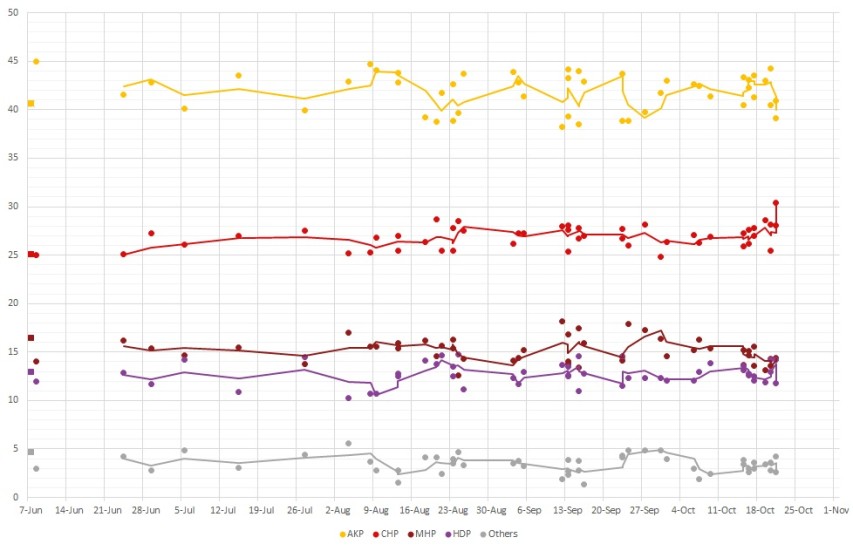
Like other observers of Turkish politics, I was stunned on November 1 when the ruling Justice and Development Party (Adalet ve Kalkınma Partisi, or AKP) was reported to have increased its share of the national vote since the last round of elections in June 2015 by 9 percent and its share of parliamentary seats by 11 percent.
The polls had consistently shown the four major parties winning about the same number of seats as in June. This made intuitive sense; they represent mutually hostile outlooks (Islamist, leftist, Kurdish, nationalist), making substantial movement between them in under five months highly unlikely. That about one in nine voters switched parties defies reason.
Polling results between the June and November 2015 Turkish elections
The AKP’s huge increase gave it back the parliamentary majority it had lost in the June 2015 elections, promising President Recep Tayyip Erdoğan a semi-legal path to the dictatorial powers he aspires to.
But, to me, the results stink of fraud. It defies reason, for example, that the AKP’s war on Kurds would prompt about a quarter of Turkey’s Kurds to abandon the pro-Kurdish party and switch their votes to the AKP.
Comments Off on Turkish politics, post-election
The evolution of the Royal Navy’s ship designs
This post is a nice summary of the Royal Navy’s frigates, destroyers, and cruisers from the Second World War through to the present day:
Before the Second World War the RN was predominantly a “cruiser navy”, holding down a range of global deployments with its 15 heavy and 41 light cruisers. These ships had endurance and combat power at the core of their designs, each could operate alone for extended periods, effectively defend itself in most circumstances and demonstrate the interest or resolve of the government in a particular region. The ensuing World War and the Cold War radically changed the type of warships the RN needed. Instead of cruisers built for endurance and complex warfighting the navy built a profusion of smaller frigates and destroyers, mainly to guard convoys and fight submarines close to the UK and in the North Atlantic. To carry out these tasks the navy could make do with smaller, cheaper, ships with relatively shorter legs and far less ability to act independently in high threat environments. Trade-offs like these were made in order to ensure the navy got enough escorts to protect the convoys which would be vital to Britain’s survival in the event of a war; and to hunt the Soviet ballistic missile submarines that threatened NATO. These were ships designed to act as part of a military system that would defeat the threat posed by hostile submarines. This system also included land based aircraft, anti submarine helicopters, aircraft and helicopter carriers and the enormous US/NATO SOSUS fixed sonar array. The Leander class is probably the most famous example of these sort of light frigates, operated by the RN into the early 1990s. When the immediate and pressing threat from submarines operating in the North Atlantic, be they German or Soviet, ceased to exist so the naval forces the UK had constructed to defeat them also fell by the wayside. These ships were, broadly speaking, a product of their time and a deviation from the much older structure that had served the RN well for centuries. This structure consisted of a core “battle fleet”, made up of capital ships; mainly there to act as a deterrent, supported by powerful forward deployed cruisers that conducted most of the day to day activity.
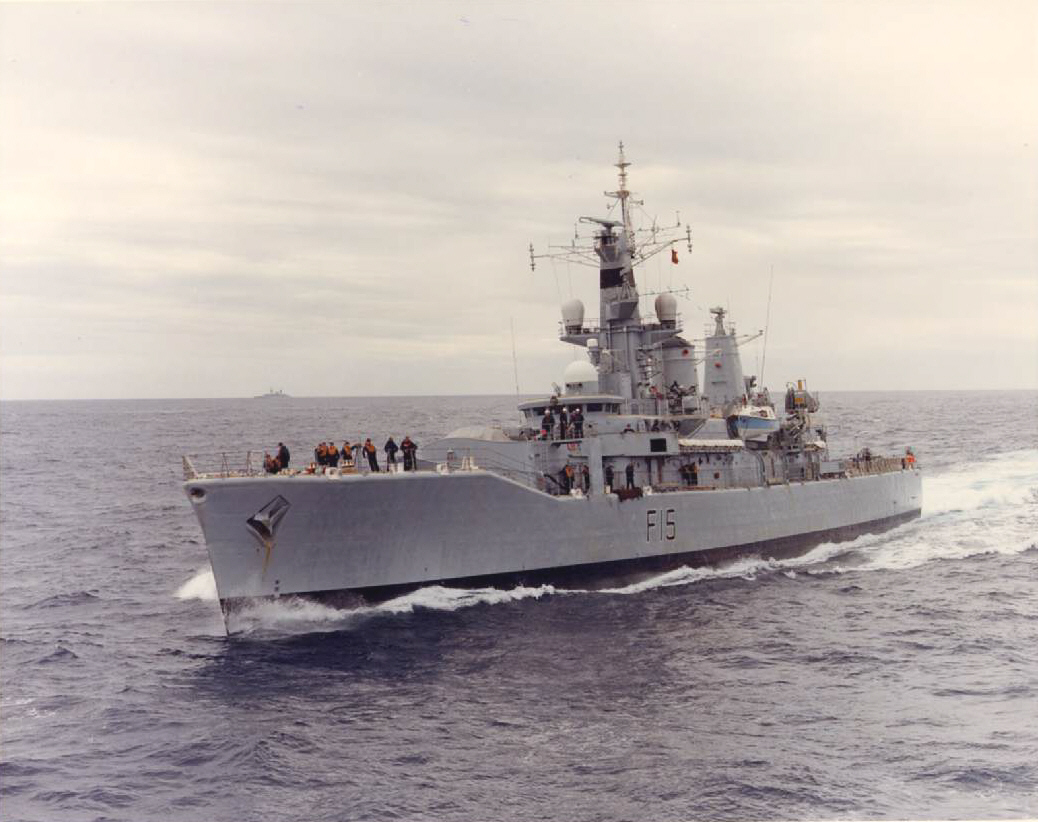
HMS Euryalus, one of 26 Leander Class frigates built for the RN
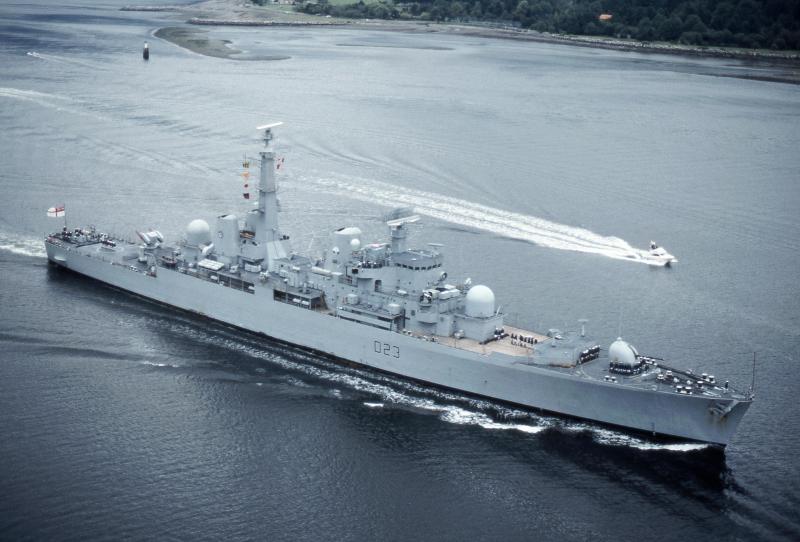
By modern standards almost all of the cheap and numerous frigates and destroyers of the past, even the excellent Leanders, would be classed as lightly armed corvettes. The simple fact was that these cheap and numerous ships sacrificed a lot of capability in order to achieve the affordability necessary to build them in numbers. They were still recognisable as frigates built in the convoy escort mold. Similarly the Type 42 anti-aircraft warfare destroyers, in service from the mid-1970s, were also a design that compromised range and armament for numbers. At only 3500 tonnes the Batch 1 Type 42s were clearly a very light and economical design. When compared with their American counterparts, the 8000 tonne Spruance class, it’s clear that these ships sacrificed range and armament for economy and numbers. Both the Leanders and the Type 42s are recognisable as frigates and destroyers, light warships designed to act in groups and alongside other warships, auxiliaries and aircraft to be effective in combat. The closest the RN came to “cruiser” designs during the Cold War were the eight County Class missile destroyers commissioned in the early 1960s and HMS Bristol, the sole survivor of the pre-1968 carrier escort programme. While these destroyer classes were cruiser-like in some aspects, they carried a far more comprehensive armament and had a greater range (in terms of fuel) than their contemporaries, they lacked the self-sustainment ability, protection, survivability and range of “true” cruisers. While Bristol was initially labelled a light cruiser by Jane’s, the Royal Navy always saw her for what she was: an oversize missile destroyer with the similar limitations to the navy’s other destroyers.
HMS Bristol, the closest the RN came to a new cruiser during the Cold War
With the later Type 22 and 23 frigates the RN moved to fewer, more individually capable, platforms. This change was partly necessitated by the introduction of a new generation of bigger towed array sonars which required larger ships to operate effectively. Despite their greatly improved self defence ability, achieved by fitting the Sea Wolf point defence missile system, these ships were still designed to be expendable escorts and lacked the endurance of cruisers. That said, these two classes signalled the start of the navy’s shift from a fleet of numerous, small and cheap escorts to fewer, larger ships capable of independent operations in a high threat environment.
Comments Off on The evolution of the Royal Navy’s ship designs
November 5, 2015
QotD: The Berlin Wall
The Berlin Wall was a symbol of the depravity and viciousness of the Marxist idea. Karl Marx was a pure hate monger masquerading as a social philosopher. His ideas may, in the end, be summarized thus: wealth can be gained only by stealing from others, and thus successful people are evil, and thus it is okay to threaten or kill rich people (or even people who are just a bit better off than you are), to steal their belongings, and to threaten anyone who might in the future have more stuff than you do. If you somehow get more things than other people, it is okay for other people to take your stuff, and if you resist, it is okay to beat you up or kill you.
Even more succinctly, Marxism is the idea that envy is laudable, and should be turned into social policy with the use of pervasive violence.
I am putting this more bluntly and baldly than the average Marxist would. They prefer concealing their central idea beneath a heavy blanket of words. They dress up their “philosophy” in avant garde costumes, adding layers of verbiage, complicated and counterfactual claims about language and logic, bizarre ideas about the nature of history, etc., all in the service of keeping people from seeing what they’re actually suggesting. What lies underneath is nothing much more than hate of people who have more stuff than you do, justified by little or nothing more than wanting to take what they have for yourself.
When you base your beliefs on this sort of foundation, the violence that proceeds is not an accident or the result of an improper understanding or implementation of an otherwise fine program. The violence is the direct and intentional result of the underlying program. The violence is the entire purpose of the underlying program.
In spite of the claims of apologists, the Marxism that fell twenty five years ago was the true Marxism. You cannot force people to work whether they get any benefit of it or not if they can flee from you, so you have to build walls. The Berlin Wall was not an aberration, it was the the only way to keep the quite literal slaves from fleeing their bondage. You cannot take stuff from people who have it without goons with guns, since they will not want to hand their material possessions over, so you bring in goons with guns to scour your population. In a free market, you get ahead by making things people want like bread or telephones, but in a Marxist society, the only way to get ahead is through gaining political power, and so people who are exceptionally talented at deploying violence and thuggery and are ambitious rise to the top of your society. Stalin or someone like him was not an accident, he was an inevitability.
Perry Metzger, “A memorable anniversary, and those who would forget it”, Samizdata, 2014-11-09.
Comments Off on QotD: The Berlin Wall
November 3, 2015
J.R.R. Tolkien – The Father of Lord of The Rings I WHO DID WHAT IN WORLD WAR 1?
Published on 2 Nov 2015
John Ronald Reuel Tolkien (JRR Tolkien) served on the Western Front of World War 1. It is believed that his experiences of the horrors war were a direct inspiration for his Lord of the Rings books. The struggle between good and evil and the price for victory are strong motives in his work. Find out which other similarities there are between the Lord of the Rings and the First World War.
Comments Off on J.R.R. Tolkien – The Father of Lord of The Rings I WHO DID WHAT IN WORLD WAR 1?
November 2, 2015
A different view of Macbeth
Anthony King looks at Macbeth as a PTSD sufferer:
Although the descriptions are graphic, Shakespeare’s play itself includes few on-stage battle scenes. Only at the very end does Macbeth actually fight on stage, a last stand in which he kills the young Siward (his last victim) and is in turn killed by MacDuff. For the rest of the play, all of Macbeth’s violence is set off stage, described but never seen. The audience imagines his violence — they do not witness it.
Justin Kurzel’s striking new adaptation of Macbeth, released on October 2, 2015 to critical acclaim and starring Marion Cotillard and Michael Fassbender, represents a cinematographic inversion of the original. In his film, battle predominates. The film begins with an extended combat sequence. Macbeth and his army are gathered on a bleak moor as they prepare for battle against Macdonaldwald’s army, unseen in the dense fog. The camera pans across the black-striped war-painted faces until, initiated by Macbeth, the host issues a war cry and plunges toward their enemies, who appear spectrally in the distance through the murk. In ultra-slow motion, the two armies clash and brutal fighting follows. Most notably, one of Macbeth’s boy soldiers, on whom the camera dwells tellingly before the battle, has his throat cut during the fighting and bleeds out darkly on screen. Eventually, Macbeth charges Macdonaldwald and slashes him to the ground. The scene is followed by a long sequence in which the dead are gathered and prepared for cremation, including the boy soldier, whose image haunts the rest of the film.
Macbeth’s apparently fearless heroism and remorseless violence is on display throughout these sequences. Yet the sequences highlight an aspect of Macbeth’s character normally absent from adaptations of the play and presumably from the original play, but highly relevant to a 21st-century audience. Macbeth is a combat veteran and, despite his courage, he is plainly severely traumatized by his war experiences. Kurzel and Fassbender construct him as a victim of PTSD, and he displays the classic symptoms of this perturbing condition.
Comments Off on A different view of Macbeth
The Top 10 Moustaches of World War 1 I THE GREAT WAR Top List
Published on 28 Oct 2015
Grow your own World War 1 moustache and send a picture to us on Facebook, Twitter or Instagram using the hashtag #TGWmovember. We will collect the best for an upcoming OUT OF THE TRENCHES.
November is the month of the year to celebrate moustaches and beards in all forms and fashions. To celebrate the start of #movember we made a new top list ranking the beards of World War 1.
Comments Off on The Top 10 Moustaches of World War 1 I THE GREAT WAR Top List
November 1, 2015
QotD: Germany’s class system
As a trader, I am inclined to think the German will, unless his temperament considerably change, remain always a long way behind his Anglo-Saxon competitor; and this by reason of his virtues. To him life is something more important than a mere race for wealth. A country that closes its banks and post-offices for two hours in the middle of the day, while it goes home and enjoys a comfortable meal in the bosom of its family, with, perhaps, forty winks by way of dessert, cannot hope, and possibly has no wish, to compete with a people that takes its meals standing, and sleeps with a telephone over its bed. In Germany there is not, at all events as yet, sufficient distinction between the classes to make the struggle for position the life and death affair it is in England. Beyond the landed aristocracy, whose boundaries are impregnable, grade hardly counts. Frau Professor and Frau Candlestickmaker meet at the Weekly Kaffee-Klatsch and exchange scandal on terms of mutual equality. The livery-stable keeper and the doctor hobnob together at their favourite beer hall. The wealthy master builder, when he prepares his roomy waggon for an excursion into the country, invites his foreman and his tailor to join him with their families. Each brings his share of drink and provisions, and returning home they sing in chorus the same songs. So long as this state of things endures, a man is not induced to sacrifice the best years of his life to win a fortune for his dotage. His tastes, and, more to the point still, his wife’s, remain inexpensive. He likes to see his flat or villa furnished with much red plush upholstery and a profusion of gilt and lacquer. But that is his idea; and maybe it is in no worse taste than is a mixture of bastard Elizabethan with imitation Louis XV, the whole lit by electric light, and smothered with photographs. Possibly, he will have his outer walls painted by the local artist: a sanguinary battle, a good deal interfered with by the front door, taking place below, while Bismarck, as an angel, flutters vaguely about the bedroom windows. But for his Old Masters he is quite content to go to the public galleries; and “the Celebrity at Home” not having as yet taken its place amongst the institutions of the Fatherland, he is not impelled to waste his, money turning his house into an old curiosity shop.
Jerome K. Jerome, Three Men on the Bummel, 1914.
Comments Off on QotD: Germany’s class system
October 30, 2015
Russia Stems The Tide – Winter Is Coming I THE GREAT WAR Week 66
Published on 29 Oct 2015
After the Great Retreat during the summer, the Russians are finally able to fight back the Germans at Dvinsk. With a new type of trench warfare, they are able to render August von Mackensen’s artillery useless and only take on small numbers of Germans at the same time. The German army is successful in Serbia though and so the situation for the Serbs looks grim. Meanwhile Benito Mussolini writes in his diary that the worst enemy is not Austria-Hungary, but lice. All of the soldiers and generals know one thing: Winter is coming.
Comments Off on Russia Stems The Tide – Winter Is Coming I THE GREAT WAR Week 66


