
Published on 29 Sep 2016
Erich von Falkenhayn had been fired from his position as Chief-of-Staff but he had a new task: Leading the combined Austro-German forces into Romania. So, this week 100 years ago Falkenhayn crosses the Carpathian mountains into Transylvania where they met fierce Romanian resistance. At the same time the British attacked at the Somme again and failed to utilise their new weapon: the tank.
October 1, 2016
Falkenhayn Crosses The Carpathians – The Battle of Sibiu I THE GREAT WAR Week 114
Comments Off on Falkenhayn Crosses The Carpathians – The Battle of Sibiu I THE GREAT WAR Week 114
September 30, 2016
Net contributors to the EU budget
A rather revealing post at Guido Fawkes:
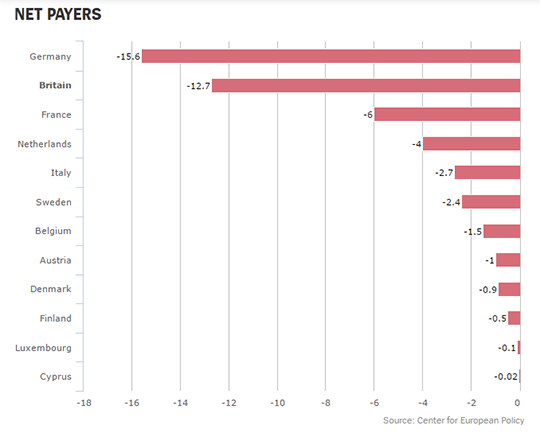
Liam Fox told the Spectator that Germany risks becoming the world’s biggest cash machine after Brexit because it may end up paying for a failing European Union that is in danger of imploding:
“If I were a German politician I would be worried that, without Britain, Germany has the potential to become the greatest ATM in global history.”
They’ve figured this out for themselves…
Of the 28 current members of the EU it may surprise co-conspirators to learn that only 12 countries were net contributors. Ireland has become the the thirteenth net contributor for the first time since it joined in 1973, hitherto it has been a net beneficiary to the order of €50 billion. Expect Irish attitudes to the EU to change as that equation changes.
Comments Off on Net contributors to the EU budget
September 27, 2016
The Lion Of Verdun – Philippe Pétain I WHO DID WHAT IN WW1?
Published on 26 Sep 2016
Philippe Pétain already had a long military career when World War 1 broke out. And even during his peacetime service, his ideas were not always popular because they went against the old doctrines of the French Army. But during World War 1 he proofed his critiques wrong and became the Lion of Verdun who halted the German advance.
Comments Off on The Lion Of Verdun – Philippe Pétain I WHO DID WHAT IN WW1?
September 25, 2016
Galicia’s role in WWI (Live from Lviv) – Handguns for Pilots – Fight or run I OUT OF THE TRENCHES
Published on 24 Sep 2016
Sitting in the Chair of Temporary Insanity, Indy talks about Galicia’s big role in war on Location, if Pilots were issued guns, and a story from a viewers great grandpa.
Comments Off on Galicia’s role in WWI (Live from Lviv) – Handguns for Pilots – Fight or run I OUT OF THE TRENCHES
September 23, 2016
Manfred von Richthofen’s First Victory – American Volunteers in WW1 I THE GREAT WAR Week 113
Published on 22 Sep 2016
This week 100 years ago Manfred von Richthofen is credited with his first aerial victory on the Western Front. He shoots down a British airplane with his Albatross D.II. At the same time the Isonzo Front is in full swing again where Luigi Cadorna is leading another offensive.
Comments Off on Manfred von Richthofen’s First Victory – American Volunteers in WW1 I THE GREAT WAR Week 113
September 21, 2016
Gracchus the Elder – Prequel: In His Footsteps – Extra History
Published on 10 Sep 2016
Special thanks to Mike Duncan for writing this episode! Check out his History of Rome podcast: http://thehistoryofrome.typepad.com/
Before Tiberius and Gracchus got famous, their father led such a break-out political career that it must have seemed impossible to live up to his legacy. Yet, his success set the stage for their falls…
____________Tiberius Gracchus the Elder has been overshadowed by his sons, but in his lifetime he had the most successful political career imaginable. Born just as the Second Punic War came to a close, he arrived on the political stage just in time to befriend the Scipio family during the Seleucid War. He secured a route of safe passage for their soldiers which led them to catch and defeat King Antiochus. The Scipios planted themselves in the east, dealing with the spoils of war and enriching themselves in the process. Upon their return to Rome, they were charged with corruption for accepting bribes, but Tiberius Gracchus the Elder had just been elected tribune of the plebs, and he voted their trial entirely. Scipio Africanus rewarded him by giving him the hand of Cornelia, his daughter and an amazing woman in her own right. Tiberius Gracchus went on the be elected aedile, and threw such lavish public games that the Senate passed a law restricting future games. It worked for him, though: he won his next election and became a praetor assigned to nearer Spain, where he launched a fierce and successful military campaign buffered by a land redistribution effort. In that way, he solved the underlying problems of poverty among the Celtiberians and secured peace for 25 years. For his success, he received a triumph and was elected consul, two of the highest honors in Roman politics. But here he played a dangerous game. Already allied with the Scipiones, he served as consul alongside their family’s biggest rival: a Claudius. He won the game and formed a relationship that would later provide his sons with important allies. Next he went to Sardinia to protect against rebellious tribes, and again he succeeded. The Gracchi name was now honored in both Spain and Sardinia, a legacy his sons would rely upon. This won him a second triumph and a role as censor, after which he joined a traveling embassy of senators to assess Rome’s client kingdoms. Tiberius Gracchus used this opportunity to forge friendships with foreign kings, like the King of Pergamum who would one day form a key part of Tiberius’s efforts to redistribute land. Finally, he won a second consulship, but here he made the mistake of screwing over a man whose son would one day lead the assault that killed Tiberius in the forum. At the end of his days, Tiberius Gracchus the Elder wasn’t just a prominent senator, but one of the most powerful men in Rome. It was the duty of a son to surpass the fame of his father, which must have seemed impossible… but Tiberius and Gracchus, building on the legacy he left, did exactly that.
P.S. If you’ve read this far, we think it’s only fair we tell you that Mike Duncan is aware the proper Latin name for the Scipio family is “Scipiones” but he allowed us to shorten it to “Scipios” to make it easier for non-Latin speakers to understand. Cheers!
Comments Off on Gracchus the Elder – Prequel: In His Footsteps – Extra History
September 20, 2016
Reaching the Masses – Propaganda Film During World War 1 I THE GREAT WAR Special
Published on 19 Sep 2016
Cinemas were already pretty popular when World War 1 broke out in 1914. After initial hesitation all warring nations started to embrace the new mass medium for their propaganda. Since it was technically difficult deliver the authentic material the audiences wanted, the films were mostly staged. Film scripts opened the opportunity to transport any message about the war to a mass audience.
Comments Off on Reaching the Masses – Propaganda Film During World War 1 I THE GREAT WAR Special
September 18, 2016
Officer and Soldier Relationships – Treatment of Criminals I OUT OF THE TRENCHES
Published on 17 Sep 2016
Sitting in the Chair of Temporary Insanity, Indy talks about officers tricking their own men, the relationships between them and how criminals were treated in the first world war.
Comments Off on Officer and Soldier Relationships – Treatment of Criminals I OUT OF THE TRENCHES
September 17, 2016
A contrarian view of the introduction of the tank
At Samizdata, Patrick Crozier gets all contrarian about the tank in a post he titles “Haig’s greatest mistake”:
On 15 September 1916 tanks made their debut at Flers-Courcelette, one of the many engagements which took place during the Battle of the Somme.
The battle marked the beginning of a sorry chapter in British military history because the truth – a truth that to this day few seem prepared to acknowledge – is that the First World War tank was useless.
The list of its failings is lengthy. It was slow, it was unreliable, it had no suspension and it was horrible to operate. The temperature inside was typically over 100°F and as exhaust gases built up so crew effectiveness collapsed. It was also highly vulnerable. Field artillery could take it out easily. Even rifle ammunition could be effective against it. While normal bullets might not be able to penetrate the armour they could knock off small pieces of metal from the inside – known as spall – which then whizzed round the interior wounding all and sundry.
That the tank was the brainchild of Winston Churchill from his days as head of the Admiralty should have alerted senior commanders to the possibility that it was yet another of his crackpot schemes. But they persisted. For his part, Haig being a technophile put a huge amount of faith in the new invention. His diary is littered with references to the tank and he seems to have made great efforts to secure ever more of them. In consequence, huge amounts of effort went into a technological dead end when it would have been far better spent on guns, shells and fuzes.
Not that such efforts were ever likely to satisfy the snake-oil salesmen who made up the ranks of the tank enthusiasts. In the face of tank failure after tank failure they simply claimed that their beloved weapon just wasn’t being used properly.
Comments Off on A contrarian view of the introduction of the tank
September 16, 2016
Beasts of Steel – The First Tanks On The Battlefield I THE GREAT WAR Week 112
Published on 15 Sep 2016
For years the British had developed the idea of the “landship” or tank and now it was finally ready for the first deployment during the Battle of Flers-Courcelette. And even though technical problems plagued the new invention, the British leadership was confident that this new weapon would break the stalemate at the Western Front for good. In the meantime Germany was focusing all offensive efforts on the Romanian front to mercilessly crush the new enemy.
Comments Off on Beasts of Steel – The First Tanks On The Battlefield I THE GREAT WAR Week 112
September 14, 2016
The Brothers Gracchi – IV: Enter Gaius – Extra History
Published on 27 Aug 2016
Gaius Gracchus took up the mantle of his dead brother, overcoming resistance from the Senate and the elites to win the election for tribune. Although he had a hot temper, he shared his brother’s charisma and talent, so he built a powerful base of popularity by creating programs for the poor, the army, and the middle class.
____________
With Tiberius dead, it fell to his brother Gaius to take up his mantle. Both brothers were talented and charismatic, but Gaius had a much more fiery temper that made the Senate wary. During his political post, as a quaestor assigned to Sardinia, they tried to bind him to his post to prevent him from running in another election. Gaius broke tradition and defied the Senate’s orders, but when they put him on trial, he brought the citizens over to his side and walked away freely. As they had feared, he ran for tribune: the same office his brother had held. Despite heavy opposition from his enemies, he won. Support for him both in and outside Rome had grown so large that people flooded the city just to vote for him. In his first act, he passed a law which applied retroactively to punish Popilius Laena, the man who had banished Tiberius’s supporters after his death. Popilius fled rather than face the law. Over the remainder of his term, Gaius proved extremely active and efficient: he passed new laws and implemented programs to help the poor, the soldiers, and the middle class through measures like the grain dole. At the end of his term, he planned to step down from politics for a while, but there weren’t enough people who won the election for tribune that year so he was reinstated by default. Now he had what his brother had died for: a second term as tribune.
Comments Off on The Brothers Gracchi – IV: Enter Gaius – Extra History
QotD: Historical novels
… the historical novel as we know it emerged at the end of the 18th century. The great historians of that age – Hume, Robertson, Gibbon and others – had moved far towards what may be called a scientific study of the past. They tried to base their narratives on established fact, and to connect them through a natural relationship of cause and effect. It was a mighty achievement. At the same time, it turned History from a story book of personal encounters and the occasional miracle to something more abstract. More and more, it did away with the kind of story that you find in Herodotus and Livy and Froissart. As we move into the 19th century, it couldn’t satisfy a growing taste for the quaint and the romantic.
The vacuum was filled by a school of historical novelists with Sir Walter Scott at its head. Though no longer much read, he was a very good novelist. The Bride of Lammermoor is one of his best, but has been overshadowed by the Donizetti opera. I’ve never met anyone else who has read The Heart of Midlothian. But Ivanhoe remains popular, and is still better than any of its adaptations. Whether still read or not, he established all the essential rules of historical fiction. The facts, so far as we can know them, are not to be set aside. They are, however, to be elaborated and folded into a coherent fictional narrative. Take Ivanhoe. King Richard was detained abroad. His brother, John, was a bad regent, and may not have wanted Richard back. There were rich Jews in England, and, rather than fleecing them, as the morality of his age allowed, John tried to flay them. But Ivanhoe and Isaac of York, and the narrative thread that leads to the re-emergence of King Richard at its climax – these are fiction.
I try to respect these conventions in my six Aelric novels. Aelric of England never existed. He didn’t turn up in Rome in 609AD, to uncover and foil a plot that I’d rather not discuss in detail. He didn’t move to Constantinople in 610, and become one of the key players in the revolution that overthrew the tyrant Phocas. He wasn’t the Emperor’s Legate in Alexandria a few years later. He didn’t purify the Empire’s silver coinage, or conceive the land reforms and cuts in taxes and government spending that stabilised the Byzantine Empire for about 400 years. He didn’t lead a pitifully small army into battle against the biggest Persian invasion of the West since Xerxes. He had nothing to do, in extreme old age, with Greek Fire. Priscus existed, and may have been a beastly as I describe him. I find it reasonable that the Emperor Heraclius was not very competent without others to advise him. But the stories are fabrications. They aren’t history. They are entertainment.
Even so, they are underpinned by historical fact. The background is as nearly right as I can make it. I’ve read everything I could find about the age in English and French and Latin and Greek. I’ve read dozens of specialist works, and hundreds of scholarly articles. My Blood of Alexandria is a good introduction to the political and religious state of Egypt on the eve of the Arab invasions. My Curse of Babylon is a good introduction to the Empire as a whole in the early years of the 7th century. The only conscious inaccuracy in all six novels comes in Terror of Constantinople, where I appoint a new Patriarch of Constantinople several months after the actual event. I did this for dramatic effect – among much else, it let me parody Tony Blair’s Diana Funeral reading – but I’ve felt rather bad about it ever since. This aside, any university student who uses me for background to the period that I cover will not be defrauded.
There’s nothing special about this. If you want to know about Rome between Augustus and Nero, the best place to start is the two Claudius novels by Robert Graves. Mary Renault is often as good as Grote or Bury on Classical Greece – sometimes better in her descriptions of the moral climate. Gore Vidal’s Julian is first class historical fiction, and also sound biography. Anyone who gets no further than C.S. Forester and Patrick O’Brien will know the Royal Navy in the age of the French Wars. Mika Waltari is less reliable on the 18th Dynasty in The Egyptian. In mitigation, we know very little about the events and family relationships of the age between Amenhotep III and Horemheb. He wrote a memorable novel despite its boggy underpinning of fact.
Richard Blake, “Interview with Richard Blake, 7th March 2014”, 2014-03-07.
Comments Off on QotD: Historical novels
September 13, 2016
Tank Development in World War 1 I THE GREAT WAR Special
Published on 12 Sep 2016
The idea for an armoured vehicle that could withstand fire and travel across battlefields was already developed in 1914 after the Race to the Sea. The British “Landship Committee” developed the tank weapon in secrecy. The French were also trying out different designs at the same time. Learn all about the development and the invention of the tank in our special episode.
Comments Off on Tank Development in World War 1 I THE GREAT WAR Special
September 12, 2016
QotD: Turning regrets into “rape”
Today, it is not uncommon for rape charges to be brought in respect of foolish or stupid sexual encounters. After presiding over back-to-back trials where a female complainant had been so drunk she could not remember what had happened and, therefore, whether she had consented to sex, Judge Mary Jane Mowat observed that “the rape conviction statistics will not improve until women stop getting so drunk”.
It was significant that Judge Mowat prefaced her comments by noting she would “be pilloried for saying” them. She may have had in mind the treatment of Ken Clarke MP, who, in 2011, referred to “serious rape”. This prompted Labour leader Ed Miliband to call for Clarke’s resignation on the grounds he was suggesting “there are other categories of rape”. Clarke spent the rest of the day saying he “always believed that all rape is extremely serious” and he was “sorry” if his comments had given any other impression.
Despite the censorious you-can’t-say-that attitude of some feminists, there is an urgent need, not to debate the seriousness of rape, but to debate what rape is. Rape, properly defined, is serious. But by redefining rape to encompass drunken or foolish sexual activity, which a man believes the woman is consenting to, the crime of rape is, in these instances, being stripped of its criminal culpability.
“Impossible”, claim rape campaigners with a glib understanding of how rape is now defined. Labour MP Harriet Harman responded to Sarah Vine’s column with an all-too-familiar analogy: “If I leave a window open an inch and someone breaks in, steals everything I own and ransacks my house, no one would say it wasn’t a crime or that the offender had ‘made a mistake’.”
Yet there is no parallel between a burglar who trespasses into a house and steals, and a man who believes a woman is consenting to sex. Trespass followed by theft is inherently unlawful. Sex, though, is inherently lawful, which is why it requires a carefully drawn law before it is criminalised. Traditionally, a conviction for rape could only be secured if the prosecution proved beyond reasonable doubt that the man either knew the woman was not consenting to sex or he could not care less whether she was consenting (Morgan, 1975). It was this mental element of the offence (mens rea, as lawyers call it) that ensured that only defendants with an appropriately guilty mind could be convicted of rape.
Jon Holbrook, “New rape laws: turning sex into a crime”, spiked!, 2015-02-12.
Comments Off on QotD: Turning regrets into “rape”
September 11, 2016
Anthony Fokker – Japanese Army – Semi-Auto Rifles I OUT OF THE TRENCHES
Published on 10 Sep 2016
It’s time for the chair of wisdom again and of course Indy answering your questions about World War 1.
Comments Off on Anthony Fokker – Japanese Army – Semi-Auto Rifles I OUT OF THE TRENCHES


