
Published on 17 Apr 2017
World War 1 was a war of artillery, 75% of casualties are attributed to artillery fire. And since the late 19th century the development of field canons, howitzers and mortars had made rapid progress. We are taking a look at the standard artillery pieces of the German, French and British Army at the outbreak of the war in this first part of a new series.
April 18, 2017
Western Front Artillery At The Outbreak of World War 1 I THE GREAT WAR Special
Comments Off on Western Front Artillery At The Outbreak of World War 1 I THE GREAT WAR Special
April 16, 2017
The tale of unsalted butter in French cuisine
At his new blog, Splendid Isolation, Kim du Toit explains the historical roots of a French culinary oddity:
One of the quirks of French cuisine is that most often the butter is unsalted, and at a French dinner table you will usually find a tiny cruet of salt with a microscopic spoon inside, so that you can salt your butter (or not) according to taste. To someone like myself, accustomed only to salted butter, this seemed like an affectation, but it wasn’t that at all: it was the result of taxation, and this is one of the things changed forever by Napoleon’s administrative reforms.
One of the best parts of our U.S. Constitution is the “interstate commerce” clause, which forbids states from levying taxes on goods and services passing from one state to another, and through another in transit. This was not the case in pre-Napoleonic France. Goods manufactured in, say, Gascony or Provence would pass through a series of customs posts en route to Paris, and at each point the various localities would levy excise taxes on the goods, driving up the final price at its eventual destination.
Which brings us to salt. French salt, you see, was produced mainly on the Atlantic coastline, and was a major “export” of Brittany to the rest of France. Butter, of course, was produced universally — in and outside Paris and ditto for every major city — but the salt for the butter came almost exclusively from Brittany, and having been taxed multiple times by the time it reached points east like Paris or Lyons, it was expensive. So the cuisine and eating habits in those parts developed without the use of salt — or, if salt was requested, at an added cost. It’s why, to this day, many French recipes use unsalted butter as an ingredient. (In contrast, butter for local consumption in western France was [and still is] almost always salted, because salt was dirt cheap there.)
Napoleon’s reforms did away with all that; he saw to it that the douane locale checkpoints and toll booths along the main roads were abolished (causing salt prices in eastern France to plummet and become a mainstay of French cuisine at last). And when the towns and villages protested about the loss of tax revenue, Napoleon made up the shortfall with “federal” funds out of the national treasury.
Of course, the French treasury had in the meantime been emptied out by, amongst other things, the statist welfare policies of the Revolutionary government (stop me if this is starting to sound familiar). Which is why, to raise money, Napoleon invaded wealthy northern Italy and western Germany (as it is now), pillaged their rich cities’ treasuries and garnered revenue from the wealthy aristocracy, who paid bribes to avoid having their palaces sacked and their wealth confiscated.
Comments Off on The tale of unsalted butter in French cuisine
Smoke Screens – Fortress Location – Recruitment Age I OUT OF THE TRENCHES
Published on 15 Apr 2017
Start your free Great Courses Plus trial today: http://ow.ly/z4VI30acl50
It’s time for Out Of The Trenches again where Indy answers your questions about World War 1, this week we talk about the recruitment age, smoke grenades and fortress locations.
Comments Off on Smoke Screens – Fortress Location – Recruitment Age I OUT OF THE TRENCHES
Damnatio memoriae
The Latin in the title is a modern construction, but it describes a fairly common way that Romans would (to borrow from Orwell) push memories down the memory hole, including even former Emperors:
In the Soviet Union, Josef Stalin didn’t just defeat his political enemies – he purged their memories from existence. Photographs were altered and history texts changed to eliminate any trace of those who stood against him, a practice that inspired George Orwell to write 1984. But Stalin was far from the first leader to erase his enemies. The ancient Romans, too, tried to erase people from history – even Emperors.
A new show on now at the British Museum explores the use of memory sanctions against Roman emperors and their families in antiquity. It also evaluates the physical treatment of objects deemed “pagan” or heretical in the Christianized empire of Late Antiquity.
But what was the point of “damnatio memoriae“? And can you ever fully expunge someone from the historical record?
A Basanite bust of Germanicus that has a series of cuts around his ear, a shorn nose, his right ear chipped away and a cross etched on his forehead. The bust is on display now at the British Museum. (Photo by Sarah E. Bond)
The British Museum is currently displaying an exhibit on ancient memory sanctions called: “Defacing the Past: Damnation and desecration in imperial Rome.” It is a fascinating look into the ways in which we interact with objects as a proxy for the actual person. It is also a look into what ancient historian Harriet Flower has called the “art of forgetting.” Although such sanctions are often called “damnatio memoriae,” this is a modern Latin phrase and thus a construct that did not in fact exist in antiquity. Use of the term suggests a monolithic way in which Romans could legally damn the memory of a disgraced or unpopular Roman emperor, when in fact there was no one term for such sanctions or even a fully systematized procedure for it. What we have today is instead the material remnants of various senatorial, imperial, and ecclesiastical decrees — as well as a number of personal choices.
Sanctions against the commemoration of a person could take many forms in ancient Rome and can be traced back to the Republican period. The dictator Sulla had the statues of his rival, Marius, pulled down. He also banned the display of wax imagines carried in funeral processions. We are told by Plutarch (Caes. 5) that the nephew of Marius, Julius Caesar, displayed these wax casts of Marius’ face for the first time in the funeral for his aunt Julia in 69 BCE. Julia had been Marius’ wife and was Caesar’s aunt. The disgraced general and his consorts were earlier declared hostes (enemies) of the Roman state, but their memory was clearly not forgotten. The absence of the imagines under Sulla had in fact always been conspicuous, rather than a tactic that led to the erasure of their deeds or memory.

Comments Off on Damnatio memoriae
If Walls Could Talk The History of the Home Episode 3 The Bedroom
Published on 1 Feb 2017
Comments Off on If Walls Could Talk The History of the Home Episode 3 The Bedroom
QotD: The fascination of Hitler and Nazi Germany
This morning I read Marina Fontaine’s review of Downfall (http://marinafontaine.blogspot.com/2017/03/netflix-review-downfall.html), yes, including mention of that scene, the one that’s been recaptioned several gazillion times, some with more humor than others. In the review, she asks why the fascination? What is it with the Nazis and Hitler?
I have a theory. It is purely mine, based on reading a metric crap-ton about all manner of things (and don’t ask me for cites because this stuff has stewed so long in the back of my head I no longer remember where I originally read whatever triggered any particular piece. You can get most of the raw facts off Wikipedia). It is also a very broad generalization. Coming years will determine whether or not it is correct in the big picture. I’m not optimistic (I hope I’ve got this horribly wrong. I fear I haven’t).
Okay. So.
The ongoing fascination with Hitler and Nazi Germany.
Simply put, it’s the most well-documented and acknowledged demonstration of the allure of evil and how easy it is for a more or less civilized people to descend into utter brutality. As such, it holds an unclean fascination not helped by uniforms that were designed to look good as well as be practical (or by the simple fact that evil, when done effectively, is sexy. Because it is invariably power, and untrammeled power at that. We’re human. Power attracts and corrupts us. The wiser among us acknowledge this so we can fight the effect).
The various Communist regimes can be dismissed as “not counting” because to the minds of those who do the dismissing, Russia, China, North Korea, and Eastern Europe “weren’t civilized”, and so Communism/Socialism would work just fine implemented by civilized people (they usually point to one of the Nordic nations when they do this). These same people are a big part of why the wrong lesson keeps being drawn from Nazi Germany.
The problem was not nationalism. It was not even the disgusting racial laws. Those laws could never have been passed, much less enforced, without the one big thing Socialism, Communism, and yes, Nazism have in common.
The supremacy of the state.
[…]
That bare listing of facts accounts for the rise of Hitler, but not the continuing notion that the Nazis were conservative (only if you define ‘conservative’ as ‘nationalist’). That one comes from two sources. One was Soviet propaganda aimed at making Communist and Nazi ideologies seem much more distinct than they actually were. The other was Allied propaganda aimed at much the same thing. It wouldn’t do, after all, to have people realize they were allied with a dictator every bit as vile as Hitler.
So in American and British media, the evil of the Nazis was played up, while the evil of the Communists was minimized where it couldn’t be silenced altogether. The Communist plants and fellow-travelers in both nations helped.
They were – and are – almost the same. Both demand an all-powerful state. The state determines who is deserving and provides for the deserving. The state dehumanizes the undeserving prior to eliminating them. The state determines the direction of industry (in the case of the Nazis, by requiring business owners to support the regime where the Communists took over the businesses). The state cares for you – but if you’re no use to the state, your care will be an unmarked grave in a prison camp/work camp/concentration camp/gulag. All hail the state.
Kate Paulk, “The Ease of Evil”, guest-posting at According to Hoyt, 2017-03-21.
Comments Off on QotD: The fascination of Hitler and Nazi Germany
April 15, 2017
Charles Joseph Minard
I first encountered Charles Joseph Minard’s best-known work in Edward Tufte’s The Visual Display of Quantitative Information in the late 1980s:
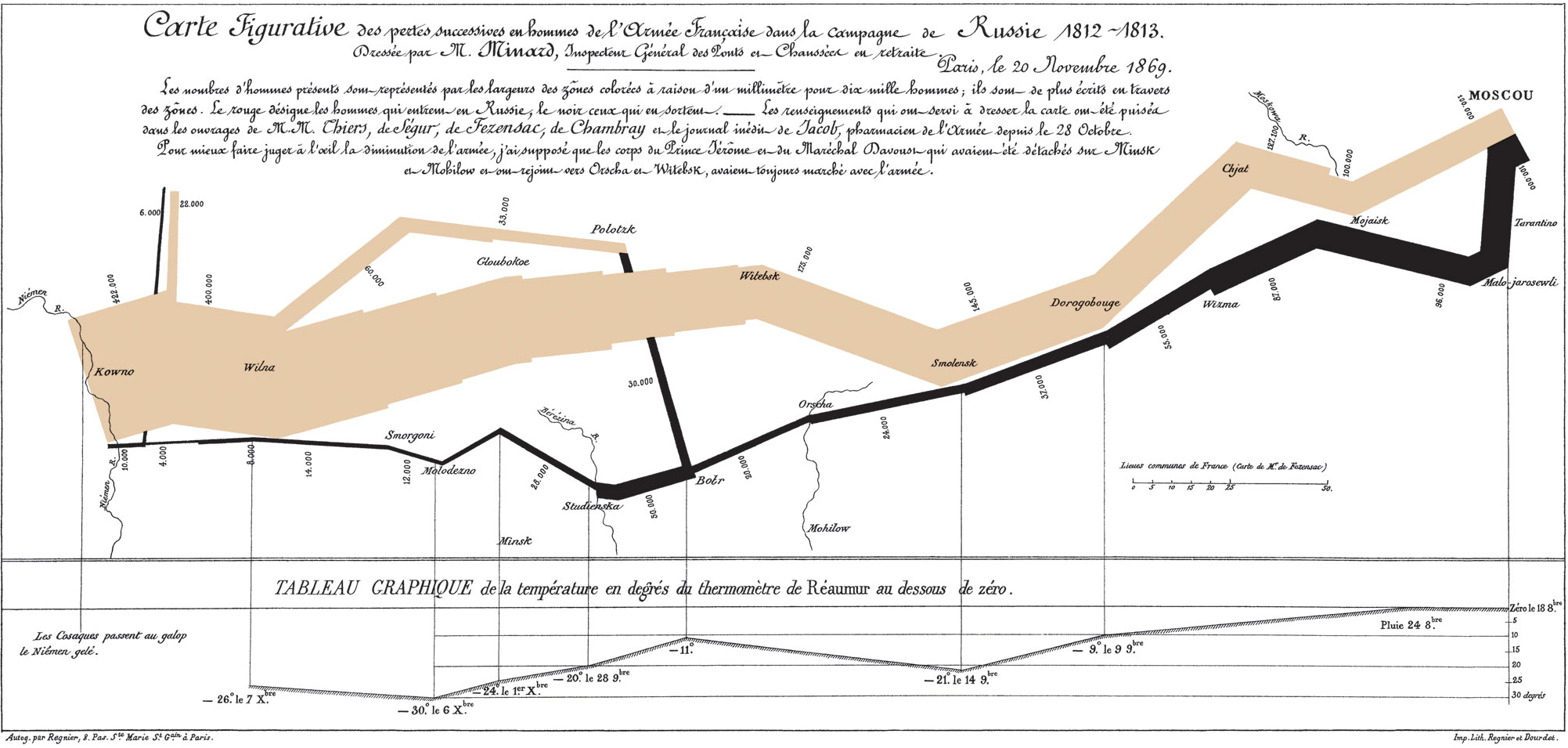
The map’s French caption reads:
Figurative Map of the successive losses in men of the French Army in the Russian campaign 1812-1813.
Drawn up by M. Minard, Inspector General of Bridges and Roads in retirement. Paris, November 20, 1869.
The numbers of men present are represented by the widths of the colored zones at a rate of one millimeter for every ten-thousand men; they are further written across the zones. The red [now brown] designates the men who enter into Russia, the black those who leave it. —— The information which has served to draw up the map has been extracted from the works of M. M. Thiers, of Segur, of Fezensac, of Chambray, and the unpublished diary of Jacob, pharmacist of the army since October 28th. In order to better judge with the eye the diminution of the army, I have assumed that the troops of prince Jerome and of Marshal Davoush who had been detached at Minsk and Moghilev and have rejoined around Orcha and Vitebsk, had always marched with the army.
The scale is shown on the center-right, in “lieues communes de France” (common French league) which is 4,444m (2.75 miles).
The lower portion of the graph is to be read from right to left. It shows the temperature on the army’s return from Russia, in degrees below freezing on the Réaumur scale. (Multiply Réaumur temperatures by 1¼ to get Celsius, e.g. −30°R = −37.5 °C) At Smolensk, the temperature was −21° Réaumur on November 14th.
(Image and translation from Wikimedia)
In National Geographic, Betsy Mason reveals more about the man who created the “best graphic ever produced”:
Charles Joseph Minard’s name is synonymous with an outstanding 1869 graphic depicting the horrific loss of life that Napoleon’s army suffered in 1812 and 1813, during its invasion of Russia and subsequent retreat. The graphic (below), which is often referred to simply as “Napoleon’s March” or “the Minard graphic,” rose to its prominent position in the pantheon of data visualizations largely thanks to praise from one of the field’s modern giants, Edward Tufte. In his 1983 classic text, The Visual Display of Quantitative Information, Tufte declared that Napoleon’s March “may well be the best statistical graphic ever produced.”
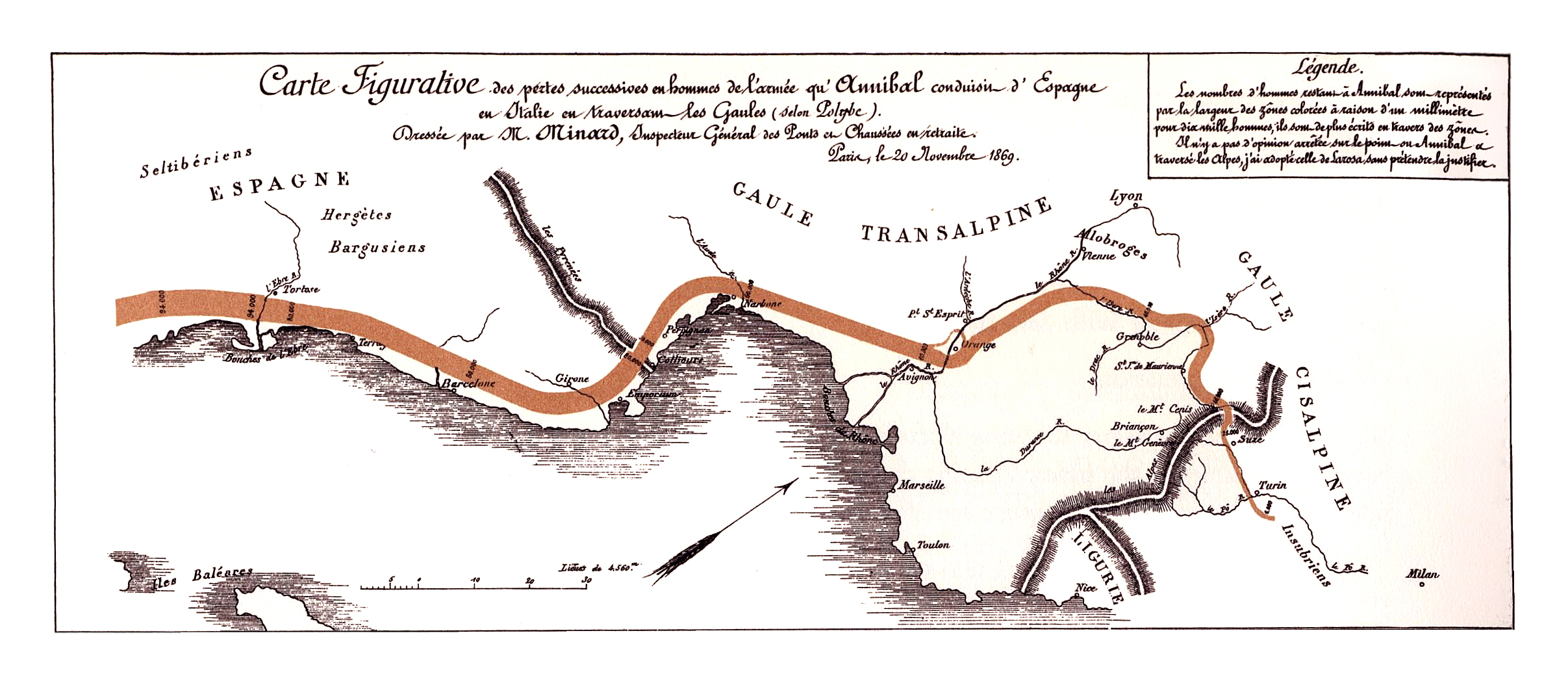
Today Minard is revered in the data-visualization world, commonly mentioned alongside other greats such as John Snow, Florence Nightingale, and William Playfair. But Minard’s legacy has been almost completely dominated by his best-known work. In fact, it may be more accurate to say that Napoleon’s March is his only widely known work. Many fans of the March have likely never even seen the graphic that Minard originally paired it with: a visualization of Hannibal’s famous military campaign in 218 BC, as seen in the image below.
Graphic information of the men losses in the raid of the troops of Hannibal from Spain to Italy (Wikimedia)
On its face, it may not seem remarkable that Minard is remembered for this one piece of work; after all, many people owe their fame to a single great achievement, and the Napoleon graphic is certainly worthy of its reputation. But Minard was most definitely not a one-hit wonder.
Comments Off on Charles Joseph Minard
Tank Chats #6 Vickers Light MKVI B
Published on 5 Jun 2015
The first mass-produced British tank.
Being, in terms of numbers, the most significant British tank at the outbreak of war, the Mark VIB saw service with the British Expeditionary Force in France, the Eighth Army in North Africa and in various subsidiary theatres. As a reconnaissance vehicle it was satisfactory, as a fighting tank quite useless since armour protection was minimal and the armament ineffective against enemy tanks.
Comments Off on Tank Chats #6 Vickers Light MKVI B
QotD: “Healthy” food choices
Whenever I find myself choosing my next meal I always like to look out for the sign that says “healthy option.” In this age of variety and abundance it can often be hugely difficult making up your mind as to what to eat next. “Healthy option” makes things so much easier. It tells me: “Avoid like the plague.”
Good news, then, for takeaway customers in Rochdale, Greater Manchester. No fewer than six local fish and chip shops have taken on board the advice of their local council’s Healthier Choices Manager and introduced special, non-greasy, low-fat menu options. So now when customers find themselves torn between the battered sausage, the chicken nuggets and the “rock salmon” at least they can be sure of what they don’t want: that insipid-looking fillet of steamed cod on a bed of salad, with so few chips they barely even qualify as a garnish.
“It’s too early to say if steamed fish will be a hit,” says an article on the council’s website. And I’ll bet when they know the answer they won’t tell us. That’s because this well-meaning scheme is doomed to flop like a wet kipper. Of course it is. No one in their right mind goes to a takeaway as part of a calorie controlled diet. You do it when you fancy a treat.
And the reason it’s a treat is precisely because that food is so deliciously greasy. As the late Clarissa Dickson-Wright, the generously girthed cook from TV’s Two Fat Ladies, once explained to me, fry-ups, sizzling bacon, battered fish, and so on will always taste nicer than the “healthy option” because fat is a great carrier of flavour.
Clarissa (who was as big an expert on the science of food as she was on cooking and eating it) remained, to the end, a great defender of butter, cream and full-fat milk. She claimed they were much better for you than most of the supposedly healthy, low-fat alternatives. And it turns out she was right. Recent studies have shown that it’s the “trans-fats” in artificial health products like margarine that are the killer, not natural animal fats you find in butter.
What’s more, the evidence increasingly suggests, that it’s sugar not fat which is most responsible for our supposed obesity epidemic. So by trying to stop customers eating fried fish in Rochdale, the council is barking up the wrong tree. It’s the cafes pushing sweet cakes and doughnuts they should be investigating.
James Delingpole, “I prefer my cod in batter, thanks very much”, James Delingpole, 2015-08-15.
April 14, 2017
The Canadian Corps Takes Vimy Ridge – The Battle of Arras I THE GREAT WAR Week 142
Published on 13 Apr 2017
This week 100 years ago, the Western Front comes to live with a big British offensive at Arras. The Canadian Corps and the British 51st Infantry Division take Vimy Ridge which had been contested for 3 years by now. The rest of the battles goes well in the beginning too but due to a snowstorm and the German defences it soon slows down.
Comments Off on The Canadian Corps Takes Vimy Ridge – The Battle of Arras I THE GREAT WAR Week 142
Happy Easter from Scarfolk!
The Scarfolk Council is pleased to present a 1970s solution to a modern problem:

Back in the 1970s, many people complained that the word “Easter” had been dropped from the packaging of chocolate eggs. They also claimed it was only a matter of time before other Christian Easter imagery, such as anthropomorphised cartoon chicks playing with bashful ducks or dungaree-wearing bunny rabbits, received the same treatment.
The Scarfolk Confectionery Company was only too happy to remind consumers of the true biblical events surrounding Easter: Gruesome acts of mutilation and torture, filicide/suicide, crude carpentry and auto-exhumation were all necessary to atone for the original sin that most people agree is historically unfounded, though still blame on one woman’s innocent desire for a healthy snack.
Comments Off on Happy Easter from Scarfolk!
April 13, 2017
“The First World War is the moment when America says, ‘We’re the big dog on the planet'”
In Maclean’s, Allen Abel looks at the US entry into World War 1 a hundred years ago this month, and wonders why it’s so little remembered by Americans today:
Precisely 100 years after U.S. president Woodrow Wilson — “with a profound sense of the solemn and even tragical character of the step I am taking” and with millions of young men of other nations already lying in the graves of Flanders — asked the United States Congress to mobilize a neutral, jazz-happy nation to save Britain, France and little Belgium from obliteration by the German kaiser, there is little in the American capital to remind a visitor of the war to end all wars. There is no sky-piercing obelisk, no haunting roster of the fallen, no sacred shrine to Wilson himself.
As Canada ritually, dutifully, predictably embraces the grimness and glory of Vimy Ridge, the American republic and its new president gird for the inevitable next conflagration — Syria; North Korea — in place of looking backward, weeping, learning.
“The First World War is the moment when America says, ‘We’re the big dog on the planet,'” notes Mark Facknitz of James Madison University, a descendant of three men who fought in the Great War for the U.S., for Germany and, fatally, for Canada, respectively. “Donald Trump keeps saying the same thing,” he goes on, “but it’s no longer true.”
Physically, and allegorically as well, small residue of Wilson’s tragical gambit endures here. Across the Potomac in Arlington, Va., rests the Tomb of the Unknown Soldier. In the city itself, a little Doric temple, 12 columns around, was erected by the District of Columbia in the 1920s to commemorate its fallen sons. There is a soaring “national” monument to the courage of the killed, but it is in Kansas City. To many Americans, the most famous battle of the First World War was Snoopy versus the Red Baron.
[…]
“At the level of the purely mythic Great War battles, nothing in the American experience rivals the Canadians at Vimy, the French at Verdun or the British at the Somme,” Facknitz says. “Our deaths from influenza [60,000] outnumbered our combat dead [50,000] in France in 1918. There was nothing compared to other nations’ Golgothas, nor, for that matter, to the enduring symbolism of Civil War battles like Gettysburg and Antietam, or to the Second World War battles that followed a short generation later—Normandy, the Bulge, Iwo Jima.”
I suspect the biggest lasting influence of American participation in WW1 was actually the political and economic ramifications of both anti-German hysteria (a lot of Schmidts became Smiths and Müllers became Millers to avoid the witch hunt) and the first major nationalizations of industry in the US (which set the stage for FDR’s New Deal during the Great Depression).
Comments Off on “The First World War is the moment when America says, ‘We’re the big dog on the planet'”
QotD: Soviet statistics
Being a correspondent in Moscow, I found, was, in itself, easy enough. The Soviet press was the only source of news; nothing happened or was said until it was reported in the newspapers. So all I had to do was go through the papers, pick out any item that might be interesting to readers of the Guardian, dish it up in a suitable form, get it passed by the censor at the Press Department, and hand it in at the telegraph office for dispatch. One might, if in a conscientious mood, embellish the item a little … sow in a little local colour, blow it up a little, or render it down a little according to the exigencies of the new situation. The original item itself was almost certainly untrue or grotesquely distorted. One’s own deviations, therefore, seemed to matter little, only amounting to further falsifying what was already false.
This bizarre fantasy was very costly and elaborate and earnestly promoted. Something gets published in Pravda; say, that the Soviet Union has a bumper wheat harvest – so many poods per hectare. There is no means of checking; the Press Department men don’t know, and anyone who does is far, far removed from the attentions of foreign journalists. Soviet statistics have always been almost entirely fanciful, though not the less seriously regarded fro that. When the Germans occupied Kiev in the 1939-45 war they got hold of a master Five Year Plan, showing what had really been produced and where. Needless to say, it was quite different from the published figures. This in no way affected credulity about such figures subsequently, as put out in Russia, or even in China.
Malcolm Muggeridge, Chronicles of Wasted Time, 2006.
Comments Off on QotD: Soviet statistics
April 12, 2017
Construction on the A1 near Catterick, North Yorkshire, reveals lost Roman settlement
Rossella Lorenzi reports for Live Science on recent finds during roadwork on the A1 in North Yorkshire:

Excavations at Catterick earlier this year. The features on show are the foundations of ovens and hearths dating to the 4th century. © Historic England
Construction work to upgrade Britain’s longest road into a major highway has revealed a treasure trove of rare artifacts from one of the earliest and wealthiest Roman settlements in the country.
The findings include ancient shoes, cups, a rare silver ring, keys, a high-relief glass bowl and an elaborately carved amber figurine, archaeologists with the public group Historic England announced yesterday (April 6).
Archaeologists uncovered the artifacts in North Yorkshire along the A1, which stretches 410 miles (660 kilometers) from London to Edinburgh, Scotland, during a major project to improve the existing roadway. [See Photos of the Excavation and Roman Artifacts]
“It is fascinating to discover that nearly 2,000 years ago, the Romans were using the A1 route as a major road of strategic importance and using the very latest technological innovations from that period to construct the original road,” Tom Howard, project manager at the government agency Highways England, said in a statement.
[…]
The excavations have also led to the discovery of a major Roman settlement at Scotch Corner, one of the best-known junctions in the country.
Taking its name from an old Roman road called Scots Dyke, Scotch Corner links Scotland with England and the east coast with the west coast.
Right there, the archaeologists with the professional consultant group Northern Archaeological Associates unearthed the remains of a large settlement dating back to A.D. 60, thus predating settlements in York and Carlisle by 10 years.
Comments Off on Construction on the A1 near Catterick, North Yorkshire, reveals lost Roman settlement
April 11, 2017
Evolution of the British Infantry during World War 1 I THE GREAT WAR Special
Published on 10 Apr 2017
The professional British soldier of 1914 had little to do with the British conscript of 1918. So, even though World War 1 is often perceived as something static, the British infantry underwent a considerable evolution during the war.
Comments Off on Evolution of the British Infantry during World War 1 I THE GREAT WAR Special


