
Does the [Republican congressional] caucus nominate a leader who will be itching for more such fights? This would be bad for America’s already dilapidated political institutions and civil society. It would also, I must point out, be bad for the Republican Party, which still shows lingering signs of infection by the dreaded “Ask for the Stars, You’ll Get the Moon” bargaining strategy. (Ever notice that’s so beloved by Hollywood, and by almost no one who actually has to negotiate deals for a living?)
The idea behind this is that you will eventually settle for something about halfway between your initial demands, and what the other side is asking for. The winning strategy is therefore to ask for enormous concessions, include unrealistic demands as bargaining chips, and convince the other side that you’re just crazy enough to walk away if they won’t make a deal.
As it happens, we have just had a demonstration of this technique — a live drama, no Hollywood effects: Greek Prime Minister Alexis Tsipras tried it with the EU. This strategy worked so well that he ended up with a worse deal than the original offer, plus a banking crisis that is still unspooling. Somehow, this never happens in Hollywood movies.
It’s easy to see why Hollywood loves this strategy: It’s really easy to explain without chewing up screen time, and it’s dramatic. Why don’t real-world negotiators more often do this?
Megan McArdle, “Let’s See What Republicans Learn From Losing Boehner”, Bloomberg View, 2015-09-25.
May 1, 2017
QotD: How to negotiate badly (unless you’re in a movie)
April 30, 2017
Fight For Air Supremacy – Bloody April 1917 I THE GREAT WAR Special feat. Real Engineering
Published on 29 Apr 2017
Check out Real Engineering and their video about WW1 airplanes: https://www.youtube.com/watch?v=MI08NGCgISE
Meet us and see original WW1 airplanes: http://bit.ly/TGWStowMaries
“Bloody April” was the result of two competing aviation strategies: The more defence oriented German Luftstreitkräfte and the more offensive oriented British Royal Flying Corps. The RFC needed air reconnaissance for the Battle of Arras and the Germans needed to deny them them. With the superior German Albatross D.III fighters, the German Jagdstaffeln inflicted heavy losses on the RFC.
QotD: Famous for being famous
Every country that has television, which is all of them, must have celebrities who are famous for almost nothing. The U.K. practically specializes in this. But the “almost” is important. Even the weird layer of U.K. celebrity that subsists on the old country’s old-fashioned panel and reality shows normally tends to demand that a celeb have been a member of Parliament or received a surgically enhanced bosom. If possible, both.
Colby Cosh, “On the ignominious downfall of Jared from Subway”, National Post, 2015-08-20.
April 29, 2017
If Walls Could Talk The History of the Home Episode 4: The Kitchen
Published on 2 Feb 2017
April 28, 2017
The Battle of Doiran – Turmoil In The French Army I THE GREAT WAR Week 144
Published on 27 Apr 2017
The Salonica Front had been quiet over the winter, but much like the recent battles on the Western Front, it erupted this week. The British Army tried to take the Bulgarian positions at Doiran – these positions might have been some of the best defences of the entire war. After the failed Nivelle Offensive, some French soldiers start to question the whole war.
April 27, 2017
Jack Dee’s Encounter with an ex-SAS Officer – Live at the Apollo – BBC
Uploaded on 7 Mar 2008
British comedian Jack Dee explains why you should never surprise an ex-SAS officer in a pub.
April 25, 2017
German Trade Submarines – Beutepanzer Upgrades – Dan Carlin I OUT OF THE TRENCHES
Published on 24 Apr 2017
Check out Dan Carlin’s Podcast about WW1: http://bit.ly/DanCarlinArmageddon
It’s Chair of Wisdom Time again and this week we talk about German Trade Submarines (Deutschland class), Beutepanzer upgrades and Dan Carlin’s Blueprint for Armageddon series.
April 24, 2017
April 23, 2017
The Real Reason We Never Hear From Monty Python Anymore
Published on 20 Apr 2017
The legendary comedy group Monty Python was once a force of nature, influencing everything that came after them with their surreal, absurdist approach to comedy. So, why don’t we hear from them anymore? When Graham Chapman ceased to be in 1989, fellow Python member Terry Jones described it as “the worst case of party-pooping [he’d] ever seen.” His death came the day before Python’s 20th anniversary, and what followed was a bizarre but fitting eulogy, written to pay tribute to the man who’d written a dead parrot into one of the troupe’s most famous sketches. Chapman becoming an ex-person seemed to put a damper on any kind of authentic reunion, but what about the others? What happened to the late, great Monty Python?
Terry Jones’s illness | 0:44
Michael Palin’s travel shows | 1:54
John Cleese’s purism | 3:01
Terry Gilliam’s moved on | 4:13
Eric Idle’s Broadway ambitions | 5:06
They want to finish on a good note | 6:02Read more here → http://www.grunge.com/53323/never-hear-monty-python-anymore-2/
April 22, 2017
Flamethrower Units – Handling of Prisoners – Artillery Fuses I OUT OF THE TRENCHES
Published on 22 Apr 2017
In this week’s episode, Indy talks about flamethrower units, the handling of war prisoners and different types of artillery fuses.
Tank Chats #7 British Mark II
Published on 2 Jul 2015
The seventh in a series of short films about some of the vehicles in our collection presented by The Tank Museum’s historian David Fletcher MBE.
Only fifty tanks each of Marks II and III were produced. They were unarmoured, in the sense that the steel from which they were built was not heat treated to make it bullet proof. The reason being that these tanks were only intended for use as training machines.
The chief external differences from Mark I lay in the tail wheels, which were not used on Marks II and III and later heavy tanks, the narrower driver’s cab and the ‘trapezoid’ hatch cover on the roof.
April 21, 2017
The Nivelle Offensive – Carnage At The Chemin Des Dames I THE GREAT WAR Week 143
Published on 20 Apr 2017
French Commander Robert Nivelle was sure that his offensive would bring the final victory against Germany. He scaled up his successful plan from Verdun which had worked so well and even when other generals questioned the very idea of the offensive, he would refuse to alter it or call it off. The Germans knew that the French were coming and were well prepared. And so the disaster at the Chemin Des Dames unfolded.
April 20, 2017
We now know that there are more than 30,000 registered gun owners in London
What’s disturbing about the knowledge is that London’s Metropolitan Police revealed that information to a private company and may have violated British privacy laws in the process:
London gun owners are asking questions of the Metropolitan Police after the force seemingly handed the addresses of 30,000 firearm and shotgun owners to a direct mail marketing agency for a commercial firm’s advertising campaign.
The first any of the affected people knew about the blunder was when the leaflet (pictured below) landed on their doormats in Tuesday’s post.
Titled “Protect your firearms and shotguns with Smartwater”, the leaflet – which features Met Police logos – advises firearm and shotgun certificate holders to “buy a firearms protection pack at a reduced price” of £8.95.
Smartwater is basically invisible ink. You mark your property using it and if you are burgled, police can use a UV light reader to see who rightfully owns stolen items. The company behind it was formed by an ex-police detective and his industrial chemist brother, and the firm has since forged very close links with a number of UK police forces. Its website boasts of the “traceable liquid’s” crime-reducing properties, something that police actively endorse.
[…]
The front and reverse of the Metropolitan Police Smartwater firearms leaflet
Questions were immediately raised as to whether the Met had broken the law. The data protection statement that both police and certificate holders agree to is found in Firearms Form 201 (PDF), the application form for a firearm certificate. It says:
I understand that all information submitted will be handled in accordance with the Data Protection Act 1998 and the Freedom of Information Act 2000 and connected legislation. I understand and give consent for information contained within my application form or obtained in the course of deciding the application to be shared with: my GP, other government departments, regulatory bodies or enforcement agencies in the course of either deciding the application or in pursuance of maintaining public safety or the peace.
Note: Any information shared will be shared in accordance with data sharing protocols. We do not share your personal or company details with other applicants or members of the public and treat information in connection with the application in confidence, but individuals should be aware that we may be required to disclose some information in accordance with the legislation referred to above.
The Register has made the Information Commissioner’s Office aware of the breach and is awaiting a statement from the data watchdog.

April 19, 2017
Voting against “Father Turk”‘s legacy
The secular Turkish Republic is fading fast, as the results of the Turkish referendum amount to a concentration of vast powers in the hands of Recep Tayyip Erdoğan. We sometimes joke that Vladimir Putin is the new Tsar, but it’s less funny to refer to Erdoğan as the new Sultan … because it’s much closer to being true:
On Jan. 20, 1921, the Turkish Grand National Assembly passed the Teşkilât-ı Esasîye Kanunu, or the Law on Fundamental Organization. It would be almost three years until Mustafa Kemal — known more commonly as Ataturk, or “Father Turk” — proclaimed the Republic of Turkey, but the legislation was a critical marker of the new order taking shape in Anatolia.
The new country called Turkey, quite unlike the Ottoman Empire, was structured along modern lines. It was to be administered by executive and legislative branches, as well as a Council of Ministers composed of elected representatives of the parliament. What had once been the authority of the sultan, who ruled alone with political and ecclesiastic legitimacy, was placed in the hands of legislators who represented the sovereignty of the people.
More than any other reform, the Law on Fundamental Organization represented a path from dynastic rule to the modern era. And it was this change that was at stake in Turkey’s referendum over the weekend. Much of the attention on Sunday’s vote was focused on the fact that it was a referendum on the power of the Turkish presidency and the polarizing politician who occupies that office, Recep Tayyip Erdogan. Yet it was actually much more.
Whether they understood it or not, when Turks voted “Yes”, they were registering their opposition to the Teşkilât-ı Esasîye Kanunu and the version of modernity that Ataturk imagined and represented. Though the opposition is still disputing the final vote tallies, the Turkish public seems to have given Erdogan and the AKP license to reorganize the Turkish state and in the process raze the values on which it was built. Even if they are demoralized in their defeat, Erdogan’s project will arouse significant resistance among the various “No” camps. The predictable result will be the continuation of the purge that has been going on since even before last July’s failed coup including more arrests and the additional delegitimization of Erdogan’s parliamentary opposition. All of this will further destabilize Turkish politics.
[…]
The AKP and supporters of the “yes” vote argue that the criticism of the constitutional amendments was unfair. They point out that the changes do not undermine a popularly elected parliament and president as well as an independent (at least formally) judiciary. This is all true, but it is also an exceedingly narrow description of the political system that Erdogan envisions. Rather, the powers that would be afforded to the executive presidency are vast, including the ability to appoint judges without input from parliament, issue decrees with the force of law, and dissolve parliament. The president would also have the sole prerogative over all senior appointments in the bureaucracy and exercise exclusive control of the armed forces. The amendments obviate the need for the post of prime minister, which would be abolished. The Grand National Assembly does retain some oversight and legislative powers, but if the president and the majority are from the same political party, the power of the presidency will be unconstrained. With massive imbalances and virtually no checks on the head of state, who will now also be the head of government, the constitutional amendments render the Law on Fundamental Organization and all subsequent efforts to emulate the organizational principles of a modern state moot. It turns out that Erdogan, who would wield power not vested in Turkish leaders since the sultans, is actually a neo-Ottoman.
Mark Steyn says “I told you so”:
As they used to say way back when in the long Ottoman twilight, the Turk is the sick man of Europe. Following this weekend’s Caliph-for-Life referendum, the Turk is sicker than ever. But he’s no longer of Europe, and instead is exiting for a destination dark and catastrophic for almost all his neighbors.
Sultan Erdoğan – who, a mere 15 years ago, was banned from holding political office – has now succeeded in dismantling almost every defining element of the Kemalist republic. What replaces it will be a crude strongman state in service of Islamic imperialism. I have read a lot of commentary this morning, starting with Douglas Murray’s “Turkish Democracy Has Just Died” and moving on to Yavuz Baydar’s “The End Of Turkey As We Know It” via Alex Alexiev’s “Who Lost Turkey?” And several readers have been kind enough to inquire where’s my own “Who Lost Turkey?” piece. Well, the truth is I published it exactly ten years ago, to the day of Erdoğan’s referendum. From the April 16th 2007 edition of National Review, “De-Boning Turkey“:
The modern secular Muslim state – a country that gave women the vote before Britain did and was Israel’s best friend in an otherwise hostile region – certainly, that Turkey seems to be being de-boned by the hour: it now has an Islamist government whose Prime Minister has canceled trade deals with Israel, denounced the Iraqi elections, and frosted out the US Ambassador because he was Jewish; a new edition of Mein Kampf is prominently displayed at the airport bookstore. In other words, the Zionist Entity’s best pal is starting to look like just another cookie-cutter death-to-the-Great-Satan stan-of-the-month.
In fairness to the new Caliph, ever since he emerged from his semi-pro footballing career to run for Mayor of Istanbul, he’s played a more cunning game than the stan-of-the-month loons. As he said in one of his most famous soundbites, democracy is a bus you ride to the stop you want – and then you get off. And he was quite happy to take the scenic route, stop by stop by stop. In the two or three years after he came to power, I was assured that he was a “moderate Islamist” not merely by the all the foreign-policy think-tank “experts” but even by his political rivals in the previous Kemalist government. […]
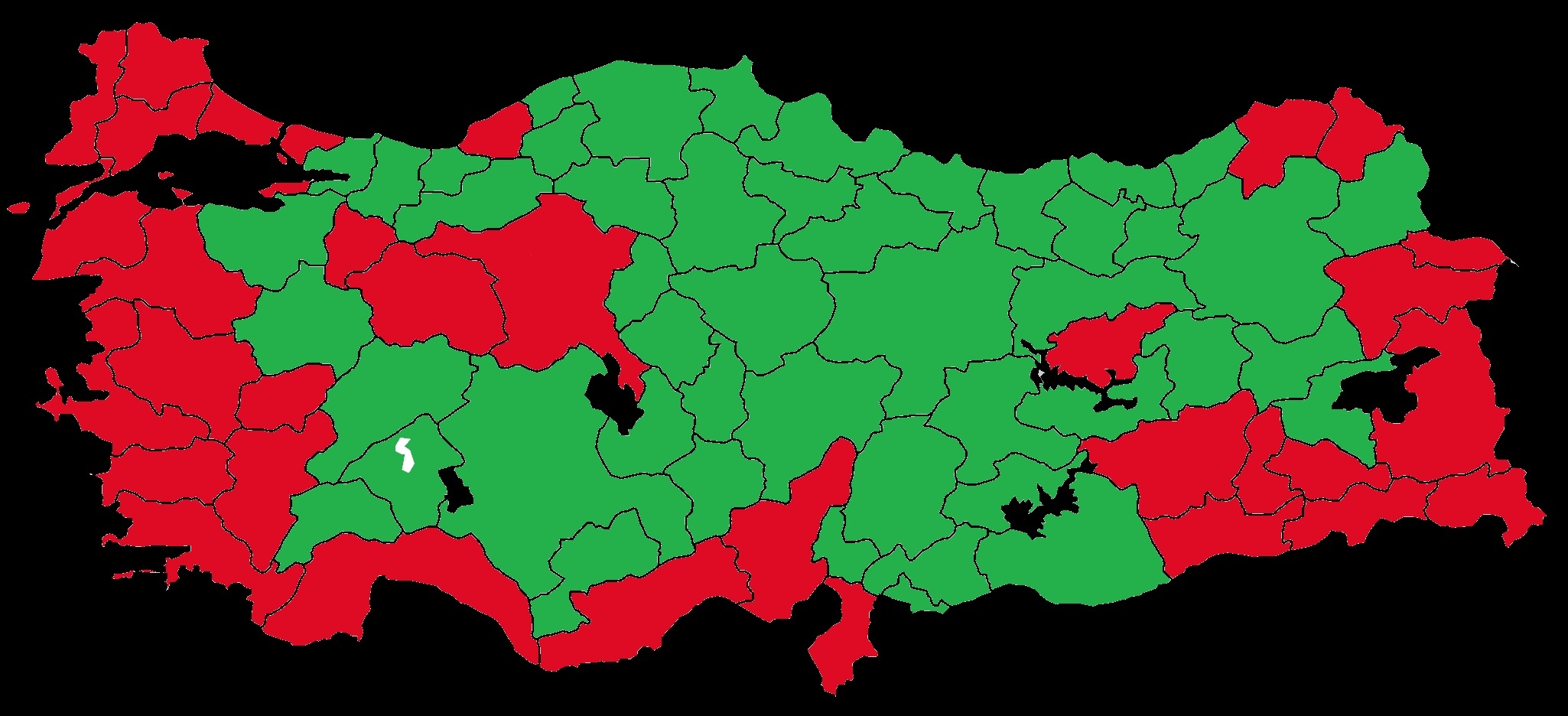
Here’s a third graphic – yesterday’s referendum results. The Kurdish south-east, the old secular Rumelian west – and in between the vast green carpet of a new post-Kemalist caliphate:
Turkish referendum results, “yes” voting areas in green, “no” in red.
Overlay the fertility rates on the electoral results: demography proved destiny. As you’ll recall, Kemal Atatürk was born Mustafa Kemal. The new moniker was a title bestowed on him by the post-Ottoman parliament. Atatürk means “Father of the Turks”. Alas, he wasn’t father of enough of them. And the men who were had other ideas about Turkey’s future. We’ve all met charming, urbane, witty, secular Turks. I worked with one recently, and enjoyed his company immensely. But on that ever expanding big green Islamic carpet from east to west there’s no place for them.
QotD: Hubris and Nemesis, or pride goeth before the fall
Few things are more likely to precede defeat than the conviction that you are on the verge of victory. One hundred years ago, in the spring of 1917, Germany had every reason to believe that it would triumph over its enemies in the First World War. France had been bled white in repeated attacks on the German army’s fortified lines, England was suffering from shortages of both munitions and military manpower, and Russia was descending into a revolution that would, within a year, enable Germany and its Austro-Hungarian allies to shift enormous numbers of troops and guns to the Western Front. Yet the entry of the United States into the war on April 6, 1917, proved to be the counterweight that shifted the balance. By the autumn of 1918, the fond hope of Germany victory had been exposed as a delusion. The ultimate result of the Kaiser’s war was the destruction of the Kaiser’s empire, and of much else besides.
What is true in war is true also in politics. Hubris is nearly always the precedent to unexpected defeat. In 1964, Lyndon Johnson won a landslide victory; less than four years later, LBJ could not even win his own party’s nomination for re-election. In 1972, Richard Nixon was re-elected in a landslide; less than two years later, he was forced to resign from office. More recently, after George W. Bush’s 2004 re-election, some imagined that this victory was the harbinger of a “permanent Republican majority” — a GOP electoral hegemony based on a so-called “center-right” realignment — but two years later, Democrats captured control of Congress and in 2008 Barack Obama was elected president. Obama’s success in turn led Democrats to become overconfident, and Hillary Clinton’s supporters believed they were “on the right side of history,” as rock singer Bruce Springsteen told a rally in Philadelphia on the eve of the 2016 election. Unfortunately for Democrats, history disagreed.
Robert Stacy McCain, “Why Is the ‘Right Side of History’ Losing?”, The American Spectator, 2017-04-05.


