
Published on 28 Mar 2017
The Spanish Civil War (1936-1939) was probably the most significant war between the First and the Second World War. [M]any important lessons were learned and NOT learned by the British, French, US, German, Italian and Soviet Forces.
Military History Visualized provides a series of short narrative and visual presentations like documentaries based on academic literature or sometimes primary sources. Videos are intended as introduction to military history, but also contain a lot of details for history buffs. Since the aim is to keep the episodes short and comprehensive some details are often cut.
May 8, 2017
Spanish Civil War – Lessons NOT Learned – The British, French & US
Comments Off on Spanish Civil War – Lessons NOT Learned – The British, French & US
May 7, 2017
Joffre The Imbecile – Nivelle’s Catastrophe I OUT OF THE ETHER
Published on 6 May 2017
It’s time to shine a light on some of the great comments we received and in the past days you guys had a lot to say about Nivelle and the French High Command in general.
Comments Off on Joffre The Imbecile – Nivelle’s Catastrophe I OUT OF THE ETHER
May 6, 2017
Marine Le Pen versus Emmanuel Macron
Megan McArdle is in France this week and watched the televised debate between Le Pen and Macron on Wednesday. She found some interesting parallels between it and the US presidential debates, but some significant differences, too:
Watching last night’s presidential debate here in France, I found it hard not to think about our own presidential debates in the U.S., lo these many months ago. In many ways, it was the same: the populist upstart against the center-left representative of the establishment, the status quo against the YOLO, the woman against the man. In other ways, it was very different — which is why, according to almost everyone, Emmanuel Macron is going to be elected president next week, and Marine Le Pen will not.
Macron, like Hillary Clinton, is the candidate of “more of the same, but with, you know, more of the same.” His contempt for Le Pen was obvious, and if this were an American debate, would have hurt him. My French is good enough to read a newspaper (very slowly) and to sort of follow the debate as long as no one else was talking. So as I watched, I paid attention to tone and body language as much as content.
[…]
Le Pen, like Trump, is basically the candidate of “things were better 40 years ago, so let’s go back there.” And it’s easy to understand why that’s appealing for a lot of voters in both France and America. The problem is, even if it were desirable to migrate en masse back to the mid-20th century, no one knows how to do it. France may be struggling to integrate its immigrants, but they are here, and cannot simply be removed the way one might get rid of a piece of furniture that clashes with the rest of the décor. Trade may have resulted in painful deindustrialization, but de-industrialization is a one-way street, and pulling out of those trade relationships will not bring back the lost factories. The euro may have been a very bad idea — no, strike that, the euro was a very bad idea, probably the worst one France has had since “let’s get into a land war in Southeast Asia” — but leaving the euro is not the same as having never adopted it. In the short term, at least, it would be catastrophically messy.
To this, Le Pen’s supporters might reply “but at least we could stop making things worse.” But even if you hold out more hope for her agenda than I do, the fact remains that if you reject the status quo in favor of radical change, you necessarily raise the risk that things will get much worse. We know approximately what the status quo looks like. Radical action means launching off into the dark. Which is why radical candidates inevitably seem less prepared, knowledgeable and plausible than their mainstream opponents.
That said, compared to Donald Trump, Marine Le Pen sounds like a wonk’s wonk. Nor does she have his propensity to lose his cool. Watching the French debate, I was struck by a repeated thought: if Clinton had had Le Pen’s speaking ability, she would be president now. During the campaign, and after, Clinton’s supporters frequently complained that Clinton was being penalized for being an older woman. But Le Pen is living proof that middle-aged ladies can be effective politicians. I don’t like her agenda, and I really don’t like her party. But looking strictly at effectiveness on the stump, she’s pretty good.
Comments Off on Marine Le Pen versus Emmanuel Macron
History of the Royal Navy – Steam, steel and Dreadnoughts (1806-1918)
Published on 1 Mar 2013
Here’s also an older post covering the technological challenges faced by the Royal Navy in the post-Napoleonic era, and some of the reasons for all those “weird” ship designs in the Victorian era.
Comments Off on History of the Royal Navy – Steam, steel and Dreadnoughts (1806-1918)
May 5, 2017
HRH The Duke of Edinburgh calls it a career
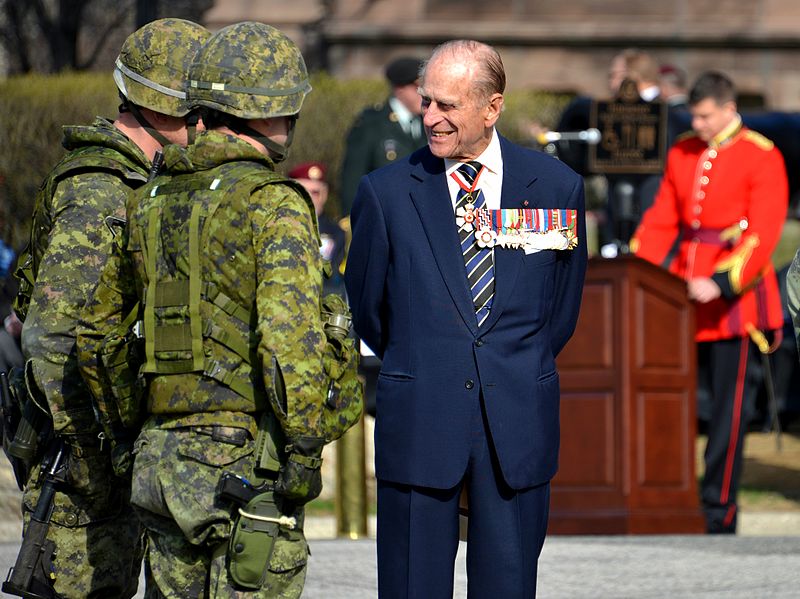
HRH Prince Philip, the Duke of Edinburgh, Colonel-in-Chief of the Royal Canadian Regiment, presenting the 3rd Battalion with their Regimental Colours, 17 April 2013. (via Wikipedia)
Mark Steyn on the announcement yesterday that His Royal Highness will be retiring from public appearances this fall:
Buckingham Palace announced today that the Duke of Edinburgh will retire from Royal engagements this autumn. He’ll be 96 next month, which is a quarter-century past the average retirement age – or four decades past it, if you’re a French or Greek civil servant.
His Royal Highness is the Queen’s consort. That’s an ill-defined role prone to an accumulation of frustrations: for Americans, think First Lady or Vice President for life. A lot of consorts are unpopular with their spouse’s subjects (for example, Queen Rania, Jordan’s current Hashemite hottie). Prince Philip has been doing it longer than anyone in the history of the Royal Family, since the day in 1952 when he and Princess Elizabeth were at Treetops in Kenya and received the news that George VI (the King’s Speech guy) had died. Harry Truman was in the White House; Stalin was in the Kremlin; some guy called Mao had just taken over in China. That’s a long time.
I last saw him five years ago in Glasgow with my daughter, who was impressed by how cool he was, and how spry for a nonagenarian. Elsewhere, opinions differ. He’s worshiped as a god in outlying parts of Vanuatu, but in Canberra the ruling Liberal Party went bananas and ended Tony Abbott’s premiership for giving the guy an Australian knighthood. Still and all, he’s kept the show on the road in an age hostile to the monarchical principle, and one which has seen the crowns of almost all his cousins come tumbling throughout Europe.
Steyn also recounts discussing the respective Australian and Canadian constitutions with Prince Philip during the Australian referendum on becoming a republic:
As a Canadian, I was somewhat distracted by the referendum Down Under, which I kept trying to slip into the conversation. But the Duke was inscrutable on that front – or perhaps, as I now think of it, quietly confident about victory. Toward the end, as he walked us to the door before my carriage turned back into a pumpkin, I made an offhand remark contrasting the 1901 Aussie constitution with the 1867 Canadian one, and the subject evidently engaged him, because he launched into a very well informed disquisition on the differences between the two. There were a half-dozen or so of us at dinner that night – an earl, a viscount, a baron, a knight, etc, plus a plain old mister (me). I’d assumed upon acceptance of my invitation that we guests would be there as unpaid jesters to amuse our Royal hosts. But, in fact, HRH was a quickwitted chap, and we were hard put to keep up with him.
One of my fellow diners, bemoaning the lack of agricultural workers in Britain, explained that his farm now brought in young Australians and South Africans, who were able to make ninety-to-a-hundred quid a day (about £60,000 a year) picking onions.
“Crying all the way to the bank?” said the Duke.
I thought that was a rather good line. Happy retirement.
Comments Off on HRH The Duke of Edinburgh calls it a career
The Battle of Arleux – Robert Nivelle Gets Fired I THE GREAT WAR Week 145
Published on 4 May 2017
The Battle of Arras continued in smaller scale attacks this week 100 years ago. Fighting focused on Arleux and the Scarpe river. Neither of these battles was able to repeat the success of the early Arras offensive. The casualties of the Nivelle Offensive were now costing Robert Nivelle his job as he was still blaming everyone but himself.
Comments Off on The Battle of Arleux – Robert Nivelle Gets Fired I THE GREAT WAR Week 145
Back from the brink of extinction … the Scottish Tory
In The Spectator, Alex Massie discusses one of the most unexpected political revivals of this century:
Twenty years ago, Conservatism all but died in Scotland. Tony Blair’s landslide victory made Scotland, at least in terms of its Westminster representation, a Tory-free zone. At no point since has the party won more than a single Scottish seat, and the last time the party won more than a quarter of the Scottish vote, in 1983, its current leader, Ruth Davidson, was four years old. Two years ago, the Tories won just 14 per cent of the vote, an even worse result than 1997. This seemed to fit a broader narrative: Toryism had been beaten back into England, a sign of the union’s exhaustion and a Scotland moving inexorably towards independence.
How different it all looks now. The most recent opinion polls in Scotland suggest the Tories could win as many as one in three ballots cast on 8 June. One opinion poll even suggested that, albeit on a uniform swing, the party could win as many as a dozen Scottish seats — including Moray, seat of the SNP’s Westminster leader Angus Robertson. In an era where elections are delivering extra-ordinary results, one might just be a stronger union and a strange rebirth of Scottish Conservatism.
Massie credits the leader of Scotland’s Conservatives for much of the turnaround:
Just as it remains hard to imagine how the SNP could have risen to its current state of supremacy without Alex Salmond, so it is difficult to underestimate Ruth Davidson’s importance to the Scottish Tory revival. Her personal background — working-class, lesbian, BBC journalist — is often used to explain her ability to reach a wider audience than previous Tory leaders, but there is more to it than that. Viewed from one angle, she is every inch the modernising Tory — her influence played a large part in persuading Theresa May to maintain the commitment to spending 0.7 per cent of GDP on international aid. But seen from a different perspective, she is also a traditional Conservative: a god-fearing Christian and former army reservist. She believes in gay marriage because she is a Conservative, not despite it.
Most of all, she offers an alternative to SNP orthodoxy. Sturgeon warns that only a vote for the SNP can ‘protect’ Scotland against an ‘unfettered’ Tory govern-ment whose values are alien and inimical to those of Scotland. Davidson observes that ‘the SNP is not Scotland’. Unionists are Scots too. Labour, not so long ago the party of Scotland, might even finish fourth in this election, at least in terms of seats won. If Ian Murray retains Edinburgh South, he will be Scotland’s only red panda.
Political anthropologists are already asking why the Scottish Tory party, previously thought close to extinction, has made such a remarkable recovery. For more than a generation on the left, the idea of the Tories being an invasive species in Scotland has been the foundation of first Labour and then SNP politics — but it no longer holds. If at least one in four Scots are prepared to endorse Tory candidates, can one really maintain the fiction there is something grubbily disreputable or even unpatriotic about voting for a Conservative candidate?
H/T to Colby Cosh for the link.
Comments Off on Back from the brink of extinction … the Scottish Tory
QotD: The British Army before WW1
When the Duke of Wellington described the British army as “the scum of the earth, enlisted for drink,” he was probably speaking no more than the truth. But what is significant is that his opinion would have been echoed by any non-military Englishman for nearly a hundred years subsequently.
The French Revolution and the new conception of “national” war changed the character of most Continental armies, but England was in the exceptional position of being immune from invasion and of being governed during most of the nineteenth century by non-military bourgeoisie. Consequently its army remained, as before, a small profession force more or less cut off from the rest of the nation. The war-scare of the [eighteen-]sixties produced the Volunteers, later to develop into the Territorials, but it was not till a few years before the Great War that there was serious talk of universal service. Until the late nineteenth century the total number of white troops, even in war-time never reached a quarter of a million men, and it is probable that every great British land battle between Blenheim and Loos was fought mainly by foreign soldiers.
George Orwell, “Democracy in the British Army”, Left, 1939-09.
Comments Off on QotD: The British Army before WW1
May 4, 2017
Marine Le Pen may win or lose on May 7th, but the voters she represents will not go away
Bill Wirtz on the long-term trends that may or may not be represented in the voting for the second round of voting in the French presidential elections:
After the first round of voting last Sunday, the French electorate decided to send independent candidate Emmanuel Macron (23.8 percent) and far-right nationalist Marine Le Pen (21.6 percent) to the next round of voting on May 7th.
Opponents of Le Pen’s radical policies are now calling for a gathering of the so-called “Front Républicain,” the Republican Front.
Inspired by the name of Le Pen’s National Front, the Republican Front gathers those who reject the rampant nationalist positions of the French far-right, which they consider contrary to the “Republican spirit.”
While not an established party in itself, the Republican Front represents a coalition of different parties in the République against a particularly unpopular candidate like Marine Le Pen. […]
For many French voters, the second round is an ideological dilemma. If for instance, the candidate they were supporting fails to progress to the next round, they may be more or less forced to throw their support behind a candidate with whom they have severe disagreements.
Now, the country’s political role models and media personalities expect the electorate to cast a “vote utile,” the “useful vote,” preventing Le Pen from coming to power. And ultimately that is exactly what will happen.
Both candidates will get involved in heated debates but in the end, the gathering of the Republic Front, with all mainstream parties rallying behind Macron in order to avoid Le Pen, will prevent the French nationalist from taking the Elysée Palace.
And yet, the consequences of this policy might be dangerously ill-advised.
Comments Off on Marine Le Pen may win or lose on May 7th, but the voters she represents will not go away
Ici Londres: Do Theresa May’s opponents seriously prefer Juncker?
Published on 3 May 2017
Comments Off on Ici Londres: Do Theresa May’s opponents seriously prefer Juncker?
May 3, 2017
QotD: “Patrick Macnee was a Serious Feminist”
Patrick Macnee
- Refused to model Steed after James Bond because Bond “uses women like battering rams”
- Embraced the concept of a female partner after being cast opposite a male one for a season
- Listened when Honor Blackman began telling him about gender inequality
- Didn’t think that being saved by a woman in any way injured his character’s masculinity
- Consistently gave the women credit for the success of the show
- Recognized that the male producers were chauvinists, and blamed himself for not doing more about it
- Stood up for Linda Thorson when the producers tried to bully her (and was apparently terrifyingly angry about it)
- Was literally the only person on that show that Diana Rigg never said a bad word about
- Consistently talked about being raised by women and viewing women as equal to men
Lauren H. Brooks, “Patrick Macnee was a Serious Feminist”, Kinkiness … and Patrick Mcnee, 2017-04-21.
Comments Off on QotD: “Patrick Macnee was a Serious Feminist”
May 2, 2017
Britain’s “foregone conclusion” election
Colby Cosh provides a thumbnail sketch of how Britain got to the point of having an election where the end result is not in great doubt, and the likely losers and big losers:
[British PM Theresa May] has now broken that promise [to serve the full term her party won in 2015], unapologetically. Any half-sane politician’s instinct would tell her that this is an incredibly dangerous thing to have done, and we all know that voters generally loathe unnecessary election activity, or that they pretend to. But the current polls suggest that the British public completely understands why she broke the promise, that they approve of her breaking it, and that they intend to reward her for it. If you follow the UK election as a Canadian, you will hear May talking about “strong and stable” government at about 200 RPM, in exactly the same way Stephen Harper used to. This is no coincidence.
The Labour Party is torn between the old-fashioned socialist militants who made Jeremy Corbyn leader and the respectable corporate types who actually run the party and serve in the House of Commons. The UK has legislation requiring fixed-term parliaments, so May needed the support of Labour in a Commons vote in order to hold an early election. A Parliament can still be dismissed early if there is a vote of no confidence in the government, or if two-thirds of MPs vote to allow it.
Which they did. Corbyn loyalists, uncertain whether their man could survive as leader until 2020, had little reason not to consent to the snap vote. Labourite Corbyn-haters, seeing a chance to dispose of their village-Marxist boss without the dangers of a party coup, went along too. They almost seem to be half-throwing the election, relieved to have some prospect of Labour returning to power before 2025.
Meanwhile, the Scottish National Party, seemingly in firm control of Scottish politics and culture, made the Quebec mistake of talking about another independence referendum too soon after losing one. It is a classic shark jump. The people of Scotland seem to have realized that within Scotland, the UK general election will be a referendum on whether they want another divisive, stressful independence struggle right away.
This is not looking like good news for the strident but useless SNP delegation to Westminster. Polls show the Conservatives running a strong second in Scotland, with a chance of taking ten or so seats away from the Nats. Four years ago, I would have fully expected to be typing “Jesus Christ just held a press conference in Clackmannanshire” before I typed the words in that last sentence.
Comments Off on Britain’s “foregone conclusion” election
Reinventing Cavalry in WW1 – Bulgarian General Ivan Kolev I WHO DID WHAT IN WW1?
Published on 1 May 2017
Cavalry was seen as leftover from the past in the dawn of modern warfare during World War 1. But Bulgarian General Ivan Kolev was one of the few who still saw a place for them on the modern battlefield. He reinvented the cavalry role and used them together with early motorised infantry – with great success during the Romanian campaign. He died before the war was over but people like August von Mackensen or Heinz Guderian were still impressed with his legacy.
Comments Off on Reinventing Cavalry in WW1 – Bulgarian General Ivan Kolev I WHO DID WHAT IN WW1?
Tank Chats #8 Renault FT-17
Published on 4 Aug 2015
The eight in a series of short films about some of the vehicles in our collection presented by The Tank Museum’s historian David Fletcher MBE.
Conceived by General Jean-Baptiste Estienne and manufactured under the control of the Renault Company this was the world’s first mass-produced tank, 3800 being built in all.
They went into action for the first time on 31 May 1918 near Ploissy-Chazelle and proved very successful when they were used in numbers. British forces used a few Renaults as liaison vehicles while the United States Army used them in combat and copied the design.
Comments Off on Tank Chats #8 Renault FT-17
May 1, 2017
“We can leave aside the idea of a libertarian revival. No one in or near government wants less control by the State”
Sean Gabb reflects on the coming British general election (where he’s decided to hold his nose and vote Conservative, despite his strong distaste for Theresa May’s governing style and the party itself):
… we are entering an age of rapid ideological change. Questions of whether we should have identity cards, or if the authorities should be able to censor the media, are becoming less important than the questions of who makes these decisions, and how they are made. There is not – and probably, in my lifetime, never has been – a libertarian option in British politics. The choice has always been so far which elements of a broadly leftist-authoritarian agenda should be pushed hardest. The choice now is between a Conservative Government that has no electoral interest in leftism, and limited inclination to uphold its hegemony, and various parties that will try to keep that hegemony going till it fully shrivels away. The Conservative Party is an organisation of frauds and liars. Its directors are in the pocket of any interest group with money to spend. Though split on exactly what it believes, however, Labour is a party of true believers. The Conservatives will do evil by inertia, Labour by choice. Without hope of immediate improvement, I will vote Conservative.
Give her a decent majority, and Theresa May will take us out of the European Union on acceptable terms. These terms will be available almost for the asking. The European Union is little more than the agent of twenty seven governments, all with conflicting interests. The British Government will have a fresh mandate to act on behalf of a unitary state. Mrs May is no fool, and she must understand that her hold on power and her place in the history books are both contingent on how she manages our disengagement. Her lack of principle is beside the point – or may be an advantage.
And then?
We can leave aside the idea of a libertarian revival. No one in or near government wants less control by the State. Hardly any of the electors want it. This is probably for the best. I have been an insider on the British free market movement for about forty years. Those who run it are willing to nod approvingly whenever freedom of speech is mentioned, or due process of law. The mainstream utopia, though, involves full speed ahead for the City banking casinos, and an immigration policy that will stuff the rest of us into sixty-storey tower blocks of bedsitting rooms. What we can more likely expect – and hope for – is what I will delicately call a revival of national identity. This will eventually involve some regard for historic liberties. It will also involve a degree of directed reindustrialisation, and even a pretty generous welfare system.
Comments Off on “We can leave aside the idea of a libertarian revival. No one in or near government wants less control by the State”


