
Published on 13 Apr 2014
Beaulieu, Hampshire.
At Lord Montagu’s Motor Museum we see the filming of the ‘tag’ pieces for episodes of The Avengers television series, where Diana Rigg and Patrick Macnee drive off in a vintage car – a different one each time.
Several shots of the cast and crew in the grounds of Beaulieu; Patrick Macnee chats to Lord Montagu. Patrick and Diana get into a veteran car; Diana puts on a groovy kind of face/eye shield and they drive off; they stop and the director gives instructions to Diana; as they start off again funny business ensues as Diana puts her feet up, then jumps from the car, leaps back in, clutches her head and so on.
Diana, in an evening outfit of a chiffon over harem pants, has her make-up touched up. Another sequence is shot with a different vintage car; when it doesn’t start, Diana gets from the back seat into the front and prepares to drive while Patrick goes to the rear to push, and ends up with a blackened face from the exhaust. He gets in; Diana drives off.
Commentator says the crew are trying to complete all these end sequences in one day’s shooting. Diana, in a blue cat suit, chews gum while receiving direction. In this sequence, Diana and Patrick start to push the veteran car which zooms off without them as they chase after it.
Note: according to a press release on file, this series was the first in Colour. More details in notes on the clothes worn and the filming of these tag pieces; Diana’s costumes were designed by Alan Hughes; Patrick wore his own suits!
May 18, 2017
The Avengers On Location (1966)
May 17, 2017
QotD: Britain’s post-Brexit access to the single market
You see, they think they are granting us a privilege by allowing us to sell them things. This is ludicrous of course, it is imports which make us richer, not exports. But let us humour their delusion for a little. The standard EU position is that if the companies and people of a country are to gain access to the Single Market then they must pay for that privilege. This cannot be about the imports that those people gain from the Single Market of course because that is always under their own domestic control. No, the EU’s insistence really is that if Switzerland gets to sell cuckoo clocks into the EU, Norway can ship fermented sharks heads and the like, then this is a privilege. And that access to the Single Market means that Switzerland and Norway must pay the EU for that privilege. And they do.
[…]
If you get to sell things in Europe then you’ve got to pay the tithe to the EU itself. Reminds me rather of Fat Tony and friends running a nice little protection racket but then much of the EU reminds me of that.
OK. But who should be paying that tithe?
Well, actually, the first question is whether that tithe is worth paying. As up above, it’s imports that make us all generally richer and that’s all under our control anyway. Exports do make some people richer – the people who profit from making exports of course. And that’s not us in general, that’s not Britain, nor the British, and it’s most certainly not the taxpayers who are made richer by exports. So, obviously, it should not be the taxpayers paying the tithe in order to gain access to that market for those exports which don’t profit them.
The people who should be paying the tithe are the people who profit from the tithe having been paid. Those very exporters. Which gives us the solution to who should be paying the tithe. And an interesting side effect of this will be that we will find out whether it’s worth paying at all.
The people who should be paying the tithe are the people who profit from the tithe having been paid. Those very exporters. Which gives us the solution to who should be paying the tithe. And an interesting side effect of this will be that we will find out whether it’s worth paying at all.
Actually, we could in fact argue that a payment into the EU budget in return for Single Market access is illegal state aid. And thus not allowed under the usual rules of trade with the EU. Because it is state aid. Exporters will face tariffs if the payment is not made. The payment thus benefits exporters. But the payment is made by taxpayers, this is thus aid from taxpayers to exporters. It’s a subsidy for exports – something that isn’t allowed.
[…]
The crucial point is that the benefits, as far as the UK is concerned, of Single Market access lie with those making the exports. Thus those making the exports should be those paying the cost of Single Market access. If those who benefit think it not worth the cost then no one should be paying such
bribesillegal state aidaccess fees. And simply by applying the costs, correctly, to those who benefit we find out which is the truth.It’s very difficult indeed, nay impossible, to see the down side of this suggestion. If exporters want Single Market access then exporters can pay for it, not taxpayers. If they won’t pay it then it’s not worth it, is it?
Tim Worstall, “Absurd But It Works – Ensure EU Single Market Access Post-Brexit With Export Taxes”, Forbes, 2016-06-27.
May 16, 2017
Exploring Fort Douaumont With The VERDUN Developers I THE GREAT WAR Special
Published on 15 May 2017
Join our Live Stream with the Developers: http://twitch.com/tgw_series
Check out Verdun: http://www.verdungame.com/We went to the Verdun area in France this winter and visited Fort Douaumont together with the developers of the video game VERDUN. They rebuilt the fort in their game and their knowledge of the sight shows when Indy is walking through the fort.
The Virtual Lorenz machine
At The Register, Gareth Corfield discusses the new virtual coding device simulating the WW2 German Lorenz cipher machine:
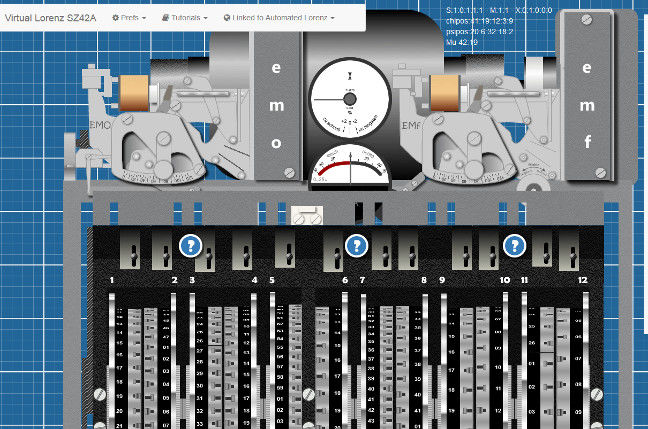
The National Museum of Computing has put an emulation of an “unbreakable” Second World War German cipher machine online for world+dog to admire.
The Virtual Lorenz machine has been launched in honour of WW2 codebreaker Bill Tutte, the man who broke the crypto used in the twelve-rotor cipher machine.
As The National Museum of Computing (TNMOC) puts it, Tutte’s work “shortened the conflict” – even though he had never even seen the cipher machine or its crypto scheme, the breaking of which the museum added was “the greatest intellectual feat of the war”.
TNMOC unveiled the Virtual Lorenz today to celebrate Tutte’s 100th birthday. Built by computing chap Martin Gillow, the simulation accurately reproduces the whirring of the cipher wheels (you might want to turn it down as the “background whirr” is a little too realistic).
The BBC profiled the “gifted mathematician” a few years ago, highlighting how the Lorenz machine whose secrets Tutte cracked was “several degrees more advanced than Enigma”, the cipher famously cracked by Tutte’s colleague Alan Turing. Tutte cracked the Lorenz in about six months, reverse-engineering its workings by reading intercepted Lorenz messages. When the Allies wanted to fool Hitler into believing the D-Day landings would take place in a false location, our ability to read Lorenz was critical for confirming that the ruse had worked – saving thousands of soldiers, sailors and airmen’s lives.
[…]
The Virtual Lorenz can be found here. Word to the wise – it’s not on an HTTPS site, so if you’re hoping to use it to thwart GCHQ, you might want to think again.
11 Things to see in Athens
Published on 5 Mar 2017
On February i got a few days away to relax from everything. I left you with some automatic videos, so you wouldn’t be without new documentaries and i went on holiday to Athens, Greece. I wanted to share a little bit about what i saw. This video is the first video made by me. (Be good, please!)
May 15, 2017
Comparing Royal Marine field ration packs
A fascinating insight into the way the Royal Marines take care of the troops in the field, showing both enlisted mens’ and officers’ ration packs:
QotD: Local government
If, that is, you believe it’s a council’s job to be lecturing takeaways shops, cafes and the like what should and shouldn’t be on the menu. Which personally, I don’t. Surely, if you’re forking out hundreds of pounds every year for your council tax, it ought to be things you actually want and need like regular dustbin collection, not for the services of some nannyish, finger-wagging lecturer treating you like a small child who refuses to eat his Brussels sprouts.
When I read that Rochdale Council employed a Healthier Choices Manager, I assumed at first it was a joke. But no: the job exists and it’s currently held by someone called Clare McNicol. Well I’m sure she’s a nice, caring, well-meaning person and she’s clearly very persuasive to have got all those chippies to participate in this ludicrous scheme. Really, though. Oughtn’t the council to have more urgent priorities than creating such busybodying non-jobs?
For example, three years ago, Rochdale was at the centre of an ugly, grooming gang scandal when a group of Pakistanis were jailed for 30 ‘horrific’ counts of child rape. With its limited budget, wouldn’t the council be better off beefing its apparently lacklustre Children’s Services Department, rather than trying to decide the local fish and chip shop menu? Isn’t the safety of vulnerable girls maybe a bit more important than the danger that someone, somewhere might put on a few more inches as a result of too many ill-advised takeaways?
Councils are always telling us how underfunded they are, how they’re expected to do more and more with less and less money. But I suspect that this is at least partly a problem of their own making. If they stuck to the basics – schools, street-cleaning, lighting and so on – and cut out all the dispensable luxuries like recycling awareness, sustainability, lesbian outreach, diet fascism, and so on, then I’m sure they’d find it much easier to live within their means. I expect most council taxpayers would be a lot happier too.
My fear, though, is that councils, especially those in inner-city Labour strongholds like Rochdale, really aren’t so interested in the dull but essential bread-and-butter stuff. (Let alone in confronting issues like the growth of intolerant Islamism). Rather they see it as their holy mission to mould the whole world in their progressive image. Hence, that multitude of different coloured bags you’re expected to sort your rubbish into, each week: they want to teach you that recycling as an act of religious devotion.
James Delingpole, “I prefer my cod in batter, thanks very much”, James Delingpole, 2015-08-15.
May 14, 2017
Junkers Fighter Planes – Whiter Feather Movement – Swiss Invasion Plans I OUT OF THE TRENCHES
Published on 13 May 2017
Chair of Wisdom Time! This week Indy talks about Junkers fighter planes, the plans for an invasion of Switzerland and he Whiter Feather Movement.
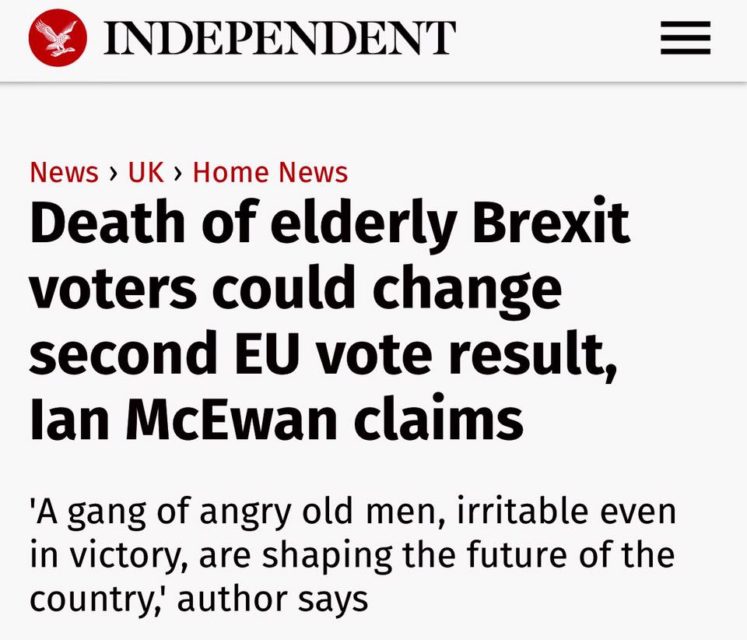
Euthanised For The EU – that’ll reverse the Brexit vote for sure…
On Facebook, Brendan O’Neill responds to an article in the Independent, calling for elderly pro-Brexit voters to just die already:
Ian McEwan says the death of ageing voters, “angry old men”, will help swing Britain back to being pro-EU. Maybe we should hurry them along? Start a “Die for Britain” scheme, where old anti-Brussels bastards could sign up to have themselves put down? Make them feel so guilty for having plunged Britain and their grandchildren’s futures into uncertainty that they will lose the will to live, or certainly to vote? Initiate a cleansing of the demos, giving over-65s the option to croak it for the sake of their grandkids’ right to study in France for six weeks? Create a Euthanised For The EU scheme? We could call it EU-thanasia, perhaps get funding for it from Brussels.
I think we sometimes fail to grasp how nasty elite Remainers are. How misanthropic, anti-old, anti-working-class and of course anti-democratic they can be. Openly fantasising about old people dying is the first step towards helping old people die. It tells old people they are scum and Britain would be better off without them. Just imagine how that makes them feel. The elitist anti-Brexit outlook is the ugliest strain in British politics right now, and the ugliest I can remember in my lifetime.
May 12, 2017
The Macedonian Standoff – The Five Nation Army Is Repelled I THE GREAT WAR Week 146
Published on 11 May 2017
Italy, France, Serbia, Britain and Russia joined forces at the Macedonian Front and the “five nation army” wants to break through the lines held by Bulgaria with some German support. But the Bulgarian defences can withstand the attack and so Maurice Sarrail is forced to abandon all hopes for a breakthrough. Meanwhile another offensive is about to proceed at the Italian front which had been quiet all winter.
Jeremy Clarkson talks speed camera politics – Top Gear – Series 1 – BBC
Uploaded on 12 Apr 2007
The Top Gear boys, Jeremy Clarkson, Richard Hammond and James May discuss the politics of speed cameras…
May 11, 2017
QotD: Stereotypes
Stereotypes are of course a tool of the trade for writers. We have to know what the stereotypes are in people’s minds, and therefore use them to suggest things we can’t thoroughly describe. (No one can thoroughly describe everything, even in a long book. Nor would you want them to. It would get truly tedious.)
Sometimes I fail at this, the same way I have trouble picking fonts for covers, because the stereotypes in my head are not the same as in most of my readers’. Take Irishmen for instance. I actually know something about the stereotype here, because it’s all over the books everywhere. However, if I’d tried to write an Irishman (or woman) when I came here, and assumed that my readers knew to round out the character with extreme politeness, drive and organization, it would backfire, and at best people would think I was being creative. At worst it would be a “wait, what?”
I suspect the Portuguese stereotype for Irish tells you rather more than you want to know about Portugal, but also about the sort of Irish we got in Portugal. Here you go people looking to make a new living, perhaps not drawn from the higher echelons of society. There you got either rich people, or people who came over as upper servants to British residents. In either case, the unruly Irishman stereotype doesn’t apply, even if both agree on song and poetry.
In the same way I often disappoint on the Portuguese stereotype, because my family runs to relatively tall, I haven’t been in the sun much the last few years, and oh, yes, I fail to be outwardly and loudly pious.
Sarah A. Hoyt, “Dealing in Stereotypes”, According to Hoyt, 2015-07-28.
May 9, 2017
The French presidency is sorted, but what about the opposition?
Megan McArdle reports on the state of the two former mainstream parties in France after both were unable to get their presidential candidate past the first round of voting:
When I arrived in France a week ago, many Americans were asking whether this election was going to be the French Brexit, and Marine Le Pen the French Trump. Given the strength of Emmanuel Macron’s lead in the polls, I thought this was the wrong question. France, in fact, already had a Brexit-sized political earthquake, when neither of the two mainstream parties of left and right made it into the second round.
The center-right Republican Party currently seems to be flailing around, trying to decide where it goes next. It is nonetheless in better shape than the left’s Socialist Party, whose devotees are currently standing around its sickbed, speaking in hushed tones. Jean-Luc Mélenchon pinched many Socialist voters, particularly lower-income and unemployed urban dwellers, with his “France Insoumise” (France unbowed) platform; Macron won over the prosperous by coming out full-bore for Europe, globalization, economic reform, and immigration. Even Le Pen got a few in the second round, mostly those who identify as “far left.” One hates to prematurely report a death, of course, but it’s certainly hard to see how the Socialists manage to recover from their humiliating single-digit performance in the first round of this election.
With both major parties in disarray, the question naturally arises: If Emmanuel Macron’s brand of ardent globalization becomes the focal ideology for one side of the political spectrum, what will constitute the natural opposition?
[…] Right now French politics doesn’t have two poles; according to political scientist Arun Kapil, it has five: the far left, the small and hardy band of loyal Socialists, En Marche!, the Republicans, and the National Front. And one possibility is that these poles winnow somewhat, but never come back to the old intra-right and intra-left alliances that stabilized French politics into something approaching a two-party system. Mélenchon is a true believer who so far seems unwilling to make strategic alliances, and the National Front is similarly uncooperative, even if other parties wanted to cooperate with them, which they don’t. If those blocs hold onto enough voters to tip an election, but never quite enough to win one, future French elections may get kind of wild.
It’s too early to tell yet which of these possible futures will hold. But we may start to get some guess in June’s legislative elections. How well En Marche! does will provide clues to just how big a shift Macron has actually achieved in French politics. How well the Republicans do will give us some sign of whether they can get their mojo back. And the performance of the far left and the far right will indicate whether France is on its way to establishing a “new normal” not that much different from the old — or striking out for uncharted territory, where there may well be some dragons lurking.
US Joins WW1 – Spring Offensives 1917 I THE GREAT WAR Summary Part 9
Published on 8 May 2017
After a rather quiet winter, the war erupts into action in 1917. Not only do the United States join the war after weeks of unrestricted submarine warfare and the uncovering of the Zimmermann Telegram. The British and French launch their own spring offensives. In the East, chaos spreads in post-revolutionary Russia and Lenin returns from exile. And in Mesopotamia the British take Baghdad.
Historical ingratitude
In the latest Libertarian Enterprise, D.J. Webb asks what Europe — individual European nations, not the EU — owe to Britain:
I do believe that historical perspective is important, and that we should deal with other nations on the basis of historical memory. For example, we recall in our dealings with Greece and Italy that these countries have been of vital importance to the historical development of civilization in Europe, and at a long remove, we should be cognizant of the cultural and economic advantages bestowed on the Roman province of Britannia by the Romans. At a minimum, they evoke in us a residual affection. Of course, as history recedes, the ability of these countries to demand a special status owing to their illustrious history has to decline too. But some recognition of the achievements of the most glorious nations and what they have done for all of European civilization is in order.
Britain is a special country — we are told in the media and in the schools today that this is not the case — but a cursory reading of history shows that we are of vital importance to Europe. Economically, we gave the world the industrial revolution and capitalism. Politically, democracy and human rights (even where absurdly misinterpreted) are among our gifts to the world. Culturally, literature, drama and film are among the arts to which we have made great contributions that remain to this day part of the canon of world literature. Scientifically, Europe looks to us for having provided electricity, railways, automobiles, planes, computers, the telephone, television and the Internet. It is not an exaggeration to state that the prosperity of the whole of Europe, and indeed of every country in the world, comes on the back our our ancestors’ — and not their ancestors’ — achievements. English children should grow up with a knowledge of and pride in this.
Geopolitically, we have always sought to prevent combinations on the Continent, and stood against the Habsburgs and Imperial Spain, Napoleonic France, the Kaiser’s Germany and Nazi Germany. We also made an outsized contribution in the Cold War. Numerous European countries owe their freedom to us. I do not deny that historical memory works both ways. Maybe — I say this for the purpose of discussion — the prominence of Polish airmen in the Battle of Britain provides us with good reason to take, if possible and where facilitated by Poland’s own foreign policy, a pro-Polish view of modern international affairs, and if we need immigrants going forward, we could well consider prioritising Poland, as well as Czechs, Belgians, Frenchmen, Canadians, Australians and New Zealanders, all represented in the Battle of Britain. However, there is no other European country that can lay claim to being the author of European freedom. True, Russian blood was expended to an immense degree in the defeat of Germany, but many European countries will be mindful that Russia was ultimately engaged in its own war of imperial conquest of Eastern Europe.
We are special, and do deserve recognition in Europe. Yet we get none. Or less than none, as all 27 EU countries have agreed to try to punish Britain for asserting its sovereignty. Would Luxembourg be free today without Britain? Jean-Claude Junker’s treatment of Britain is disgusting from a Luxembourgeois national. Does he not know that Luxemburgers huddled round the wireless in the 1940s listening to the World Service, hoping or praying that Britain or America would come to their salvation? I cannot abide the continental Europeans who refuse to acknowledge this. They will end up making an enemy of Britain, with long-term consequences.
It’s time to realise that the European nations we liberated were not worth it. They turned out to be ingrates. We need to face up to this. We wasted the lives of our servicemen for nothing. Who would wage war to liberate Belgium now?


