
Published on 10 Apr 2017
The professional British soldier of 1914 had little to do with the British conscript of 1918. So, even though World War 1 is often perceived as something static, the British infantry underwent a considerable evolution during the war.
April 11, 2017
Evolution of the British Infantry during World War 1 I THE GREAT WAR Special
Comments Off on Evolution of the British Infantry during World War 1 I THE GREAT WAR Special
April 10, 2017
100 years later, the second day at Vimy
David Warren recalls the then-ongoing battle at Vimy Ridge, along with a ghostly visit from his grandfather, who fought in WW1:
Today is the hundredth anniversary of the day after the four divisions of the Canadian Corps launched their assault up Vimy Ridge, and stormed to the top, as part of the Battle of Arras in the Great War. This was a task the British and French armies had failed to accomplish. In the national mythology, it was the day we truly became a nation, at the cost of more than ten thousand casualties, including three thousand five hundred and ninety-eight dead; and rather more, I should say, among the Sixth German Army. The engagement was essentially settled in the first light hours of April 9th, which was Easter Monday. The mop-up continued until the 12th, when we took “The Pimple,” silencing the enemy’s last artillery.
One cannot argue with mythology, and I was not arguing with my grandfather, Harry Roy Warren, when he appeared to me in a dream last night. This helped me recall what he had had to say about the whole affair, when he still lived. He said that the gods were with us, in the form of the magnificent British artillery and logistics that lay behind us; the remarkable generalship of the very British “Bungo” Byng, and of our beloved Canadian, Arthur Currie; and most importantly, the sky. After an unusually cold and prolonged winter, it was hurling snow and sleet into the faces of the defenders, who were often shooting blind. But to our farm boys, from across the fair Dominion, it was, if one could overlook the shell-bursts, just like home.
Grandpa was more impressed with the casualties. It was the first in a long string of engagements in which the Canadians were used as shock troops — Hill 70! Amiens! Cambrai! — as the allies broke the German lines, setting stage for the rest of the twentieth century.
Comments Off on 100 years later, the second day at Vimy
Small Arms of WWI Primer 022: German T-Gewehr Anti-Tank Rifle
Published on Mar 29, 2016
Othais and Mae delve into the story of this WWI classic. Complete with history, function, and live fire demonstration.
C&Rsenal presents its WWI Primer series; covering the firearms of this historic conflict one at a time in honor of the centennial anniversary. Join us every other Tuesday!
Cartridge: 13.2x92mmR
Capacity: 1 rnd
Length: 5.5′
weight: 37.7 lbsAdditional reading:
Das Tankgewehr Mauser M 1918
Wolfgang KernDWJ – 1972 – Volume 4
Die Panzerbuchse 18
K. D. Meyer
Comments Off on Small Arms of WWI Primer 022: German T-Gewehr Anti-Tank Rifle
QotD: Noblesse Oblige, pre-teens, and teenagers
This – ah – female privilege of course established “the way girls fight” usually underhanded, and without the adult noticing. Pinches, kicks to the ankle (my poor male friends in middle school) and also gossip and character destruction and other, less physical means of retaliation.
Because women are still human and will still fight.
But by middle school, we had it well established. A boy understood he would take whatever the girl dished out physically, if a girl were so uncouth as to hit him, and treat it as a joke. (And by that time they were that much stronger – thanks to testosterone – that they could do that, in most cases.) The girl in turn knew if she’d hit a boy, short of self-defense in a dark classroom, where he ambushed her, thereby putting himself beyond the protection of social rules, she’d committed a social sin and broken a major unspoken rule.
This kept fist fights between the sexes from happening. And most girls, though they might character assassinate one another, had learned to keep the boys out of it, because they weren’t adroit in the art and therefore were as vulnerable to that type of war as women to punches.
Or to put it another way, as the good professor says, “Chivalry imposed obligations upon both sexes.” And it can’t continue when one breaks the compact. The same way that other imbalances of power in society can’t continue unless both parts play by the rules.
When one part forgets the rules, they don’t leave the peasants enough to live on, and the peasants chop their necks off.
Look, I’m a libertarian and in the US. I believe all men and women should be equal under the law. But you can’t eliminate imbalances of power unless you stop being human. Communism fails, in large measure, because it wants to eliminate imbalances of power completely by making humans into something different. They believe they can shape a social ape into something more like ants or bees (don’t argue. Yeah, they do want to have rulers. One ruler over faceless millions. Because someone has to enforce equality. Yes, I know about the myth of the vanishing state.) Hence the myth of the homo Sovieticus, the selfless, perfectly acting man who would emerge once the distortions of capitalism were removed from the “natural” man who was of course a Rousseaunian noble savage. No, I don’t believe it. No one should believe it. The rejects of that culling program have filled a hundred million graves and bid fair to fill more. Because Rousseau was wrong and the mythology of communism is a hot and sticky repulsive mess.
Some people will always be taller, larger, stronger. Some will be smarter. Some will, for whatever reason like “my ancestors got here earlier” have the advantage of a better adaption to the society they live in.
I, for instance, got both sides of the noblesse oblige speech because I was taller than most of my male teachers by 13, and probably stronger too. It took. Sort of. I knew how to subdue a badly acting male without hitting him by the time I was 20, and only psychopaths did not respond. (And for those there was hitting, hence the weaponized umbrella.)
Because I WAS a walking imbalance of power, frankly.
Noblesse oblige is needed to keep things from coming to extremes.
Sarah Hoyt, “Noblesse Oblige and Mare’s Nests”, According to Hoyt, 2015-05-05.
Comments Off on QotD: Noblesse Oblige, pre-teens, and teenagers
April 9, 2017
Vimy Ridge: The Canadian National Memorial
Published on 11 Nov 2014
A visit to the Canadian National Vimy Memorial in northern France. The memorial commemorates the lives lost in the April 1917 battle of Vimy Ridge.
Comments Off on Vimy Ridge: The Canadian National Memorial
April 8, 2017
The “Three Stooges of the Apocalypse”
David Warren takes a well-deserved kick at Lloyd George, Clemenceau, and (especially) Woodrow Wilson:
A century has now passed since President Wilson disowned President Washington’s advice to his successors — to stay out of European conflicts — and war was declared by the United States on Germany. A moral preener, Wilson justified himself by declaring an even more extravagant mission to go with it:
“The world must be made safe for democracy.”
However large, a war is just a war. It should have a beginning and an end. As my old Indian girlfriend explained, “Too much war only leads to peace. Too much peace only leads to war.” As most people prefer peace, most of the time, it is well that war is not a permanent condition. But a war to some idealistic purpose can get very large, and go on for a long time, and morph into conditions which resemble peace, but are not peace. We’ve been making the world safe for democracy for at least a century. By now we have far too much.
[…]
In my view, that Great War, that Totaler Krieg, hasn’t ended yet. The old etiquette, that war was for soldiers — that non-combatants should be non-involved — became a thing of nostalgia. Vast conscript armies had been summoned, and would never be fully demobilized. The men I call the “Three Stooges of the Apocalypse” — Wilson, Lloyd George, Clemenceau — clinched at Versailles this new normal. It was not simply the punitive terms that were imposed on the war’s losers, but a more fundamental reorganization of all national and international affairs: “statecraft” became “policy.”
For Wilson was also the pioneer of progressive schemes to change the American way of life. He was, in some sense, a second Washington, consolidating a second American Revolution that had begun more modestly with Lincoln and the Union victory in the Civil War. America would be recreated, along bureaucratic lines, in a tireless campaign for full secularization, under centralized government control. The general mobilization of the First World War, now in America as well as Europe, created a new opportunity, by accustoming men to following orders; by the propaganda that made them identify with huge abstractions.
This is of course an inexhaustible topic, at which I pick away, in my attempts to explain if only to myself what makes our world so different from all preceding. It embraces more than any single force or event. We must also go back to the Prussian invention of the welfare state, and for that matter to the Gatling gun. Post-modernity is an invention of modernity, as modernity was an invention of the Middle Ages. The contemporary revolution has antecedents that may be found in the Enlightenment and in the Reformation. (What will post-modernity beget?)
Comments Off on The “Three Stooges of the Apocalypse”
April 7, 2017
The First American Shots Of WW1 – Guam And The Cormoran I THE GREAT WAR Special
Published on 6 Apr 2017
Learn more about Guam in WW1: www.visitguam.com/smscormoranguam/
The Island of Guam was on the other end of the world when the US declared war on Germany in 1917. However, they had been involved in the global conflict for years already. When the Germans lost their colonies in the Pacific, the German merchant raider SMS Cormoran II had no other choice but to seek refuge in the then neutral Arpor Harbour, Guam. For months the German crew around Adalbert Zuckschwerdt stayed on the island and became a kind of sensation. But that all changed on April 6, 1917.
Comments Off on The First American Shots Of WW1 – Guam And The Cormoran I THE GREAT WAR Special
Some people build boats as a hobby … this guy built a Fokker Dreidecker I
At The Register, the story of Dr Peter Brueggemann’s quest to build a close replica of the kind of WW1 aircraft made famous by the Red Baron:
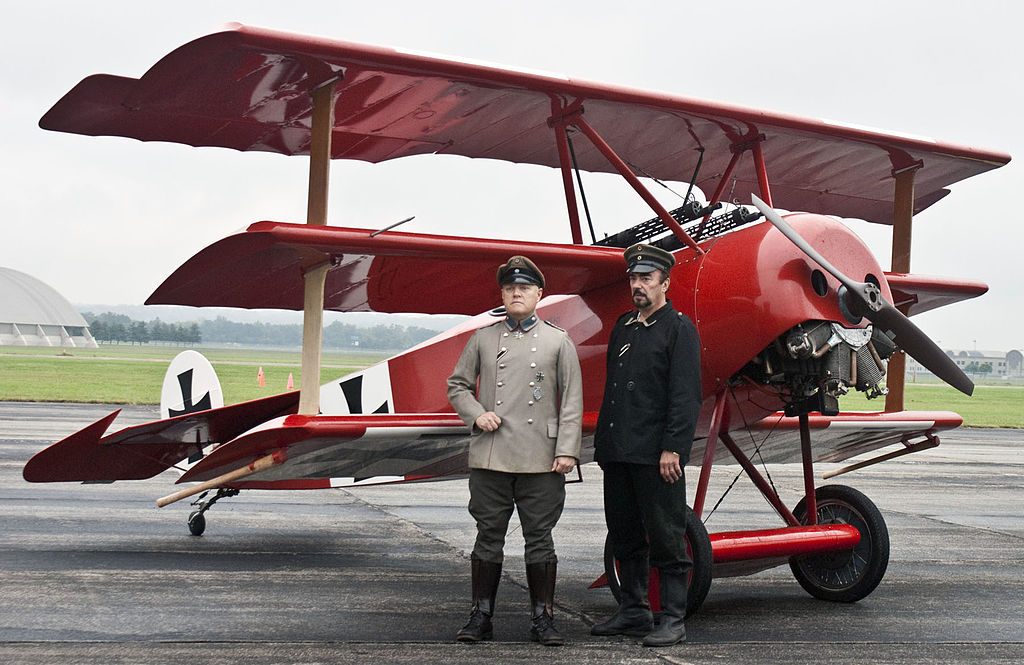
World War I Dawn Patrol Rendezvous DAYTON, Ohio — Reenactors stand in front of a Fokker Dr. I during the World War I Dawn Patrol Rendezvous at the National Museum of the U.S. Air Force, 8 August 2009. (U.S. Air Force photo, via Wikimedia)
A German orthopaedic surgeon in Norfolk has spent £70,000 building himself a flyable full-size replica of the Red Baron’s Fokker Triplane.
Dr Peter Brueggemann built the First World War-era aircraft by hand – even though when he started he couldn’t fly, as ITV News reported.
The bright red Fokker Dreidecker I (German for “three-decker”, or triplane) was built to a set of technical drawings prepared by an American aviation fanatic in the 1970s. No original Dr.Is exist, though a number of replicas have been put together during the 20th century.
Dr Brueggemann even acquired the title of baron from the Principality of Sealand, ready for when his Fokker makes its planned first flight this summer.
He told the telly station: “Being a surgeon has certainly helped and I have used surgical equipment like needles and forceps when stitching materials to the ribs of the plane.”
[…]
Fokker copied the original Dr.I design from British company Sopwith. During the early stages of air fighting in WWI, rate of climb was deemed vitally important. As aeronautical science was still in its infancy – aircraft were built from plywood and canvas, while the relatively primitive rotary engines of the day were only capable of around 110hp – the easiest way of increasing the amount of lift available was to add more wings.
First seeing action in early 1917, the Sopwith Triplane was an instant success. However, a captured example shown to Anthony Fokker, prompting German development of their own version. The first pre-production Dr.I was issued to a frontline unit in August 1917 and proved an instant hit. German fighter squadron commander Manfred von Richthofen recommended the Dr.1 be issued to as many frontline units as possible.
Comments Off on Some people build boats as a hobby … this guy built a Fokker Dreidecker I
April 6, 2017
The United States Declares War on Germany I THE GREAT WAR Week 141
Published on 5 Apr 2017
Diplomatic tensions after the return of German unrestricted submarine warfare and the aftermath of the Zimmermann telegram lead to the United States declaration of war on Germany this week 100 years ago. Meanwhile the British and French high command are still debating the upcoming offensive, namely the Battle of Arras which includes taking the contested Vimy Ridge and the Nivelle Offensive at the Chemin Des Dames.
Comments Off on The United States Declares War on Germany I THE GREAT WAR Week 141
American “isolationism” between the wars
Reason‘s Jesse Walker linked to this article by Andrew Bacevich which helps to debunk the routine description of US foreign policy between the first and second world wars as “isolationism”:
… McCain is worried about the direction of world events, with Russian provocations offering but one concern among many. Patterson shares McCain’s apprehensions, compounded by what he sees as a revival of “the isolationism in Europe and America that precipitated World War II.”
Now as an explanation for the origins of the war of 1939-1945, American “isolationism” is as familiar as the sweet-and-sour pork featured at your local Chinese takeout joint. Its authenticity is equally dubious. Yet Patterson’s assertion has this virtue: It captures in less than a sentence a prime obstacle to instituting a realistic, fact-based approach to foreign policy.
In truth, isolationism is to history what fake news is to journalism. The oft-repeated claim that in the 1920s and 1930s the United States raised the drawbridges, stuck its head in the sand, and turned its back on the world is not only misleading, but also unhelpful. Citing a penchant for isolationism as a defect afflicting the American character is like suggesting that members of Congress suffer from a lack of self-esteem. The charge just doesn’t square with the facts, no matter how often repeated.
Here, by way of illustrating some of those relevant facts, is a partial list of places beyond the boundaries of North America, where the United States stationed military forces during the interval between the two world wars: China, the Philippines, Guam, Hawaii, Panama, Cuba, and Puerto Rico. That’s not counting the U.S. Marine occupations of Nicaragua, Haiti, and the Dominican Republic during a portion of this period. Choose whatever term you like to describe the U.S military posture during this era — incoherent comes to mind — but isolationism doesn’t fill the bill.
As for Patterson’s suggestion that the behavior of the United States “precipitated” World War II, the claim is simply laughable. World War I precipitated World War II, or more specifically the European malaise resulting from the bloodletting of 1914-1918, compounded by the Bolshevik Revolution and the spread of fascism, and further exacerbated by profoundly shortsighted policies pursued by Great Britain and France. Throw into the mix the Great Depression, Japanese imperial ambitions, and the diabolical plotting of Adolf Hitler and his henchmen, and you have the makings of a catastrophe. Some few observers foresaw that catastrophe, but preventing it lay well beyond the ability of the United States, even if U.S. leaders had been clairvoyant.
Comments Off on American “isolationism” between the wars
April 5, 2017
If Walls Could Talk The History of the Home Episode 2: The Bathroom
Published on 31 Jan 2017
Comments Off on If Walls Could Talk The History of the Home Episode 2: The Bathroom
QotD: Sir John Falstaff
… in the back of my mind always ran the great anti-perfectionist utterance of Sir John Falstaff, Shakespeare’s indelible comic character, in Part 1 of Henry IV: “Banish plump Jack, and banish all the world.” A world of perfect sense and good behavior would be well-nigh intolerable: we need Falstaffs, even if we are not Falstaffian ourselves.
If we were to describe a man as deceitful, drunken, cowardly, dishonest, boastful, unscrupulous, gluttonous, vainglorious, lazy, avaricious, and selfish, we should hardly leave room in him for good qualities. No one would take it as a compliment to be described in this way, and we would avoid a person described in such a fashion. Falstaff was all those things, but probably no character in all literature is better loved. Only Don Quixote can compete; and our love of Falstaff is not despite his roguery but because of it. Certainly we would rather spend an evening in his company than with the totally upright Lord Chief Justice of Part 2 of Henry IV. A world of such rectitude, in which everyone had the justice’s probity, would be better, no doubt: but it would not be much fun.
But there is everything in the fat old knight to repel us also: he is almost certainly dirty, and, as a doctor, I would not have looked forward to performing a physical examination on him. He is so fat that the slightest physical effort causes him to exude greasy sweat. As Prince Hal says, he “lards the lean earth as he walks along.” To enjoy Falstaff, you have to be in a tavern; but the world, for most people, cannot be a giant tavern, and outside that setting, Falstaff is distinctly less amusing.
[…]
When Falstaff toward the end of Part 2 of Henry IV learns from Pistol that the old king is dead and that Prince Hal has succeeded him, he immediately sees his opportunity for the unmerited advancement not only of himself but of his cronies. He knows the worthlessness of the rural magistrate, Robert Shallow, and of the ensign, Pistol, only too well; yet he says: “Master Robert Shallow, choose what office thou wilt in the land, ’tis thine. Pistol, I will double charge thee with dignities.” He gives not a moment’s thought—he is temperamentally incapable of doing so—to the consequences of treating public office as a means only of living perpetually at other people’s expense.
Again, when given the task of raising foot soldiers, Falstaff has no compunction in selling exemptions from service and appropriating to himself the money for arms and equipment, leaving his soldiers ill prepared for the battle and with, as he says, “not a shirt and a half” between them: “I have led my ragamuffins where they are peppered [with shot]. There’s not three of my hundred and fifty left alive.” Falstaff sheds not even a crocodile tear for his lost men; their fate simply does not interest him, once they have served his turn and he has made his profit from having recruited them. Even Doctor Johnson is too indulgent when he says: “It must be observed that he is stained with no enormous or sanguinary crimes, so that his licentiousness is not so offensive but that it may be borne for his mirth.” True, he is not sanguinary as a sadist is sanguinary; but depriving 150 men of the means to fight before a battle that ends in their deaths is no mere peccadillo, either.
Why, then, do we forgive and even still love him? If he had been thin, we might have been much less accommodating of his undoubted vices (Hazlitt, in his essay on Falstaff, emphasized the importance of his fatness). At a time when to be a “stuffed cloak-bag of guts,” as Prince Hal calls him, was unusual and most men were, of necessity, thin, Falstaff’s immense size was a metonym for jollity and good cheer — as fatness still is with Santa Claus. It would not have made sense for Julius Caesar, after noting that “Yon Cassius has a lean and hungry look,” to say that such men are well contented. And had Falstaff been slender, he would not have been what Johnson called him, “the prince of perpetual gaiety.”
Falstaff appeals to us because he holds up a distorting mirror to our weaknesses and makes us laugh at them. Falstaff’s dream is that of half of humanity: of luxurious ease and continual pleasure, untroubled by the necessity to work or to do those things that he would rather not do (Falstaff will do anything for money except work for it). There is luxury in time as well as in material possessions, and no figure lives in greater temporal luxury than Falstaff, to whom the concept of punctuality or a timetable would be anathema. Former Italian prime minister Silvio Berlusconi was — or rather, appeared to be — a kind of Falstaff figure, admired by many, though eventually detested by even more, who seemed to lead an effortless life of merrymaking and who was unafraid of the world’s censure. He was therefore able to say heartless but witty things that the rest of us, cowed by the moral disapproval of others, laughed at under our breaths but would not dare to say ourselves.
Theodore Dalrymple, “Why We Love Falstaff: There is some of Shakespeare’s incorrigible rogue in all of us”, City Journal, 2015-08-16.
Comments Off on QotD: Sir John Falstaff
April 4, 2017
The Forgotten Ally – Portugal in WW1 I THE GREAT WAR Special
Published on 3 Apr 2017
Portugal’s participation in the First World War 1, especially the service of the Portuguese Expeditionary Corps on the Western Front, is often forgotten. And even when the troops were still fighting, the political situation back home had changed so much that the soldiers were largely forgotten.
Comments Off on The Forgotten Ally – Portugal in WW1 I THE GREAT WAR Special
Archaeological evidence of corpse mutilation in deserted medieval village of Wharram Percy
A bit of gruesome post-death ritual from the middle ages in Wharram Percy:
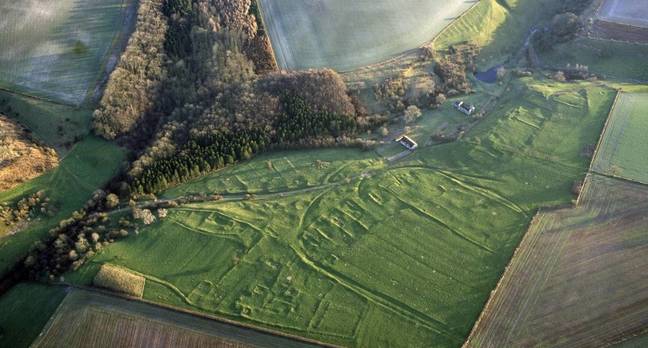
Wharram Percy, aerial view © Wharram Research Project/Historic England
Archaeologists investigating human bones excavated from the deserted mediaeval village of Wharram Percy in North Yorkshire have suggested that the villagers burned and mutilated corpses to prevent the dead from rising from their graves to terrorise the living.
Although starvation cannibalism often accounts for the mutilation of corpses during the Middle Ages, when famines were common, researchers from Historic England and the University of Southampton have found that the ways in which the Wharram Perry remains had been dismembered suggested actions more significant of folk beliefs about preventing the dead from going walkabout.
Their paper, titled A multidisciplinary study of a burnt and mutilated assemblage of human remains from a deserted mediaeval village in England, is published today in the Journal of Archaeological Science.
Located in the Yorkshire Wolds, Wharram Percy was continuously occupied for about 600 years, and was probably founded in the 9th or 10th century, but had become deserted by the early 16th century as a result of gradual abandonment and forced evictions. The ruined church is the last-standing mediaeval building, beside it remaining the grassed-over foundations of two manors and about 40 peasant houses and their outbuildings.
Since 1948 the settlement has been the focus of intensive research, which has made it Europe’s best-known deserted mediaeval village, and in what may be the first good archaeological find regarding the practice, human remains from the site suggest the predominance of folk beliefs regarding revenants in 11th-13th century England.
Comments Off on Archaeological evidence of corpse mutilation in deserted medieval village of Wharram Percy


