
Published on 19 Aug 2017
Out Of The Trenches is finally back! In this episode Indy talks about the role of trench mortars in contrast to artillery, how the Germans could condemn the use of shotguns and saw-back bayonets while using chemical weapons, and a shovel with a hole in it.
August 20, 2017
Trench Mortars – German Double Standards – Hughes’ Shovel I OUT OF THE TRENCHES
Comments Off on Trench Mortars – German Double Standards – Hughes’ Shovel I OUT OF THE TRENCHES
Getting out of EUrope
At Samizdata, Brian Micklethwait encourages the Brexiteers, as staying in the EU is clearly not a viable option:
The EU is very complicated and confusing, which is a big reason for Brexit. But also very complicated and confusing, say the Remainers, is the process of Britain getting out of the EU. For that reason, they say, best to stay in. But I say that the more complicated and confusing it is to get Britain out, the more reason there is for Britain to get out. The more complicated getting out is, that means the more complicated the damn thing itself must be. The question becomes: Which is better? Complication for a year or three, while we extricate ourselves from this ghastly morass? Or: Complication for ever as we sink ever deeper into it? I say we should, you know, go with the result of the Referendum, and get out. Happily, that is now happening.
[…]
Another Remainer argument which has a similar logical structure is that the EU, in addition to being diabolically complicated and confusing to get out of, on account of itself being diabolically complicated and confusing, is also determined to stop us Brits getting out easily. The only exit terms we will ever be able to extract from it will be crushingly punitive. Ergo, we should stay.
Britain’s exit deal may indeed prove costly to us. If EUrope lets us out easy, other rebellious bits of EUrope may also then try to leave.
The EU’s negotiating team is likely to operate under detailed instructions for maximum punishment of the British traitors. They need to make Brexit as painful as possible, to deter les autre, but not so painful that Britain just walks away from the table. That will be quite a challenge, which is why the British media are clamouring for the British government to lay out their negotiating strategy in great detail … to ensure that the EU has as much leverage as possible.
Comments Off on Getting out of EUrope
World of Warships – The Queen, God Bless Her! (Part 3)
Published on 18 Aug 2017
Took us long enough, but we finally arrived at tier 8, and here’s where the real fun begins.
Music in Conqueror segment – “In A World of Derp” by D1 of Aquavibe.
Comments Off on World of Warships – The Queen, God Bless Her! (Part 3)
Thucydides again
David Warren found a dip into Thucydides was at least as informative on political issues today as any current “reporting”:
What a week it has been, at least in the yellow world of journalism and politics. I have had nothing new to say on anything — at least I hope to have said nothing new, for my intention in commenting on passing events is simply to repeat the old gnomes which they freshly illustrate. Thucydides, into whose works I privately dipped last Tuesday, was as up-to-date as anything I found “breaking” on the Internet.
Consider, for instance, the career of the Athenian general (then Spartan, then Persian, then Athenian again), Alcibiades — more sinned against than sinning, and more sinning than sinned against, by turns. A large man, persistently underridden by the mean and small; a hero and no saint. Loved to the point of worship by the crowds; hated by the umbrous, to the point of madness; and always “in the news.”
A polarizing figure, as we’d say today; who, for his impieties, was finally run down by a mob. They set fire to the cottage where he’d retired with his mistress. (The Spartans commissioned the mob by one account; the young lady’s parents by another.) Boldly emerging from the flames to confront the whole tribe of his adversaries, he died in a hail of arrows. The gods let only Stalin die in his sleep. (Or so we thought until we got more information.)
Comments Off on Thucydides again
August 19, 2017
Dieppe Raid 19 August, 1942 – Assault, escape and aftermath
Published on 22 Mar 2009
The Dieppe Raid was one of the costliest days for the Canadian Army in the entire Second World War. 907 Canadians were killed, in addition more than 2,500 were wounded or captured, all on August 19 of 1942.
At the BBC site: Julian Thompson’s summary of the Dieppe Raid.
Comments Off on Dieppe Raid 19 August, 1942 – Assault, escape and aftermath
August 18, 2017
The Battle of Hill 70 – Mackensen Advances in Romania I THE GREAT WAR Week 160
Published on 17 Aug 2017
The Battle of Passchendaele has turned into a muddy mess, the weather conditions take a toll on both the defenders and the attackers alike. The Canadians relieve some pressure on the British Army in the Battle of Hill 70 south of Ypres. Meanwhile, August von Mackensen is fighting back the Romanian offensive that was unleashed last week.
Comments Off on The Battle of Hill 70 – Mackensen Advances in Romania I THE GREAT WAR Week 160
QotD: “Justifying” the Holocaust
… that underlying tone of “Of course what Hitler and the Nazis did was unjustifiable, they were wrong about what was going on around them” whenever the topic of the Holocaust is discussed implies that, if they had been right, what they did would have been, at least, justifiable. In other words, there’s an acceptance of the underlying logic of collective justice going on there, and when you put adjectives in front of justice, you almost never get justice.
Which brings us to the current brawl in SF/F and the wider culture. There’s a very large swathe, of Western society that has regressed, though they call it progress, to the idea that one should deliberately punish all members of a group for the actions, real or imagined, of a few members, and to the idea that because members of a group are over-represented in a particular area that it is a deliberate choice on the part of the group, rather than an accident of history.
You see it nearly everywhere. The idea that SF was somehow filled with racist, sexist hatemongers until … well, as near as I can tell, around five years ago is ludicrous when you have H. Beam Piper writing stories where racial intermarriage has turned almost all of humanity a nice shade of brown and there are heroic characters with names like Themistocles M’Zangwe. But, even if that were true — what, we should stop reading (and buying books from) straight white male authors for an entire year? Because a bunch of people they never even met were theoretically jerks?
Sarah Hoyt, “Social Injustice – 60 Guilders”, According to Hoyt, 2015-07-31.
Comments Off on QotD: “Justifying” the Holocaust
August 17, 2017
HMS Queen Elizabeth enters Portsmouth harbour
At The Register, Gareth Corfield reports from Portsmouth as the Royal Navy’s new aircraft carrier HMS Queen Elizabeth visits her new home port for the first time:
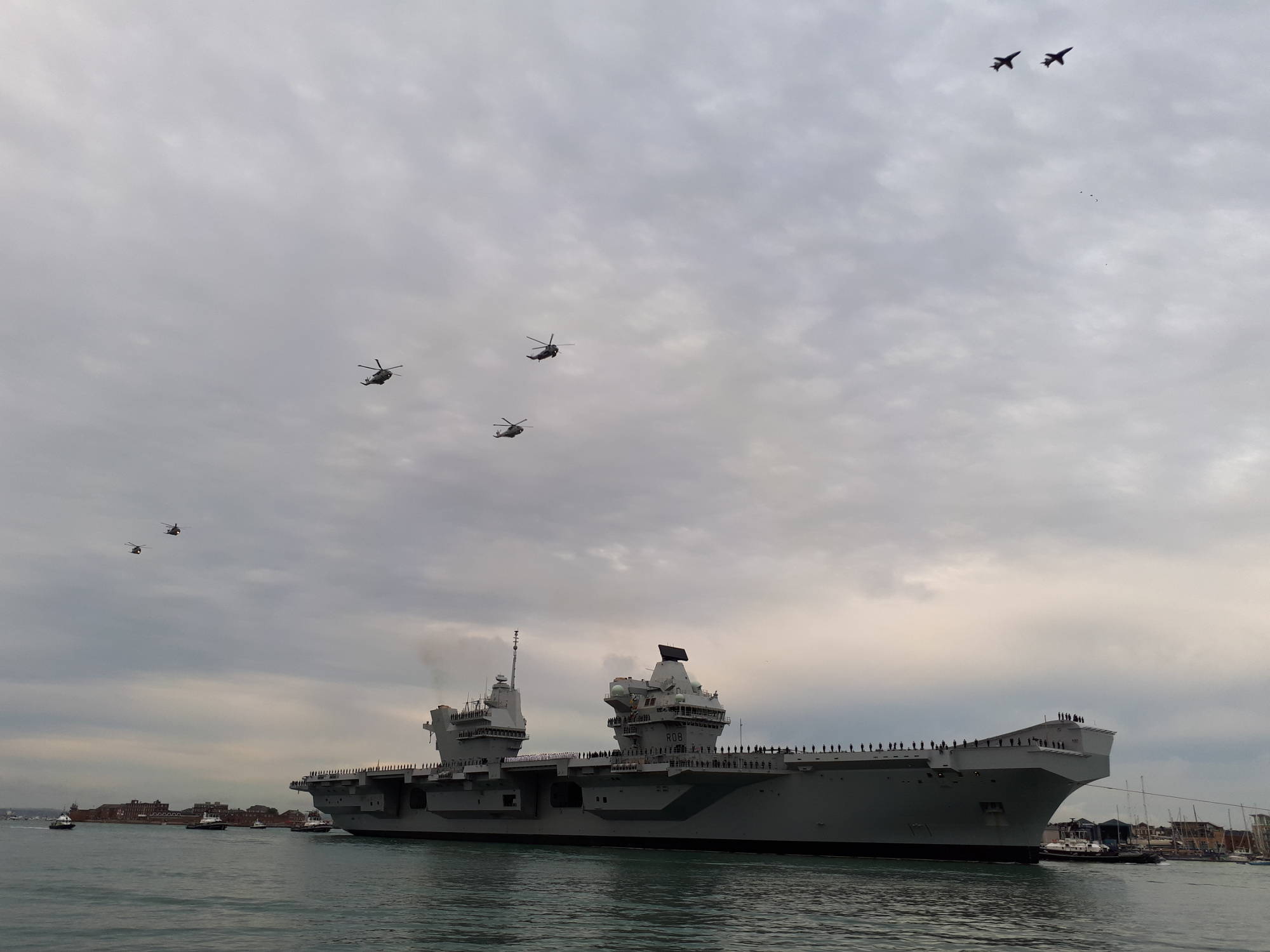
Royal Navy aircraft fly over HMS Queen Elizabeth as she enters Portsmouth harbour. Click to see full-sized photo.
Britain’s newest warship, its biggest warship of all time, HMS Queen Elizabeth, entered Portsmouth Harbour for the first time this morning.
The 65,000-tonne aircraft carrier entered the port at 0710 this morning under the watchful eye of half a dozen tugboats, a small flotilla of police vessels – and crowds of thousands lining the sea front along Portsmouth and Southsea.
In addition, scores of smaller civil vessels accompanied the carrier at a respectful distance. A flypast of Royal Navy helicopters and fast jets – Hawk training aircraft – also took place as the carrier made her stately way towards the naval base.
Admiral Lord West, the former head of the navy and now a Labour Party peer, told The Register as the ship came in: “This is a very joyous day. She looks splendid. We had lost sight of our maritime capability. This is something very special for Portsmouth and the Navy.”
When asked if the Queen Elizabeth-class carriers were necessary, the admiral said: “The one thing you can’t guarantee is what will happen tomorrow. When they’ve got their fixed wing assets, they’ll be one of the only capabilities [the UK has that will have] a strategic impact. It’s 4.5 acres of British sovereign territory.”
Comments Off on HMS Queen Elizabeth enters Portsmouth harbour
World of Warships – The Queen, God Bless Her! (Part Two)
Published on 16 Aug 2017
In which I attempt to cover the British tier 7 – 10 Battleships, but can’t stop running my mouth off about the King George V and Nelson so it looks like we’ll be back later this week to finish.
Comments Off on World of Warships – The Queen, God Bless Her! (Part Two)
August 16, 2017
World of Warships – The Queen, God Bless her!
Published on 15 Aug 2017
Join me in the traditional Royal Navy toast to the Monarch, as I raise a glass to the long awaited British Battleships in World of Warships. Thank God they don’t suck!
Mostly.
Comments Off on World of Warships – The Queen, God Bless her!
Canadian War Museum highlights the six Canadian VCs won at the Battle of Hill 70
On August 15th, 1917, the Canadian Corps began a planned attack on German positions near Lens in northern France, to relieve pressure on the larger British and Imperial operations at Passchendaele. During the vicious fighting around the feature designated as “Hill 70”, the valour of six Canadians was deemed deserving of the highest military honour the British Empire could bestow, the Victoria Cross. From the institution of the medal in 1856, only 96 Canadians have been awarded a VC. David Pugliese reports for the Ottawa Citizen:
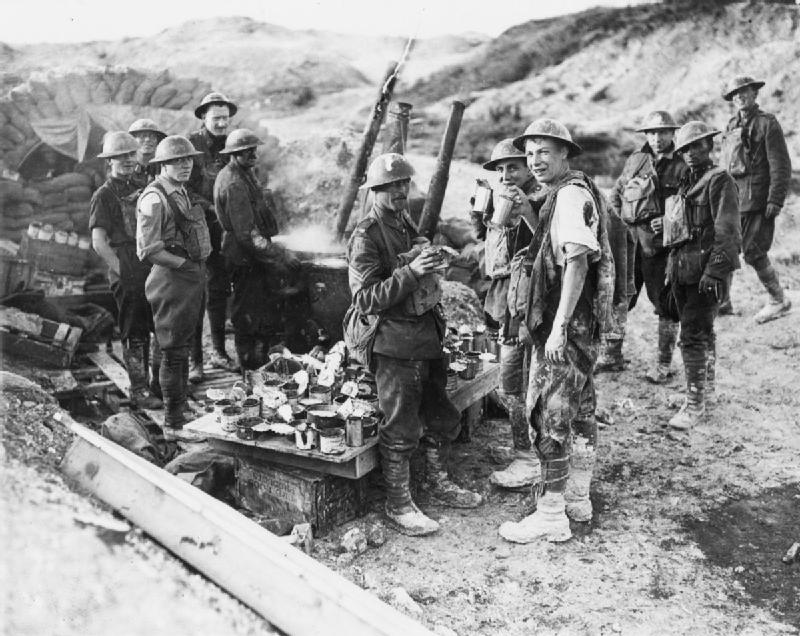
IWM caption : Hill 70 (Lens) 15-25 August: A group of Canadians, standing with mugs at a soup kitchen set up on boards “100 yards from Boche lines” during the push on Hill 70 (via Wikimedia)
The Canadian War Museum is marking the centenary of the Battle of Hill 70 with a special display highlighting the six Canadian soldiers who received Victoria Cross decorations as a result of their courageous actions. The Battle of Hill 70, which includes portraits of the recipients and some of their medals, will be on view from August 15 until Remembrance Day, according to the Canadian War Museum.
“Sir Arthur Currie described the Battle of Hill 70 in August 1917 as ‘altogether the hardest battle in which the Corps has participated,’” Stephen Quick, Director General of the Canadian War Museum, said in a news release. “It’s remarkable that this 11-day battle, fought four months after Vimy Ridge, resulted in six Canadian soldiers of varying backgrounds and ranks being awarded the highest honour for military valour in the British Empire.”
Here the Canadian War Museum also provides details about the battle and the Victoria Cross winners:
The Canadian Corps, under the command of Sir Arthur Currie, launched an attack on the German-held city of Lens in northern France on August 15, 1917. His strategy was to capture the high ground overlooking the town, forcing the enemy to counterattack. This prevented German units from reinforcing formations facing Allied troops struggling to gain ground at Passchendaele in Flanders. By August 25, the Canadians had withstood 21 failed counterattacks and suffered 9,000 casualties at Hill 70, but they had killed, wounded or taken as prisoner about 12,000 Germans. It was a significant and costly tactical victory for the Allies.
The Battle of Hill 70 introduces visitors to Sergeant Frederick Hobson, Corporal Filip Konowal, Private Harry Brown, Private Michael James O’Rourke, Acting Major Okill Massey Learmonth and Sergeant-Major Robert Hill Hanna. They are among only 96 Canadian recipients of the Victoria Cross since its introduction during the Crimean War in 1856.
Comments Off on Canadian War Museum highlights the six Canadian VCs won at the Battle of Hill 70
August 15, 2017
Italian Pistols of World War 1 I THE GREAT WAR Special feat. C&Rsenal
Published on 14 Aug 2017
Italian Gisenti 1910 Pistol in detail: https://www.youtube.com/watch?v=M7eLhcNRwps
In this edition of our live stream episodes with C&Rsenal we take a look at the Italian pistols of World War 1.
Comments Off on Italian Pistols of World War 1 I THE GREAT WAR Special feat. C&Rsenal
The Civil Service on Helping Foreign Nations
Published on 23 Nov 2010
Taken from Yes, Prime Minister
Comments Off on The Civil Service on Helping Foreign Nations
QotD: Platonism versus Epicureanism
It is all this that made Epicurus and his philosophy so scandalous in the ancient world and beyond. Plato never did get to create his perfect society. But his followers did manage to establish variants of Platonism as the dominant philosophy of later antiquity. And all the other main schools of philosophy were agreed that the world should be ruled by intellectuals. These should tell the civil authorities how to govern. They should provide the moral and spiritual justification for the rule of absolute and unaccountable systems of government — systems of which the Roman imperial system was only the most developed. They should have positions of honour within these systems.
Epicureanism was a standing challenge to these pretensions. We have no precise evidence for the spread of Epicureanism in the ancient world. But it does seem to have spread very widely. Why else should Cicero, Plutarch and many of the Christian Fathers have given so much effort to sustained attacks on it? Why else, in spite of his emphatic remarks on the nature of happiness, was Epicurus, even in his own lifetime, subjected to the most outrageous accusations?
We have one statement from Cicero, that Epicureanism in his own day was one of the dominant schools of philosophy in Italy. So far, he says, Greek philosophy had been available only in the original language. But writers such as Amafinius had translated several Epicurean works — on the publishing of whose writings the people were moved, and enlisted themselves chiefly under this sect, either because the doctrine was more easily understood, or because they were invited thereto by the pleasing thoughts of amusement, or that, because there was nothing better, they laid hold of what was offered them.
There is no doubt that it influenced the classical literature of Rome. Of course, there is the great poem by Lucretius. But there is also Catullus and Horace and even Virgil. Without citing them, their works are imbued with an Epicurean outlook on life, either directly from Epicurus or indirectly from Lucretius.
Another indication of popularity is that once converted to Epicureanism, people hardly ever switched to another philosophy. The philosopher Arcesilaus testifies to this fact even as he tries to explain it:
You can turn a man into a eunuch, but you can’t turn a eunuch into a man.
Then there is the curious testimony of the Jews. During the three centuries around the birth of Christ, the main everyday language of many Jewish communities was Greek. The Gospels and Letters of Saint Paul were all directed at mainly Jewish audiences and are in Greek. One of the most important philosophers of the age, Philo of Alexandria, was a Jew. Many Jews took on Greek ways. Many, no doubt, stopped being Jews and made themselves into Greeks. The condemnation of these Hellenised Jews is Apikorsim, which may easily be taken as a Semitic version of Epicurean. The term survives in Jewish theological writing. According to one Internet source, Apikorsim are what Chasidim refer to as Jewish Goyim, or secular Jews. They seem to be the worst opposition for Hasidic Jewry.
A term of abuse so loaded with contempt is unlikely to have been taken from the doctrines of an insignificant philosophical tradition among ordinary people of the age. It is reasonable to suppose that many lapsed Jews became Epicureans. If so, Epicureanism must already have had large numbers of adherents among at least the semi-educated classes.
Sean Gabb, “Epicurus: Father of the Enlightenment”, speaking to the 6/20 Club in London, 2007-09-06.
Comments Off on QotD: Platonism versus Epicureanism
August 14, 2017
Tank Chats #16 Panther
Published on 18 Mar 2016
Probably the best German tank design of the Second World War.
The Panther was not as thickly armoured, nor as heavily armed, as tanks such as the Tiger but was probably a much more balanced design. It was one of the fastest German tanks, highly manoeuvrable and equipped with an accurate gun. Its worst defect was a propensity to catch fire if the engine backfired.
Comments Off on Tank Chats #16 Panther


