Geography plays an important part in all of this. While the sea surface itself is without geography, naval forces are dependent on shore facilities for support. In the age of sail, this was mostly for supply and repair, while coaling stations defined naval geography during the early age of steam, giving the British a huge advantage over all opponents. The US, lacking such facilities, built bigger, longer-ranged ships. Today, we’ve created forward bases in Europe and Japan, to allow our ships to spend more time on station, and replenishment ships to allow ships to spend more time at sea.
Moreover, a huge fraction of global trade flows through a few key choke points. A century ago, Jackie Fisher described “Five keys [that] lock up the world! Singapore. The Cape. Alexandria [Suez]. Gibraltar. Dover.” Today, we’d have to add the Strait of Hormuz, but the basic truth remains the same. Control of trade through these critical areas gives immense power, and it is in the interest of a maritime power to have that control, or at least to have great influence over how it is used.
“bean”, “Basics of Naval Strategy”, Naval Gazing, 2018-01-22.
April 21, 2020
QotD: Admiral Jackie Fisher’s five keys to “lock up the world”
April 20, 2020
QotD: The Columbus myth
My favorite example is the Columbus myth, the idea that the people who argued against Columbus were ignorant flat-earthers who thought his ships would sail off the edge. That is almost the precise opposite of the truth. By the time Columbus set off, a spherical Earth had been the accepted scientific view for well over a thousand years. Columbus’s contemporaries not only knew that the Earth was round, they knew how big around it was, that having been correctly calculated by Eratosthenes in the third century B.C.
By the fifteenth century they also had a reasonably accurate estimate of the width of Asia. Subtracting the one number from the other they could calculate the distance from where Columbus was starting to where Columbus claimed to be going and correctly conclude that it was much farther than his ships could go before running out of food and water. The scientific ignorance was on the side of Columbus and those who believed him; he was claiming a much smaller circumference for the Earth and a much larger width of Asia, hence a much shorter distance from Spain to the far end of Asia. We will probably never know whether he believed his own numbers or was deliberately misrepresenting the geographical facts in order to get funding for his trip in the hope that he would find land somewhere between Spain and Japan, as in fact he did.
David D. Friedman, “Slandering the Past”, Ideas, 2018-02-14.
April 19, 2020
Yugoslavia Crushed – Battle for Greece Continues – WW2 – 086 – April 18, 1941
World War Two
Published 18 Apr 2020The Battles for Yugoslavia and Greece continue as the Soviet-Union and Japan sign a non-aggression pact.
Join us on Patreon: https://www.patreon.com/TimeGhostHistory
Or join The TimeGhost Army directly at: https://timeghost.tvFollow WW2 day by day on Instagram @World_war_two_realtime https://www.instagram.com/world_war_t…
Between 2 Wars: https://www.youtube.com/playlist?list…
Source list: http://bit.ly/WW2sourcesWritten and Hosted by: Indy Neidell
Director: Astrid Deinhard
Producers: Astrid Deinhard and Spartacus Olsson
Executive Producers: Astrid Deinhard, Indy Neidell, Spartacus Olsson, Bodo Rittenauer
Creative Producer: Joram Appel
Post-Production Director: Wieke Kapteijns
Research by: NN
Edited by: Iryna Dulka
Sound design: Marek Kamiński
Map animations: Eastory (https://www.youtube.com/c/eastory)Colorizations by:
– Norman Stewart – https://oldtimesincolor.blogspot.com/
– Adrien Fillon – https://www.instagram.com/adrien.colo…
– Julius Jääskeläinen – https://www.facebook.com/JJcolorization/
– Carlos Ortega Pereira, https://www.instagram.com/blaucoloriz…Sources:
– Bundesarchiv, CC-BY-SA 3.0: Bild 101III-Weyer-024-05A/Weyer, Bild 146-1975-036-24/Gofferjé, Leander, Bild 101I-161-0317-26/Bauer, Bild 101I-158-0094-35/Kisselbach, Bild 102-17311
– Narodowe Archiwum Cyfrowe
– fractured arm icon by ProSymbols from the Noun Project
– Imperial War Museum: D 4311Archive by Screenocean/Reuters https://www.screenocean.com.
A TimeGhost chronological documentary produced by OnLion Entertainment GmbH.
In healthcare matters, Confederation is working as intended
Chris Selley on the viewing-with-alarm concerns that we don’t have a single nation-wide standard of care, and why the Swedish approach to the Wuhan Coronavirus epidemic is worth observing closely:

Front view of Toronto General Hospital in 2005. The new wing, as shown in the photograph, was completed in 2002.
Photo via Wikimedia Commons.
Last week, Maclean’s reported on a group of University of Ottawa researchers who had found, to their consternation, that each province offers different advice to people who think they might be showing coronavirus symptoms. “Even in a cross-Canada pandemic as devastating as this, there is not a single, evidence-based Canadian standard of care simply for self-assessment,” the researchers wrote.
It’s strange how many Canadians seem uncomfortable with the most basic design of their country, which is that of a federation. What the U of O researchers find alarming is not just a matter of Canada operating as it was intended to operate, but also a good example of the benefits. Provinces and territories can shape their responses to the needs of their populations. They can learn from each other what works. It’s a living laboratory.
In the same vein, assuming things don’t go catastrophically wrong, we should be thankful that Sweden is sticking to its guns in avoiding a total lockdown. That, too, will provide very useful data in preparation for COVID-the-next.
It is important to realize that lockdowns take a human toll, sometimes fatal, just like coronaviruses (though probably not on the same scale). Emergency room doctors are worried about their lack of business nowadays, the National Post‘s Richard Warnica reported Friday. “Doctors believe … patients who are afraid of contracting COVID-19 are just waiting (to seek treatment) and getting sicker,” Warnica reported. The head of a Vancouver ER department noted that opioid overdose deaths are up, even as his hospital treats far fewer. Are they overdosing alone, whereas before they might have been saved? When we postmortem this pandemic, we will hear about sexual and domestic assaults, suicides and other isolation-related harms. They will need to be weighed against the risks inherent in a less draconian approach.
Sweden’s strategy has been somewhat caricatured. High schools and universities closed; people aged 70 or older were advised to self-isolate; large gatherings ceased. Easter travel was down a reported 90 per cent. More Swedes have reportedly filed for unemployment benefits than during 2008 crash. Restaurants, pubs and cafés remain open, which seems unfathomable to a Canadian. But “it’s a myth that it’s business as usual,” as Sweden’s deputy prime minister Isabella Lovin told the Financial Times this week.
French Foreign Legion | Stuff That I Find Interesting
Jabzy
Published 14 Oct 2017
QotD: Early Greek philosophers
Democritus was still living when the new scientific movement suffered a violent reverse. It was in Athens, a center of conservatism, that the opposition arose and it was brilliantly headed. The leader was no other than Socrates, who despaired of the possibility of scientific knowledge. Even Aristotle, who pioneered in some branches of science, rejected the atomic theory. Between these two great names came that of Plato, who believed the ultimate realities to be not atoms but triangles, cubes, spheres and the like. By a kind of analogy he extended this doctrine to the realm of abstract thought. If, for example, perfect spheres exist, why should not perfect justice exist also? Convinced that such perfect justice did exist, he sought in his own way to find it. The ten books of his Republic record only part of his searchings of the mind. At the core of all this thinking lies the doctrine that the eternal, unchangeable things are forms, shapes, models, patterns, or, what means the same thing in Greek, “ideas.” All visible things are but changing copies of unchanging forms.
The Epicurean Revival
After the great triumvirate of Socrates, Plato and Aristotle had passed away the scientific tradition was revived with timely amendments by Epicurus. In his time it was the prevalent teaching that the qualities of compound bodies must be explained by the qualities of the ingredients. If the compound body was cold, then it must contain the cold element air, if moist, water, if dry, earth, and if hot, fire. Even Aristotle sanctioned this belief in the four elements. Epicurus, on the contrary, maintained that colorless atoms could produce a compound of any color according to the circumstances of their combination. This was the first definite recognition of what we now know as chemical change.
The Stoic Reaction
Epicurus was still a young man when Athenian conservatism bred a second reaction to the new science. This was headed by Zeno, the founder of Stoicism. His followers welcomed a regression more extreme than that of Aristotle in respect to the prime elements. For the source of their physical theories they went back to Heracleitus, who believed that the sole element was fire. This was not a return to the Stone Age but it was a longish way in that direction.
This Heracleitus had been a doleful and eccentric individual and became known, in contrast to the cheerful Democritus, as the weeping philosopher. His gloom was perpetuated in Stoicism, a cheerless creed, of which the founder is described as “the sour and scowling Zeno.” Epicurus, on the contrary, urged his disciples to “wear a smile while they practiced their philosophy.”
Running parallel to these contrasting attitudes toward life and physical theories was an equally unbroken social divergence. Platonism as a creed was always aristocratic and in favor in royal courts. “I prefer to agree with Plato and be wrong than to agree with those Epicureans and be right,” wrote Cicero, and this snobbish attitude was not peculiar to him. Close to Platonism in point of social ranking stood Stoicism, which steadily extolled virtue, logic, and divine providence. This specious front was no less acceptable to hypocrites than to saints. Aptly the poet Horace, describing a pair of high-born hypocrites, mentions “Stoic tracts strewn among the silken cushions.” Epicureanism, on the contrary, offered no bait to the silk-cushion trade. It eschewed all social distinction. The advice of the founder was to have only so much regard for public opinion as to avoid unfriendly criticism for either sordidness or luxury. This was no fit creed for the socially or politically ambitious.
Norman W. DeWitt, “Epicurus: Philosophy for the Millions”, The Classical Journal, 1947-01.
April 18, 2020
Miscellaneous Myths: Typhon
Overly Sarcastic Productions
Published 17 Apr 2020Are you getting sick of Zeus? Are his constant antics getting you down? Do you wanna hear about the time he got his ass kicked by Godzilla?
Our content is intended for teenage audiences and up.
PATREON: https://www.Patreon.com/OSP
MERCH LINKS: https://www.redbubble.com/people/OSPY…
OUR WEBSITE: https://www.OverlySarcasticProductions.com
Find us on Twitter https://www.Twitter.com/OSPYouTube
Find us on Reddit https://www.Reddit.com/r/OSP/
Discord: https://discord.gg/h3AqJPe

April 17, 2020
Charles De Gaulle – The Flame of French Resistance? – WW2 Biography Special
World War Two
Published 16 Apr 2020Charles De Gaulle is a towering figure in history, and not just because of his height. Becoming increasingly political in the interwar years due to his unorthodox views on military strategy, The Fall of France will thrust him into the limelight.
Join us on Patreon: https://www.patreon.com/TimeGhostHistory
Or join The TimeGhost Army directly at: https://timeghost.tvFollow WW2 day by day on Instagram @World_war_two_realtime https://www.instagram.com/world_war_t…
Between 2 Wars: https://www.youtube.com/playlist?list…
Source list: http://bit.ly/WW2sourcesHosted by: Indy Neidell
Written by: Francis van Berkel
Director: Astrid Deinhard
Producers: Astrid Deinhard and Spartacus Olsson
Executive Producers: Astrid Deinhard, Indy Neidell, Spartacus Olsson, Bodo Rittenauer
Creative Producer: Joram Appel
Post-Production Director: Wieke Kapteijns
Research by: Catherine Burton
Edited by: Mikołaj Cackowski
Sound design: Marek Kamiński
Map animations: Eastory (https://www.youtube.com/c/eastory)Colorizations by:
Carlos Ortega Pereira, BlauColorizations, https://www.instagram.com/blaucoloriz…
Dememorabilia – https://www.instagram.com/dememorabilia/
Norman Stewart – https://oldtimesincolor.blogspot.com/
Adrien Fillon – https://www.instagram.com/adrien.colo…
Sources:
Outdoor family portrait, with lurkers (c.1920), courtesy pellethepoet https://flic.kr/p/ompxgf
IWM A 1464, E 2324, D 1966
Frederick Milthorp collectionSoundtracks from the Epidemic Sound:
Max Anson – “Ancient Saga”
Farell Wooten – “Blunt Object”
Johannes Bornlof – “Deviation in Time”
Reynard Seidel – “Deflection”
Johannes Bornlof – “The Inspector 4”
Phoenix Tail – “At the Front”Archive by Screenocean/Reuters https://www.screenocean.com.
A TimeGhost chronological documentary produced by OnLion Entertainment GmbH.

“Diary Of An Unknown Soldier” – Lost in the Great War – Sabaton History 063 [Official]
Sabaton History
Published 16 Apr 2020The bells rang on Armistice Day 1920 in the 11th hour, and two minutes of silence followed. One minute for the soldiers that had fought in the Great War and had come back. The second for those who did not. Those unfortunate souls that had been left behind. They had died like so many others, but had been denied a final resting place due to the violence of war. They had vanished, without a trace, without an identity. Those men where the Unknown Soldiers.
Support Sabaton History on Patreon: https://www.patreon.com/sabatonhistory
Listen to “Diary of an Unknown Soldier” on the album The Last Stand:
CD: http://bit.ly/TheLastStandStore
Spotify: http://bit.ly/TheLastStandSpotify
Apple Music: http://bit.ly/TheLastStandItunes
iTunes: http://bit.ly/TheLastStandItunes
Amazon: http://bit.ly/TheLastStandAmz
Google Play: http://bit.ly/TheLastStandGooglePlayWatch the official lyric video of “Diary Of An Unknown Soldier” here:
https://www.youtube.com/watch?v=Jhkz5…Check out the trailer for Sabaton’s new album The Great War right here: https://www.youtube.com/watch?v=HCZP1…
Listen to Sabaton on Spotify: http://smarturl.it/SabatonSpotify
Official Sabaton Merchandise Shop: http://bit.ly/SabatonOfficialShopHosted by: Indy Neidell
Written by: Markus Linke and Indy Neidell
Directed by: Astrid Deinhard and Wieke Kapteijns
Produced by: Pär Sundström, Astrid Deinhard and Spartacus Olsson
Creative Producer: Joram Appel
Executive Producers: Pär Sundström, Joakim Broden, Tomas Sunmo, Indy Neidell, Astrid Deinhard, and Spartacus Olsson
Post-Production Director: Wieke Kapteijns
Edited by: Iryna Dulka
Sound Editing by: Marek Kaminski
Maps by: Eastory – https://www.youtube.com/c/eastoryArchive by: Reuters/Screenocean https://www.screenocean.com
Music by Sabaton.Sources:
– National Library of Scotland
– National Library of France
– Imperial War Museum: Q 10378, Q 100373, Q 57227, Q 100624, Q 53727, Q 29155, ART 3991 a, Q 109517, Q 100928, Q 100699, Q 100913, Q 45814, Q 23706, Q 14963, Q 31518, Q 31494, RAF-T 3129, Q 31514, Q 909, Q 87441, Documents.5323, Q 100486, Q 48929A, Q 78614An OnLion Entertainment GmbH and Raging Beaver Publishing AB co-Production.
© Raging Beaver Publishing AB, 2019 – all rights reserved.
From the comments:
Sabaton History
2 days ago
Something different this time. Since we already have two episodes about the fighting in the Argonne, we thought this time we’d talk about the sacrifice and the legacy of the “Unknown Soldier”. Of those who fought and died but were not fortunate enough to have a last known resting place. We hope you still enjoy the episode!
Prototype Mauser 1917 Trench Carbine
Forgotten Weapons
Published 20 Dec 2019http://www.patreon.com/ForgottenWeapons
Cool Forgotten Weapons merch! http://shop.bbtv.com/collections/forg…
In the latter stages of World War One, the German military was looking for new arms for its Sturmtruppen. Without a reliable self-loading rifle design to use, they instead focused on pistol-caliber arms. The first to be used was the existing P08 artillery Luger, fitted with a drum magazine. At the very end of the war, these were being replaced by Bergmann MP-18,I submachine guns. But there was another gun that was tested but not adopted — the 1917 trench carbine variation of Mauser’s C96 “Broomhandle” pistol. Only about 40 of these guns were made as prototypes and trials models, and they were not adopted for reasons that are not entirely clear (but cost is probably a significant element). Only a few examples survive, and they vary substantially in their details. In addition, they are substantially different from both standard C96 pistols and also the sporting carbines made before the war.
All the 1917 trench carbines used a magazine developed from the 1906/08 pistol; an excellent double-stack, double-feed type. Magazines of 10, 20, and 40-round capacity were made, although all known examples were only semiautomatic (the full-auto Schnellfeuer Mausers would not come until the early 1930s).
Contact:
Forgotten Weapons
6281 N. Oracle #36270
Tucson, AZ 85704

QotD: Rommel arrives in North Africa
Rommel had his orders, but he had ignored orders in the past and been decorated for it. With British forces stripped to fight an exceedingly ill-advised campaign in Greece, he carried out a quick personal reconnaissance in his trusty little Fieseler Storch airplane, then launched an offensive in concert with his Italian partners (Ariete armored division and the infantry divisions of X Corps, Bologna and Pavia). He penetrated British defenses at El Agheila on March 24th, then drove on to Mersa el Brega on March 31st, pausing only long enough to take (and ignore) a number of radio messages from Berlin and Rome warning him not to do anything rash. Finally, he smashed the British defenders at Agedabia (elements of the green 2nd Armoured Division, equipped partially with captured Italian M13/40 tanks), pinning them in front with the infantry of 5th Light Division while dispatching his Panzers on a ride around the open desert flank to the south, the first use of a tactic that would become his signature move.
These three tiny encounters, none of them exceeding regimental strength, were enough to unhinge the entire British defensive position in Cyrenaica. Rommel now expanded his “reconnaissance in force” into a general offensive, although the forces involved were still minuscule. One column headed up the coast road towards Benghazi, while two more sliced across the Cyrenaican bulge, scooping up a mountain of British supplies at Msus and Mechili. The British rear was in chaos. On April 6th, a German motorcycle patrol actually captured the British commander in Cyrenaica, General Philip Neame, as well as General Richard O’Connor, the victor of Beda Fomm. By April 11th, the Germans had surrounded the coastal fortress of Tobruk while smaller formations pressed on to the east, taking Bardia and reaching the Egyptian border at Sollum and Ft. Capuzzo.
This was top speed maneuver, and the distances were vast, with the Afrika Korps covering over 600 miles in less than two weeks. An amazing feat, to be sure, but may we not legitimately ask, Six-hundred miles to where? Rommel had lunged from central Libya to the Egyptian border in a great bound, but now he had an unconquered fortress sitting in his rear, a serious threat to his lines of communication and supply. Two hastily marshaled attempts to storm Tobruk went badly wrong. In the “Easter battle” (April 10th-14th) and the “battle of the Salient” (April 30th-May 4th), the defenders of the 9th Australian Division hung tough. Minefields channeled the German attacks, while direct fire from artillery, antitank guns, and supporting tanks shot up the assault forces quite badly and killed General Heinrich von Prittwitz, commander of 15th Panzer Division.
The very presence of an unconquered Tobruk rendered the drive across the desert pointless. Indeed, for all the fame it had brought Rommel in the world press, this first campaign won him few friends among command echelons in Berlin. General Halder was especially unimpressed. Rommel, he wrote, “storms around all day long with formations strewn all over the place.” The man had apparently “gone insane.” There was some justice to the complaint. A German division-plus had overrun territory — a vast wasteland, to be precise — but it hadn’t really won anything. There had been no battle of annihilation, no Kesselschlacht, nor could there have been. The Afrika Korps had come a long way, but now sat precariously on the edge of nowhere. Although Rommel and his command had shown a satisfying level of aggression, something the entire officer corps understood, most of them saw his drive to the Egyptian border as a misfire.
Robert Citino, “Drive to Nowhere: The Myth of the Afrika Korps, 1941-43″, The National WWII Museum, 2012. (Originally published in MHQ, Summer 2012).
April 16, 2020
Prologue: The Dutch Colonial Whip | The Indonesian War Of Independence
TimeGhost History
Published 15 Apr 2020This is the prologue to our five-part Indonesian War of Independence Miniseries. It sets the stage of brutal colonial repression, a growing sense of Indonesian Nationalism and ultimately the desire to be free.
Join us on Patreon: https://www.patreon.com/TimeGhostHistory
Hosted by: Indy Neidell
Written by:
Spartacus Olsson and Joram Appel
Directed by: Astrid Deinhard
Produced by: Astrid Deinhard and Spartacus Olsson
Executive Producers: Astrid Deinhard, Indy Neidell, Spartacus Olsson, Bodo Rittenauer
Creative Producer: Joram Appel
Post-Production Director: Wieke Kapteijns
Research by: Joram Appel and Isabel Wilson
Edited by: Wieke Kapteijns, Guido Becker
Sound design: Marek KamińskiColorizations by: Dememorabilia – https://www.instagram.com/dememorabilia/
Research Sources: https://bit.ly/IndoSources
Visual Sources:
Tropenmuseum, part of the National Museum of World Cultures
Wellcome ImagesIcons retrieved via The Nounproject: gold by Phạm Thanh Lộc, slaves by Salaidinovich, silver by Marie Van den Broeck, spice by ahmad, Opium Poppies by Matt Wasser.
Music:
“Disciples of Sun Tzu” – Christian Andersen
“Weapon of Choice” – Fabien Tell
“Guilty Shadows 4” – Andreas Jamsheree
“Road To Tibet 5” – Rannar Sillard
“Sailing for Gold” – Howard Harper-Barnes
“The Inspector 4” – Johannes Bornlöf
“The Dominion” – Bonnie Grace
“Heroes On Horses” – Gunnar Johnsén
“Not Safe Yet” – Gunnar JohnsenA TimeGhost chronological documentary produced by OnLion Entertainment GmbH.
From the comments:
TimeGhost History
2 days ago (edited)
This is the prologue to our new ‘Indonesian War of Independence’ mini-series. Now, we initially only wanted to do five episodes, but episode one became double as long as we imagined, so we decided to cut the historical context out and put it in a prologue. These series are mainly written by Joram and Isabel, two historians from the Netherlands and the United Kingdom. Now, you might say that we are not in the best position to talk about European Imperialism because of that. However, as we’re both academically trained historians, we believe that we’re able to overcome any bias through the use of academic methods and peer-reviewed academic sources. If anyone is interested to take a look at our source-list, you can find it right here: https://bit.ly/IndoSourcesThese mini-series have been chosen out of a bigger selection by our TimeGhost Army. They fund almost our entire production – this would not exist without them. Become one of them to choose future series and to support the creation of content just like this! You can do that at patreon.com/timeghosthistory or https://timeghost.tv.
Cheers,
Joram
Was the Afrika Korps worth it?
Military History not Visualized
Published 20 Apr 2018Was it worth it to send the Afrika Korps at all? In this video we look at the Mediterranean Campaign in World War 2, which is usually overshadowed by the “Desert Warfare” between Rommel and Montgomery.
»» SUPPORT MHV ««
» patreon – https://www.patreon.com/mhv
» paypal donation – https://www.paypal.com/cgi-bin/webscr…»» MERCHANDISE – SPOILS OF WAR ««
» shop – https://www.redbubble.com/people/mhvi…»» SOCIAL MEDIA ««
» twitter – https://twitter.com/MilHiVisualizedMilitary History Vlogs is a support channel to Military History Visualized with a focus personal accounts, answering questions that arose on the main channel and showcasing events like visiting museums, using equipment or military hardware.
» SOURCES «
Ball, Simon: “The Mediterranean and North Africa, 1940-1944”, in: Cambridge History of the Second World War – Volume I, p. 358-388
Preston, Paul: “Spain: betting on a Nazi victory”; in: Cambridge History of the Second World War: Volume II: Politics & Ideology, p. 324-349
Das Deutsche Reich und der Zweite Weltkrieg, Band 3: Der Mittelmeerraum und Südosteuropa 1940-1941 (English Version below)
ENGLISH VERSION: Germany and the Second World War, Volume 3, The Mediterranean, South-east Europe, and North Africa, 1939-1941Das Deutsche Reich und der Zweite Weltkrieg – Band 6 – Der Globale Krieg
ENGLISH VERSION: Germany and the Second World War – Volume 6 – The Global WarDas Deutsche Reich und der Zweite Weltkrieg – Band 8
ENGLISH VERSION: Germany and the Second World War – Volume 8 – The Eastern Front 1943-1944: The War in the East and on the Neighbouring Fronts» CREDITS & SPECIAL THX «
Song: Ethan Meixsell – “Demilitarized Zone”#AfrikaKorps #AfricaCorps #WW2

April 15, 2020
The Industrial Revolution and the Society for the Encouragement of Arts, Manufactures and Commerce
In the latest from Anton Howes’ Age of Invention newsletter, we are introduced to the Society for the Encouragement of Arts, Manufactures and Commerce:
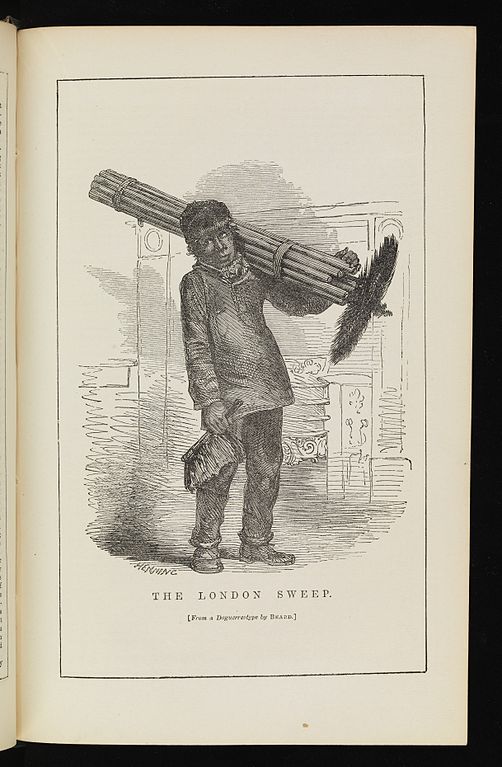
The London Sweep (from a Daguerreotype by BEARD).
Image from London labour and the London poor : a cyclopaedia of the condition and earnings of those that will work, those that cannot work, and those that will not work, 1851, via the Wellcome Collection.
When we think of the British Industrial Revolution, the image that springs to mind tends to be of soot-belching factories and foundries, of child labour and squalid cities. The inventors who spring to mind tend to be James Watt and his steam engines, or Richard Arkwright and his cotton-spinning machines. But what people tend to forget is that the Industrial Revolution was unleashed by a much broader tide of accelerating innovation — as I never tire of repeating, it touched everything from agriculture to watchmaking, and everything inbetween. Just as some inventors pioneered the use of factories, other inventors sought solutions to industrialisation’s social ills.
Last time, I mentioned the Society for the Encouragement of Arts, Manufactures and Commerce, set up in 1754 in a London coffee house (the Society of Arts for short). What’s so fascinating about the organisation — which still exists today, now called “Royal” — is that it was closely involved with many of the more socially-oriented innovations of the period. By this, I mean the kinds of inventions that were rarely immediately profitable, but which aimed to save lives, to alleviate suffering, or to remedy some other social ill. The Society advertised premiums — cash prizes or honorary medals — for solutions to the problems that its members identified. And it offered similar rewards, which they called bounties, for unsolicited inventions.
It awarded a bounty of fifty guineas and a gold medal to Henry Greathead, for example, one of the claimants for the invention of the lifeboat. It gave another fifty guineas to a sergeant of the Royal Artillery, John Bell, for a method of firing a rope and grapple by mortar from a ship to the shore, to save people on board from shipwreck during storms. (Some years later, it even gave a gold medal to another inventor for a device that did the opposite, firing from shore to ship.) The Society awarded a medal to a Sheffield schoolmaster, John Hessey Abraham, for a magnetic apparatus that would prevent metal dust getting into the eyes and lungs of workers employed in grinding the points of needles. And in 1767 it awarded a bounty to a clockmaker, Christopher Pinchbeck, for a safer crane — cranes at the time were like gigantic hamster wheels, but for humans. When lines snapped, the results could be fatal, so Pinchbeck added a pneumatic braking mechanism.
The list goes on — in all, over the course of about a century, the Society of Arts awarded over two thousand premiums and bounties for inventions. But there is one that really stands out: a premium for the invention of a mechanical means of cleaning chimneys. With such an invention, the Society hoped to abolish the employment of children, sometimes as young as 4, who were forced to climb up inside chimneys in order to clean them. These children were sometimes abducted by the master chimney sweeps, and frequently perished in horrific accidents or of soot-induced cancers. Strikingly, the use of climbing boys was thought to be unique to Britain — the “peculiar disgrace of England” as the campaigners put it (though I don’t think this was quite true). The Society’s idea was that if a technological replacement could be found, then the case for outright abolition could be made — they wanted to create a machine to take the children’s jobs.
The Society of Arts played its role with the offer of a premium, but it acted alongside another campaign run by a few of its members, who ran the snappily titled “Society for Superseding the Necessity of Climbing Boys, by Encouraging a New Method of Sweeping Chimnies, and for Improving the Condition of Children and Others Employed by Chimney Sweepers”, founded in 1803 at the London Coffee-House on Ludgate Hill. Let’s call it the SSNCB for short. There had been earlier campaigns to abolish the use of climbing boys, one of the most prominent being run by Jonas Hanway (a prominent philanthropist, also a member of the Society of Arts, whose various claims to fame include being the first man in London to sport an umbrella). But the 1803 campaign was to prove the most successful, drawing on wider political support. The SSNCB’s key members included William Wilberforce, who later became famous for his zeal in abolishing the slave trade.
Girls Armed With Pitchforks – The Women’s Land Army – On the Homefront 002
World War Two
Published 14 Apr 2020Now that the labour-needs and the availability of manpower has changed due to the outbreak of World War Two, Women are required to join the workforce. They’re put to work in the Women’s Land Army.
Join us on Patreon: https://www.patreon.com/TimeGhostHistory
Or join The TimeGhost Army directly at: https://timeghost.tvFollow WW2 day by day on Instagram @World_war_two_realtime https://www.instagram.com/world_war_t…
Between 2 Wars: https://www.youtube.com/playlist?list…
Source list: http://bit.ly/WW2sourcesHosted by: Anna Deinhard
Written by: Spartacus Olsson and Francis van Berkel
Produced and Directed by: Spartacus Olsson and Astrid Deinhard
Executive Producers: Bodo Rittenauer, Astrid Deinhard, Indy Neidell, Spartacus Olsson
Creative Producer: Joram Appel
Post-Production Director: Wieke Kapteijns
Research by: Tom Meaden
Edited by: Mikołaj Cackowski
Map animations: Eastory (https://www.youtube.com/c/eastory)Colorizations by:
Dememorabilia – https://www.instagram.com/dememorabilia/
Julius Jääskeläinen – https://www.facebook.com/JJcolorization/Sources:
IWM A 19891, Q 54607, Q 54601, Q 54602, D 8793, D 204, D 199, D 18050, D 8463, D 18062, D 20722, D 8833, D 2973, D 14123, D 115, D 11256, D 14090, D 8806, TR 911, D 21057, D 128, CH 4119, D 3324, TR 912, D 18057, IWM TR 1568, D 21958, D 8794, TR 913
Picture of Women’s Land Army memorial in Scotland, courtesy of IWM, Martin Briscoe (WMR-69248)
Library of Congress
Portrait of Hilda Gibson, taken 2008 at 10 Downing Street, courtesy BBC PM blog http://www.bbc.co.uk/blogs/pm/2008/07…Soundtracks from the Epidemic Sound:
Johannes Bornlof – “Deviation In Time”
Wendel Scherer – “Defeated”
Johannes Bornlof – “Magnificent March 3”
Reynard Seidel – “Deflection”
Max Anson – “Ancient Saga”
Johannes Bornlof – “The Inspector 4”
Christian Andersen – “Quiet Contemplation”Archive by Screenocean/Reuters https://www.screenocean.com.
A TimeGhost chronological documentary produced by OnLion Entertainment GmbH.
From the comments:
World War Two
22 minutes ago (edited)
This is the second instalment of our monthly ‘On the Homefront’ series and it’s about the Women’s Land Army. Now, with these series we’re planning to cover the events and cultural and social changes that occurred during World War Two, as well as the organisations and individuals that lived through them. As with the other specials, we want to cover all the homefronts, from all nations all across the world. If you have any good ideas for future episodes, please let us know in the comments!
Cheers and stay safe!
Joram