
TimeGhost History
Published 19 May 2021In the winter of 1923, a controversial activist takes a Catholic doctor to trial for libel. The proceedings capture a much bigger moment in the history of the interwar period: the controversial — but inherent — link between birth control and eugenics.
(more…)
May 20, 2021
The Birth Control Movement and Eugenics – A Curious Link | B2W: ZEITGEIST! I E.18 – Winter 1923
Comments Off on The Birth Control Movement and Eugenics – A Curious Link | B2W: ZEITGEIST! I E.18 – Winter 1923
Men Will Be Boys (1970)
British Pathé
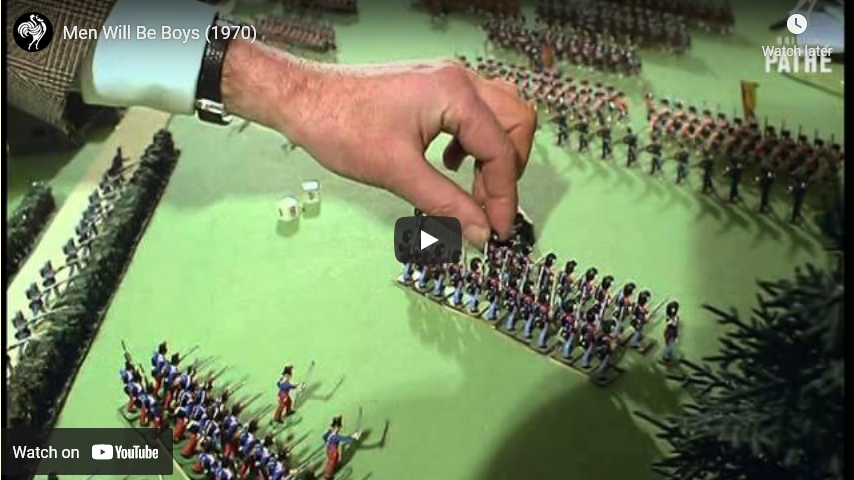
Published 13 Apr 2014Men will be boys. Various locations.
M/S men round lake with boats. C/U man in lake with waders with model boat. C/U another man with model boat. Man lighting boiler. C/U engine working. M/S as model of paddle boat moves through water. M/S paddle boat on water. In foreground a swan. C/U another model boat going through water. M/S pan scale model of Hitler’s yacht. M/S men playing with model cars on race track. C/U cars going round race track. C/U men’s hands on controls. C/U men looking at cars go past. L/S of cars going round race track.
L/S men playing war games with model soldiers. on large table. C/U as man moves soldiers out of line laying them on ground. M/S man moves horses forward. C/U hand placing cannon into position. C/U hand places horse troops in position. M/S lines of soldier. Hand places another in position. M/S of troops being moved.
M/S Mr Victor Martin and wife go through gate by railway crossing dressed up in their uniforms, carrying lamps etc. M/S as they make their way to their signal boxes. C/U railway notice ‘By Midland Railway’. Pa off notice to show Mr Martin approaching his signal box. M/S Martin going into signal box. M/S Mrs Martin going into signal box. C/U Mrs Martin going into signal box. C/U interior. Mr Martin hanging up his jacket inside signal box. He then sits at the controls. C/U signal controls working. C/U of Mr Martin operating signals. Camera zooms back and we see train going past him along track. C/U model train over track. C/U Mrs Martin working in her signal box.
M/S Mrs Martin working signal controls. C/U Mrs Martin. M/S showing trains going over track. C/U trains moving. Camera zooms out to show tracks . C/U trains moving. C/U looking along tunnel showing trains moving. C/U exterior. Signals working. Then camera pans to show where the trains run on an enclosed section out in the open. C/U goods train and passenger train moving. M/S Interior. Trains going over track and Mr Martin at controls.
FILM ID:2241.18A VIDEO FROM BRITISH PATHÉ. EXPLORE OUR ONLINE CHANNEL, BRITISH PATHÉ TV. IT’S FULL OF GREAT DOCUMENTARIES, FASCINATING INTERVIEWS, AND CLASSIC MOVIES. http://www.britishpathe.tv/
FOR LICENSING ENQUIRIES VISIT http://www.britishpathe.com/
British Pathé also represents the Reuters historical collection, which includes more than 136,000 items from the news agencies Gaumont Graphic (1910-1932), Empire News Bulletin (1926-1930), British Paramount (1931-1957), and Gaumont British (1934-1959), as well as Visnews content from 1957 to the end of 1984. All footage can be viewed on the British Pathé website. https://www.britishpathe.com/
Comments Off on Men Will Be Boys (1970)
QotD: Jeeves
Jeeves — my man, you know — is really a most extraordinary chap. So capable. Honestly, I shouldn’t know what to do without him. On broader lines he’s like those chappies who sit peering sadly over the marble battlements at the Pennsylvania Station in the place marked “Inquiries.” You know the Johnnies I mean. You go up to them and say: “When’s the next train for Melonsquashville, Tennessee?” and they reply, without stopping to think, “Two-forty-three, track ten, change at San Francisco.” And they’re right every time. Well, Jeeves gives you just the same impression of omniscience.
As an instance of what I mean, I remember meeting Monty Byng in Bond Street one morning, looking the last word in a grey check suit, and I felt I should never be happy till I had one like it. I dug the address of the tailors out of him, and had them working on the thing inside the hour.
“Jeeves,” I said that evening. “I’m getting a check suit like that one of Mr. Byng’s.”
“Injudicious, sir,” he said firmly. “It will not become you.”
“What absolute rot! It’s the soundest thing I’ve struck for years.”
“Unsuitable for you, sir.”
Well, the long and the short of it was that the confounded thing came home, and I put it on, and when I caught sight of myself in the glass I nearly swooned. Jeeves was perfectly right. I looked a cross between a music-hall comedian and a cheap bookie. Yet Monty had looked fine in absolutely the same stuff. These things are just Life’s mysteries, and that’s all there is to it.
But it isn’t only that Jeeves’s judgment about clothes is infallible, though, of course, that’s really the main thing. The man knows everything. There was the matter of that tip on the “Lincolnshire.” I forget now how I got it, but it had the aspect of being the real, red-hot tabasco.
“Jeeves,” I said, for I’m fond of the man, and like to do him a good turn when I can, “if you want to make a bit of money have something on Wonderchild for the ‘Lincolnshire.'”
He shook his head.
“I’d rather not, sir.”
“But it’s the straight goods. I’m going to put my shirt on him.”
“I do not recommend it, sir. The animal is not intended to win. Second place is what the stable is after.”
Perfect piffle, I thought, of course. How the deuce could Jeeves know anything about it? Still, you know what happened. Wonderchild led till he was breathing on the wire, and then Banana Fritter came along and nosed him out. I went straight home and rang for Jeeves.
“After this,” I said, “not another step for me without your advice. From now on consider yourself the brains of the establishment.”
“Very good, sir. I shall endeavour to give satisfaction.”
And he has, by Jove! I’m a bit short on brain myself; the old bean would appear to have been constructed more for ornament than for use, don’t you know; but give me five minutes to talk the thing over with Jeeves, and I’m game to advise any one about anything.
P.G. Wodehouse, “Leave it to Jeeves”, My Man Jeeves, 1919.
Comments Off on QotD: Jeeves
May 19, 2021
The ginger Windsor loose cannon on “bonkers” free speech protection in the United States
James Delingpole on the latest unfortunate burble from one of the much lesser members of the House of Windsor:
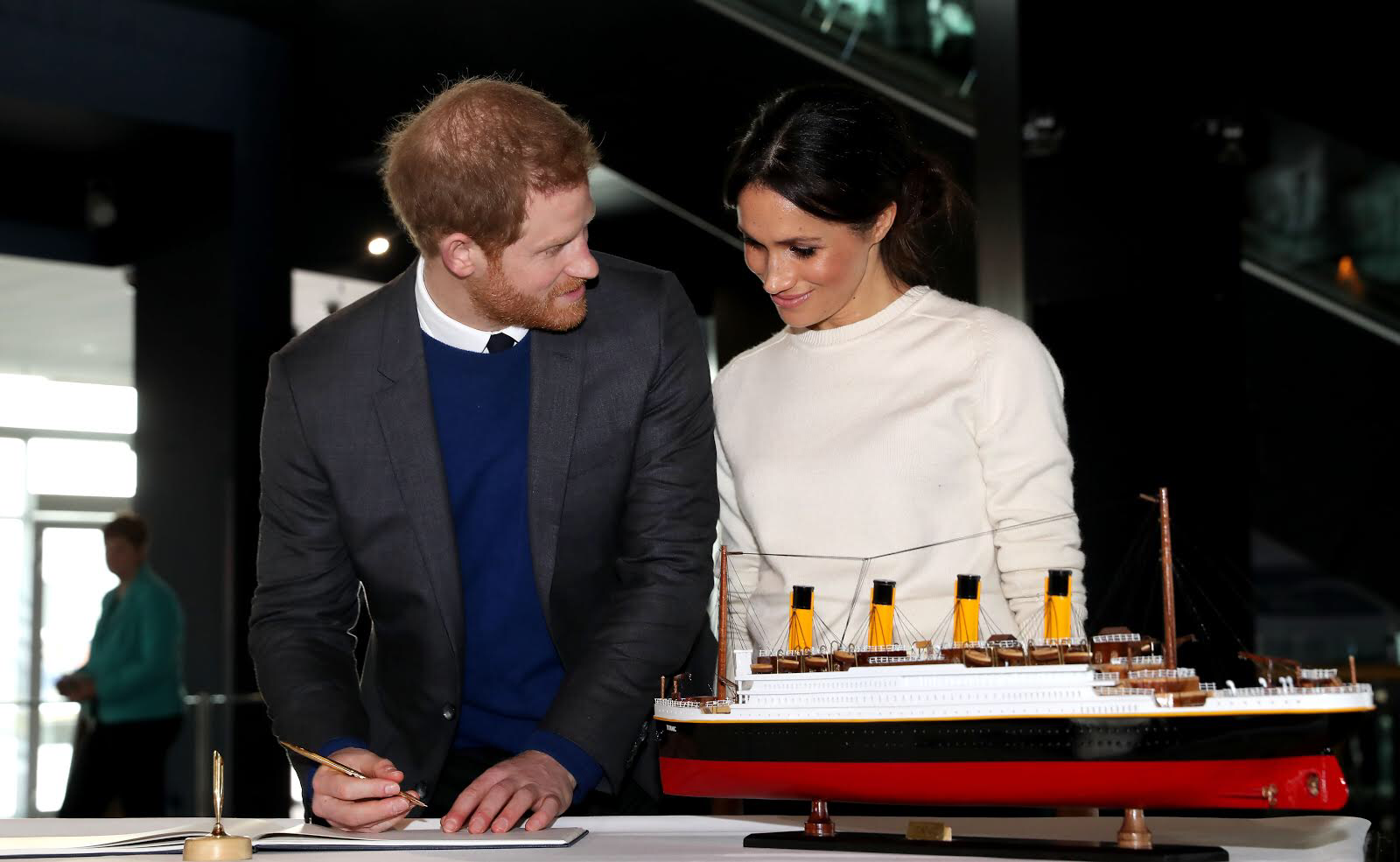
Prince Harry and Meghan Markle visit Titanic Belfast in March 2018.
Photo from the Northern Ireland Office via Wikimedia Commons.
Prince Harry’s epic stupidity is probably inherited from his presumed father, the Prince of Wales. Prince Charles, too, only got two A levels — a B in History and a C in French — yet somehow strings were pulled to land him a place at Cambridge University (normally it would have required something like three A grades at A Level, plus a decent performance in the entrance exam), where he scraped a lowly 2:2 in History.
There is, of course, nothing wrong with being epically, fabulously, unbelievably stupid. Many upper-class men successfully make their brainlessness part of their comical charm. Where stupidity becomes unattractive and culpable, though, is when it’s deployed to comment on issues far, far above its pay grade, and when it’s afforded undeserved prestige.
No one as thick as Harry, it’s surely a given, ought ever be allowed on to a public platform to pronounce on issues as vital as the protection of free speech. Yet this is exactly what happened when Harry was given space to expound his half-baked views on a podcast. Sure, Harry had the good grace to admit that he hadn’t a clue what he was talking about:
I don’t want to start going down the First Amendment route because that’s a huge subject and one which I don’t understand because I’ve only been here a short time.
Unfortunately, that didn’t stop him declaring that he thought the First Amendment was “bonkers”.
His explanation as to why he thought so was a bit incoherent, but it seemed to involve his belief that it could be used for something bad called “ideology” and could be used as an excuse to “spread hate”. He added: “Laws were created to protect people.” What I’m guessing Harry was struggling to do was to try to wheel out the woke cliche that while free speech is fine, “hate speech” isn’t fine and should not enjoy constitutional protection. This threadbare argument can be demolished in a second by anyone with more than two A Levels. Essentially if “free speech” laws don’t protect “hate speech” then they are not really free speech protection laws at all.
Like Prince Harry, I wouldn’t consider myself to be an expert on U.S. history. But I do dimly recall that round about the second half of the 18th century America’s colonists successfully freed themselves from rule by one of Prince Harry’s ancestors. The U.S. Constitution — and that pesky First Amendment — was one of the consequences.
Comments Off on The ginger Windsor loose cannon on “bonkers” free speech protection in the United States
Why Did We Stop Wearing Hats?
Karolina Żebrowska
Published 28 Apr 2020should we bring hats back? what do you think?
_____________
My Instagram: https://bit.ly/2Qo9rrI
My nudes: https://bit.ly/2UHHY6N
My merch: bit.ly/2CCq5jE

Comments Off on Why Did We Stop Wearing Hats?
May 18, 2021
What is Maskirovka? Russian Military Deception #Military101
Military History Visualized
Published 5 May 2017A short introduction into Russian Military Deception — called Maskirovka. “Maskirovka is most simply defined as a set of processes designed to mislead, confuse, and interfere with accurate data collection regarding all areas of Soviet plans, objectives, and strengths or weaknesses.” (Smith, Charles L.: “Soviet Maskirovka“, in: Airpower Journal – Spring 1988)
Military History Visualized provides a series of short narrative and visual presentations like documentaries based on academic literature or sometimes primary sources. Videos are intended as introduction to military history, but also contain a lot of details for history buffs. Since the aim is to keep the episodes short and comprehensive some details are often cut.
» HOW YOU CAN SUPPORT MILITARY HISTORY VISUALIZED «
(A) You can support my channel on Patreon: https://www.patreon.com/join/mhv(B) You can also buy “Spoils of War” (merchandise) in the online shop: https://www.redbubble.com/people/mhvi…
» SOCIAL MEDIA LINKS «
twitter: https://twitter.com/MilHiVisualized
tumblr: http://militaryhistoryvisualized.tumb…» SOURCES «
Maier, Morgan: A Little Masquerade: Russia’s Evolving Employment of Maskirovka
http://cgsc.contentdm.oclc.org/cdm/si…Smith, Charles L.: “Soviet Maskirovko“, in: Airpower Journal – Spring 1988
http://www.airpower.maxwell.af.mil/ai…Lindley-French, Julian: NATO: Countering Strategic Maskirovka. Canadian Defence & Foreign Affairs Institute. (2015)
Glantz: The Red Mask: The Nature and Legacy of Soviet Military Deception in the Second World War
https://en.wikipedia.org/wiki/Russian…
Keating, Kenneth: The Soviet System of Camouflage
http://www.dtic.mil/dtic/tr/fulltext/…Krueger, Daniel: Maskirovka – What’s in it for us?
http://www.dtic.mil/dtic/tr/fulltext/…» TOOL CHAIN «
PowerPoint 2016, Word, Excel, Tile Mill, QGIS, Processing 3, Adobe Illustrator, Adobe Premiere, Adobe Audition, Adobe Photoshop, Adobe After Effects, Adobe Animate.» CREDITS & SPECIAL THX «
Song: Ethan Meixsell – “Demilitarized Zone”

Comments Off on What is Maskirovka? Russian Military Deception #Military101
SMLE MkI***: The Updated Early Lee Enfields (and Irish Examples!)
Forgotten Weapons
Published 3 Feb 2021http://www.patreon.com/ForgottenWeapons
https://www.floatplane.com/channel/Fo…
Cool Forgotten Weapons merch! http://shop.bbtv.com/collections/forg…
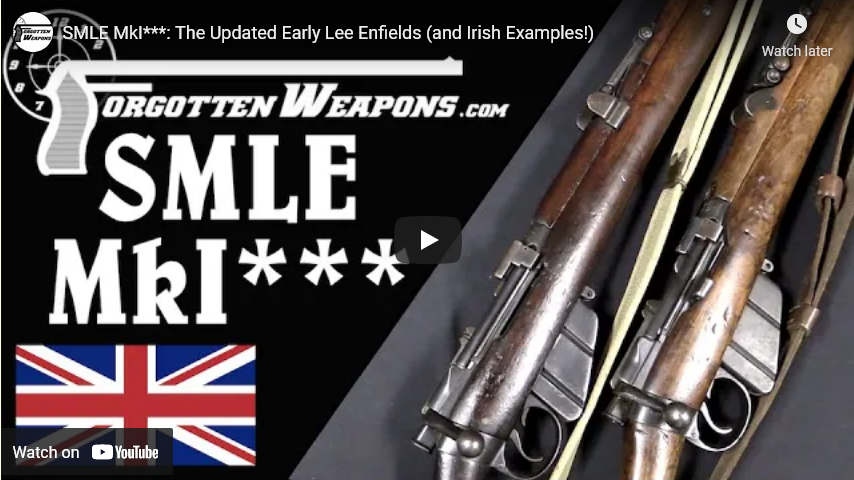
When the British adopted a new high-velocity spitzer bullet for the .303 cartridge, they had to update their rifles to use it. Specifically, the sights had to be recalibrated for the flatter trajectory of the new MkVII ammunition. In addition, the sight picture was changed from a barleycorn front and V-notch rear to the more precise square front post and rear U-notch.
These rifles are quite scarce, but several thousand were brought into the US in the early 1960s as surplus from Ireland. These Irish examples all had new serial numbers applied when the were sent to Ireland by the British in the 1920s, and they are in two different batches (one in MkI*** configuration, and one with the MkIII rear sight). We will take a look at both patterns today as well, so you can see the difference between the much more available Irish type and the pure British version.
Contact:
Forgotten Weapons
6281 N. Oracle #36270
Tucson, AZ 85740
Comments Off on SMLE MkI***: The Updated Early Lee Enfields (and Irish Examples!)
May 17, 2021
Christopher Hitchens – On EconTalk discussing George Orwell [2009]
CaNANDian
Published 25 Sep 2012Christopher Hitchens talked with EconTalk host Russ Roberts about George Orwell. Drawing on his book Why Orwell Matters, Hitchens talked about Orwell’s opposition to imperialism, fascism, and Stalinism, his moral courage, and his devotion to language. Along the way, Hitchens made the case for why Orwell matters.
Download audio: http://www.econtalk.org/archives/2009…

Comments Off on Christopher Hitchens – On EconTalk discussing George Orwell [2009]
An older BBC dramatization on the slave trade that seems to have gone down the memory hole
At Samizdata, Niall Kilmartin wondered why the BBC hadn’t gotten around to showing a 1970s historical series through the year-and-more of the pandemic lockdowns. He doesn’t mention the name of the series, and an unusually unhelpful BBC site search didn’t turn up a name but IMDB suggests it was 1975 and the series was called The Fight Against Slavery:
Fifty years ago, the BBC screened a dramatised documentary series about the fight to abolish the slave trade. Even a year of the virus limiting new series, at a time of great BBC eagerness to talk about racism, has not made them screen it again.
– I see one reason why they have not: the series displayed sleazy white slave traders and abusive white slave owners prominently, but it also showed white people eager to end the slave trade and (much worse) black people eager to continue it. It included the king of Dahomey’s threat: “if you do not allow me to sell you my slaves, their fate will be a great deal worse” (a very brief scene of the Dahomey murder spectacle lent meaning to his remark). After abolition was voted, it showed a white slave trader assuring the Dahomans, as a drug dealer might his suppliers, “It is one thing for parliament to pass a law …”, hinting at the Royal Navy’s long and hard campaign to enforce it.
– Only recently did I spot another reason why they would not want to show it again – the scene in which a corrupt old white slave trader warns his young colleague that “it’s more than your life’s worth” to doubt the ability of their slave-selling hosts to count very accurately the quantity of trade goods being handed over in exchange, and to assess their quality knowledgeably. The traders well knew that Africans counted two plus two as four, just as they did. Any trader who imagined that black ability to add diverged enough from white to enable an attempt to short-change them had learned otherwise long before the 1780s.
– The southern Confederacy thought the same. Until its death throes, it forbade enlisting a southern black as a Confederate soldier because, as one Confederate senator put it, “If blacks can make good soldiers then our whole theory of slavery is wrong.” (Perhaps also because even southern white Democrats realised that southern black desire to fight against blacks being freed was likely to be a very minority taste.) But there was one exception. Every regiment had its regimental band, which played to set the pace at the start and end of marches, used trumpets to signal commands in battle – and fought when other duties did not supervene. From its start to its end, Confederate law said any black could enlist as bandsman, with the same pay and perquisites as a white – a very rare example of formal legal equality. (Playing music requires the ability to count time. For the woke, “dismantling the legacy of the Confederacy” apparently includes dismantling its realisation – shared by the Victorian composer Dvorak – that blacks often excelled in music so much as to overcome prejudice against black ability. Today, it’s “racist” to value instrumental skill.)
“Politically correct” has meant “actually wrong” ever since the first commissar explained to the first party comrade that it was neither socialist nor prudent to notice a factual error in the party line. “Structurally racist” is PC’s modern companion. No longer are the woke content merely to imply (“mathematics is racist”, “punctuality is racist”, “politeness is racist”) that blacks can’t count, can’t tell the time and can only behave crudely. They’re starting to say it in words of fewer syllables.
If I’d scrolled down to the comments, I’d have discovered that Natalie Solent had also dug up the name of the series:
Natalie Solent (Essex)
May 10, 2021 at 4:30 pm
Outstanding post, Niall. Was the BBC series you mentioned “The Fight Against Slavery“, written and narrated by Evan Jones? I have not seen it – given that I was ten or eleven in 1975 my parents probably thought I was too young too see it.However someone called “InternetPilgrim” has put up three videos of the series on YouTube. There is a link to Part I here, Part II here and Part III here, so I will try to remedy that lack soon.
Comments Off on An older BBC dramatization on the slave trade that seems to have gone down the memory hole
QotD: Orpheus and Eurydice
Orpheus descends into Hades to retrieve his bride, Eurydice. In the account we read in Virgil’s Georgics, the point of the tale is already slightly smoothed, blunted. Orpheus has made the mistake of looking back on her countenance, when he is almost home. He has emerged in the sun, but she is still in the shadows. As he looks back, she recedes, disappears; she is now lost forever. In modern “education” we used to weep for the tragedy. He almost succeeded. It is a tragedy, strictly in the Roman pagan sense.
But it was a tragedy in the Greek sense, first. If we go instead to Plato, and listen to the aristocratic Phaedrus in the Symposium, we learn that Orpheus was thoroughly in the wrong, in his attempt to retrieve Eurydice. He was bound to be punished. His mistake was not a technicality. His living descent into Hades was a challenge not only to the gods, but to nature, and to the truth of things. His love for Eurydice, so affecting in his mournful dirges — moving everyone to tears — was not true love. A coward, he would not die for it.
Hades has presented him with a wraith, in Eurydice’s outward form. Inevitably, this illusion would dissolve in the sunlight. And the fate of Orpheus was now set — the fate of an eloquent softie, who loves an imaginary woman — a woman he had created from the start. He will die at the hands of the real ones he rejected. He will be torn apart by the Maenads, as by wild beasts. His lyre will be destroyed. This is the fate of our shallow romantic star; the pretty boy whose lyre and whose voice had once been an enchantment.
Boethius deals with that backward gaze, in the Consolations of Philosophy. We who seek to lead into the light of the upper day — we triumphalist philosophers — are bound to look back into the Tartarean cave. And when we do, the clarity of our “vision” will be obscured; then ruined, totally. To guide we must be guided; or all will be lost.
David Warren, “A backward glance”, Essays in Idleness, 2021-02-09.
Comments Off on QotD: Orpheus and Eurydice
May 16, 2021
Joseph Stalin Jumps the Gun – 142 – May 16, 1942
World War Two
Published 15 May 2021The Soviets pre-empt a German offensive with one of their own in the south of the Eastern Front, but that’s not the only fighting. The skies over Malta and the waters of the Gulf of St. Lawrence are full of action. Meanwhile, two races against time — and the Japanese — come to an end in India.
(more…)
Comments Off on Joseph Stalin Jumps the Gun – 142 – May 16, 1942
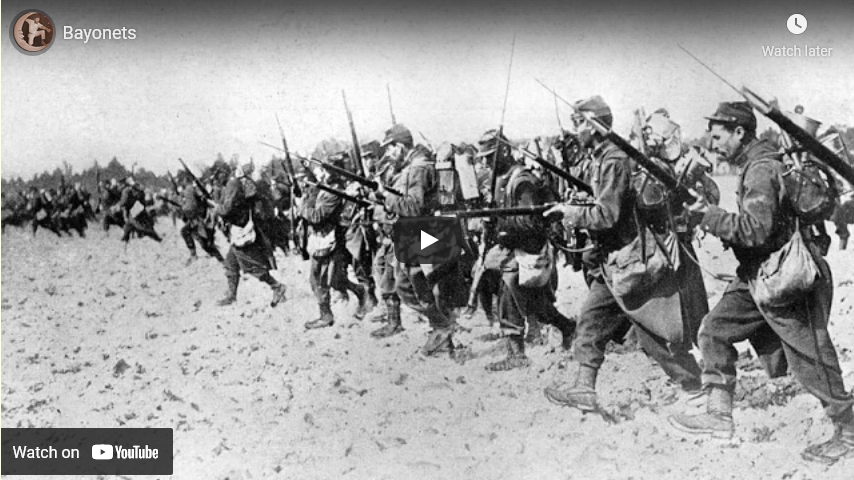
Bayonets
Lindybeige
Published 26 Feb 2011A weapon can be very effective even if it never actually kills anyone.
Support me on Patreon: https://www.patreon.com/Lindybeige
Lindybeige: a channel of archaeology, ancient and medieval warfare, rants, swing dance, travelogues, evolution, and whatever else occurs to me to make.
▼ Follow me…
Twitter: https://twitter.com/Lindybeige I may have some drivel to contribute to the Twittersphere, plus you get notice of uploads.
website: www.LloydianAspects.co.uk
May 14, 2021
100,000 Dead British Subjects in Burma – WAH 034 – May 1942, Pt. 1
World War Two
Published 13 May 2021A large number of European and asian inhabitants of South-East Asia are locked up in Japanese prison camps, while in Burma, a big refugee crisis claims the lives of thousands. In Auschwitz-Birkenau and Sobibor, gassing Jews on an immense scale begins.
(more…)
Comments Off on 100,000 Dead British Subjects in Burma – WAH 034 – May 1942, Pt. 1
Tank Chats Special | Pak 43/41 Anti-Tank Gun | The Tank Museum
The Tank Museum
Published 18 Sep 2020The Tank Museum’s Archive and Library Manager Stuart Wheeler presents this Tank Chat Special on the Pak 43/41. Find out the history behind the infamous anti-tank gun and the story behind how it came to be in The Tank Museum’s collection — from its time as a gate-guard, to its restoration, and finally its display in the Museum.
Support the work of The Tank Museum on Patreon: ► https://www.patreon.com/tankmuseum
Visit The Tank Museum SHOP & become a Friend: ► tankmuseumshop.orgTwitter: ► https://twitter.com/TankMuseum
Instagram: ► https://www.instagram.com/tankmuseum/
#tankmuseum #tanks

Comments Off on Tank Chats Special | Pak 43/41 Anti-Tank Gun | The Tank Museum
May 11, 2021
Wheellocks – Real or Fake? And What is “Fake”, Really?
Forgotten Weapons
Published 16 Aug 2016http://www.patreon.com/ForgottenWeapons
When someone makes a “fake” historical gun, they can do so with the intent to deceive or be up-front with the gun’s new manufacture. Those acknowledged reproductions are a great option to have — guns like Uberti reproduction revolvers give us an excellent opportunity to shoot antique designs without the cost of true originals and without the risk of damaging them. On the other hand, creating “antiques” fraudulently to deceive someone into believing they are actually originals is a reprehensible practice.
What about when you don’t know, though? In the Victorian era, it was popular to have fancy antique guns — like these wheellock pistols. Just like today, not everyone could afford to actually go buy a 300-year-old ornate gun, though. So, many people would commission new replicas made (and I’m sure plenty of fraudulent copies were created as well). Fast forward a hundred years or more to the present day, and we have a bit of a conundrum for the potential buyer. Is a gun 100 years old or 400? It takes some substantial experience and knowledge to be able to tell the difference — and yet an acknowledged Victorian copy is still a potentially fantastic piece of workmanship and collectible in its own right.

Comments Off on Wheellocks – Real or Fake? And What is “Fake”, Really?


