Quotulatiousness

December 15, 2021

Why Real Wasabi Is So Expensive | So Expensive

Filed under: Britain, Business, Environment, Food, Japan — Tags: , — Nicholas @ 02:00

Business Insider
Published 19 Jan 2019

The green paste you’ve been eating with your sushi isn’t really wasabi. If you check the ingredients on the packet, you might see a mixture of sweetener, horseradish and perhaps a small percentage of the real thing. Real wasabi is hard to come across and it can cost $250 per kilo. So what actually is wasabi, and why is it so expensive?

For more from The Wasabi Company, go to: https://www.thewasabicompany.co.uk/

——————————————————

#Wasabi #Expensive #BusinessInsider

Business Insider tells you all you need to know about business, finance, tech, retail, and more.
BI on Instagram: https://read.bi/2Q2D29T
BI on Twitter: https://read.bi/2xCnzGF

December 14, 2021

Minoan Civilization

Filed under: Europe, History — Tags: , , , , , , — Nicholas @ 04:00

Thersites the Historian
Published 25 Jan 2018

In this video, I look at the Bronze Age civilization on Crete known as the Minoans.

Chatellerault M24/29: France’s New Wave of Post-WWI Small Arms

Filed under: France, History, Military, Weapons, WW2 — Tags: , , , , , — Nicholas @ 02:00

Forgotten Weapons
Published 26 Aug 2017

France fought the Great War with an array of weapons which were all sub-par in one way or another — the Lebel rifle was obsolescent by 1914, the Berthier was a cavalry carbine forced into rifle service, the Chauchat was an emergency wartime design optimized for production volume instead of quality, and the handguns were a mixture of old revolvers and desperate imports from Spain. Once the war finally ended, the French military would move to replace the whole lot with new and modern arms.

This would begin by finally replacing the 8mm Lebel cartridge with a non-tapered, rimless cartridge — something that would be well suited to use in magazines and repeating arms. Simultaneously, a new light machine gun would be found, as this was deemed to most important improvement to be made. The cartridge was adopted in 1924 as the 7.5x58mm, but it would soon be realized that there was a critical problem with that round. The French military had a large supply of German arms taken as war reparations, and the new 7.5mm cartridge looked very similar to the 8x57mm Mauser cartridge. Worse, the Mauser round would chamber and fire in the new French chambers, causing serious damage to guns when the 8mm bullet was squeezed down to 7.5mm. To fix this issue, the French cut their cartridge down by 4mm, resulting in the 1929 adoption of the 7.5x54mm round — the chamber of which would no longer fit a German 8mm round.

As for the machine gun, the first choice was to simply adopt the Browning BAR — but France insisted on obtaining the technical data package and producing the guns in France, and they could not come to an agreement with Colt over the price of such a license. So, the French held trials of other guns, looking at virtually everything then available. In the aftermath of the trials, it was decided that the Chatellerault arsenal could design its own weapon using the best features of the other existing guns. The arsenal rather quickly produced prototypes, and they were adopted in 1924 (and then updated to use the shorter version of the 7.5mm cartridge in 1929).

The Chatellerault M24/29 is a quite good weapon, especially considering how early it was designed. It uses a tilting bolt and a top-mounted 25 round magazine. It has two triggers, the front one firing in semiautomatic and the rear one in fully automatic. The wooden front handguard allows for fire from the hip or shoulder if desired, and a set of thorough dust covers keep the gun free from ingress of mud or dirt. About 188,000 would be manufactured, and it would stay in service for many decades.

http://www.patreon.com/ForgottenWeapons

Cool Forgotten Weapons merch! http://shop.bbtv.com/collections/forg…

If you enjoy Forgotten Weapons, check out its sister channel, InRangeTV! http://www.youtube.com/InRangeTVShow

QotD: Insulated from reality

To understand the green movement, really understand it, you could do worse than look at the photographs of today’s vast tailbacks on the M25. Here were thousands of ordinary people – workers, deliverymen, mums and dads, holidaymakers – delayed for hours by the self-righteousness of middle-class greens. Activists from a group called Insulate Britain – which, almost comically, agitates for the insulation of British homes – blocked various junctions on the M25, causing distress to people who had places to be. It was eco-elitism distilled: the sanctimonious zealots of the green religion disrupting the lives of the plebs to make some daft point.

The first notable thing about today’s act of public nuisance masquerading as a protest was the hilarity of the campaign group itself. Remember when radicals fought for higher wages or better working conditions or for a revolution to replace capitalism with something else? Not anymore. Today’s self-styled militants demand the insulation of houses. “What do we want? The creation of a thermal envelope in people’s homes! When do we want it? Now!” What a crock to go to the barricades for. Also notable is the irony of supposed planet-lovers causing so much pollution by forcing hundreds of cars and trucks to sit still for ages, chugging fumes into the air for nought. Well played, greenies.

But the most striking thing about these kinds of protests is their sheer arrogance. Their inherently anti-democratic, anti-masses nature, where the aim is always, but always, to inconvenience the little people and teach us a lesson. You’re on your way to Heathrow for a much-needed jaunt to Malaga to escape the stresses of work? Not anymore, you’re not – the eco-elitists blocked junction 14, which leads to one of Heathrow’s terminals. You’re a knackered trucker who’s been driving all night long and now wants to get back to his family? Tough shit. These plummy alarmists have decided to make you the collateral damage of one of their narcissistic stunts.

Brendan O’Neill, “Environmentalism is a revolt against the people”, Spiked, 2021-09-13.

December 13, 2021

The Battle of Cannae (216 B.C.E.)

Filed under: Africa, Europe, History, Italy, Military — Tags: , , , , — Nicholas @ 02:00

Historia Civilis
Published 29 Jun 2015

Patreon | http://historiacivilis.com/patreon
Donate | http://historiacivilis.com/donate
Merch | http://historiacivilis.com/merch
Twitter | http://historiacivilis.com/twitter
Website | http://historiacivilis.com

Music is Beethoven’s “Sonata No. 32 in C Minor, Op. 111” – I. Maestoso – Allegro con brio ed appassionato, performed by Daniel Veesey

QotD: Cultural undermining of the British “establishment” was effectively complete by 1970

Filed under: Britain, History, Media, Politics, Quotations — Tags: , , , , — Nicholas @ 01:00

Beyond the Fringe, Forty Years On and TW3 created a tradition of “anti-establishment” comedy which continued long after its roots were forgotten. There may still have been an “establishment” of snobbery, church, monarchy, clubland and old-school-tie links in 1961. There was no such thing ten years later, but it suited the comics and all reformers to pretend that there was and to continue to attack this mythical thing. After all, if there were no snobbery, no crusty old aristocrats and cobwebbed judges, what was the moral justification for all this change, change which benefited the reformers personally by making them rich, famous and influential?

[…]

It also made the middle class, especially the educated and well-off middle class, despise themselves and feel a sort of shame for their supposedly elitist prejudices, based upon injustice and undermined by their failure to defend the nation from its enemies in the era of appeasement. Thanks to this, in another paradox, they have often felt unable to defend things within Britain which they value and which help to keep them in existence, from the grammar schools to good manners. They are ashamed of being higher up the scale, though for most middle-class people this is more a matter of merit than birth, and nothing to be ashamed of at all.

[…]

Since the 1960s, when the Left began its conquest of the cultural battlements, it has always been surprised and annoyed by Tory election victories. The 1970 Tory triumph, though entirely predictable, took the cultural establishment by surprise. The 1979 Tory win, though even more predictable, infuriated them. They had won control of broadcasting, of the schools, of the universities, the church, the artistic, musical and architectural establishment? How was it possible that they could not also be the government? Their rage was enormous, and increased with each successive Labour defeat. It was an injustice. How could the people be so foolish? Now, instead of aristocratic snobs misgoverning the country, the establishment was portrayed as a sort of fascistic semi-dictatorship, hacking at the NHS and the welfare state, waging aggressive wars abroad and enriching itself while the poor lived in misery.

This series of falsehoods has now become a weapon ready and waiting for unscrupulous demagogues to harness, and perhaps use against the new “establishment” which has benefited so much from the satire boom and the alternative comedians. Once you have begun to use dishonest mockery as a weapon, you can never be entirely sure that it will not eventually be turned against you, by others who have learned that abuse and jeering pay much easier and swifter dividends than hard fact or serious argument. It could be that the civilized mirth of the sixties leads in a direct line to the crude hyena cackling of the mob. In any case, there is no sign of the humour industry taking the side of traditional morality, patriotism or civility. The best it can do is dignify itself with noisy and public collections for sentimental and prominent charity. Once you step beyond the fringe, you sooner or later find yourself in very wild country indeed.

Peter Hitchens, The Abolition of Britain, 1988.

December 12, 2021

One Year Since Pearl Harbor – WW2 – 172 – December 11, 1942

World War Two
Published 11 Dec 2021

The Japanese try and fail to supply their starving soldiers. The Allies fail to break through in Tunisia and New Guinea. The fighting in the USSR is bloody, but the Axis prepare for a new offensive there.
(more…)

How They Did It – Pet Dogs in Ancient Rome

Filed under: Europe, History — Tags: , , , — Nicholas @ 02:00

Invicta
Published 12 Sep 2018

Our history with man’s best friend stretches far into the past. Today we take a look at the lives of dogs in ancient Rome; how they named, trained, and raised them.

Bibliography:
Xenophon and Arrian: On Hunting (1999) translated by A. A. Phillips and M. M. Willcock
Metamorphoses Book III by Ovid
Names of Dogs in Ancient Greece by Adrienne Mayor
Greek and Roman Household Pets by Francis D. Lazenby

Artwork:
Beverly Johnson (https://www.behance.net/bevsi)

Music:
“Strings and Drums Comedy” by 8th Mode Music
“Emotional” by 8th Mode Music

#RomanHistory
#HowTheyDidIt

QotD: Britain’s alienated intelligentsia of the 1930s

Filed under: Britain, History, Politics, Quotations, WW2 — Tags: , , , , — Nicholas @ 01:00

In intention, at any rate, the English intelligentsia are Europeanized. They take their cookery from Paris and their opinions from Moscow. In the general patriotism of the country they form a sort of island of dissident thought. England is perhaps the only great country whose intellectuals are ashamed of their own nationality. In left-wing circles it is always felt that there is something slightly disgraceful in being an Englishman and that it is a duty to snigger at every English institution, from horse racing to suet puddings. It is a strange fact, but it is unquestionably true that almost any English intellectual would feel more ashamed of standing to attention during “God save the King” than of stealing from a poor box. All through the critical years many left-wingers were chipping away at English morale, trying to spread an outlook that was sometimes squashily pacifist, sometimes violently pro-Russian, but always anti-British. It is questionable how much effect this had, but it certainly had some. If the English people suffered for several years a real weakening of morale, so that the Fascist nations judged that they were “decadent” and that it was safe to plunge into war, the intellectual sabotage from the Left was partly responsible. Both the New Statesman and the News-Chronicle cried out against the Munich settlement, but even they had done something to make it possible. Ten years of systematic Blimp-baiting affected even the Blimps themselves and made it harder than it had been before to get intelligent young men to enter the armed forces. Given the stagnation of the Empire, the military middle class must have decayed in any case, but the spread of a shallow Leftism hastened the process.

It is clear that the special position of the English intellectuals during the past ten years, as purely negative creatures, mere anti-Blimps, was a by-product of ruling-class stupidity. Society could not use them, and they had not got it in them to see that devotion to one’s country implies “for better, for worse”. Both Blimps and highbrows took for granted, as though it were a law of nature, the divorce between patriotism and intelligence. If you were a patriot you read Blackwood’s Magazine and publicly thanked God that you were “not brainy”. If you were an intellectual you sniggered at the Union Jack and regarded physical courage as barbarous. It is obvious that this preposterous convention cannot continue. The Bloomsbury highbrow, with his mechanical snigger, is as out-of-date as the cavalry colonel. A modern nation cannot afford either of them. Patriotism and intelligence will have to come together again. It is the fact that we are fighting a war, and a very peculiar kind of war, that may make this possible.

George Orwell, “The Lion And The Unicorn: Socialism and the English Genius”, 1941-02-19.

December 11, 2021

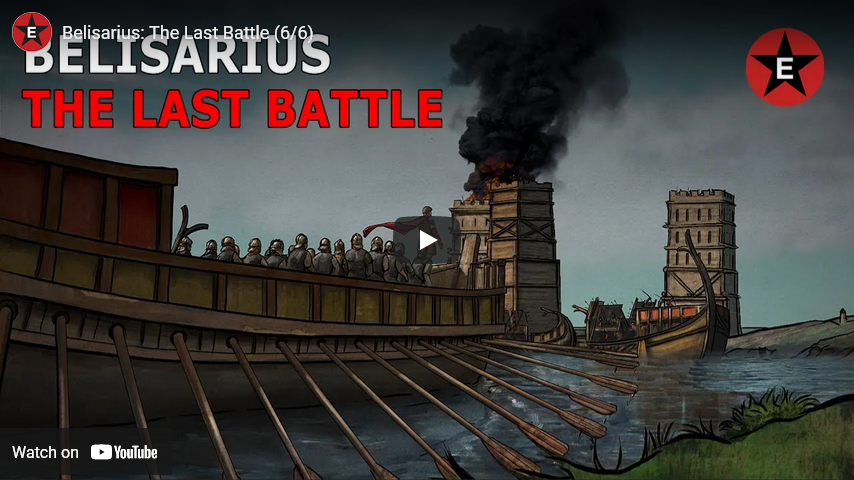
Belisarius: The Battle of Rome

Epic History TV
Published 10 Dec 2021

Thank you to our sponsor Private Internet Access.
Get the Epic History TV special offer using this link: https://www.privateinternetaccess.com…

Big thanks to Legendarian for Total War: Attila gameplay footage, check out his YouTube channel here: https://www.youtube.com/channel/UCOI2…

Thanks also to our series consultant Professor David Parnell of Indiana University Northwest, who you can follow on Twitter here: https://twitter.com/byzantineprof

Total War: Attila gameplay footage used with kind permission of Creative Assembly — buy the game here: https://geni.us/qDreR

Support Epic History TV on Patreon from $1 per video, and get perks including ad-free early access & votes on future topics https://www.patreon.com/EpicHistoryTV

🎨 Original artwork by Miłek Jakubiec https://www.artstation.com/milek

📚Recommended reading (as an Amazon Associate I earn from qualifying purchases):
📖 Procopius, History of the Wars https://geni.us/L3Pgc
📖 The Wars of Justinian by Michael Whitby https://geni.us/Xxrd3
📖 Rome Resurgent by Peter Heather https://geni.us/ZFoU1
📖 The Armies of Ancient Persia: the Sassanians by Kaveh Farrokh https://geni.us/jMQo3z
📖 Late Roman Cavalryman AD 236–565 (Osprey) by Simon MacDowall https://geni.us/XMGl

👕 Buy EHTV t-shirts, hoodies, mugs and stickers here! teespring.com/en-GB/stores/epic-histo…

🎶Music from Filmstro: https://filmstro.com/?ref=7765
Get 20% off an annual license with this exclusive code: EPICHISTORYTV_ANN

#EpicHistoryTV #RomanEmpire #EasternRomanEmpire #Justinian #Belisarius #ByzantineEmpire #Romans

The Stahlhelm

Filed under: Germany, History, Military, WW1, WW2 — Tags: , , — Nicholas @ 04:00

World War Two
Published 10 Dec 2021

The Stahlhelm. Perhaps the most iconic symbol of German military power, ever present in images of the war. Hitler believes it strikes fear in his enemies and makes his own troops fearless. But where does it come from and why is it so enduring?
(more…)

December 10, 2021

The Frozen Battlefields of France – Battle of Beaugency 1870

Filed under: France, Germany, History, Military — Tags: , , — Nicholas @ 06:00

Real Time History
Published 9 Nov 2021

Support us on Patreon: https://patreon.com/realtimehistory

On the frozen battlefields of France, the exhausted German and French armies are still fighting. The Battle of Beaugency sees a desperate struggle in which soldiers on both sides suffer from the harsh winter conditions. Meanwhile, the Siege of Paris continues to starve the population of the French capital.

» THANK YOU TO OUR CO-PRODUCERS
John Ozment
James Darcangelo
Jacob Carter Landt
Thomas Brendan
James Giliberto
Kurt Gillies
Albert B. Knapp MD
Tobias Wildenblanck
Richard L Benkin
Scott Deederly
John Belland
Adam Smith
Taylor Allen
Jim F Barlow
Rustem Sharipov

» OUR PODCAST
https://realtimehistory.net/podcast – interviews with historians and background info for the show.

» LITERATURE
Arand, Tobias: 1870/71. Der Deutsch-Französische Krieg erzählt in Einzelschicksalen. Hamburg 2018

Buk-Swienty, Tom: Feuer und Blut. Hauptmann Dinesen. Hamburg 2014

Gouttman, Alain: La grande défaite. 1870-1871. Paris 2015

» SOURCES
Chanzy, Général: La deuxième Armée de la Loire. Paris 1872

Goncourt, Edmond de: Journal des Goncourts. II.1. 1870-1871. Paris 1890

Horne, Alistair: Es zogen die Preußen wohl über den Rhein. Bern, München, Wien 1967

Kühnhauser, Florian: Kriegs-Erinnerungen eines Soldaten des königlich bayerischen Infanterie Leibregiments. Partenkirchen 1898

Sarcey, Francisque: Le siege de Paris: impressions et souvenirs. Paris 1871

» OUR STORE
Website: https://realtimehistory.net

»CREDITS
Presented by: Jesse Alexander
Written by: Cathérine Pfauth, Prof. Dr. Tobias Arand, Jesse Alexander
Director: Toni Steller & Florian Wittig
Director of Photography: Toni Steller
Sound: Above Zero
Editing: Toni Steller
Motion Design: Philipp Appelt
Mixing, Mastering & Sound Design: http://above-zero.com
Maps: Battlefield Design
Research by: Cathérine Pfauth, Prof. Dr. Tobias Arand
Fact checking: Cathérine Pfauth, Prof. Dr. Tobias Arand

Channel Design: Battlefield Design

Contains licensed material by getty images
All rights reserved – Real Time History GmbH 2021

How WW2 Created a Welfare State – WW2 – On the Homefront 013

Filed under: Britain, Economics, Government, History, WW2 — Tags: , , , — Nicholas @ 04:00

World War Two
Published 9 Dec 2021

In predicament due to the extreme situation of war, people are in dire need for a working system of social security. Therefore, Beveridge is instructed by the British government to draw up a report on the state of the country´s insurance schemes. But in his opinion, a war is no time for patching up a collapsing system – and he is ready to make some waves.
(more…)

Was Constantine’s conversion a form of reaction to societal decadence?

Filed under: Europe, History, Religion — Tags: , , , , , , — Nicholas @ 03:00

At his new place, Severian makes a case for Emperor Constantine’s conversion to Christianity being a reaction to (and attempted cure for) civilizational decadence:

The Vision of Constantine the Great by Stylianos Stavrakis (1709-1786). “The emperor, depicted mounting and dressed in decorated military uniform, appears to gaze at the Inscription ΕΝ ΤΟΥΤΩ ΝΙΚΑ ΚΩΝΣΤΑΝΤΙΝΕ/ In hoc signo vinces, that is written around a cycle of stars enclosing a cross. The scene is set in front of the harbour of a town, probably Constantinople, with low hills and pine slopes.”
Byzantine Museum via Wikimedia Commons.

The legend says that as Constantine the Great was preparing to fight the Battle of Milvian Bridge, he saw a cross in the sky and the words “In Hoc Signo Vinces” — “in this sign you shall conquer”. He converted to Christianity on the spot, won the battle, and made Christianity the official religion of the now-reunified Roman Empire.

If any of that is true is, of course, impossible to know. He’d been at least favorable to Christianity for some time, helping to promulgate the Edict of Milan that extended toleration to Christianity across the parts of the Empire where his writ ran. However it happened, Constantine’s conversion story — the myth that has come down to us — carries a lesson we Dissidents should study.

Constantine came up at the tail end of the Crisis of the Third Century, in which the Roman Empire all but collapsed. It’s traditional to say that the CTC “ended” with Diocletian (r. 284-305), but obviously the ructions continued, as the Battle of Milvian Bridge was one of several in a new round of civil wars. I’m no scholar of Late Antiquity, but I can boil down all the many overlapping causes of the CTC to a word: Decadence.

The Roman Empire after Aurelius was simply too decadent to go on. Your Marxist would point to serious and irreparable class divisions within the Empire, and he’d be right. Other Marxist-flavored historians would point out the collapse of the currency, the rudimentary and laughably flawed taxation system, and so forth, and they’d be right, too. Military historians would say that the Empire simply lacked sufficient manpower, or at least, sufficient high-quality manpower, for the tasks at hand, exacerbated by the other stuff we just discussed … and they, too, would be right. Let’s not forget the Antonine Plagues, of course, which older historians argued were horrible but, as I understand it, a new generation of bio-archaeologists are proving were far worse than we suspected …

All that played its part, but above all, the Empire was just tired. Bored. Worn out. Overstuffed. Made sick by its own excesses. In a word, decadent.

That’s where Constantine’s conversion comes in. Marcus Aurelius, the last good Emperor, was the world’s most famous Stoic, then as now. Stoicism is indeed proof against decadence … but Stoicism is a harsh, cold philosophy. It’s not just “suppressing your emotions and acting like a hardass all the time,” as so many young men on the internet seem to think — far, far from that — but the Stoic lives by reason. His whole goal in life is to live “in conformity to nature,” and on the Stoic view, “Reason” and “Nature” are one and the same.

For all Stoic discipline seems to focus on the body, then, it’s really in the mind where true Stoics are made. If it’s a religion – and I’d argue that it is, but that’s irrelevant — then it’s the most cerebral creed ever devised. You don’t have to be a brainiac to be a Stoic — no less a Stoic than Marcus frequently upbraids himself for being a bit slow on the uptake — but you do have to live, and have an overwhelming desire to live, entirely inside your own head.

History Summarized: Britain and the Empire

Overly Sarcastic Productions
Published 20 Aug 2021

How is it that the history of some islands off the northern coast of Europe balloons into a worldwide history? Empire is how! Let’s dig into the history of Britain since Union of the Crowns of England and Scotland in 1603, and follow that narrative through the monumental rise and precipitous fall of the British Empire.

Special thanks to the community members on Discord who assisted me with my script: Corvin the Crow, Johnny, Jdedredhed, Joud, Jéuname, Klieg, RileyTheProcrastinator, The Missing Link, and thesleepingmeerkat

SOURCES & Further Reading: The Great Courses Lecture series Foundations of Western Civilization II: A History of the Modern Western World by Robert Buchols lectures 11, 12, 13, 14, 15, 18, 19, 20, 21, 22, 30, The History Of England volumes 3 Rebellion, 4 Revolution & 5 Dominion by Peter Ackroyd, Scotland: A Concise History by Fitzroy MacLean, The Great Cities in History by John Julius Norwich, A Concise History of Wales by Geraint H. Jenkins, Sea Power: The History and Geopolitics of the World’s Oceans by James Stavridis.

Our content is intended for teenage audiences and up.

PATREON: https://www.Patreon.com/OSP

PODCAST: https://overlysarcasticpodcast.transi…

DISCORD: https://discord.gg/osp

MERCH LINKS: http://rdbl.co/osp

OUR WEBSITE: https://www.OverlySarcasticProductions.com
Find us on Twitter https://www.Twitter.com/OSPYouTube
Find us on Reddit https://www.Reddit.com/r/OSP/

« Newer PostsOlder Posts »

Powered by WordPress