
J. Draper
Published 9 May 2022Content warning: mentions of sexual abuse, suicide.
Yes, it is awkward being next-door neighbours with THE ACTUAL SUN, thank you for asking.
(more…)
August 13, 2023
A Deep Dive Into Victorian Servants
Comments Off on A Deep Dive Into Victorian Servants
August 12, 2023
The urge to compare our own culture to the declining Roman Empire
In UnHerd, Alexander Poots wants pundits to stop comparing this or that country in the West to the latter stages of the Gibbonian decline of Rome:
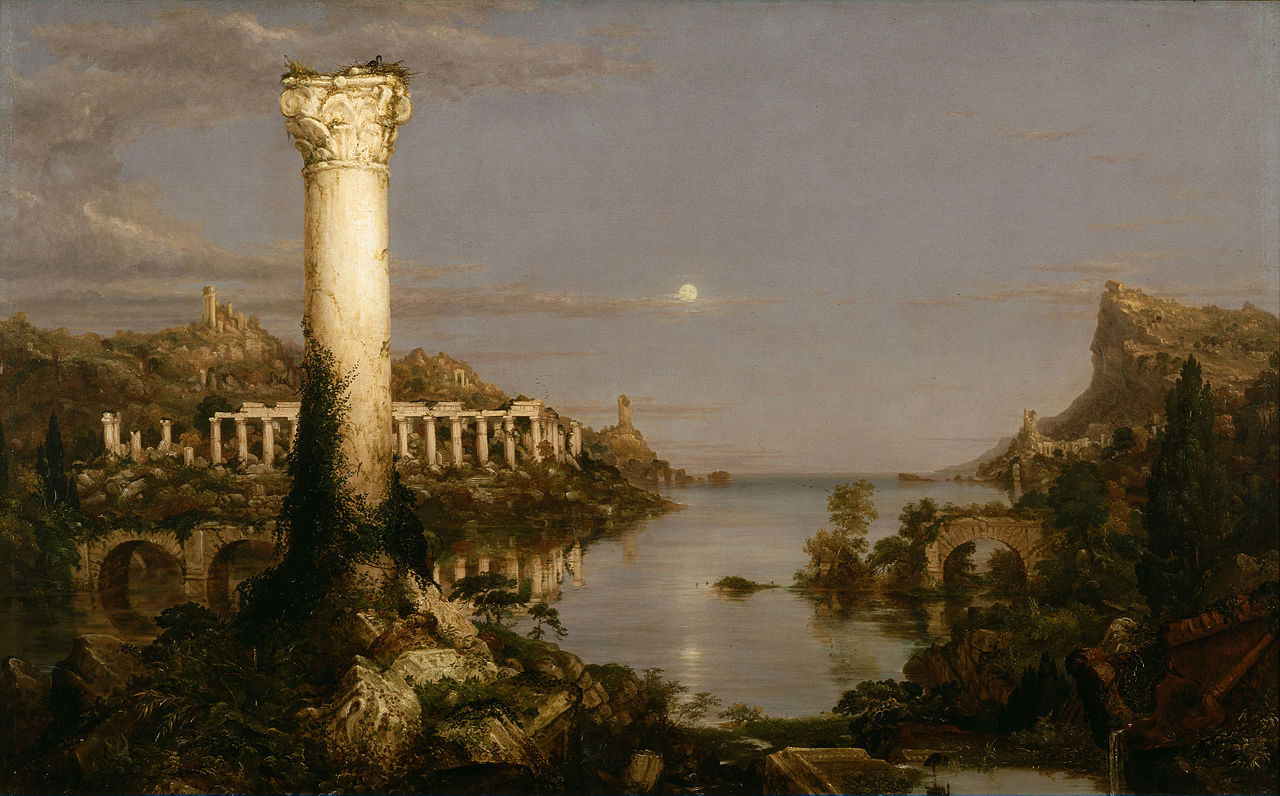
“The Course of Empire – Desolation” by Thomas Cole, one of a series of five paintings created between 1833 and 1836.
Wikimedia Commons.
On both sides of the Atlantic, hysterical comparisons between the collapse of the Roman Empire and the senile polities of the modern West have become the journalistic norm. Every major problem facing our society — from climate change to Covid to inflation — has received the Gibbon treatment.
There are, of course, regional variations. The British, tied by geography to Europe’s fortunes, tend to favour the definitive fall of the Western empire in AD 476. The Americans, ever fearful of an over-mighty executive, linger on the collapse of senatorial authority in 49 BC. And it is also more than a journalistic trope, with the unacknowledged legislators of our world also playing the same game. Elon Musk recently suggested that today’s baby drought is analogous to the low birth rates of Julius Caesar’s dictatorship. Marc Andreessen has compared California to Rome circa AD 250. Joe Rogan, meanwhile, is beginning to suspect that all this gender business might have a worrying ancient precedent.
Such appeals to the past are only human. The fourth word in Virgil’s Aeneid is Troiam. This is the first fact that we learn about Aeneas: he is from Troy. Virgil does not even bother to tell us his hero’s name until the 92nd line. Doubtless, the poets of Ur and Hattusha had their own Troys. And perhaps the first men who placed one mud brick upon another sang of flooded valleys, choked caves and herds that no longer ran. But Rome has been our common loss since the early Middle Ages. As Virgil looked back to Priam, so we look back to Virgil. In 1951, it was perfectly natural for W. H. Auden to compare a dying Britain with a dead Rome: “Caesar’s double-bed is warm / As an unimportant clerk / Writes I DO NOT LIKE MY WORK / On a pink official form”
But journalists and billionaires do not work in a poetic register. They deal in facts and lucre. When they say that Britain or America is following imperium Romanum down the dusty track to oblivion, they seem to be speaking literally. This is not a mistake that Virgil would have made. It is all very well to evoke Rome as an elegiac warning. But if we believe that there are concrete lessons to learn from the Roman Empire’s decline and fall, then we will have to examine the mother of cities as she really was. The results are surprising.
In AD 384, 400 years after Virgil composed his Aeneid, Quintus Aurelius Symmachus had a bridge problem. Symmachus was Urban Prefect of Rome, a role of huge responsibility. By the fourth century, the city of Rome was no longer the imperial capital of the western empire; it had been replaced in 286 by Mediolanum (modern Milan), which was a good deal closer to the empire’s febrile northern borders. But Rome remained the nation’s hearthstone. Her good governance was of the highest priority. The Urban Prefect dispensed justice, organised games, fed the mob and looked after the material fabric of the city. It was not an enviable position. One man had to keep the vast, turbulent metropolis ticking over with the minimum of rioting. Symmachus was well aware of the touchiness of the Roman pleb. His own father had been burned out of his house and chased from the city after making a catty remark of the “let them eat cake” variety during the wine shortage of 375.
The bridge problem went like this. Around 382, the emperor Gratian ordered that a new bridge be built across the Tiber. It soon became clear that construction was taking too long and costing too much. Two years later, as the project neared completion, one span collapsed. Such waste of public funds could not be ignored, and so an inquiry was launched. A specialist diver was engaged to examine the structure; he discovered that the job had been bodged. The engineers responsible for the project, Cyriades and Auxentius, were summoned to account for their failure. Each blamed the other, before Auxentius, who had been caught backfilling sections of the bridge with bales of hay, fled the city — pockets doubtless jingling with public gold.
On the face of it, this sounds like a very late Roman story: a nation once famous for its engineering prowess could no longer build a bridge across the Tiber without everything going horribly wrong. But I’m not sure that’s true. Problems arise all the time, and in themselves tell us very little about a society. What matters is the response to those problems. And Symmachus’s dispatches to the imperial court make it clear that his response was considered and comprehensive. The bridge was completed in the end, and stood for over 1,000 years until its demolition in 1484. Now think of 21st-century London: remember what happened the last time we tried to build a bridge across the Thames?
Comments Off on The urge to compare our own culture to the declining Roman Empire
Churchill and India
Andreas Koureas posted an extremely long thread on Twitter, outlining the complex situation he and his government faced during the Bengal Famine of 1943, along with more biographical details of Churchill’s views of India as a whole (edits and reformats as needed):
The most misunderstood part of Sir Winston Churchill’s life is his relationship with India. He neither hated Indians nor did he cause/contribute to the Bengal Famine. After reading through thousands of pages of primary sources, here’s what really happened.
A thread 🧵
I’ve covered this topic before, but in a recent poll my followers wanted a more in-depth thread. Sources are cited at the end. I’m also currently co-authoring a paper for a peer reviewed journal on the subject of the Bengal Famine, which should hopefully be out later this year.
I’ll first address the Bengal Famine (as that is the most serious accusation) and then Churchill’s general views on India. It goes without saying that there will be political activists who will completely ignore what I have to say, as well as the primary sources I’ll cite. I have no doubt, that just like in the past, there will be those who accuse me of only using “British sources”.
This is not true. I have primary sources written by Indians as well as papers by Indian academics.
Moreover, I have no doubt that such activists will, choose to “cite” the ahistorical journalistic articles from The Guardian or conspiratorial books like Churchill’s Secret War by Mukerjee — a debunked book that ignores most of what I’m about to write about, and is really what sparked the conspiracy of Churchill and the Bengal Famine. For everyone else, I hope you find this thread useful.
(more…)
Comments Off on Churchill and India
Hotchkiss Universal SMG
Forgotten Weapons
Published 27 Aug 2012The Hotchkiss Universal is a pretty interesting submachine gun, despite its rather clumsy appearance. The overriding design intent was to make a very compact folding carbine, and Hotchiss certainly met that objective. However, the gun ended up being too expensive and complex to achieve any real commercial success. Some wound up in Indochina, and some sales were made to Venezuela and Morocco, but that was about the extent of the Universal’s production. There are a few of these guns that were imported into the US as live semi-auto carbines, interestingly.
(more…)
Comments Off on Hotchkiss Universal SMG
August 11, 2023
Queer Eye for the Tudor ?guy?
At First Things, Carl R. Trueman looks into a recent post from the Mary Rose Museum (where the remains of King Henry VIII’s favourite warship now resides), considering Tudor artifacts recovered from the wreck from a Queer perspective:
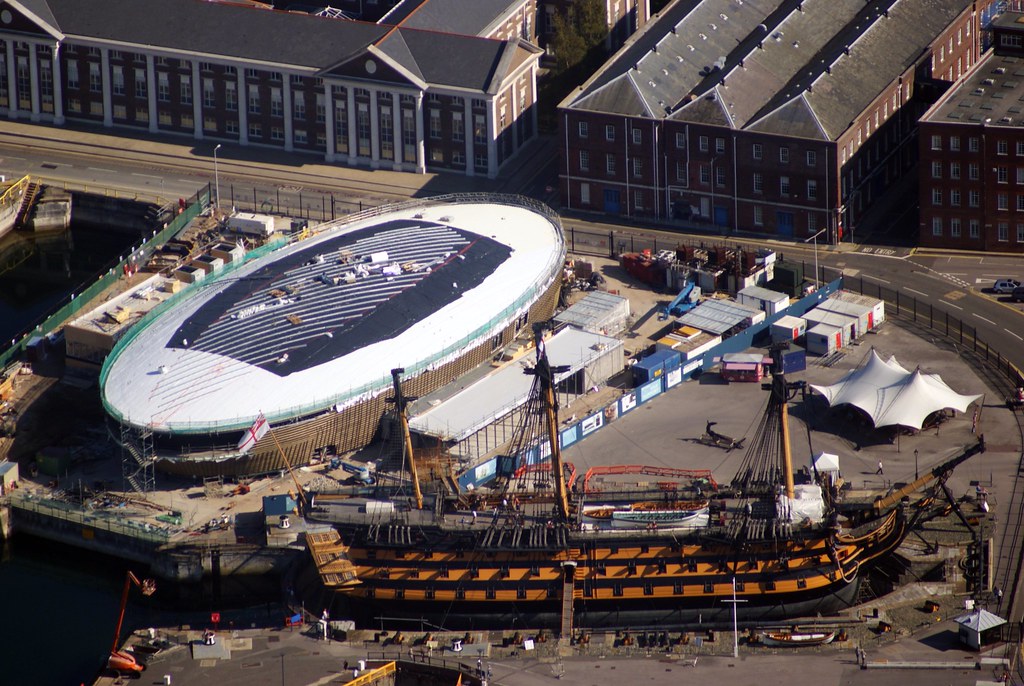
“Mary Rose Museum & HMS Victory” by Silly Little Man is licensed under CC BY-SA 2.0 

 .
.
The anti-Western left has been exposed for its sexual imperialism over the last few months. Evidence is all around. American Muslims have led protests against the imposition of LGBTQ policies and curricula in schools, leaving American progressives uncomfortably caught between two pillars of their favored rhetoric of political thought-crime: transphobia and Islamophobia. The Washington Post opined that anti-LGBTQ moves in the Middle East were “echoing” those of the American culture wars—as if Turkey, Saudi Arabia, and Pakistan had been listed by the Human Rights Campaign as favored vacation destinations until their ruling elites started reading the website of Moms for Liberty.
It is, of course, the nature of imperialism that everything, everywhere, is always to be measured by the imperialists’ standards. And that is also what makes them so impervious to spotting their own imperialism. “Queering the Mary Rose‘s Collection”, an article on the website of the Mary Rose Museum in Portsmouth, England, is a recent example of this. The Mary Rose was a Tudor warship that sank in 1545 and was raised from the seabed in 1982 in a groundbreaking act of marine archaeology. The museum is dedicated to displaying artifacts retrieved from the wreck, some of which are now been analyzed “through a Queer lens”.
The specific examples are an octagonal mirror, nit combs, a gold ring, and Paternosters. Apparently, looking into a mirror can stir strong emotions for both straight and queer people, and for the latter it can generate, for example, feelings of gender dysphoria or euphoria, depending on whether the reflection matches their gender identity. Combs would have been used by the sailors to remove the eggs of hair lice. Today they are reminders of how hairstyles can be the result of imposed gender stereotypes, but also make possible the subverting of these through hairdos that break with social expectations. Rings are a reminder of marriage and, of course, that the Church of England founded by Henry VIII, king during the Mary Rose‘s working life, still does not allow gay marriage. Finally, the Paternosters remind us that the crew were “practicing” Christians and that, once again, Henry VIII, via his initiation of the English Reformation, facilitated the civil criminalization of homosexual acts.
Two things are striking about the article, in addition to its lack of any intellectual merit. First, the absence of any historical awareness is striking. For example, the category of “practicing Christian” is essentially meaningless when applied to the early sixteenth century. Everybody, bar a few underground Jews, Anabaptists, and radicals, was part of the Catholic Church by baptism. The question of how the crew might have understood themselves, whether in terms of mirrors, rings, combs, or Paternosters, is never asked. To be fair, a short blog post cannot ask all the relevant questions, but this does not even nod in the direction of suggesting that the differences between yesterday and today might be remotely interesting or instructive.
David Thompson also has some thoughts on the Mary Rose artifact interpretations:
It’s quality stuff. Just like being there, in the mists of history. And not at all inept, or jarring, or comically incongruous.
As we have seen, many objects can be viewed through a Queer lens and can indirectly tell LGBTQ+ stories.
And thanks to peering through this “Queer lens”, readers will doubtless find that their understanding of Tudor history has been enriched no end.
We’re told – indeed, assured – by Hannah McCann, of the museum’s collections and curatorial staff,
From the Tate Britain and the Wellcome Collection, to the Rijks Museum in Amsterdam and the Whitney Museum of American Art in New York City, museums are reinterpreting and Queering their objects.
A comfort, I know.
Exactly why such “queering” is underway – what its relevance might be – is not, however, made clear. An explanation for this bolting-on of irrelevant, flimsy tat – in the name of “queer theory” – was not, it seems, deemed necessary. Nor is it entirely obvious how such “queering” of museum contents benefits those who wish to know more about Henry VIII’s favourite warship.
Comments Off on Queer Eye for the Tudor ?guy?
Toward a more perfect Homo Sovieticus
Ed West on the interplay between Soviet ideology and Soviet humour during the Cold War:
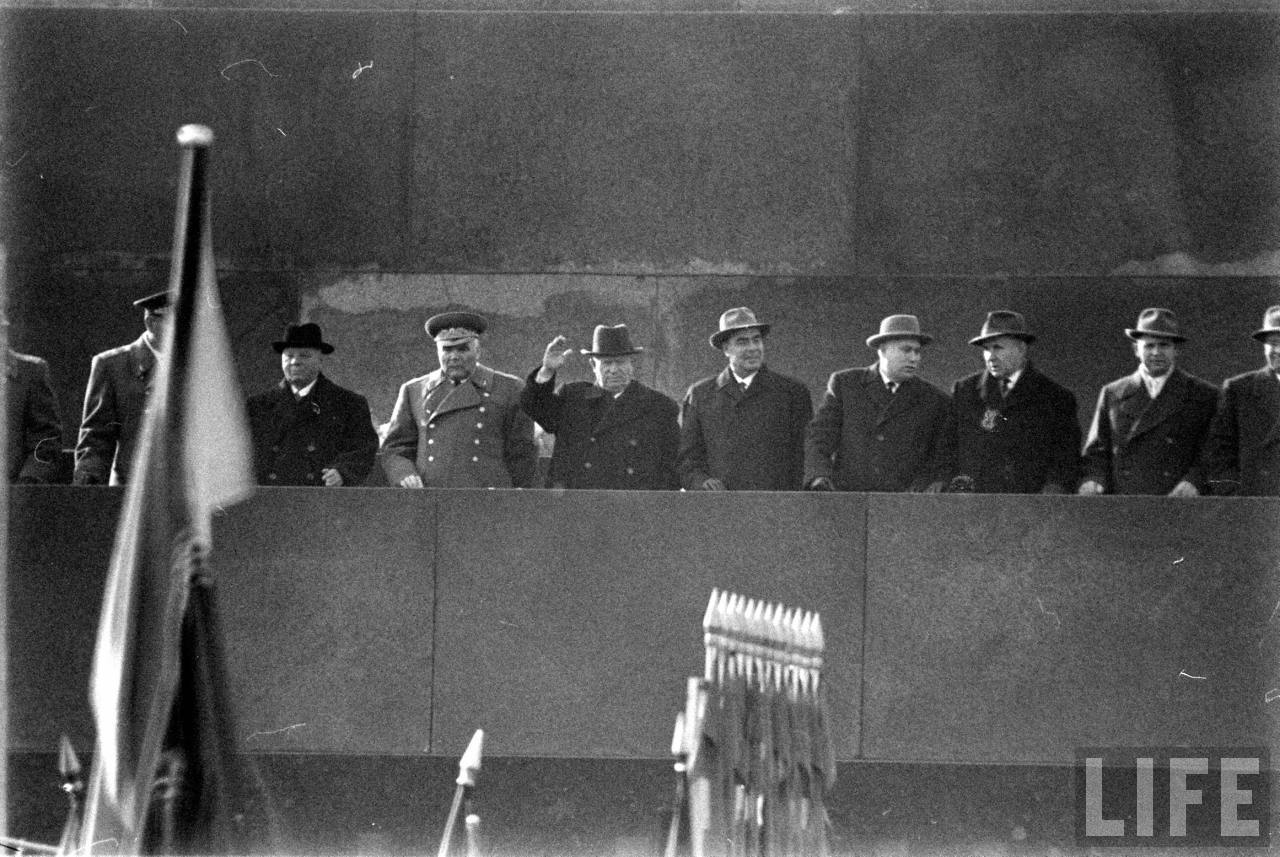
Krushchev, Brezhnev and other Soviet leaders review the Revolution parade in Red Square, 1962.
LIFE magazine photo by Stan Wayman.
Revolutions go through stages, becoming more violent and extreme, but also less anarchic and more authoritarian. Eventually the revolutionaries mellow, and grow dull. Once in power they become more conservative, almost by definition, and more wedded to a set of sacred beliefs, with the jails soon filling up with people daring to question them.
The Soviet system was based on the idea that humans could be perfected, and because of this they even rejected Mendelian genetics and promoted the scientific fraud Trofim Lysenko; he had hundreds of scientists sent to the Gulag for refusing to conform to scientific orthodoxy. Lysensko once wrote that: “In order to obtain a certain result, you must want to obtain precisely that result; if you want to obtain a certain result, you will obtain it … I need only such people as will obtain the results I need.”
Thanks in part to this scientific socialism, harvests repeatedly failed or disappointed, and in the 1950s they were still smaller than before the war, with livestock counts lower than in 1926.
“What will the harvest of 1964 be like?” the joke went: “Average – worse than 1963 but better than 1965”.
The Russians responded to their brutal and absurd system with a flourishing culture of humour, as Ben Lewis wrote in Hammer and Tickle, but after the death of Stalin the regime grew less oppressive. From 1961, the KGB were instructed not to arrest people for anti-communist activity but instead to have “conversations” with them, so their “wrong evaluations of Soviet society” could be corrected.
Instead, the communists encouraged “positive satire” – jokes that celebrated the Revolution, or that made fun of rustic stupidity. “An old peasant woman is visiting Moscow Zoo, when she sets eyes on a camel for the first time. ‘Oh my God,’ she says, ‘look what the Bolsheviks have done to that horse’.” The approved jokes blamed bad manufacturing on lazy workers, while the underground and popular ones blamed the economic system itself. This official satire was of course nothing of the sort, making fun of the old order and the foolish hicks who still didn’t embrace the Revolution and the future.
Communists likewise set up anti-western “satirical” magazines in Poland, East Germany, Czechoslovakia and Hungary, where the same form of pseudo-satire could mock the once powerful and say nothing about those now in control.
Indeed in 1956, the East German Central Committee declared that the construction of socialism could “never be a subject for comedy or ridicule” but “the most urgent task of satire in our time is to give Capitalism a defeat without precedent”. That meant exposing “backward thinking … holding on to old ideologies”.
[…]
Leonid Brezhnev had a stroke in 1974 and another in 1976, becoming an empty shell and inspiring the gag: “The government of the Union of Soviet Socialist Republics has announced with great regret that, following a long illness and without regaining consciousness, the General Secretary of the Central Committee of the Communist Party and the President of the highest Soviet, Comrade Leonid Brezhnev, has resumed his government duties.”
Brezhnev was an absurd figure, presiding over a system few still believed in. His jacket was filled with medals – he had 260 awards by the time of his death – and when told that people were joking he was having chest expansion surgery to make room for all the medals he’d awarded himself, he apparently replied: “If they are telling jokes about me, it means they love me.”
Comments Off on Toward a more perfect Homo Sovieticus
QotD: Subsistence versus market-oriented farming in pre-modern societies
Large landholders interacted with the larger number of small farmers (who make up the vast majority of the population, rural or otherwise) by looking to trade access to their capital for the small farmers’ labor. Rather than being structured by market transactions (read: wage labor), this exchange was more commonly shaped by cultural and political forces into a grossly unequal exchange whereby the small farmers gathered around the large estate were essentially the large landholder’s to exploit. Nevertheless, that exploitation and even just the existence of the large landholder served to reorient production away from subsistence and towards surplus, through several different mechanisms.
Remember: in most pre-modern societies, the small farmers are largely self-sufficient. They don’t need very many of the products of the big cities and so – at least initially – the market is a poor mechanism to induce them to produce more. There simply aren’t many things at the market worth the hours of labor necessary to get them – not no things, but just not very many (I do want to stress that; the self-sufficiency of subsistence farmers is often overstated in older scholarship; Erdkamp (2005) is a valuable corrective here). Consequently, doing anything that isn’t farming means somehow forcing subsistence farmers to work more and harder in order to generate the surplus to provide for those people who do the activities which in turn the subsistence farmers might benefit from not at all. But of course we are most often interested in exactly all of those tasks which are not farming (they include, among other things, literacy and the writing of history, along with functionally all of the events that history will commemorate until quite recently) and so the mechanisms by which that surplus is generated matter a great deal.
First, the large landholder’s farm itself existed to support the landholder’s lifestyle rather than his actual subsistence, which meant its production had to be directed towards what we might broadly call “markets” (very broadly understood). Now many ancient and even medieval agricultural writers will extol the value of a big farm that is still self-supporting, with enough basic cereal crops to subsist the labor force, enough grazing area for animals to provide manure and then the rest of the land turned over to intensive cash-cropping. But this was as much for limiting expenses to maximize profits (a sort of mercantilistic maximum-exports/minimum-imports style of thinking) as it was for developing self-sufficiency in a crisis. Note that we (particularly in the United States) tend to think of cash crops as being things other than food – poppies, cotton, tobacco especially. But in many cases, wheat might be the cash crop for a region, especially for societies with lots of urbanism; good wheat land could bring in solid returns […]. The “cash” crop might be grapes (for wine) or olives (mostly for olive oil) or any number of other necessities, depending on what the local conditions best supported (and in some cases, it could be a cash herd too, particularly in areas well-suited to wool production, like parts of medieval Britain).
Second, the exploitation by the large landholder forces the smaller farmers around him to make more intensive use of their labor. Because they are almost always in debt to the fellow with the big farm and because they need to do labor to get access to plow teams, manure, tools, or mills and because the large landholder’s land-ready-for-sharecropping is right there, the large landholder both creates the conditions that impel small farmers to work more land (and thus work more days) than their own small farms do and also creates the conditions where they can farm more intensively (both their own lands and the big farm’s lands, via plow teams, manure, etc.). Of course the large landholder then generally immediately extracts that extra production for his own purposes. […] all of the folks who aren’t small farmers looking to try to get small farmers to work harder than is in their interest in order to generate surplus. In this case, all of that activity funnels back into sustaining the large landholder’s lifestyle (which often takes place in town rather than in the countryside), which in turn supports all sorts of artisans, domestics, crafters and so on.
And so the large landholder needs the small subsistence farmers to provide flexible labor and the small subsistence farmers (to a lesser but still quite real degree) need the large landholder to provide flexibility in capital and work availability and the interaction of both of these groups serves to direct more surplus into activities which are not farming.
Bret Devereaux, “Collections: Bread, How Did They Make It? Part II: Big Farms”, A Collection of Unmitigated Pedantry, 2020-07-31.
Comments Off on QotD: Subsistence versus market-oriented farming in pre-modern societies
August 10, 2023
“Forget global boiling … It’s global gaslighting we should be worried about”
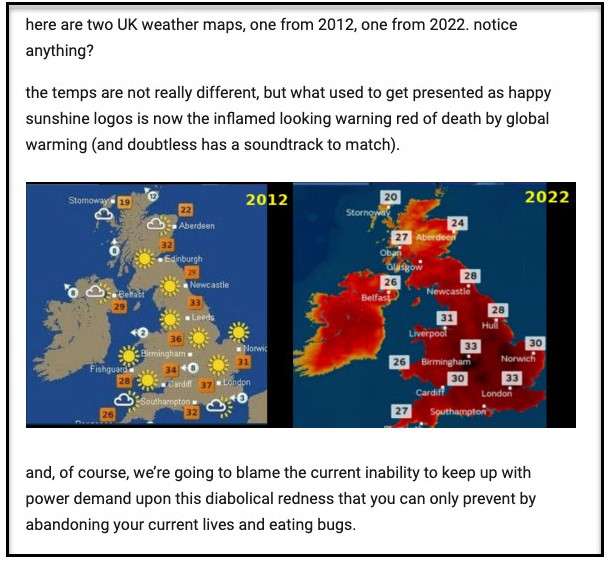
Remember when [your local TV station/newspaper] was blaring the alarming news that your [city/town/state/province] was warming at twice the rate of everything else? All the legacy media NPCs got the same patch at the same time — and it was blatant enough that most people realized it was utter bullshit. As Brendan O’Neill explains, they’re not normally quite so clumsy in their constant attempts to gaslight us all about the climate, but they’re definitely still doing it:
Picture the scene. You’re in London, the sky is menacingly grey, it’s drizzling. You zip your jacket against the elements, annoyed that Britain has just had one of its wettest Julys since records began. Then you reach for your copy of the Evening Standard as you head home from work, only to see splashed across the front page a Photoshopped image of the Earth on fire. “WHO WILL STOP EARTH BURNING?”, the hysterical headline asks. The drizzle turns to rain and you fold your Standard in two to use as an impromptu umbrella, turning a mad piece of global-boiling propaganda into flimsy protection from this strange, wet summer.
This was London yesterday. It really happened. It was yet another overcast day, in keeping with the record-breaking precipitation of the past month. The UK had an average of 140.1mm of rain in July, the sixth-highest level of July rainfall since records were first kept in 1836. And yet here was the freebie London paper warning us that flames will shortly engulf our celestial home. That heat death is coming. That an inferno of our own dumb making is licking at our feet. I know we live in mad times but even I never expected to see damp commuters brushing raindrops off their shoulders while surrounded by discarded papers telling us it’s so hellishly hot we might all soon die. Rarely has the gap between MSM BS and real life felt so cavernously vast.
They’re lying to us. Forget global boiling, the crazy term invented by UN chief António Guterres a couple of weeks ago. Forget global warming, even. It’s global gaslighting we should be worried about. If gaslighting, in the words of the Oxford dictionary, is “the process of making somebody believe untrue things in order to control them”, then that lunatic Standard cover was classic gaslighting. The planet is not on fire. Earth is not burning. These are untruths. This is delirium, not journalism; fearmongering, not fact-gathering. And the aim, it seems to me, is to try to control us; to frighten us with pseudo-Biblical prophesies of hellfire and doom until we obediently bow down to the eco-ideology.
Adding insult to injury, the Standard frontpage had pics of Joe Biden, Xi Jinping, Narendra Modi and Rishi Sunak next to its crackpot query, “WHO WILL STOP EARTH BURNING?”. Let’s leave to one side that President Biden doesn’t seem to know what planet he’s on half the time, never mind being able to save one; and that Rishi can’t even control Britain’s borders, far less the climate of our entire mortal coil; and that Xi and Modi are surely more concerned with their pursuit of economic development than with indulging the End Times hysteria of the Notting Hill set that writes and publishes the Standard. The more pressing point is this: no one needs to stop Earth from burning because Earth isn’t burning. You can’t put out a fire that doesn’t exist. As Bjorn Lomborg said last week, the idea that the “world is ablaze” is pure bunkum.
Comments Off on “Forget global boiling … It’s global gaslighting we should be worried about”
MOBAT, WOMBAT, CONBAT | Anti-Tank Chats
The Tank Museum
Published 5 May 2023Welcome to this episode of Anti-Tank Chats. Today, Chris will be discussing the variations of a lesser-known weapon, the British Army’s B.A.T. (Battalion Anti-Tank Gun).
(more…)
Comments Off on MOBAT, WOMBAT, CONBAT | Anti-Tank Chats
August 9, 2023
Russian 1895 Nagant Revolver
Forgotten Weapons
Published 20 May 2013One of the mechanically interesting guns that is really widely available in the US for a great price (or was until very recently, it seems) is the Russian M1895 Nagant revolver. It was adopted by the Imperial Russian government in 1895 (replacing the Smith & Wesson No.3 as service revolver), and would serve all the way through World War II in the hands of the Red Army.
As with its other standard-issue arms, the Russian government intended to manufacture the M1895 revolvers domestically. However, when the Nagant was officially adopted the major Russian arsenals were already working at capacity to make the relatively new M1891 rifle, so the first 20,000 revolvers were made by Nagant in Liege, Belgium. In 1898 space had been freed up to start production at the Tula arsenal, where they would be made until 1945 (Ishevsk put the Nagant revolver into production as well during WWII).
The common version available in the US today is a 7-shot, double action revolver chambered for 7.62x38mm. That cartridge is a very long case with the bullet sunk down well below the case mouth. The cylinder of the Nagant cams forward upon firing, allowing the case mount to protrude into the barrel and seal the cylinder gap, thus increasing muzzle velocity slightly. This also allows the Nagant to be used effectively with a suppressor, unlike almost all other revolvers (in which gas leaking from the cylinder gap defeats the purpose of a suppressor).
The Nagant’s 7.62x38mm cartridge pushes a 108 grain jacketed flat-nose projectile at approximately 850 fps (I believe a lighter 85-grain load was also used by the military later, but I haven’t fired any of it), which puts it roughly between .32 ACP and .32-20 ballistics. Not a hand cannon by any stretch, but fairly typical for the era (the 8mm Nambu and 8mm French revolver cartridges were both pretty similar in performance to the 7.62mm Nagant).
As far as being a shooter, the Nagant is mediocre, but reliable. The grip and sights are acceptable (but not great), and the cylinder loads and unloads one round at a time. The low pressure round doesn’t stick in the cylinder, at least. The worst part for a recreational shooter is the trigger, which is very heavy in double action. Single action is also heavy, but very crisp. Recoil is mild, and not uncomfortable at all. The design was simple and effective, and really a good fit for the Red Army and WWII fighting conditions.
Comments Off on Russian 1895 Nagant Revolver
August 8, 2023
How the Battle of Amiens Influenced the “Stab in the Back” Myth
OTD Military History
Published 7 Aug 2023The Battle of Amiens started on August 8 1918. It started the process that caused the final defeat of the German Army on the battlefield during World War 1. Many people falsely claimed that the German Army was not defeated on the battlefield but at home by groups that wished to see German fall. One person who helped to create this myth was German General Erich Ludendorff. He called August 8 “the black day of the German Army”.
See how this statement connects to the stab in the back myth connects to Amiens and the National Socialists in Germany.
(more…)
Comments Off on How the Battle of Amiens Influenced the “Stab in the Back” Myth
Holding the BBC to account for their climate change alarmism
Paul Homewood‘s updated accounting of the BBC’s coverage — and blatant falsehoods — of climate change news over the last twelve months:

The BBC’s coverage of climate change and related policy issues, such as energy policy, has long been of serious and widespread concern. There have been numerous instances of factual errors, bias and omission of alternative views to the BBC’s narrative. Our 2022 paper, Institutional Alarmism, provided many examples. Some led to formal complaints, later upheld by the BBC’s Executive Complaints Unit. However, many programmes and articles escaped such attention, though they were equally biased and misleading.
The purpose of this paper is to update that previous analysis with further instances of factual errors, misinformation, half truths, omissions and sheer bias. These either post-date the original report or were not included previously. However, the list is still by no means complete.
The case for the prosecution
The third most active hurricane season
In December 2021, BBC News reported that “The 2021 Atlantic hurricane season has now officially ended, and it’s been the third most active on record”. It was nothing of the sort. There were seven Atlantic hurricanes in 2021, and since 1851 there have been 32 years with a higher count. The article also made great play of the fact that all of the pre-determined names had been used up, implying that hurricanes are becoming more common. They failed to explain, however, that with satellite technology we are now able to spot hurricanes in mid-ocean that would have been missed before.Hurricanes: are they getting more violent?
Shortly after Hurricane Ian in September 2022, a BBC “Reality Check” claimed that “Hurricanes are among the most violent storms on Earth and there’s evidence they’re getting more powerful”. The video offered absolutely no data or evidence to back up this claim, which contradicted the official agencies. For instance, the US National Oceanic and Atmospheric Administration (NOAA) state in their latest review:
There is no strong evidence of century-scale increasing trends in U.S. landfalling hurricanes or major hurricanes. Similarly for Atlantic basin-wide hurricane frequency (after adjusting for observing capabilities), there is not strong evidence for an increase since the late 1800s in hurricanes, major hurricanes, or the proportion of hurricanes that reach major hurricane intensity.
The IPCC came to a similar conclusion about hurricanes globally in their latest Assessment Review. However, the BBC article failed to mention any of this.
Comments Off on Holding the BBC to account for their climate change alarmism
Up close with Royal Marines landing craft
Forces News
Published 12 Jul 2022Specialists in small craft operations and amphibious warfare, 47 Commando (Raiding Group) Royal Marines are preparing for overseas training in the Netherlands.
Briohny Williams met up with the marines and found out more about their landing craft.
(more…)
Comments Off on Up close with Royal Marines landing craft
QotD: The British imperial educational “system”
(At the risk of straying too far afield, let’s briefly note that “senior churchman” was a common, indeed almost traditional, career path for the spare sons of the aristocracy. Well into the 18th century, every titled parent’s goal was “an heir and a spare”, with the heir destined for the title and castle and the spare earmarked for the church … but not, of course, as some humble parish priest. It was pretty common for bishops or abbots, and sometimes even cardinals, to be ordained on the day they took over their bishoprics. See, for example, Cesare Borgia. Meanwhile the illiterate, superstitious, brutish parish priest was a figure of satire throughout the Middle Ages and Renaissance. A guy like Thomas Wolsey was hated, in no small part, precisely because he was a commoner who leveraged his formal education into a senior church gig, taking a bunch of plum positions away from the aristocracy’s spare sons in the process).
That being the case — that schools were for education, universities for training — the fascinating spectacle of some 18 year old fop fresh out of Eton being sent to govern the Punjab makes a lot more sense. His character, formed by his education (in our sense), was considered sufficient; he’d pick up such technical training as he needed on the job … or employ trained technicians to do it for him. So too, of course, with the army, and the more you know about the British Army before the 20th century, the more you’re amazed that they managed to win anything, much less an empire — the heir’s spare’s spare traditionally went into the army, buying his commission outright, which meant that quite senior commands could, and often did, go to snotnosed teenagers who didn’t know their left flank from their right.
Alas, governments back in the days were severely under-bureaucratized, meaning that the aristocracy lacked sufficient spares to fill all the technician roles the heirs required in a rapidly urbanizing, globalizing world… which meant that talented commoners had to be employed to fill the gaps. See e.g. Wolsey, above. The problem with that, though, is that you can’t have some dirty-arsed commoner, however skilled, wiping his nose on his sleeve while in the presence of His Lordship, so universities took on a socializing function. And so (again, grossly oversimplifying for clarity) the “bachelor of arts” was born, meaning “a technician with the social savvy to work closely with his betters”. A good example is Thomas Hobbes, whose official job title in the Earl of Devonshire’s household was “tutor”, but whose function was basically “intellectual technician” — he was a kind of man-of-all-work for anything white collar …
At that point, if there had been a “system” of any kind, what the system’s designers should’ve done is set up finishing schools. The “universities” of Oxford, Cambridge, etc. are made up of various “colleges” anyway, each with their own rules and traditions and house colors and all that Harry Potter shit. Their Lordships should’ve gotten together and endowed another college for the sole purpose of knocking manners into ambitious commoners on the make (Wolsey might actually have had something like this in mind with Cardinal College … alas).
But they didn’t, and so the professors at the traditional colleges were forced into a role for which they were not designed, and unqualified. That tends to happen a lot — have you noticed? It actually happened to them twice, once with the need for technicians-with-manners became apparent, and then again when the realization dawned — as it did by the 1700s, if not earlier — that some subjects, like chemistry, require not just technicians and technician-trainers, but researchers. Hard to blame the “system” for this, since of course there is no “system”, but also because such a thing would be ruinously expensive.
Hence by the time an actual system came into being — in Prussia, around 1800 — the professors awkwardly inhabited the three roles we started with. The Professor of Chemistry, say, was supposed to conduct research while training technicians-with-manners. As with the pre-machinegun British army, the astounding thing is that they managed to pull it off at all, much less to such consistently high quality. They were real men back then …
Severian, “Education Reform”, Rotten Chestnuts, 2020-11-17.
Comments Off on QotD: The British imperial educational “system”
August 7, 2023
The Longest Year in Human History (46 B.C.E.)
Historia Civilis
Published 24 Apr 2019
(more…)
Comments Off on The Longest Year in Human History (46 B.C.E.)


