
The Tank Museum
Published Jun 14, 2024Normandy, 1944: in the dense bocage countryside, two tanks, the US-built M4 Sherman and the German PzKpfw IV go head-to-head in the fighting around the Allied bridgehead. Both are similar in capabilities but which will prevail?
In this film, Chris Copson compares the armour protection, firepower and mobility of the two designs, and we recount the events of a specific engagement fought at Mouen near Caen on 28th June, 1944.
00:00 | Intro
01:45 | Meet the Tanks
03:08 | Armour
07:37 | Firepower
12:19 | Mobility & Operation
13:29 | Tank Crews
16:37 | Summary
17:15 | Mouen, Normandy, 28 June 1944
23:10 | ConclusionThis video features archive footage courtesy of British Pathé.
#tankmuseum
October 14, 2024
Quality v Quantity? | Panzer IV v M4 Sherman | Tank V Tank – Normandy, 1944
Comments Off on Quality v Quantity? | Panzer IV v M4 Sherman | Tank V Tank – Normandy, 1944
October 13, 2024
Occupation of Germany, Plunder and Enslavement?
World War Two
Published 12 Oct 2024The Allies’ occupation of Germany was marked by competing visions for its future, ranging from France’s focus on security to the Soviet push for reparations. This episode dives into the complex negotiations that determined Germany’s borders, industrial disarmament, and economic management, all of which would shape Europe’s post-war order and fuel the East-West divide.
(more…)
Comments Off on Occupation of Germany, Plunder and Enslavement?
Bismarck, Moltke, and the Kaiser’s General Staff
From Bruce Gudmundsson’s weekly Milstack recommendations, here’s part of an essay on Kaiser Wilhelm and some of the important men in his government in the lead-up to the First World War:
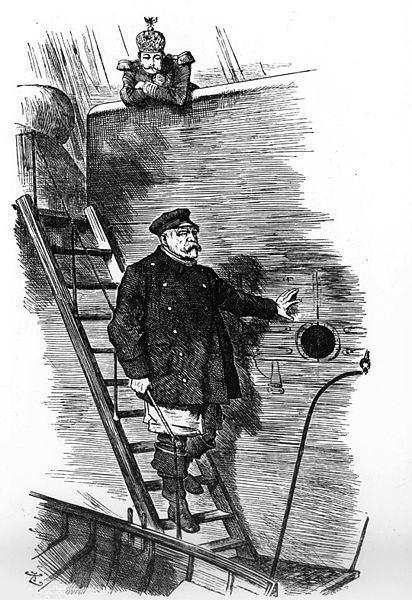
“Dropping the Pilot”. Caricature by Sir John Tenniel (1820-1914), first published in the British magazine Punch, March 1890. Showing German Emperor Wilhelm II and the departing Chancellor Otto von Bismarck.
By the 1870s, Germany was the dominant land power in Europe. It had defeated the preeminent powers on the continent and seemed poised for an era of dominance not seen since Napoleon. However, how quickly Germany’s power was checked and ultimately fell is a cautionary tale about the limits and consequences of the predominance of the military profession. Victories in the war had propelled the Prussian Officer Corps to the status of “demigods” that now held “unquestioned authority and legitimacy” in German politics and society.1 But this status meant they had carte blanche over war planning and became increasingly influential in politics. This produced a civil-military relationship in which, “leaders subordinated political ends to military ends; considerations of war dominated considerations of politics”.2 The German General staff was rapidly departing from Clausewitz’s teachings regarding the primacy of policy.
By the 1880s, Otto von Bismarck and Helmuth von Moltke, the key architects of German unification both politically and militarily, were nearing the end of their distinguished careers. Now, a younger generation of German nationalists and military officers were chomping at the bit to further expand Germany’s power and formed the engine of what some have called, “a political doomsday machine”.3 The militarists believed preemptive war was the uniform solution to the rising power of Germany’s neighbors. Likewise, success in the wars of unification had led nationalists to dream of a greater Germany “from Berlin to Baghdad”.4 Even in his late career, Bismarck had the experience and gravitas to stymie attempts to initiate a “preventative” war. For instance, in 1887, the senior military leadership cooked up a scheme to convince the Kaiser to declare war on Russia on a whim; they also encouraged Austria-Hungary to do the same. Bismarck stopped it before it became a crisis. But it was a bad omen and showed how the military leadership was increasingly out of control.
Bismarck and Moltke had their issues, but they eventually built a strong relationship, leading the Chief of the General Staff to discuss prospective war plans with the Chancellor, something that had not occurred regularly before and a sign of good civil-military relations. Moltke continued to hold his role until 1888 when he retired. His thinking in his late career had evolved beyond the axiomatic focus on total victory.5 The Battle of Sedan was as complete a victory as one could imagine, yet it did not end the Franco-Prussian War. The ensuing experience of the Volkskrieg (“People’s War”) which encompassed fighting a tough insurgency in France had disillusioned him with the idea of a short war. In one of his final speeches in the Reichstag in 1890, he stated of the next war that,
If this war breaks out, then its duration and its end will be unforeseeable. The greatest powers of Europe, armed as never before, will be going into battle with each other; not one of them can be crushed so completely in one or two campaigns that it will admit defeat, be compelled to conclude peace under hard terms, and will not come back, even if it is a year later, to renew the struggle. Gentlemen, it may be a war of seven years or thirty years’ duration — and woe to him who sets Europe alight, who [first] puts the fuse to the powder keg!6
Moltke now conceded the need for diplomacy to find a resolution after the army did what it could. “Total victory” was no longer the objective. Unfortunately, by then, the aged Field Marshal was isolated in his work on operational plans and studies. The General Staff had been educated in his original concepts which had been inculcated in the official histories of the wars of unification. Moltke’s genius, shown in the breadth of his thinking, was never absorbed by the institution.
German military historian Gerhard Ritter would distinguish Moltke from his successors for his lack of fatalism. While the Elder Moltke often pressed for preventative war, he made the argument from the military point of view, i.e. that war would be more advantageous now rather than later.7 Moltke was not overly disturbed when Bismarck quashed proposals of preventative war. In contrast to his successors, Moltke was confident in his ability to meet the challenges of war whenever it arrived. He did not view the political situation as intractable. If the statesman did not want to utilize an opportunity for an easy victory in a preventative war, that was the business of the statesman. In other words, Moltke accepted Bismarck’s “right to be wrong”. A working relationship was therefore possible with the statesman who described his policy as “the most dangerous road last”.8
In the final years of their careers, both Bismarck and Moltke foresaw the dangers of a Germany where military prerogatives began to overshadow political ones. Bismarck, the architect of Germany’s rise, understood that the state’s survival hinged not just on military prowess but on the balancing of diplomatic relationships and restrained use of force. Moltke, though a staunch advocate of military autonomy, ultimately recognized the futility of unchecked military power in the context of modern warfare. Their eventual departures left a vacuum, filled by more aggressive military leaders, weak chancellors, and a feckless Kaiser. The political flexibility that had defined Germany’s rise came to be disregarded. As the officer corps grew more entrenched in its dominance, the military’s rigid and totalizing mindset contributed to Germany’s plunge into one of the most destructive conflicts in human history.9
1. Jack Snyder, “Civil-Military Relations and the Cult of the Offensive, 1914 and 1984”. International Security 9 (1) (1984).
2. Keir A. Lieber, “The New History of World War I and What It Means for International Relations Theory”. International Security 32 (2) (2007): 161.
3. Henry Kissinger, Diplomacy (New York: Simon & Schuster, 1995), 168.
4. For more on ultranationalist critique of the German government see Stig Förster, Der Doppelte Militarismus: Die Deutsche Heeresrüstungspolitik Zwischen Status-Quo-Sicherung Und Aggression, 1890-1913, Institut Für Europäische Geschichte Mainz: Veröffentlichungen Des (F. Steiner Verlag Wiesbaden, 1985).
5. For further detail, see Gerhard P. Gross, The Myth and Reality of German Warfare: Operational Thinking from Moltke the Elder to Heusinger.
6. Stig Förster, “Dreams and Nightmares: German Military Leadership and the Images of Future Warfare, 1871-1914”. In Anticipating Total War, The German and American experiences, 1871-1914, 343-376 (Cambridge: Cambridge University Press. 2013), 347.
7. A preventative war, in this context, is a conflict initiated to preemptively counter an anticipated future threat or to prevent a rival power from becoming stronger in the long term.
8. Gerhard Ritter, The Sword and the Scepter: The Problem of Militarism in Germany (Coral Gables: University of Miami Press, 1973), vol. 1 of 4, 243.
9. For more on Imperial German military culture, see Isabel Hull, Absolute Destruction: Military Culture and the Practices of War in Imperial Germany (Ithaca, NY: Cornell University Press, 2005).
Comments Off on Bismarck, Moltke, and the Kaiser’s General Staff
October 11, 2024
German free speech – only applicable when used to criticize the “far right”
C.J. Hopkins discovers the stark contrast between actual freedom of speech and German freedom of speech:
The first rule of New Normal Germany is, you do not compare New Normal Germany to Nazi Germany. If you do that, New Normal Germany will punish you. It will sic the Federal Criminal Police on you. It will report you to its domestic Intelligence agency. It will ban your books. It will censor your Tweets. It will prosecute you on fabricated “hate-crime” charges.
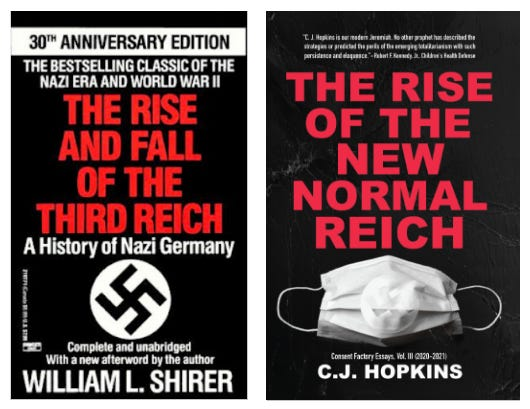
I know this, because that’s what happened to me. I broke the first rule of New Normal Germany. I compared New Normal Germany to Nazi Germany. I did it with the cover artwork of my book.
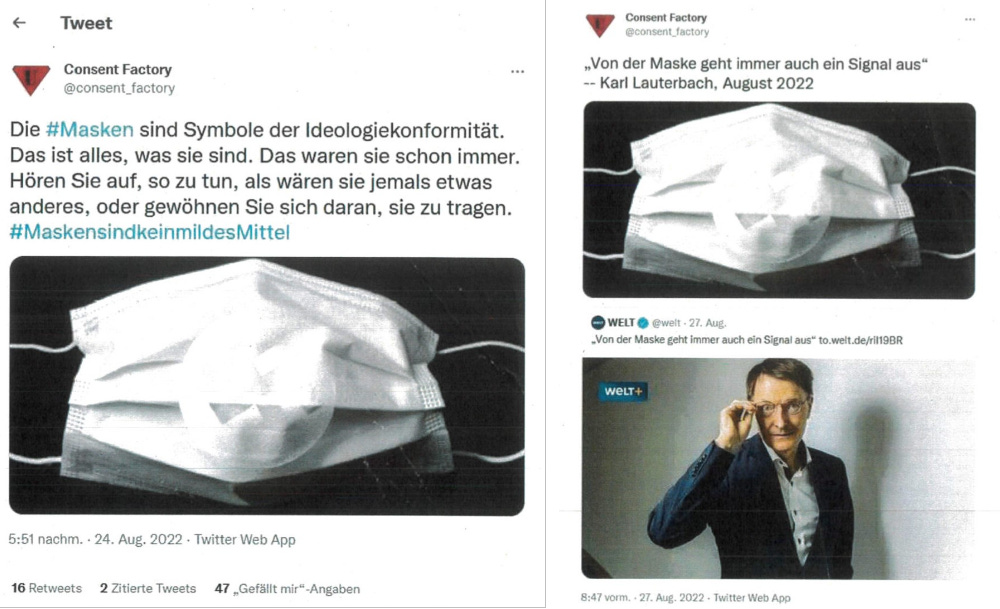
Yes, that’s a swastika on the cover. A swastika covered by a medical mask. I tweeted that artwork in 2022. The German authorities prosecuted me for that, and convicted me for that. So, now I’m a “hate criminal”, and an “anti-Semite”, and a “trivializer of the Holocaust”.
That’s the second rule of New Normal Germany. You never, ever, display a swastika. Displaying a swastika is not “in Ordnung“. Displaying swastikas is totally “verboten“.
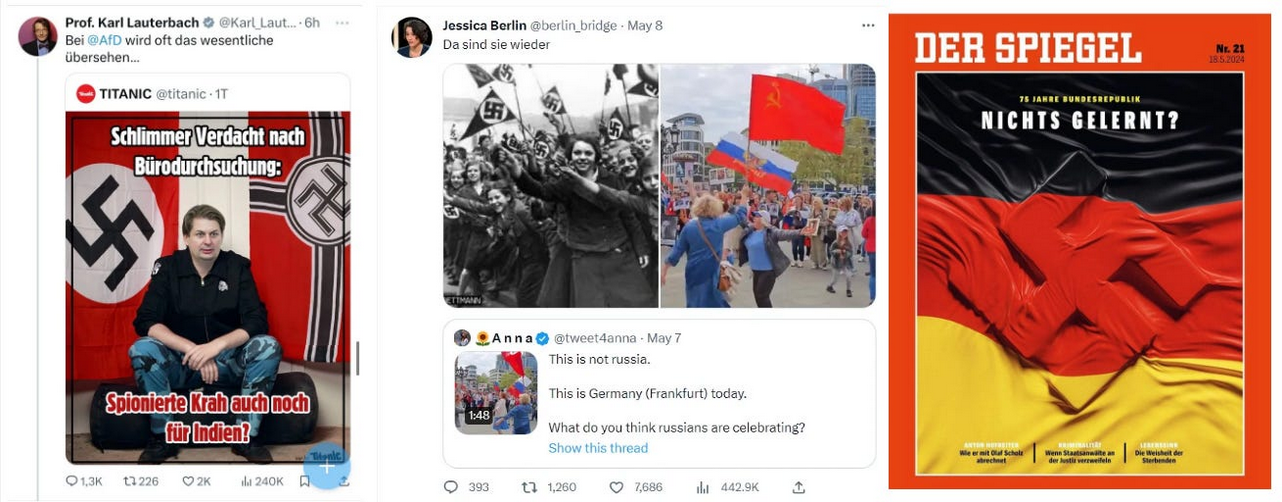
Unless you are the Health Minister of New Normal Germany, and you’re comparing your political opponents to the Nazis. Or unless you are a popular German celebrity, and you’re comparing the Russians and their supporters to the Nazis. Or unless you are a mainstream magazine, and you’re comparing German populists to the Nazis.
In which case, displaying a swastika is fine. And is not “verboten“. And definitely not a “hate crime”.
And that’s the third rule of New Normal Germany. If you agree with the government, obey their orders, and parrot their propaganda, you are not a “hate criminal”. If you are the government, like an actual minister in the government, like the Minister of Health, you’re definitely not a “hate criminal”. And, if you are part of government’s propaganda apparatus, needless to say, you’re also not a “hate criminal”.
However, if you criticize the government, or if you compare the government to Nazi Germany, and if you do that using your book-cover art featuring a swastika behind a Covid mask, then you’re absolutely officially a “hate criminal”, and an “anti-Semite”, and a “trivializer of the Holocaust”.
Comments Off on German free speech – only applicable when used to criticize the “far right”
QotD: Fascists are inherently bad at war
For this week’s musing, I wanted to take the opportunity to expand a bit on a topic that I raised on Twitter which draw a fair bit of commentary: that fascists and fascist governments, despite their positioning are generally bad at war. And let me note at the outset, I am using fascist fairly narrowly – I generally follow Umberto Eco’s definition (from “Ur Fascism” (1995)). Consequently, not all authoritarian or even right-authoritarian governments are fascist (but many are). Fascist has to mean something more specific than “people I disagree with” to be a useful term (mostly, of course, useful as a warning).
First, I want to explain why I think this is a point worth making. For the most part, when we critique fascism (and other authoritarian ideologies), we focus on the inability of these ideologies to deliver on the things we – the (I hope) non-fascists – value, like liberty, prosperity, stability and peace. The problem is that the folks who might be beguiled by authoritarian ideologies are at risk precisely because they do not value those things – or at least, do not realize how much they value those things and won’t until they are gone. That is, of course, its own moral failing, but society as a whole benefits from having fewer fascists, so the exercise of deflating the appeal of fascism retains value for our sake, rather than for the sake of the would-be fascists (though they benefit as well, as it is, in fact, bad for you to be a fascist).
But war, war is something fascists value intensely because the beating heart of fascist ideology is a desire to prove heroic masculinity in the crucible of violent conflict (arising out of deep insecurity, generally). Or as Eco puts it, “For Ur-Fascism there is no struggle for life, but, rather, life is lived for struggle … life is permanent warfare” and as a result, “everyone is educated to become a hero“. Being good at war is fundamentally central to fascism in nearly all of its forms – indeed, I’d argue nothing is so central. Consequently, there is real value in showing that fascism is, in fact, bad at war, which it is.
Now how do we assess if a state is “good” at war? The great temptation here is to look at inputs: who has the best equipment, the “best” soldiers (good luck assessing that), the most “strategic geniuses” and so on. But war is not a baseball game. No one cares about your RBI or On-Base percentage. If a country’s soldiers fight marvelously in a way that guarantees the destruction of their state and the total annihilation of their people, no one will sing their praises – indeed, no one will be left alive to do so.
Instead, war is an activity judged purely on outcomes, by which we mean strategic outcomes. Being “good at war” means securing desired strategic outcomes or at least avoiding undesirable ones. There is, after all, something to be said for a country which manages to salvage a draw from a disadvantageous war (especially one it did not start) rather than total defeat, just as much as a country that conquers. Meanwhile, failure in wars of choice – that is, wars a state starts which it could have equally chosen not to start – are more damning than failures in wars of necessity. And the most fundamental strategic objective of every state or polity is to survive, so the failure to ensure that basic outcome is a severe failure indeed.
Judged by that metric, fascist governments are terrible at war. There haven’t been all that many fascist governments, historically speaking and a shocking percentage of them started wars of choice which resulted in the absolute destruction of their regime and state, the worst possible strategic outcome. Most long-standing states have been to war many times, winning sometimes and losing sometimes, but generally able to preserve the existence of their state even in defeat. At this basic task, however, fascist states usually fail.
The rejoinder to this is to argue that, “well, yes, but they were outnumbered, they were outproduced, they were ganged up on” – in the most absurd example, folks quite literally argued that the Nazis at least had a positive k:d (kill-to-death ratio) like this was a game of Call of Duty. But war is not a game – no one cares what your KDA is if you lose and your state is extinguished. All that matters is strategic outcomes: war is fought for no other purpose because war is an extension of policy (drink!). Creating situations – and fascist governments regularly created such situations. Starting a war in which you will be outnumbered, ganged up on, outproduced and then smashed flat: that is being bad at war.
Countries, governments and ideologies which are good at war do not voluntarily start unwinnable wars.
So how do fascist governments do at war? Terribly. The two most clear-cut examples of fascist governments, the ones most everyone agrees on, are of course Mussolini’s fascist Italy and Nazi Germany. Fascist Italy started a number of colonial wars, most notably the Second Italo-Ethiopian War, which it won, but at ruinous cost, leading it to fall into a decidedly junior position behind Germany. Mussolini then opted by choice to join WWII, leading to the destruction of his regime, his state, its monarchy and the loss of his life; he managed to destroy Italy in just 22 years. This is, by the standards of regimes, abjectly terrible.
Nazi Germany’s record manages to somehow be worse. Hitler comes to power in 1933, precipitates WWII (in Europe) in 1939 and leads his country to annihilation by 1945, just 12 years. In short, Nazi Germany fought one war, which it lost as thoroughly and completely as it is possible to lose; in a sense the Nazis are necessarily tied for the position of “worst regime at war in history” by virtue of having never won a war, nor survived a war, nor avoided a war. Hitler’s decision, while fighting a great power with nearly as large a resource base as his own (Britain) to voluntarily declare war on not one (USSR) but two (USA) much larger and in the event stronger powers is an act of staggeringly bad strategic mismanagement. The Nazis also mismanaged their war economy, designed finicky, bespoke equipment ill-suited for the war they were waging and ran down their armies so hard that they effectively demodernized them inside of Russia. It is absolutely the case that the liberal democracies were unprepared for 1940, but it is also the case that Hitler inflicted upon his own people – not including his many, horrible domestic crimes – far more damage than he meted out even to conquered France.
Beyond these two, the next most “clearly fascist” government is generally Francisco Franco’s Spain – a clearly right-authoritarian regime, but there is some argument as to if we should understand them as fascist. Francoist Spain may have one of the best war records of any fascist state, on account of generally avoiding foreign wars: the Falangists win the Spanish Civil War, win a military victory in a small war against Morocco in 1957-8 (started by Moroccan insurgents) which nevertheless sees Spanish territory shrink (so a military victory but a strategic defeat), rather than expand, and then steadily relinquish most of their remaining imperial holdings. It turns out that the best “good at war” fascist state is the one that avoids starting wars and so limits the wars it can possibly lose.
Broader definitions of fascism than this will scoop up other right-authoritarian governments (and start no end of arguments) but the candidates for fascist or near-fascist regimes that have been militarily successful are few. Salazar (Portugal) avoided aggressive wars but his government lost its wars to retain a hold on Portugal’s overseas empire. Imperial Japan’s ideology has its own features and so may not be classified as fascist, but hardly helps the war record if included. Perón (Argentina) is sometimes described as near-fascist, but also avoided foreign wars. I’ve seen the Baathist regimes (Assad’s Syria and Hussein’s Iraq) described as effectively fascist with cosmetic socialist trappings and the military record there is awful: Saddam Hussein’s Iraq started a war of choice with Iran where it barely managed to salvage a brutal draw, before getting blown out twice by the United States (the first time as a result of a war of choice, invading Kuwait!), with the second instance causing the end of the regime. Syria, of course, lost a war of choice against Israel in 1967, then was crushed by Israel again in another war of choice in 1973, then found itself unable to control even its own country during the Syrian Civil War (2011-present), with significant parts of Syria still outside of regime control as of early 2024.
And of course there are those who would argue that Putin’s Russia today is effectively fascist (“Rashist”) and one can hardly be impressed by the Russian army managing – barely, at times – to hold its own in another war of choice against a country a fourth its size in population, with a tenth of the economy which was itself not well prepared for a war that Russia had spent a decade rearming and planning for. Russia may yet salvage some sort of ugly draw out of this war – more a result of western, especially American, political dysfunction than Russian military effectiveness – but the original strategic objectives of effectively conquering Ukraine seem profoundly out of reach while the damage to Russia’s military and broader strategic interests is considerable.
I imagine I am missing other near-fascist regimes, but as far as I can tell, the closest a fascist regime gets to being effective at achieving desired strategic outcomes in non-civil wars is the time Italy defeated Ethiopia but at such great cost that in the short-term they could no longer stop Hitler’s Anschluss of Austria and in the long-term effectively became a vassal state of Hitler’s Germany. Instead, the more standard pattern is that fascist or near-fascist regimes regularly start wars of choice which they then lose catastrophically. That is about as bad at war as one can be.
We miss this fact precisely because fascism prioritizes so heavily all of the signifiers of military strength, the pageantry rather than the reality and that pageantry beguiles people. Because being good at war is so central to fascist ideology, fascist governments lie about, set up grand parades of their armies, create propaganda videos about how amazing their armies are. Meanwhile other kinds of governments – liberal democracies, but also traditional monarchies and oligarchies – are often less concerned with the appearance of military strength than the reality of it, and so are more willing to engage in potentially embarrassing self-study and soul-searching. Meanwhile, unencumbered by fascism’s nationalist or racist ideological blinders, they are also often better at making grounded strategic assessments of their power and ability to achieve objectives, while the fascists are so focused on projecting a sense of strength (to make up for their crippling insecurities).
The resulting poor military performance should not be a surprise. Fascist governments, as Eco notes, “are condemned to lose wars because they are constitutionally incapable of objectively evaluating the force of the enemy”. Fascism’s cult of machismo also tends to be a poor fit for modern, industrialized and mechanized war, while fascism’s disdain for the intellectual is a poor fit for sound strategic thinking. Put bluntly, fascism is a loser’s ideology, a smothering emotional safety blanket for deeply insecure and broken people (mostly men), which only makes their problems worse until it destroys them and everyone around them.
This is, however, not an invitation to complacency for liberal democracies which – contrary to fascism – have tended to be quite good at war (though that hardly means they always win). One thing the Second World War clearly demonstrated was that as militarily incompetent as they tend to be, fascist governments can defeat liberal democracies if the liberal democracies are unprepared and politically divided. The War in Ukraine may yet demonstrate the same thing, for Ukraine was unprepared in 2022 and Ukraine’s friends are sadly politically divided now. Instead, it should be a reminder that fascist and near-fascist regimes have a habit of launching stupid wars and so any free country with such a neighbor must be on doubly on guard.
But it should also be a reminder that, although fascists and near-fascists promise to restore manly, masculine military might, they have never, ever actually succeeded in doing that, instead racking up an embarrassing record of military disappointments (and terrible, horrible crimes, lest we forget). Fascism – and indeed, authoritarianisms of all kinds – are ideologies which fail to deliver the things a wise, sane people love – liberty, prosperity, stability and peace – but they also fail to deliver the things they promise.
These are loser ideologies. For losers. Like a drunk fumbling with a loaded pistol, they would be humiliatingly comical if they weren’t also dangerous. And they’re bad at war.
Bret Devereaux, “Fireside Friday, February 23, 2024 (On the Military Failures of Fascism)”, A Collection of Unmitigated Pedantry, 2024-02-23.
October 6, 2024
Will the President Abolish Democracy? – Rise of Hitler 03, March 1930
World War Two
Published 5 Oct 2024In the March 1930 Issue of the Weimar Wire Chancellor Muller resigns, the coalition government collapses, and Heinrich Brüning tries to build a new cabinet amidst street violence and political chaos. With the Nazis and Communists gaining strength, will Brüning succeed, or is the Weimar Republic heading for disaster?
(more…)
Comments Off on Will the President Abolish Democracy? – Rise of Hitler 03, March 1930
October 4, 2024
Gustloff VG1-5 Nazi Last Ditch Rifles
Forgotten Weapons
Published Nov 20, 2015The Volkssturmgewehr Gustloff, more commonly (albeit incorrectly) known as the VG1-5, was one of the few semiautomatic Volkssturm weapons produced at the end of WWII. I have discussed these rifles before, but wanted to take advantage of the opportunity to take a close look at two more examples of the type.
Mechanically the Gustloff uses a system quite unusual in rifles — gas delayed blowback. Chambered for the 8×33 Kurz cartridge, there are 4 small gas vent holes in the front half of the barrel which vent gas into a chamber in the front muzzle plug. Pressure in this chamber acts to keep the slide closed, thus delayed the opening of the action. A nearly identical system is used in the much later Steyr GB pistol.
One of these in particular still has its original sling, which is a neat feature (the other clearly was issued with a sling but has lost it). In total 10,000 of these were manufactured, but they were not able to make a significant impact to prolong Germany’s war effort.
Comments Off on Gustloff VG1-5 Nazi Last Ditch Rifles
October 3, 2024
D-Day 80th Anniversary Special, Part 2: Landings with firearms expert Jonathan Ferguson
Royal Armouries
Published Jun 12, 2024This year marks the 80th anniversary of D-Day, the Allied invasion of France which took place on 6th June 1944. From landing on the beaches of Normandy, the Allies would push the Nazi war machine and breach Hitler’s Atlantic Wall.
To commemorate this, we’re collaborating with IWM to release a special two-part episode as Jonathan will look at some of the weapons that influenced and shaped this historic moment in history.
Part 2 is all about the pivotal landings, including allied efforts to aid in its success.
0:00 Intro
0:25 Twin Vickers K Gun
2:03 Pointe du Hoc
2:45 Water off a DUKW’s back?
3:50 Magazines x3
4:07 Usage & History
5:50 Bring up the PIAT!
7:00 Dispelling (Or Projecting via Spigot) Myths
7:55 PIAT Firing Process
9:50 PIAT Details
10:31 Usage in D-Day
13:19 Pegasus Bridge
15:05 MG 42
15:41 Defensive Machine Gun
16:37 1200 RPM
17:35 Replaceable Barrel
19:08 Usage in D-Day
21:37 Sexton Self-Propelled Gun
21:33 Artillery in D-Day
22:15 Run-In Shoot
22:40 The Need for Mobile Artillery
23:25 Usage in D-Day
24:21 17-Pounder Gun
25:11 Function & Usage
26:05 Usage in D-Day
28:00 IWM at HMS Belfast
30:27 Outro
(more…)
Comments Off on D-Day 80th Anniversary Special, Part 2: Landings with firearms expert Jonathan Ferguson
QotD: Historical echoes in the American left and right
The Trump movement does have some real [historical Nazi] characteristics. Many low-level people feel remarkably empowered to do things, to get creative to help the cause (and also make some coin; how many Trump medals, flags, and coffee cups does one buy?), and to get out there and just stir the pot for the Orange guy. Then we saw The Donald at the top not exercising real power, other than to exhort others to get shit done, whatever unnamed shit that needed doing.
My first run-through suggests that calling the Juggs and their minions “filthy commies” actually is not just a kneejerk response, but it lands mostly true, in the ways that matter. The Jugg argument that Trump and his people are a bunch of Nazis also has some real truthy elements to it as well (though the true elements are generally probably far afield from the Nazi stuff the Juggs have in mind).
Commies and Nazis gain traction when the basic job of governance is found lacking, and the caliber of people tasked with getting things back in line is not up to the task. Then the various totalitarian solutions become more popular. Even when the intentions are pure (I will give most of the Trump people that assumption), unfettered ambitions, allowed to flower, will go bad if the normal checks and balances of the system are all out of whack. It is just human nature.
Our systems are all out of whack. That is why AOC can call for impeachment of [six US Supreme Court justices] with a straight face, and there is no broadly based “hey, wait a minute, Bucko” response. Things might be too far gone, and there is no way to pull back into a system that actually well serves the average American (think of what constituencies the typical elected official actually serves — the deep state apparat, the ultra-rich guys, and the corporate lobbyists). It all means the Trump movement is a tool, not to restore something, but to accelerate the “get through it and start afresh”. With that in mind, the November results tend to be more of “six of one, half a dozen of the other” than people think they are.
“Dutch”, commenting on “How Juggs Think the World Works”, Founding Questions, 2024-07-02.
Comments Off on QotD: Historical echoes in the American left and right
October 2, 2024
QotD: Alternative history Operation Barbarossa
Knowing full well how dumb it is to bring up World War II on the Internet, consider that a pretty reasonable case can be constructed for Operation Barbarossa. Having purged all their competent, experienced officers, the Red Army had just gotten their clocks cleaned by the Finns in the Winter War. Yeah, the Soviets “won” in the end, but with that disparity of forces, there’s pretty much no possible “win” that doesn’t look like a loss … and the Soviets, to put it mildly, were nowhere near that best-case scenario. Moreover, even if you took the show trials for exactly that — kangaroo courts — their very existence showed there was a deep rift at the very top of the Soviet leadership. Anyone, not just Hitler, could be forgiven for thinking that the Soviet Union would collapse under one big sledgehammer blow.1
It works the other way, too. If we accept the “Suvorov Thesis”, that Hitler only attacked Stalin because Stalin was gearing up to attack Hitler, then we can easily construct a similar case from The Boss’s perspective: The Wehrmacht can’t play defense. The one time they came up against anything approaching a real opponent with technological parity (the Battle of Britain), it was at best a bloody draw, more than likely a stinging defeat. And the Hitler regime was reeling, internally. No show trials for der Führer, but Rudolf Hess, who was at least the number three man in the Reich and at the time Hitler’s heir apparent, had just defected to the British. Anyone, not just Stalin, could be forgiven for thinking that the Third Reich would collapse under one big sledgehammer blow.
See what I mean? Both of those cases are quite plausible, and fit with most known historical facts … and yet, they’re retcons. “Rationalizations” might even be a better word, because the thing is, even though those arguments are “logical”, and might indeed have been convincing to important people at the time, that’s not why Hitler did what he did, or why Stalin would’ve done what he would’ve done under the Suvorov Thesis. No, the truth is simpler, and much more horrifying: They would’ve done it anyway, because that’s who they were.
That’s what the Castle Wolfenstein people got right about the Nazis. Same deal with that Amazon show (which was interesting for a season) The Man in the High Castle. In the real world, there’s no possible way the Nazis could’ve invaded the USA, no matter how it turned out on the Eastern Front …
… but in the real world they would’ve tried nonetheless, somehow, because that’s just who they were. Everything Stalin, Khrushchev, et al did during the Cold War here in the real world, Hitler, Heydrich, and the gang would’ve done in the Castle Wolfenstein world where the Battles of Stalingrad and Kursk went the other way.2 They couldn’t have done any different, without being different people, and while it’s fun to speculate on questions like “who would’ve been the Nazi Gorbachev, who self-destructed the Reich by attempting however you say ‘perestroika‘ in German”, it’s not really germane.
Severian, “The Man in the High Chair”, Rotten Chestnuts, 2021-07-05.
1. And Soviet losses were stupendous, utterly mind-boggling, in the first few months of Barbarossa. Tanks and planes destroyed in their tens of thousands, prisoners captured in millions. Even as it became clear that OKW had underestimated Red Army strength by orders of magnitude, it was still almost inconceivable that they had anything left to fight with. Just one more push …
2. This is actually the world of a fun novel, Robert Harris’s Fatherland.
Comments Off on QotD: Alternative history Operation Barbarossa
September 30, 2024
Saving German democracy seems to require not following the law for some reason
[Update below] I’m sure that Germany is being well-served by their politicians who only seem to want to obey the law when it suits them. I mean, that’s how you save democracy, right? By ignoring democratic laws for a “higher good” every now and again?
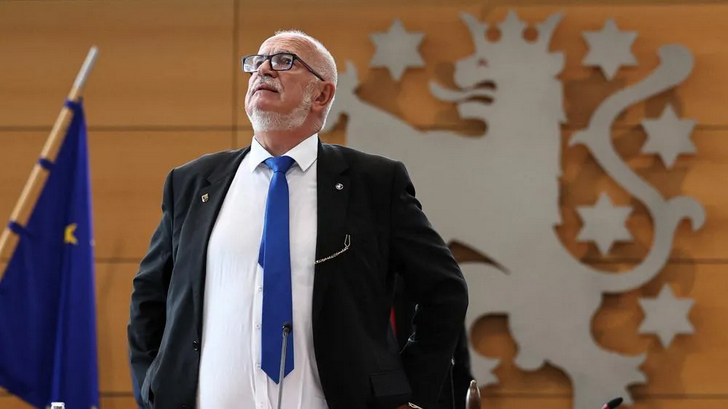
Jürgen Treutler, the supergenius fascist who discovered that all you need to do to establish fascism is follow all democratic laws and procedures rigorously and to the letter.
They never tire of telling us that we live in a democracy.
This means that that dreaded mass known as “the people” are permitted – with however much groaning and reluctance – to present themselves every four years to choose their representatives. These representatives then betake themselves to the parliament, where they form some manner of government, which proceeds to rule us in highly democratic ways. This is is literally the best thing ever, except for the fact that “the people”, in their profound stupidity, cannot always be relied upon to vote for the right parties. Sometimes they vote for the wrong ones, and in these cases democratic solutions must be found to rein in the rabble’s undemocratic exercise of democracy.
The people of Thüringen have proven themselves particularly inconvenient to democracy, in that they have exercised their democratic rights to vote overwhelmingly for the evil, fascist and antidemocratic party known as Alternative für Deutschland. What makes the AfD so evil and fascist is never quite explained, but we hear all the time that they are very bad so the point must be beyond question. The people of Thüringen transgressed against democracy so powerfully, that they gave the AfD 32 seats of their 88-seat state parliament – far more than they granted to any of the upstanding, democratic parties. These parties include such paragons of democratic virtue as Die Linke (the Left Party), which somehow manages to be both officially democratic and also the direct successor to the DDR-era Socialist Unity Party (they got a mere 12 seats); the Linke-offshoot party known as the Bündnis Sahra Wageknecht (they got 15 seats); the Christian Democrats (they got 23 seats); and the Social Democrats (they got 6 seats, lol).
Now, a naive person might think that the AfD, being the party most favoured by the people of Thüringen, should enjoy certain parliamentary prerogatives. Existing procedures, for example, grant the strongest party the right to propose candidates for the office of parliamentary president. The president is the person who presides over the meetings of the parliament; he is like a glorified committee chair and his powers are not all that great. The very idea that the AfD might have the right to suggest their own candidates for president, however, strikes enormous fear into the hearts of the “democratic” parties, who are determined to save Thuringian democracy by all the antidemocratic means at their disposal. If necessary, we must destroy democracy itself, to save the Thuringian parliament from the spectre of a democratically elected AfD president.
This brings us to the absolute unprecedented clownshow that unfolded yesterday at the Thuringian parliament in Erfurt. It was set to be a day of boring, routine procedure, when the newly elected parliament would constitute itself and elect a president. Thüringen is anomalous, in that this state – alone of all the federal states of Germany – has a specific law mandating adherence to parliamentary procedures. New parliaments cannot just change these procedures on the fly; they have to be officially constituted as a legislative body first. These legally mandated procedures require that an acting “senior president” preside over the first meeting of the new parliament. This senior president is simply the oldest member of the dominant party – in this case an affable rotund AfD politician named Jürgen Treutler.
Update: eugyppius updates the state of play in Thuringia after the relevant court rules that the law can be set aside in this case:
In not-so-good news (but as I predicted), the state constitutional court in Thüringen ruled in favour of the CDU last Friday. The other parties were able to change the procedural rules in the Thuringian parliament and exclude the AfD not only from the office of president, but also from the entire executive committee of the Landtag. The “democratic” parties have also altered procedural rules to reduce AfD representation on parliamentary committees, effectively preventing the strongest party in the Landtag from exercising their blocking minority there.
They really are determined to destroy the democracy to save it.
Comments Off on Saving German democracy seems to require not following the law for some reason
September 27, 2024
Evolution of the Karabiner 98k, From Prewar to Kriegsmodell
Forgotten Weapons
Published 7 Nov 2018The Mauser Karabiner 98k began production as an excellent quality rifle, with every nuance of fine fit and finish one would have expected from the Mauser company. World War Two had barely begun by the time a few compromises began to be made to maintain production, however — and by the end of the war the K98k was a mere shadow of its former self. As with the similar deterioration in quality with Japanese Arisaka rifles, the critical mechanical elements of the K98k were just as safe and functional at the very end as the were at the beginning — but the ancillary aspects came crashing down. One might argue that these changes should have been made from the beginning; that issuing an infantry rifle made to the same finish as a fine commercial sporting arm is a silly waste of resources …
(more…)
Comments Off on Evolution of the Karabiner 98k, From Prewar to Kriegsmodell
September 23, 2024
Berlin’s Der Tagesspiegel wants to help you keep your kids from the perils of right-wing ideology
eugyppius on the help Berlin’s leading daily newspaper is offering to their readers whose kids are hearing the siren call of non-progressive politics:

This obviously charming, cheerful and not at all withered or overwrought woman is named Eva Prausner. She is a social worker, and she directs something called the “Project for Strengthening Parents“, which provides “Training, networking, and counselling in the area of family and right-wing extremism”. This means that she runs around telling parents what to do when they suspect their children are succumbing to political wrong-think. And this in turn makes Frau Prausner the woman of the hour, for never before in the history of the Federal Republic have so many undemocratic children bloomed under the noses of so many upstanding democratic parents.
It is very hard to understand how this happened. The leftists and the Greens, after all, have been doing the Lord’s work teaching leftism and Greenism in schools for decades now, but despite their valiant efforts we are rapidly losing our youth to malign antidemocratic forces. It can’t be that elevating leftoid lunacy into an establishment ideology has backfired, transforming the once cool, counter-cultural left into a political movement for middle-aged scolds and schoolmarms – the kind of thing from which teenagers flee in terror. No, nothing could be less plausible. The real reason for the pandemic of right-wing children must simply be that we haven’t indoctrinated them enough. If parents will not do their part and bring indoctrination also to the home, our democracy will collapse and it will be 1933 all over again, just like it was 1933 all over again two weeks ago after the elections in Thüringen and Saxony.
For these reasons, Der Tagesspiegel, Berlin’s largest daily newspaper, interviewed Prausner on her advice for parents who find themselves forced to deal with their evil, right-leaning spawn. The product is a prescient write-up for the ages bearing the headline “Help, my child is turning right-wing! Eight tips for democratic parents with undemocratic children“.
The rightward shift in East Germany is a shift above all among the youngest, as the elections in Saxony and Thüringen have shown. One in three young people there voted for the far right. In Thüringen, as many as 38% of 18- to 34-year-olds cast their ballot for the AfD – more than in any other age group. Many a parent who values living in a democracy will have wondered: “What have we done wrong?”
In Brandenburg, too, it is becoming clear that even the youngest are now leaning towards the right. In the under-16 vote a week before the state election, the AfD came out on top with around 30% … In the state elections on 22 September, the AfD could become the strongest force, thanks in part to young first-time voters.
Do parents still have any influence over their AfD-voting children?
Alas, Prausner is not very certain that they do, but she believes that democratic parents “should at least try” to rescue their children from the grave heresy of voting for the wrong political parties. Children in Brandenburg are particularly endangered, because Brandenburg is largely rural, and Prausner has discovered that the countryside is absolutely dripping with “condensed prejudicial attitudes”. There is so much racial prejudice in the Brandenburg air that it is collecting on cool surfaces, like windows and beer glasses, that is how bad things are there. Also all children everywhere are in danger because the internet is a powerful right-wing force that helps bad organisations like the AfD pump their fascist mind virus directly into millions of young yet-forming cerebral cortices.
Comments Off on Berlin’s Der Tagesspiegel wants to help you keep your kids from the perils of right-wing ideology
September 22, 2024
How to Make a Nazi Martyr – Rise of Hitler 02, February 1930
World War Two
Published 21 Sep 2024In this issue of the Weimar Wire, we dive deep into the critical events of February 1930. Political violence continues to claim victims on the streets, the future Polish-German relationship is up in the air, the other powers bicker at the London Naval conference, all the while, the current government struggles to fill a ginormous budget hole.
(more…)
Comments Off on How to Make a Nazi Martyr – Rise of Hitler 02, February 1930
September 20, 2024
How Popular Was Hitler?
World War Two
Published 19 Sep 2024In the summer of 1940, Hitler was at the peak of his popularity as he conquered Germany’s enemies seemingly at will. But just how quickly did this approval decline as the war turned further and further against Germany? What did the Germans think of him by the end of the war? Is there any love left for Hitler in postwar Germany? Today Spartacus answers these questions.
(more…)
Comments Off on How Popular Was Hitler?


