
The Great War
Published on 12 May 2018Chair of Wisdom Time!
May 13, 2018
Marie Curie in WW1 – Who Killed The Red Baron? I OUT OF THE TRENCHES
Comments Off on Marie Curie in WW1 – Who Killed The Red Baron? I OUT OF THE TRENCHES
May 11, 2018
The Ostende Raid – Peace of Bucharest I THE GREAT WAR Week 198
The Great War
Published on 10 May 2018Even though the first raid on Ostende and the Raid on Zeebrugge were not entirely successful, the Royal Navy is still determined to block access to the German submarine ports in Belgium. And this week they attack Ostende again. Meanwhile, the Germans are planning their next offensives for late May 1918 even though ten percent of the Western Front army has become a casualty in the offensives this year alone.
Comments Off on The Ostende Raid – Peace of Bucharest I THE GREAT WAR Week 198
May 8, 2018
Charge of the Light Brigade | Animated History
The Armchair Historian
Published on 28 Dec 2017The Charge of the Light Brigade, Animated History
Comments Off on Charge of the Light Brigade | Animated History
April 29, 2018
Pipe Dreams: What Happened To Hovertrains?
Mustard
Published on 8 Apr 2018In 1974, a French train sets a speed record, exceeding 250 miles per hour. But this train is unlike any other before it. Instead of rolling on wheels, it hovers on a cushion of air. In the 1970’s hovertrains were seriously being considered the solution to slow, antiquated railways, which increasingly had to compete with new superhighways and even intercity air travel.
Without the rolling resistance of train wheels, hovertrains promised greater efficiency and much higher speeds. By feeding high pressure air through lifting pads, hovertrains float on a cushion of air much like a hovercraft.
One of the most widely known hovertrain prototypes was called the Aerotrain. Lead engineer Jean Bertin and his team in France, designed several versions, including one that could carry 80 passengers. The i80HV was powered by a turbofan sourced from an airliner, producing over twelve thousand pounds of thrust. At the front, a 400 horse power gas-turbine supplied high-pressure air to hover the twenty loaded train a quarter of an inch off its guideway. The British and Americans also experimented with hovertrain technology, incorporating the linear induction motor for improved efficiency. British research led to the development of the RTV-31 Tracked Hovercraft, and the American’s developed several prototypes, culminating in the development of the Urban Tracked Air Cushion Vehicle (UTACV).
But like their counterpart the Maglev, Hovertrains failed to revolutionize rail. Hovertrains, Maglevs, or any other innovative alternative to rail has to compete with nearly a million miles of rail line already in existence. With stations and infrastructure built-out in nearly every city in the world. The limitations of conventional railways were overcome not a single innovative leap forward, but by incremental improvements. Existing rail networks were modernized with sections of track that could handle higher speeds. New signaling technologies were developed along with more advanced wheelsets.
Comments Off on Pipe Dreams: What Happened To Hovertrains?
April 24, 2018
“Brilliant” plans to win WWII: How France planned to win the war?
Eastory
Published on 12 May 2017In these series we will examine several “brilliant” plans to win World War II and see why they failed. This video shows how France planned to win the upcoming confrontation with Germany and how it all went wrong.
Comments Off on “Brilliant” plans to win WWII: How France planned to win the war?
April 23, 2018
Tank Chats #28 Char B-1 Bis | The Tank Museum
The Tank Museum
Published on 3 Nov 2016A French heavy tank from 1940.
In its day the Char B was regarded as one of the most powerful tanks in the world, yet still had many features which harked back to the First World War. The Char B was issued to tank battalions in armoured divisions and saw extensive combat in the summer of 1940.
Of the 365 Char B-1 bis built, large numbers were captured intact by the Germans in France in 1940. Those tanks that survived were later incorporated into the German Army and modified in various ways.
http://www.tankmuseum.org/museum-online/vehicles/object-e1951-40
Comments Off on Tank Chats #28 Char B-1 Bis | The Tank Museum
April 22, 2018
Hunting – Dreyfuss Affair – Equipment Modifications I OUT OF THE TRENCHES
The Great War
Published on 21 Apr 2018Chair of Wisdom Time!
Comments Off on Hunting – Dreyfuss Affair – Equipment Modifications I OUT OF THE TRENCHES
April 10, 2018
France Before WW1 – La Belle Époque? I THE GREAT WAR Special
The Great War
Published on 9 Apr 2018The time between the French defeat against Prussia in the Franco-Prussian War and the outbreak of the First World War is often described as the Belle Époque. But it certainly was a turbulent time for one of the major world powers too.
Comments Off on France Before WW1 – La Belle Époque? I THE GREAT WAR Special
March 28, 2018
Backs To The Wall – All Eyes On Amiens I THE GREAT WAR Week 192
The Great War
Published on 27 Mar 2018The German Operation Michael continues this week and after some uncertainty, the Germans put their eyes on Amiens. The city is a vital communications and transport hub for the Entente and so Ferdinand Foch decides to mount a defence in front of the city.
Comments Off on Backs To The Wall – All Eyes On Amiens I THE GREAT WAR Week 192
March 23, 2018
Kaiserschlacht – German Spring Offensive 1918 I THE GREAT WAR Week 191
The Great War
Published on 22 Mar 2018It was all or nothing for the German Army under General Erich Ludendorff now: They unleashed the biggest offensive of the entire war on the Western Front trying to split the British and French Armies, drive the British off the continent and capture Paris.
Comments Off on Kaiserschlacht – German Spring Offensive 1918 I THE GREAT WAR Week 191
March 16, 2018
The Imperial German Army’s final throw of the dice – Operation Michael, March 1918
Victor Davis Hanson summarizes the Central Powers’ brief moment of strength early in 1918:
One hundred years ago this month, all hell broke loose in France. On March 21, 1918, the German army on the Western Front unleashed a series of massive attacks on the exhausted British and French armies.
German General Erich Ludendorff thought he could win World War I with one final blow. He planned to punch holes between the French and British armies. Then he would drive through their trenches to the English Channel, isolating and destroying the British army.
The Germans thought they had no choice but to gamble.
The British naval blockade of Germany after three years had reduced Germany to near famine. More than 200,000 American reinforcement troops were arriving each month in France. (Nearly 2 million would land altogether.) American farms and factories were sending over huge shipments of food and munitions to the Allies.
Yet for a brief moment, the war had suddenly swung in Germany’s favor by March 1918. The German army had just knocked Russia and its new Bolshevik government out of the war. The victory on the Eastern Front freed up nearly 1 million German and Austrian soldiers, who were transferred west.
Germany had refined new rolling artillery barrages. Its dreaded “Stormtroopers” had mastered dispersed advances. The result was a brief window of advantage before the American juggernaut changed the war’s arithmetic.
The Spring Offensive almost worked. Within days, the British army had suffered some 50,000 casualties. Altogether, about a half-million French, British and American troops were killed or wounded during the entire offensive.
But within a month, the Germans were sputtering. They could get neither supplies nor reinforcements to the English Channel. Germany had greedily left 1 million soldiers behind in the east to occupy and annex huge sections of conquered Eastern Europe and western Russia.
The British and French had learned new ways of strategic retreat. By summer of 2018, the Germans were exhausted. In August, the Allies began their own (even bigger) offensive and finally crushed the retreating Germans, ending the war in November 1918.
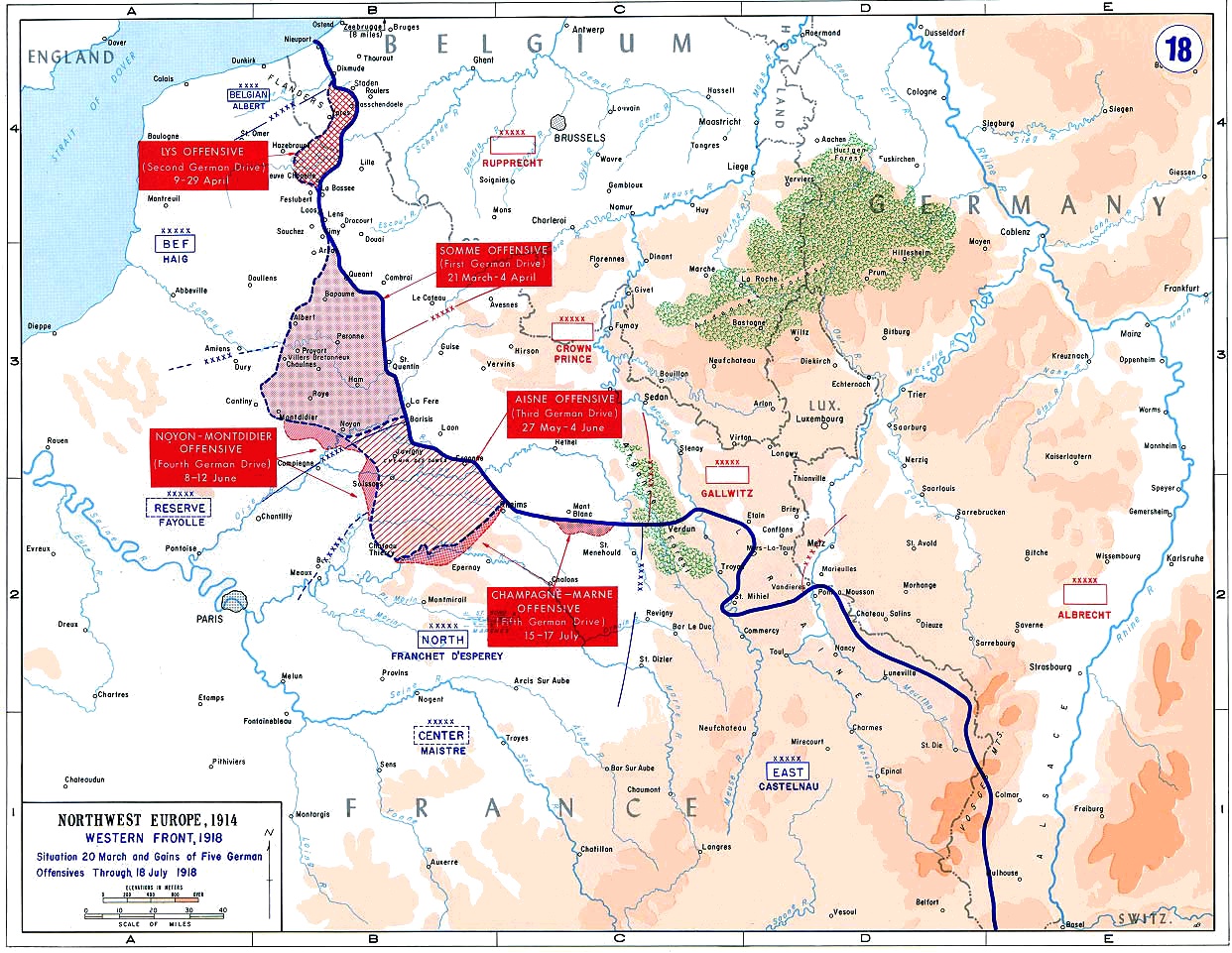
Click to see full-sized image.
For more information on Operation Michael, sometimes known as “The Kaiser’s Battle”, here’s the Wikipedia entry.
Comments Off on The Imperial German Army’s final throw of the dice – Operation Michael, March 1918
March 11, 2018
Savage Division – Displaced People – Sexual Relations I OUT OF THE TRENCHES
The Great War
Published on 10 Mar 2018Chair of Wisdom time!
Comments Off on Savage Division – Displaced People – Sexual Relations I OUT OF THE TRENCHES
March 4, 2018
From Caporetto to Cambrai I THE GREAT WAR Summary Part 12
The Great War
Published on 3 Mar 2018The popular narrative of World War 1 usually ignores the constant evolution of warfare and the end of 1917 was definitely a short time period where a lot of changes came together, the 2nd Russian Revolution, the Battle of Cambrai and the Battle of Caporetto all illustrated that 1918 would be a rather different year in World War 1.
Comments Off on From Caporetto to Cambrai I THE GREAT WAR Summary Part 12
March 2, 2018
DicKtionary – F is for Fraud – Jeanne de Valois Saint-Remy
TimeGhost
Published on 28 Feb 2018F is for fraud, the art of deceit,
And it’s not so nice to be labeled a cheat,
F is also for France, and female, so let me,
Introduce today’s hero, Jeanne Saint-Remy.Join us on Patreon: https://www.patreon.com/TimeGhostHistory
Like TimeGhost on Facebook: https://www.facebook.com/TimeGhostHistory/
Written and Hosted by: Indy Neidell
Based on a concept by Astrid Deinhard and Indy Neidell
Produced by: Spartacus Olsson
Executive Producers: Bodo Rittenauer, Astrid Deinhard, Indy Neidell, Spartacus Olsson
Camera by: Ryan Tebo
Edited by: Bastian BeißwengerA TimeGhost format produced by OnLion Entertainment GmbH
Comments Off on DicKtionary – F is for Fraud – Jeanne de Valois Saint-Remy
February 22, 2018
Curse of the FRIDAY THE 13TH I IT’S HISTORY
IT’S HISTORY
Published on 21 Feb 2018On today’s episode we are going to talk about the end of the Templar Order and the famous curse of Jacques de Molay.
Comments Off on Curse of the FRIDAY THE 13TH I IT’S HISTORY


