
If you still don’t think the myth of the unappreciated writer, who labors in extreme poverty but creates True Art™, is nonsense, let me explain.
How do we know it’s true art? And before you start making gestures and sputtering, to finally come back with “knowledgeable people know that,” let me cut through the fog. The answer is, we don’t. No, not even experts. If everyone knew what great art was, investment in art wouldn’t be such a risky business. Great art, great literature, any form of “greatness” in creative expression is ultimately “What future generations think is great.” And, like all speculation about the future, it’s difficult, if not impossible. In visual art, what is often the acclaimed taste of an era is the laughable, ridiculous pastiche of a later era. In literature … Do me a favor, let your fingers do the walking through Gutenberg, then look up the biographies of some of those authors. Many of the people who make you say “who?” and who in fact would make anyone but an expert in the literature of their time go “who?” were literary lions in their times, acclaimed by all and pronounced “the next Shakespeare.” (Who, like “the next Heinlein,” used to rise every generation until people got tired of it.)
If the art is so great, how come no one is buying it? Besides the artist who is spending way too much time with absinthe and way too little time with quill and paper, or brushes and canvas, that is?
Oh. I see. Because the general public is too stupid to appreciate the greatness of the artist. Because the artist is “ahead” of the public.
Yeah, if you believe that you probably also think that history comes with an arrow since obviously art does. That is, art moves from “primitive” to “exquisite and advanced.” If you truly believe this, I invite you to go through any local art museum and move through it from, say, Roman times till now. And then I invite you to think. The Denver Museum of Art has an installation that consists of a bunch of twisted-together kitchen implements, something that often happens in my house due to the habit of overfilling drawers and my tendency – pre-coffee – to think there is no problem brute force can’t solve.
This is an “installation” worth 2 million and if you believe it is superior to Leonardo da Vinci’s Virgin of the Rocks, you should stop hitting the absinthe. No, wait. Have another cup. I have this installation …
Sarah Hoyt, “What Happens When the Artist Chides His Audience?”, PJ Media, 2017-07-13.
August 7, 2019
QotD: “Great” “Art”
August 5, 2019
QotD: Depictions of Heaven
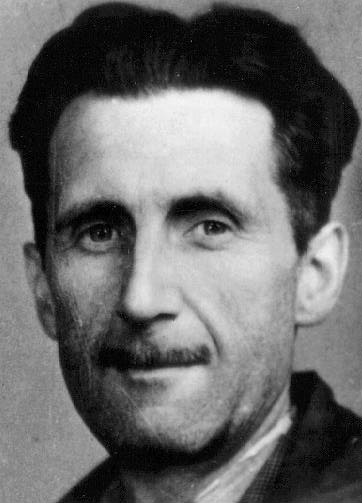
Orwell’s press card portrait, 1943
Attempts at describing a definitely other-worldly happiness have been no more successful. Heaven is as great a flop as Utopia though Hell occupies a respectable place in literature, and has often been described most minutely and convincingly.
It is a commonplace that the Christian Heaven, as usually portrayed, would attract nobody. Almost all Christian writers dealing with Heaven either say frankly that it is indescribable or conjure up a vague picture of gold, precious stones, and the endless singing of hymns. This has, it is true, inspired some of the best poems in the world:
Thy walls are of chalcedony,
Thy bulwarks diamonds square,
Thy gates are of right orient pearl
Exceeding rich and rare!But what it could not do was to describe a condition in which the ordinary human being actively wanted to be. Many a revivalist minister, many a Jesuit priest (see, for instance, the terrific sermon in James Joyce’s Portrait of the Artist) has frightened his congregation almost out of their skins with his word-pictures of Hell. But as soon as it comes to Heaven, there is a prompt falling-back on words like ‘ecstasy’ and ‘bliss’, with little attempt to say what they consist in. Perhaps the most vital bit of writing on this subject is the famous passage in which Tertullian explains that one of the chief joys of Heaven is watching the tortures of the damned.
The pagan versions of Paradise are little better, if at all. One has the feeling it is always twilight in the Elysian fields. Olympus, where the gods lived, with their nectar and ambrosia, and their nymphs and Hebes, the ‘immortal tarts’ as D.H. Lawrence called them, might be a bit more homelike than the Christian Heaven, but you would not want to spend a long time there. As for the Muslim Paradise, with its 77 houris per man, all presumably clamouring for attention at the same moment, it is just a nightmare. Nor are the spiritualists, though constantly assuring us that ‘all is bright and beautiful’, able to describe any next-world activity which a thinking person would find endurable, let alone attractive.
George Orwell (writing as “John Freeman”), “Can Socialists Be Happy?”, Tribune, 1943-12-20.
August 2, 2019
QotD: What we mean by “civilization”
Which is when the dime dropped and I realized you guys immediately translated civilization to “as good as we have or better.” Which, of course, made me giggle. Because I’d have liked you to tell a Roman, with their world-bestriding empire that they weren’t civilized. Or, before that a classical Greek.
Understand I am not imagining others before us had the internal combustion engine, or steam, or trains, or … Sure, they might have, but that’s a heck of a coincidence, since those things usually come about by an individual stroke of genius, and even when they do they often aren’t used the way we did (Romans and their mechanical toys.)
To imagine other civilizations of which we’ve forgotten every trace followed exactly the same route we did to the same place we’re at requires believing that inventing steam and the internal combustion engine and harnessing electricity is as natural to humans as dams to beavers.
Now, maybe that’s true. It would certainly make for a very good science fiction story. (Short story, I think. Too much of a punchline thing for a novel.) BUT the odds defy rationality.
I was imagining, you know “builds houses of wood or stone. Domesticated SOME animals. Has villages and cities. Might have trade over long routes. MIGHT have had wheeled vehicles.” (The last, as we know, one can have quite sophisticated civilizations without.)
Look, it’s not your fault. Since the seventies, we’ve been bombarded by crazy BS about superior aliens or superior lost civilizations. (And before that, there was a trickle of it, too, going back I think to the eighteenth century, just couched in different terms.) You’ll get stuff about how the pyramids were built of stones that floated at the sound of a certain note. (A C note, or the equivalent, I bet. “Listen, Mac, you take this stone to the top of the pyramid, I give you a C Note. A hundred Amontheps in your pocket, bucko. Buys a lot of fish and falafel.”)
Part of this, and part of the reason it intensified since the seventies were the “unilateral disarmament people.” You know, those jokers who wanted us to get rid of our own nukes and stand disarmed in front of the USSR, who would then realize we were peaceful, and not attack, and everyone would live in peace and harmony with rainbows and farting unicorns. Yes, it was a stupid and crazy idea since the continued survival of the USSR depended on plunder and conquest. But I’ll remind you our last president still believes that bag of moonshine. All of it, including the unicorn farts.
Sarah Hoyt, “We Are The Superior Civilization”, According to Hoyt, 2017-05-15.
July 31, 2019
All Art Is Propaganda: Christopher Hitchens on George Orwell – George Packer Interview (2009)
The Film Archives
Published on 27 Jan 2014George Packer (born August 13, 1960) is an American journalist, novelist, and playwright.
He is perhaps best known for his writings for The New Yorker about U.S. foreign policy and for his related book The Assassins’ Gate: America in Iraq.
Packer was born in Santa Clara, California. Packer’s parents, Nancy (née Huddleston) and Herbert Packer, were both academics at Stanford University; his maternal grandfather was George Huddleston, a congressman from Alabama. His sister, Ann Packer, is also a writer. His father was Jewish and his mother was from a Christian background. Packer graduated from Yale College, where he lived in Calhoun College, in 1982, and served in the Peace Corps in Togo. His essays and articles have appeared in Boston Review, The Nation, World Affairs, Harper’s, The New York Times, and The New Yorker, among other publications. Packer was a columnist for Mother Jones and has been a staff writer for The New Yorker since May 2003.
Packer was a Holtzbrinck Fellow Class of Fall 2009 at the American Academy in Berlin.
His book The Assassins’ Gate: America in Iraq analyzes the events that led to the 2003 invasion of Iraq and reports on subsequent developments in that country, largely based on interviews with ordinary Iraqis. He was a supporter of the Iraq war. He was a finalist for the 2004 Michael Kelly Award.
He is married to Laura Secor and was previously married to Michele Millon.
Books
The Village of Waiting (1988). New York: Farrar, Straus and Giroux (1st Farrar edition, 2001). Pb. ISBN 0-374-52780-6
The Half Man (1991). Random House ISBN 0-394-58192-X
Central Square (1998). Graywolf Press ISBN 1-55597-277-2
Blood of the Liberals (2000). Farrar, Straus and Giroux ISBN 0-374-25142-8
The Fight is for Democracy: Winning the War of Ideas in America and the World (2003, as editor). Harper Perennial. Pb. ISBN 0-06-053249-1
The Assassins’ Gate: America in Iraq (2005) Farrar, Straus and Giroux 2005 ISBN 0-374-29963-3
Betrayed: A Play (2008) Faber & Faber
Interesting Times: Writings from a Turbulent Decade (2009). ISBN 978-0-374-17572-6
The Unwinding: An Inner History of the New America (2013). ISBN 978-0-374-10241-8Articles
Packer, George (28 September 2009). “A Reporter at Large: The Last Mission”. The New Yorker 85 (30): 38-55. [Richard Holbrooke’s plan to avoid the mistakes of Vietnam in Afghanistan].
Packer, George (15 March 2010). “A Reporter at Large: Obama’s Lost Year”. The New Yorker 86 (4): 40-51.
Packer, George (12 September 2011). “A Reporter at Large: Coming Apart”. The New Yorker. [An assessment of the post 9/11 decade]
Packer, George (27 May 2013). “A Reporter at Large: Change the World”. The New Yorker.
July 30, 2019
Moira Greyland discusses how she came to write The Last Closet
Tamara Wilhite discusses some of the events that prompted Moira Greyland to write about her mother, Marion Zimmer Bradley and some of the reactions from readers of the book:

The Last Closet was written by Moira Greyland. She’s the daughter of Marion Zimmer Bradley, author of The Mists of Avalon and Walter Breen. It is Marion Bradley’s book from which the book title is drawn. “The Last Closet: The Dark Side of Avalon” is equal parts autobiography and true-crime thriller with a tragic sprinkling of the history of science fiction fandom mixed in.
Moira’s book includes large sections of horrifying personal stories, but she has gone to great length to document what happened. For example, her father’s repeated arrests on pedophilia charges (he died in prison) and her mother’s testimony during such trials are public record. She’s backed up everything she can from external sources.
I had the opportunity to interview Moira, and the transcript is below.
Tamara: Some of the events in the book go back forty years. What prompted you to write the book in 2017?
Moira: In 2014, a blogger named Deirdre Saoirse Moen contacted me. She was protesting Tor book’s publication of a puff piece lauding my mother, which did not mention either my father’s conviction or her court-documented collusion with him.
I only knew Deirdre as a woman from science fiction fandom who had hired me for a harp concert, and I did not realize how famous she was. My responses to her email consisted of a brief assent that my father had indeed done all that he was accused of and convicted for and more, but it also included the new for her information that my mother had been a great deal worse than my father. I also included my two poems “Mother’s Hands” and “They Did Their Best.”
Deirdre was horrified, and reported that she had lost her lunch upon reading my reply. Her blog posts about my mother and my responses were reblogged to 92 countries all over the world. There was furious controversy, mostly consisting of everyone who tried to defend my mother getting shouted down. Some people read my mother’s appallingly callous court testimony and pronounced her guilty from her own words. Other people saw themselves in my poetry, in the flatness and horror so familiar to the trauma patient. Still others recognized things in my mother’s books about incest and sexual abuse which had never quite seemed right to them.
I was astonished at the volume of response, and at the many, many, MANY letters addressed directly to me. Most of the letters included both sympathy for me and my brother, but nearly all contained reports of the letter writer’s own abuse, many containing the words “I never told anyone this before.”
I was asked to fill in the rest of my story, and I did so, in a blog post called “The Story of Moira Greyland,” hosted on the blog of Katy Faust, another child of gays and lesbians as I am. My blog post was nominated for a Hugo in 2015, and I was offered a book contract by Vox Day of Castalia House.
The only concern I had about writing my book was that my late brother Mark was having a very hard time with the unplanned public exposure. He was having flashbacks about our father, and beginning to have a lot more trouble managing his health. The reason that was so problematic for him was that we both identified our mother as being the scary, dangerous one, where our father was comparatively gentle and loving. Having to deal with his history meant that there was no even remotely good parent left for him, even as a matter of memory.
His distress predated the book, though, and I did not think that it would be relieved by my silence.
I was given a year to complete the book, and I beat my deadline. It would do no good to mention the particular kind of hell it was to tell the story, and I credit my beloved late husband with sticking by my side through the entire process. Anyone with a trauma history can imagine that all of my trauma symptoms from flashbacks to ataxia got worse. It became very clear to me while writing exactly why it was that so few people talk about their injuries.
July 23, 2019
QotD: Science of the ancient Greeks
The problem with all this is not just that the scholars of the Mouseion were rather more interested in the textual variants of Pindar’s paianes than studying physics, but also a common modern misunderstanding about the nature of Greek “science”. Many modern people, including modern scientists, hear about the Greeks discussing motion or “atoms” or doing geometry to measure the circumference of the Earth or the distance to the Sun and assume that they were doing “science” in the modern sense of the word. Historians also sometimes refer to Greek natural philosophy as “science” and popularisations of the history of science draw simplistic direct lines between things like Greek discussions of “atoms” and modern atomic theory. But this obscures the fact that Greek proto-science was, while a distant lineal ancestor of the modern sciences, very unlike them in many important respects. At best, it was a highly rational attempt at understanding fundamental precepts of the physical and natural world. But it used induction and common sense more than measurement and experiment. There were exceptions (mainly in geometry and its related field, astronomy), but the Greeks were usually not interested in empirical measurement and so were usually even less interested in genuine experiments. Most Greek proto-science was a highly abstract and philosophical affair, based on some observations, but without modern ideas of carefully designed and repeatable experiments with calibrated measurement and attendant mathematics. Most of their “science” was done by sitting around, thinking and talking about concepts, not by actually dropping weights from towers – though they did do thought experiments which sometimes led to correct conclusions and sometimes did not. Their “science” was not our science.
This means that a Greek conversation about “atoms” was largely an abstract and metaphysical exercise about the philosophical nature of a thing and how many times it could be divided conceptually and what this may mean; the word comes from the Greek ἄτομος meaning “unhewn, uncut, indivisible”. No Greek philosopher walked away from such a conversation and decided to try to build some equipment to explore the physical nature of atomic structure and would probably have considered such an idea absurd. Nor would they have taken the step of considering that different forms of matter, liquid or gas were made up of different combinations of atoms and so decide to experiment with these substances to understand this better, since this was completely contrary to their (erroneous) conception of the “Four Elements” of Earth, Air, Water and Fire. The nature of Greek thought did allow them to draw useful and often correct conclusions about the physical universe, but it also set up barriers to the true scientific method that they simply did not and could not cross.
This was one of the reasons there was no direct link between their proto-scientific “science” and technology. Natural philosophy was, as the term would suggest, the preserve of philosophers. In a world where most of the population had to be devoted to agricultural production and most of the rest often barely got by, sitting around and talking about abstractions like “atoms” was a rich man’s luxury. Most philosophers either came from the upper class (though maybe its lower echelons in many cases) or had rich patrons or both, which meant most philosophers had little interest in making or inventing things: that was generally the preserve of lowly mechanics and slaves. Again, there were exceptions to this – Archimedes seems to have had some interest in the engineering applications of his ideas, even if most of the inventions attributed to him are probably legends. On the whole, however, lofty Greek philosophers didn’t think to soil their hands with something as lowly as inventing and making things.
Tim O’Neill, “The Great Myths 5: The Destruction Of The Great Library Of Alexandria”, History for Atheists, 2017-07-02.
July 18, 2019
QotD: “They might speak English, but they don’t speak Western”
But something happened to me last night, I had a kind of realization. It suddenly hit me WHY that is.
It’s because Harry Potter is literally all they collectively know.
Schools don’t teach history anymore.
They no longer teach the canon of Western literature.
They certainly don’t teach the Bible.So Millennials literally have no points of common reference. It’s not that they all just want to look like complete morons by infantilizing their political metaphor to the level of a children’s book, it’s that they have no other choice.
They’re literally bereft of the allegorical language of the West. I’m sure there’s some Harry Potter monster analogy I could use to explain it to them, how it’s like monsters have come along and literally stolen their ability to speak, their common language, and their birthright.
They can no longer express or understand the set of references we have from our past, our most prized stories, and our culture’s religious quotations. They can’t do Shakespeare, Milton, or even Mark Twain because they’ve never learned any of these while they were being taught Indonesian multicultural dancing and given participation awards. They don’t know what happened at Hastings in 1066, at Runnymede in 1215, or even at Sarajevo in 28th June 1914, because they were being given feminist diversity training instead of learning the history of their civilization. They certainly don’t know what “the least of these” refers to or where it comes from, as a recent event with a White House staffer proved.
They’ve lost the entire allegorical language of the West. They might speak English, but they don’t speak Western. To them, it’s like a foreign, dead, alien language. A set of stories they do not know.
RPGPundit, “Harry Potter and the way Millennial Leftists Don’t Even Speak Western Anymore”, The RPGPundit, 2017-02-02.
July 16, 2019
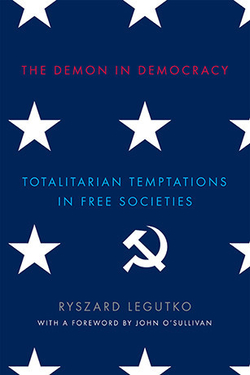
Totalitarian Temptations in Free Societies by Ryszard Legutko
Daniel Pipes reviews a recent translation (from Polish) by Teresa Adelson:
Legutko does not claim liberalism resembles communism in its monstrosity, much less that the two ideologies are identical; he fully acknowledges that the first is democratic and the second brutally tyrannical. After recognizing this contrast, however, he gets down to the more pungent topic of what the two have in common.
He first perceived those commonalities in the 1970s when visiting the West, where he saw how its liberals preferred communists to anti-communists; later, with the overthrow of the Soviet Bloc, he watched liberals warmly welcome communists, but not their anti-communist opponents. Why so?
Because, he argues, liberalism shares with communism a powerful faith in rational minds finding solutions which translates into a drive to improve the citizen, modernize him, and mold him into a superior being. Accordingly, both ideologies politicize, and thereby debase, every aspect of life, including sexuality, the family, religion, sports, entertainment, and the arts. (Here’s a mischievous but deadly serious question: which is the more awful art, the communist or the liberal, Stalin’s or the Venice Biennale’s?) [see below]
Both engage in social engineering to create a society whose members are “indistinguishable, in words, thoughts, and deeds ” from one another, aiming for a largely interchangeable population with no dissidents making trouble. Each sublimely assumes its specific vision constitutes the greatest hope for mankind and represents the end of history, the final stage of mankind’s evolution.
Trouble is, such grand schemes for improving mankind inevitably lead to severe disappointment; human beings, it turns out, are far more stubborn and less malleable then dreamers would like. When things go badly (say, food production for communists, unfettered immigration for liberals), two nasty consequences follow.
Here’s a mischievous but deadly serious question:
Which is the more awful "art", #Stalin’s or the Venice Biennale's (@la_Biennale)?
– Both are political kitsch
– But #SocialRealism is for the simple minded & #AvantGardism for the sophisticated
– The one lies, the other perverts pic.twitter.com/mgd1DX1FPF— Daniel Pipes دانيال بايبس (@DanielPipes) July 8, 2019
July 8, 2019
QotD: Orwell on capitalism versus socialism
Orwell’s press card portrait, 1943
No one can question the dirtiness of international politics from 1870 onwards: it does not follow that it would have been a good thing to allow the German army to rule Europe. It is just possible that some rather sordid transactions are going on behind the scenes now, and that current propaganda “against Nazism” (cf. “against Prussian militarism”) will look pretty thin in 1970, but Europe will certainly be a better place if Hitler and his followers are removed from it. Between them these two books sum up our present predicament. Capitalism leads to dole queues, the scramble for markets, and war. Collectivism leads to concentration camps, leader worship, and war. There is no way out of this unless a planned economy can somehow be combined with the freedom of the intellect, which can only happen if the concept of right and wrong is restored to politics.
Both of these writers are aware of this, more or less; but since they can show no practicable way of bringing it about the combined effect of their books is a depressing one.
George Orwell, “The Road to Serfdom by F.A. Hayek / The Mirror of the Past by K. Zilliacus”, Observer, 1944-04-09.
July 6, 2019
QotD: How to learn
That fits the pattern of most modern schooling at all levels. Someone else decides what you should learn, tells you what you must do to learn it, and makes some attempt to make sure you follow his instructions. It is not a model I think highly of. A much superior model in my view, if you can pull it off, is to get someone to learn something primarily because he finds it interesting. The best way of doing that is to provide students with things to read that are worth reading on their own, not things they read only because they are ordered to. Not even things they read only because they think the labor of reading them will pay off in future benefit.
That view of education is why both children of my present marriage were unschooled. It is also why all of my nonfiction books, with the partial exception of Price Theory, were targeted at the proverbial intelligent layman. They can be, and sometimes are, used as textbooks, but they were written with the assumption that if the reader did not find a chapter worth finishing he was likely not to finish it.
David Friedman, “Thoughts on Literature, Economics and Education”, Ideas, 2017-05-01.
July 5, 2019
QotD: The paradox of tolerance
This is now referred to as “the paradox of tolerance.”
Popper argues that unlimited tolerance is self-defeating. If a tolerant society is tolerant of the intolerant, the intolerant will defeat the tolerant. Therefore, tolerance is all well and good, but to defend itself, it must maintain a certain degree of intolerance towards the intolerant.
It it this defense of intolerance that radicals use to justify violence against their political opponents.
If one dares to question the legitimacy of “direct action” from communist groups against their political opponents, these groups will quickly cite this paradox of tolerance. When fascists are shooting up mosques and synagogues, it’s difficult to defend them against mere milkshakes.
Which is why the paradox of tolerance is constantly brought up to defend violence: It’s hard to argue against. Only the most strict pacifist will argue against violence in (the name of) self-defense. Karl Popper was right to point out that a tolerant society that is tolerant toward its enemies will be destroyed.
Nathan Kreider, “Misconceptions of the Paradox of Tolerance”, Being Libertarian, 2019-05-31.
June 28, 2019
QotD: “Intelligence” is just a noun
We have said that we will be drawing most heavily on data from the classical tradition. That implies that we also accept certain conclusions undergirding that tradition. To draw the strands of our perspective together and to set the stage for the rest of the book, let us set them down explicitly. Here are six conclusions regarding tests of cognitive ability, drawn from the classical tradition, that are by now beyond significant technical dispute:
- There is such a thing as a general factor of cognitive ability on which human beings differ.
- All standardized tests of academic aptitude or achievement measure this general factor to some degree, but IQ tests expressly designed for that purpose measure it most accurately.
- IQ scores match, to a first degree, whatever it is that people mean when they use the word intelligent or smart in ordinary language.
- IQ scores are stable, although not perfectly so, over much of a person’s life.
- Properly administered IQ tests are not demonstrably biased against social, economic, ethnic, or racial groups.
- Cognitive ability is substantially heritable, apparently no less than 40 percent and no more than 80 percent.
Charles Murray, “The Bell Curve Explained”, American Enterprise Institute, 2017-05-20.
June 25, 2019
QotD: Perpetual adolescence
SENATOR BEN SASSE: Yes, so this book is 100 percent not about politics, and it’s 99 percent not about policy. It’s about this new category of perpetual adolescence. And, first, let’s just say that, over the last two millennia or so, the emergence of a category called adolescence is a pretty special gift. We believe that, when our kids become biological adults, when they hit puberty, they don’t have to be fully formed, morally, emotionally, economically, educationally, in terms of household structure. They don’t have to go out and be fully adult immediately. They don’t have to go off to war, and they don’t have to become economically self-sufficient. That’s glorious, to have that protected space between childhood and adulthood. But it’s only glorious if you understand that it’s a transitional state, it’s a means to an end. Peter Pan’s Neverland is a hell. It’s a dystopia. And we don’t want to be — have our kids caught at a place where they’re not learning how to be adults. And, right now, we’re not tending to the habit formation aspects of a republic.
“Face the Nation transcript, May 14, 2017: Schiff, Sasse, Gates”, CBS News, 2017-05-14.
June 23, 2019
QotD: The American way of war
One paragraph caught my eye:
We prefer our wars quick and decisive, concluding with a surrender ceremony, and we like firepower more than we want to admit, while counterinsurgency requires supreme restraint. Its apostles in Vietnam used to say, “The best weapon for killing is a knife. If you can’t use a knife, then a gun. The worst weapon is airpower.” Counterinsurgency is, according to the experts, 80 percent political. We spend our time on American charts and plans and tasks, as if the solution to another country’s internal conflict is to get our own bureaucracy right. And maybe we don’t take the politics of other people seriously. It comes down to the power of our belief in ourselves. If we are good — and are we not good? — then we won’t need to force other people to do what we want. They will know us by our deeds, and they will want for themselves what we want for them.
There is, I fear, a lot of truth in that little paragraph and I am also worried that the American fascination (mainly the Pentagon’s fascination) with process and organization has spread to Canberra, London, Ottawa, Wellington and even Berlin. The notion is that if we can just get our organizations and procedures right then everything will fall into line. We have forgotten that while good, sound organizations and sensible, simple, robust procedure do matter, they need to be in service to a sound strategic aim (a vision, if you like) and, sometimes, ad hoc organizations and “off-the-wall” procedures work best in new situations, whether counter-insurgency or all-out war against a peer.
Ted Campbell, “Following the blind leader (3)”, Ted Campbell’s Point of View, 2019-05-21.
June 20, 2019
A Clockwork Orange – Dystopias and Apocalypses – Extra Sci Fi
Extra Credits
Published on 18 Jun 2019Go to https://NordVPN.com/ExtraCredits to get 75% off a 3 year plan and use code
ExtraCreditsto get an extra month free. Protect yourself online today!A Clockwork Orange reflects a cultural fear of society’s moral decay in the 1960s. Its usage of a mashup slang language known as “nadsat” illustrates the complexities of rebellious youth culture. Ultimately, Anthony Burgess’s work asks us to think about if or when free will should ever be suppressed, but the major differences between the book and the film version of this story present contrasting takeaways.
Where the dystopias of Brave New World and 1984 warned against the easy slide into totalitarianism, and painted for us worlds in which freedom is nearly a forgotten thing… A Clockwork Orange presents us with a protagonist who has almost an excess of freedom, and in doing so it shows us the shift in societal fears.



